TL;DR: Revelo places senior engineers from Latin America on month-to-month terms at an all-in yearly rate it publishes, about $86,000 to $129,000 for a senior full-stack hire. Toptal publishes a $79 monthly subscription, quotes the talent’s rate on a call, and introduces candidates within 24 hours from a global network. Pick Revelo for long-term hires who work US hours, and Toptal for a fast shortlist, a defined project or a skill outside engineering.
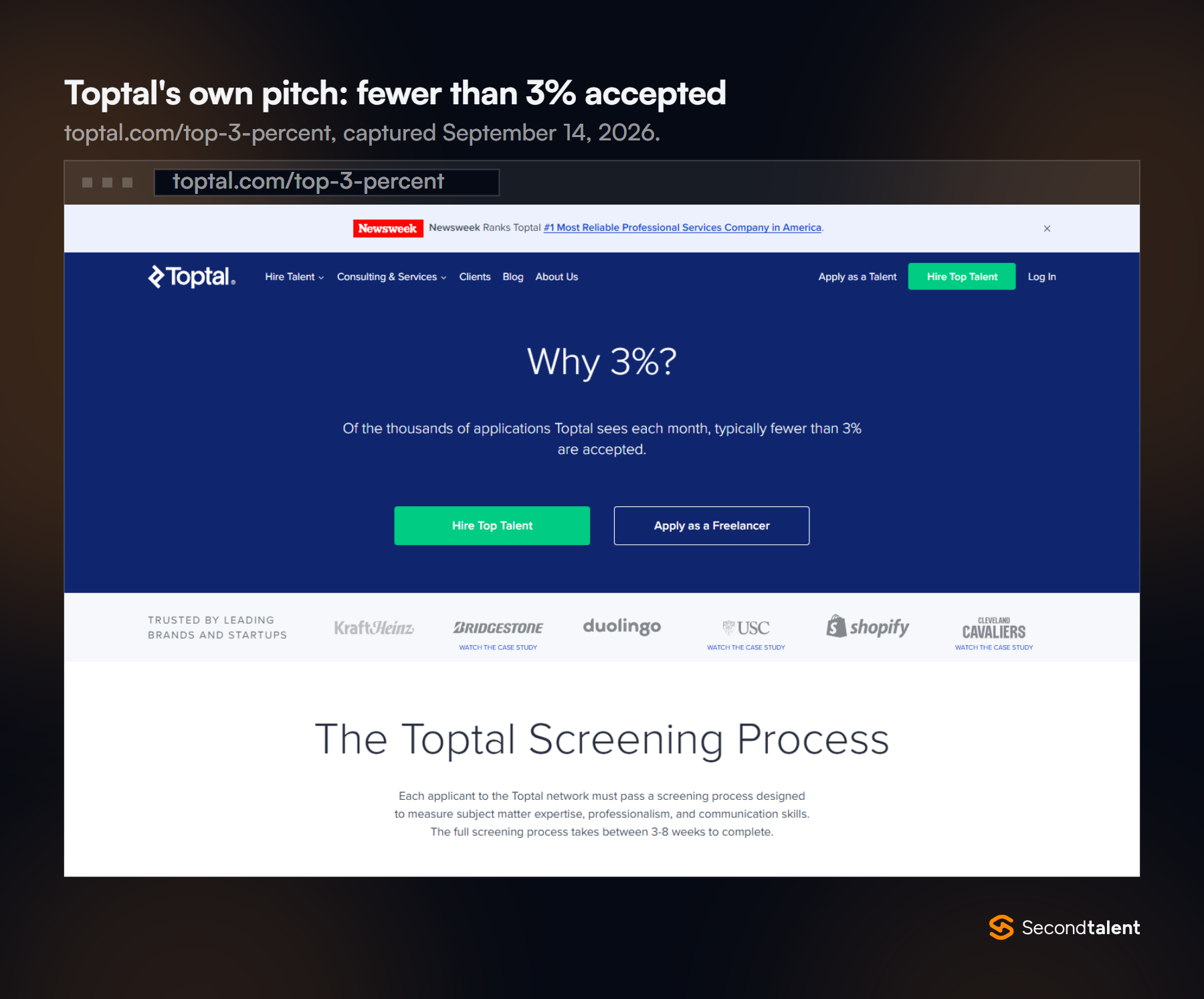
Both companies vet engineers before you meet them, and both say only a few percent of applicants make it. Revelo puts its bar at the top 2%. Toptal accepts fewer than 3%.
The difference is what you buy. Revelo sells a person who joins your team for as long as you need them, paid monthly. Toptal sells engagements with talent from 155+ countries, billed twice a month.
- 1Revelo’s calculator prices a Strong-tier senior full-stack hire at $115,000 a year all-in, or about $9,600 a month. Toptal gives no rate until you talk to it.
- 2Engineers on both platforms work as independent contractors. Revelo runs the contracts as an agent of record; Toptal sells employment through its HireGlobal add-on, from $199 a worker a month.
- 3Toptal is faster to a first name: candidates within 24 hours against Revelo’s 72-hour shortlist and 14-day average hire.
- 4Revelo’s engineers sit within 2 hours of US Eastern time. A Toptal hire’s hours depend on where that one person lives.
Revelo or Toptal: which should you use?
Use Revelo if you are adding engineers who will stay on your team for a year or more and need to work US hours.
You get a price before the first call, month-to-month terms, and one vendor for contracts, payroll and benefits in 18 Latin American countries.
Use Toptal if you need someone this week, the work has an end date, or the role sits outside engineering. Toptal also covers designers, finance experts and project managers, and it lets you trial up to three people for one position.
The table sets the two side by side from each company’s own pages, read on September 15, 2026. For the wider field, see our Revelo alternatives and Toptal alternatives pages.
| Revelo | Toptal | |
|---|---|---|
| What it sells | Full-time remote engineers and squads from Latin America, plus AI training data | Freelance engagements across engineering, design, finance and project management, plus HireGlobal payroll and EOR |
| Talent location | Latin America, within 2 hours of US Eastern time | 155+ countries |
| Published prices | All-in yearly rate by role, seniority and tier; senior full-stack $86,400 to $128,600 | $79 monthly subscription once you proceed; talent rates quoted on a call |
| Screening | Technical, English and soft skills; top 2% pass | Five stages; fewer than 3% accepted |
| Speed claim | Shortlist of 3 to 5 in 72 hours; hire in 14 days on average | Candidates within 24 hours |
| If it fails | 14-day risk-free trial; backfills at no extra cost | No-risk trial of up to two weeks; up to three trial candidates per position |
| Contract | Month-to-month; one-month refundable deposit | Cancel the subscription any time; weekly price for the talent |
| Worker status | Independent contractor, with Revelo as agent of record | Contractor; employment through HireGlobal at $199 or $399 a month |
| Track record | 2,500+ companies; 89% of hires stay 3+ years | 35,000+ clients and 91,000+ engagements by 2025 |
What each one charges
Revelo publishes a calculator on its pricing page, built on its Salary Guide 2026. Pick a role, a seniority and a talent tier, and it returns a yearly all-in rate.
Revelo says that rate covers salary, benefits, payroll processing and its hiring support, with no hidden fees.
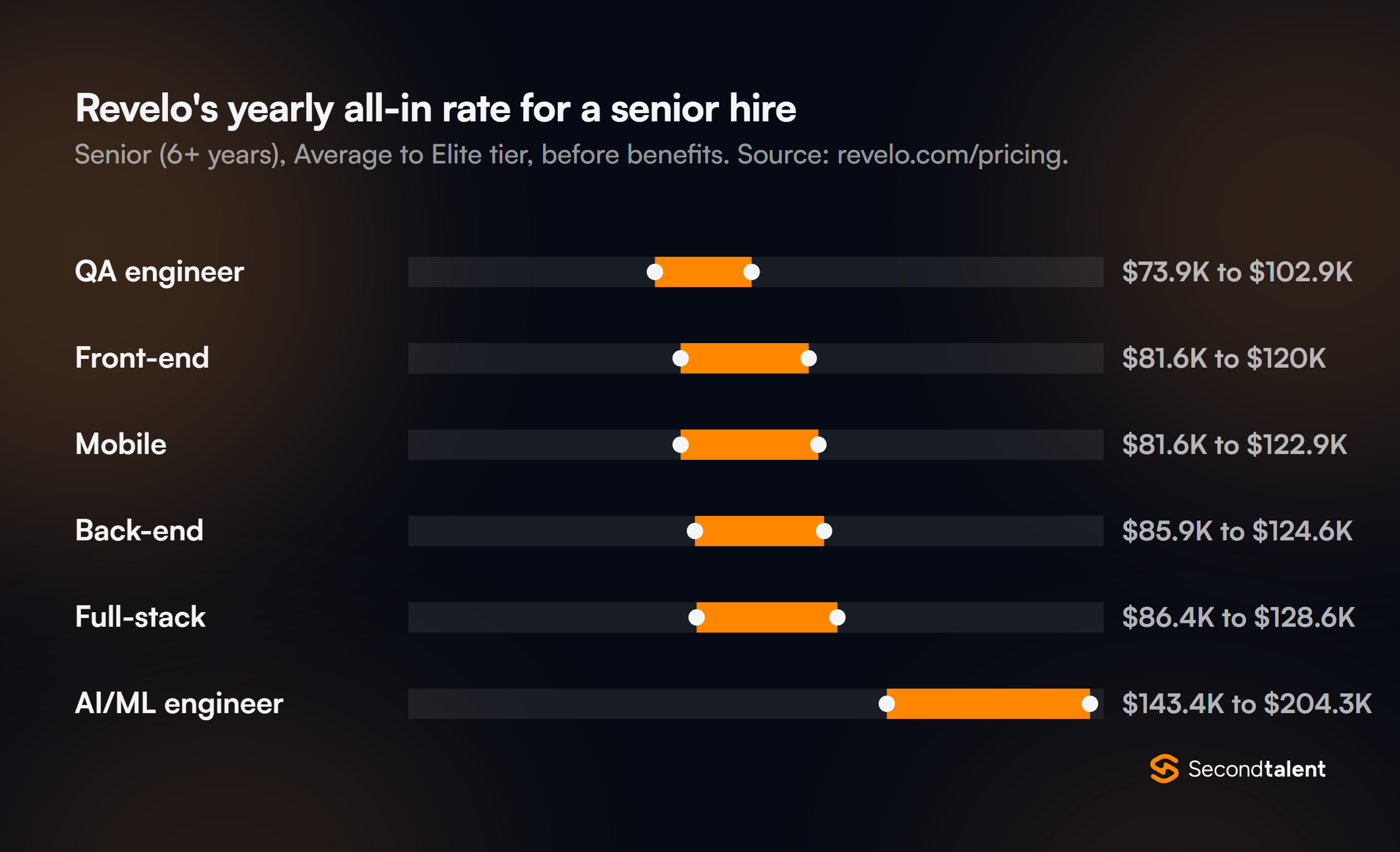
For a senior full-stack engineer with six or more years, the rate runs from $86,400 at the Average tier to $128,600 at Elite. The calculator adds $3,600 a year of health, dental and vision benefits on top.
At the default Strong tier that makes $115,000 a year, or about $9,600 a month, billed monthly. Senior AI/ML engineers sit much higher, at $143,400 to $204,300.
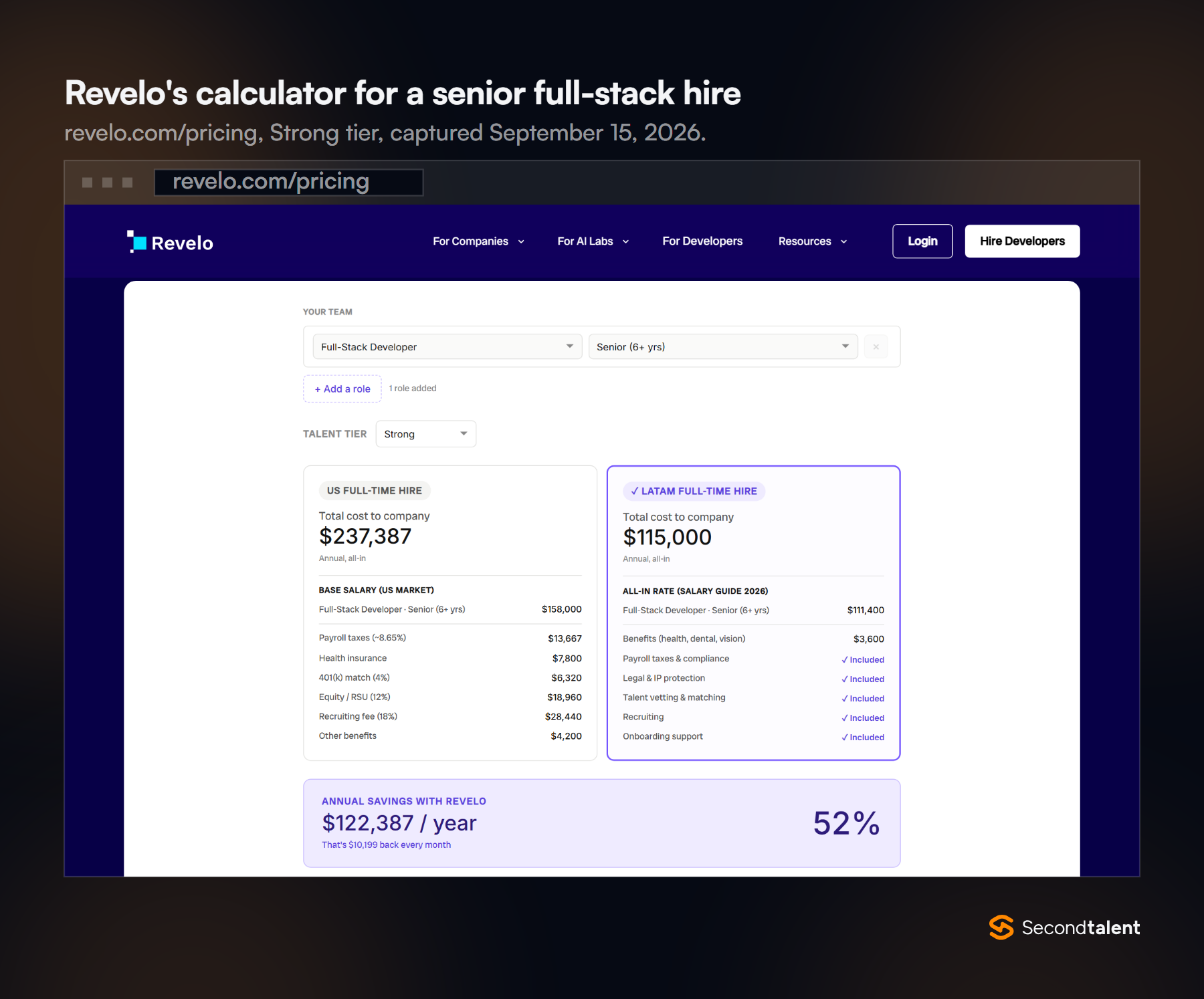
The same screen claims a 52% saving against a US hire at $237,387. Read that figure with its assumptions. The US side adds a 12% equity grant and an 18% recruiting fee to a $158,000 salary, so the gap is widest for companies that pay both.
Revelo’s own Revelo vs Toptal page adds one cost the calculator leaves out: a refundable deposit equal to one month of the engineer’s payment, credited against your final invoice.
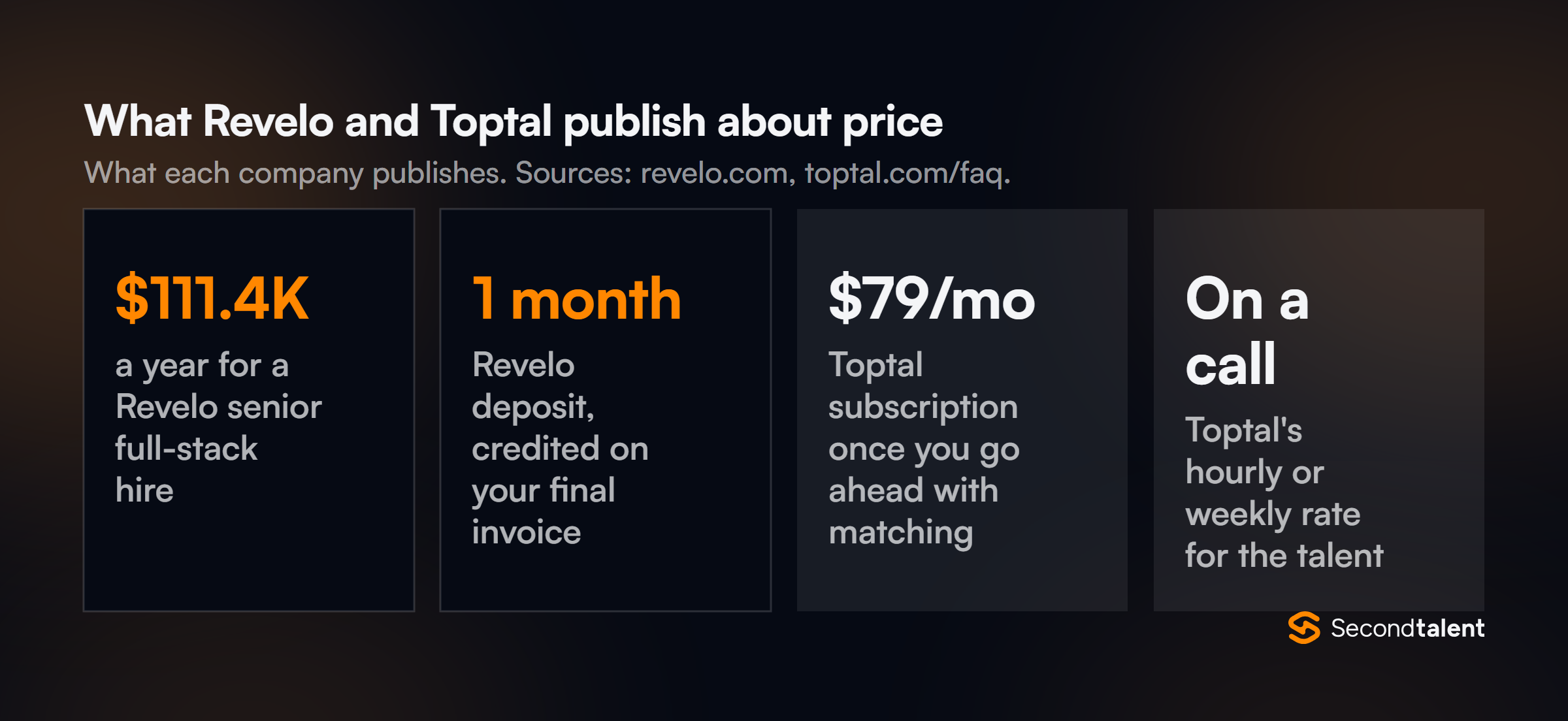
Toptal publishes one fee. Its FAQ describes a flat $79 monthly subscription, charged once you decide to proceed with talent matching. You can cancel at any time, and ask for a refund if Toptal cannot provide talent.
The talent’s own price is a fixed weekly figure for hourly, part-time or full-time work, which you get on a call. Toptal invoices twice a month on Net 10 terms.
Revelo’s comparison page also says Toptal takes a $500 deposit. Toptal’s FAQ does not mention one, so ask before you sign. To benchmark hourly rates by stack and region before either call, use our freelance developer rate index.
How the two screen talent
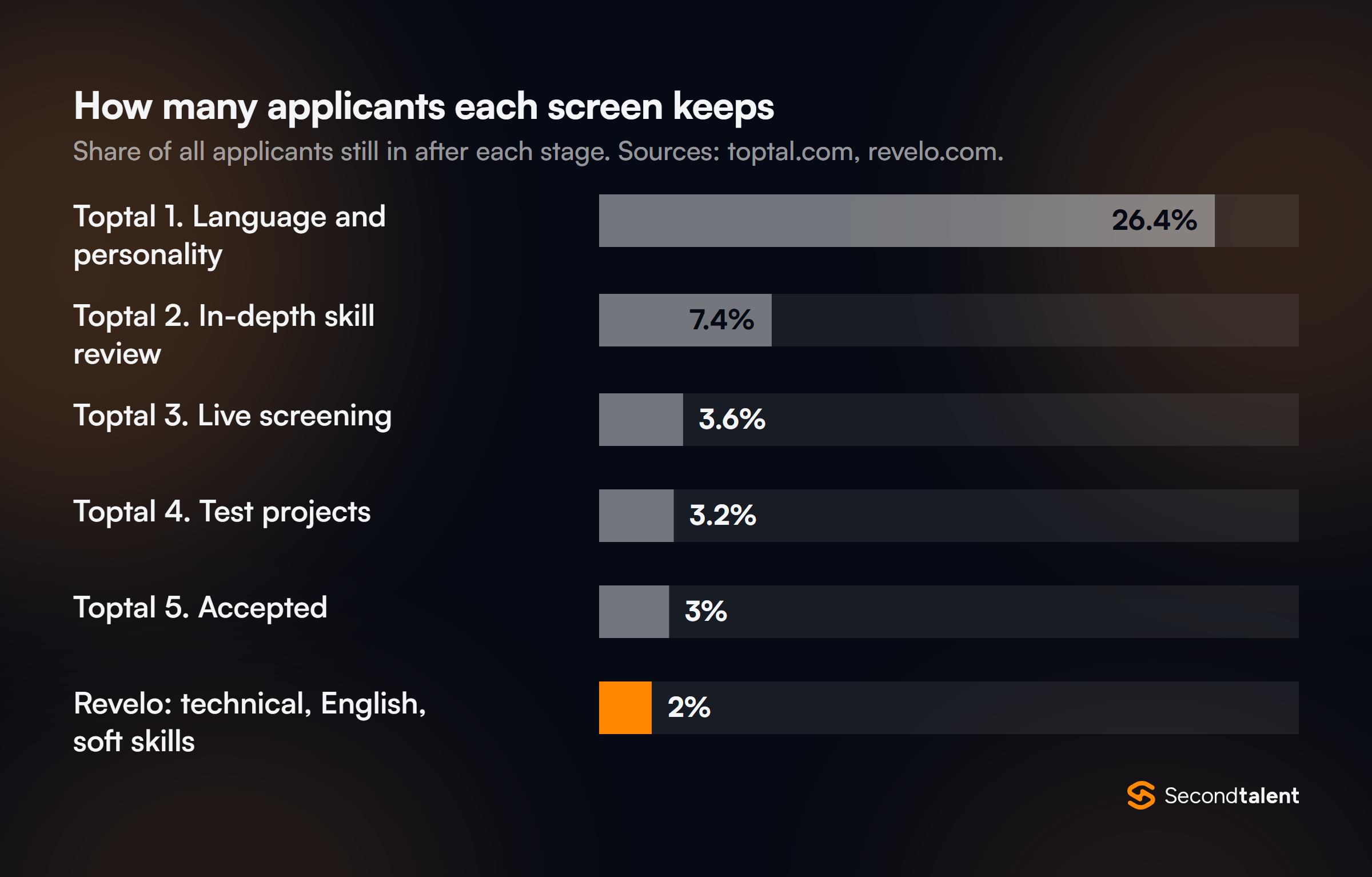
Toptal publishes the share of applicants still in after each stage of its screening process. Only 26.4% pass the first interview, on English, communication and personality. An in-depth skill review leaves 7.4%.
A live screening with experts in the candidate’s field leaves 3.6%, and a test project of one to three weeks leaves 3.2%. Fewer than 3% are accepted, and Toptal says the process takes 3 to 8 weeks.
Revelo publishes the end result but no stage rates. Its how Revelo works page says each applicant is checked for technical expertise, English fluency and soft skills, and that only the top 2% get through.
Shortlisted candidates are identity-confirmed, skills-tested and human-screened. Revelo’s comparison page puts the bar at the top 3% instead, so treat both numbers as rough.
After the shortlist, Revelo fits your process: one interview or five, live coding or a take-home. It handles scheduling, salary benchmarking, offer negotiation and contracts.
Revelo’s comparison page says 73.1% of its placements are senior engineers and 24.6% mid-level.
Speed to a first candidate
Toptal’s FAQ says it introduces candidates within 24 hours in almost all cases, and that 90% of clients hire the first candidate it introduces.
Revelo promises three to five matched candidates within 72 hours, though its homepage hero says 48. Interviews and an offer then take one to two weeks, and Revelo puts its average time to hire at 14 days.
The two clocks stop at different moments. Toptal’s 24 hours ends at an introduction. Revelo’s 14 days ends with an engineer onboarded.
Both skip the slow part of hiring: writing a job ad, reading CVs and running first-round screens yourself.
Trials and replacements
Toptal starts each engagement with a trial of up to two weeks. If you are not satisfied, you are not billed. You can then trial someone else, with up to three people per position.
Revelo offers a 14-day risk-free trial and says you only pay if you hire. After that the terms are month-to-month, so you can release an engineer or add one as your roadmap changes.
If a hire does not work out, Revelo says it backfills the role at no additional cost.
Contractor or employee
On worker status the two are closer than they look. Revelo’s terms of service say each engineer is engaged by the client “as a consultant or independent contractor”.
Its comparison page calls Revelo an agent of record: it writes the local contract, invoices you, pays the engineer in local currency and administers benefits.
Revelo says its standard terms include indemnification if a classification is challenged, within the limits of your agreement.
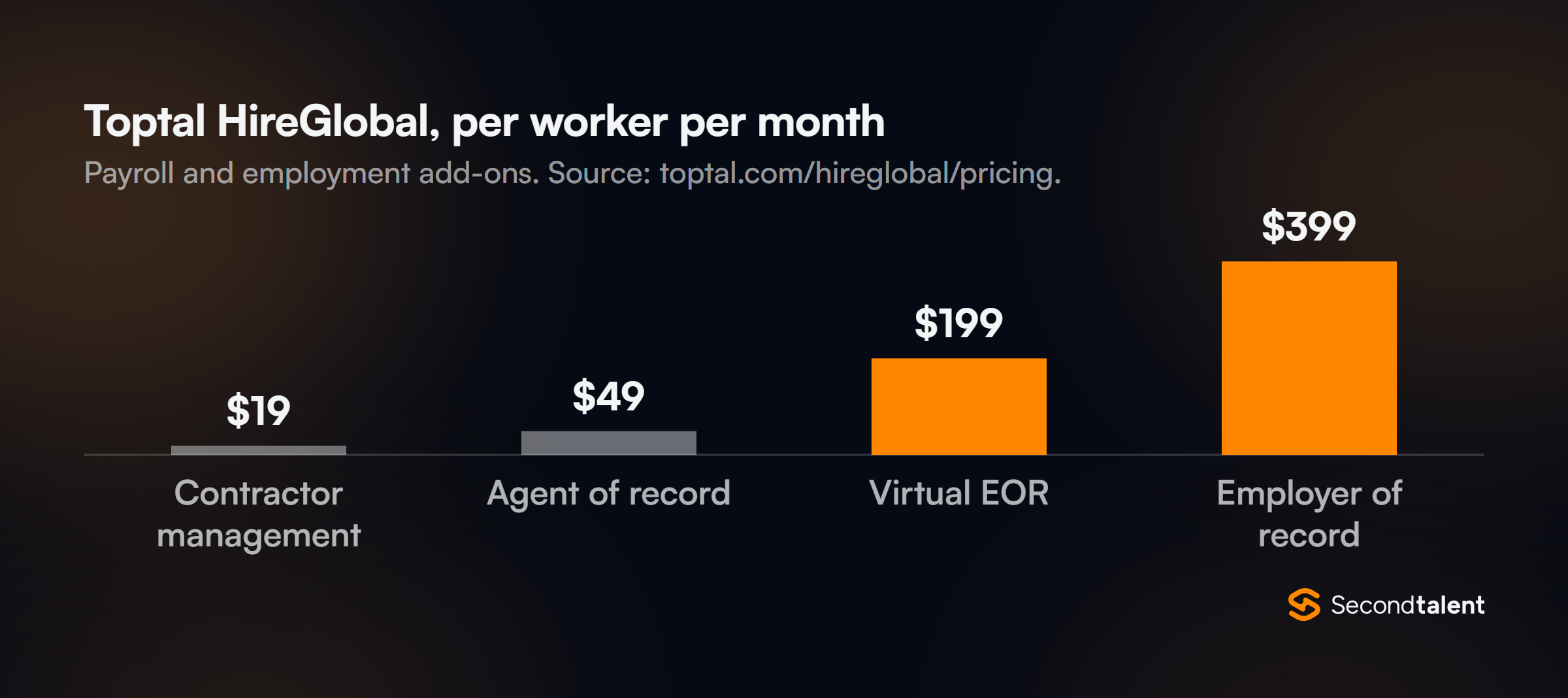
Toptal describes its network as independent contractors too. For employees, Toptal sells HireGlobal, priced per worker per month.
Contractor management is $19, an agent of record plan is $49, a virtual employer of record is $199 and a full employer of record is $399.
The $199 virtual EOR carries $1M of indemnification cover per worker, and HireGlobal works in 180+ countries.
So neither platform makes the engineer your employee by default. If you want that, you need an employer of record, from Toptal or elsewhere. Our employer of record guides cover the rules market by market.
Network and time zones
Revelo was founded by Lachlan de Crespigny and Lucas Mendes. Its about page dates the company to 2015 and describes a Series B startup headquartered in Miami, with over 250 remote employees in the US and Latin America.
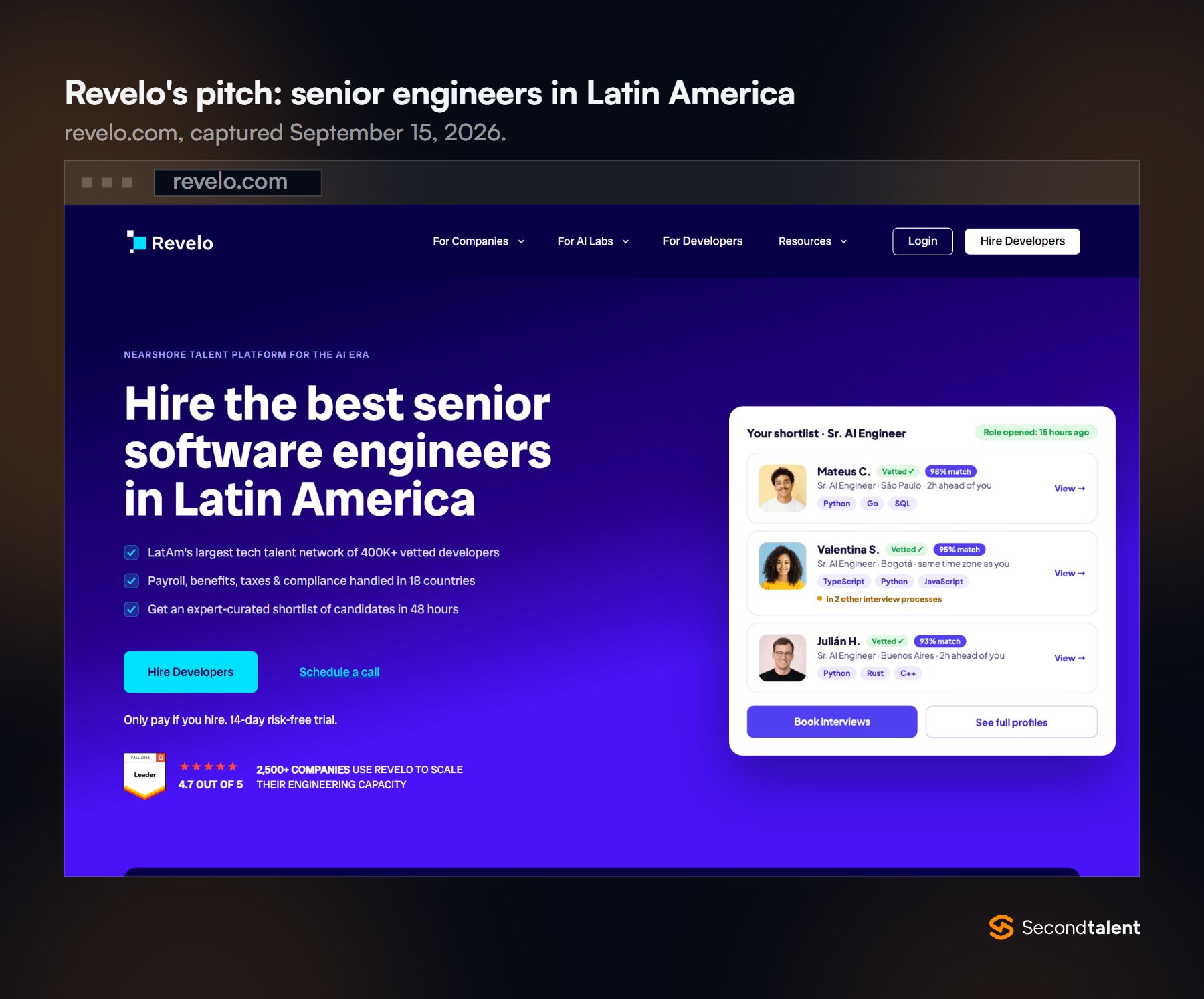
Revelo counts 400,000+ vetted engineers and 2,500+ client companies. It hires from Brazil, Mexico, Colombia, Argentina, Chile, Peru, Uruguay and more, and says those engineers work within 2 hours of US Eastern time.
For a team that pairs live or runs daily standups, that overlap is Revelo’s strongest point.
The same network now serves a second business. Revelo’s page for AI labs sells coding datasets, RL environments and model evaluations written and graded by its engineers, and it runs a public coding leaderboard called the Revelo Code Index.
Toptal publishes running totals instead of a live network size. Its about page counts 3,600,000+ talent applications by 2025, 35,000+ clients, 91,000+ engagements and talent in 155+ countries.
In 2026 it bought four more networks: QO Collective, Adeva, No Single Individual and Graphite. Time-zone overlap depends on the person you pick.
Full-time engineers from Asia with Second Talent
Second Talent vets engineers and employs them for you in nine Asian markets: Vietnam, the Philippines, Indonesia, Singapore, Malaysia, Thailand, Hong Kong, Taiwan and China.
The price is a flat $3,000 to $6,000 a month per engineer, all-in, covering sourcing, vetting and our managed EOR. Your engineer is an employee, not a contractor.
Our engineers pass four vetting stages: a technical assessment, an AI-native tooling check covering Claude Code, Cursor and Copilot, English at C1 or above, and a behavioural interview.
Search our talent directory yourself or send us a brief. We are engineering first, with a limited non-technical bench in design, sales development, data annotation and operations. Terms are on our pricing page.
Frequently asked questions
Is Revelo cheaper than Toptal?
Revelo is the only one with published rates, so you can price it before a call. A fair comparison needs a Toptal quote for the same role and hours, plus its $79 monthly subscription.
Are Revelo engineers employees?
No. Revelo’s terms engage them as consultants or independent contractors, with Revelo running contracts, payments and benefits as agent of record.
Does Toptal have engineers in Latin America?
Yes, among talent in 155+ countries, but it does not sell a Latin America-only pool the way Revelo does.
Related comparisons: Toptal vs Turing · Arc.dev vs Toptal · Toptal vs Upwork · Revelo alternatives · Toptal alternatives