TL;DR: Staff augmentation supplies engineers who work under your direction. A managed service takes over a function and runs it against service levels. One question sorts most cases: do you want to keep directing the work? Everything else follows. The expensive mismatch is buying a managed service for work that moves every sprint, because every redirection then becomes a priced change request.
This page takes the two models on their own. Our three-model comparison covers both alongside project work at a higher level; this page goes further into the two things that decide a managed services engagement in practice, which are the service levels and the vendor management.
The structural difference
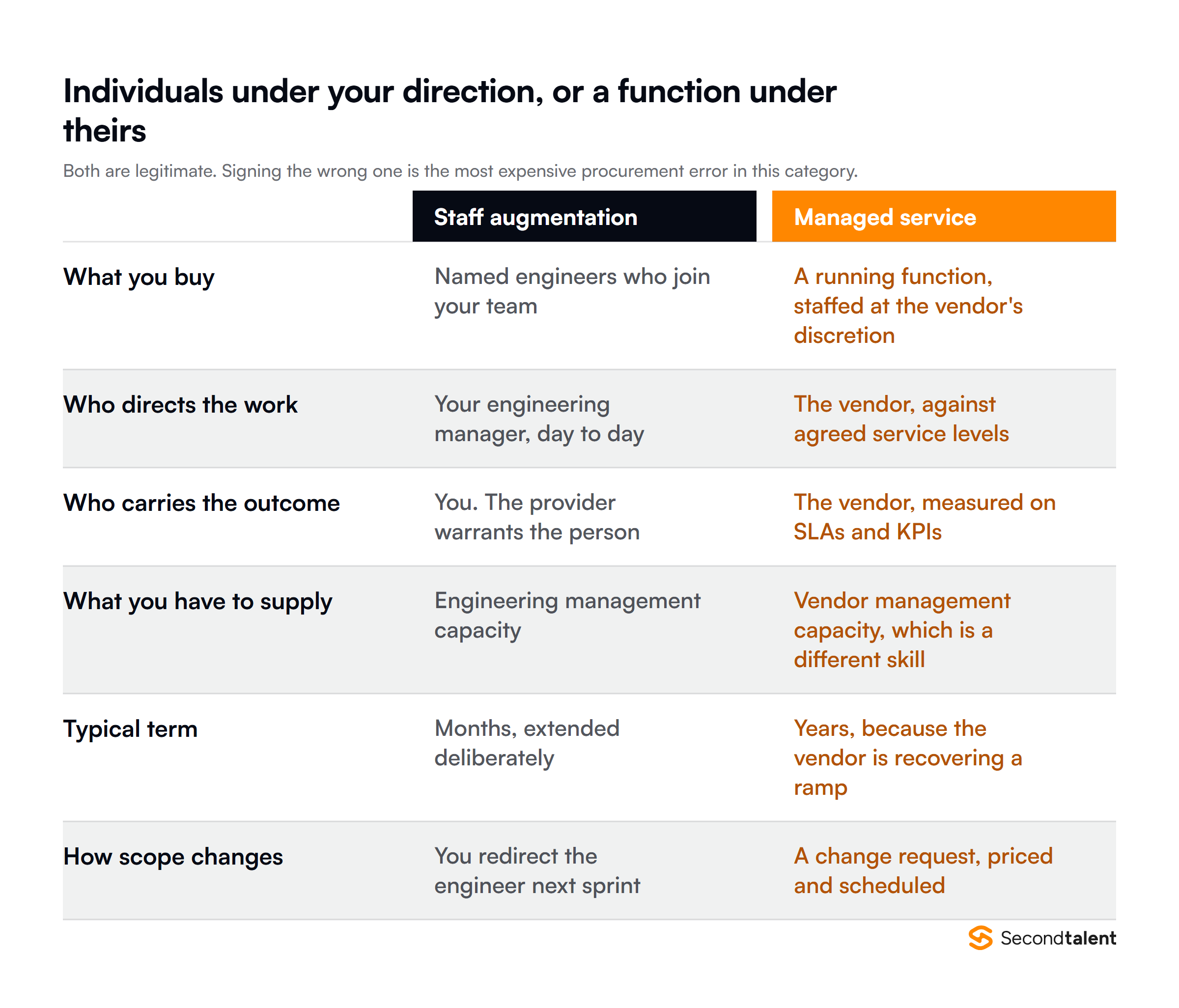
Staff augmentation supplies named individuals. They work under your direction, on your team, with your tools. You carry outcome risk and the provider carries employment risk.
A managed service takes a function. The vendor staffs it at its own discretion, runs it with its own processes, and answers on agreed service levels. The vendor carries outcome risk and you carry vendor management overhead.
Two consequences follow that people underestimate. Scope changes are a conversation in one model and a priced change request in the other. And the vendor’s staffing discretion means you stop choosing who does what, which matters if you later need to say who touched a given system.
Writing service levels that mean something
The clause buyers under-negotiate and later discover was decorative.
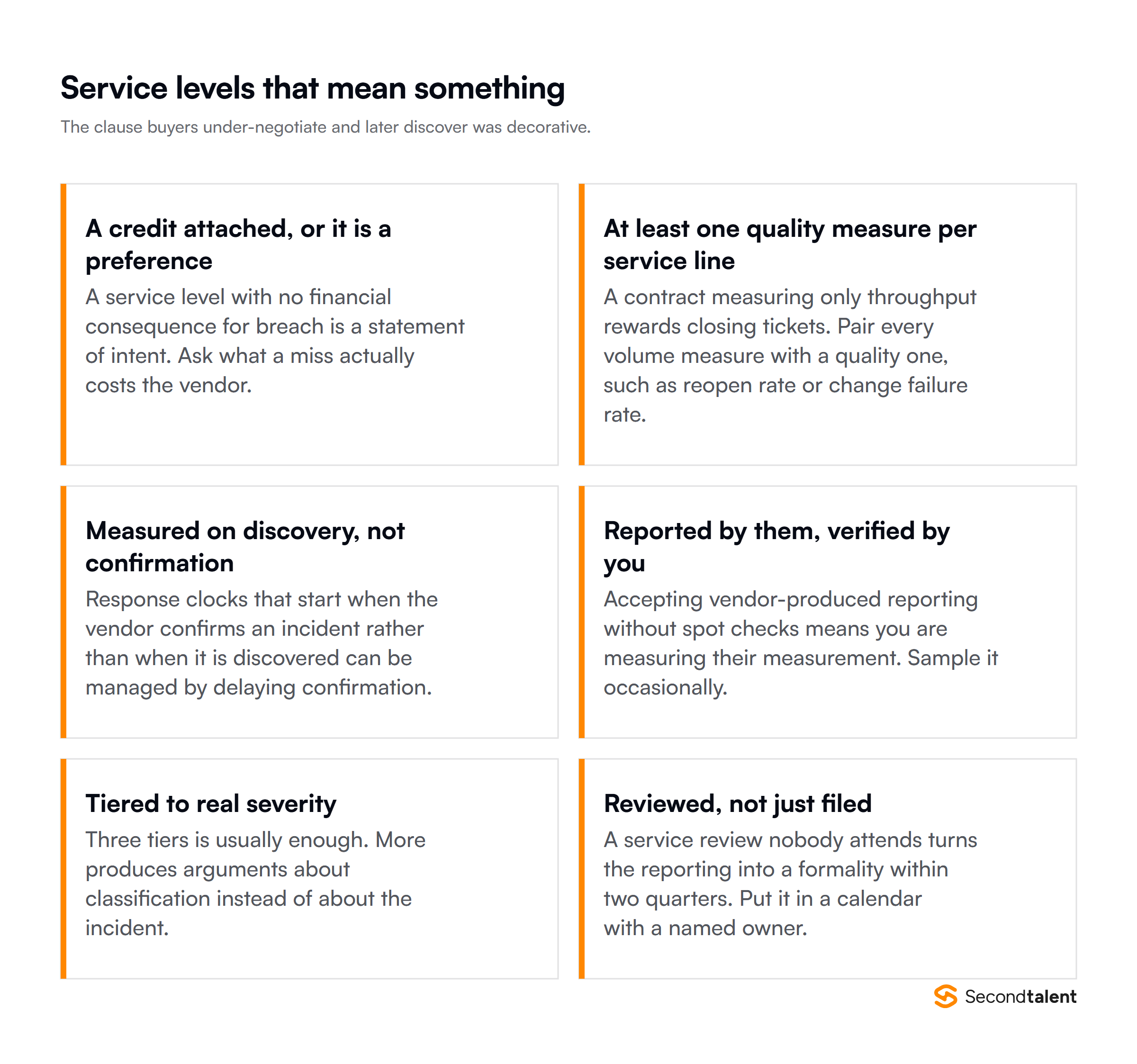
Attach a credit, or it is a preference. A service level with no financial consequence for breach is a statement of intent. Ask what a miss actually costs the vendor.
Pair every volume measure with a quality one. A contract measuring only tickets closed rewards closing tickets. Reopen rate, change failure rate or defect escape rate keep that honest.
Start the clock at discovery, not confirmation. A response time measured from when the vendor confirms an incident can be managed by taking longer to confirm.
Verify the reporting. The party being measured produces the measurement, which shapes it. Sample it occasionally and ask what a metric excludes as well as what it counts.
Keep the tiers few. Three severity tiers is usually enough. More produces arguments about classification rather than about the incident.
Review it, do not just file it. A service review nobody attends turns into a formality within two quarters.
What vendor management actually involves
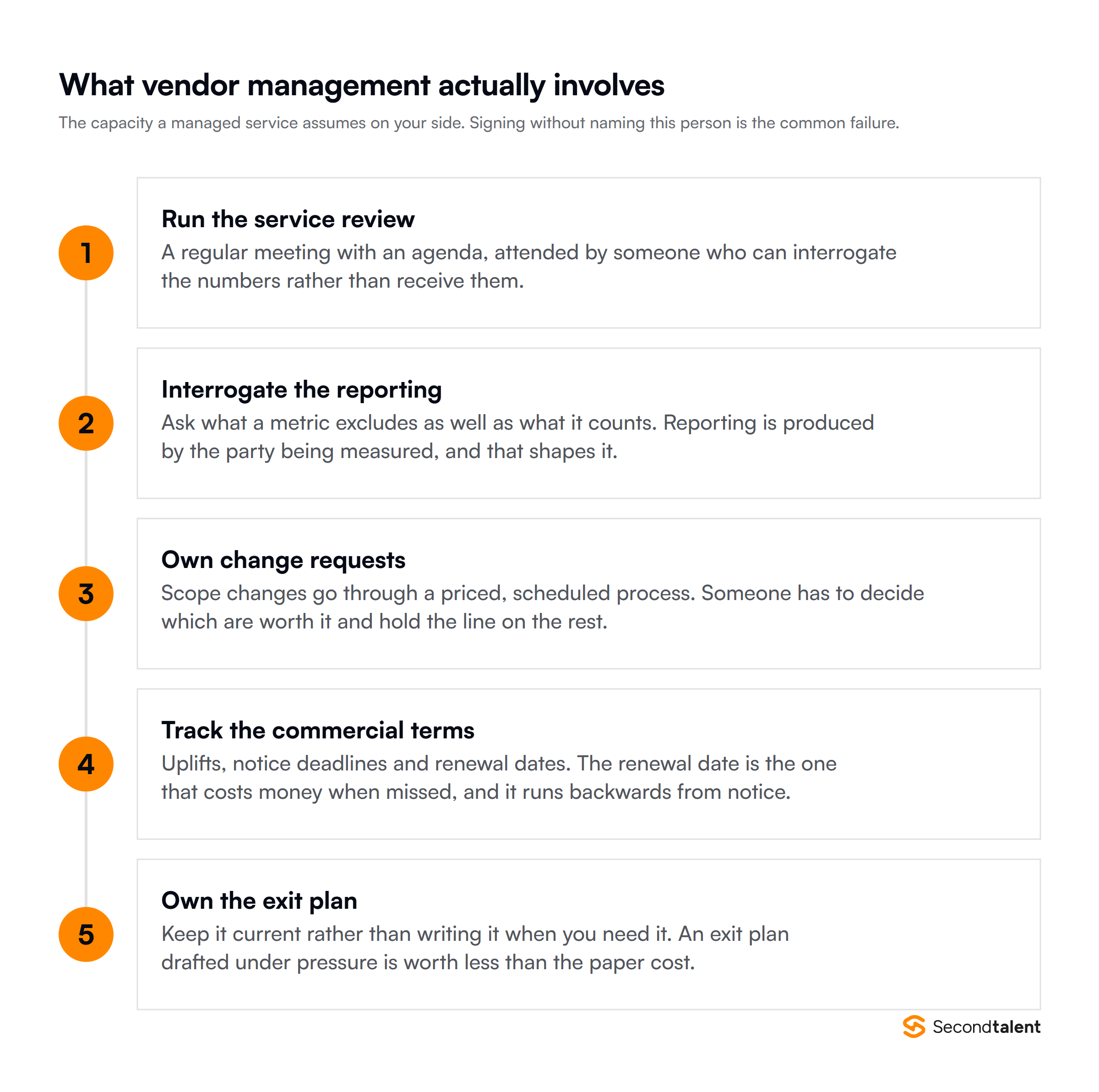
This is the capacity a managed service assumes on your side, and signing without naming the person is the most common failure.
The role runs the service review, interrogates the reporting rather than receiving it, owns change requests, tracks uplifts and notice deadlines, and keeps the exit plan current.
None of that is glamorous and all of it is real work. Teams that assign it to an engineering manager as an extra duty find it gets done in the weeks when delivery is calm, which is not most weeks.
Name the vendor manager before you sign. If nobody can be named, you are about to buy a service that reports on whatever is convenient to measure, on a multi-year term. That is not a vendor problem. It is a structural gap on your side that the vendor has no incentive to point out.
Which one for this work
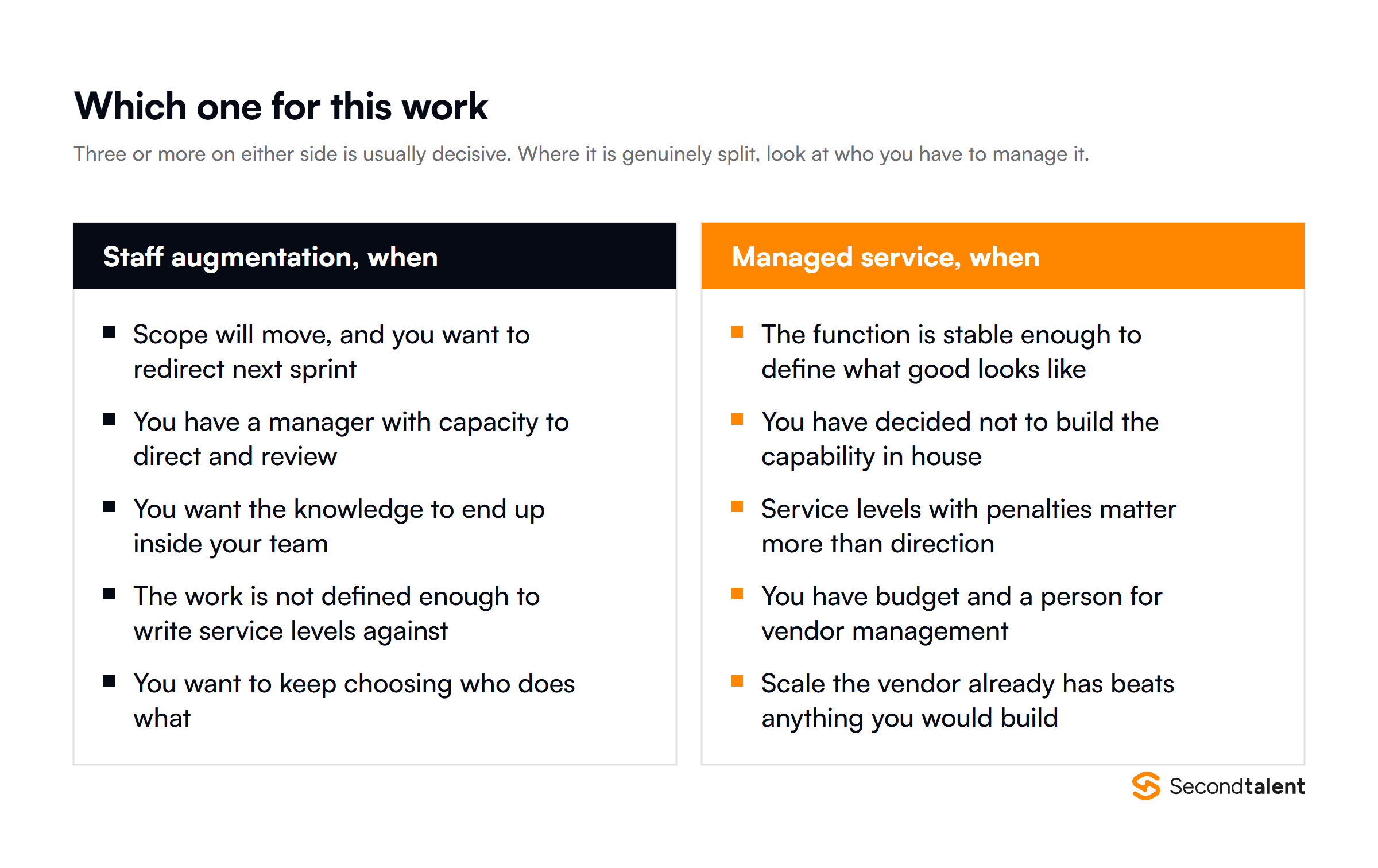
Staff augmentation when scope will move and you want to redirect next sprint, when you have a manager with capacity to direct and review, when the knowledge should end up inside your team, when the work is not defined enough to write service levels against, and when you want to keep choosing who does what.
A managed service when the function is stable enough to define what good looks like, when you have decided not to build the capability in house, when service levels with penalties matter more than direction, when you have budget and a person for vendor management, and when the vendor’s existing scale beats anything you would build.
Three or more on either side is usually decisive. Where it splits, the deciding question is who you have available to manage it.
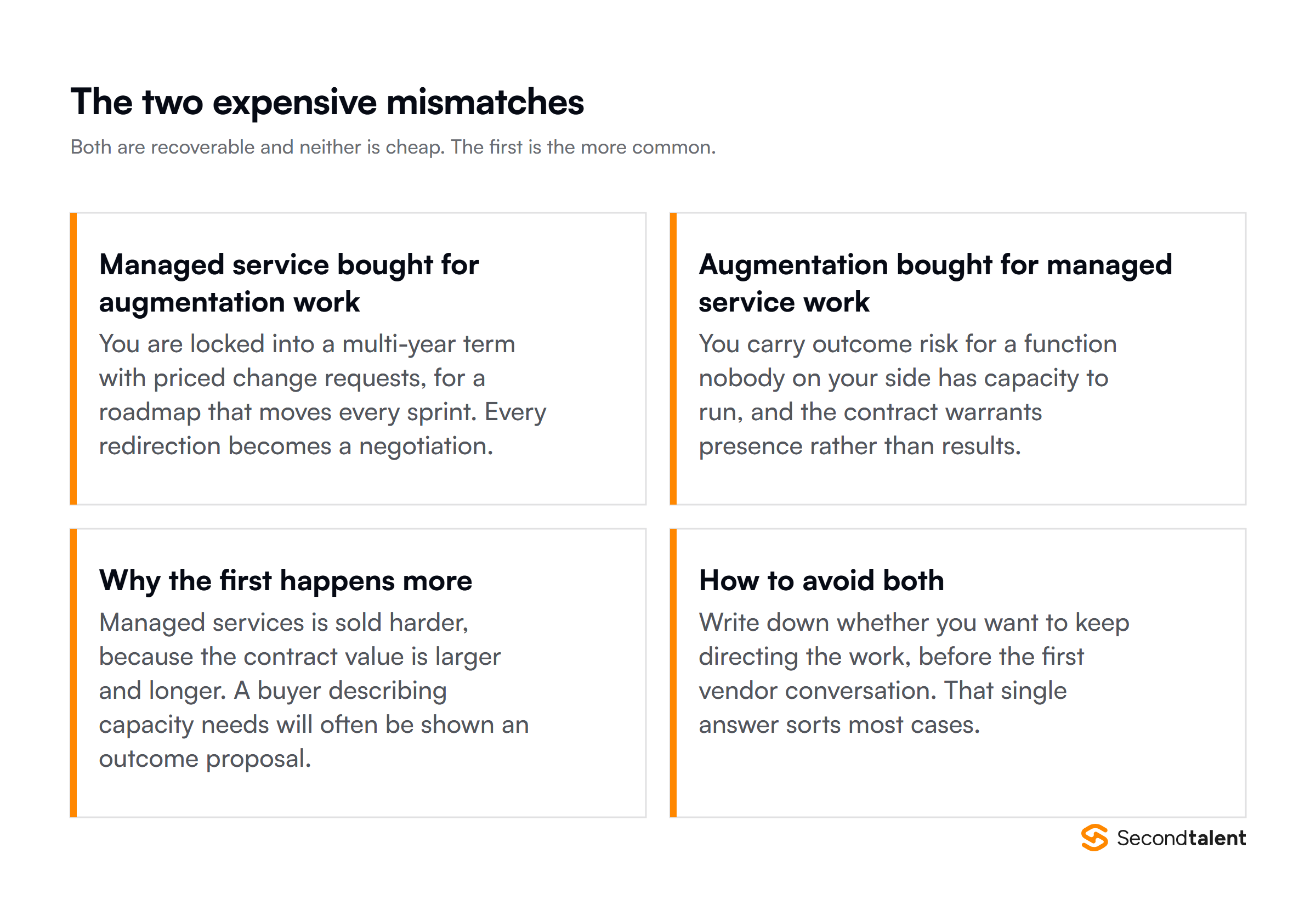
The two expensive mismatches
A managed service bought for augmentation work. You are locked into a multi-year term with priced change requests, for a roadmap that moves every sprint. Every redirection becomes a negotiation, and the flexibility you needed is precisely what the contract is designed to prevent.
Augmentation bought for managed service work. You carry outcome risk for a function nobody on your side has capacity to run, and the contract warrants presence rather than results. This surfaces the first time something breaks out of hours.
The first happens more often, and the reason is commercial rather than sinister. Managed services carries larger, longer contract value, so it gets sold harder. A buyer describing capacity needs will often be shown an outcome proposal, and the proposal will be good.
The defence is cheap: write down whether you want to keep directing the work, before the first vendor conversation.
What each model does to your knowledge
This decides more long-run outcomes than the rate does and gets a fraction of the attention.
Under augmentation, work happens in your repositories under your review, so knowledge accumulates with your team by default. Under a managed service, the capability develops inside the vendor. That is the point of the model rather than a flaw, and it is also what makes leaving expensive.
If you buy a managed service, decide deliberately whether you are comfortable not having that capability. For an operational function you have chosen to stop owning, that is a reasonable trade. For anything adjacent to your product, think harder.
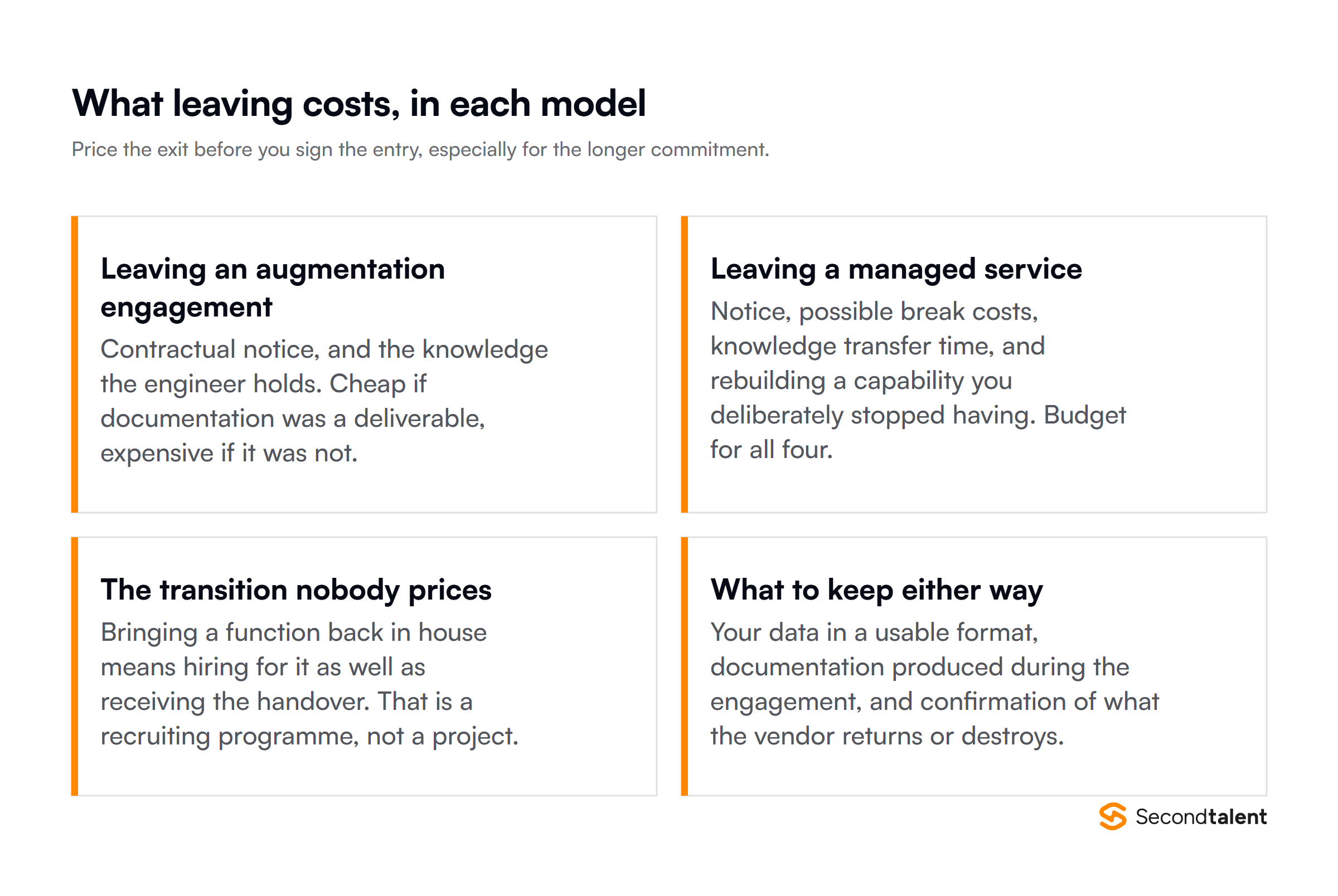
Price the exit before the entry
Leaving an augmentation engagement costs contractual notice and whatever knowledge went undocumented. Leaving a managed service costs notice, possible break fees, knowledge transfer time, and rebuilding a capability you deliberately stopped having.
That last item is the one nobody prices. Bringing a function back in house means hiring for it as well as receiving a handover, and that is a recruiting programme rather than a project.
Ask three questions before signing: what does termination for convenience cost, how long is the notice period, and what do you charge for knowledge transfer on the way out. A vendor who will not put those in writing is telling you what the renewal conversation will be like. Our breakdown of the MSA clauses that shift risk covers the drafting.
Compliance differs too
The two models put employment questions in different places, which is worth knowing before you choose.
Under augmentation you direct the work, so classification matters and the provider needs to be the employer. The IRS common-law test and the HMRC CEST tool both turn on control, and augmentation is control by design.
Where any part of a managed service runs on the vendor’s own infrastructure, you are auditing rather than controlling. Ask for assurance evidence such as an AICPA SOC report, and borrow the NIST Cybersecurity Framework vocabulary for the oversight clauses rather than drafting a bespoke list nobody can audit against.
Under a managed service the vendor directs its own people, which sidesteps that question and raises others. Where the function touches personal data the vendor is a processor, and GDPR Article 28 sets what the contract must contain, including the conditions for engaging a sub-processor. That is a real advantage of the model and a real obligation attached to it.
What to ask a vendor selling either one
Five questions work on both, and the answers tell you which model the vendor is really proposing regardless of what the deck says.
- Who names the people? If you interview and approve them, that is augmentation. If the vendor assigns and reserves the right to rotate, that is a managed service.
- What does the contract promise? A qualified person available, or a response time and a throughput number.
- Whose systems does the work happen on? Yours points to augmentation, theirs to a managed service.
- What is your twelve-month retention? Worth asking in both cases, because rotation affects you either way.
- What does leaving cost? Notice, break fees and knowledge transfer, in writing.
Where the answers split across those five, you are probably being offered something between the two, which is fine as long as everyone says so. Our checklist on evaluating IT staffing companies extends this into a scoring framework, and the 15 questions to ask before signing covers the contractual detail.
Running both at once
Larger teams end up with both, and the failure mode there is different from picking wrong.
Keep one register listing every engagement, which model it sits under, who directs it, the notice period and the renewal date. Those five fields are what teams lose when two commercial shapes run in parallel.
Watch the boundary in particular. A managed service quietly absorbing work an augmentation contract already covers is the duplication that survives several quarters, because neither vendor has a reason to raise it and nobody internally owns the comparison. Our planning template covers keeping the register.
Model comparison FAQs
Can we start with augmentation and move to a managed service?
Yes, and it is a sensible sequence. Running the function with augmented engineers first tells you what good looks like, which is exactly what you need to write service levels against. Trying to define them before you have run the function produces vague ones.
Does a managed service cost more?
Per unit of engineering, generally yes, because you are also buying management and accountability. Whether it costs more in total depends on whether you would otherwise have hired the management yourself.
Can one vendor provide both?
Many do. Be precise in the contract about which you are buying for each piece of work, because the same company and the same engineers can sit under very different obligations.
What if the vendor keeps rotating people?
Under a managed service that is their right, and it is one of the trades you accepted. If continuity of specific people matters to you, that is a signal you wanted augmentation.
Takeaways
- One question sorts most cases: do you want to keep directing the work?
- A service level without a credit attached is a preference, not a commitment.
- Name the vendor manager before signing, or the reporting will drift to what is convenient.
- Managed services is sold harder because the contract is larger. Decide before the first call.
- Price the exit, including rebuilding a capability you chose to stop having.
If you want to keep directing the work
Second Talent supplies augmentation with EOR cover across Asia: named engineers who work under your manager, matched within 24 hours, at 92 percent twelve-month retention.
Tell us what you are trying to ship, or read what IT staffing is for how the models sit alongside each other.