On a benchmark of 448 graduate-level science questions called GPQA, experts holding or pursuing PhDs in the relevant field scored 65 percent. Highly skilled non-experts, given more than 30 minutes per question and unrestricted web access, scored 34 percent. Search does not close the gap between knowing a field and looking it up.
That gap is why model labs now pay doctors, lawyers, mathematicians and analysts to write and check training data. Published rates for physician work now reach $250 an hour, and the professional rules on confidentiality still apply to every task.
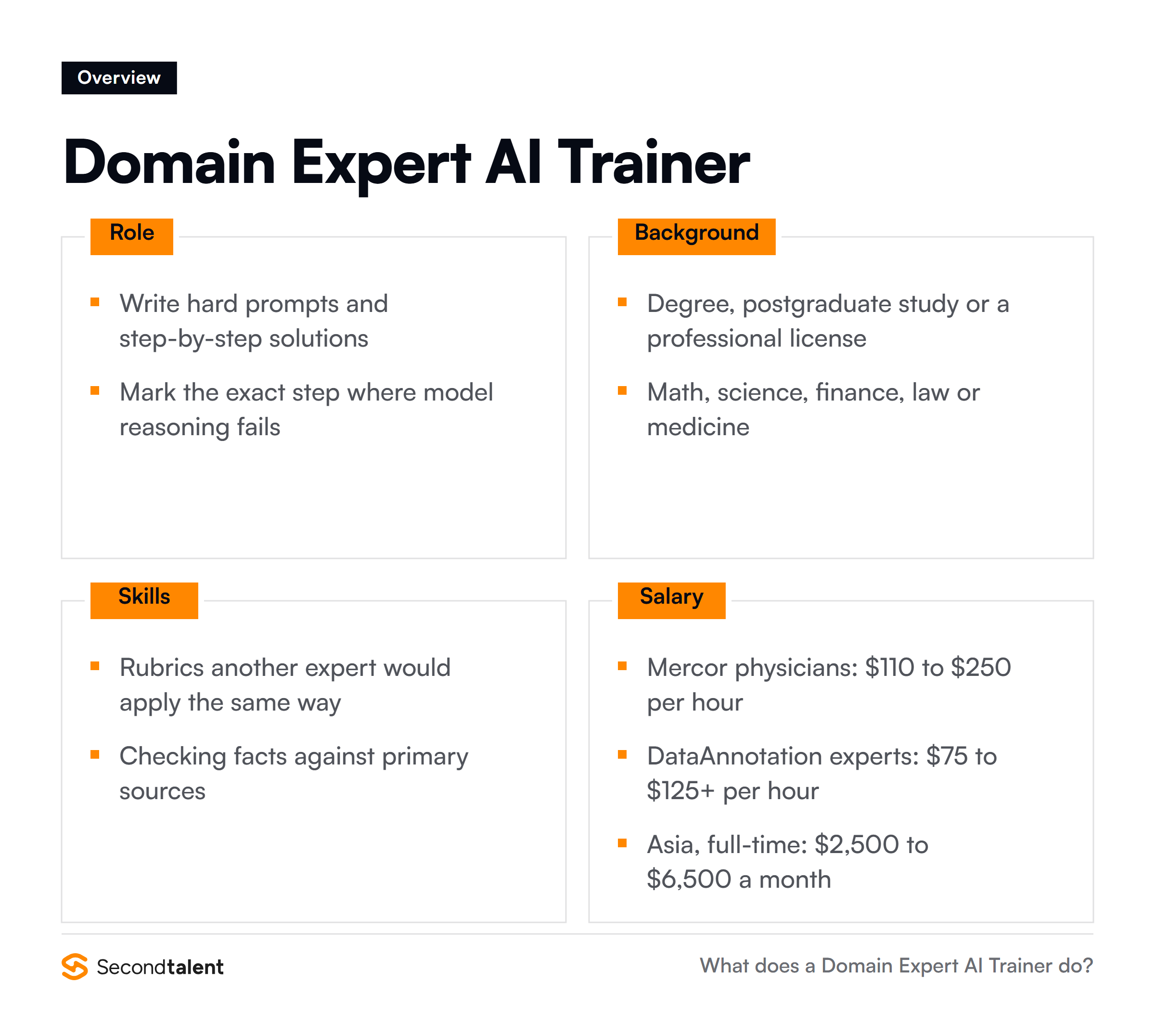
What is a Domain Expert AI Trainer?
A domain expert AI trainer is a graduate, postgraduate or licensed professional who produces training and evaluation data in their own field. The fields in highest demand are mathematics, the physical and life sciences, finance and accounting, law, and medicine.
The core work is expert judgment written down in a form a model can learn from:
- Expert prompts: hard, realistic questions and tasks that a strong model still gets wrong
- Worked solutions: step-by-step answers with the reasoning shown, for supervised fine-tuning
- Rubrics: the criteria that define a correct, complete and safe answer in the field
- Error finding: checking model reasoning line by line and marking the exact step where it fails
- Preference judgments: ranking responses on accuracy first, then clarity
What separates this from general preference work is the cost of a wrong answer. A fluent, confident and incorrect answer about a drug interaction or a tax treatment does more damage than no answer. A generalist can judge whether a response reads well. Only an expert can judge whether it is right.
Domain Expert AI Trainer Job Market and Pay
The market moved decisively toward specialists in 2025. In September that year xAI cut 500 generalist annotators, about a third of its annotation team, and posted that it would surge its specialist AI tutor team by 10x, hiring across STEM, finance, medicine and safety.
Expert marketplaces grew on the same demand. When Mercor raised $350 million at a $10 billion valuation in October 2025, it told TechCrunch it had more than 30,000 experts on its roster, earning over $85 an hour on average, and paid out more than $1.5 million a day.
Contract rates published by platforms and employers (checked September 2026):
- Mercor, physician roles: $110 to $250 per hour
- Mercor, investment banking experts: $130 to $180 per hour
- Mercor, lawyers: $55 to $150+ per hour, depending on specialization
- DataAnnotation, STEM, finance, legal and medical roles: $75 to $125+ per hour
- Outlier, statistics PhDs: up to $150 per hour
- Handshake AI, PhD and master’s holders in the US: up to $100 per hour
- xAI, AI Tutor, Legal and Compliance: $50 to $100 per hour, requiring a J.D. and 2+ years of practice
These are ceilings for contract work, and hours depend on project demand. The salaried end of the path is much higher: Anthropic posts $350,000 to $850,000 for a Research Engineer, Domain Scaling, working on finance, healthcare and legal knowledge work.
Across Asia, full-time dedicated domain expert AI trainers hired through Second Talent typically cost $2,500 to $6,500 a month, from strong graduates on a first AI project to licensed practitioners and published researchers who set rubrics and review other experts.
Essential Domain Expert AI Trainer Skills and Qualifications
Credentials by Field:
- Mathematics: a degree or postgraduate study, with competition or research experience for the hardest work
- Physics, chemistry and biology: postgraduate study or research experience, and comfort with multi-step quantitative problems
- Finance and accounting: qualified accountants and analysts with modeling, valuation or reporting-standards experience
- Law: law graduates and qualified lawyers, with the jurisdiction stated clearly
- Medicine and health: physicians, pharmacists and nurses with clinical practice experience
Beyond the Credential:
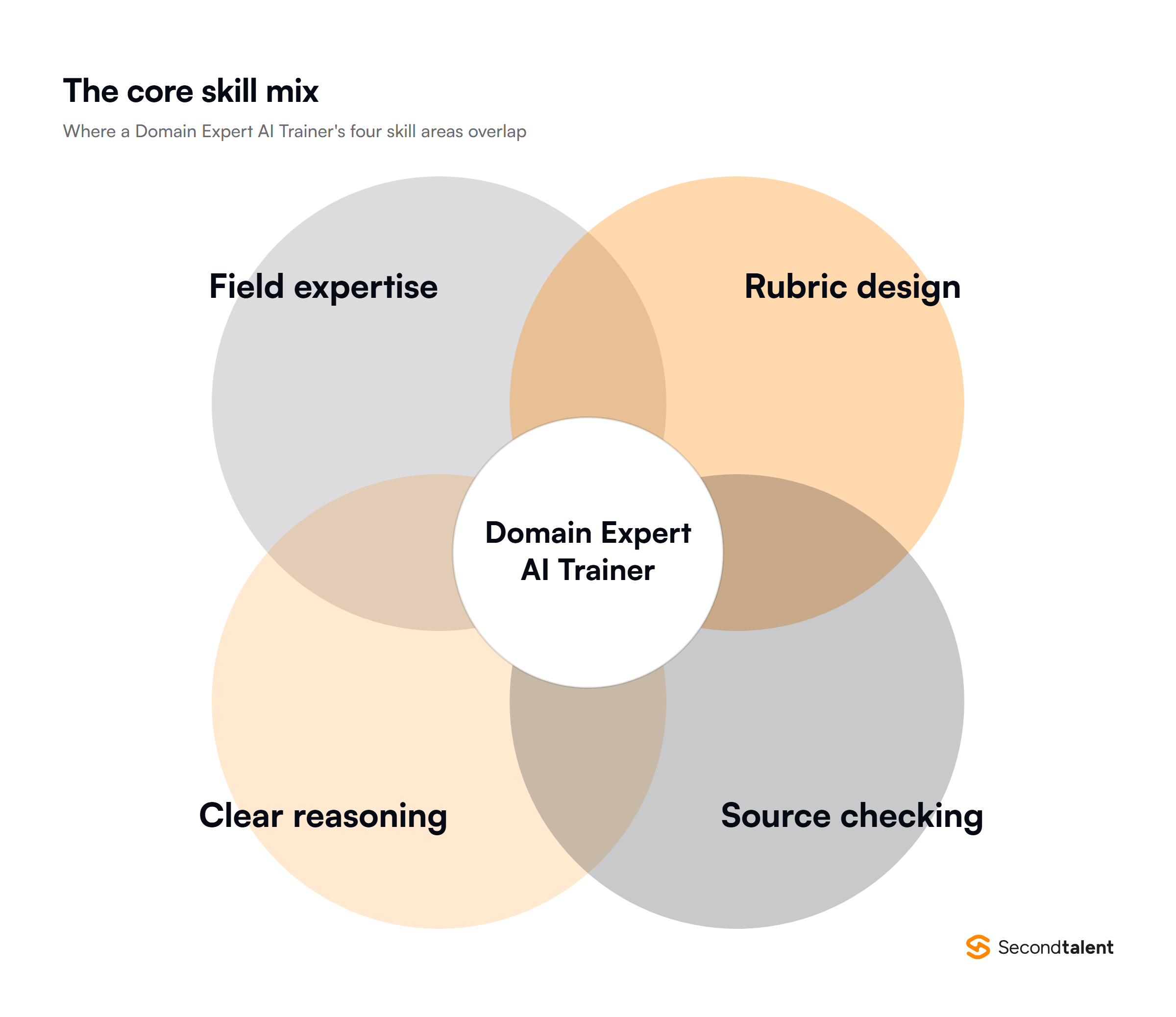
- Explaining reasoning plainly, step by step, since a brilliant answer with the steps skipped teaches a model nothing
- Writing questions that are hard for the right reason, not because they are ambiguous or rely on an obscure fact
- Writing rubrics that another expert would apply the same way
- Checking facts, formulas and citations against primary sources rather than memory
- Staying calibrated: flagging where experts in your field genuinely disagree instead of presenting one view as settled
Screening: Selection is by trial task, not résumé alone. OpenAI chose the 262 physicians behind HealthBench from 1,021 applicants, 26 percent of the pool, using paid introductory tasks that included rubric writing.
Domain Expert AI Trainer Career Paths and Progression
Common Routes In:
- From graduate study: PhD candidates and postdocs, often starting part-time alongside research
- From practice: lawyers, physicians and accountants adding contract work, or leaving practice for it
- From teaching: lecturers and examiners, already skilled at writing hard questions and marking against a scheme
- From general RLHF work: raters with a relevant degree who move into their field’s projects for higher rates
Progression Within the Role:
- Contributor: writing prompts and solutions, and grading model answers in your field
- Senior expert: reviewing other experts’ items and handling the hardest tasks
- Rubric lead: defining what a correct answer means for a whole project
- Domain lead: owning quality for a field across a lab’s or vendor’s programs
Where It Leads: Some experts move into salaried roles on lab teams that specialize models for a field, or into human data program management. Others move into AI safety auditing and evaluation for regulated industries, where the combination of professional credentials and model literacy is rare.
What Expert-Written Training Data Looks Like
The public benchmarks built by experts show the standard labs now expect.
GDPval. OpenAI’s GDPval covers 1,320 tasks across 44 occupations in the nine sectors contributing most to US GDP. Experts needed at least four years in their occupation and averaged 14, and each task took an expert about seven hours. In the paper, the best model, Claude Opus 4.1, produced work graded as good as or better than the expert’s 47.6 percent of the time.
Humanity’s Last Exam. The benchmark holds 2,500 questions from nearly 1,000 subject experts at more than 500 institutions in 50 countries, mostly professors, researchers and graduate degree holders. Contributors competed for a $500,000 prize pool that paid $5,000 each for the top 50 questions.
HealthBench. Its 262 physicians practiced in 60 countries, spanned 26 specialties and worked in 49 languages. Together they wrote 48,562 rubric criteria for grading medical conversations.
FrontierMath. Epoch AI built FrontierMath with more than 60 mathematicians, including professors, IMO question writers and Fields medalists. Its hardest tier was written mostly by professors and postdocs, each contracted for a several-week research project that produced a single problem.
The pattern is consistent. Expert data is slow, reviewed several times, and paid for by the item or the hour at professional rates.
How to Become a Domain Expert AI Trainer
- Decide which subfields you can judge at a professional level, and state your jurisdiction if you work in law or medicine
- Practice writing three or four questions a strong model gets wrong, with full worked solutions
- Grade model answers in your field and mark the exact step where each one fails
- Write a short rubric for one question type and test it by having a colleague apply it
- Apply to expert programs that assess with paid trial tasks, and keep your credentials ready for verification
Professional obligations still apply. The ABA’s Formal Opinion 512 (July 2024) requires lawyers to evaluate disclosure risks before putting client information into a generative AI tool. The Federation of State Medical Boards’ April 2024 policy calls for rigorous safeguards on patient data used to develop and evaluate AI. Neither addresses training contracts directly, but the practical rule is plain: no client or patient material goes into a training task, even anonymized, without authority to use it.
Second Talent confirms each candidate’s degree or license before a field-specific test in which they solve hard problems and grade flawed model answers. The experts who pass are the ones who can explain their reasoning plainly, not only reach the right answer.
Domain Expert AI Trainer vs Adjacent Roles
Domain Expert AI Trainer vs RLHF Specialist: Both rank responses and write rationales. An RLHF specialist works on general tasks where a careful reader can judge quality. A domain expert trainer works where correctness itself takes professional knowledge to check.
Domain Expert AI Trainer vs AI Evaluator & Trainer: The evaluator title covers rating output across many task types and building evaluation suites. Domain experts are usually brought in for one field, often to write the hardest items in those suites.
Domain Expert AI Trainer vs Coding AI Trainer: Coding trainers are the software engineering version of the same role. Code is easier to verify automatically, so coding work leans on tests. Expert work in law or medicine leans on rubrics and human review instead.
Domain Expert AI Trainer vs practicing professional: The trainer is not advising a client or treating a patient. The output is data, and the professional obligations that follow from that are covered in the section on getting started below.
Future of the Domain Expert AI Trainer Role
The case for expert data keeps growing because model errors in expert fields are now well documented. Damien Charlotin’s database of court cases involving AI-hallucinated material listed 2,038 cases as of September 11, 2026, including 811 involving lawyers. Stanford researchers found that leading legal research AI tools hallucinated between 17 and 33 percent of the time.
Medicine shows a subtler problem. In a February 2026 Nature Medicine study of 1,298 participants, models alone identified the relevant conditions in 94.9 percent of scenarios, but participants using the same models did so in fewer than 34.5 percent. The authors concluded that standard benchmarks did not predict those failures.
That points to where expert work is heading: away from question-and-answer pairs and toward realistic tasks, messy inputs, and rubrics that capture what a professional would actually accept. Those are harder to write, which keeps demand concentrated on experienced practitioners.
Expect the talent pool to widen as well. Qualified doctors, lawyers, accountants and scientists across Asia can do this work at a lower cost than US contract rates, as long as the project states which jurisdiction and standards the model must follow.
Frequently Asked Questions
What does a domain expert AI trainer do?
A domain expert AI trainer writes and checks training data in their own professional field. The work includes writing hard, realistic prompts, producing step-by-step worked solutions, writing rubrics that define a correct answer, finding the exact step where a model’s reasoning fails, and ranking responses on accuracy.
How much do domain expert AI trainers earn?
Published contract rates in September 2026 include $110 to $250 per hour for physician roles and $130 to $180 per hour for investment banking experts on Mercor, $75 to $125+ per hour for STEM, finance, legal and medical roles on DataAnnotation, and $50 to $100 per hour for xAI’s legal tutor role. Full-time dedicated experts in Asia typically cost $2,500 to $6,500 a month.
What qualifications do you need to become a domain expert AI trainer?
Most programs require a degree in the field and prefer postgraduate study or professional experience. Law and medical roles usually require a qualification such as a J.D. or medical license, sometimes with years of practice. Selection is by paid trial task, so the ability to write clear rubrics and worked solutions matters as much as the credential.
Can lawyers and doctors do AI training work?
Yes, and many do, often part-time. Professional rules on confidentiality still apply: ABA Formal Opinion 512 requires lawyers to evaluate disclosure risks before putting client information into AI tools, and medical boards expect patient data to be protected. The safe practice is to keep all client and patient material out of training tasks.
Why do AI companies need domain experts instead of general raters?
Because correctness in expert fields takes expertise to check. On the GPQA benchmark, experts holding or pursuing PhDs scored 65 percent while skilled non-experts with web access scored 34 percent. xAI cut 500 generalist annotators in September 2025 and said it would grow its specialist tutor team tenfold.
How quickly can Second Talent place a domain expert AI trainer?
We send a shortlist of pre-vetted domain expert trainers within 24 hours of receiving your brief, covering the field, difficulty level, jurisdiction and expected volume. Every candidate’s degree or license is confirmed before a field-specific test, and most clients have an expert working within a week.
Related Roles
Explore related roles you can hire on Second Talent: RLHF Specialist, Coding AI Trainer, Multilingual AI Trainer, AI Evaluator & Trainer, AI Safety Auditor, Applied Scientist, AI Research Scientist.