English makes up about 40 percent of the pages in Common Crawl’s August 2026 crawl, one of the main sources of web text for training language models. Vietnamese and Indonesian are each about 1 percent. Thai is 0.37 percent, and Tagalog 0.012 percent. Models are strongest in the languages they see most, and these shares are small.
A multilingual AI trainer closes part of that gap by writing and judging data in their own language. Machine-translating English data does not fix the gap, because it carries English content and assumptions into the new language.
What is a Multilingual AI Trainer?
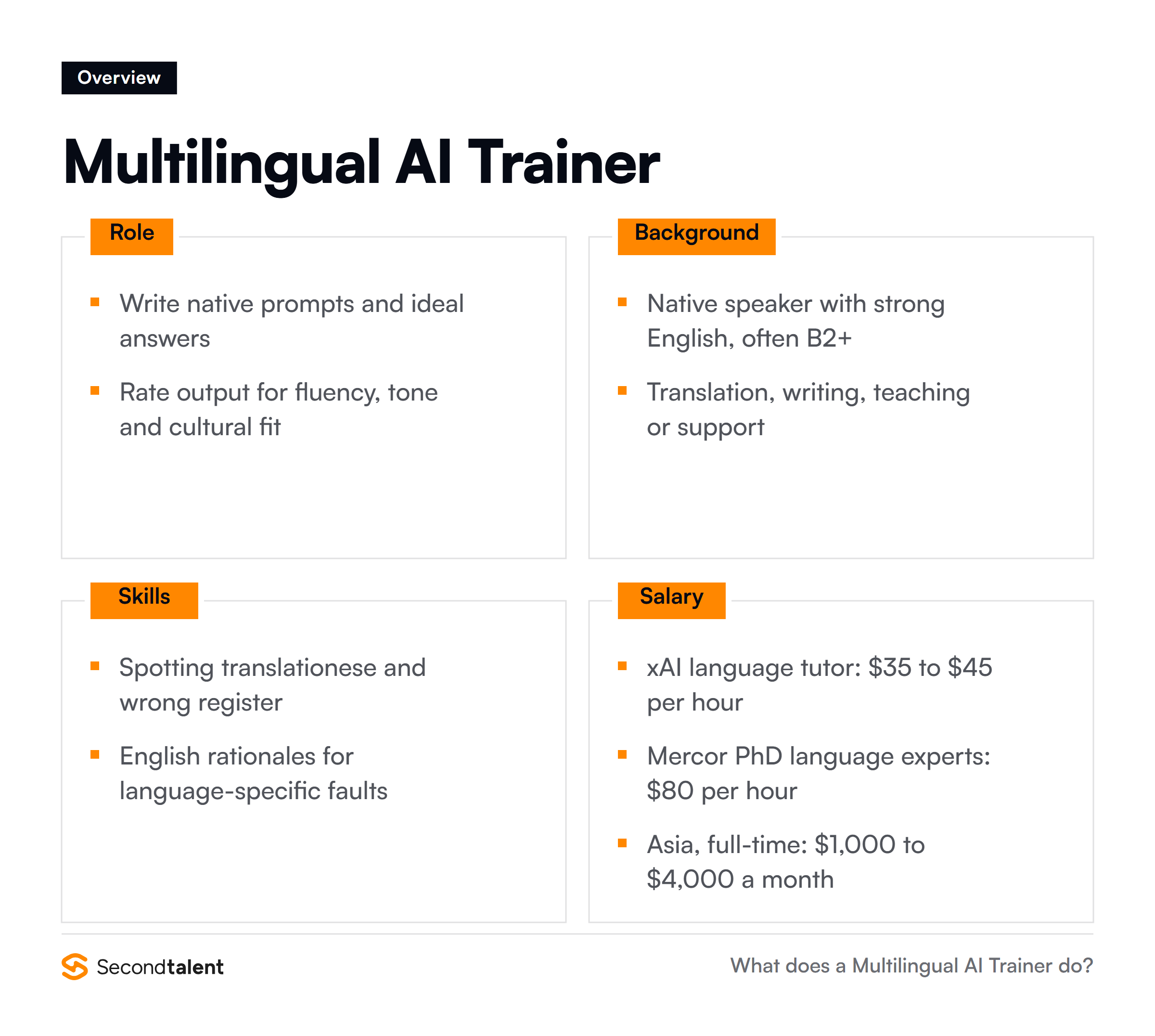
A multilingual AI trainer is a native speaker who produces and evaluates training data in their language, while working fluently in English so they can follow guidelines and write rationales the team can read. The role matters most for languages that are widely spoken but thinly represented online, which includes most of Southeast Asia.
Typical work includes:
- Native prompts and responses: writing natural questions and ideal answers directly in the target language, not translating them from English
- Output rating: ranking model responses for fluency, accuracy, tone and cultural fit
- Translation review: fixing machine-translated data so it reads as if it were written natively
- Localization checks: catching wrong formats, units, names, honorifics and cultural references
- Safety review in context: flagging content that is offensive or sensitive locally even when it looks harmless in English
- Code-switching data: covering the mixed-language speech common in Singapore, Malaysia and the Philippines
A good trainer can explain why a sentence sounds wrong to a native ear. That explanation is what turns a rating into data a model can learn from.
Multilingual AI Trainer Job Market and Pay
Pay for language work depends as much on where the trainer lives and the project’s difficulty as on the language itself. The same platform can pay very different rates for different markets.
Published rates and postings (checked September 2026):
- xAI, AI Tutor, Khmer: $35 to $45 per hour for US-based candidates, the same band as on its other language tutor postings
- Mercor, Thai Audio Generalist Evaluator Expert: $50 per hour, including writing evaluation rubrics in Thai and English
- Mercor, Language Experts, PhDs (including Cantonese, Indonesian, Mandarin, Thai and Vietnamese): $80 per hour
- Mercor, AI Safety Experts, English and Thai: $24 to $35 per hour; the English and Vietnamese version pays $17 to $25
- DataAnnotation, multilingual projects: starting at $20+ per hour
- Outlier, Vietnamese Voice AI Evaluator: up to $11 per hour; its Thai, Indonesian and Tagalog evaluator roles list $7.50 to $10
The spread is wide. Short, specialized projects with rubric writing or red-teaming pay several times more than open-ended rating queues priced for local labor markets. Trainers who can do the harder work, in both their language and English, reach the upper end.
For companies, full-time dedicated multilingual AI trainers hired through Second Talent typically cost $1,000 to $4,000 a month across Asia, from native speakers on a first AI project to leads who own quality for a whole language.
Essential Multilingual AI Trainer Skills and Qualifications
Language:
- Native fluency in the target language, including informal speech, regional variation and register
- Strong English, usually at least B2, since guidelines and rationales are written in English
- Awareness of your own variety: northern versus southern Vietnamese, Malay versus Bahasa Indonesia, written Cantonese versus standard written Chinese
What Trainers Watch For, by Language:
- Vietnamese: tone marks and regional usage
- Thai: word segmentation, polite particles and formal registers
- Bahasa Indonesia and Malay: shared roots with vocabulary that differs, and formal versus everyday registers
- Filipino: frequent switching with English, which Filipino speakers call Taglish
- Mandarin and Cantonese: simplified versus traditional script, and mainland versus regional usage
Judgment and Writing:
- Rating against a rubric consistently, and flagging where the rubric assumes English norms that do not apply
- Writing short rationales in English that explain a language-specific problem to someone who does not speak the language
- Recognizing translationese, the stiff and literal phrasing that marks translated text
Background: No specific degree is required. Strong candidates often come from translation, localization, journalism, teaching, or customer support in their language. A linguistics degree helps with guideline writing, and some short expert projects prefer a doctorate.
Multilingual AI Trainer Career Paths and Progression
Common Routes In:
- From translation and localization: strong on accuracy, needing to shift from faithful translation to native judgment
- From writing, editing and journalism: strong on natural prose and register
- From teaching: used to explaining why a sentence is wrong, which is the core of a good rationale
- From content moderation: already fluent in local safety norms
Progression Within the Role:
- Rater: ranking and rating output in your language against a rubric
- Writer and reviewer: producing native prompts and ideal responses, and checking other raters
- Language lead: writing language-specific guidelines and running calibration
- Multilingual quality lead: owning data quality across several languages for a program
Where It Leads: Experienced trainers move into language program management, multilingual evaluation, and conversation design for products launching in their market. Some move toward NLP engineering with further technical study, bringing native-speaker judgment that engineering teams rarely have.
Why Translated Data Is Not Enough
The cheap way to get non-English data is to machine-translate English data. The research says it carries English assumptions into the new language.
The content is Western. When Cohere For AI examined the widely used MMLU benchmark for Global-MMLU, it found 28 percent of questions required culturally sensitive knowledge, and 84.9 percent of the geography questions focused on North America or Europe. Human reviewers then made 7,565 edits to the machine translations, 36.9 percent of the samples they reviewed.
Translation erases culture. AI Singapore built its SEA-HELM benchmark with a team of paid native speakers, warning that automatic translation misses cultural nuance and can cause cultural erasure. Its results showed Tamil and Filipino performance relatively poor even for strong models.
Gaps persist at the top. On FilBench, a 2025 Filipino benchmark across 27 models, the best model scored 72.23 percent, and models trained specifically for Southeast Asian languages tended to score lower.
The languages cost more to process. A 2023 study of tokenizers found the same text could take up to 15 times more tokens in some languages than in English. On the tokenizer used by ChatGPT and GPT-4 at the time, Thai took 4.39 times as many tokens as English and Vietnamese 2.45 times.
Code-switching trips models up. Researchers testing code-mixed text generation found ChatGPT produced fluent Singlish but mostly broken English-Tamil mixes, and advised against using models for such text without extensive human checks.
Multilingual AI Trainer vs Adjacent Roles
Multilingual AI Trainer vs translator: A translator carries meaning from one language to another. A multilingual trainer often starts from nothing in the target language, and judges model output against how a native speaker would actually write, which is a different skill from faithful translation.
Multilingual AI Trainer vs RLHF Specialist: The judging work is similar. The difference is the language: most RLHF work runs in English, while a multilingual trainer applies the same rubric discipline in Vietnamese, Thai, Bahasa Indonesia or Cantonese.
Multilingual AI Trainer vs AI Training Data Annotator: Annotators label data at volume, including in Asian languages. Multilingual trainers produce and judge open-ended text, where naturalness and register matter as much as correctness.
Multilingual AI Trainer vs Domain Expert AI Trainer: The two combine when a model needs expert answers in a local language, such as medical or legal questions in Thai. Those projects need both a qualification and native fluency, and pay accordingly.
How to Become a Multilingual AI Trainer
- Pin down your variety and register strengths honestly, since projects often specify them
- Practice rating model answers in your language, writing a two-sentence English rationale for each
- Rewrite machine-translated passages until they read natively, and note every change you made and why
- Write a few natural prompts a local user would actually ask, with ideal answers in the right register
- Apply to platforms with language tracks, then use your quality record to reach expert, safety or dedicated roles
Expect testing in both languages. Second Talent’s vetting for dedicated multilingual trainers includes a writing test in the target language, a rating exercise with known answers, a translation review task and an English check, all scored for naturalness as well as accuracy.
Future of the Multilingual AI Trainer Role
Regional investment in human-written data is growing. Cohere’s Aya Dataset gathered 204,114 hand-written examples in 65 languages from 2,997 contributors across 119 countries. AI Singapore released SEA-LION v4.5 in May 2026, covering Burmese, Indonesian, Filipino, Malay, Tamil, Thai and Vietnamese.
In March 2026 Google.org gave US$1 million to AI Singapore’s Project Aquarium, a data effort for eight Southeast Asian languages spoken by over 700 million people.
Demand follows users. The e-Conomy SEA 2025 report counts over 200 million new internet users in Southeast Asia over the past decade, and Google reports consumer interest in AI topics there at three times the global average. Every product launching to those users needs a model that speaks their language well.
Expect the work to move from volume rating toward harder tasks: safety red-teaming in local languages, voice and audio evaluation, expert answers in local languages, and code-switched data. Those projects reward trainers who combine native judgment with strong English and a consistent quality record.
Frequently Asked Questions
What does a multilingual AI trainer do?
A multilingual AI trainer is a native speaker who writes prompts and ideal responses in their language, rates model output for fluency, accuracy and cultural fit, fixes machine-translated data, checks localization details, and reviews content for local safety concerns. They also work in English to follow guidelines and explain their judgments.
How much do multilingual AI trainers earn?
Rates vary widely by language, location and project. In September 2026, xAI posted $35 to $45 per hour for US-based language tutors, Mercor posted $50 per hour for a Thai audio evaluator and $80 per hour for PhD language experts, and Outlier listed up to $11 per hour for Vietnamese voice evaluation. Full-time dedicated multilingual trainers in Asia typically cost $1,000 to $4,000 a month.
Is multilingual AI training the same as translation?
No. Translation carries meaning faithfully from one language to another. Multilingual AI training usually means writing data natively in the target language and judging model output against how a native speaker would express it. Research such as Global-MMLU found machine-translated data carries Western cultural assumptions that native writing avoids.
Which languages are in demand for AI training?
Demand is strongest for languages with many speakers but little online text. In Common Crawl’s August 2026 crawl, English was about 40 percent of pages while Vietnamese and Indonesian were about 1 percent each and Thai 0.37 percent. Southeast Asian languages, Cantonese and code-switched varieties such as Taglish and Singlish are all areas of active investment.
Do you need a degree to become a multilingual AI trainer?
No degree is required for most language work. Platforms test native fluency, English ability and rating consistency directly. A linguistics or translation background helps with guideline writing, and some short expert projects prefer a doctorate.
How quickly can Second Talent place a multilingual AI trainer?
We send a shortlist of pre-vetted multilingual AI trainers within 24 hours of receiving your brief, covering languages, task types and expected volume. We cover Vietnamese, Thai, Bahasa Indonesia, Filipino, Malay, Mandarin and Cantonese, and most clients have a trainer working within a week.
Related Roles
Explore related roles you can hire on Second Talent: RLHF Specialist, Domain Expert AI Trainer, Coding AI Trainer, AI Training Data Annotator, Natural Language Processing (NLP) Engineer, Conversation Designer, AI Content Moderator.