TL;DR: Blockchain developers from Asia who already work for foreign companies earn $2,000 to $9,000 a month on our rate cards, and Second Talent shortlists 6-8 pre-vetted candidates within 24 hours. The closest US benchmark, the BLS median for software developers, was $135,980 a year in May 2025.
Asia became the largest continent for crypto developers in Electric Capital's October 2024 geography analysis, with 32% of developers who report a location, up from 13% in 2015. India accounted for 12%, second only to the US at 19%. The code they deploy often holds user funds, so the screening has to happen before anything reaches mainnet.
Key takeaways
- Foundry is now the primary framework for 57% of Solidity developers, and Truffle is down to a single user, so a portfolio built only on Truffle and Ganache is out of date.
- The FBI attributed the $1.5 billion Bybit theft of February 2025 to North Korea, and Chainalysis reports North Korean IT workers embedded inside crypto companies. Identity checks belong in the hire.
- Ethereum's Fusaka upgrade was scheduled for 5:49 am Manila time, so protocol changes can land outside US working hours.
- The IRS treats digital assets as property, not currency, which matters if you plan to pay a contractor in tokens.
What Blockchain Developers Earn Working for International Clients in Asia
Malaysia has the highest floor in the table at $3,500 a month, and the Philippines the lowest ceiling at $6,500. The ranges are what developers in each market earn working directly for foreign companies, before any employer or platform costs.
| Market |
Monthly pay working for international clients (USD) |
| Indonesia |
$2,000-$8,000 |
| Philippines |
$2,200-$6,500 |
| Vietnam |
$2,200-$8,500 |
| Thailand |
$2,500-$8,500 |
| Malaysia |
$3,500-$9,000 |
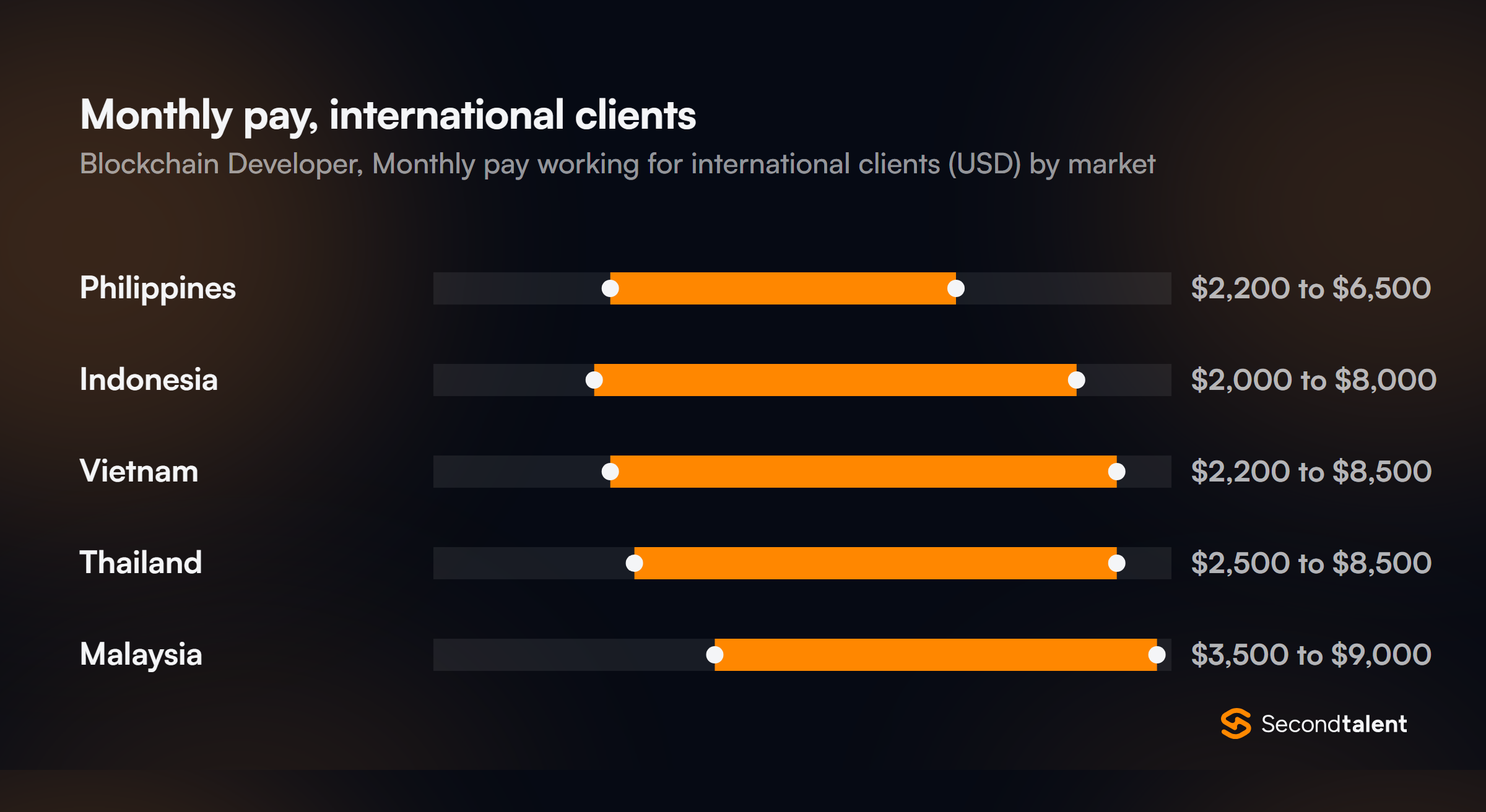
Monthly ranges from the Remote (Working for International Clients) figures on our rate cards for Indonesia, Philippines, Vietnam, Thailand and Malaysia, converted at ExchangeRate-API mid-market rates for 14 September 2026. All five cards publish US dollar figures, so the conversion leaves them unchanged.
The regional finance hubs sit far higher. Our Singapore blockchain card starts at $11,840 a month for the same remote work, converted from Singapore dollars.
Second Talent bills a blockchain developer as one monthly fee that bundles salary, payroll taxes, statutory contributions and our service fee. Our pricing page sets out the subscription and direct-hire options.
US Pay Benchmark for Blockchain Developers
Electric Capital counts 81% of crypto developers as living outside the US, so most of the pool a US company recruits from is already offshore. BLS publishes no blockchain title. Blockchain developers map to Software Developers (SOC 15-1252), because the work is designing and developing software that runs on a public chain.
| BLS OEWS, May 2025, national |
Software Developers (15-1252) |
| Employment |
1,687,890 |
| Median annual |
$135,980 |
| 10th percentile, monthly |
$6,870 |
| 25th percentile, monthly |
$8,770 |
| Median, monthly |
$11,330 |
| 75th percentile, monthly |
$14,330 |
| 90th percentile, monthly |
$17,890 |
Monthly figures are the annual wages on the OEWS profile for 15-1252 divided by 12, rounded to the nearest $10. The occupation-wide figure is the best federal benchmark available; it does not isolate smart contract specialists.
Salary is only part of the US cost. In the BLS Employer Costs for Employee Compensation release for June 2026, wages and salaries made up 68.5% of employer compensation costs for full-time private industry workers, and benefits the other 31.5%.
Time Zone Overlap with ET, CT and PT
The Ethereum Foundation scheduled Fusaka for 21:49:11 UTC on 3 December 2025. That was 4:49 pm in New York and 5:49 am on 4 December in Manila. Chains run through US nights and weekends, and none of the Asian cities below change their clocks. US daylight time runs from 8 March to 1 November 2026, per NIST.
| Engineer's city |
UTC offset |
9:00 am ET (EDT) |
9:00 am CT (CDT) |
9:00 am PT (PDT) |
| Manila, Singapore, Kuala Lumpur, Taipei |
UTC+8 |
9:00 pm |
10:00 pm |
12:00 midnight |
| Ho Chi Minh City, Jakarta, Bangkok |
UTC+7 |
8:00 pm |
9:00 pm |
11:00 pm |
| Bengaluru |
UTC+5:30 |
6:30 pm |
7:30 pm |
9:30 pm |
After 1 November 2026, every time in the table moves one hour later.
The Bangkok row: 9:00 am EDT is 13:00 UTC, and 13:00 plus seven hours is 20:00. Two shifts that produce overlap, computed for September:
- Kuala Lumpur, 5:00 pm to 2:00 am (09:00 to 18:00 UTC) covers 5:00 am to 2:00 pm in New York: five hours inside a 9-to-5 ET day, four with Chicago and two with San Francisco.
- Bangkok or Ho Chi Minh City, 3:00 pm to midnight (08:00 to 17:00 UTC) covers 4:00 am to 1:00 pm in New York: four hours with ET and three with CT.
Use the shared hours for design reviews, audit findings and deployment sign-off. The Asian afternoon before the shared window suits monitoring dashboards, testnet runs and mempool alerts that fired overnight in the US. We set that schedule before the offer, which is how our placements get 4-6 hours of daily overlap with US hours.
Late hours cost more for employees. Vietnam's Labor Code counts 22:00 to 06:00 as night work and adds at least 30% (Articles 98 and 106). That covers the last two hours of the Ho Chi Minh City shift.
For employees in Manila, the Philippine Labor Code sets a night shift differential of at least 10% for each hour between 10 pm and 6 am (Article 86).
Blockchain Developer Skills to Screen For
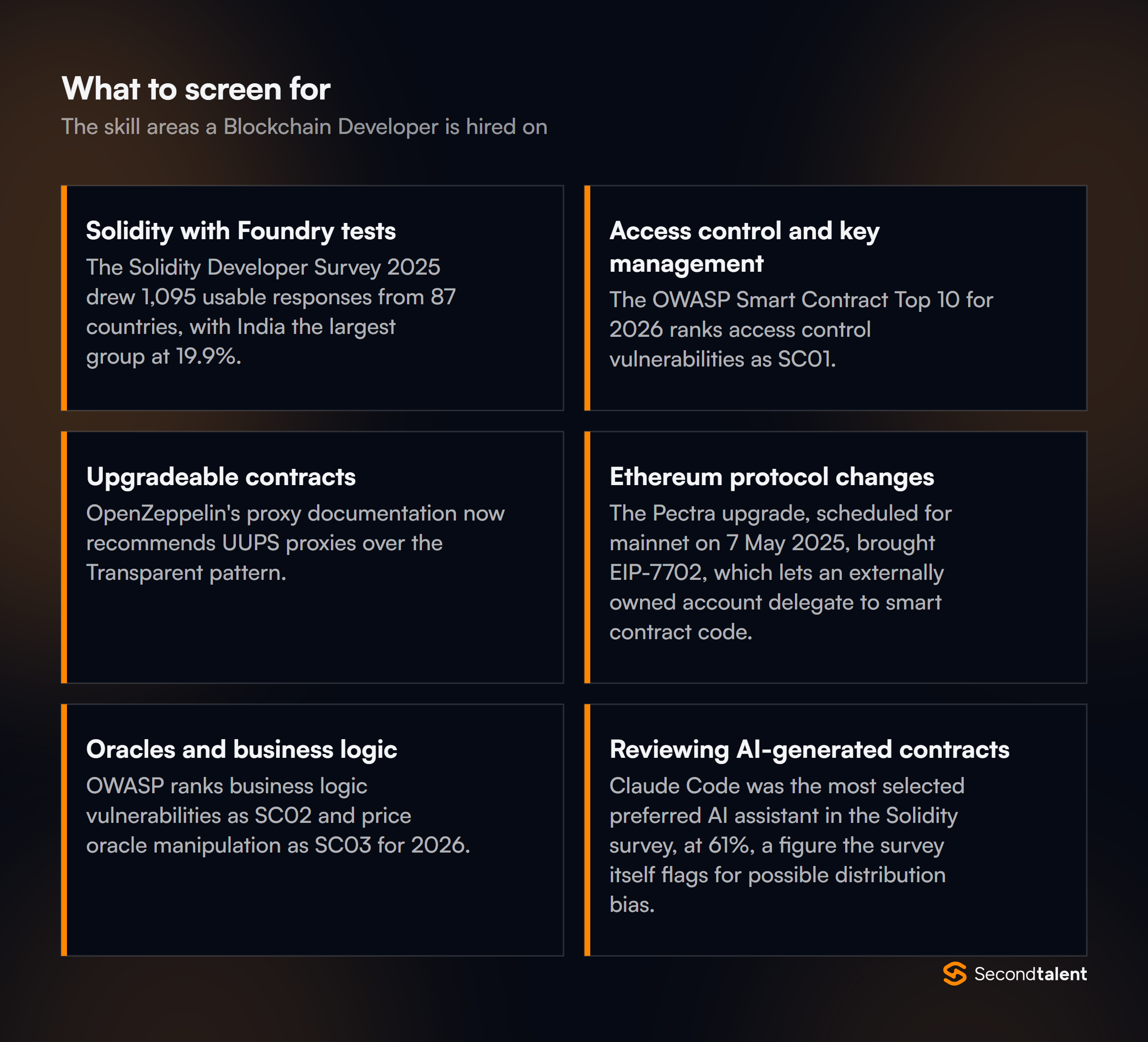
The code at a deployed contract address stays fixed, so screen for the mistakes that cost funds. Each area comes with an exercise.
Solidity with Foundry tests
The Solidity Developer Survey 2025 drew 1,095 usable responses from 87 countries, with India the largest group at 19.9%.
Foundry was the primary framework for 57%, up from 51% in 2024, and had the highest share of expert users. Foundry v1.0 shipped in February 2025 with faster fuzz and invariant tests. Ask the candidate to write an invariant test for a vault: the share count must match the assets held after any deposit or withdrawal.
Access control and key management
The OWASP Smart Contract Top 10 for 2026 ranks access control vulnerabilities as SC01. These flaws let unauthorized roles invoke privileged functions, often through exposed admin, governance or upgrade paths. Chainalysis counts over $3.4 billion stolen from January to early December 2025, $1.5 billion of it from Bybit. It describes attackers who trick legitimate signers into authorizing malicious transactions. Ask how the candidate would structure a multisig and verify what a signer approves.
Upgradeable contracts
OpenZeppelin's proxy documentation now recommends UUPS proxies over the Transparent pattern. It warns that a UUPS implementation behind a TransparentUpgradeableProxy might let non-admins perform upgrades. Give the candidate an upgradeable token and ask who can call _authorizeUpgrade and how the storage layout survives version 2.
Ethereum protocol changes
The Pectra upgrade, scheduled for mainnet on 7 May 2025, brought EIP-7702, which lets an externally owned account delegate to smart contract code. Fusaka followed with PeerDAS (EIP-7594), which lets nodes verify blob data by sampling.
A candidate building wallets should explain how EIP-7702 delegation changes the old assumption that an EOA has no code. A candidate on a rollup should explain what blob capacity means for its fees.
Oracles and business logic
OWASP ranks business logic vulnerabilities as SC02 and price oracle manipulation as SC03 for 2026. The oracle category covers weak price feeds that let attackers skew reference prices for borrowing, liquidations and swaps. Give the candidate a lending function that reads a spot price from a single pool, and score whether they spot the flash-loan path.
Reviewing AI-generated contracts
Claude Code was the most selected preferred AI assistant in the Solidity survey, at 61%, a figure the survey itself flags for possible distribution bias. In Stack Overflow's 2025 AI results, 66% of all respondents named "AI solutions that are almost right, but not quite" as a frustration. Almost-right contract code can pass a unit test and still break an invariant. Hand the candidate an AI-written contract with a missing access modifier and score what they catch.
Contractor or Employer of Record for a US Company
The FBI's January 2025 public service announcement on North Korean IT workers describes remote hires who copied company code repositories. After discovery, some extorted their employers. It advises identity verification during interviewing, onboarding and throughout employment.
Chainalysis writes that North Korea's record 2025 likely reflects more IT workers placed inside exchanges, custodians and web3 firms. Whatever contract you use, verify the person first.
Software is not one of the nine categories of commissioned work that can be "work made for hire" under 17 U.S.C. § 101. Smart contracts, deploy scripts and front-end code a contractor writes stay theirs until they transfer them, and a transfer must be in writing and signed under § 204(a).
Tax follows where the work happens. IRS Publication 515 says the place where services are performed determines the source of the income, and the developer gives you Form W-8BEN to certify foreign status. If you pay in tokens, the IRS digital assets page states that digital assets are property, not currency, for US tax purposes.
The developer's own country applies its own employment test:
- Vietnam: under Article 13 of the 2019 Labor Code, an agreement under another name that covers a paid job, wages and one party's management and supervision counts as a labor contract.
- Philippines: courts apply the four-fold test (selection, wages, dismissal, control), and in Atok Big Wedge v. Gison the Supreme Court called control the most important of the four.
|
Independent contractor |
Employer of Record |
| Legal employer |
None; the developer invoices you |
The EOR's local entity |
| US paperwork |
Form W-8BEN from the developer |
Service agreement with the EOR |
| IP |
Written assignment signed by the developer |
Assignment in the employment contract and your EOR agreement |
| Local labor law |
Classification risk if the work looks like employment |
Night premiums, public holidays and leave apply |
| Pay currency |
Agreed in the contract; the IRS treats digital assets as property |
Local currency; Vietnam's Labor Code states wages in dong (Article 95) |
A fixed audit-remediation project suits a contractor agreement. A developer with deploy rights and a seat on your multisig is the case an Employer of Record covers. Our Vietnam EOR page lists the employer contributions to budget for. This is a summary, not legal advice.
English Level and Working Norms
Thailand's IT workers score 459 on the EF English Proficiency Index 2025, 57 points above the national 402, which ranks 116th of 123 countries and regions. The global average is 488.
| Country |
EF EPI 2025 score |
World rank (of 123) |
IT job-function score |
| Malaysia |
581 |
24 |
590 |
| Philippines |
569 |
28 |
581 |
| Vietnam |
500 |
64 |
500 |
| Indonesia |
471 |
80 |
523 |
| Thailand |
402 |
116 |
459 |
Scores come from EF's country pages, such as Thailand and Indonesia.
Much of a blockchain developer's output is read by outsiders: specifications, audit responses and governance proposals for token holders. Ask for a one-page design note on the assessment contract, and check that it states the trust assumptions in plain English.
Chains do not observe holidays, so plan cover across both calendars. Thanksgiving on 26 November 2026 is a normal working day across Asia, and a developer there can watch contracts while your US team is off.
Article 112 of Vietnam's Labor Code gives five paid days for Lunar New Year, in late January or February, so name a US engineer for incident response that week.
Blockchain Developer Hiring Process
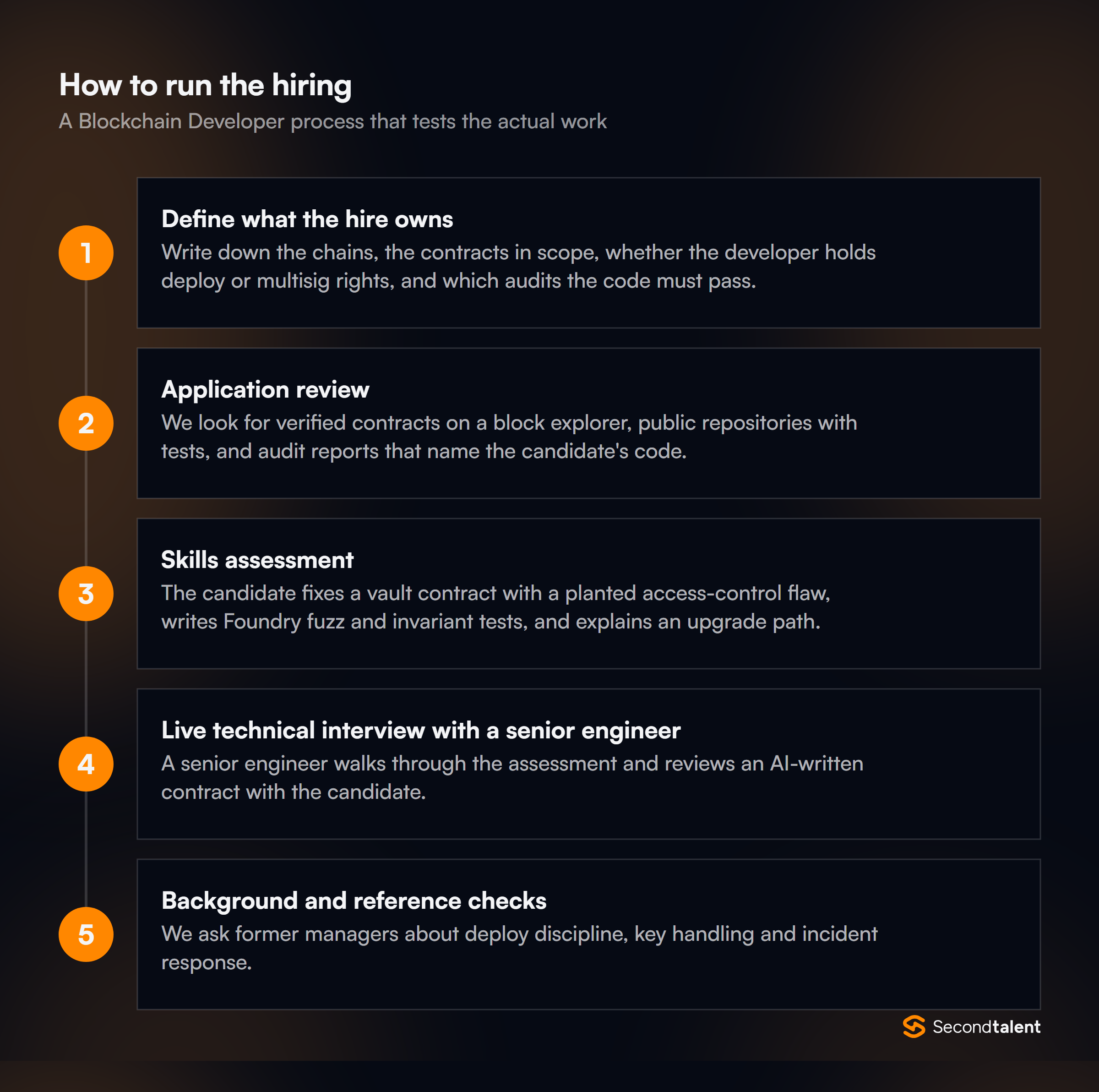
Second Talent's vetting covers stages 2 to 5 before you see a profile. For narrower searches, our Solidity developer page and Web3 developer page cover the adjacent roles.
Stage 1: Define what the hire owns
Write down the chains, the contracts in scope, whether the developer holds deploy or multisig rights, and which audits the code must pass. A DeFi protocol engineer and a wallet integration developer share the title and need different tests.
Stage 2: Application review
We look for verified contracts on a block explorer, public repositories with tests, and audit reports that name the candidate's code. We ask what went wrong after deployment and who fixed it.
Stage 3: Skills assessment
The candidate fixes a vault contract with a planted access-control flaw, writes Foundry fuzz and invariant tests, and explains an upgrade path. We score the design note as well as the code.
Stage 4: Live technical interview with a senior engineer
A senior engineer walks through the assessment and reviews an AI-written contract with the candidate. The engineer then asks how EIP-7702 delegation changes the threat model for the candidate's last wallet integration.
Stage 5: Background and reference checks
We ask former managers about deploy discipline, key handling and incident response. Before you grant access, follow the FBI's advice and confirm the developer's identity at onboarding, then sign with the IP assignment in place and grant on-chain roles last.
Hire Blockchain Developers from Asia with Second Talent
We shortlist 6-8 candidates within 24 hours from 100,000+ pre-vetted engineers, accepting only the top 1% of applicants. Blockchain developers come with $0 upfront, no lock-in and 4-6 hours of daily overlap with US hours. We handle contracts, payroll and equipment, with compliant EOR contracts and payroll in 9 Asian markets.
Our pricing page covers subscription, direct-hire and EOR pricing. Open Campus, the Web3 education protocol, hired 10 engineers in Vietnam within 2 months through us. The Open Campus case study reports a 70% increase in productivity.