TL;DR: Mobile app designers from Asia earn $1,280 to $6,500 a month working for foreign companies, and Second Talent shortlists 6-8 candidates within 24 hours. The BLS median for US web and digital interface designers was $104,000 a year in May 2025.
iOS ignores the key that keeps an app's pre-Liquid Glass look once a developer builds it for iOS 27, per Apple's documentation. Apps that target Android 16 can no longer opt out of edge-to-edge layouts. The mobile app designer you hire this year inherits both redesigns.
Key takeaways
- Google Play requires new apps and app updates to target Android 16 from 31 August 2026, with extensions available to 1 November 2026.
- Apple's default control size on iOS is 44x44 points, and Android's accessibility guide asks for touch targets of at least 48dp.
- In a Manila shift that overlaps three hours of a New York morning, two of the nine hours fall inside the Philippine night-work window.
- Figma files, icon sets and design tokens made by an independent contractor need a signed written assignment before your company owns them.
What Mobile App Designers Earn Working for International Clients in Asia
The Philippine range starts lowest, at $1,280 a month, while Indonesia's card reaches $6,500 with a fixed top. We publish no rate card for mobile app designers alone, so the table uses our UI/UX designer rate cards, the closest match. The figure is what designers in each market earn working directly for foreign companies, before any employer or platform costs.
| Market |
Monthly pay working for international clients (USD) |
| Philippines |
$1,280-$3,270+ |
| India |
$1,670-$6,480+ |
| Vietnam |
$1,800-$4,500 |
| Indonesia |
$1,800-$6,500 |
| Malaysia |
$2,000-$4,500 |
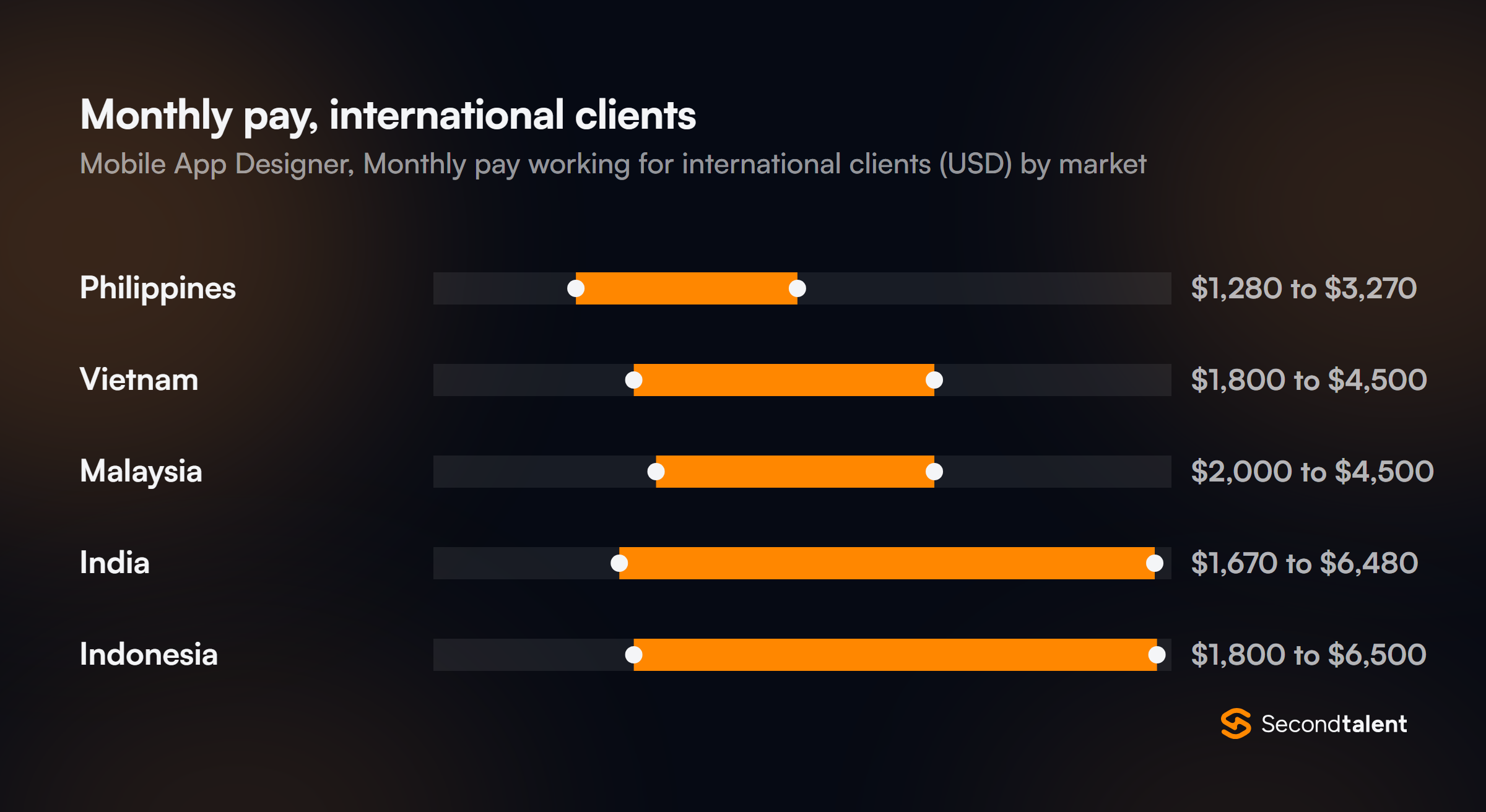
Monthly ranges from the Remote (Working for International Clients) figures on our rate cards for the Philippines, India, Vietnam, Indonesia and Malaysia, converted at ExchangeRate-API mid-market rates for 14 September 2026.
The Vietnam, Indonesia and Malaysia cards quote this figure in US dollars with a fixed ceiling. The Philippine and Indian cards quote pesos and rupees, open at the top, and India's range is the widest in the table, a gap of more than $4,800 between floor and ceiling.
Through Second Talent you pay one monthly fee that bundles salary, payroll taxes, statutory contributions and our service fee. Our pricing page explains how the subscription works.
US Pay Benchmark for Mobile App Designers
BLS has no mobile app designer occupation. The role maps to Web and Digital Interface Designers (SOC 15-1255), because BLS defines that occupation as designing digital user interfaces and testing layouts, functionality and navigation "across browsers or devices".
| BLS OEWS, May 2025, national |
Web and Digital Interface Designers (15-1255) |
| Employment |
113,330 |
| Median annual |
$104,000 |
| 10th percentile, monthly |
$4,480 |
| 25th percentile, monthly |
$6,110 |
| Median, monthly |
$8,670 |
| 75th percentile, monthly |
$13,240 |
| 90th percentile, monthly |
$16,800 |
Monthly figures are the annual wages on the OEWS profile for 15-1255 divided by 12, rounded to the nearest $10. The same profile puts 27,090 of these jobs in California and 16,560 in New York.
The spread is wide: the 90th percentile pays more than three times the 10th. A designer who owns a design system and runs usability research sits near the top; a designer who produces screens from someone else's wireframes sits near the bottom. BLS excludes graphic designers (27-1024) from this occupation, so benchmark a pure visual or icon designer elsewhere.
Salary is only part of the US cost. In the BLS Employer Costs for Employee Compensation release for June 2026, wages and salaries made up 68.5% of employer compensation costs for full-time private industry workers, and benefits the other 31.5%.
For short engagements, our UI/UX designer cost-to-hire page puts a mid-level US freelance or contract designer at $65 to $100 an hour, before payroll, insurance and leave.
Time Zone Overlap with ET, CT and PT
Design work needs fewer live hours than engineering work, but critiques and handoff meetings still need a shared window. Asian cities keep one offset all year, and US daylight time runs from 8 March to 1 November 2026, per NIST.
| Engineer's city |
UTC offset |
9:00 am ET (EDT) |
9:00 am CT (CDT) |
9:00 am PT (PDT) |
| Manila, Singapore, Kuala Lumpur, Taipei |
UTC+8 |
9:00 pm |
10:00 pm |
12:00 midnight |
| Ho Chi Minh City, Jakarta, Bangkok |
UTC+7 |
8:00 pm |
9:00 pm |
11:00 pm |
| Bengaluru |
UTC+5:30 |
6:30 pm |
7:30 pm |
9:30 pm |
After 1 November 2026, every time in the table moves one hour later.
A worked example: a Manila designer on a 3:00 pm to midnight shift works 07:00 to 16:00 UTC. That is 3:00 am to noon EDT, so three hours overlap a New York day and two a Chicago day. San Francisco gets none, because the shift ends at 9:00 am PDT.
For a West Coast product team, run the design cycle across the time gap.
The designer posts prototypes and a recorded walk-through at the end of the Asian day, your product manager comments during the US day, and the designer revises overnight US time. Keep one live critique a week inside the shared hours. We set the schedule before the offer, which is how our placements get 4-6 hours of daily overlap with US hours.
Late shifts cost more for employees. The Philippine Labor Code sets a night shift differential of at least 10% for work between 10 pm and 6 am (Article 86), which covers two hours of the Manila shift above. Vietnam's Labor Code adds at least 30% for work between 22:00 and 06:00 (Articles 98 and 106).
Mobile App Designer Skills to Screen For
Apple announced Liquid Glass on 9 June 2025 as a new material across iOS 26, iPadOS 26, macOS Tahoe 26, watchOS 26 and tvOS 26, per its newsroom release. A portfolio built only on flat iOS 18 screens is a year behind the platform.
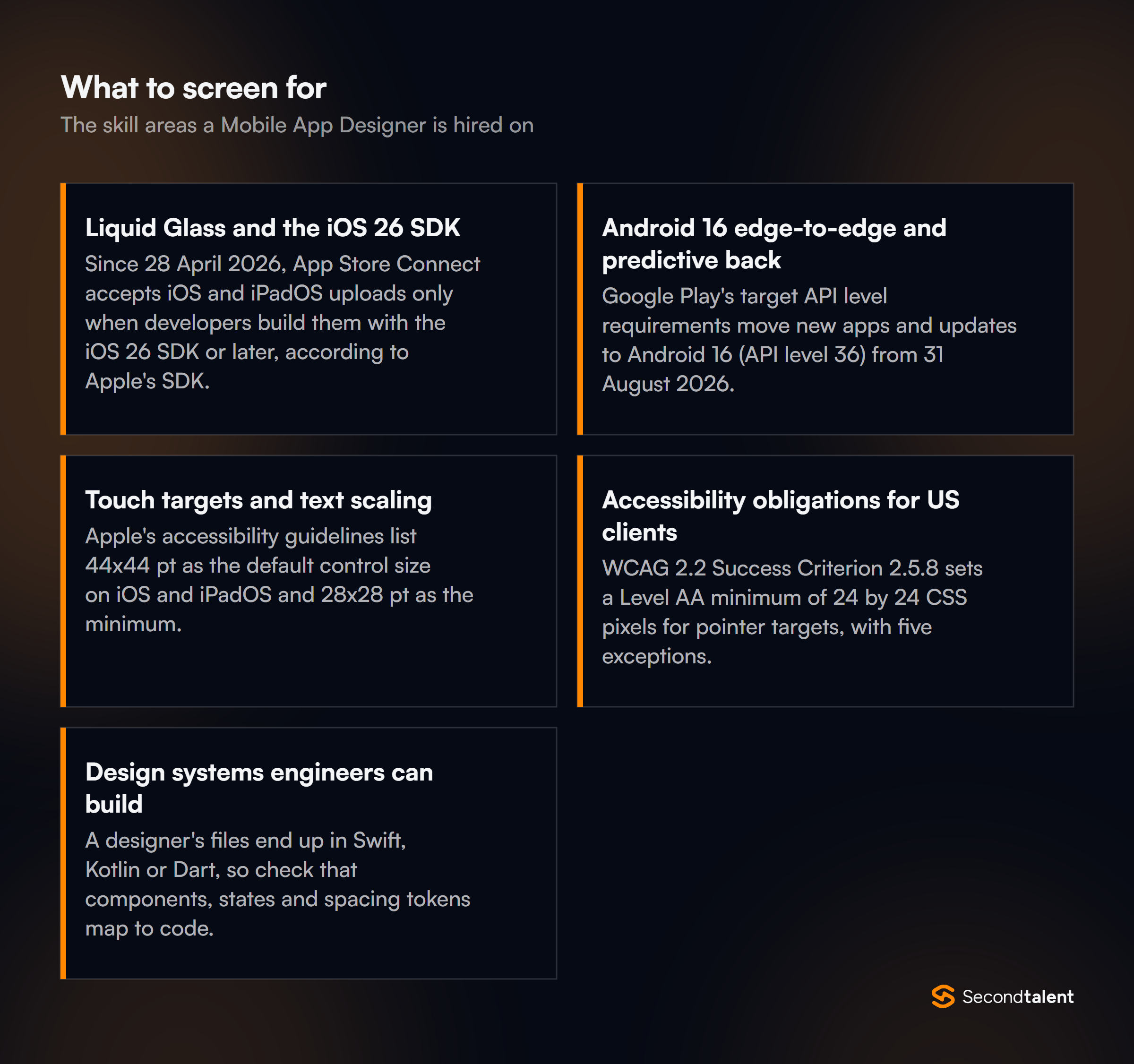
Liquid Glass and the iOS 26 SDK
Since 28 April 2026, App Store Connect accepts iOS and iPadOS uploads only when developers build them with the iOS 26 SDK or later, according to Apple's SDK requirements notice. Apple's documentation for UIDesignRequiresCompatibility describes that key, which keeps the older design, as a temporary measure while teams refine their UI. Ask the candidate to redesign one of your tab bars or toolbars for the new material and explain what happens to legibility over busy content.
Android 16 edge-to-edge and predictive back
Google Play's target API level requirements move new apps and updates to Android 16 (API level 36) from 31 August 2026. For those apps, the Android 16 behavior changes disable the edge-to-edge opt-out and turn predictive back animations on by default. Give the candidate a screen with a bottom sheet and a floating button, and check whether their mockup accounts for the status bar, the gesture area and the back preview.
Touch targets and text scaling
Apple's accessibility guidelines list 44x44 pt as the default control size on iOS and iPadOS and 28x28 pt as the minimum. They also ask designers to let users enlarge text by at least 200 percent. Android's accessibility guide sets touch targets at 48dp by 48dp and a 4.5:1 contrast ratio for text smaller than 18sp. Hand finalists a dense settings screen and ask them to rebuild it at the largest Dynamic Type size.
Accessibility obligations for US clients
WCAG 2.2 Success Criterion 2.5.8 sets a Level AA minimum of 24 by 24 CSS pixels for pointer targets, with five exceptions. If your app serves state or local governments, the Justice Department's ADA Title II rule makes WCAG 2.1 Level AA the standard for their mobile apps. Its fact sheet now sets compliance for entities of 50,000 or more at 26 April 2027. Ask candidates which criteria they check before handoff and how they document them.
Design systems engineers can build
A designer's files end up in Swift, Kotlin or Dart, so check that components, states and spacing tokens map to code. Ask for one component the candidate specified, with its empty, loading, error and disabled states, and have one of your engineers review it. For the build side we staff iOS developers, Android developers and Flutter developers.
Contractor or Employer of Record for a US Company
Software is not one of the nine categories of commissioned work that can be "work made for hire" under 17 U.S.C. § 101, and a copyright transfer must be in writing and signed under § 204(a). Name the Figma files, component libraries, icon sets, illustrations and prototypes in the assignment, and keep the files in your company's workspace from day one.
IRS Publication 515 says the place where services are performed determines the source of the income, so a designer working from Manila or Hanoi earns foreign-source income. A foreign individual gives the payer Form W-8BEN to certify foreign status.
Local law applies its own test for employment. Philippine courts use the four-fold test, and in Atok Big Wedge v. Gison the Supreme Court called the power of control the most important of the four. In Vietnam, Article 13 of the 2019 Labor Code treats an agreement under another name as a labor contract when it covers a paid job, wages and one party's management and supervision.
A one-off app redesign with a fixed scope suits a contractor agreement. A designer who joins your sprint rituals, works your hours and takes direction from your product lead fits the employment tests above, which is the case an Employer of Record covers. Our EOR, PEO and contractor comparison sets out the trade-offs. This is a summary, not legal advice.
|
Independent contractor |
Employer of Record |
| Legal employer |
None; the designer invoices you |
The EOR's local entity |
| US paperwork |
Form W-8BEN from the designer |
Service agreement with the EOR |
| IP |
Written assignment naming design files, libraries and assets |
Assignment in the employment contract and your EOR agreement |
| Local labor law |
Classification risk if you set hours and review methods |
Night premiums, public holidays and leave apply |
| Pay currency |
Agreed in the contract, often USD |
Local currency; Vietnam's Labor Code states wages in dong (Article 95) |
English Level and Working Norms
Filipino adults score 603 for writing on the EF English Proficiency Index 2025, and a mobile designer writes more than most expect: button labels, error messages, onboarding copy and the rationale attached to each design review. The index covers 123 countries and regions, with a global average of 488.
| Country |
EF EPI 2025 score |
World rank (of 123) |
IT job-function score |
| Malaysia |
581 |
24 |
590 |
| Philippines |
569 |
28 |
581 |
| Vietnam |
500 |
64 |
500 |
| India |
484 |
74 |
487 |
| Indonesia |
471 |
80 |
523 |
Scores come from EF's country pages, such as the Philippines and Indonesia. Ask each finalist to present one case study live for ten minutes, then write the microcopy for an empty state in your app. The first tests how they defend a decision to a US stakeholder; the second tests the words your users will read.
Plan release reviews around both calendars. Thanksgiving on 26 November 2026 is a working day in Asia, so a designer there can finish holiday-sale screens while your US team is off. Article 112 of Vietnam's Labor Code gives five paid days for Lunar New Year, so lock design sign-off for a February release before that week.
Mobile App Designer Hiring Process
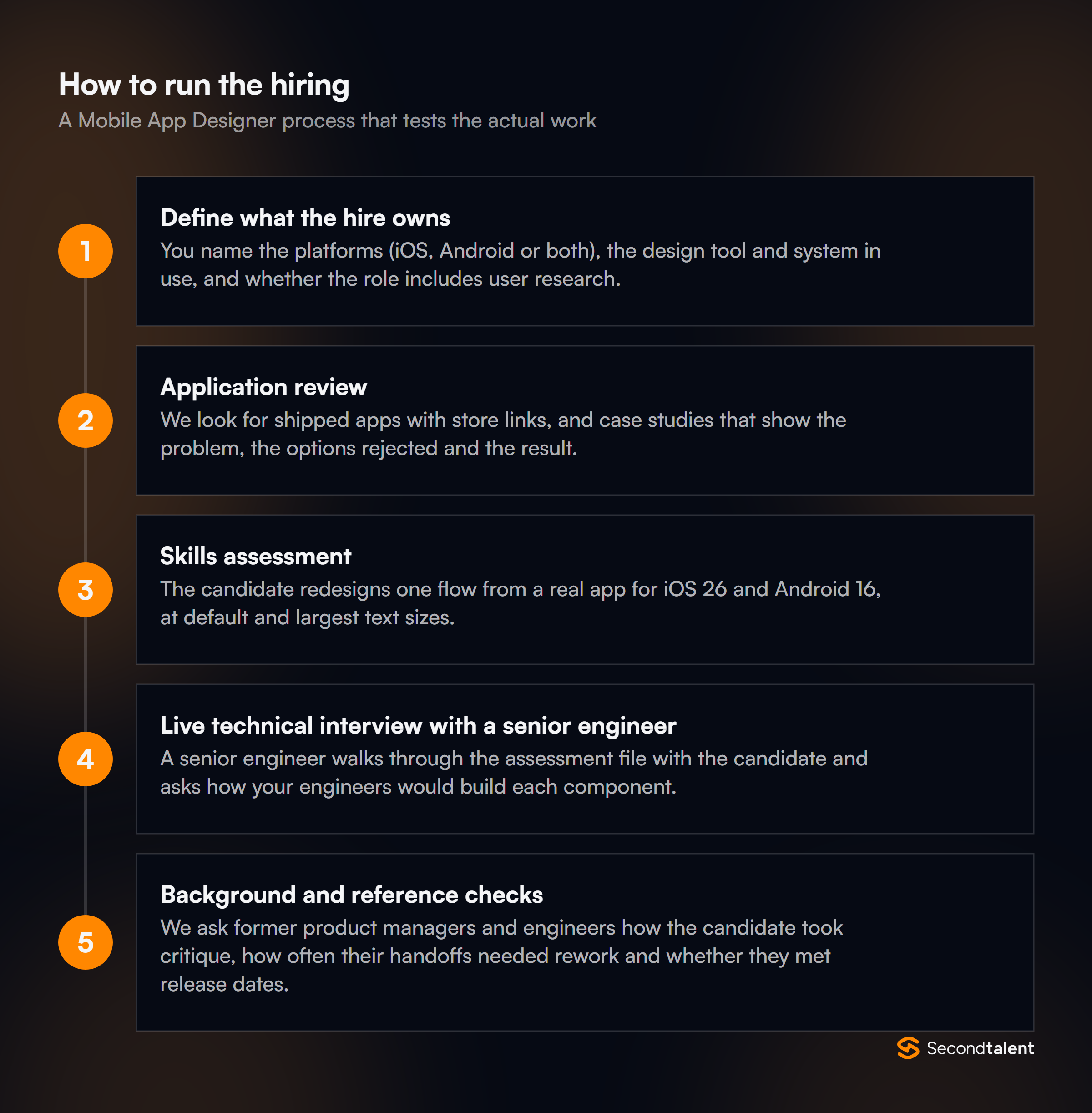
Second Talent's vetting covers stages 2 to 5 before you see a profile.
Stage 1: Define what the hire owns
You name the platforms (iOS, Android or both), the design tool and system in use, and whether the role includes user research. State who signs off on designs and the overlap window that person needs.
Stage 2: Application review
We look for shipped apps with store links, and case studies that show the problem, the options rejected and the result. A Dribbble shot of a screen with no app behind it does not pass.
Stage 3: Skills assessment
The candidate redesigns one flow from a real app for iOS 26 and Android 16, at default and largest text sizes. We score touch targets, contrast, states and how the candidate organizes the file for an engineer.
Stage 4: Live technical interview with a senior engineer
A senior engineer walks through the assessment file with the candidate and asks how your engineers would build each component. The candidate explains which platform conventions they followed, which they broke and why.
Stage 5: Background and reference checks
We ask former product managers and engineers how the candidate took critique, how often their handoffs needed rework and whether they met release dates. You then choose the contractor or EOR route above.
Hire Mobile App Designers from Asia with Second Talent
We shortlist 6-8 candidates within 24 hours from 100,000+ pre-vetted engineers, accepting only the top 1% of applicants. Mobile app designers come with $0 upfront, no lock-in and 4-6 hours of daily overlap with US hours. We handle contracts, payroll and equipment, with compliant EOR contracts and payroll in 9 Asian markets.
Our pricing page sets out subscription, direct-hire and EOR pricing, and our mobile app developer page covers the engineers who build what your designer specifies. SatLayer, a Web3 security layer, hired frontend engineers and product designers from Taiwan through us, and its case study reports 20% team expansion in two months.