TL;DR: Engineers from Asia who train and fine-tune machine learning models earn from $2,200 a month working for foreign companies, and Second Talent shortlists candidates within 24 hours. The median US data scientist earns $120,230 a year, on BLS data for May 2025.
In OpenAI's InstructGPT study, human raters preferred the answers of a 1.3 billion parameter model fine-tuned on human feedback over those of the 175 billion parameter GPT-3. A model training specialist decides what goes into that data, how the model learns from it and how you find out whether it worked.
Key takeaways
- On our machine learning engineer rate cards, Malaysia's open-topped range runs past $11,300 a month, almost double the $6,000 ceiling in the Philippines.
- LoRA cut trainable parameters 10,000 times and GPU memory three times against full fine-tuning of GPT-3, and QLoRA later fine-tuned a 65 billion parameter model on one GPU.
- OWASP lists data and model poisoning at pre-training, fine-tuning and embedding stages among its 2025 LLM risks, so ask where each training file came from.
- Checkpoints, datasets and evaluation sets a contractor produces need a signed written assignment, the same as code.
What AI Model Training Specialists Earn Working for International Clients in Asia
Malaysia sits at the top of this table, with a range running from $3,930 to $11,300 and beyond, while Indonesia opens lowest at $2,200. We publish no card for model training specialists as such, so the figures come from our machine learning engineer rate cards, the closest match for engineers who build, train and evaluate models.
| Market |
Monthly pay working for international clients (USD) |
| Indonesia |
$2,200-$8,500 |
| India |
$2,410-$9,410+ |
| Philippines |
$2,500-$6,000 |
| Vietnam |
$2,500-$7,000 |
| Malaysia |
$3,930-$11,300+ |
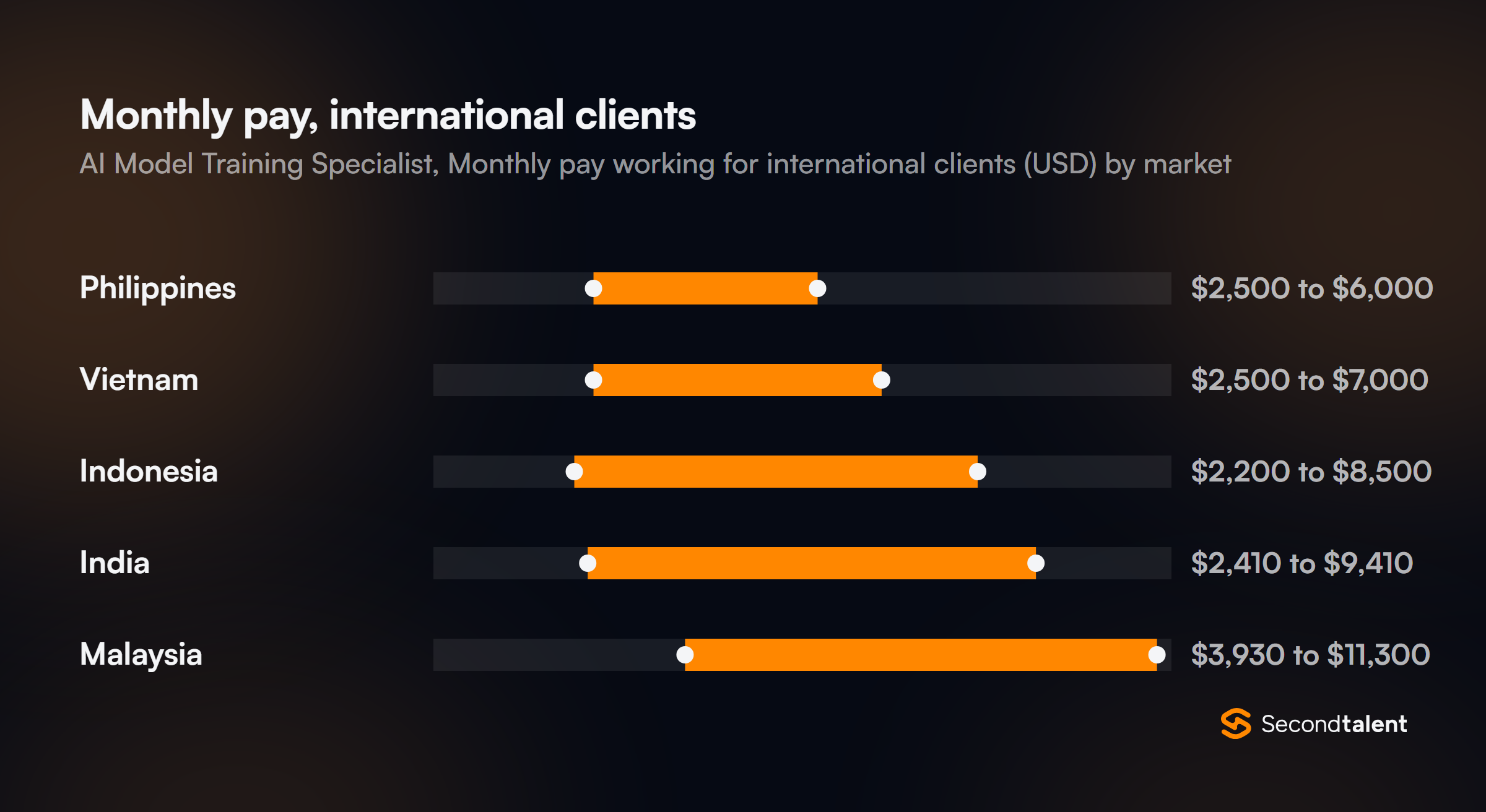
Monthly ranges from the Remote (Working for International Clients) figures on our rate cards for Indonesia, India, Philippines, Vietnam and Malaysia, converted at ExchangeRate-API mid-market rates for 14 September 2026. The Indonesian, Philippine and Vietnamese cards publish US dollars; the Indian card uses rupees (₹95.61 to the dollar) and the Malaysian card ringgit (RM4.07).
Each range is what machine learning engineers in that market earn working directly for foreign companies, before any employer or platform costs. Second Talent charges one monthly fee that bundles salary, payroll taxes, statutory contributions and our service fee; the pricing page sets out the pricing models.
US Pay Benchmark for AI Model Training Specialists
The bottom tenth of US data scientists earn $5,600 a month or less, a figure inside all five ranges in the table above. Model training maps to Data Scientists (15-2051), because the federal definition of that occupation names machine learning applied to large datasets; Computer and Information Research Scientists (15-1221) is the closer match for research-grade work on new architectures.
| BLS OEWS, May 2025, national |
Data Scientists (15-2051) |
Computer and Information Research Scientists (15-1221) |
| Median annual |
$120,230 |
$140,300 |
| 10th percentile, monthly |
$5,600 |
$6,850 |
| Median, monthly |
$10,020 |
$11,690 |
| 90th percentile, monthly |
$16,590 |
$19,220 |
Monthly figures are the annual wages on the BLS occupation profiles for 15-2051 and 15-1221 divided by 12, rounded to the nearest $10.
Salary is only part of the US cost. In the BLS Employer Costs for Employee Compensation release for June 2026, wages and salaries made up 68.5% of employer compensation costs for full-time private industry workers, and benefits the other 31.5%.
Time Zone Overlap with ET, CT and PT
A training run can use the hours when your US team is offline. If an engineer in Jakarta launches a 10-hour fine-tune at 5:00 pm local time, it is 6:00 am in New York, and the run finishes at 4:00 pm New York time, early enough for your US team to read the evaluation that day.
| Engineer's city |
UTC offset |
9:00 am ET (EDT) |
9:00 am CT (CDT) |
9:00 am PT (PDT) |
| Manila, Singapore, Kuala Lumpur, Taipei |
UTC+8 |
9:00 pm |
10:00 pm |
12:00 midnight |
| Ho Chi Minh City, Jakarta, Bangkok |
UTC+7 |
8:00 pm |
9:00 pm |
11:00 pm |
| Bengaluru |
UTC+5:30 |
6:30 pm |
7:30 pm |
9:30 pm |
After 1 November 2026, every time in the table moves one hour later.
The Jakarta example in numbers: 5:00 pm in Jakarta (UTC+7) is 10:00 UTC, which is 6:00 am EDT, and ten hours later it is 4:00 pm in New York. US daylight time runs from 8 March to 1 November 2026 (NIST); no market in the rate table changes its clocks.
Three schedules that give live overlap in September, against a 9-to-5 US day:
- Jakarta, 4:00 pm to 1:00 am (09:00 to 18:00 UTC) covers 5:00 am to 2:00 pm ET: five hours with New York, four with Chicago, two with San Francisco.
- Manila, 4:00 pm to 1:00 am (08:00 to 17:00 UTC) covers 4:00 am to 1:00 pm ET: four hours with New York, three with Chicago.
- Bengaluru, 1:30 pm to 10:30 pm (08:00 to 17:00 UTC) covers 4:00 am to 1:00 pm ET, four hours with New York.
The last three hours of the Manila schedule fall between 10 pm and 6 am, so an employee earns at least 10% more for them under Article 86 of the Philippine Labor Code. In Vietnam the equivalent premium is at least 30% for 22:00 to 06:00.
AI Model Training Specialist Skills to Screen For
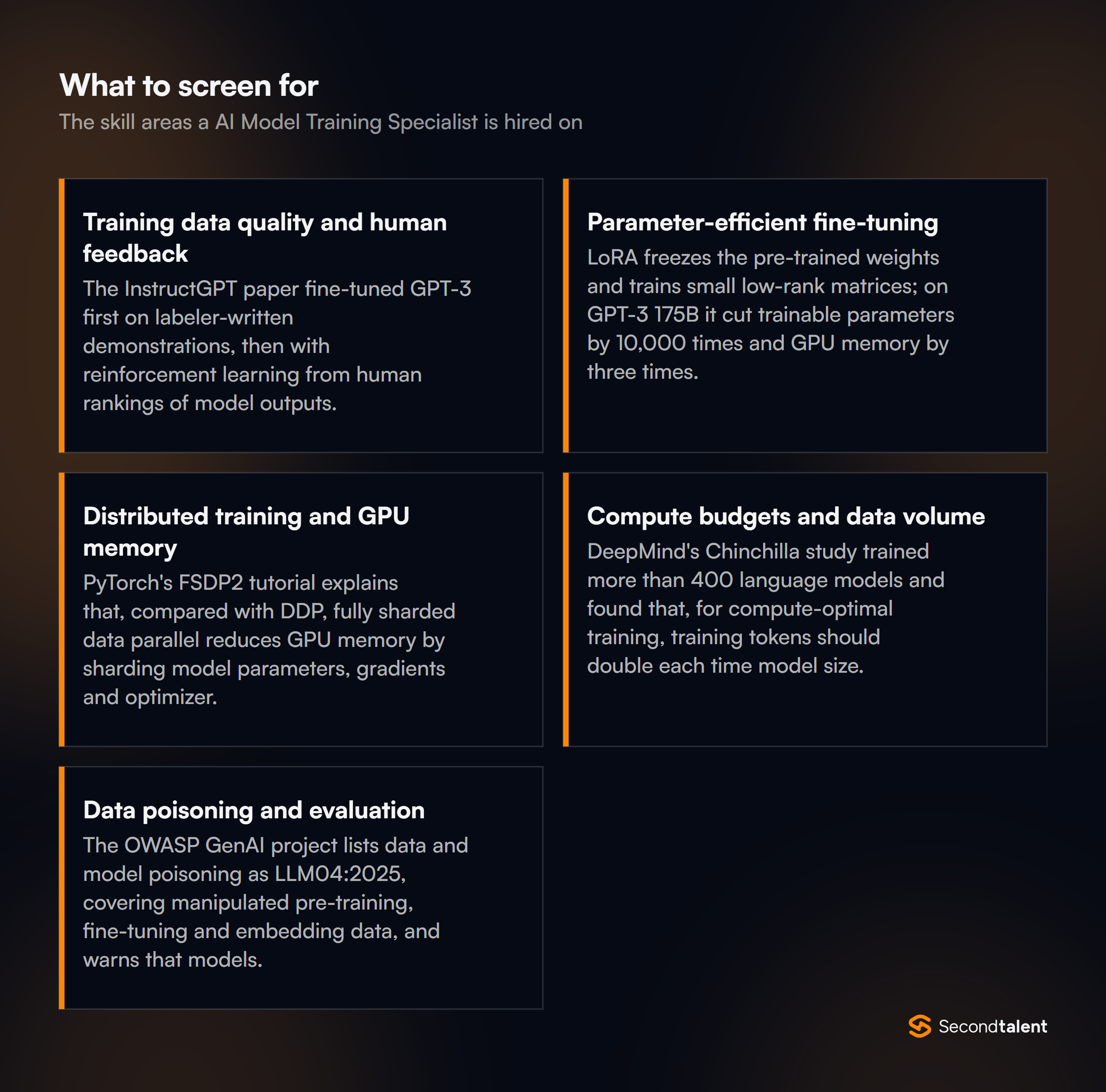
Framework syntax takes minutes to check. Spend the interview time on decisions about data, compute and evaluation, which determine whether a trained model ships.
Training data quality and human feedback
The InstructGPT paper fine-tuned GPT-3 first on labeler-written demonstrations, then with reinforcement learning from human rankings of model outputs. Raters preferred the 1.3 billion parameter result to the 175 billion parameter base model, despite 100 times fewer parameters. Give the candidate 200 labeled examples with 15 planted label errors and ask how they would find them before training.
Parameter-efficient fine-tuning
LoRA freezes the pre-trained weights and trains small low-rank matrices; on GPT-3 175B it cut trainable parameters by 10,000 times and GPU memory by three times while matching full fine-tuning quality. QLoRA added 4-bit quantization and fine-tuned a 65 billion parameter model on a single 48GB GPU. Ask which rank and target modules the candidate would pick for your model and what they would watch to tell whether the adapter is underfitting.
Distributed training and GPU memory
PyTorch's FSDP2 tutorial explains that, compared with DDP, fully sharded data parallel reduces GPU memory by sharding model parameters, gradients and optimizer states, so a model too big for one GPU can still train. Ask the candidate to estimate the memory for your model at bf16 with Adam, then explain where FSDP, activation checkpointing or a smaller batch fits.
Compute budgets and data volume
DeepMind's Chinchilla study trained more than 400 language models and found that, for compute-optimal training, training tokens should double each time model size doubles.
Chinchilla, at 70 billion parameters and four times the data, beat the 280 billion parameter Gopher on the same compute. A specialist who knows this asks how much clean data you have before recommending a model size.
Data poisoning and evaluation
The OWASP GenAI project lists data and model poisoning as LLM04:2025, covering manipulated pre-training, fine-tuning and embedding data, and warns that models pulled from shared repositories can carry malicious pickled code. Ask how the candidate loads third-party checkpoints, how they keep test examples out of the training set, and which metric would have caught a regression your last release missed.
Contractor or Employer of Record for a US Company
Software is not one of the nine categories of commissioned work that can be "work made for hire" under 17 U.S.C. § 101, and § 204(a) makes a transfer of copyright valid only in writing and signed. For a training contractor, write the assignment to name code, datasets, labeling guidelines, checkpoints and evaluation sets, so the assignment covers what the engagement produces.
Keep compute in your name as well. Run training on cloud accounts and storage buckets your company owns, so the checkpoints and experiment logs stay with you when the engagement ends.
IRS Publication 515 treats the place where the specialist does the work as the source of the income, so a specialist training models from Manila earns foreign-source income, and a foreign individual gives the payer Form W-8BEN to certify foreign status.
The Philippines applies a four-fold test for employment, set out by the Supreme Court in Atok Big Wedge v. Gison: selection and engagement, payment of wages, the power of dismissal and the power of control, which the court calls "the most important". A specialist who works your hours on your roadmap meets the control element.
Philippine employees also receive 13th-month pay under PD 851 and Memorandum Order 28, with contributions to SSS (15% shared, credit cap ₱35,000), PhilHealth (5%, cap at ₱100,000) and Pag-IBIG (2% each side, ₱10,000 cap).
|
Independent contractor |
Employer of Record (EOR) |
| Legal employer |
None; the specialist invoices you |
The EOR's local entity |
| US paperwork |
Form W-8BEN from the specialist |
Service agreement with the EOR |
| IP |
Written assignment signed by the specialist, naming datasets and checkpoints |
Assignment terms in the employment contract and your EOR agreement |
| Local labor law |
Classification risk if the work looks like employment |
Night premiums, 13th-month pay and leave apply |
| Pay currency |
Agreed in the contract |
Set in the employment contract and paid through the EOR's local payroll |
A one-off fine-tune with a fixed evaluation target suits a contractor. A specialist who retrains your models each quarter suits employment through our EOR service, with market detail on the Indonesia EOR page and the Philippines EOR page. This is a summary, not legal advice.
English Level and Working Norms
India scores 484 on the EF English Proficiency Index 2025, four points under the global average of 488, while Malaysia's IT workers reach 590. A model training specialist's English shows up in labeling guidelines and experiment write-ups, which your US team reads without the author in the room.
| Country |
EF EPI 2025 score |
World rank (of 123) |
IT job-function score |
| Malaysia |
581 |
24 |
590 |
| Philippines |
569 |
28 |
581 |
| Vietnam |
500 |
64 |
500 |
| India |
484 |
74 |
487 |
| Indonesia |
471 |
80 |
523 |
The figures come from EF's country pages, including India, Indonesia and Vietnam.
Ask for a one-page experiment report during the assessment: the hypothesis, the data used, the result and what the candidate would try next. Labeling guidelines matter more still if annotators work from them, since vague instructions become noisy labels.
Plan around both calendars. Vietnam's Labor Code gives five paid days off for Lunar New Year, in late January or February, so avoid scheduling a retraining deadline that week. Thanksgiving, 26 November 2026, is a working day across Asia, useful for long runs that finish while your US team is away.
AI Model Training Specialist Hiring Process
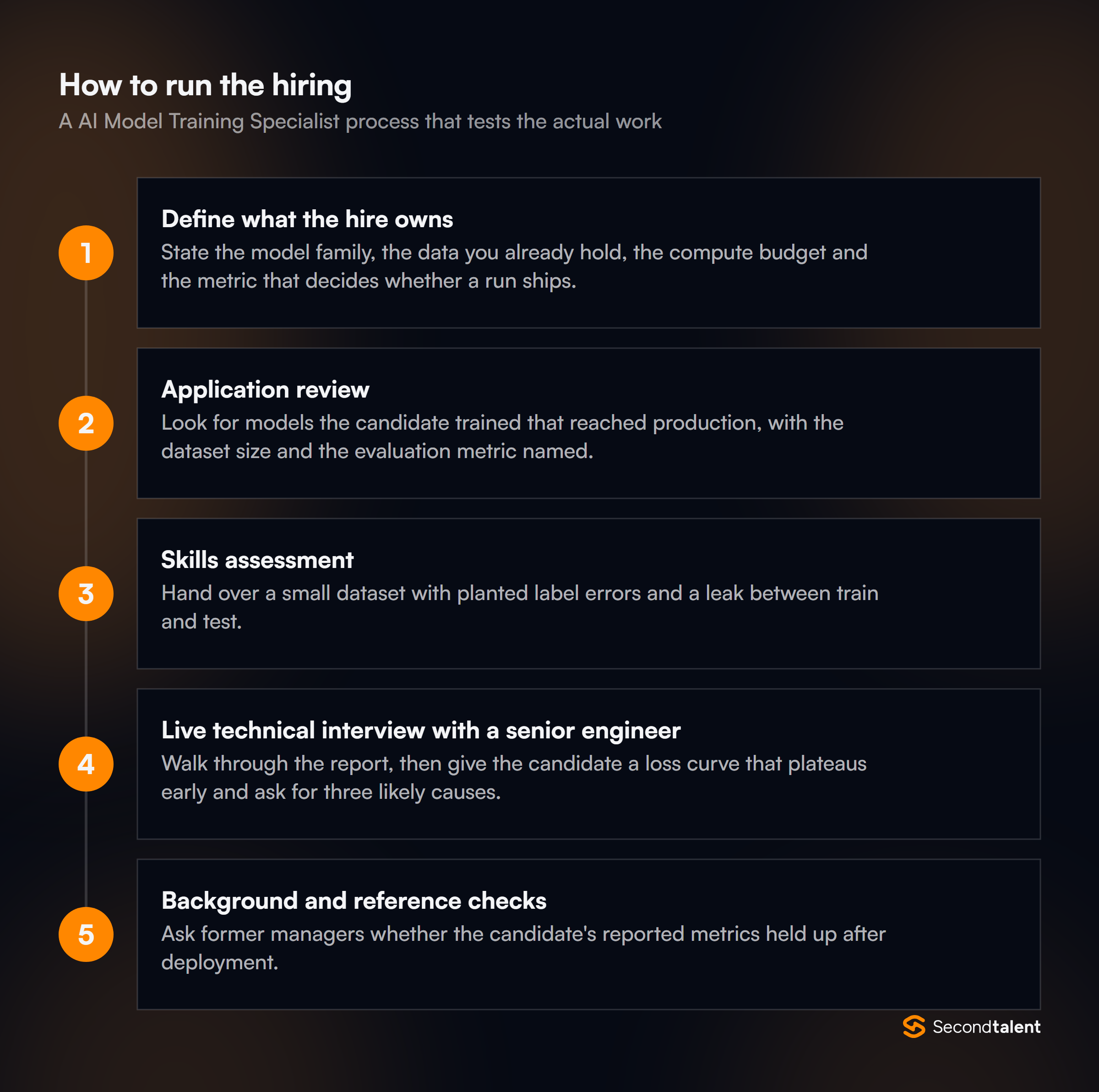
Second Talent's vetting covers stages 2 to 5 before you see a profile. The training-specific tests below belong in your own final round; our machine learning engineer interview guide has question sets for stage 4.
Stage 1: Define what the hire owns
State the model family, the data you already hold, the compute budget and the metric that decides whether a run ships. A specialist fine-tuning an open-weight language model and one training a vision model from scratch need different tests.
Stage 2: Application review
Look for models the candidate trained that reached production, with the dataset size and the evaluation metric named. Ask what the data looked like before cleaning and who labeled it.
Stage 3: Skills assessment
Hand over a small dataset with planted label errors and a leak between train and test. Ask for a LoRA fine-tune, an evaluation report and a note on what they fixed in the data first.
Stage 4: Live technical interview with a senior engineer
Walk through the report, then give the candidate a loss curve that plateaus early and ask for three likely causes. Finish with a GPU memory estimate for your production model.
Stage 5: Background and reference checks
Ask former managers whether the candidate's reported metrics held up after deployment. Then sign the contract with an assignment that names datasets and checkpoints, and grant access to your cloud account.
Related roles: machine learning engineers, PyTorch developers and data annotation specialists.
Hire AI Model Training Specialists from Asia with Second Talent
We shortlist 6-8 candidates within 24 hours from 100,000+ pre-vetted engineers, accepting only the top 1% of applicants. AI model training specialists come with $0 upfront, no lock-in and 4-6 hours of daily overlap with US hours. We handle contracts, payroll and equipment, with compliant EOR contracts and payroll in 9 Asian markets.
Our pricing page sets out subscription, direct-hire and EOR pricing. The Maneva case study covers six hires for the industrial AI company, including an AI software engineer and four data annotators, with the AI engineering brief filled in 27 days.