TL;DR: Move developers from Asia earn $2,000 to $9,000 a month working for foreign companies, and Second Talent shortlists 6-8 candidates within 24 hours. The BLS median for US software developers was $135,980 a year in May 2025.
On 22 May 2025, an attacker drained about $223 million from Cetus, a decentralized exchange on Sui written in Move. The flaw sat in a custom overflow check, and Move's left shift drops bits without aborting. Screen a Move developer's arithmetic with the same care as their grasp of the type system.
Key takeaways
- About $162 million of the Cetus funds stayed frozen on Sui after validators blocked the attacker's addresses, and about $60 million crossed to Ethereum.
- Move on Sui drops Diem-style global storage, so Aptos code built on
move_to and borrow_global needs a redesign before it runs on Sui.
- Sui's documentation calls Diem the original use case for Move, and the Diem Association sold its assets to Silvergate on 31 January 2022.
- Aptos added signed integer types,
i8 to i256, in Move 2.3.
What Move Developers Earn Working for International Clients in Asia
Malaysia tops the table at $9,000 a month, and Indonesia has the lowest floor at $2,000. We publish no Move-only rate card, so the table uses our blockchain developer rate cards, the closest match. The figure is what developers in each market earn working directly for foreign companies, before any employer or platform costs.
| Market |
Monthly pay working for international clients (USD) |
| Indonesia |
$2,000-$8,000 |
| Philippines |
$2,200-$6,500 |
| Vietnam |
$2,200-$8,500 |
| Thailand |
$2,500-$8,500 |
| Malaysia |
$3,500-$9,000 |
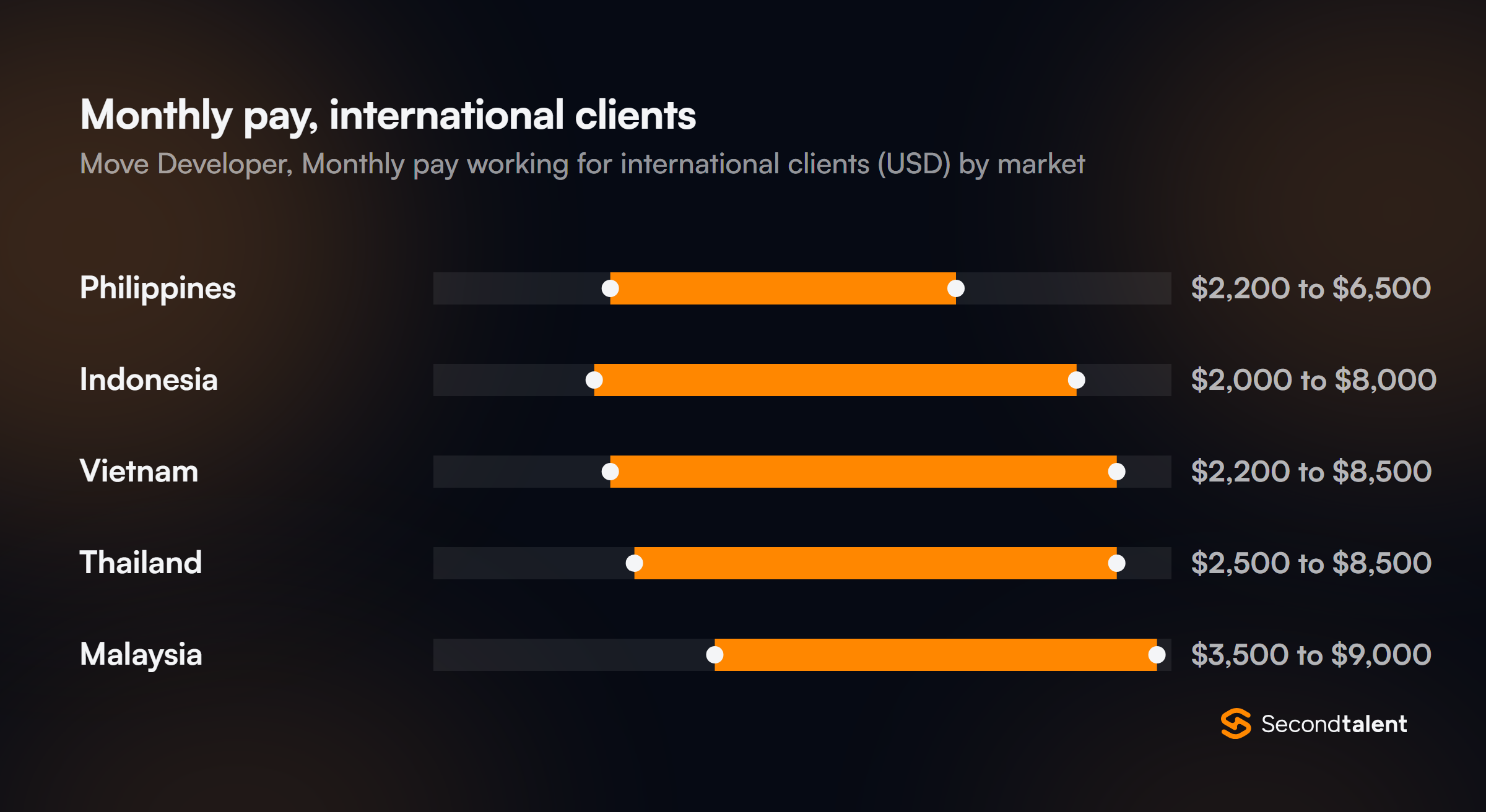
Monthly ranges from the Remote (Working for International Clients) figures on our rate cards for Indonesia, the Philippines, Vietnam, Thailand and Malaysia, converted at ExchangeRate-API mid-market rates for 14 September 2026.
All five cards quote this figure in US dollars with a fixed ceiling, so no row needed conversion. The Philippine ceiling sits $2,000 below Vietnam's, although both start at $2,200.
Through Second Talent you pay one monthly fee that bundles salary, payroll taxes, statutory contributions and our service fee; our pricing page explains the subscription.
US Pay Benchmark for Move Developers
BLS publishes no blockchain or smart contract occupation. The role maps to Software Developers (SOC 15-1252), because a Move developer designs, writes and tests the modules that run on a production network.
| BLS OEWS, May 2025, national |
Software Developers (15-1252) |
| Median annual |
$135,980 |
| 10th percentile, monthly |
$6,870 |
| 25th percentile, monthly |
$8,770 |
| Median, monthly |
$11,330 |
| 75th percentile, monthly |
$14,330 |
| 90th percentile, monthly |
$17,890 |
Monthly figures are the annual wages on the OEWS profile for 15-1252 divided by 12, rounded to the nearest $10.
For a Move hire who also writes formal specifications and reviews security, compare against the 75th and 90th percentile rows. Our Rust developer page covers the language whose ownership rules Move developers most often come from.
Salary is only part of the US cost. In the BLS Employer Costs for Employee Compensation release for June 2026, wages and salaries made up 68.5% of employer compensation costs for full-time private industry workers, and benefits the other 31.5%.
Time Zone Overlap with ET, CT and PT
Blockchains run through the US night, and exploits do too. A Move team in Asia can watch contracts while your US engineers sleep and still join the US morning. US daylight time runs until 1 November 2026, per NIST, and none of the cities below changes its clocks.
| Engineer's city |
UTC offset |
9:00 am ET (EDT) |
9:00 am CT (CDT) |
9:00 am PT (PDT) |
| Manila, Singapore, Kuala Lumpur, Taipei |
UTC+8 |
9:00 pm |
10:00 pm |
12:00 midnight |
| Ho Chi Minh City, Jakarta, Bangkok |
UTC+7 |
8:00 pm |
9:00 pm |
11:00 pm |
| Bengaluru |
UTC+5:30 |
6:30 pm |
7:30 pm |
9:30 pm |
After 1 November 2026, every time in the table moves one hour later.
A worked example: a Ho Chi Minh City developer on a 3:00 pm to midnight shift works 08:00 to 17:00 UTC. Subtract four hours and that is 4:00 am to 1:00 pm EDT, which overlaps four hours of a New York day, three in Chicago and one in San Francisco.
Split the work along that line. Code review, audit calls and upgrade planning go in the shared hours; test runs, Prover checks and on-chain monitoring fill the rest. We set the schedule before the offer, which is how our placements get 4-6 hours of daily overlap with US hours.
The last two hours of that shift fall inside Vietnam's night window. The Labor Code adds at least 30% for employees working between 22:00 and 06:00 (Articles 98 and 106). In the Philippines the night shift differential is at least 10% for work between 10 pm and 6 am (Article 86).
Move Developer Skills to Screen For
Move runs in production on two networks, Aptos and Sui, and Sui's mainnet opened to public use on 3 May 2023, per the Sui Foundation's 2023 milestones. The two dialects share syntax and diverge on storage, so start by asking which chain the candidate has shipped on.
Sui objects or Aptos global storage
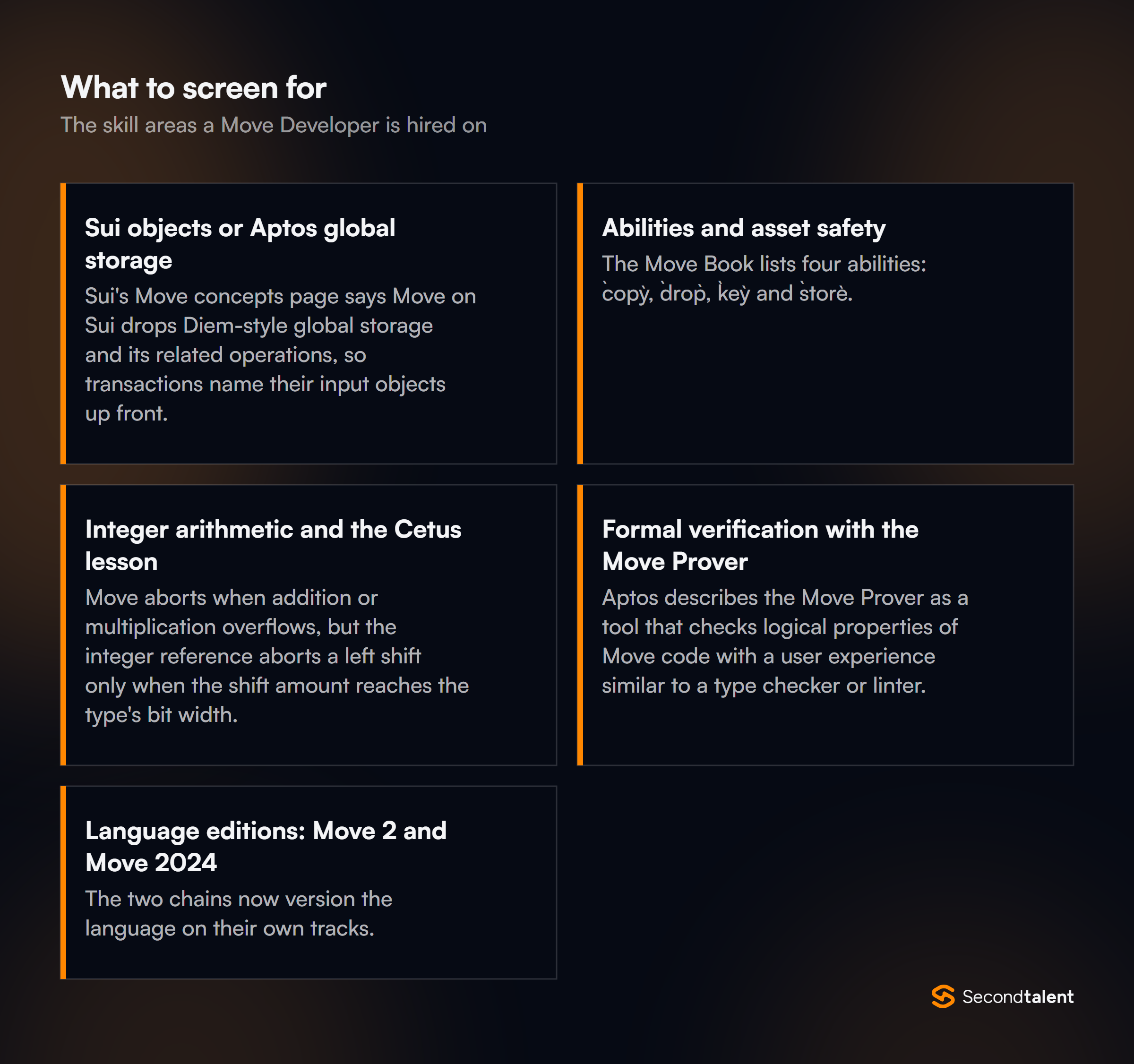
Sui's Move concepts page says Move on Sui drops Diem-style global storage and its related operations, so transactions name their input objects up front. On Sui, key marks a struct as an object type whose first field is id: UID. The Move on Aptos book keeps five global storage operators, from move_to to exists, and each address can hold at most one resource of a given type. Give an Aptos developer a Sui task, or the reverse, and watch how they restructure ownership.
Abilities and asset safety
The Move Book lists four abilities: copy, drop, key and store. Grant a coin type copy and code can duplicate it; grant it drop and code can discard it. Ask the candidate to write a token struct, justify each ability they grant, and show the compiler error when a function tries to discard it.
Integer arithmetic and the Cetus lesson
Move aborts when addition or multiplication overflows, but the integer reference aborts a left shift only when the shift amount reaches the type's bit width. Cetus relied on a checked_shlw function from the integer-mate library, and Cyfrin's analysis found its overflow condition let values through that should have aborted. Hand the candidate that function and a price-range calculation, and ask for the bug and a test that proves the fix.
Formal verification with the Move Prover
Aptos describes the Move Prover as a tool that checks logical properties of Move code with a user experience similar to a type checker or linter. Ask for one invariant they specified, such as total supply matching the sum of balances, and what the Prover caught.
Language editions: Move 2 and Move 2024
The two chains now version the language on their own tracks. The Aptos language versions page lists enum types and receiver-style calls in Move 2.0, and signed integers in 2.3. Sui's Move 2024 migration guide requires let mut for reassignable variables and replaces friend with public(package). Code written before either edition reads as dated, so ask how the candidate migrated an older package.
Contractor or Employer of Record for a US Company
Software is not one of the nine categories of commissioned work that can be "work made for hire" under 17 U.S.C. § 101. Move modules, Prover specifications and deployment scripts a contractor writes stay theirs until they sign a written transfer under § 204(a). Agree in the same document who controls the publishing account and upgrade rights for each deployed package.
IRS Publication 515 says the place where services are performed determines the source of the income, so a developer working from Hanoi or Kuala Lumpur earns foreign-source income. A foreign individual gives the payer Form W-8BEN to certify foreign status. Paying in stablecoins or tokens adds a US tax question: the IRS digital assets page treats digital assets as property, not currency.
Local law applies its own test. Philippine courts use the four-fold test, and in Atok Big Wedge v. Gison the Supreme Court called the power of control the most important of the four. Article 13 of Vietnam's 2019 Labor Code treats an agreement under another name as a labor contract when it covers a paid job, wages and management or supervision.
|
Independent contractor |
Employer of Record |
| Legal employer |
None; the developer invoices you |
The EOR's local entity |
| US paperwork |
Form W-8BEN from the developer |
Service agreement with the EOR |
| IP |
Written assignment covering modules, specs and deploy scripts |
Assignment in the employment contract and your EOR agreement |
| Local labor law |
Classification risk if you direct hours and methods |
Night premiums, public holidays and leave apply |
| Pay currency |
Agreed in the contract; token pay is property for US tax |
Local currency; Vietnam's Labor Code states wages in dong (Article 95) |
A fixed-scope audit fix suits a contractor agreement. A developer on your protocol team with deploy rights, reviews to attend and a monitoring rota meets both tests above, and our Employer of Record service employs that developer in-country for you. Our EOR, PEO and contractor comparison sets out the trade-offs. This is a summary, not legal advice.
English Level and Working Norms
Your US security reviewer reads audit reports, upgrade proposals and incident notes without the author on a call. Malaysia and the Philippines rank 24th and 28th of 123 countries and regions on the EF English Proficiency Index 2025, against a global average of 488.
| Country |
EF EPI 2025 score |
World rank (of 123) |
IT job-function score |
| Malaysia |
581 |
24 |
590 |
| Philippines |
569 |
28 |
581 |
| Vietnam |
500 |
64 |
500 |
| Indonesia |
471 |
80 |
523 |
| Thailand |
402 |
116 |
459 |
Scores come from EF's country pages, such as Vietnam and Thailand. Thailand's IT job-function score runs 57 points above its national score, so test the individual. Ask finalists to write a short finding in audit-report format for the Cetus function above.
Plan mainnet upgrades around both calendars. Thanksgiving on 26 November 2026 is a working day in Asia, so a developer there can monitor a release while your US team is off. Article 112 of Vietnam's Labor Code gives five paid days for Lunar New Year, so avoid shipping a package upgrade that week with a Vietnam-based team.
Move Developer Hiring Process
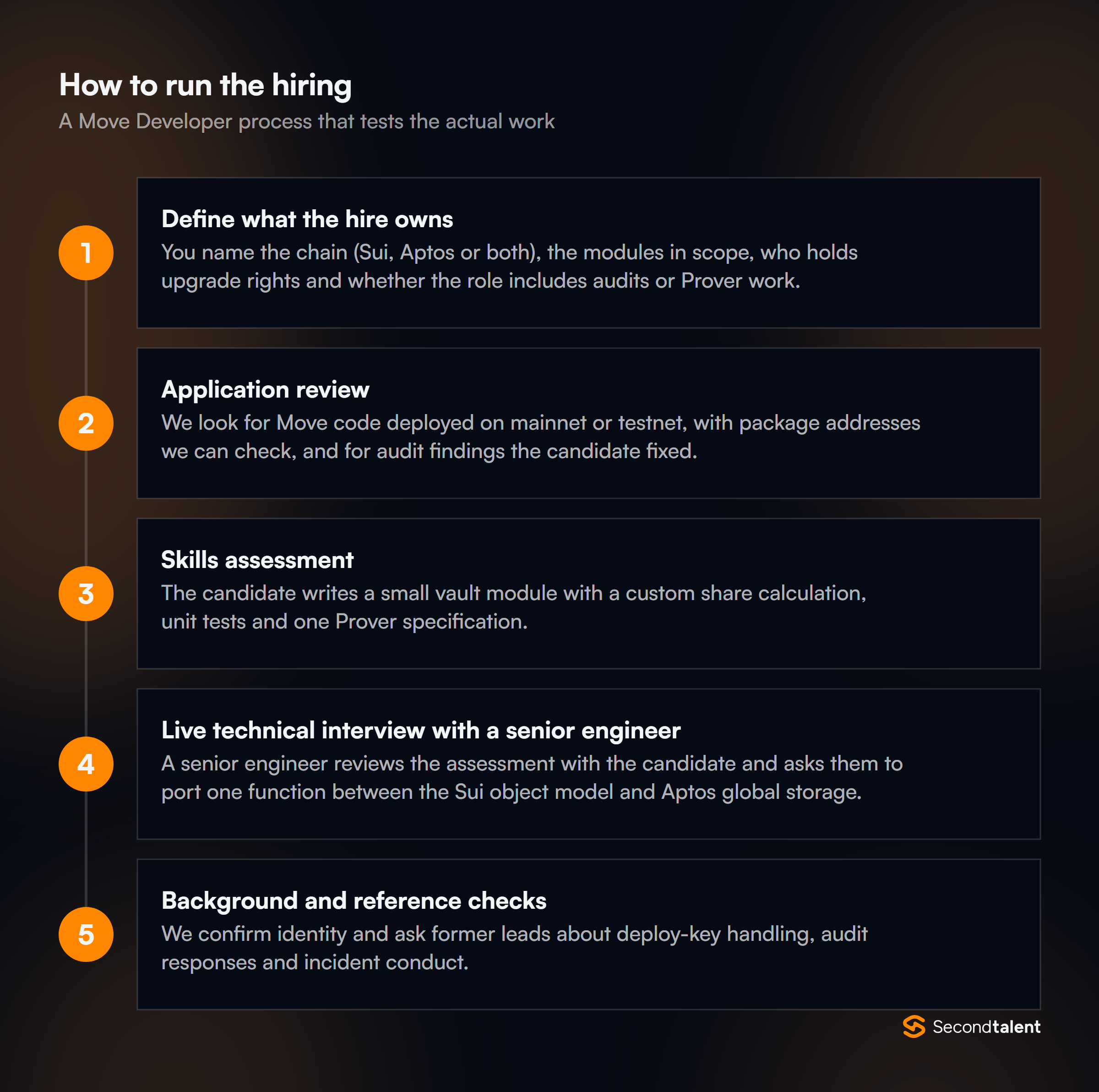
Second Talent's vetting covers stages 2 to 5 before you see a profile.
Stage 1: Define what the hire owns
You name the chain (Sui, Aptos or both), the modules in scope, who holds upgrade rights and whether the role includes audits or Prover work. Add the overlap window your security reviewer needs.
Stage 2: Application review
We look for Move code deployed on mainnet or testnet, with package addresses we can check, and for audit findings the candidate fixed. Tutorials and Solidity-only portfolios do not pass for a Move seat.
Stage 3: Skills assessment
The candidate writes a small vault module with a custom share calculation, unit tests and one Prover specification. We plant an unchecked shift in a helper function and score whether they find it.
Stage 4: Live technical interview with a senior engineer
A senior engineer reviews the assessment with the candidate and asks them to port one function between the Sui object model and Aptos global storage. The candidate explains each ability they granted.
Stage 5: Background and reference checks
We confirm identity and ask former leads about deploy-key handling, audit responses and incident conduct. For a hire with access to protocol funds, these checks matter as much as the code test.
Hire Move Developers from Asia with Second Talent
We shortlist 6-8 candidates within 24 hours from 100,000+ pre-vetted engineers, accepting only the top 1% of applicants. Move developers come with $0 upfront, no lock-in and 4-6 hours of daily overlap with US hours. We handle contracts, payroll and equipment, with compliant EOR contracts and payroll in 9 Asian markets.
Our pricing page covers subscription, direct-hire and EOR pricing. Open Campus, the Web3 education protocol, hired 10 engineers in Vietnam within 2 months through us, and its case study reports a 70% increase in productivity.