TL;DR: Ethereum developers from Asia who work for foreign companies earn $2,000-$9,000 a month on our rate cards, and Second Talent shortlists 6-8 pre-vetted candidates within 24 hours. The closest US benchmark, the BLS median for software developers, was $135,980 a year in May 2025.
Consensys moved Truffle and Ganache to public archives on 20 December 2023, and ChainSafe archived web3.js on 4 March 2025, pointing its users to viem and ethers.js. A senior Ethereum developer in 2026 has moved at least one codebase off those tools and can tell you what broke in the move.
Key takeaways
- Pectra went live at 10:05 UTC on 7 May 2025: 6:05 pm in Manila and 6:05 am in New York.
- Solidity 0.8.31 deprecated
send() and transfer(), whose 2,300-gas stipend assumed opcode prices would stay fixed. Both are scheduled for removal in the 0.9.0 breaking release.
- The EIP-7702 specification warns that a flawed delegate contract can give an attacker near complete control over a user's account.
- Etherscan said its V1 API requests would stop working after 15 August 2025, so older verification scripts need the V2
chainid parameter.
What Ethereum Developers Earn Working for International Clients in Asia
Vietnam shows the widest spread in the table, $6,300 between floor and ceiling, and the Philippines the narrowest at $4,300. We publish no Ethereum-only card, so the figures come from our blockchain developer rate cards. Each range is what developers in that market earn working directly for foreign companies, before any employer or platform costs.
| Market |
Monthly pay working for international clients (USD) |
| Indonesia |
$2,000-$8,000 |
| Philippines |
$2,200-$6,500 |
| Vietnam |
$2,200-$8,500 |
| Thailand |
$2,500-$8,500 |
| Malaysia |
$3,500-$9,000 |
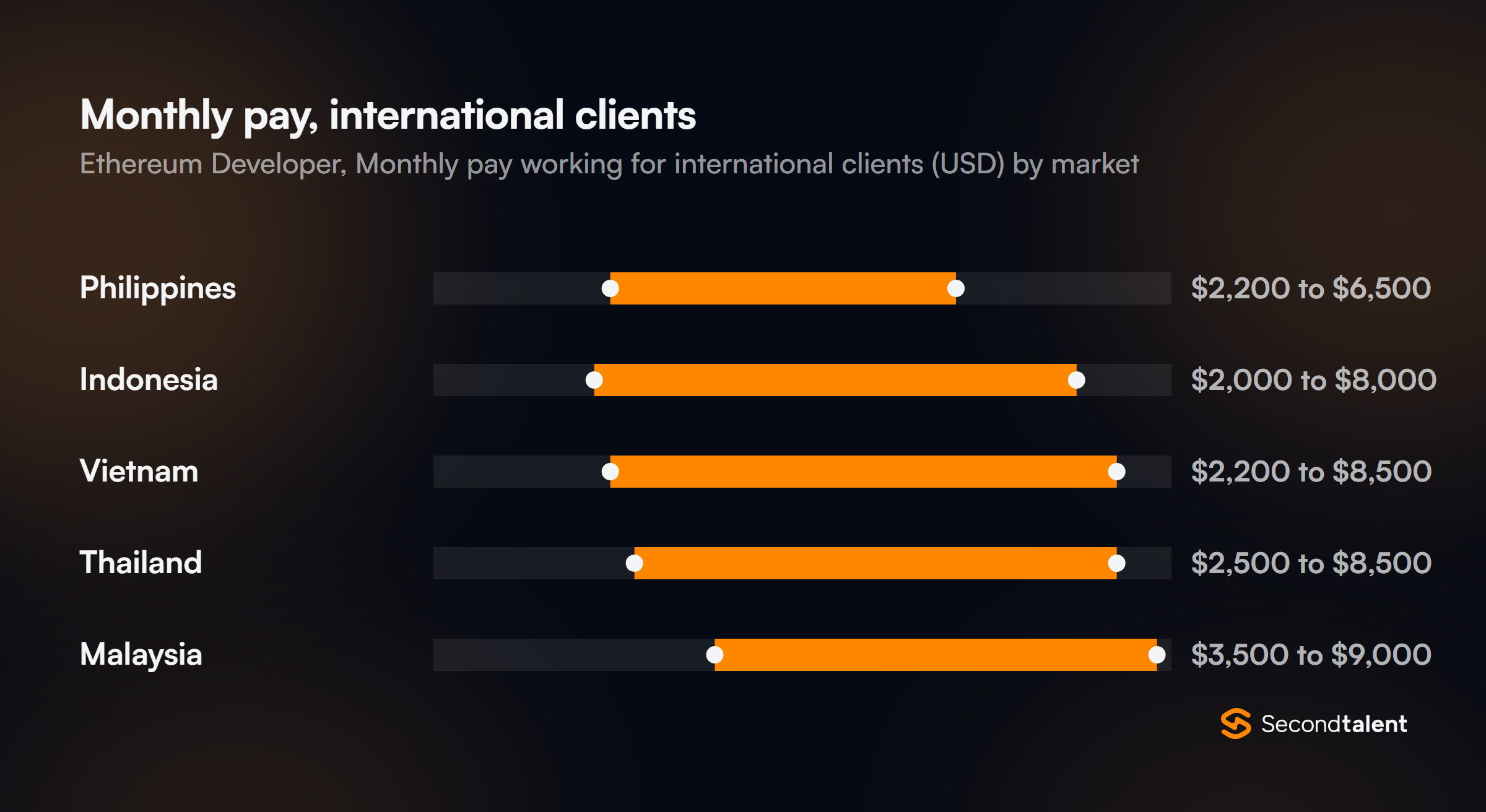
Monthly ranges from the Remote (Working for International Clients) figures on our rate cards for Indonesia, the Philippines, Vietnam, Thailand and Malaysia, converted at ExchangeRate-API mid-market rates for 14 September 2026. All five cards quote US dollars, so the conversion leaves the figures unchanged.
The Vietnam card adds that clients expect strong written English and a few hours of daily overlap. Our cards for Singapore, Hong Kong and China quote local currency and start several times higher, so they sit outside this comparison.
Second Talent bills an Ethereum developer as one monthly fee that bundles salary, payroll taxes, statutory contributions and our service fee. The pricing page sets out how the subscription works.
US Pay Benchmark for Ethereum Developers
BLS has no occupation for smart contract or Ethereum developers. The role maps to Software Developers (SOC 15-1252), because the job is writing and testing software whose runtime happens to be the Ethereum Virtual Machine.
| BLS OEWS, May 2025, national |
Software Developers (15-1252) |
| Median annual |
$135,980 |
| 10th percentile, monthly |
$6,870 |
| 25th percentile, monthly |
$8,770 |
| Median, monthly |
$11,330 |
| 75th percentile, monthly |
$14,330 |
| 90th percentile, monthly |
$17,890 |
Monthly figures are the annual wages on the OEWS profile for 15-1252 divided by 12, rounded to the nearest $10. The occupation covers all software developers, so treat it as a floor for a US engineer who has shipped audited contracts to mainnet.
Salary is only part of the US cost. In the BLS Employer Costs for Employee Compensation release for June 2026, wages and salaries made up 68.5% of employer compensation costs for full-time private industry workers, and benefits the other 31.5%.
Time Zone Overlap with ET, CT and PT
Ethereum's core developers schedule their calls in UTC. The All Core Devs execution call on 10 September 2026 started at 14:00 UTC, which was 10:00 am in New York and 10:00 pm in Manila, and its agenda covered Glamsterdam, the next network upgrade. No city in the table changes its clocks, and US daylight time runs from 8 March to 1 November 2026, per NIST.
| Engineer's city |
UTC offset |
9:00 am ET (EDT) |
9:00 am CT (CDT) |
9:00 am PT (PDT) |
| Manila, Singapore, Kuala Lumpur, Taipei |
UTC+8 |
9:00 pm |
10:00 pm |
12:00 midnight |
| Ho Chi Minh City, Jakarta, Bangkok |
UTC+7 |
8:00 pm |
9:00 pm |
11:00 pm |
| Bengaluru |
UTC+5:30 |
6:30 pm |
7:30 pm |
9:30 pm |
After 1 November 2026, every time in the table moves one hour later.
A Manila shift from 5:00 pm to 2:00 am runs 09:00 to 18:00 UTC. Subtract four hours for EDT and it covers 5:00 am to 2:00 pm in New York: five hours of a 9-to-5 ET day, four with Chicago and two with San Francisco. A 14:00 UTC core devs call falls at 10:00 pm, inside that shift.
Network upgrades do not wait for US mornings. Pectra activated at 10:05 UTC on 7 May 2025, early evening in Manila and hours before most US teams started work. A developer in Asia can watch the first blocks after an upgrade and leave a written status for your team's morning.
We agree the shift before the offer, which is how our placements get 4-6 hours of daily overlap with US hours.
Evening hours cost more for employees. The Philippine Labor Code sets a night shift differential of at least 10% for work between 10 pm and 6 am (Article 86), four hours of the Manila shift above. Vietnam's Labor Code adds at least 30% for work between 22:00 and 06:00 (Articles 98 and 106).
Ethereum Developer Skills to Screen For
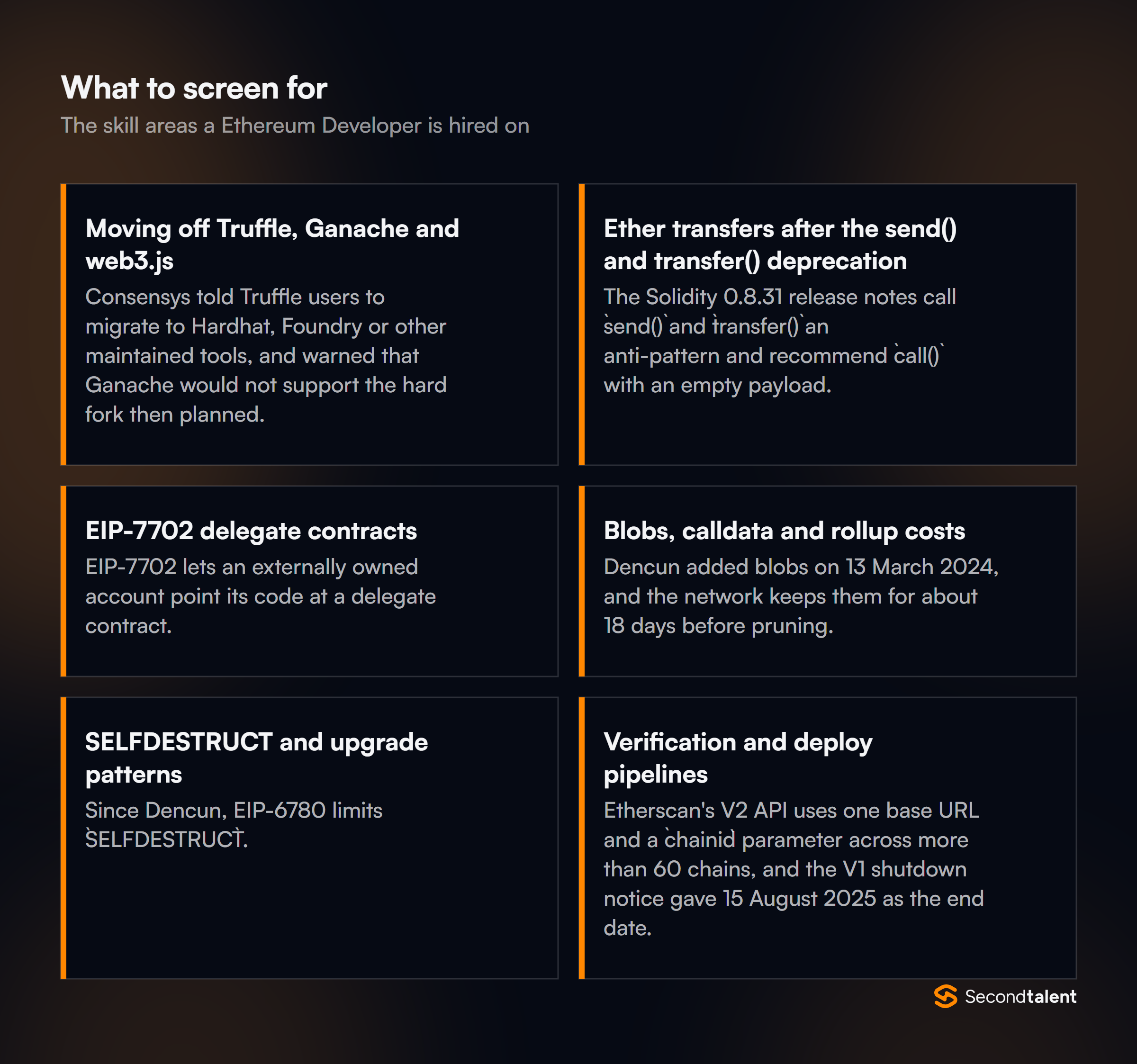
Dencun in March 2024 and Pectra in May 2025 changed rules that contract code relies on, and the compiler has started deprecating old habits. A developer who learned Solidity in 2022 can write code that compiles and still carries retired assumptions, so test against current rules.
Moving off Truffle, Ganache and web3.js
Consensys told Truffle users to migrate to Hardhat, Foundry or other maintained tools, and warned that Ganache would not support the hard fork then planned. Hardhat 3 ships Foundry-compatible Solidity tests for unit, fuzz and invariant testing, with TypeScript integration tests alongside. Give the candidate a small Truffle project with web3.js scripts and ask for a migration plan: which tests move to Solidity, which scripts move to viem or ethers.js, and what they check before trusting the new suite.
Ether transfers after the send() and transfer() deprecation
The Solidity 0.8.31 release notes call send() and transfer() an anti-pattern and recommend call() with an empty payload. The notes add that call() gives no reentrancy protection by default, and point to a guard in transient storage or the checks-effects-interactions pattern. Transient storage arrived with EIP-1153 in the Dencun upgrade. Hand the candidate a withdrawal function that still uses transfer() and score the rewrite for ordering as well as syntax.
EIP-7702 delegate contracts
EIP-7702 lets an externally owned account point its code at a delegate contract. Its security section says a delegate must require a signature over a nonce for replay protection, plus the value, gas, target and calldata. Without them, a sponsor or attacker can repeat or redirect the call. The same section says delegation can break reentrancy guards written as require(tx.origin == msg.sender). Ask the candidate to find that guard in your codebase and replace it.
Blobs, calldata and rollup costs
Dencun added blobs on 13 March 2024, and the network keeps them for about 18 days before pruning. Pectra raised the blob target from 3 to 6 per block and the maximum from 6 to 9.
Pectra also raised calldata pricing for data-heavy transactions. A developer on a rollup team should explain where your chain posts its data and what happens to fees when blob demand spikes.
SELFDESTRUCT and upgrade patterns
Since Dencun, EIP-6780 limits SELFDESTRUCT. Outside the transaction that created the contract, the opcode sends the balance to the target and deletes no code or storage. Designs that destroyed a contract to redeploy different code at the same address lost that deletion step. Ask the candidate how they would retire a contract today, and what users see at the old address.
Verification and deploy pipelines
Etherscan's V2 API uses one base URL and a chainid parameter across more than 60 chains, and the V1 shutdown notice gave 15 August 2025 as the end date. Ask to see a deploy script that verifies source on each chain the project uses. Then ask who holds the deployer key and how a second person approves a mainnet release.
Contractor or Employer of Record for a US Company
Verifying a contract on a block explorer makes its source public, and publishing code transfers no rights in it. The Solidity documentation notes that making source code available "always touches on legal problems with regards to copyright", and asks for an SPDX license identifier at the top of each source file. Agree the licence line before the first deploy.
Software is not one of the nine categories of commissioned work that can be "work made for hire" under 17 U.S.C. § 101, and a transfer of copyright must be in writing and signed under § 204(a). Name the contracts, tests, deploy scripts and front-end code in the assignment.
IRS Publication 515 says the place where services are performed determines the source of the income, so a developer working from Jakarta or Manila earns foreign-source income. A foreign individual gives the payer Form W-8BEN to certify foreign status.
The developer's own country then applies its test for employment:
- Philippines: courts use the four-fold test, and in Atok Big Wedge v. Gison the Supreme Court called the power of control the most important of the four.
- Vietnam: Article 13 of the 2019 Labor Code treats an agreement under another name as a labor contract when it covers a paid job, wages and one party's management and supervision.
|
Independent contractor |
Employer of Record |
| Legal employer |
None; the developer invoices you |
The EOR's local entity |
| US paperwork |
Form W-8BEN from the developer |
Service agreement with the EOR |
| IP |
Written assignment naming contracts, tests and deploy scripts |
Assignment in the employment contract and your EOR agreement |
| Local labor law |
Classification risk if you control hours and methods |
Night premiums, public holidays and leave apply |
| Pay currency |
Agreed in the contract, often USD |
Local currency; Vietnam's Labor Code states wages in dong (Article 95) |
A fixed-scope job, such as migrating a test suite off Truffle, suits a contractor agreement. A full-time developer on your release rota with a seat on the deployer multisig fits the employment tests above, which is the case an Employer of Record covers. Our comparison of EOR, PEO and contractor models sets out the trade-offs, and the Vietnam EOR page covers that market. This is a summary, not legal advice.
English Level and Working Norms
Indonesian IT workers score 523 on the EF English Proficiency Index 2025, 52 points above the national score of 471. Ethereum's design record is in English, from EIP security sections to Ethereum Magicians threads. The index ranks 123 countries and regions against a global average of 488.
| Country |
EF EPI 2025 score |
World rank (of 123) |
IT job-function score |
| Malaysia |
581 |
24 |
590 |
| Philippines |
569 |
28 |
581 |
| Vietnam |
500 |
64 |
500 |
| Indonesia |
471 |
80 |
523 |
| Thailand |
402 |
116 |
459 |
Scores come from EF's country pages, such as Indonesia and Thailand.
Test the English the job uses. Ask finalists to summarise the security considerations of an EIP your contracts depend on, in half a page, for a product manager who has not read it.
Plan releases around both calendars. Thanksgiving on 26 November 2026 is a working day in Asia, so a developer there can monitor contracts and bridges while your US team is off.
Article 112 of Vietnam's Labor Code gives five paid days for Lunar New Year, in late January or February, so avoid scheduling a mainnet deploy that week with a Vietnam-based team.
Ethereum Developer Hiring Process
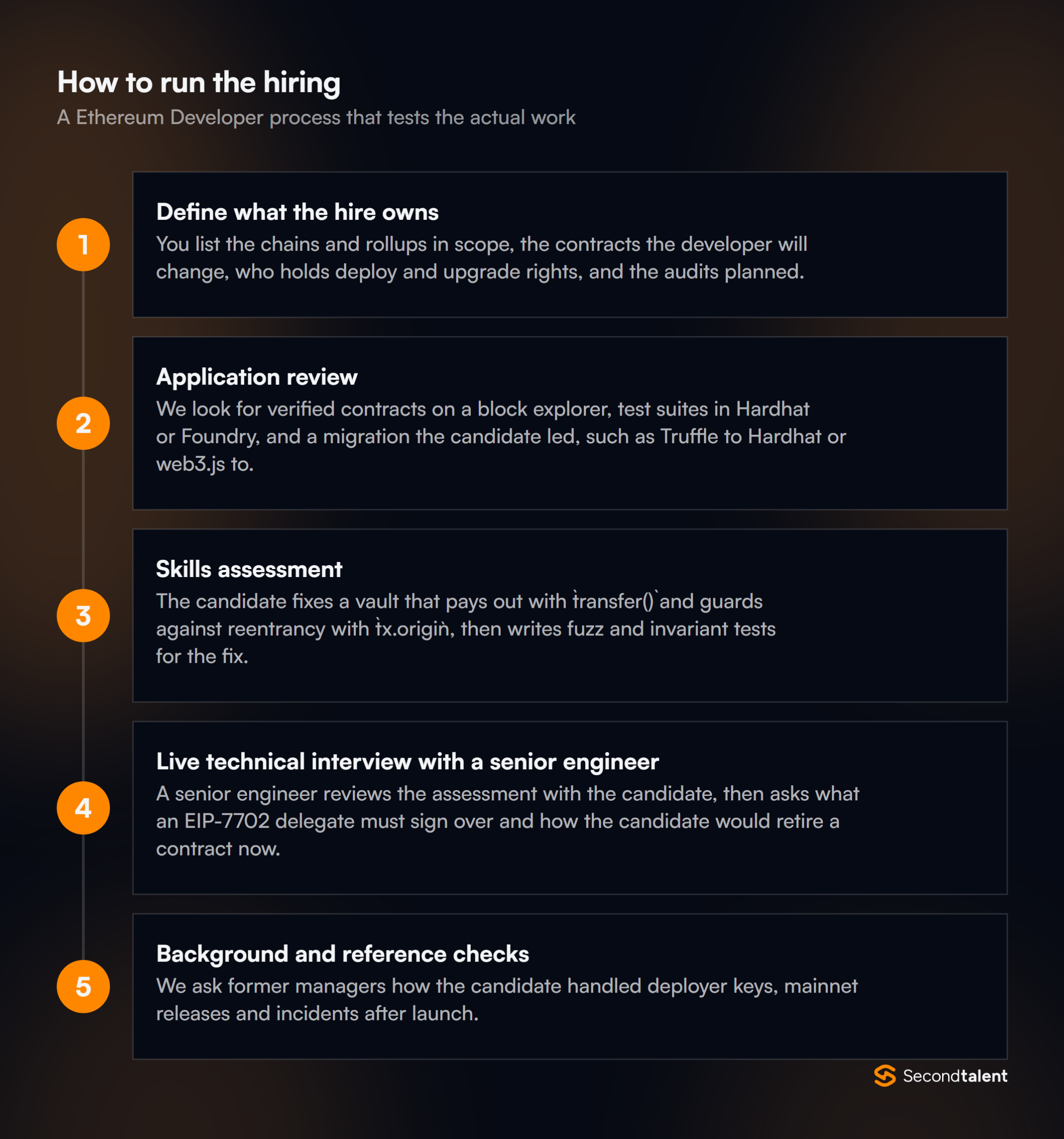
Second Talent's vetting covers stages 2 to 5 before you see a profile. For adjacent briefs we also staff Solidity developers and Web3 developers.
Stage 1: Define what the hire owns
You list the chains and rollups in scope, the contracts the developer will change, who holds deploy and upgrade rights, and the audits planned. Add the release window your signers need.
Stage 2: Application review
We look for verified contracts on a block explorer, test suites in Hardhat or Foundry, and a migration the candidate led, such as Truffle to Hardhat or web3.js to viem. A tutorial token contract alone does not pass.
Stage 3: Skills assessment
The candidate fixes a vault that pays out with transfer() and guards against reentrancy with tx.origin, then writes fuzz and invariant tests for the fix. The tests carry the same weight as the patch in our scoring.
Stage 4: Live technical interview with a senior engineer
A senior engineer reviews the assessment with the candidate, then asks what an EIP-7702 delegate must sign over and how the candidate would retire a contract now that SELFDESTRUCT no longer deletes code.
Stage 5: Background and reference checks
We ask former managers how the candidate handled deployer keys, mainnet releases and incidents after launch. You then choose the contractor or EOR route above and grant on-chain roles last.
Hire Ethereum Developers from Asia with Second Talent
We shortlist 6-8 candidates within 24 hours from 100,000+ pre-vetted engineers, accepting only the top 1% of applicants. Ethereum developers come with $0 upfront, no lock-in and 4-6 hours of daily overlap with US hours. We handle contracts, payroll and equipment, with compliant EOR contracts and payroll in 9 Asian markets.
Our pricing page covers subscription, direct-hire and EOR pricing. Open Campus, the Web3 education protocol, hired 10 engineers in Vietnam within 2 months through us, and the Open Campus case study reports a 70% increase in productivity.