TL;DR: Rust developers from Asia earn $1,200-$5,500 a month in Indonesia and $2,410-$8,990+ in India working for international clients, per our Golang rate cards, and we shortlist 6-8 candidates in 24 hours. The closest US benchmark, the BLS median for software developers, was $135,980 a year in May 2025.
On 20 August 2026, an attacker republished the arrayref crate with a dependency on proc-macro1, whose build script downloaded malware. The Rust Security Response Team deleted that release 86 minutes after it went up. The borrow checker ignores code Cargo runs at build time. Your Rust hire decides what executes on your CI runners.
Key takeaways
- Rust was the most admired language in Stack Overflow's 2025 survey, at 72%, and 14.5% of professional developers used it.
- Google estimates 0.2 memory safety vulnerabilities per million lines of Rust in Android, against close to 1,000 per million lines in its historical C and C++ code.
- Tokio's 1.47.x long-term support line ends this month; the 1.51.x line is supported until March 2027.
- A Bengaluru shift from 2:30 pm to 11:30 pm covers five hours of a New York working day.
What Rust Developers Earn Working for International Clients in Asia
We publish no Rust rate card, so the table uses our Golang developer rate cards: teams weigh Go and Rust for the same concurrent back-end services and infrastructure tooling. Each figure is what developers in that market earn working directly for foreign companies, before any employer or platform costs.
| Market |
Monthly pay working for international clients (USD) |
| Indonesia |
$1,200-$5,500 |
| Philippines |
$1,800-$6,500 |
| Vietnam |
$2,200-$6,500 |
| India |
$2,410-$8,990+ |
| Malaysia |
$2,700-$5,040+ |
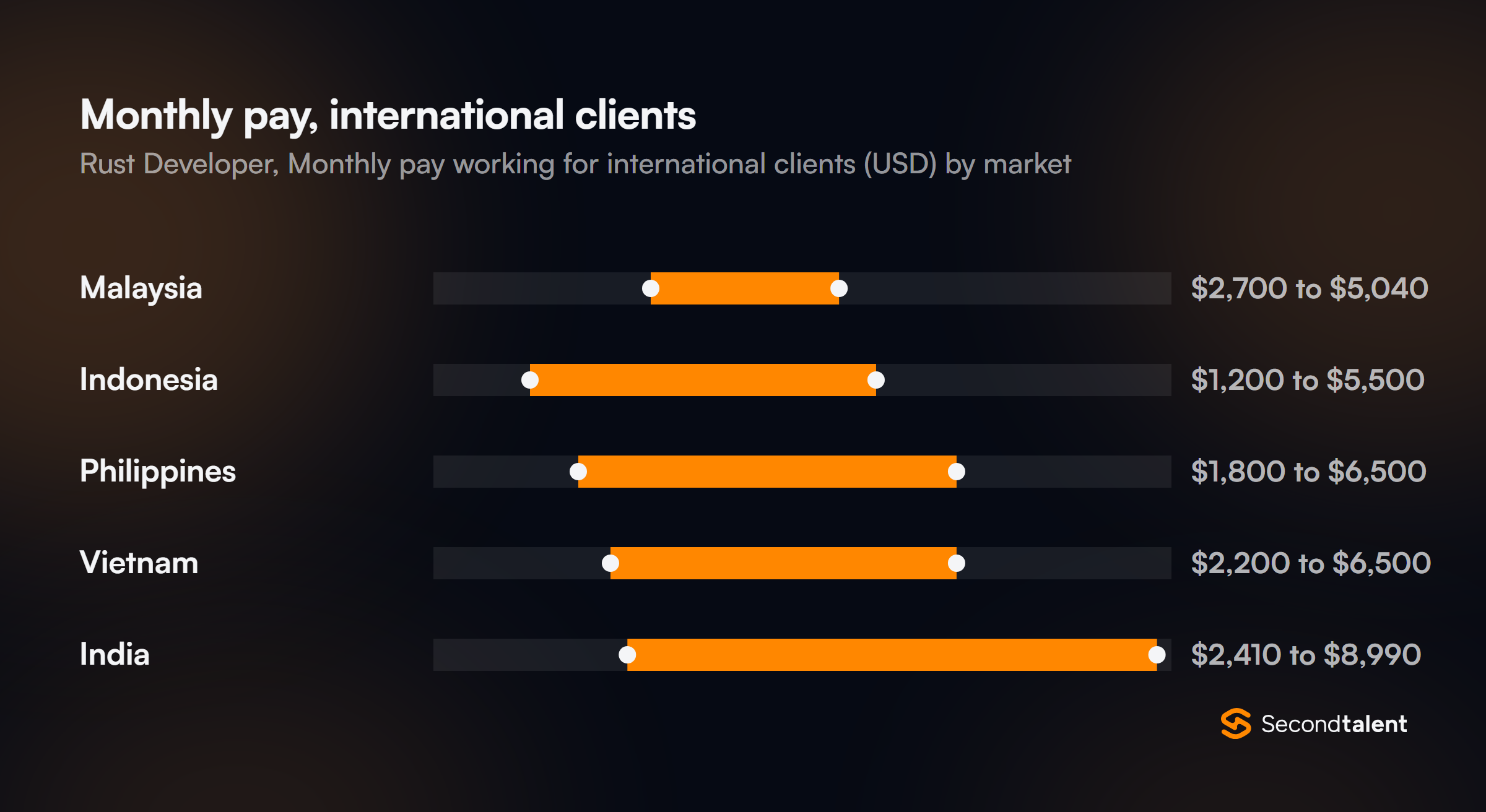
Monthly ranges from the Remote (Working for International Clients) figures on our rate cards for Indonesia, the Philippines, Vietnam, India and Malaysia, converted at ExchangeRate-API mid-market rates for 14 September 2026.
India's range spans $6,580 from floor to ceiling, the widest here. Malaysia starts highest and tops out lowest. The Go cards price general back-end work, so budget toward the top of a row for a developer with years of unsafe code, FFI or embedded work.
Second Talent charges one monthly fee that bundles salary, payroll taxes, statutory contributions and our service fee; our pricing page shows how it works. On the contract side, our Rust cost-to-hire page puts a mid-level US freelance or contract Rust developer at $85 to $135 an hour, before payroll, insurance and leave.
US Pay Benchmark for Rust Developers
BLS has no Rust occupation. The role maps to Software Developers (15-1252), because Rust developers write the services, libraries, command-line tools and systems software that occupation covers.
| BLS OEWS, May 2025, national |
Software Developers (15-1252) |
| Median annual |
$135,980 |
| 10th percentile, monthly |
$6,870 |
| 25th percentile, monthly |
$8,770 |
| Median, monthly |
$11,330 |
| 75th percentile, monthly |
$14,330 |
| 90th percentile, monthly |
$17,890 |
Monthly figures are the annual wages on the OEWS profile for 15-1252 divided by 12, rounded to the nearest $10.
Salary is only part of the US cost. In the BLS Employer Costs for Employee Compensation release for June 2026, wages and salaries made up 68.5% of employer compensation costs for full-time private industry workers, and benefits the other 31.5%.
Use the 75th or 90th percentile column for a hire who will own unsafe code, a C++ interop layer or a latency budget.
Time Zone Overlap with ET, CT and PT
Rust builds are slow, and the 2025 State of Rust Survey still ranks compile times and storage use among the problems its 7,156 respondents hit most. The time difference lets a team run long CI, fuzzing and release builds while the other side sleeps. US daylight time runs until 1 November 2026, per NIST, and none of the Asian cities below change their clocks.
| Engineer's city |
UTC offset |
9:00 am ET (EDT) |
9:00 am CT (CDT) |
9:00 am PT (PDT) |
| Manila, Singapore, Kuala Lumpur, Taipei |
UTC+8 |
9:00 pm |
10:00 pm |
12:00 midnight |
| Ho Chi Minh City, Jakarta, Bangkok |
UTC+7 |
8:00 pm |
9:00 pm |
11:00 pm |
| Bengaluru |
UTC+5:30 |
6:30 pm |
7:30 pm |
9:30 pm |
After 1 November 2026, every time in the table moves one hour later.
Two schedules fit most Rust teams:
- Design reviews and pairing: Bengaluru, 2:30 pm to 11:30 pm (09:00 to 18:00 UTC). That is 5:00 am to 2:00 pm EDT: five hours of a 9-to-5 day in New York, four with Chicago and two with San Francisco. Arithmetic: 2:30 pm minus 5 hours 30 minutes is 09:00 UTC, and 09:00 UTC minus four hours is 5:00 am EDT.
- Overnight builds and review: Jakarta, 9:00 am to 6:00 pm (02:00 to 11:00 UTC). That is 10:00 pm to 7:00 am in New York. The developer picks up pull requests your US team opened the evening before, reads the overnight fuzzing and Miri results, and hands back fixes before your standup.
Night hours cost extra for employees in two markets: at least 10% for work between 10 pm and 6 am in the Philippines (Labor Code Article 86), and at least 30% between 22:00 and 06:00 in Vietnam (Labor Code Articles 98 and 106). Moved to Ho Chi Minh City, the 9:00 am to 6:00 pm shift stays clear of the Vietnamese window. For a hire who needs shared hours, we agree a schedule before the offer that gives 4-6 hours of daily overlap with US hours.
Rust Developer Skills to Screen For
Rust 1.98.1 shipped on 3 September 2026 to fix a compiler miscompilation: in some circumstances rustc built a trait object vtable with a null pointer where a function pointer belonged, which leads to undefined behavior. Stable Rust ships every six weeks, with point releases like this one in between. Ask each candidate how they pin the toolchain in CI and how fast they roll out a point release.
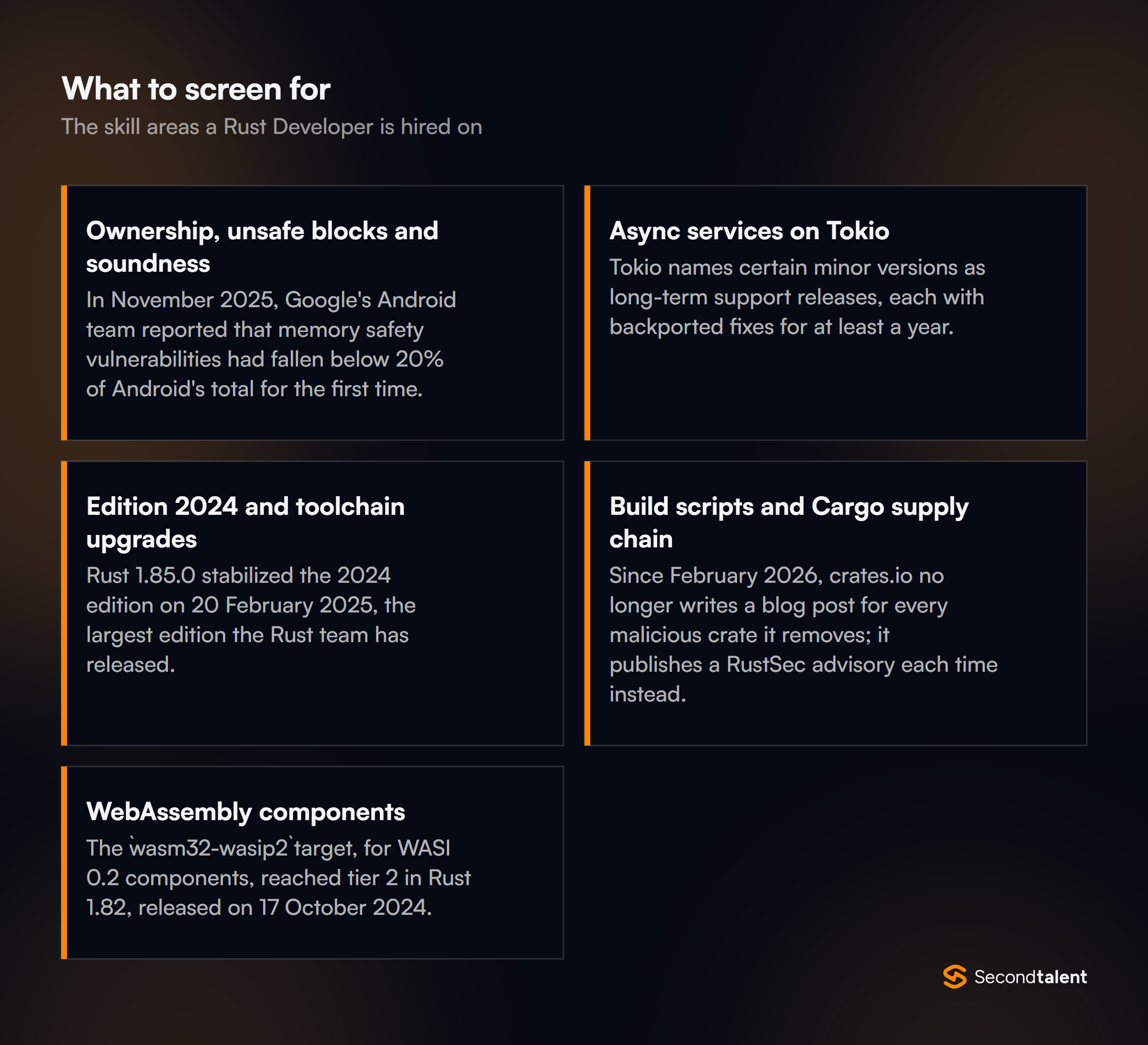
Ownership, unsafe blocks and soundness
In November 2025, Google's Android team reported that memory safety vulnerabilities had fallen below 20% of Android's total for the first time. The same post places the main security concern about Rust in the 4% or so of code written inside unsafe{} blocks.
Google's first near-miss Rust memory safety bug, a buffer overflow in CrabbyAVIF (CVE-2025-48530), sat in unsafe code. Its Comprehensive Rust course is adding a module on safety comments and safe wrappers. Hand the candidate an unsafe block with no safety comment. Ask them to write the comment, or show why no honest one exists.
Async services on Tokio
Tokio names certain minor versions as long-term support releases, each with backported fixes for at least a year. Tokio supports the 1.47.x line until September 2026 and the 1.51.x line until March 2027. Tokio raises its minimum supported Rust version only to releases at least six months old.
Ask which Tokio version your candidate pinned in their last service, how they found a task that blocked the runtime, and how they shut down an Axum or Actix Web server without dropping requests.
Edition 2024 and toolchain upgrades
Rust 1.85.0 stabilized the 2024 edition on 20 February 2025, the largest edition the Rust team has released. It made std::env::set_var and remove_var unsafe functions, turned on the unsafe_op_in_unsafe_fn warning by default and switched Cargo to a resolver that considers each package's rust-version. The release notes warn that cargo fix makes conservative conversions, which should not be read as recommendations. Ask how the candidate migrated a workspace, and what they did about the if let temporary scope change.
Build scripts and Cargo supply chain
Since February 2026, crates.io no longer writes a blog post for every malicious crate it removes; it publishes a RustSec advisory each time instead. Cargo had its own flaw that year: CVE-2026-33056, in the tar crate Cargo uses to unpack packages, let a malicious crate change permissions on arbitrary directories during a build, and Rust 1.94.1 shipped the patched dependency. Ask how the candidate reviews a new dependency's build.rs, and whether they run cargo audit or cargo deny in CI.
WebAssembly components
The wasm32-wasip2 target, for WASI 0.2 components, reached tier 2 in Rust 1.82, released on 17 October 2024. Tier 2 means the target is guaranteed to build and installs with rustup target add wasm32-wasip2, so tooling no longer needs a post-processing step to produce WASI 0.2 components. For an edge or plugin brief, ask the candidate to explain how they would keep a Wasm module small and how their TypeScript callers handle its errors. We staff TypeScript developers for the other side of that boundary.
Contractor or Employer of Record for a US Company
Software is not one of the nine categories of commissioned work that can be "work made for hire" under 17 U.S.C. § 101, and a copyright transfer must be in writing and signed under § 204(a). Name crates, FFI bindings, build scripts and any fuzzing harnesses in the assignment, including crates you plan to publish under your organization's account.
IRS Publication 515 says the place where services are performed determines the source of the income, so a developer working from Bengaluru or Jakarta earns foreign-source income. A foreign individual gives the payer Form W-8BEN to certify foreign status.
Local law applies its own test for employment. Philippine courts use the four-fold test, and in Atok Big Wedge v. Gison the Supreme Court called the power of control the most important of the four. Article 13 of Vietnam's 2019 Labor Code treats an agreement under any name as a labor contract when it covers a paid job, wages and one party's management and supervision.
|
Independent contractor |
Employer of Record |
| Legal employer |
None; the developer invoices you |
The EOR's local entity |
| US paperwork |
Form W-8BEN from the developer |
Service agreement with the EOR |
| IP |
Written assignment covering crates, bindings and build scripts |
Assignment terms in the employment contract and your EOR agreement |
| Local labor law |
Classification risk if you set the developer's hours and methods |
Night premiums, public holidays and leave apply |
| Pay currency |
Agreed in the contract, often USD |
In Vietnam, contract wages are stated in dong (Article 95) |
A fixed-scope port of one C library suits a contractor agreement. A developer who holds publish tokens for your crates and sits on your incident rotation fits the employment tests above, and our Employer of Record service employs that developer in-country. Our EOR, PEO and contractor comparison sets out the trade-offs. This is a summary, not legal advice.
English Level and Working Norms
Rust reviews run on written reasoning: the // SAFETY: comment above an unsafe block has to convince a reader who cannot ask a follow-up until the next day. Malaysia and the Philippines rank 24th and 28th of 123 countries and regions on the EF English Proficiency Index 2025, against a global average of 488.
| Country |
EF EPI 2025 score |
World rank (of 123) |
IT job-function score |
| Malaysia |
581 |
24 |
590 |
| Philippines |
569 |
28 |
581 |
| Vietnam |
500 |
64 |
500 |
| India |
484 |
74 |
487 |
| Indonesia |
471 |
80 |
523 |
Scores come from EF's country pages for Malaysia, the Philippines, Vietnam, India and Indonesia. Indonesia's IT score of 523 sits 52 points above its overall score, the biggest gap in the table.
Ask finalists to write the safety comment for an FFI call and a short design note for a crate's public API. Both show whether a US reviewer can approve the work without a meeting.
Thanksgiving on 26 November 2026 is a working day in Asia, so an engineer there can finish a toolchain upgrade while your US team is off. Vietnam's Labor Code gives five paid days for Lunar New Year (Article 112), so keep a Vietnam-based developer's edition migration or Tokio upgrade clear of that week.
Rust Developer Hiring Process
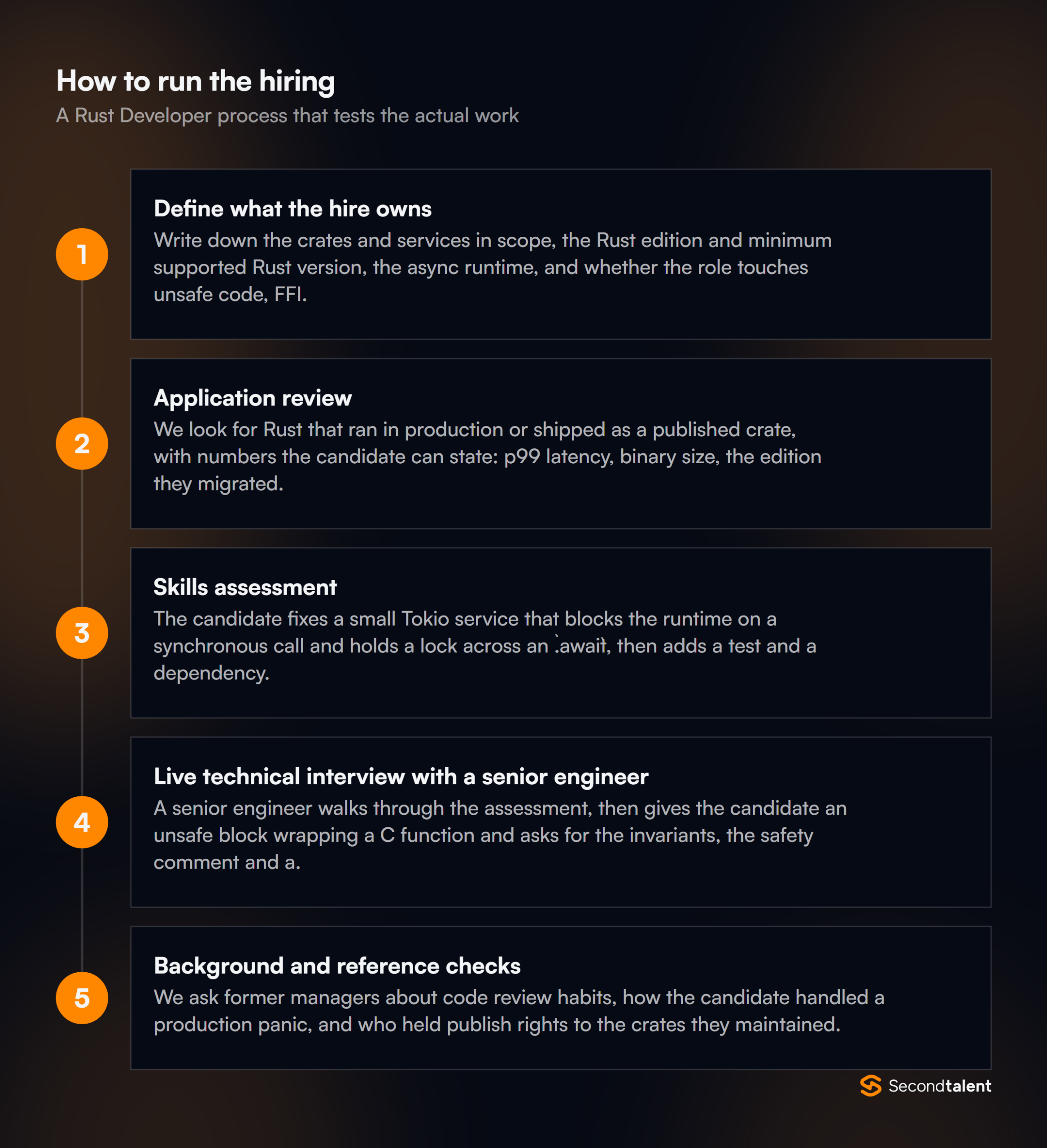
Second Talent's vetting covers stages 2 to 5 before you see a profile. Our Rust backend interview questions give you material for your own final round.
Stage 1: Define what the hire owns
Write down the crates and services in scope, the Rust edition and minimum supported Rust version, the async runtime, and whether the role touches unsafe code, FFI or WebAssembly. A Rust hire for a web API and one for a C++ migration need different tests.
Stage 2: Application review
We look for Rust that ran in production or shipped as a published crate, with numbers the candidate can state: p99 latency, binary size, the edition they migrated from. A finished tutorial or Advent of Code repository alone does not pass.
Stage 3: Skills assessment
The candidate fixes a small Tokio service that blocks the runtime on a synchronous call and holds a lock across an .await, then adds a test and a dependency review of one crate with a build.rs. We score the fix, the test and the written review.
Stage 4: Live technical interview with a senior engineer
A senior engineer walks through the assessment, then gives the candidate an unsafe block wrapping a C function and asks for the invariants, the safety comment and a safe wrapper. For mixed-language teams, we also ask when they would choose Go instead.
Stage 5: Background and reference checks
We ask former managers about code review habits, how the candidate handled a production panic, and who held publish rights to the crates they maintained. You then choose the contractor or EOR route above.
Hire Rust Developers from Asia with Second Talent
We shortlist 6-8 candidates within 24 hours from 100,000+ pre-vetted engineers, accepting only the top 1% of applicants. Rust developers come with $0 upfront, no lock-in and 4-6 hours of daily overlap with US hours. We handle contracts, payroll and equipment, with compliant EOR contracts and payroll in 9 Asian markets.
Our pricing page sets out the subscription, direct-hire and EOR options, and for services work in several languages we also staff back-end developers.