TL;DR: SolidJS developers from Asia start from $2,999 a month through Second Talent, matched in 24 hours. The closest US benchmark, the BLS median for software developers, was $135,980 a year in May 2025.
Only 10% of respondents to the State of JavaScript 2025 survey use Solid, yet it has posted the highest satisfaction among front-end frameworks for five years running. Solid 2.0 reached its eighth release candidate on 11 September 2026, while the stable line is still 1.9. A hire this quarter writes 1.9 code and plans the move to 2.0.
Key takeaways
- A Solid component function runs once, when it first renders, and destructuring its props can break reactivity.
- SolidStart v2, stable since 4 August 2026, replaces Vinxi with Vite's Environment API and requires Node.js 24 or newer.
- Before version 1.9.4, solid-js rendered user input as raw HTML inside JSX fragments on the server (CVE-2025-27109).
- Stack Overflow listed Solid.js at 1.2% of all respondents in 2024, then left it off its 2025 web framework list.
What SolidJS Developers Earn Working for International Clients in Asia
China's React card has the highest fixed ceiling in the table, at $9,500 a month. The Indian and Malaysian cards leave their tops open. We publish no SolidJS rate card, so the table uses our React developer rate cards, the closest match for a JSX component framework. Each range is what developers in that market earn working for foreign companies as their direct clients, before any employer or platform costs.
| Market |
Monthly pay working for international clients (USD) |
| Philippines |
$1,200-$4,500 |
| Indonesia |
$1,200-$6,500 |
| Vietnam |
$1,800-$6,500 |
| India |
$1,880-$7,530+ |
| China |
$2,800-$9,500 |
| Malaysia |
$2,950-$7,000+ |
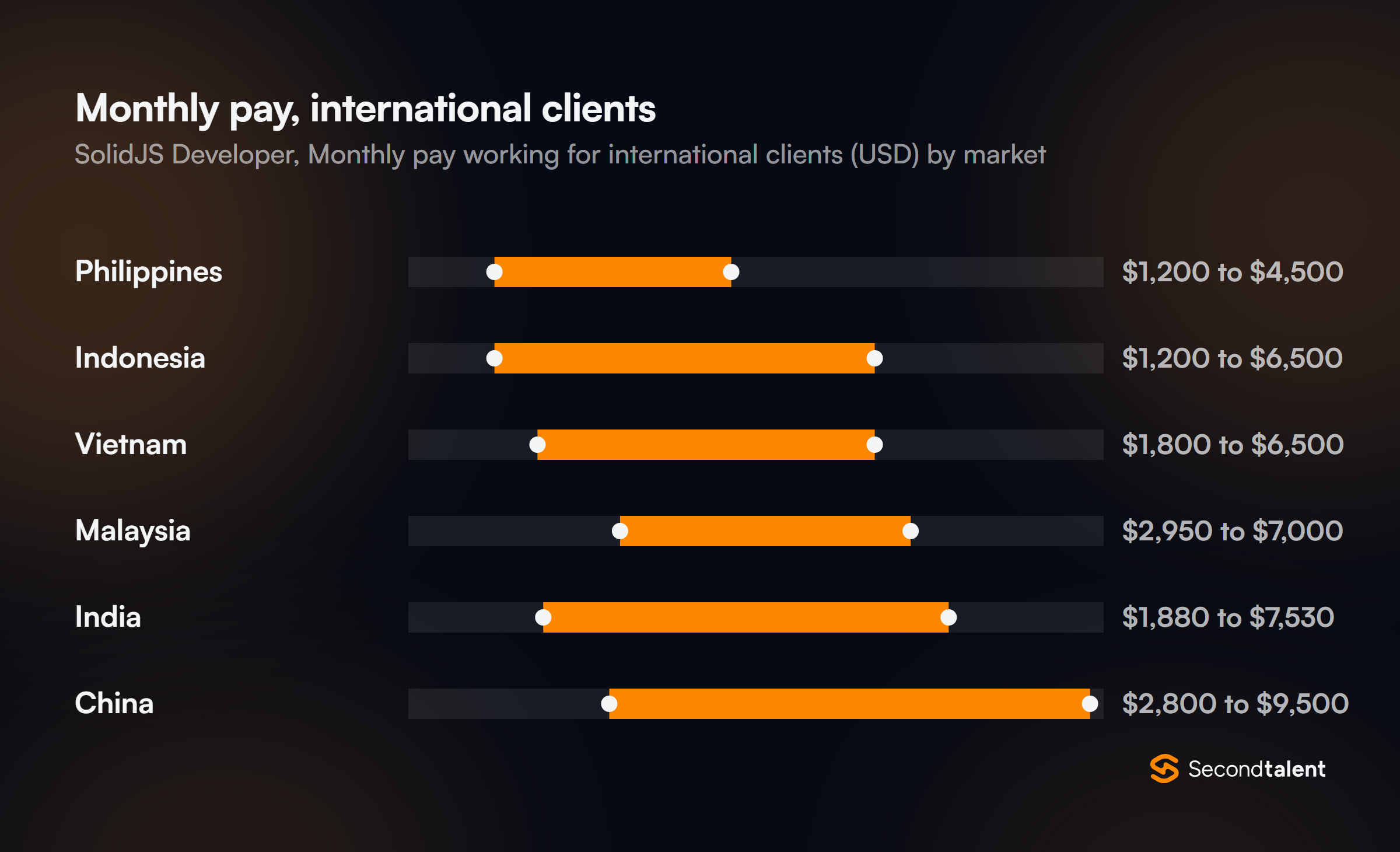
Monthly ranges from the Remote (Working for International Clients) figures on our rate cards for the Philippines, Indonesia, Vietnam, India, China and Malaysia, converted at ExchangeRate-API mid-market rates for 14 September 2026.
Four cards quote US dollars, so conversion leaves them unchanged. The Indian card quotes ₹180,000 to ₹720,000+ and the Malaysian card RM 12,000 to RM 28,500+.
Through Second Talent, SolidJS developers start from $2,999 a month: one monthly fee that bundles salary, payroll taxes, statutory contributions and our service fee. Our pricing page explains the subscription. For teams on other frameworks we also staff React developers and front-end developers.
US Pay Benchmark for SolidJS Developers
A mid-level US freelance or contract front-end developer costs $89 to $140 an hour on our front-end cost-to-hire page, before payroll, insurance and leave. BLS has no occupation for a single framework. SolidJS developers map to Software Developers (15-1252), because a Solid developer on a product team builds application software. The table adds Web Developers (15-1254) for a hire who builds sites and content pages.
| BLS OEWS, May 2025, national |
Software Developers (15-1252) |
Web Developers (15-1254) |
| Median annual |
$135,980 |
$92,650 |
| 10th percentile, monthly |
$6,870 |
$4,010 |
| 25th percentile, monthly |
$8,770 |
$5,350 |
| Median, monthly |
$11,330 |
$7,720 |
| 75th percentile, monthly |
$14,330 |
$10,520 |
| 90th percentile, monthly |
$17,890 |
$13,520 |
Monthly figures are the annual wages on the BLS OEWS profiles for 15-1252 and 15-1254 divided by 12, rounded to the nearest $10.
Salary is only part of the US cost. In the BLS Employer Costs for Employee Compensation release for June 2026, wages and salaries made up 68.5% of employer compensation costs for full-time private industry workers, and benefits the other 31.5%.
Time Zone Overlap with ET, CT and PT
Bengaluru runs nine and a half hours ahead of New York while US daylight time lasts, and Manila twelve hours ahead. Daylight time runs from 8 March to 1 November 2026, per NIST, and none of the cities below change their clocks.
| Engineer's city |
UTC offset |
9:00 am ET (EDT) |
9:00 am CT (CDT) |
9:00 am PT (PDT) |
| Manila, Singapore, Kuala Lumpur, Taipei |
UTC+8 |
9:00 pm |
10:00 pm |
12:00 midnight |
| Ho Chi Minh City, Jakarta, Bangkok |
UTC+7 |
8:00 pm |
9:00 pm |
11:00 pm |
| Bengaluru |
UTC+5:30 |
6:30 pm |
7:30 pm |
9:30 pm |
After 1 November 2026, every time in the table moves one hour later.
A worked shift for September: Bengaluru from 2:30 pm to 11:30 pm is 09:00 to 18:00 UTC. Subtract four hours for EDT and it covers 5:00 am to 2:00 pm in New York. That gives five hours inside a 9-to-5 ET day, four with Chicago and two with San Francisco.
Front-end work runs on quick feedback from design and product. Book design reviews and preview-deploy walkthroughs in the shared hours, and leave the Indian afternoon for building against the notes. We agree the shift before the offer, which is how our placements get 4-6 hours of daily overlap with US hours.
For employees, evening hours cost more in two markets: at least 10% extra between 10 pm and 6 am in the Philippines (Labor Code Article 86), and at least 30% between 22:00 and 06:00 in Vietnam (Labor Code Articles 98 and 106).
SolidJS Developer Skills to Screen For
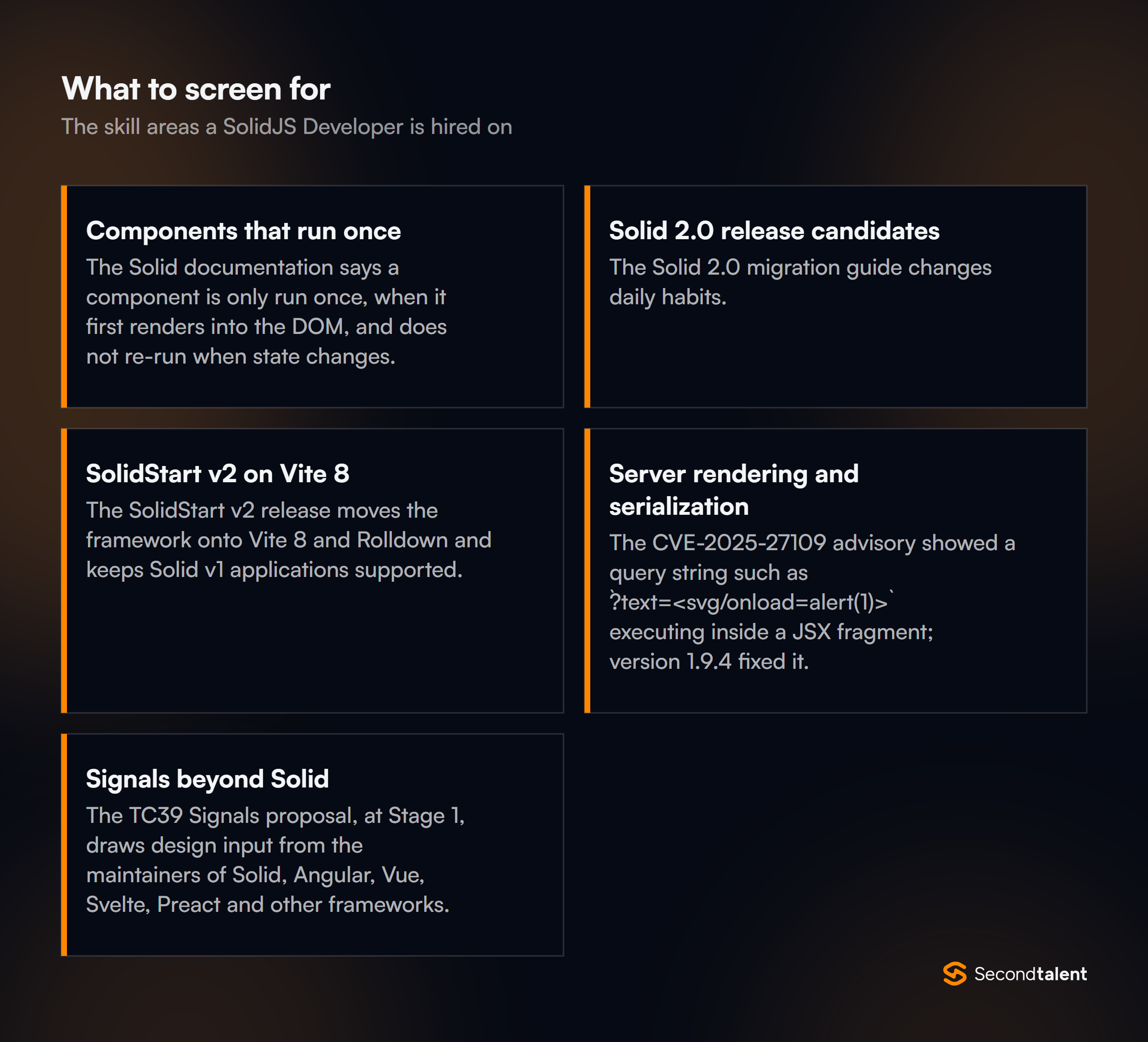
Solid writes components in JSX, so code built on React habits compiles and runs. The bugs surface later, as views that stop updating. Screen for the places where the two models part ways, then for the 2026 release changes.
Components that run once
The Solid documentation says a component is only run once, when it first renders into the DOM, and does not re-run when state changes. Solid's fine-grained reactivity guide says an update goes to the targeted attribute that needs to change. The props guide warns that destructuring props can break reactivity and offers splitProps instead.
Give the candidate a React component with useEffect, a derived value and destructured props. Ask for the Solid port, then change a prop and check that the view updates.
Solid 2.0 release candidates
The Solid 2.0 migration guide changes daily habits. Setters no longer update what reads return until the microtask batch flushes. onMount becomes onSettled, Suspense becomes Loading, and createResource gives way to async computations. Index is gone, mergeProps and splitProps become merge and omit, and JSX types move to @solidjs/web.
Ask the candidate to list what in your codebase breaks under 2.0, in order of risk. A strong answer starts with code that reads a signal right after setting it.
SolidStart v2 on Vite 8
The SolidStart v2 release moves the framework onto Vite 8 and Rolldown and keeps Solid v1 applications supported. Most v1 apps upgrade by moving framework configuration from app.config.ts to vite.config.ts. Ask the candidate to upgrade a small v1 app and report which deployment adapter or plugin needed the most changes.
Server rendering and serialization
The CVE-2025-27109 advisory showed a query string such as ?text=<svg/onload=alert(1)> executing inside a JSX fragment; version 1.9.4 fixed it. Solid 2.0 RC 8 fixed a second server-side escaping flaw, in strings returned through flow-control components such as Show and For.
Both solid-js and SolidStart list seroval, a library that stringifies JavaScript values, as a dependency. A seroval advisory, CVE-2026-23737, described remote code execution through JSON deserialization in versions up to 1.4.0. Ask the candidate how they would find which seroval version your lockfile resolves, and what they check before a SolidStart server function trusts its input.
Signals beyond Solid
The TC39 Signals proposal, at Stage 1, draws design input from the maintainers of Solid, Angular, Vue, Svelte, Preact and other frameworks. Ask the candidate to sketch a signal, a memo and an effect in 20 lines of plain JavaScript and say when the effect re-runs.
Contractor or Employer of Record for a US Company
Software is not one of the nine categories of commissioned work that can be "work made for hire" under 17 U.S.C. § 101, and a copyright transfer must be in writing and signed under § 204(a). Name components, server functions, styles and build configuration in the assignment, since a SolidStart app mixes client and server code in one repository.
IRS Publication 515 says the place where services are performed determines the source of the income, so a developer working from Bengaluru or Manila earns foreign-source income. A foreign individual gives the payer Form W-8BEN to certify foreign status.
The developer's own country applies its test for employment:
- Philippines: courts use the four-fold test, and in Atok Big Wedge v. Gison the Supreme Court called the power of control the most important of the four.
- Vietnam: Article 13 of the 2019 Labor Code treats an agreement under another name as a labor contract when it covers a paid job, wages and one party's management and supervision.
A fixed project, such as upgrading one app to SolidStart v2, suits a contractor agreement. A developer inside your sprint who ships user-facing features each week fits the employment tests above. That is the case an Employer of Record covers, and our comparison of EOR, PEO and contractor models sets out the trade-offs. This is a summary, not legal advice.
|
Independent contractor |
Employer of Record |
| Legal employer |
None; the developer invoices you |
The EOR's local entity |
| US paperwork |
Form W-8BEN from the developer |
Service agreement with the EOR |
| IP |
Written assignment naming components, server functions and build configuration |
Assignment in the employment contract and your EOR agreement |
| Local labor law |
Classification risk if you control hours and methods |
Night premiums, public holidays and leave apply |
| Pay currency |
Agreed in the contract, often USD |
Local currency; Vietnam's Labor Code states wages in dong (Article 95) |
English Level and Working Norms
China's IT workers score 491 on the EF English Proficiency Index 2025, 27 points above the national score of 464 and three above the global average of 488. The index ranks 123 countries and regions.
| Country |
EF EPI 2025 score |
World rank (of 123) |
IT job-function score |
| Malaysia |
581 |
24 |
590 |
| Philippines |
569 |
28 |
581 |
| Vietnam |
500 |
64 |
500 |
| India |
484 |
74 |
487 |
| Indonesia |
471 |
80 |
523 |
| China |
464 |
86 |
491 |
Scores come from EF's country pages, such as China and India.
Solid 2.0's migration guide, RFCs and release notes are written in English on GitHub, and a Solid developer reads them to keep up with the release candidates. Ask finalists to summarise one Solid 2.0 change from the migration guide for a React developer on your team, in five sentences.
Plan releases around both calendars. Thanksgiving on 26 November 2026 is a working day in Asia, so a developer there can finish a release branch while your US team is off. Article 112 of Vietnam's Labor Code gives five paid days for Lunar New Year, in late January or February.
SolidJS Developer Hiring Process
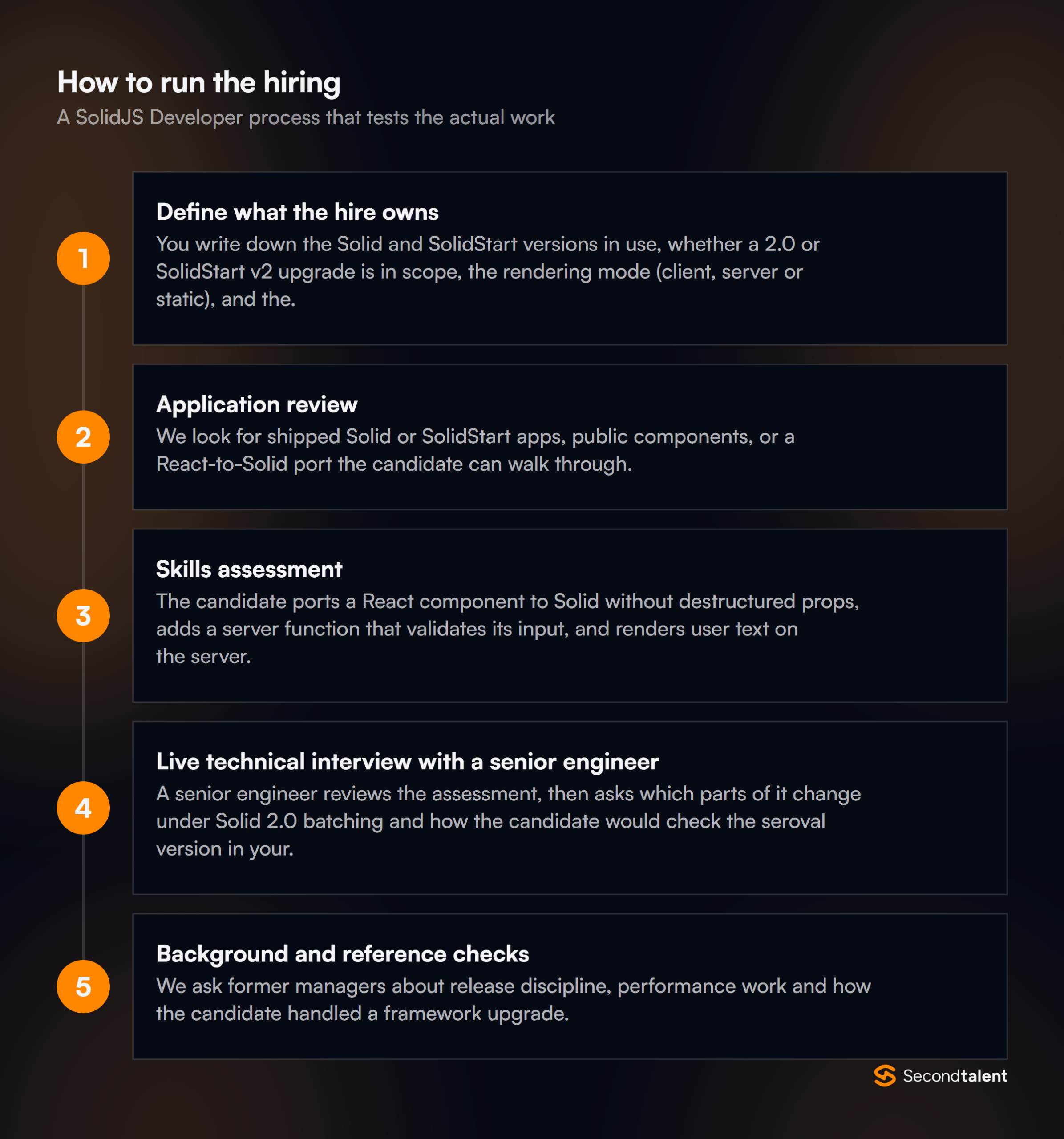
Second Talent's vetting covers stages 2 to 5 before you see a profile.
Stage 1: Define what the hire owns
You write down the Solid and SolidStart versions in use, whether a 2.0 or SolidStart v2 upgrade is in scope, the rendering mode (client, server or static), and the design system the hire builds against.
Stage 2: Application review
We look for shipped Solid or SolidStart apps, public components, or a React-to-Solid port the candidate can walk through. A to-do demo alone does not pass.
Stage 3: Skills assessment
The candidate ports a React component to Solid without destructured props, adds a server function that validates its input, and renders user text on the server without injecting HTML. We score the tests alongside the code.
Stage 4: Live technical interview with a senior engineer
A senior engineer reviews the assessment, then asks which parts of it change under Solid 2.0 batching and how the candidate would check the seroval version in your lockfile.
Stage 5: Background and reference checks
We ask former managers about release discipline, performance work and how the candidate handled a framework upgrade. You then choose the contractor or EOR route above.
Hire SolidJS Developers from Asia with Second Talent
We shortlist 6-8 candidates within 24 hours from 100,000+ pre-vetted engineers, accepting only the top 1% of applicants. SolidJS developers start from $2,999 a month, with $0 upfront, no lock-in and 4-6 hours of daily overlap with US hours. We handle contracts, payroll and equipment, with compliant EOR contracts and payroll in 9 Asian markets.
Our pricing page covers subscription, direct-hire and EOR pricing. SatLayer grew its team by 20% in two months with front-end engineers and product designers from Taiwan, and the SatLayer case study reports a 50% productivity boost.