TL;DR: Vue developers from Indonesia, the Philippines and Vietnam earn $1,200 to $5,500 a month working for foreign companies, and Second Talent shortlists 6-8 candidates within 24 hours. The BLS median for US software developers was $135,980 a year in May 2025.
Nuxt 3 reached end-of-life on 31 July 2026, four days after a security release fixed a route-rule flaw that skipped authorization middleware on mixed-case paths. Vue 2 lost support at the end of 2023. Expect a new Vue hire to spend the first quarter on an upgrade, and test for migrations.
Key takeaways
- Vue's own documentation calls Vuex "now in maintenance mode" and recommends Pinia for new applications.
- A Vue 2 regular expression denial-of-service flaw published in October 2024 lists 3.0.0-alpha.0 as its only patched version.
- Vue 3.6, the release that brings the opt-in Vapor Mode compiler, was still at release candidate 8 on 11 September 2026.
- Among professional developers in Stack Overflow's 2025 survey, 18.4% used Vue.js and 4.1% used Nuxt.js.
What Vue Developers Earn Working for International Clients in Asia
Vietnam carries the highest fixed ceiling in the table at $5,500 a month, while Indonesia and the Philippines both stop at $4,500. China sits in a different band: its floor is above Vietnam's ceiling. Each figure is what Vue developers in that market earn working directly for foreign companies, before any employer or platform costs.
| Market |
Monthly pay working for international clients (USD) |
| Indonesia |
$1,200-$4,500 |
| Philippines |
$1,500-$4,500 |
| Vietnam |
$1,800-$5,500 |
| China |
$5,960-$15,340+ |
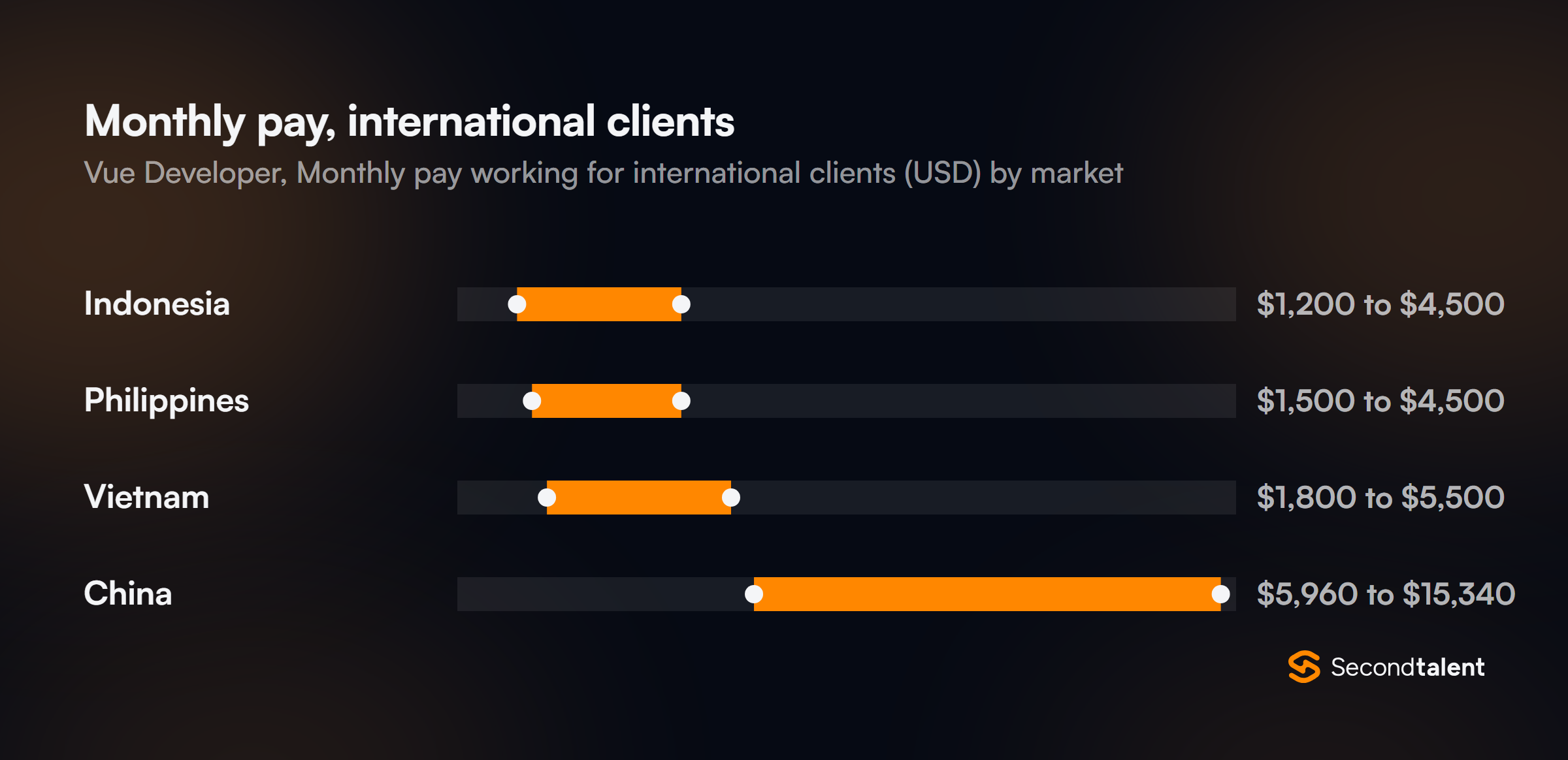
Monthly ranges from the Remote (Working for International Clients) figures on our rate cards for Indonesia, the Philippines, Vietnam and China, converted at ExchangeRate-API mid-market rates for 14 September 2026.
The Indonesian, Philippine and Vietnamese cards publish US dollars with a fixed top, so conversion leaves them unchanged. The Chinese card is set in yuan, ¥40,000 to ¥103,000+, and is open at the top.
Second Talent bills a Vue developer as one monthly fee that bundles salary, payroll taxes, statutory contributions and our service fee. Our pricing page sets out the subscription and direct-hire options. For the freelance route, our Vue.js cost-to-hire page puts a mid-level US contract Vue developer at $89 to $140 an hour.
US Pay Benchmark for Vue Developers
BLS publishes no framework-level titles. A Vue developer maps to Software Developers (15-1252), because most Vue work is application software: dashboards, admin panels and single-page products. The table adds Web Developers (15-1254) for a hire who builds marketing sites and content pages in Nuxt.
| BLS OEWS, May 2025, national |
Software Developers (15-1252) |
Web Developers (15-1254) |
| Median annual |
$135,980 |
$92,650 |
| 10th percentile, monthly |
$6,870 |
$4,010 |
| 25th percentile, monthly |
$8,770 |
$5,350 |
| Median, monthly |
$11,330 |
$7,720 |
| 75th percentile, monthly |
$14,330 |
$10,520 |
| 90th percentile, monthly |
$17,890 |
$13,520 |
Monthly figures are the annual wages on the BLS OEWS profiles for 15-1252 and 15-1254 divided by 12, rounded to the nearest $10.
Salary is only part of the US cost. In the BLS Employer Costs for Employee Compensation release for June 2026, wages and salaries made up 68.5% of employer compensation costs for full-time private industry workers, and benefits the other 31.5%.
Time Zone Overlap with ET, CT and PT
A Nuxt release that breaks a cached page shows up first in your US traffic, so the hours worth buying are the ones around your morning deploy. Asian cities keep one offset all year, and US daylight time runs from 8 March to 1 November 2026, per NIST.
| Engineer's city |
UTC offset |
9:00 am ET (EDT) |
9:00 am CT (CDT) |
9:00 am PT (PDT) |
| Manila, Singapore, Kuala Lumpur, Taipei |
UTC+8 |
9:00 pm |
10:00 pm |
12:00 midnight |
| Ho Chi Minh City, Jakarta, Bangkok |
UTC+7 |
8:00 pm |
9:00 pm |
11:00 pm |
| Bengaluru |
UTC+5:30 |
6:30 pm |
7:30 pm |
9:30 pm |
After 1 November 2026, every time in the table moves one hour later.
A worked example: a Ho Chi Minh City shift from 5:00 pm to 2:00 am runs from 10:00 to 19:00 UTC. That is 6:00 am to 3:00 pm EDT, so it covers six hours of a 9-to-5 day in New York, five in Chicago and three in San Francisco.
The cost sits at the end of that shift. Vietnam's Labor Code counts 22:00 to 06:00 as night work and adds at least 30% for employees (Articles 98 and 106), which catches the last four hours.
In Manila, the same UTC window runs from 6:00 pm to 3:00 am, and the Labor Code sets a night shift differential of at least 10% between 10 pm and 6 am (Article 86).
A shorter schedule often does the job. Keep code review and component work in the Asian afternoon, and put design sign-off and release checks in the shared hours. We agree that schedule before the offer, which is how our placements get 4-6 hours of daily overlap with US hours.
Vue Developer Skills to Screen For
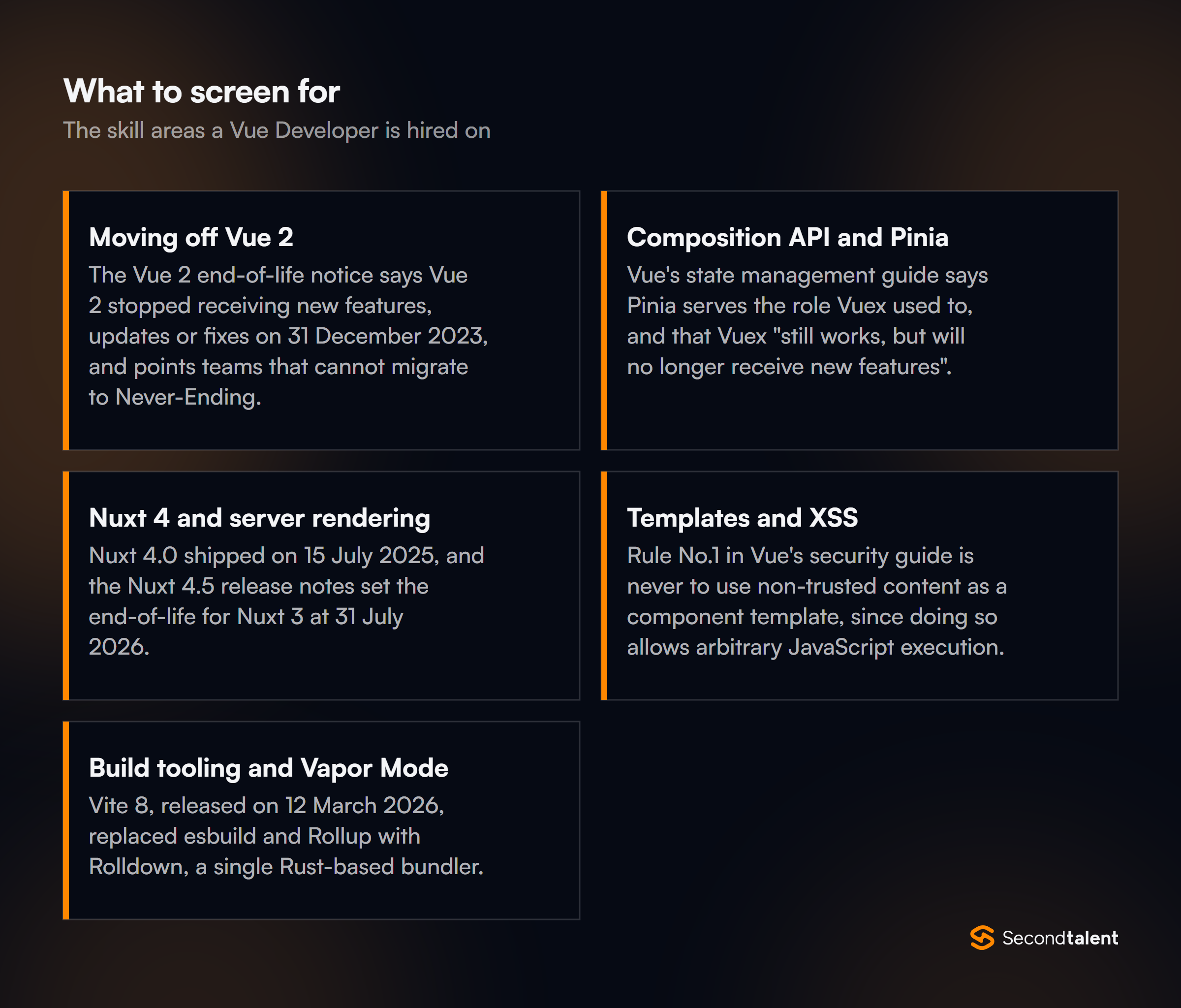
Nuxt's July 2026 security release listed eight advisories, from a server-side code execution path to cached payloads served to the wrong user. Most of the risk in a Vue codebase now sits where the framework meets the server, the build and the version you are stuck on.
Moving off Vue 2
The Vue 2 end-of-life notice says Vue 2 stopped receiving new features, updates or fixes on 31 December 2023, and points teams that cannot migrate to Never-Ending Support from HeroDevs. GitHub's advisory for CVE-2024-9506, a low-severity ReDoS in the template parser, lists all 2.x releases as affected. Vue's migration build, @vue/compat, runs Vue 3 in Vue 2 mode by default, with Vue 2 behavior configurable, so a team can upgrade in steps. Ask the candidate how they ordered their last migration, and what they did about filters, $listeners and Vuetify 2.
Vuex, Pinia and the Composition API
Vue's state management guide says Pinia serves the role Vuex used to, and that Vuex "still works, but will no longer receive new features". Vuex's last npm release, 4.1.0, dates from October 2022, while Pinia reached 4.0.0 in July 2026. Ask the candidate to rewrite a Vuex module and a mixin as a Pinia store and a typed composable.
Nuxt 4 and server rendering
Nuxt 4.0 shipped on 15 July 2025, and the Nuxt 4.5 release notes set the end-of-life for Nuxt 3 at 31 July 2026. The July advisories show where server rendering goes wrong. One affected apps that cache authenticated pages with swr or isr route rules, where _payload.json could reach a different user. Another, CVE-2026-71315, skipped route-rule middleware on mixed-case paths. Ask the candidate where they put an authorization check in Nuxt, and which pages they would keep out of the cache.
Hiring Nuxt.js developers: data fetching and runtime config
Many teams that ask for a Vue developer need Nuxt work (see our Nuxt.js developers page), and the skills differ: a developer who has only built single-page apps may never have handled server-side state. Nuxt's data fetching guide warns that calling $fetch in a component's setup can fetch the same data twice, once on the server and again during hydration. useFetch and useAsyncData forward the server result to the client in the payload, and calls that share a key also share the same data, error and status refs, so a careless key mixes one page's data into another.
Secrets are the second test. In Nuxt's runtime config, keys under public are exposed to the browser and the rest stay on the server, with NUXT_ environment variables overriding them at runtime. Give the candidate a page that calls $fetch in setup and an API key placed under public, and score whether they fix both. Then ask them to add one route under server/api/ and explain where that code runs once deployed.
Templates and XSS
Rule No.1 in Vue's security guide is never to use non-trusted content as a component template, since doing so allows arbitrary JavaScript execution. During server rendering, it can lead to a server breach. The July server-side code execution advisory fits that rule: with vue.runtimeCompiler enabled, crafted island props could run code in the Nitro server process. Show the candidate a component that renders CMS content through v-html and score how they sanitize it.
Build tooling and Vapor Mode
Vite 8, released on 12 March 2026, replaced esbuild and Rollup with Rolldown, a single Rust-based bundler. In the Vite team's announcement, Linear reported production builds falling from 46 seconds to 6. Vue 3.6 adds Vapor Mode, which Evan You's 3.6.0-alpha.1 notes describe as a 100% opt-in compilation mode for <script setup> components. An app created with createVaporApp leaves out the Virtual DOM runtime, and the same notes advised against migrating existing components during the alpha. Ask where the candidate would try Vapor first, and what a bundler swap broke in their last upgrade.
Vue Storefront (Alokai) and Vuetify projects
Vue Storefront renamed itself Alokai in March 2024 after launching a React version of its storefront kit, so an older CV may say Vue Storefront and a newer one Alokai for the same experience. The work is a headless commerce front end that talks to a separate commerce platform through an integration layer. Ask the candidate which commerce back end their storefront ran on, how they cached product and category pages, and how cart and checkout state survived a server-rendered page load.
Vuetify is the other library worth naming in the brief. Vuetify 2 targets Vue 2 and Vuetify 3 targets Vue 3, and the jump changes components and theming, which is why a Vuetify 2 admin panel often holds back a whole Vue 3 migration. Ask for a component the candidate rebuilt across that upgrade and what changed in the theme.
Contractor or Employer of Record for a US Company
Software is not one of the nine categories of commissioned work that can be "work made for hire" under 17 U.S.C. § 101. Components, composables, Pinia stores and Nuxt modules a contractor writes for you stay theirs until transferred, and § 204(a) requires that transfer in writing, signed.
IRS Publication 515 says the place where services are performed determines the source of the income, so a developer working from Jakarta or Hanoi earns foreign-source income. A foreign individual gives the payer Form W-8BEN to certify foreign status.
The developer's own country applies its own employment test:
- Philippines: courts use the four-fold test, and in Atok Big Wedge v. Gison the Supreme Court called the power of control the most important of the four.
- Vietnam: under Article 13 of the 2019 Labor Code, an agreement under another name that covers a paid job, wages and one party's management and supervision counts as a labor contract.
|
Independent contractor |
Employer of Record |
| Legal employer |
None; the developer invoices you |
The EOR's local entity |
| US paperwork |
Form W-8BEN from the developer |
Service agreement with the EOR |
| IP |
Written assignment covering components, composables and stores |
Assignment in the employment contract and your EOR agreement |
| Local labor law |
Classification risk if you set hours and assign daily tickets |
Night premiums, public holidays and leave apply |
| Pay currency |
Agreed in the contract, often USD |
Local currency; Vietnam's Labor Code states wages in dong (Article 95) |
A fixed-scope Vue 2 to Vue 3 migration with a delivery date suits a contractor agreement. A developer who joins your sprints and owns the front end fits the employment tests above, and our Employer of Record service employs that developer in-country for you. Our Vietnam EOR page lists the employer contributions to budget for. This is a summary, not legal advice.
English Level and Working Norms
Indonesian IT workers score 523 on the EF English Proficiency Index 2025, 52 points above Indonesia's national score of 471. China's IT workers also score above their national figure, 491 against 464. The index covers 123 countries and regions, with a global average of 488.
| Country |
EF EPI 2025 score |
World rank (of 123) |
IT job-function score |
| Philippines |
569 |
28 |
581 |
| Vietnam |
500 |
64 |
500 |
| Indonesia |
471 |
80 |
523 |
| China |
464 |
86 |
491 |
Scores come from EF's country pages, such as Indonesia and China.
Vue's documentation has complete translations in Simplified Chinese, Japanese and Traditional Chinese, so a developer can know the framework well without reading much English. Test the writing that reaches your team: ask finalists for the pull request description of their assessment, and for the migration note a US product manager would read.
Plan releases around both calendars. Thanksgiving on 26 November 2026 is a working day in Asia, so a developer there can watch a front-end release while your US team is off. Vietnam's Labor Code gives five paid days for Lunar New Year (Article 112), and a Nuxt upgrade should not go live that week with a Vietnam-based developer.
Vue Developer Hiring Process
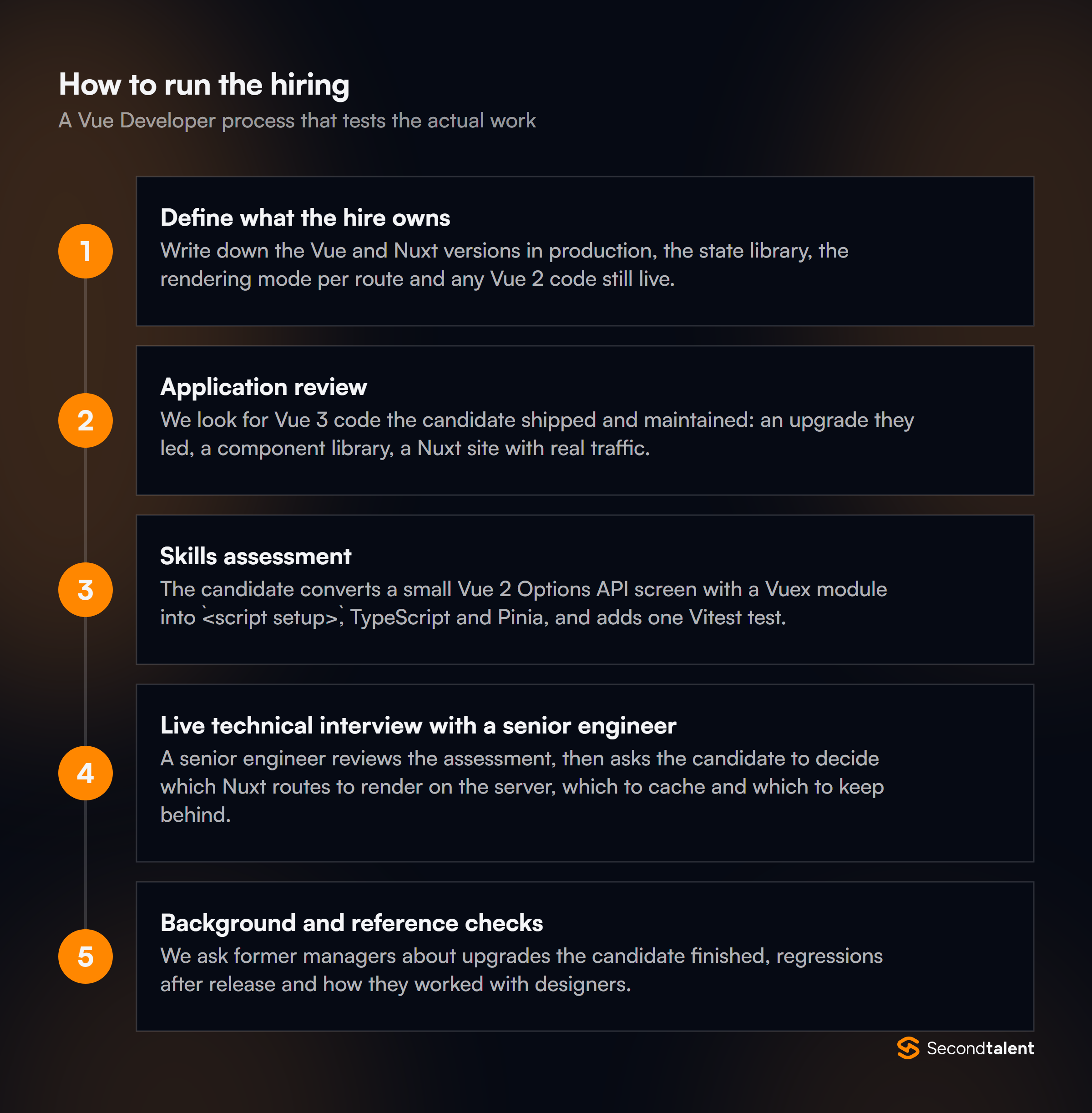
Second Talent's vetting covers stages 2 to 5 before you see a profile. Our Vue.js interview guide has question sets for your own final round.
Stage 1: Define what the hire owns
Write down the Vue and Nuxt versions in production, the state library, the rendering mode per route and any Vue 2 code still live. A migration hire and a greenfield Nuxt 4 build need different tests.
Stage 2: Application review
We look for Vue 3 code the candidate shipped and maintained: an upgrade they led, a component library, a Nuxt site with real traffic. For Laravel shops we check Inertia work, since Laravel's starter kits ship a Vue option built on Inertia and the Composition API.
Stage 3: Skills assessment
The candidate converts a small Vue 2 Options API screen with a Vuex module into <script setup>, TypeScript and Pinia, and adds one Vitest test. We plant a v-html binding fed by user input and score whether they catch it.
Stage 4: Live technical interview with a senior engineer
A senior engineer reviews the assessment, then asks the candidate to decide which Nuxt routes to render on the server, which to cache and which to keep behind middleware, and why a mixed-case path matters.
Stage 5: Background and reference checks
We ask former managers about upgrades the candidate finished, regressions after release and how they worked with designers. You then choose the contractor or EOR route above.
Hire Vue Developers from Asia with Second Talent
We shortlist 6-8 candidates within 24 hours from 100,000+ pre-vetted engineers, accepting only the top 1% of applicants. Vue developers come with $0 upfront, no lock-in and 4-6 hours of daily overlap with US hours. We handle contracts, payroll and equipment, with compliant EOR contracts and payroll in 9 Asian markets.
Our pricing page sets out subscription, direct-hire and EOR pricing. For a React or TypeScript codebase we also staff React developers and front-end developers.