TL;DR: ZK developers from Asia who work for foreign companies earn $2,000 to $9,000 a month on our blockchain developer rate cards, and Second Talent shortlists 6-8 pre-vetted candidates within 24 hours. The closest US benchmark, the BLS median for software developers, was $135,980 a year in May 2025.
Fifteen of the 27 bugs in 0xPARC's community ZK Bug Tracker carry the under-constrained circuit tag. In one, circomlib's MiMC hash used = where it needed <==, which would have let an attacker fake a Merkle root in Tornado Cash and withdraw someone else's ETH. The core ZK skill is finding the missing constraint.
Key takeaways
- Malaysia has the highest floor on our blockchain developer cards, $3,500 a month, and the Philippines the lowest ceiling, $6,500.
- The Ethereum Foundation reported zkVMs proving 99% of Ethereum blocks in under 10 seconds on target hardware by December 2025.
- Its end-of-2026 target is 128-bit provable security with final proofs of 300 KiB or less.
- Ethereum's KZG ceremony drew 141,416 contributions over 208 days in 2023, and needed only one honest participant.
What ZK Developers Earn Working for International Clients in Asia
We publish no ZK-only rate card, so the table uses our blockchain developer rate cards, the closest match for engineers who write circuits and the verifier contracts that check them. Each range is what developers in that market earn working directly for foreign companies, before any employer or platform costs.
| Market |
Monthly pay working for international clients (USD) |
| Indonesia |
$2,000-$8,000 |
| Philippines |
$2,200-$6,500 |
| Vietnam |
$2,200-$8,500 |
| Thailand |
$2,500-$8,500 |
| Malaysia |
$3,500-$9,000 |
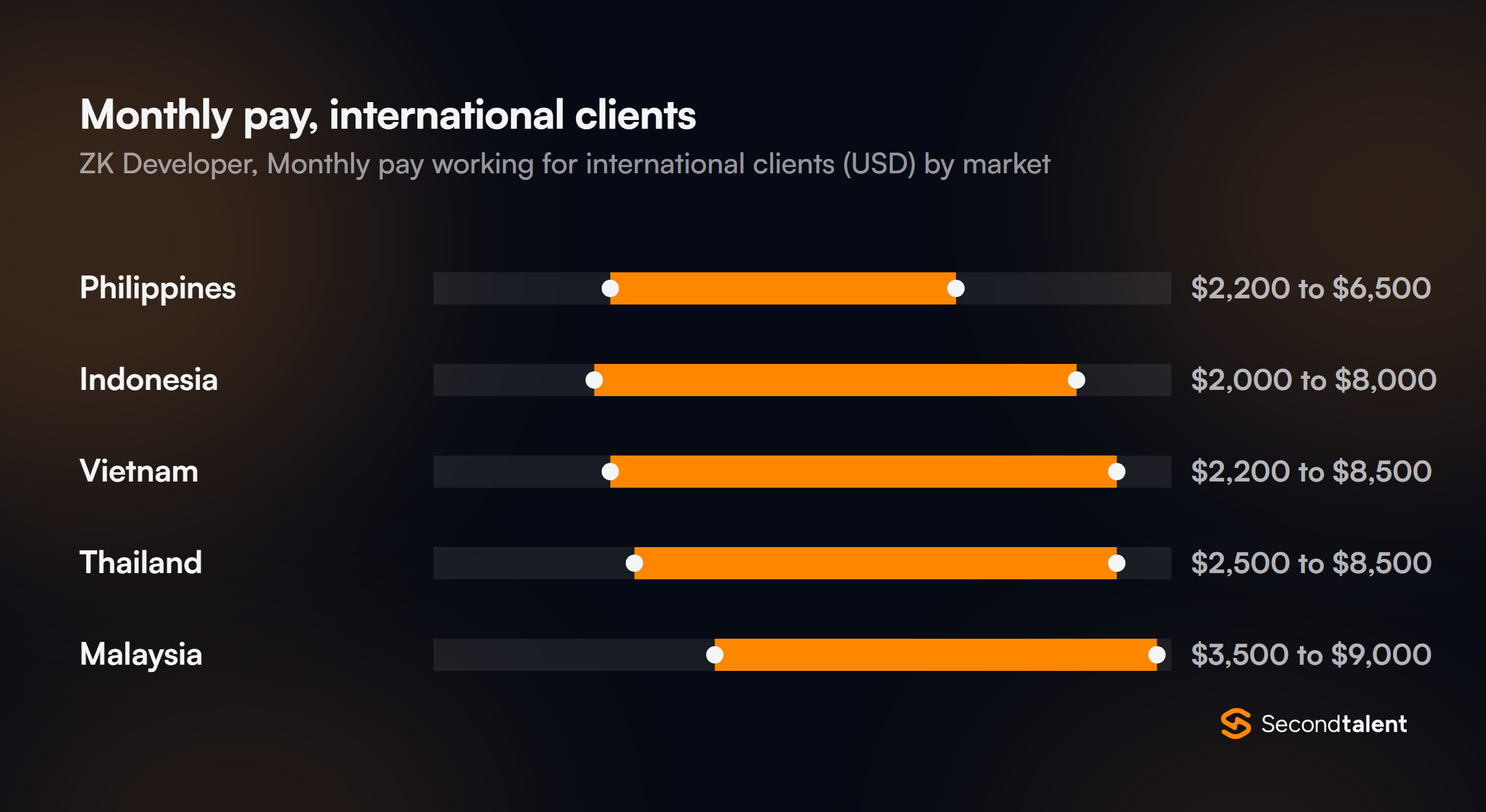
Monthly ranges from the Remote (Working for International Clients) figures on our rate cards for Indonesia, the Philippines, Vietnam, Thailand and Malaysia, converted at ExchangeRate-API mid-market rates for 14 September 2026. All five cards publish US dollar figures, so the conversion leaves them unchanged.
Vietnam and Thailand share the same $8,500 ceiling, and Vietnam shows the widest spread, $6,300 from floor to top. The cards cover blockchain development in general, not circuit work in particular.
Second Talent bills a ZK developer as one monthly fee that bundles salary, payroll taxes, statutory contributions and our service fee. The pricing page sets out the subscription and direct-hire options.
US Pay Benchmark for ZK Developers
BLS publishes no cryptography engineer title. ZK developers map to Software Developers (15-1252), the occupation used for blockchain roles, because the job is building circuits, provers and verifier contracts that run in production.
| BLS OEWS, May 2025, national |
Software Developers (15-1252) |
| Median annual |
$135,980 |
| 10th percentile, monthly |
$6,870 |
| 25th percentile, monthly |
$8,770 |
| Median, monthly |
$11,330 |
| 75th percentile, monthly |
$14,330 |
| 90th percentile, monthly |
$17,890 |
Monthly figures are the annual wages on the OEWS profile for 15-1252 divided by 12, rounded to the nearest $10. A researcher who designs new proof systems rather than implementing them sits closer to Computer and Information Research Scientists (15-1221), with a national median of $140,300 a year.
Salary is only part of the US cost. In the BLS Employer Costs for Employee Compensation release for June 2026, wages and salaries made up 68.5% of employer compensation costs for full-time private industry workers, and benefits the other 31.5%.
Time Zone Overlap with ET, CT and PT
Much of ZK work runs unattended. Benchmark sweeps, prover builds and constraint-count checks can run for hours on GPU machines. An engineer in Asia can start them before signing off and read the results while your US team is still asleep.
US daylight time runs from 8 March to 1 November 2026, per NIST, and none of the cities below change their clocks.
| Engineer's city |
UTC offset |
9:00 am ET (EDT) |
9:00 am CT (CDT) |
9:00 am PT (PDT) |
| Manila, Singapore, Kuala Lumpur, Taipei |
UTC+8 |
9:00 pm |
10:00 pm |
12:00 midnight |
| Ho Chi Minh City, Jakarta, Bangkok |
UTC+7 |
8:00 pm |
9:00 pm |
11:00 pm |
| Bengaluru |
UTC+5:30 |
6:30 pm |
7:30 pm |
9:30 pm |
After 1 November 2026, every time in the table moves one hour later.
A Ho Chi Minh City shift from 4:00 pm to 1:00 am runs 09:00 to 18:00 UTC. Subtract four hours for EDT and it covers 5:00 am to 2:00 pm in New York: five hours inside a 9-to-5 day, four with Chicago and two with San Francisco.
We set that schedule before the offer, which is how our placements get 4-6 hours of daily overlap with US hours. Spend the shared hours on circuit reviews, audit findings and specification changes, where a misunderstanding costs a week of rework.
For employees, three hours of that shift fall inside Vietnam's night-work window of 22:00 to 06:00, which carries at least 30% extra under Labor Code Articles 98 and 106. The Philippine Labor Code sets at least 10% for work between 10 pm and 6 am (Article 86).
ZK Developer Skills to Screen For
The Circom docs on constraint generation show why ZK code needs its own review. <-- assigns a value without adding a constraint, === adds the constraint, and <== does both. Since version 2.0.8 the compiler warns when <-- assigns a quadratic expression that <== should have constrained.
Constraints in Circom circuits
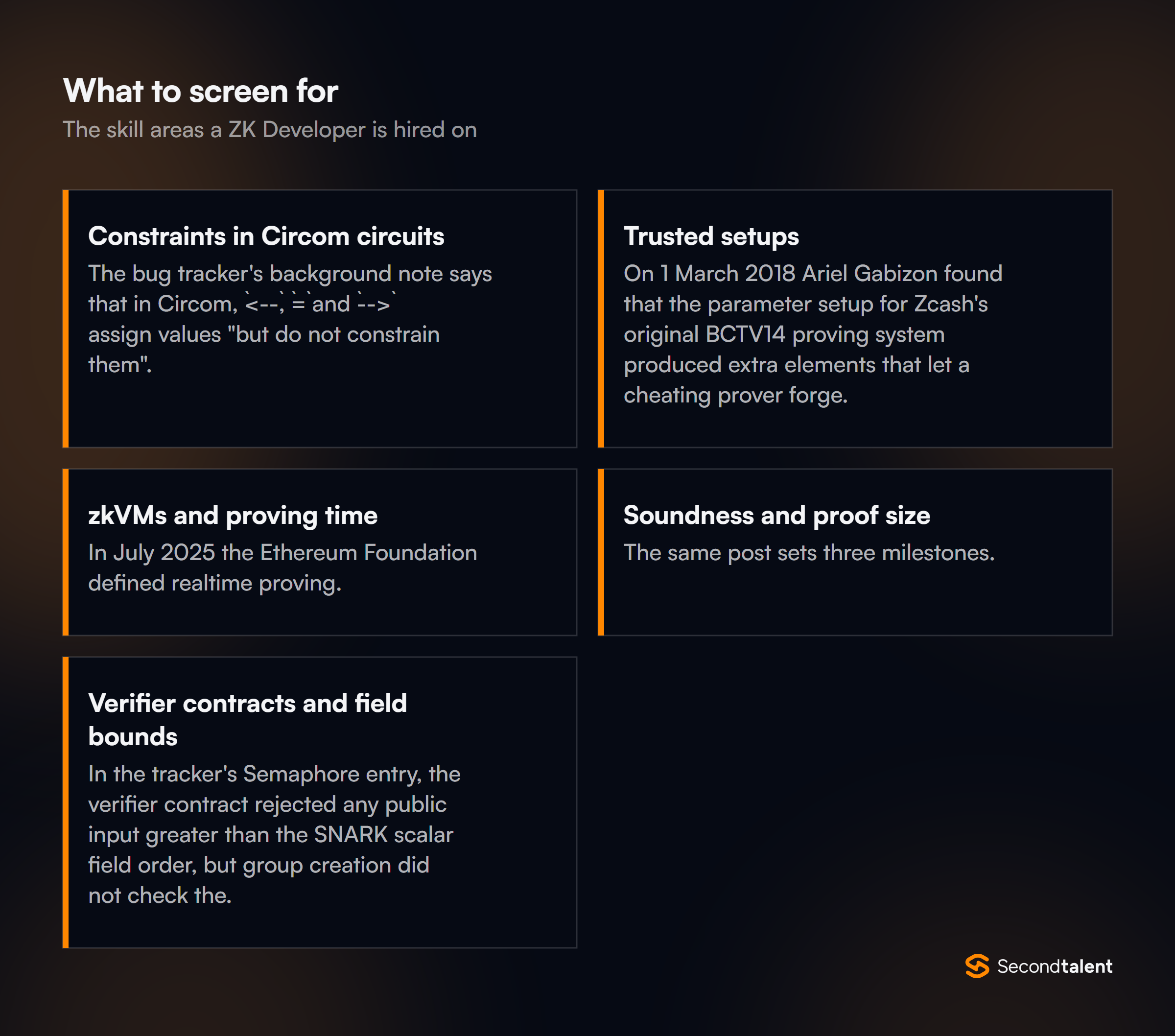
The bug tracker's background note says that in Circom, <--, = and --> assign values "but do not constrain them". Trail of Bits built Circomspect, a static analyzer and linter for Circom, to catch potential issues in circuits. Give the candidate a range-check template with one signal assigned but never constrained, and ask them to write the proof that exploits it before they fix it.
Trusted setups
On 1 March 2018 Ariel Gabizon found that the parameter setup for Zcash's original BCTV14 proving system produced extra elements that let a cheating prover forge proofs. The Zcash disclosure says the Sapling upgrade of 28 October 2018 fixed it by moving to Groth16 with new parameters, and that the company saw no evidence counterfeiting occurred.
Ethereum's KZG ceremony needed only one honest participant among its 141,416 contributions. Ask the candidate which parts of your stack depend on a per-circuit setup, a universal one, or none.
zkVMs and proving time
In July 2025 the Ethereum Foundation defined realtime proving. The target: 10 seconds or less for P99 of mainnet blocks, on hardware costing $100,000 or less and drawing 10 kW or less, with at least 128 bits of security. Its December security foundations post reported latency down from 16 minutes to 16 seconds and costs down 45 times.
Ask the candidate when they would write a custom circuit and when they would compile Rust to a zkVM instead. Then ask what that choice does to proving cost.
Soundness and proof size
The same post sets three milestones. Teams were to integrate soundcalc by the end of February 2026 and reach 100-bit provable security with proofs of 600 KiB or less by the end of May. The end-of-2026 goal is 128-bit provable security at 300 KiB or less. It warns that many STARK-based zkEVMs "rely on unproven mathematical conjectures to hit their security targets".
Ask the candidate to state the security level of a proof system they shipped and whether that figure is proven or conjectured.
Verifier contracts and field bounds
In the tracker's Semaphore entry, the verifier contract rejected any public input greater than the SNARK scalar field order, but group creation did not check the group ID against it. A Solidity uint256 holds larger numbers, so an owner could create a group that always failed verification.
The tracker also notes that since Circom 2.0 the optimizer can remove public inputs that appear in no constraint. Hand the candidate a verifier contract and ask for every input check the circuit assumes.
Contractor or Employer of Record for a US Company
Privacy code attracts attackers. The FBI's January 2025 public service announcement on North Korean IT workers describes remote hires who copied company code repositories to personal accounts and later held that code for ransom. It recommends identity verification during interviewing, onboarding and throughout employment.
Software is not one of the nine categories of commissioned work that can be "work made for hire" under 17 U.S.C. § 101. Circuits, prover code and verifier contracts a contractor writes stay theirs until transferred, and § 204(a) requires that transfer in writing, signed.
IRS Publication 515 says the place where services are performed determines the source of the income. A foreign individual gives the payer Form W-8BEN to certify foreign status.
Product scope matters too. Treasury removed sanctions on Tornado Cash on 21 March 2025, citing novel legal and policy issues, and said it remains concerned about North Korean hacking and money laundering. If your product moves value privately, have US counsel review it before you staff the team.
The developer's own country applies its own employment test. Philippine courts use the four-fold test, and in Atok Big Wedge v. Gison the Supreme Court called control the most important of the four. Under Article 13 of Vietnam's 2019 Labor Code, an agreement under another name that covers a paid job, wages and one party's management and supervision counts as a labor contract.
|
Independent contractor |
Employer of Record |
| Legal employer |
None; the developer invoices you |
The EOR's local entity |
| US paperwork |
Form W-8BEN from the developer |
Service agreement with the EOR |
| IP |
Written assignment covering circuits, prover code and verifier contracts |
Assignment in the employment contract and your EOR agreement |
| Local labor law |
Classification risk if the work looks like employment |
Night premiums, public holidays and leave apply |
| Pay currency |
Agreed in the contract |
Local currency; Vietnam's Labor Code states wages in dong (Article 95) |
A fixed circuit audit or a one-off prover port suits a contractor agreement. A developer who holds the setup keys or deploy rights for your verifier contracts fits the tests above, and our Employer of Record service employs that developer in-country. Our Vietnam EOR page lists the employer contributions to budget for. This is a summary, not legal advice.
English Level and Working Norms
ZK teams publish their reasoning: circuit specifications, security assumptions and replies to auditors. Malaysia ranks 24th of 123 countries and regions on the EF English Proficiency Index 2025, and the Philippines 28th, against a global average of 488.
| Country |
EF EPI 2025 score |
World rank (of 123) |
IT job-function score |
| Malaysia |
581 |
24 |
590 |
| Philippines |
569 |
28 |
581 |
| Vietnam |
500 |
64 |
500 |
| Indonesia |
471 |
80 |
523 |
| Thailand |
402 |
116 |
459 |
Scores come from EF's country pages, such as the Philippines and Thailand. Ask finalists for a one-page specification of the assessment circuit that lists each public input and the constraint that binds it.
Plan audits across both calendars. Thanksgiving on 26 November 2026 is a working day in Asia, so a developer there can answer auditor questions while your US team is off.
Article 112 of Vietnam's Labor Code gives five paid days for Lunar New Year, in late January or February. Avoid booking an audit kickoff that week with a Vietnam-based lead.
ZK Developer Hiring Process
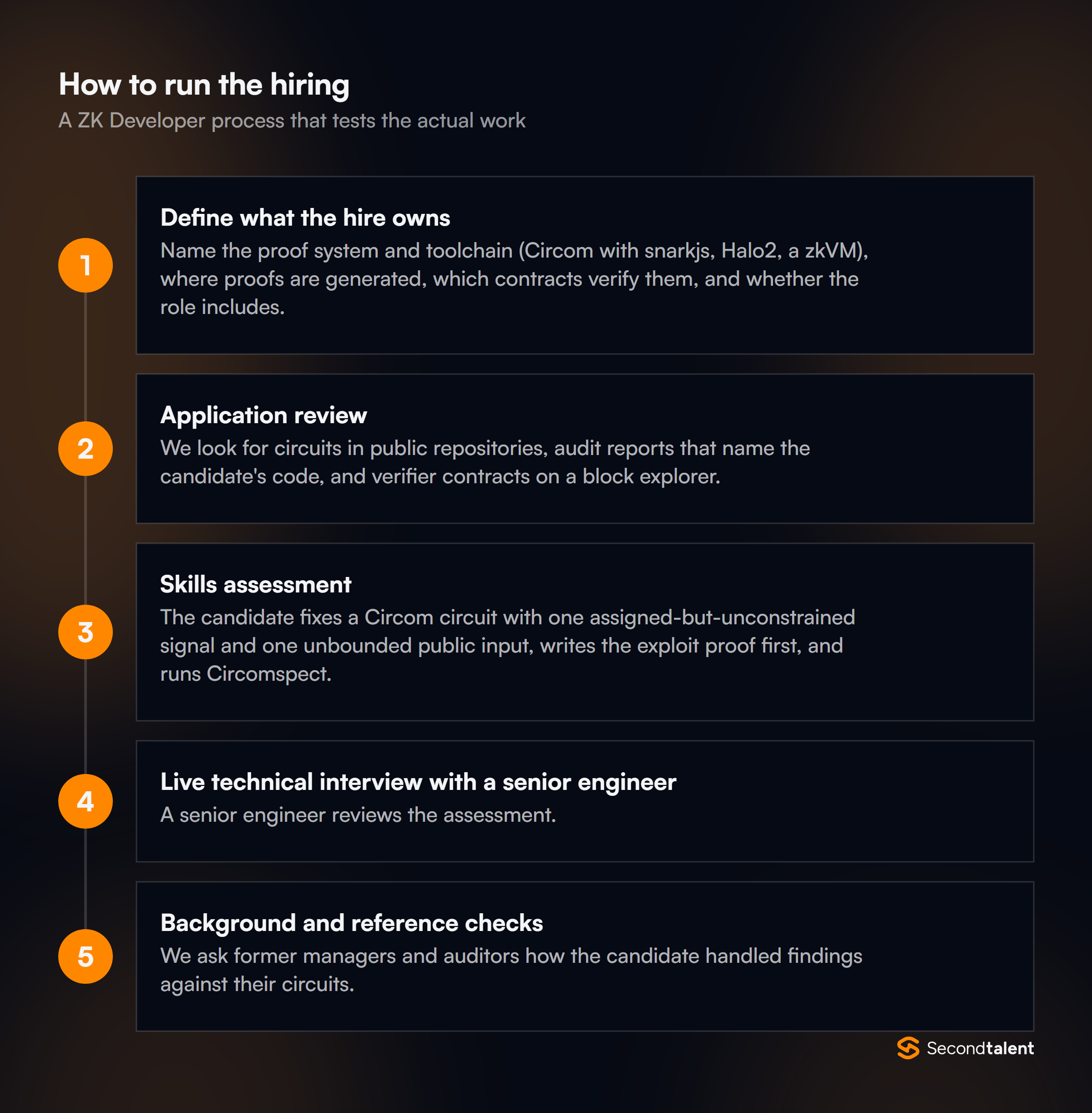
Second Talent's vetting covers stages 2 to 5 before you see a profile. For the contract side of a ZK product, our Solidity developer page and Rust developer page cover the adjacent roles.
Stage 1: Define what the hire owns
Name the proof system and toolchain (Circom with snarkjs, Halo2, a zkVM), where proofs are generated, which contracts verify them, and whether the role includes setup ceremonies. Circuit implementation and proof-system research need different tests.
Stage 2: Application review
We look for circuits in public repositories, audit reports that name the candidate's code, and verifier contracts on a block explorer. We ask for constraint counts and proving times in plain numbers.
Stage 3: Skills assessment
The candidate fixes a Circom circuit with one assigned-but-unconstrained signal and one unbounded public input, writes the exploit proof first, and runs Circomspect on the result. We score the written specification alongside the code.
Stage 4: Live technical interview with a senior engineer
A senior engineer reviews the assessment. The candidate then compares a custom circuit with a zkVM for one of your use cases and states the security level of each option.
Stage 5: Background and reference checks
We ask former managers and auditors how the candidate handled findings against their circuits. Before granting repository access, confirm identity at onboarding as the FBI advises, then sign with the IP assignment in place.
Hire ZK Developers from Asia with Second Talent
We shortlist 6-8 candidates within 24 hours from 100,000+ pre-vetted engineers, accepting only the top 1% of applicants. ZK developers come with $0 upfront, no lock-in and 4-6 hours of daily overlap with US hours. We handle contracts, payroll and equipment, with compliant EOR contracts and payroll in 9 Asian markets.
Our pricing page covers subscription, direct-hire and EOR pricing. Open Campus, the Web3 education protocol, hired 10 engineers in 2 months through us, and the Open Campus case study reports a 70% increase in productivity.