TL;DR: Flutter developers from Asia who work for international clients earn $1,500 to $7,010+ a month on our rate cards, and we shortlist 6-8 candidates within 24 hours. The closest US benchmark, the BLS median for software developers, was $135,980 a year in May 2025.
Flutter 3.47, released on 12 August 2026, moved Material and Cupertino out of the core SDK into standalone material_ui and cupertino_ui packages. Google plans to deprecate the built-in copies in the November stable release, and the CocoaPods registry goes read-only on 2 December 2026. Both deadlines fall inside a new hire's first 90 days.
Key takeaways
- Dart was used by 6.1% of professional developers in Stack Overflow's 2025 survey, against 5.7% for Swift.
- Android runs on 78.13% of mobile devices in Asia but only 39.29% in the US, so a Flutter hire in Asia tests on a different mix of phones from the one your US users carry.
- Apple has required builds from Xcode 26 since 28 April 2026, and Flutter 3.47 raised the minimum iOS version to 15.
- Code a contractor writes for you is not "work made for hire" under US copyright law, so the contract needs a signed assignment.
What Flutter Developers Earn Working for International Clients in Asia
Thailand has the highest floor of the six markets, at $2,270 a month, while India's range reaches the highest ceiling, $7,010 with no published top. The figures are what Flutter developers in each market earn working directly for foreign companies, before any employer or platform costs.
| Market |
Monthly pay working for international clients (USD) |
| Indonesia |
$1,500-$4,500 |
| Philippines |
$1,600-$3,270+ |
| India |
$1,880-$7,010+ |
| Vietnam |
$2,000-$5,500 |
| Malaysia |
$2,200-$5,500 |
| Thailand |
$2,270-$4,230+ |
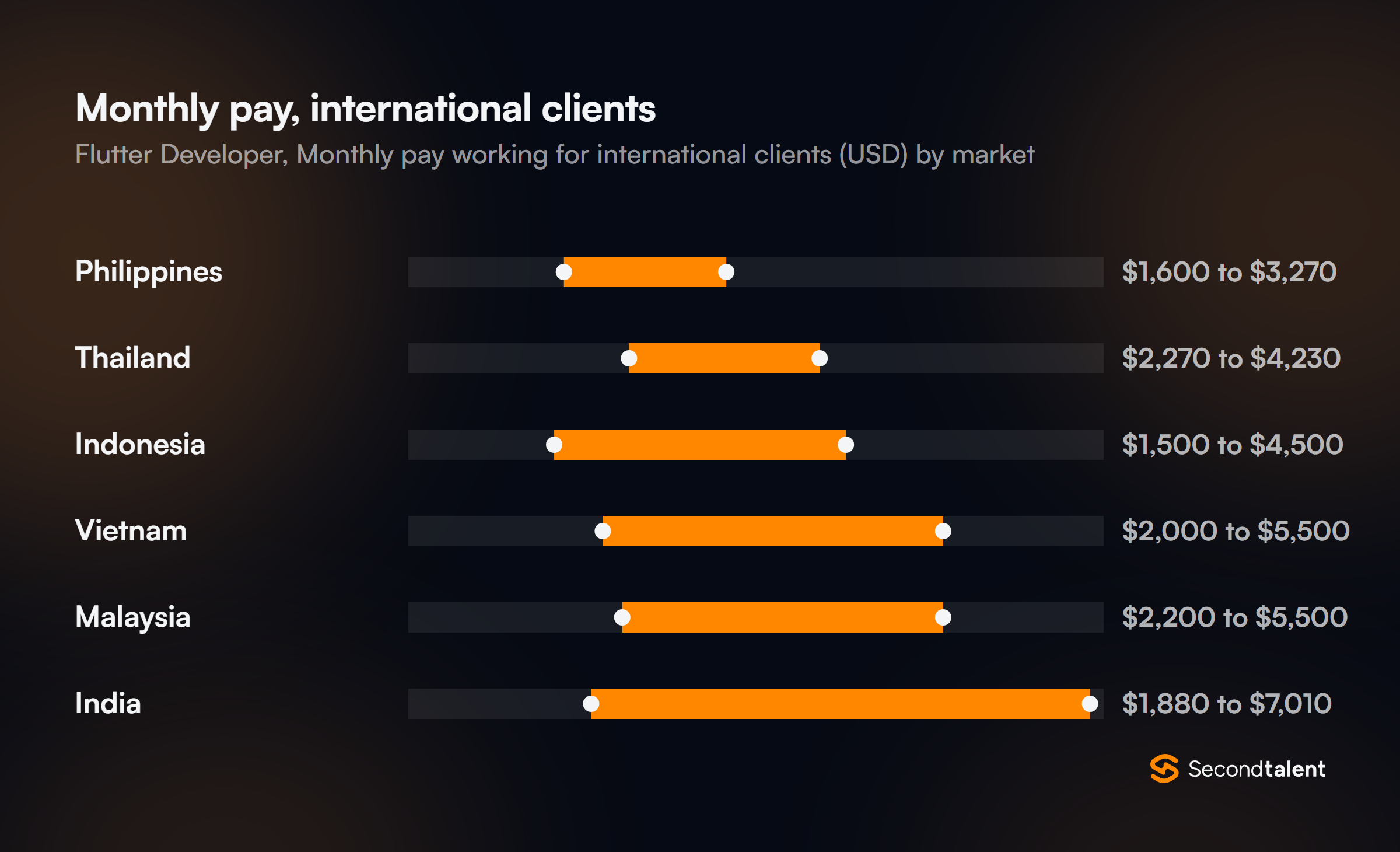
Monthly ranges from the Remote (Working for International Clients) figures on our rate cards for Indonesia, the Philippines, India, Vietnam, Malaysia and Thailand, converted at ExchangeRate-API mid-market rates for 14 September 2026.
The Indonesian, Vietnamese and Malaysian cards publish this figure in US dollars with a fixed top. The Philippine card quotes pesos (₱62.69 to the dollar), the Indian card rupees (₹95.61) and the Thai card baht (฿33.08), each with an open top marked "+".
Vietnam's top is 2.75 times its floor, so the brief (a greenfield app or a five-year-old codebase with custom plugins) moves the figure more than the country does. Our pricing page explains how we bill a Second Talent subscription, and our Flutter interview guide has question sets you can reuse in your own final round.
US Pay Benchmark for Flutter Developers
A US software developer at the 10th percentile earns $6,870 a month, three times Thailand's $2,270 floor, the highest floor in the table above. BLS has no separate mobile or cross-platform occupation, so Flutter work maps to Software Developers (15-1252), the occupation that designs and builds applications.
| BLS OEWS, May 2025, national |
Software Developers (15-1252) |
| Median annual |
$135,980 |
| 10th percentile, monthly |
$6,870 |
| 25th percentile, monthly |
$8,770 |
| Median, monthly |
$11,330 |
| 75th percentile, monthly |
$14,330 |
| 90th percentile, monthly |
$17,890 |
Monthly figures are the annual wages on the BLS OEWS profile for 15-1252 divided by 12, rounded to the nearest $10.
Salary is only part of the US cost. In the BLS Employer Costs for Employee Compensation release for June 2026, wages and salaries made up 68.5% of employer compensation costs for full-time private industry workers, and benefits the other 31.5%.
For the contract route, our Flutter developer cost-to-hire page, updated on 12 September 2026, puts a mid-level US freelance or contract Flutter developer at $108 to $165 an hour.
Time Zone Overlap with ET, CT and PT
A TestFlight build uploaded at 9:00 am in New York lands at 9:00 pm in Manila, so the release rhythm decides the schedule. No city in the table changes its clocks, and US daylight time runs from 8 March to 1 November 2026, per NIST.
| Engineer's city |
UTC offset |
9:00 am ET (EDT) |
9:00 am CT (CDT) |
9:00 am PT (PDT) |
| Manila, Singapore, Kuala Lumpur, Taipei |
UTC+8 |
9:00 pm |
10:00 pm |
12:00 midnight |
| Ho Chi Minh City, Jakarta, Bangkok |
UTC+7 |
8:00 pm |
9:00 pm |
11:00 pm |
| Bengaluru |
UTC+5:30 |
6:30 pm |
7:30 pm |
9:30 pm |
After 1 November 2026, every time in the table moves one hour later.
Three local shifts land on the same UTC window, 09:00 to 18:00:
- Manila, 5:00 pm to 2:00 am
- Ho Chi Minh City, 4:00 pm to 1:00 am
- Bengaluru, 2:30 pm to 11:30 pm
For Manila, 17:00 minus eight hours is 09:00 UTC, and minus four more is 5:00 am EDT. The window runs 5:00 am to 2:00 pm in New York: five hours inside a 9-to-5 day on the East Coast, four with Chicago and two with San Francisco.
After 1 November the East Coast figure drops to four hours unless the shift starts an hour later.
Use the shared hours for Figma reviews, iPhone bugs your US testers reproduce and store rejections. Widget builds and plugin upgrades fit the first hours of the shift. We agree that split before the offer, which is how our placements keep 4-6 hours of daily overlap with US hours.
Late hours cost more for employees. The Philippine Labor Code adds at least 10% for work between 10 pm and 6 am (Article 86), four hours of the Manila shift, and Vietnam's Labor Code adds at least 30% for 22:00 to 06:00 (Articles 98 and 106), three hours of the Ho Chi Minh City shift.
Flutter Developer Skills to Screen For
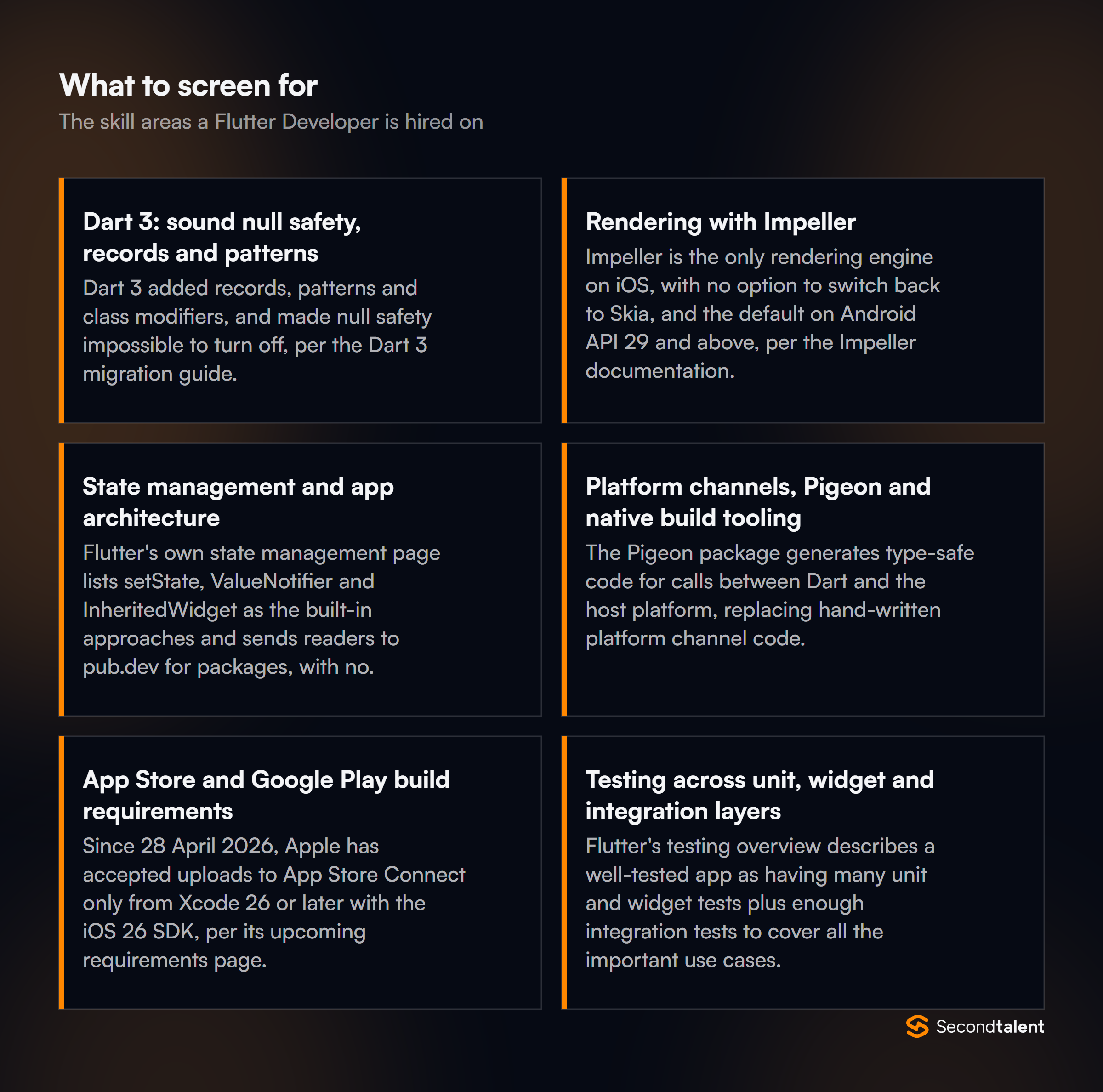
Flutter has shipped a stable release about once a quarter: 3.38 in November 2025, 3.41 in February 2026, 3.44 in May and 3.47 in August, per the SDK release archive. Each one carries a list of breaking changes and migrations. Screen for a developer who reads that list, because most of the risk in a Flutter codebase sits in the upgrade.
Dart 3: sound null safety, records and patterns
Dart 3 added records, patterns and class modifiers, and made null safety impossible to turn off, per the Dart 3 migration guide. In Stack Overflow's 2025 survey, 47.1% of developers who had worked with Dart wanted to keep using it. Ask the candidate to model an API response as a sealed class and handle every case in a switch expression, then add a new case and see whether the analyzer catches the gap.
Rendering with Impeller
Impeller is the only rendering engine on iOS, with no option to switch back to Skia, and the default on Android API 29 and above, per the Impeller documentation. Older Android devices, or ones without Vulkan, fall back to OpenGL. Since Flutter 3.47, Impeller is also the default on macOS, Windows and Linux. Give the candidate a list screen that drops frames on a mid-range Android phone and ask them to find the rebuild or the image decode behind it in DevTools.
State management and app architecture
Flutter's own state management page lists setState, ValueNotifier and InheritedWidget as the built-in approaches and sends readers to pub.dev for packages, with no single package endorsed. The architecture guide recommends splitting each feature into a view, a view model, repositories and services, with repositories as the source of truth for app data. The choice between Riverpod, Bloc and plain ChangeNotifier matters less than one skill: moving a feature's logic out of its widgets and writing a test for it.
Platform channels, Pigeon and native build tooling
The Pigeon package generates type-safe code for calls between Dart and the host platform, replacing hand-written platform channel code.
The native build tooling changed on both platforms this year. Swift Package Manager became the default for iOS and macOS dependencies in Flutter 3.44, with CocoaPods kept in maintenance mode, per the Swift Package Manager guide. On Android, Android Gradle Plugin 9 makes built-in Kotlin the default, and apps that still apply the Kotlin Gradle Plugin fail to build until they migrate to built-in Kotlin or set the temporary opt-out Flutter added in 3.44. Ask the candidate which of your plugins would block removing CocoaPods, and how they would find out.
App Store and Google Play build requirements
Since 28 April 2026, Apple has accepted uploads to App Store Connect only from Xcode 26 or later with the iOS 26 SDK, per its upcoming requirements page. The Flutter 3.47 announcement raised the minimum iOS version from 13 to 15. It also warns that apps built with Xcode 27 that skip the UIScene lifecycle will fail to launch.
On Android, Google Play has required new apps and updates to target API level 36 since 31 August 2026 (Play target API policy), From 1 February 2027, Google Play will refuse updates to apps whose native libraries lack support for 16 KB page sizes. Ask for the last store rejection the candidate fixed and what caused it.
Testing across unit, widget and integration layers
Flutter's testing overview describes a well-tested app as having many unit and widget tests plus enough integration tests to cover all the important use cases. On StatCounter figures for August 2026, Android held 78.13% of mobile OS share in Asia, while iOS held 60.68% in the US. Ask which physical iPhones the candidate tests on, and have them write one widget test for a form that must show a validation error.
Contractor or Employer of Record for a US Company
Software is not one of the nine categories of commissioned work that can be "work made for hire" under 17 U.S.C. § 101. The Dart code, custom plugins and native iOS and Android glue a contractor writes stay theirs until transferred, and § 204(a) requires that transfer to be in writing and signed.
A Flutter app has two store listings to own as well as a repository. Apple's enrollment page requires a D-U-N-S Number for an organization account, and Google Play asks for one on organization accounts too. Enroll the company in both stores, then add the developer as a team member, so signing certificates, reviews and listings stay with you when the engagement ends.
IRS Publication 515 says the place where the developer performs the services determines the source of the income, so a developer working from Ho Chi Minh City earns foreign-source income. A foreign individual gives the payer Form W-8BEN to certify foreign status.
The developer's own country applies its own employment test. Philippine courts use the four-fold test, and in Atok Big Wedge v. Gison the Supreme Court called the power of control the most important of the four. Article 13 of Vietnam's 2019 Labor Code treats an agreement under another name as a labor contract when it covers a paid job, wages and management or supervision.
|
Independent contractor |
Employer of Record |
| Legal employer |
None; the developer invoices you |
The EOR's local entity |
| US paperwork |
Form W-8BEN from the developer |
Service agreement with the EOR |
| IP |
Written assignment covering Dart code, plugins and native modules |
Assignment terms in the employment contract and your EOR agreement |
| Local labor law |
Classification risk if you set hours and methods |
Night premiums, public holidays and leave apply |
| Pay currency |
Agreed in the contract, often USD |
Local currency through the EOR's payroll; Vietnam's Labor Code states wages in dong (Article 95) |
A fixed-scope job, such as moving an app to the standalone Material package before November, fits a contractor agreement. A developer who ships your releases each sprint meets both employment tests above, and our Employer of Record service employs that developer in-country, with country detail on the Vietnam EOR page. This is a summary, not legal advice.
English Level and Working Norms
Thailand's IT workers score 459 on the EF English Proficiency Index 2025, 57 points above the country's overall 402, and Indonesia's IT score runs 52 points above its national figure. The index covers 123 countries and regions, with a global average of 488.
| Country |
EF EPI 2025 score |
World rank (of 123) |
IT job-function score |
| Malaysia |
581 |
24 |
590 |
| Philippines |
569 |
28 |
581 |
| Vietnam |
500 |
64 |
500 |
| India |
484 |
74 |
487 |
| Indonesia |
471 |
80 |
523 |
| Thailand |
402 |
116 |
459 |
Scores come from EF's country pages, such as the Philippines, Indonesia and Thailand.
Mobile work produces English that strangers read: App Review notes, store release notes and replies to one-star reviews. Ask finalists to answer a sample App Review rejection in writing. It shows whether the developer can explain a fix to a reviewer who has not seen the code.
Plan releases around both calendars. Thanksgiving on 26 November 2026 is a working day in Asia, so a developer there can watch crash reports from the holiday traffic while your US team is off.
Vietnam's Labor Code gives five paid days for Lunar New Year (Article 112), in late January or February, so hold major store submissions that week with a Vietnam-based developer.
Flutter Developer Hiring Process
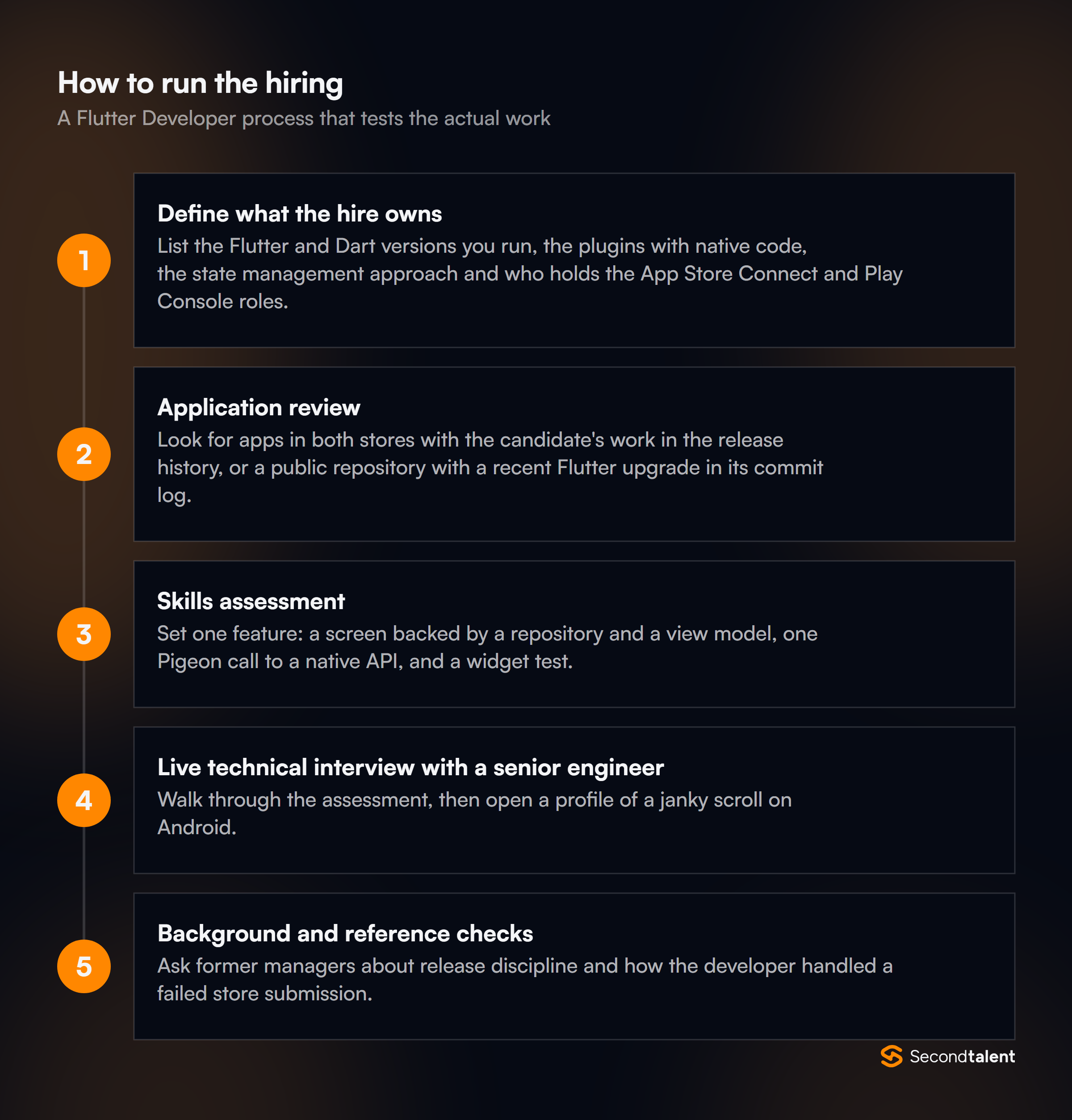
Second Talent's vetting covers stages 2 to 5 before you see a profile. The exercises below are the Flutter versions to run in your own final round, and our Dart interview guide adds language questions.
Stage 1: Define what the hire owns
List the Flutter and Dart versions you run, the plugins with native code, the state management approach and who holds the App Store Connect and Play Console roles. Say whether the app also ships to web or desktop, because that changes the test.
Stage 2: Application review
Look for apps in both stores with the candidate's work in the release history, or a public repository with a recent Flutter upgrade in its commit log. Ask which Flutter version the app shipped on and who handled store rejections.
Stage 3: Skills assessment
Set one feature: a screen backed by a repository and a view model, one Pigeon call to a native API, and a widget test. Plant an import of the in-SDK Material library and score whether the candidate flags the November deprecation.
Stage 4: Live technical interview with a senior engineer
Walk through the assessment, then open a profile of a janky scroll on Android. Ask how the candidate would take your app from the Flutter version you run to 3.47, and which plugin they would check first.
Stage 5: Background and reference checks
Ask former managers about release discipline and how the developer handled a failed store submission. Then sign the contract with the IP assignment and add the hire to both store accounts with the roles the job needs.
For native work alongside the Flutter app, compare our iOS developer and Android developer pages.
Hire Flutter Developers from Asia with Second Talent
We shortlist 6-8 candidates within 24 hours from 100,000+ pre-vetted engineers, accepting only the top 1% of applicants. Flutter developers come with $0 upfront, no lock-in and 4-6 hours of daily overlap with US hours. We handle contracts, payroll and equipment, with compliant EOR contracts and payroll in 9 Asian markets.
Our pricing page sets out subscription, direct-hire and EOR pricing. Truckstop, the US freight technology company, hired eight engineers in Vietnam through us, two of them mobile developers, at an average of 22 days to hire, as the Truckstop case study sets out.