TL;DR: LangGraph developers from Asia earn $2,390 to $10,210+ a month working for international clients on our AI engineer rate cards, and we shortlist 6-8 candidates within 24 hours. The closest US benchmark, the BLS median for software developers, was $135,980 a year in May 2025.
A LangGraph run that resumes after a human approval restarts the paused node from its first line, so any API call placed before the interrupt runs a second time. The LangGraph interrupts documentation tells developers to keep those side effects idempotent or move them after the interrupt. Duplicate refunds, double-sent emails and repeated tickets start there.
Key takeaways
- LangChain says LangGraph is downloaded more than 65 million times a month, three years after the team started building it.
- GitHub's advisory database lists four deserialization advisories for LangGraph's checkpoint and cache layers between November 2025 and June 2026, so treat the checkpoint store as part of your security boundary.
- A 7:00 pm to 4:00 am shift in Ho Chi Minh City covers a full New York working day, and six of its hours fall in Vietnam's night-work window.
- LangChain's migration guide moves
langgraph-supervisor users to subagents called as tools, because it has stopped maintaining that package.
What LangGraph Developers Earn Working for International Clients in Asia
Our rate cards carry no LangGraph title, so the table uses our AI engineer rate cards, the closest match for engineers who design stateful agent systems on top of model APIs. The figure is what developers in each market earn working directly for foreign companies, before any employer or platform costs.
| Market |
Monthly pay working for international clients (USD) |
| Philippines |
$2,390-$4,790+ |
| India |
$2,610-$10,150+ |
| Malaysia |
$3,690-$7,370+ |
| Vietnam |
$3,870-$7,730+ |
| Indonesia |
$4,540-$10,210+ |
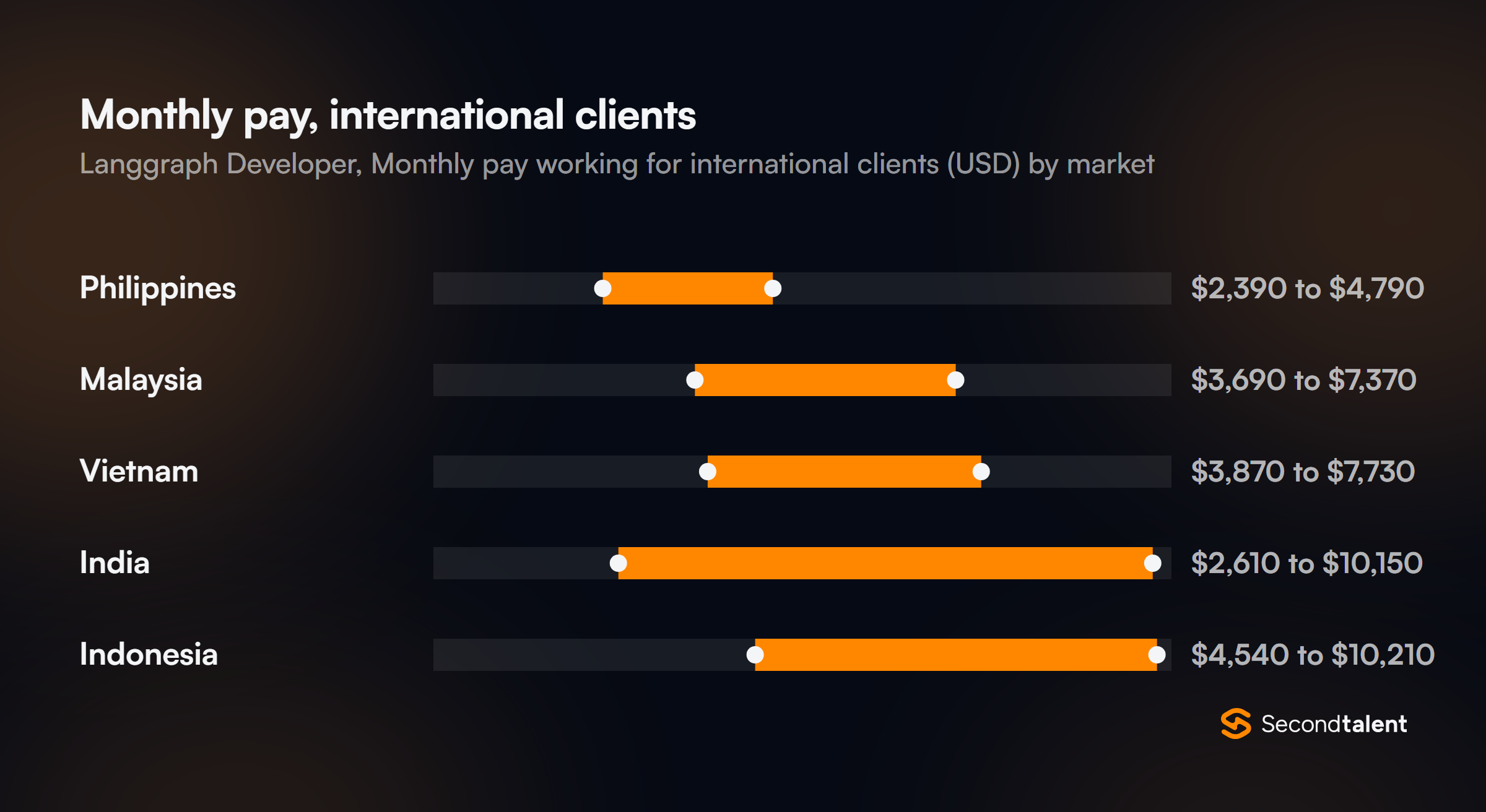
Monthly ranges from the Remote (Working for International Clients) figures on our rate cards for the Philippines, India, Malaysia, Vietnam and Indonesia, converted at ExchangeRate-API mid-market rates for 14 September 2026.
Vietnam's floor of $3,870 is the second highest in the table, which matters because the shift plan below favors Ho Chi Minh City. India spans the widest range, and its ceiling is almost four times its floor.
For contract rates, our AI agent developer cost-to-hire page puts a mid-level US freelance or contract agent developer at $119 to $185 an hour. Our pricing page explains how a Second Talent subscription bills a full-time hire.
US Pay Benchmark for LangGraph Developers
BLS publishes no occupation for agent framework work. The role maps to Software Developers (SOC 15-1252), because a LangGraph developer writes and operates production software whose control flow is a graph of code, model calls and tools.
| BLS OEWS, May 2025, national |
Software Developers (15-1252) |
| Median annual |
$135,980 |
| 10th percentile, monthly |
$6,870 |
| 25th percentile, monthly |
$8,770 |
| Median, monthly |
$11,330 |
| 75th percentile, monthly |
$14,330 |
| 90th percentile, monthly |
$17,890 |
Monthly figures are the annual wages on the OEWS profile for 15-1252 divided by 12, rounded to the nearest $10.
Salary is only part of the US cost. In the BLS Employer Costs for Employee Compensation release for June 2026, wages and salaries made up 68.5% of employer compensation costs for full-time private industry workers, and benefits the other 31.5%.
Time Zone Overlap with ET, CT and PT
A graph paused on a human approval waits until someone answers. For a LangGraph team, overlap hours decide how long a run sits in that state. Asian cities keep one offset all year, and US daylight time runs from 8 March to 1 November 2026, per NIST.
| Engineer's city |
UTC offset |
9:00 am ET (EDT) |
9:00 am CT (CDT) |
9:00 am PT (PDT) |
| Manila, Singapore, Kuala Lumpur, Taipei |
UTC+8 |
9:00 pm |
10:00 pm |
12:00 midnight |
| Ho Chi Minh City, Jakarta, Bangkok |
UTC+7 |
8:00 pm |
9:00 pm |
11:00 pm |
| Bengaluru |
UTC+5:30 |
6:30 pm |
7:30 pm |
9:30 pm |
After 1 November 2026, every time in the table moves one hour later.
A Ho Chi Minh City shift from 7:00 pm to 4:00 am runs 12:00 to 21:00 UTC, which is 8:00 am to 5:00 pm EDT. It covers all eight hours of a 9-to-5 day in New York, seven in Chicago and five in San Francisco.
That schedule has a price. Vietnam's Labor Code adds at least 30% for employees working between 22:00 and 06:00 (Articles 98 and 106), and six hours of the shift, from 22:00 to 04:00, fall in that window. In the Philippines the night shift differential is at least 10% for work between 10 pm and 6 am (Labor Code Article 86).
Most teams do not need a full night shift. Approvals, trace reviews and graph changes need both sides online; long-running graphs and evaluation sweeps do not. We agree the split before the offer, which is how our placements get 4-6 hours of daily overlap with US hours.
LangGraph Developer Skills to Screen For
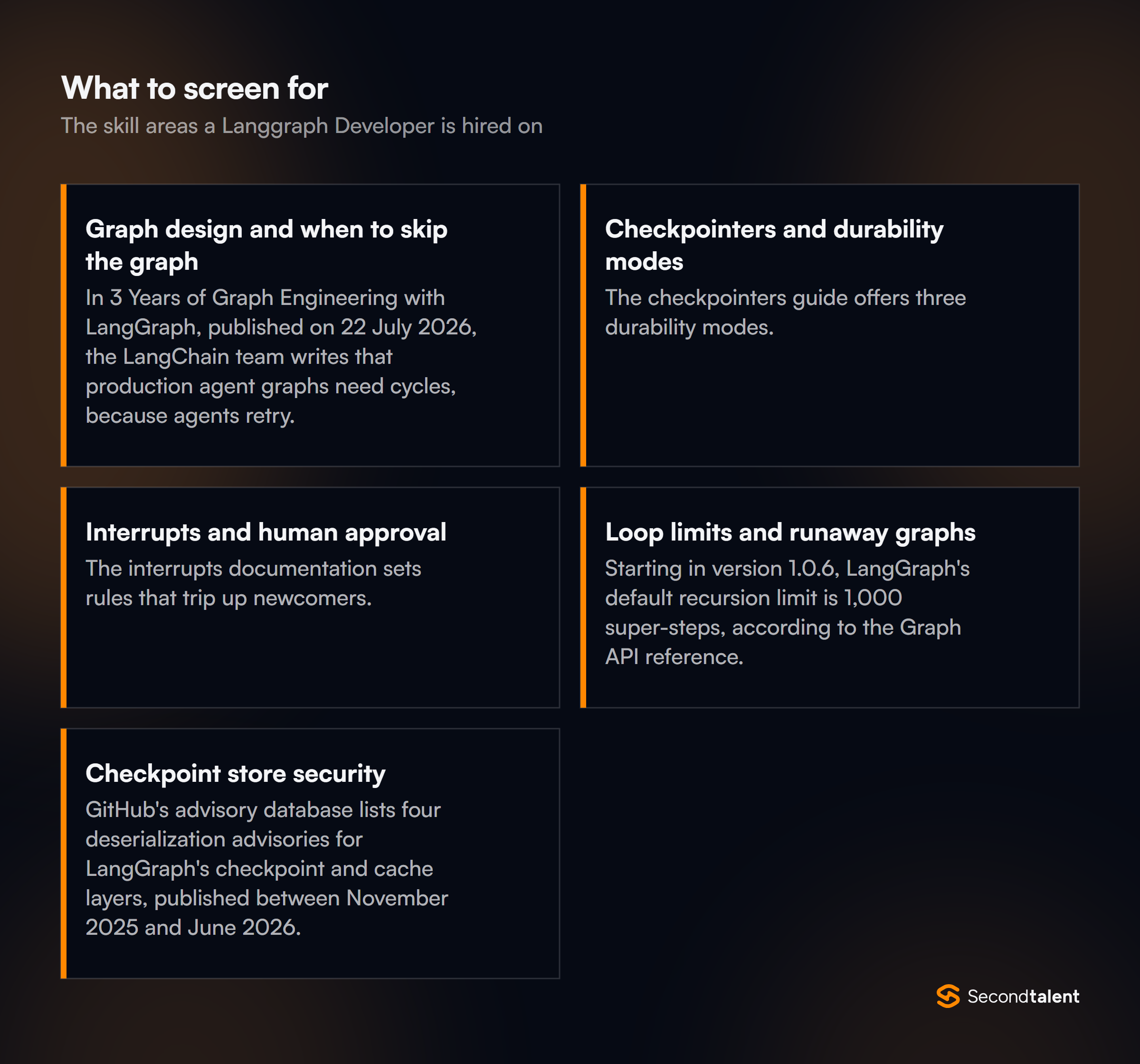
LangGraph was used by 16.2% of Stack Overflow respondents who build AI agents, in its 2025 AI survey, about half the 32.9% who used LangChain. Screen the five areas below.
Graph design and when to skip the graph
In 3 Years of Graph Engineering with LangGraph, published on 22 July 2026, the LangChain team writes that production agent graphs need cycles, because agents retry failed tool calls, ask users for missing input and loop. The same post says open-ended tasks such as deep research fit an agent harness better than a fixed graph. Its supervisor migration guide describes the langgraph-supervisor package as no longer maintained. Ask the candidate to sketch your workflow and mark which steps are code, which are single model calls and which are agents.
Checkpointers and durability modes
The checkpointers guide offers three durability modes. "exit" saves only when the run ends, "async" saves while the next step runs, and "sync" writes every checkpoint before the next step starts. InMemorySaver is for experimentation, and the guide marks the Postgres and MongoDB savers as ideal for production. Ask which mode the candidate chose for their last graph and what a process crash mid-run cost them.
Interrupts and human approval
The interrupts documentation sets rules that trip up newcomers. Do not wrap interrupt in a bare try/except, because it pauses by raising a special exception. Keep multiple interrupts in a node in the same order, since LangGraph matches resume values by index. Give the candidate a node that writes a database record and then asks for approval, and ask what happens on resume.
Loop limits and runaway graphs
Starting in version 1.0.6, LangGraph's default recursion limit is 1,000 super-steps, according to the Graph API reference. Reaching it raises GraphRecursionError. The same page documents RemainingSteps, which lets a graph wind down before the limit. Ask what limit the candidate sets per graph, and what the user sees when a run stops early.
Checkpoint store security
GitHub's advisory database lists four deserialization advisories for LangGraph's checkpoint and cache layers, published between November 2025 and June 2026. All four turn on bytes read back from a store that can rebuild Python objects. CVE-2025-64439 allowed remote code execution through the serializer's "json" mode before langgraph-checkpoint 3.0. CVE-2026-48775, fixed in 4.1.1, covers an attacker who can write to the store. Checkpointers can encrypt persisted state with EncryptedSerializer and an AES key. Ask who can write to the candidate's checkpoint database, and whether they encrypt what it holds.
Contractor or Employer of Record for a US Company
Software is not one of the nine categories of commissioned work that can be "work made for hire" under 17 U.S.C. § 101, and a copyright transfer must be in writing and signed under § 204(a). List graph definitions, state schemas, prompts, tools and evaluation sets in the assignment.
IRS Publication 515 says the place where someone performs the services determines the source of the income, so a developer working from Ho Chi Minh City earns foreign-source income. A foreign individual gives the payer Form W-8BEN to certify foreign status.
Local law applies its own test for employment. Article 13 of Vietnam's 2019 Labor Code treats an agreement under another name as a labor contract when it covers a paid job, wages and one party's management or supervision. Philippine courts use the four-fold test, and in Atok Big Wedge v. Gison the Supreme Court called the power of control the most important of the four.
|
Independent contractor |
Employer of Record |
| Legal employer |
None; the developer invoices you |
The EOR's local entity |
| US paperwork |
Form W-8BEN from the developer |
Service agreement with the EOR |
| IP |
Written assignment covering graphs, state schemas, prompts and tools |
Assignment in the employment contract and your EOR agreement |
| Local labor law |
Classification risk if you set hours and supervise the work |
Night premiums, public holidays and leave apply |
| Pay currency |
Agreed in the contract, often USD |
Vietnam's Labor Code states wages in dong (Article 95) |
A developer on a fixed US-hours shift, answering to your engineering lead, fits the Vietnamese test above. That is the case our Employer of Record service covers, with market detail on the Vietnam EOR page. This is a summary, not legal advice.
English Level and Working Norms
An approval interrupt puts text in front of a reviewer: the action the agent wants to take and the reason for it. Vietnam scores 500 on the EF English Proficiency Index 2025, and the same 500 in the IT job function, ranking 64th of 123 countries and regions against a global average of 488.
| Country |
EF EPI 2025 score |
World rank (of 123) |
IT job-function score |
| Malaysia |
581 |
24 |
590 |
| Philippines |
569 |
28 |
581 |
| Vietnam |
500 |
64 |
500 |
| India |
484 |
74 |
487 |
| Indonesia |
471 |
80 |
523 |
Scores come from EF's country pages, such as Vietnam and the Philippines. Test the skill the job uses: ask finalists to write the approval message a reviewer sees before an agent issues a refund.
Plan releases around both calendars. Thanksgiving on 26 November 2026 is a working day in Asia, so your developer there can clear approvals while the US team is off. Article 112 of Vietnam's Labor Code gives five paid days for Lunar New Year, so route approvals to another reviewer that week.
LangGraph Developer Hiring Process
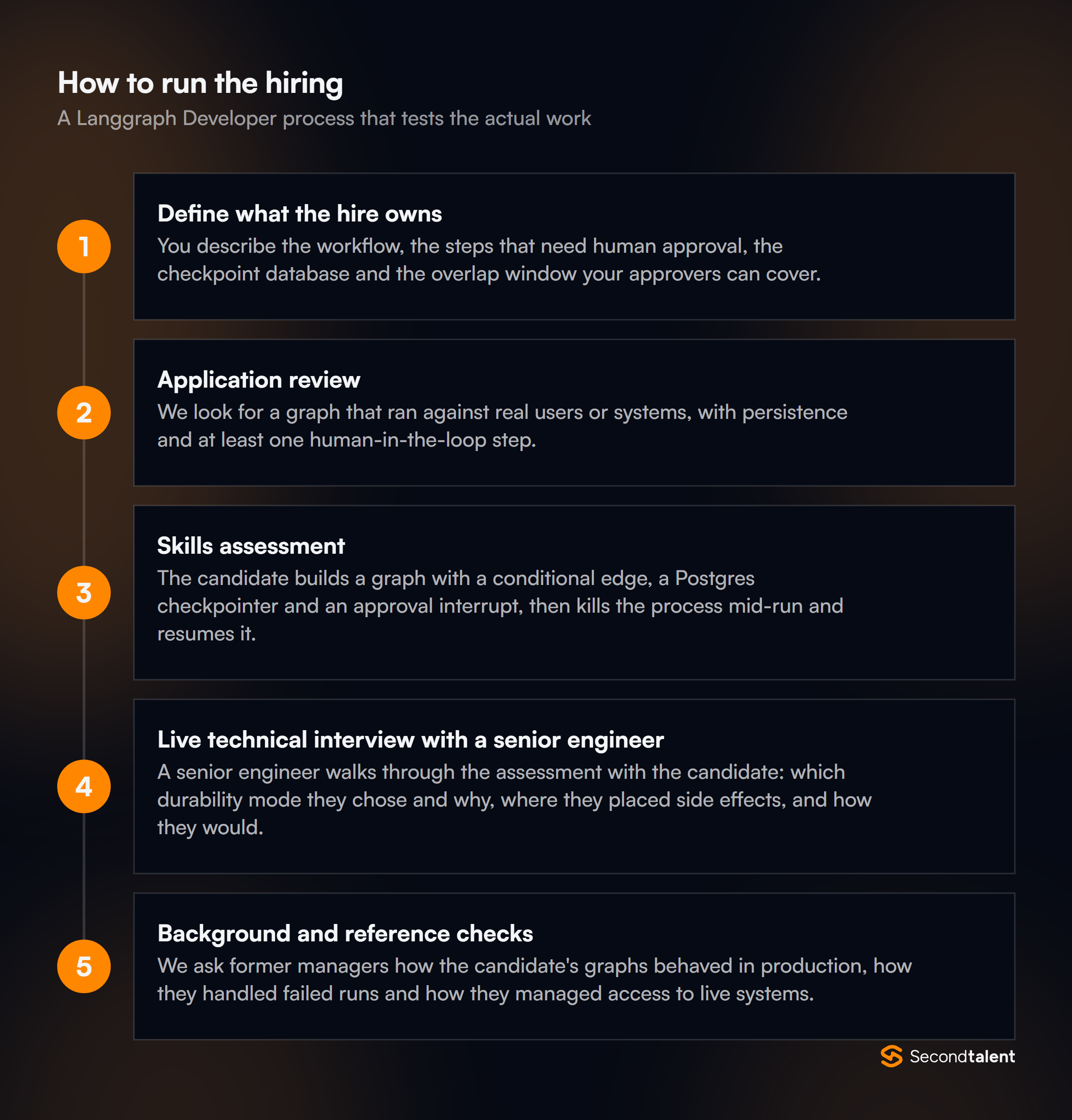
Second Talent's vetting covers stages 2 to 5 before you see a profile.
Stage 1: Define what the hire owns
You describe the workflow, the steps that need human approval, the checkpoint database and the overlap window your approvers can cover. Say whether the hire builds new graphs or maintains ones already in production.
Stage 2: Application review
We look for a graph that ran against real users or systems, with persistence and at least one human-in-the-loop step. Candidates describe the state schema and what happened on the last failed run.
Stage 3: Skills assessment
The candidate builds a graph with a conditional edge, a Postgres checkpointer and an approval interrupt, then kills the process mid-run and resumes it. We check for duplicate side effects and for a recursion limit set on purpose.
Stage 4: Live technical interview with a senior engineer
A senior engineer walks through the assessment with the candidate: which durability mode they chose and why, where they placed side effects, and how they would secure the checkpoint store.
Stage 5: Background and reference checks
We ask former managers how the candidate's graphs behaved in production, how they handled failed runs and how they managed access to live systems. You then choose the contractor or EOR route above.
Hire LangGraph Developers from Asia with Second Talent
We shortlist 6-8 candidates within 24 hours from 100,000+ pre-vetted engineers, accepting only the top 1% of applicants. LangGraph developers come with $0 upfront, no lock-in and 4-6 hours of daily overlap with US hours. We handle contracts, payroll and equipment, with compliant EOR contracts and payroll in 9 Asian markets.
Our pricing page covers the subscription, and for retrieval and higher-level agent work we also staff LangChain developers.