TL;DR: OpenCV developers from Asia earn $2,200 to $11,300+ a month working for international clients on our machine learning engineer rate cards, and we shortlist 6-8 candidates in 24 hours. The closest US benchmark, the BLS median for software developers, was $135,980 a year in May 2025.
OpenCV 5.0.0 shipped on 6 June 2026, the first major version since November 2018. It deletes the Caffe and Darknet model loaders and moves the ml module and the Haar and HOG detectors out of the main repository. Your next OpenCV hire should list which pipelines break before anyone upgrades.
Key takeaways
- On our machine learning engineer cards, the Philippine and Vietnamese ranges both open at $2,500 a month, and Malaysia and Thailand both open at $3,930.
- OpenCV 5's new default DNN engine runs on CPU only, so GPU inference needs the classic engine or an ONNX Runtime build.
- A mid-level US freelance or contract computer vision engineer costs $119 to $185 an hour, before payroll, insurance and leave.
- The opencv-python wheels come in four packages that share one cv2 namespace, and the project tells you to install only one of them per environment.
What OpenCV Developers Earn Working for International Clients in Asia
Our rate cards carry no OpenCV title, so the table uses our machine learning engineer cards, the closest match for engineers who build vision pipelines around trained models. Malaysia has the highest ceiling at $11,300+, and Indonesia the lowest floor.
Each figure is what engineers in that market earn working directly for foreign companies, before any employer or platform costs.
| Market |
Monthly pay working for international clients (USD) |
| Indonesia |
$2,200-$8,500 |
| India |
$2,410-$9,410+ |
| Philippines |
$2,500-$6,000 |
| Vietnam |
$2,500-$7,000 |
| Malaysia |
$3,930-$11,300+ |
| Thailand |
$3,930-$8,770+ |
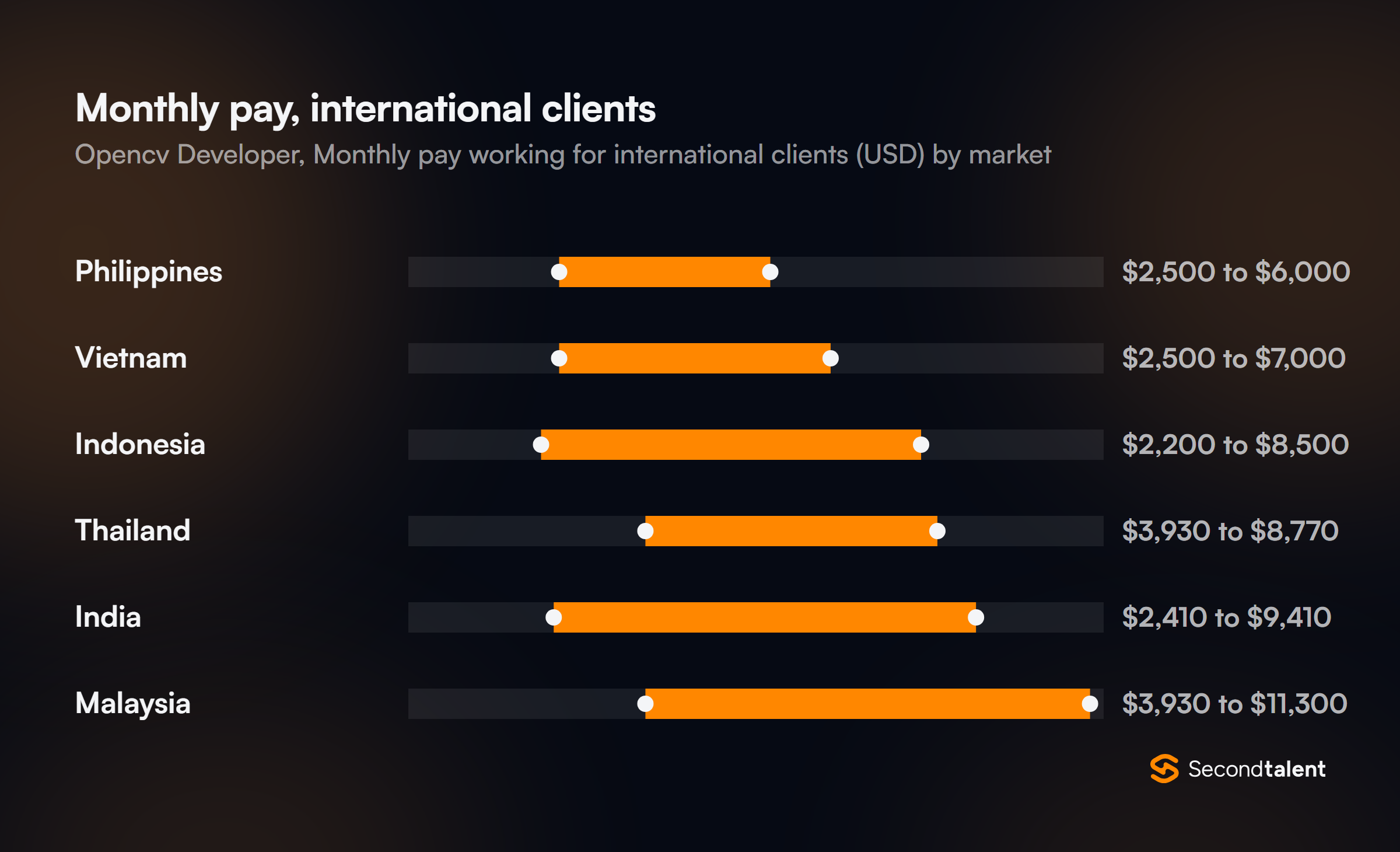
Monthly ranges from the Remote (Working for International Clients) figures on our rate cards for Indonesia, India, the Philippines, Vietnam, Malaysia and Thailand, converted at ExchangeRate-API mid-market rates for 14 September 2026.
The Indonesian, Philippine and Vietnamese cards publish this figure in US dollars with a fixed top, so those rows need no conversion. The Indian, Malaysian and Thai cards quote local currency with an open top.
Our pricing page explains the monthly fee, which bundles salary, payroll taxes, statutory contributions and our service fee. If the vision work sits inside a broader model team, we also staff machine learning engineers and PyTorch developers.
US Pay Benchmark for OpenCV Developers
BLS has no computer vision occupation. An OpenCV developer maps to Software Developers (15-1252), because the job is shipping production code that reads frames, runs models and returns decisions. A hire who invents new vision methods sits closer to Computer and Information Research Scientists (15-1221).
| BLS OEWS, May 2025, national |
Median annual |
10th percentile, monthly |
Median, monthly |
90th percentile, monthly |
| Software Developers (15-1252) |
$135,980 |
$6,870 |
$11,330 |
$17,890 |
| Computer and Information Research Scientists (15-1221) |
$140,300 |
$6,850 |
$11,690 |
$19,220 |
Monthly figures are the annual wages on the OEWS profiles for 15-1252 and 15-1221 divided by 12, rounded to the nearest $10. For 15-1252, the 25th and 75th percentiles come to $8,770 and $14,330 a month.
Salary is only part of the US cost. In the BLS Employer Costs for Employee Compensation release for June 2026, wages and salaries made up 68.5% of employer compensation costs for full-time private industry workers, and benefits the other 31.5%.
The contract route costs more by the hour. Our computer vision engineer cost-to-hire page puts a mid-level US freelancer at $119 to $185 an hour, or $19,040 to $29,600 a month at 160 hours.
Time Zone Overlap with ET, CT and PT
Vision work splits well across a 12-hour gap. Your developer in Asia can label, replay and score footage from a US day shift overnight, and the shared hours go to the problems that need a camera and a person on site. US daylight time runs from 8 March to 1 November 2026, per NIST, and none of the cities below change their clocks.
| Engineer's city |
UTC offset |
9:00 am ET (EDT) |
9:00 am CT (CDT) |
9:00 am PT (PDT) |
| Manila, Singapore, Kuala Lumpur, Taipei |
UTC+8 |
9:00 pm |
10:00 pm |
12:00 midnight |
| Ho Chi Minh City, Jakarta, Bangkok |
UTC+7 |
8:00 pm |
9:00 pm |
11:00 pm |
| Bengaluru |
UTC+5:30 |
6:30 pm |
7:30 pm |
9:30 pm |
After 1 November 2026, every time in the table moves one hour later.
A worked example: a Manila shift from 5:00 pm to 2:00 am runs 09:00 to 18:00 UTC. That is 5:00 am to 2:00 pm EDT, five hours inside a New York working day, four with Chicago and two with San Francisco.
Put the calibration sessions, the live camera checks and the model sign-offs in those hours. Batch re-runs over a day's footage, benchmark sweeps and dataset rebuilds go into the US night. We agree that split before the offer, which is how our placements get 4-6 hours of daily overlap with US hours.
Late hours carry a premium for employees. The Philippine Labor Code sets at least 10% extra for work between 10 pm and 6 am (Article 86), four hours of the Manila shift above. In Vietnam the floor is 30% for work between 22:00 and 06:00 (Labor Code Articles 98 and 106).
OpenCV Developer Skills to Screen For
OpenCV 5 changes outputs as well as imports. Nearest-neighbour resize now follows the Pillow convention, and warpAffine, warpPerspective and remap return new bilinear and bicubic values, per the project's 4-to-5 migration guide. A test suite built on pixel-exact baselines from 4.x will fail on upgrade, even where the code is correct.
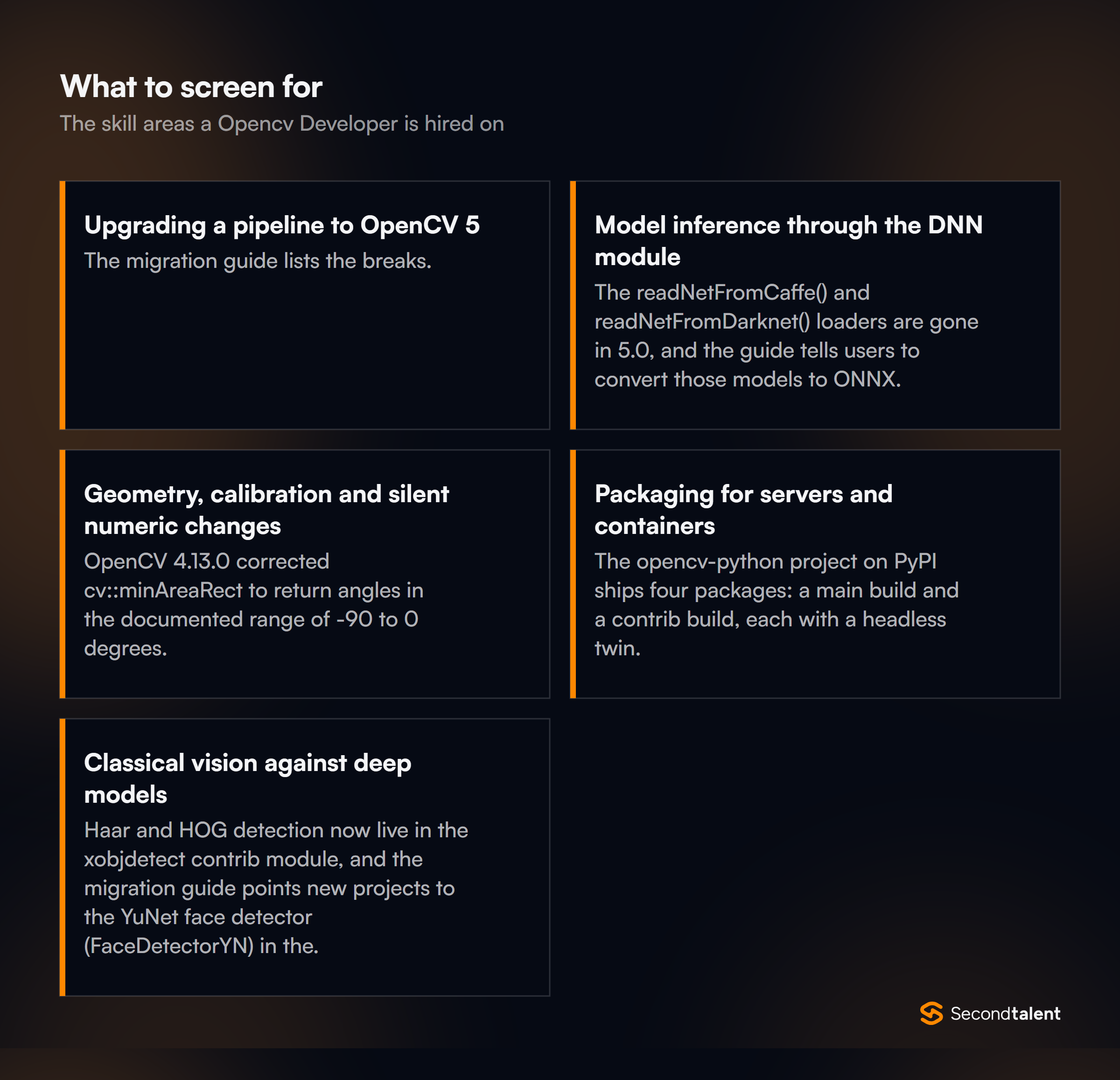
Upgrading a pipeline to OpenCV 5
The migration guide lists the breaks. OpenCV 5 requires C++17, drops Python 2, removes the legacy C API (IplImage, CvMat) and splits calib3d into geometry, calib and stereo modules. Python calls to the split modules keep working; Java imports change. VideoCapture::get() now returns -1 for an unsupported property, where 4.x returned 0.
Hand the candidate a 4.x script with a Haar cascade, a cv2.ml classifier and a get() check, and ask what breaks and how they would fix each one.
Model inference through the DNN module
The readNetFromCaffe() and readNetFromDarknet() loaders are gone in 5.0, and the guide tells users to convert those models to ONNX. By default, readNet() tries the new engine first and falls back to the classic engine if the model will not load.
The new engine runs on CPU only, so GPU inference means forcing the classic engine or building with ONNX Runtime and NVIDIA execution providers. Ask how the candidate would confirm which engine served a production request, and how long a YOLO-style detector takes per frame on your target hardware.
Geometry, calibration and silent numeric changes
OpenCV 4.13.0 corrected cv::minAreaRect to return angles in the documented range of -90 to 0 degrees. Versions 4.5.1 to 4.12.0 used a different range.
Any pick-and-place or measurement code that reads that angle can shift orientation after a routine upgrade. Screen for engineers who pin versions, log calibration reprojection error and keep a regression set of real frames from the line.
Packaging for servers and containers
The opencv-python project on PyPI ships four packages: a main build and a contrib build, each with a headless twin. Its instructions say to select only one, because all four use the same cv2 namespace.
The headless builds leave out the GUI libraries, which keeps Docker images smaller. The current release is 5.0.0.93 under the Apache 2.0 license, so an unpinned pip install in a 4.x project now pulls a new major version. Ask what the candidate's last Dockerfile installed and why.
Classical vision against deep models
Haar and HOG detection now live in the xobjdetect contrib module, and the migration guide points new projects to the YuNet face detector (FaceDetectorYN) in the main objdetect module.
Thresholds, morphology and contours still solve plenty of inspection jobs at a fraction of a model's compute. Give the candidate a defect image set and ask where they would stop with classical operators and start training a model, and how many labelled frames that model would need.
Contractor or Employer of Record for a US Company
Software is not one of the nine categories of commissioned work that can be "work made for hire" under 17 U.S.C. § 101, and a copyright transfer must be in writing and signed under § 204(a). Name the pipeline code, calibration files, trained weights, annotation guidelines and labelled datasets in the assignment.
IRS Publication 515 says the place where services are performed determines the source of the income, so a developer working from Bangkok or Ho Chi Minh City earns foreign-source income. A foreign individual gives the payer Form W-8BEN to certify foreign status.
Local law applies its own employment test. Philippine courts use the four-fold test, and in Atok Big Wedge v. Gison the Supreme Court called the power of control the most important of the four. Article 13 of Vietnam's 2019 Labor Code treats an agreement under any name as a labor contract when it covers a paid job, wages and management or supervision.
A three-month proof of concept on sample footage suits a contractor agreement. A developer on your hours, with access to customer camera feeds and your model registry, fits the employment tests above, and our Employer of Record service employs that developer in-country for you. This is a summary, not legal advice.
|
Independent contractor |
Employer of Record |
| Legal employer |
None; the developer invoices you |
The EOR's local entity |
| US paperwork |
Form W-8BEN from the developer |
Service agreement with the EOR |
| IP |
Written assignment covering code, weights, calibration files and datasets |
Assignment in the employment contract and your EOR agreement |
| Local labor law |
Classification risk if you control hours and methods |
Night premiums, public holidays and leave apply |
| Pay currency |
Agreed in the contract, often USD |
Local currency; Vietnam's Labor Code states wages in dong (Article 95) |
English Level and Working Norms
Thai IT professionals score 459 on the EF English Proficiency Index 2025, 57 points above Thailand's national score of 402. A candidate's field can move the result that far, so test the written English your pipeline needs. The index covers 123 countries and regions, with a global average of 488.
| Country |
EF EPI 2025 score |
World rank (of 123) |
IT job-function score |
| Malaysia |
581 |
24 |
590 |
| Philippines |
569 |
28 |
581 |
| Vietnam |
500 |
64 |
500 |
| India |
484 |
74 |
487 |
| Indonesia |
471 |
80 |
523 |
| Thailand |
402 |
116 |
459 |
Scores come from EF's country pages, such as the Philippines and Thailand.
Vision teams run on written instructions: what counts as a scratch against a reflection, where a bounding box starts, why the model rejected a frame. Ask finalists to write a one-page labelling guideline for a defect class you choose.
Plan releases around both calendars. Thanksgiving on 26 November 2026 is a working day in Asia, so a developer there can watch a model rollout while your US team is off. Vietnam's Labor Code gives five paid days for Lunar New Year (Article 112), so freeze model changes on a Vietnam-owned pipeline that week.
OpenCV Developer Hiring Process
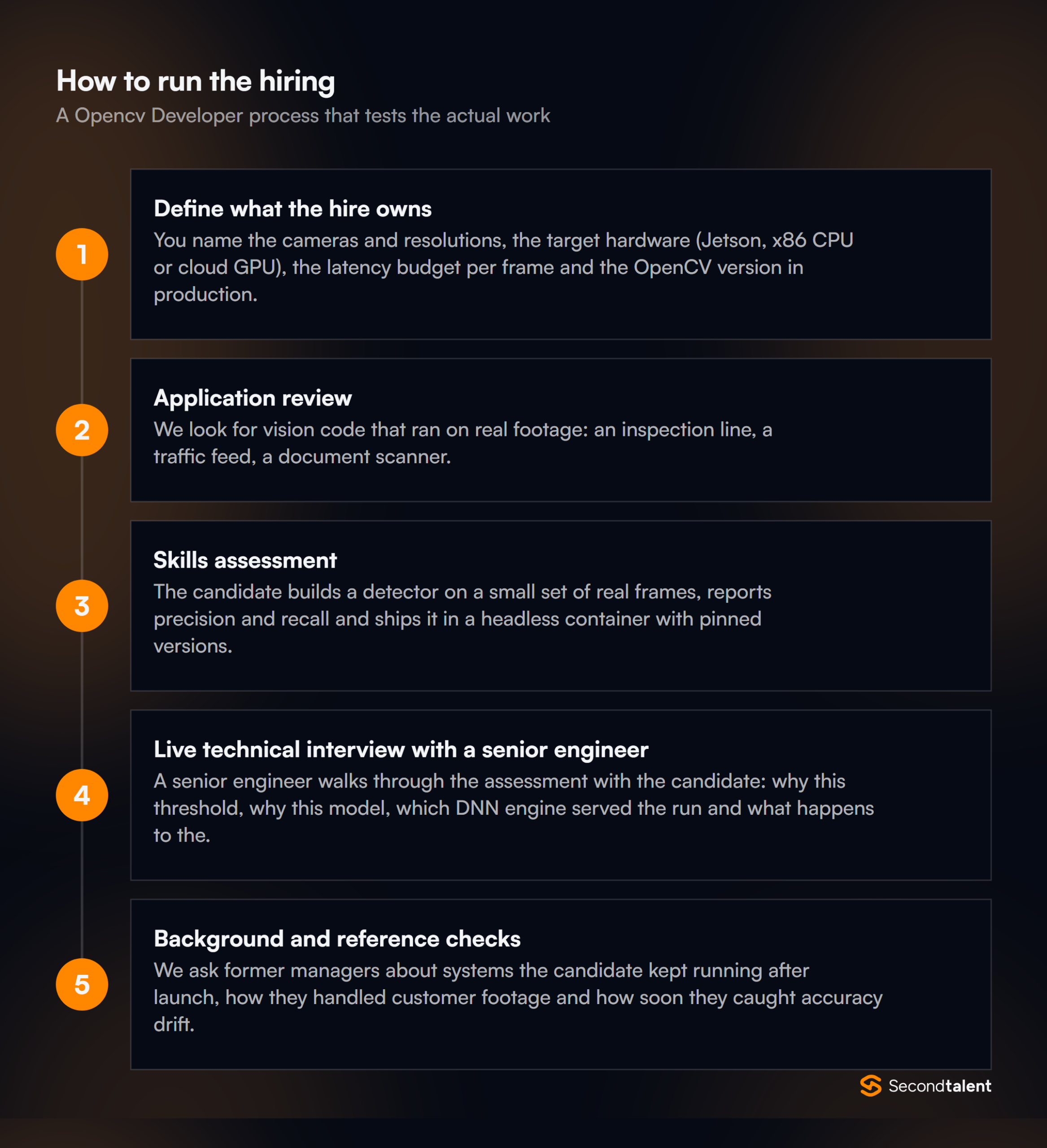
Second Talent's vetting covers stages 2 to 5 before you see a profile.
Stage 1: Define what the hire owns
You name the cameras and resolutions, the target hardware (Jetson, x86 CPU or cloud GPU), the latency budget per frame and the OpenCV version in production. Say whether a 5.0 upgrade is part of the job.
Stage 2: Application review
We look for vision code that ran on real footage: an inspection line, a traffic feed, a document scanner. We ask for frame rates, hardware and error rates in plain numbers. A tutorial notebook on a public dataset does not pass.
Stage 3: Skills assessment
The candidate builds a detector on a small set of real frames, reports precision and recall and ships it in a headless container with pinned versions. We add a 4.x script to port and score the list of breaks they find.
Stage 4: Live technical interview with a senior engineer
A senior engineer walks through the assessment with the candidate: why this threshold, why this model, which DNN engine served the run and what happens to the output when lighting changes on the line.
Stage 5: Background and reference checks
We ask former managers about systems the candidate kept running after launch, how they handled customer footage and how soon they caught accuracy drift. You then choose the contractor or EOR route above.
Hire OpenCV Developers from Asia with Second Talent
We shortlist 6-8 candidates within 24 hours from 100,000+ pre-vetted engineers, accepting only the top 1% of applicants. OpenCV developers come with $0 upfront, no lock-in and 4-6 hours of daily overlap with US hours. We handle contracts, payroll and equipment, with compliant EOR contracts and payroll in 9 Asian markets.
Our pricing page sets out subscription, direct-hire and EOR pricing. Maneva turns ordinary factory cameras into real-time quality control, and it filled its AI software engineering brief through us in 27 days, one of six hires across three roles, according to the Maneva case study.