TL;DR: Senior Kubernetes engineers from Asia cost $3,200-$7,500 a month through Second Talent, matched in 24 hours. The closest US benchmark, the BLS median for computer network architects, was $134,050 a year in May 2025.
Helm 3 stops receiving security fixes on 11 November 2026, a year after Helm 4 shipped at KubeCon. Helm 4 adds server-side apply and WebAssembly plugins. A Kubernetes engineer who joins this autumn should move your charts and pipelines to Helm 4 before that date.
Key takeaways
- Amazon EKS charges $0.10 per cluster hour while a Kubernetes version has standard support and $0.60 once it moves to extended support, 14 months after its EKS release.
- The Kubernetes project patches 1.37, 1.36 and 1.35, and 1.35 reaches end of life on 28 February 2027.
- CVE-2025-1974 in ingress-nginx, rated 9.8 CVSS, combined with flaws patched the same day to give anything on the Pod network a good chance of taking over the cluster with no credentials.
- Kubernetes was used by 30.1% of professional developers in Stack Overflow's 2025 survey.
What Kubernetes Engineers Earn Working for International Clients in Asia
Indonesia has both the highest floor and the highest listed figure in the table, from $4,540 to $10,210 a month. We publish no Kubernetes card, so the ranges come from our DevOps engineer rate cards. Each figure is what engineers in that market earn working directly for foreign companies, before any employer or platform costs.
| Market |
Monthly pay working for international clients (USD) |
| India |
$2,200-$8,470+ |
| Philippines |
$2,390-$4,790+ |
| Vietnam |
$3,090-$6,180+ |
| Malaysia |
$3,690-$7,370+ |
| Indonesia |
$4,540-$10,210+ |
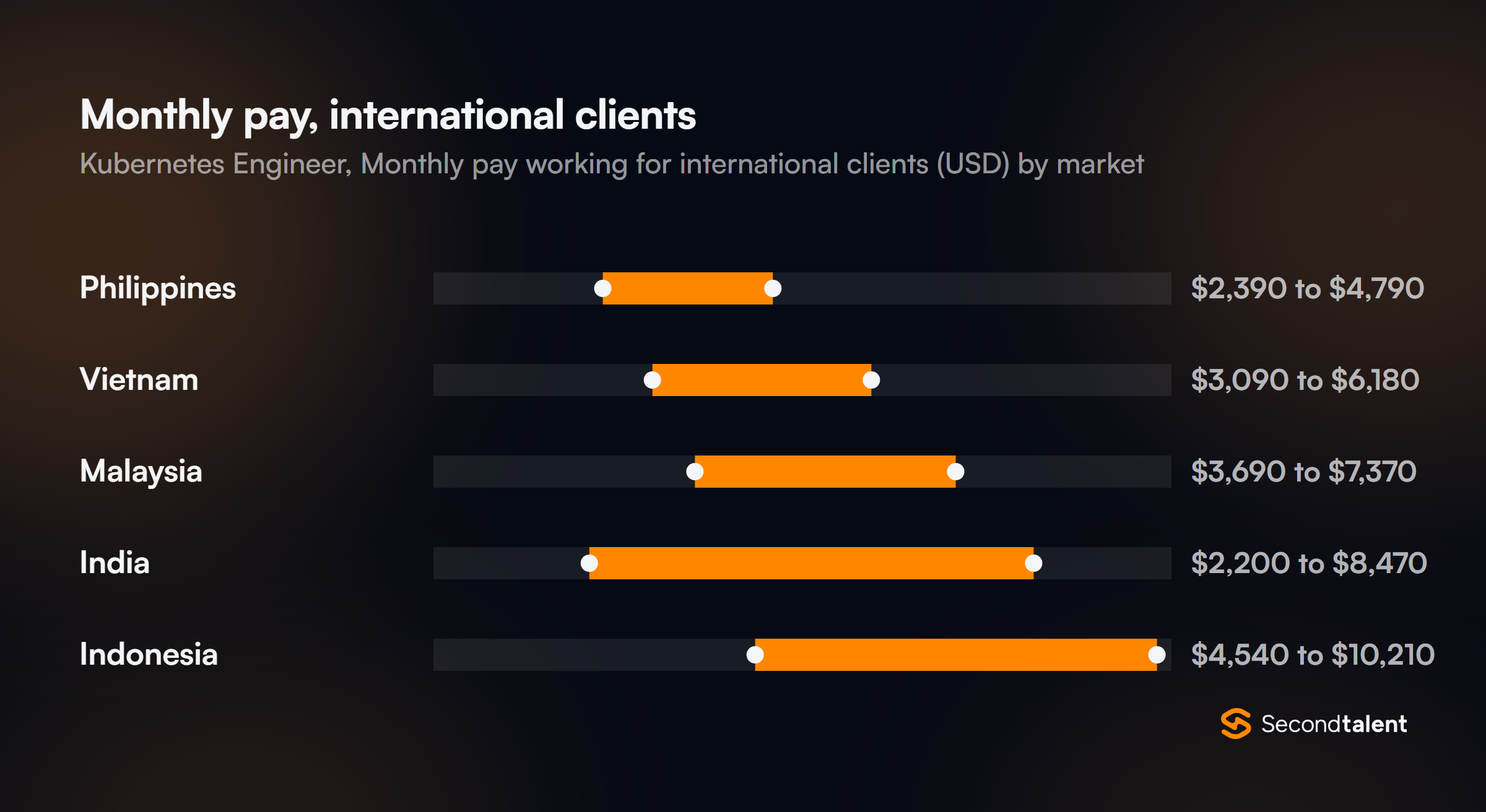
Monthly ranges from the Remote (Working for International Clients) figures on our rate cards for India, the Philippines, Vietnam, Malaysia and Indonesia, converted at ExchangeRate-API mid-market rates for 14 September 2026.
All five cards quote local currency, and every range is open at the top.
Through Second Talent, senior Kubernetes engineers cost $3,200-$7,500 a month: one monthly fee that bundles salary, payroll taxes, statutory contributions and our service fee. Our pricing page shows how the subscription works. For pipeline-first roles see our DevOps engineer page, and for a single market our India DevOps page.
US Pay Benchmark for Kubernetes Engineers
BLS defines computer network architects as workers who design and implement networks and plan for the capacity needs of network infrastructure, which is the design half of running Kubernetes. Kubernetes engineers therefore map to Computer Network Architects (15-1241).
An engineer whose job is operating and patching clusters sits closer to Network and Computer Systems Administrators (15-1244), whom BLS describes as maintaining operating systems and physical and virtual servers.
| BLS OEWS, May 2025, national |
Computer Network Architects (15-1241) |
Network and Computer Systems Administrators (15-1244) |
| Median annual |
$134,050 |
$99,130 |
| 10th percentile, monthly |
$6,660 |
$5,220 |
| Median, monthly |
$11,170 |
$8,260 |
| 90th percentile, monthly |
$16,890 |
$12,920 |
Monthly figures are the annual wages on the BLS OEWS profiles for 15-1241 and 15-1244 divided by 12, rounded to the nearest $10.
Use the architects column for a hire who designs clusters, networking and multi-tenant platforms, and the administrators column for an operations seat.
Salary is only part of the US cost. In the BLS Employer Costs for Employee Compensation release for June 2026, wages and salaries made up 68.5% of employer compensation costs for full-time private industry workers, and benefits the other 31.5%.
Time Zone Overlap with ET, CT and PT
A Manila day shift from 9:00 am to 6:00 pm runs 01:00 to 10:00 UTC, which is 9:00 pm to 6:00 am in New York and 6:00 pm to 3:00 am in San Francisco while US daylight time lasts. A node pool upgrade started at the beginning of that shift can finish before US users log in.
Asian cities keep one offset all year, and US daylight time runs from 8 March to 1 November 2026, per NIST.
| Engineer's city |
UTC offset |
9:00 am ET (EDT) |
9:00 am CT (CDT) |
9:00 am PT (PDT) |
| Manila, Singapore, Kuala Lumpur, Taipei |
UTC+8 |
9:00 pm |
10:00 pm |
12:00 midnight |
| Ho Chi Minh City, Jakarta, Bangkok |
UTC+7 |
8:00 pm |
9:00 pm |
11:00 pm |
| Bengaluru |
UTC+5:30 |
6:30 pm |
7:30 pm |
9:30 pm |
After 1 November 2026, every time in the table moves one hour later.
The Manila shift sits outside the Philippine night window of 10 pm to 6 am, so employees on it earn no night shift differential under Article 86, which sets at least 10% for those hours. It also gives no overlap with a US workday.
For live pairing, move the shift later. A Kuala Lumpur shift from 4:30 pm to 1:30 am runs 08:30 to 17:30 UTC, or 4:30 am to 1:30 pm EDT: four and a half hours inside a New York day, three and a half with Chicago and one and a half with San Francisco.
Split the work between the two schedules: maintenance windows and upgrades on the day shift, design reviews and change approvals on the late one. The same UTC hours run 3:30 pm to 12:30 am in Ho Chi Minh City, where Vietnam's Labor Code adds at least 30% for employees working between 22:00 and 06:00 (Articles 98 and 106).
Kubernetes Engineer Skills to Screen For
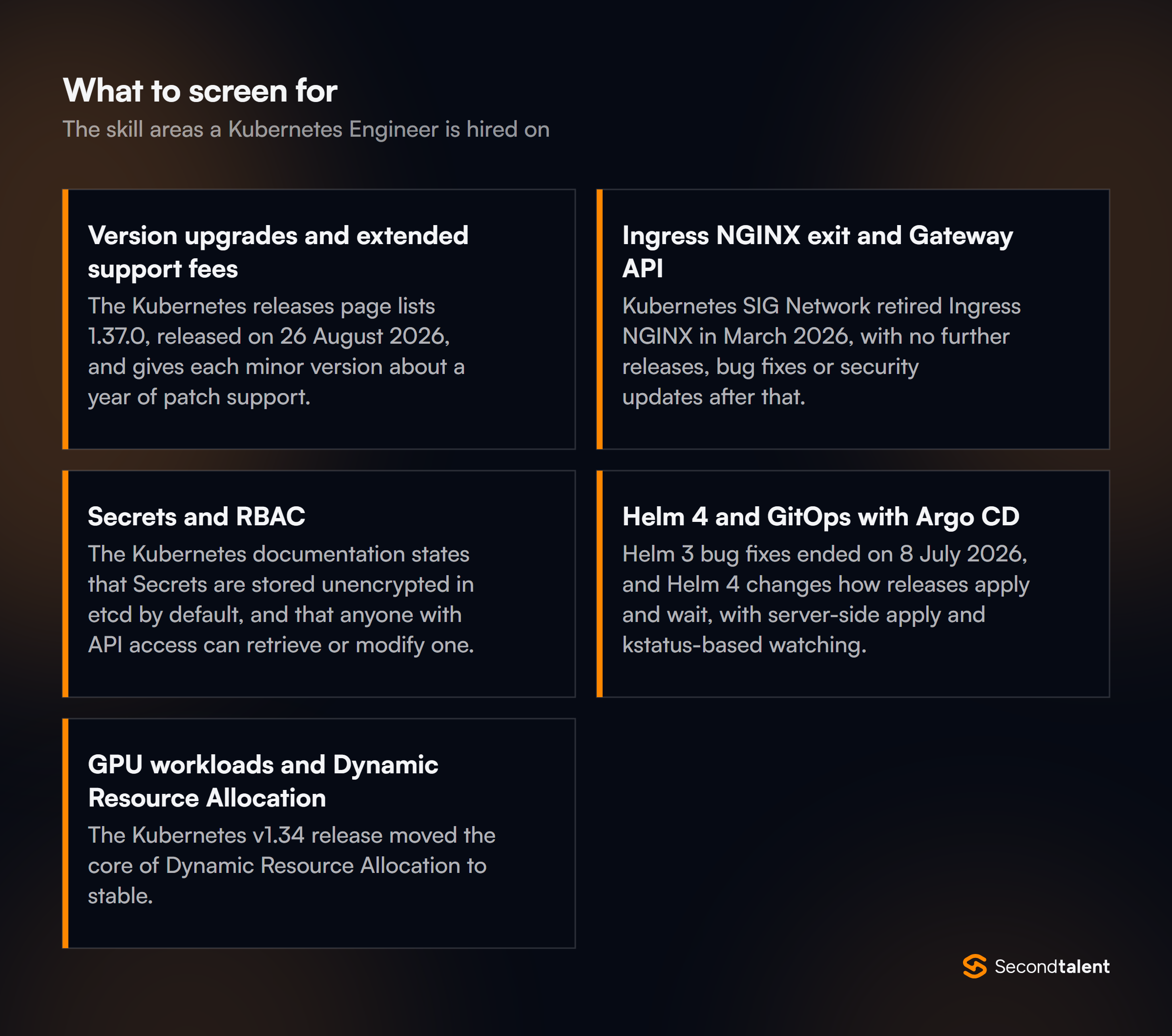
The Linux Foundation's CKA exam gives candidates 2 hours at a command line on Kubernetes v1.35, and troubleshooting carries 30% of the weight. The certificate lasts 2 years, so check the date on it, then test the five areas below yourself.
Version upgrades and extended support fees
The Kubernetes releases page lists 1.37.0, released on 26 August 2026, and gives each minor version about a year of patch support. On Amazon EKS pricing, a version gets 14 months of standard support, then 12 months of extended support at $0.60 per cluster hour, six times the standard rate. Ask the candidate how they found deprecated APIs before their last control plane upgrade, and what they upgraded first.
Ingress NGINX exit and Gateway API
Kubernetes SIG Network retired Ingress NGINX in March 2026, with no further releases, bug fixes or security updates after that. A year earlier the project had patched CVE-2025-1974, which it rated 9.8 CVSS and said affected a controller deployed in over 40% of Kubernetes clusters. Ask the candidate to map three of your Ingress resources to Gateway API routes and explain what breaks during cutover.
Secrets and RBAC
The Kubernetes documentation states that Secrets are stored unencrypted in etcd by default, and that anyone with API access can retrieve or modify one. The ingress-nginx advisory adds that the controller could read Secrets cluster-wide by default. Give the candidate a namespace with a service account bound to cluster-admin and score how far they cut its permissions.
Helm 4 and GitOps with Argo CD
Helm 3 bug fixes ended on 8 July 2026, and Helm 4 changes how releases apply and wait, with server-side apply and kstatus-based watching. The Argo project, which includes Argo CD, graduated in the CNCF on 6 December 2022. Ask for a chart the candidate upgraded to Helm 4 and how Argo CD synced it without a drift loop.
GPU workloads and Dynamic Resource Allocation
The Kubernetes v1.34 release moved the core of Dynamic Resource Allocation to stable. DRA selects, allocates and shares GPUs, TPUs and network cards through resource claims. If you run inference or training on the cluster, ask the candidate to write a ResourceClaimTemplate for a pod that can fall back from one large GPU to two smaller ones.
Contractor or Employer of Record for a US Company
Software is not one of the nine categories of commissioned work that can be "work made for hire" under 17 U.S.C. § 101. Helm charts, operators and GitOps manifests a contractor writes for you stay theirs until transferred, and § 204(a) requires the transfer in writing, signed.
IRS Publication 515 says the place where services are performed determines the source of the income. An engineer working from Jakarta or Bengaluru therefore earns foreign-source income. A foreign individual gives the payer Form W-8BEN to certify foreign status.
Local law applies its own employment test. Philippine courts use the four-fold test, and in Atok Big Wedge v. Gison the Supreme Court called the power of control the most important of the four. Article 13 of Vietnam's 2019 Labor Code treats an agreement under another name as a labor contract when it covers a paid job, wages and management or supervision.
Employees in the Philippines also receive 13th-month pay under PD 851 and Memorandum Order 28, with contributions to SSS (15% shared, credit cap ₱35,000), PhilHealth (5%, cap at ₱100,000) and Pag-IBIG (2% each side, ₱10,000 cap).
|
Independent contractor |
Employer of Record |
| Legal employer |
None; the engineer invoices you |
The EOR's local entity |
| US paperwork |
Form W-8BEN from the engineer |
Service agreement with the EOR |
| IP |
Written assignment covering charts, operators and manifests |
Assignment terms in the employment contract and your EOR agreement |
| Local labor law |
Classification risk if you control hours and methods |
Night premiums, 13th-month pay and leave apply |
| Pay currency |
Agreed in the contract, often USD |
Local currency; Vietnam's Labor Code states wages in dong (Article 95) |
A one-off migration from ECS or virtual machines, with an end date, fits a contractor agreement. An engineer holding cluster-admin credentials and a place on your upgrade rota fits employment, and our Employer of Record service covers that, with country detail on the Philippines EOR page. Our EOR, PEO and contractor comparison sets out the trade-offs. This is a summary, not legal advice.
English Level and Working Norms
For IT workers, four of the five markets in the cost table score at or above the EF English Proficiency Index 2025 global average of 488, and India sits one point below at 487. The index ranks 123 countries and regions.
| Country |
EF EPI 2025 score |
World rank (of 123) |
IT job-function score |
| Malaysia |
581 |
24 |
590 |
| Philippines |
569 |
28 |
581 |
| Vietnam |
500 |
64 |
500 |
| India |
484 |
74 |
487 |
| Indonesia |
471 |
80 |
523 |
Scores come from EF's country pages, such as Vietnam and Indonesia.
A day-shift engineer who upgrades clusters while your team sleeps hands over in writing. Give finalists kubectl output from a failed rollout and ask for the handover note your US on-call engineer would read at 9:00 am.
Plan maintenance windows on both calendars. Thanksgiving, 26 November 2026, is a working day in Asia, so an engineer there can hold the pager while US staff are off. Vietnam's Labor Code gives five paid days for Lunar New Year (Article 112), so freeze upgrades that week if the engineer works from Vietnam.
Kubernetes Engineer Hiring Process
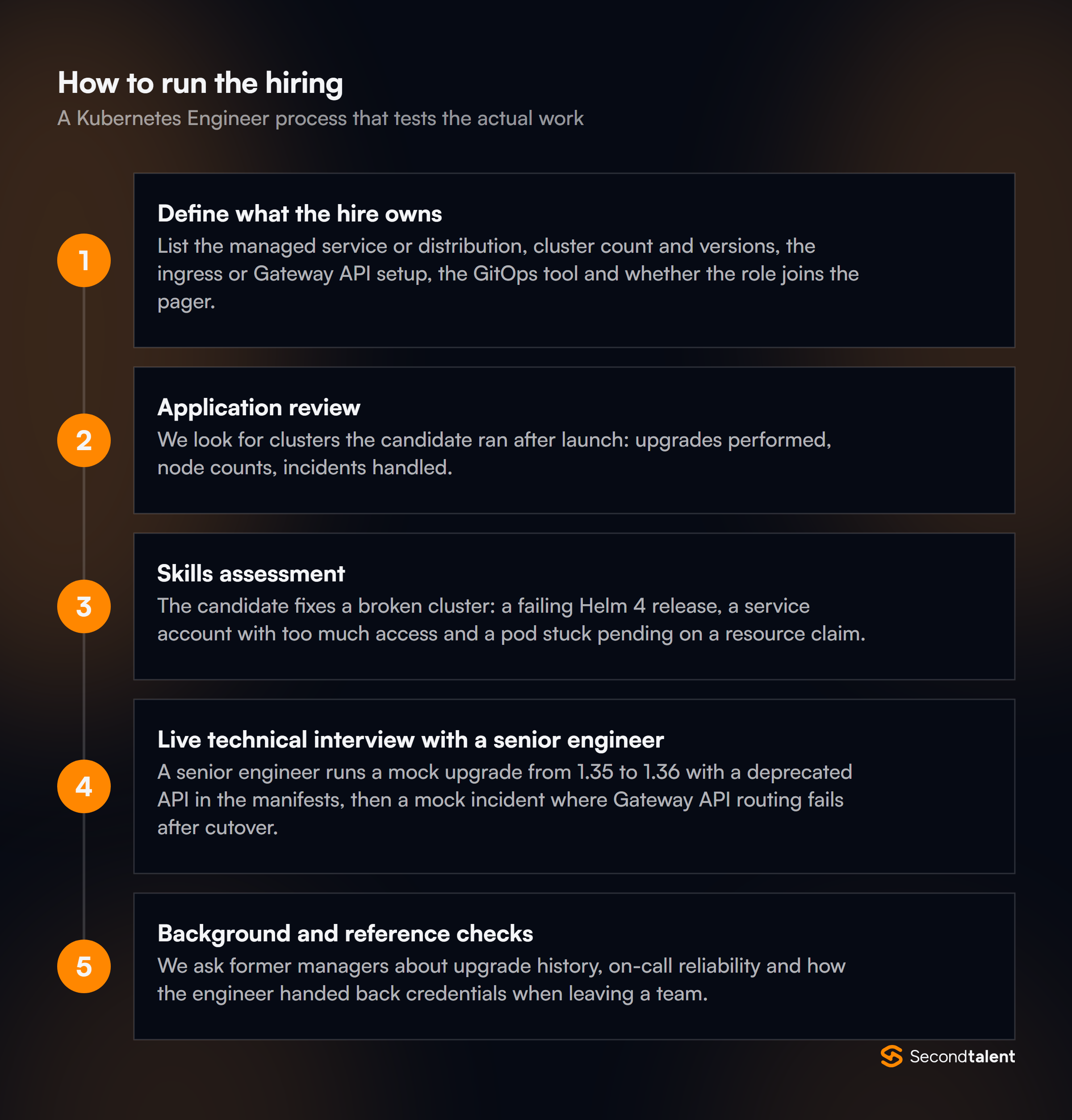
Second Talent's vetting covers stages 2 to 5 before you see a profile. Our Kubernetes interview questions add material for your own final round.
Stage 1: Define what the hire owns
List the managed service or distribution, cluster count and versions, the ingress or Gateway API setup, the GitOps tool and whether the role joins the pager. That also decides which BLS column fits the budget.
Stage 2: Application review
We look for clusters the candidate ran after launch: upgrades performed, node counts, incidents handled. A CKA counts only if it is current, and it does not replace production history.
Stage 3: Skills assessment
The candidate fixes a broken cluster: a failing Helm 4 release, a service account with too much access and a pod stuck pending on a resource claim. We score the commands, the order of the fixes and the written summary.
Stage 4: Live technical interview with a senior engineer
A senior engineer runs a mock upgrade from 1.35 to 1.36 with a deprecated API in the manifests, then a mock incident where Gateway API routing fails after cutover. Watch whether the candidate rolls back or fixes forward, and why.
Stage 5: Background and reference checks
We ask former managers about upgrade history, on-call reliability and how the engineer handed back credentials when leaving a team. You then sign the IP assignment, as a contractor or through an EOR, and grant cluster access by role.
Hire Kubernetes Engineers from Asia with Second Talent
We shortlist 6-8 candidates within 24 hours from 100,000+ pre-vetted engineers, accepting only the top 1% of applicants. Kubernetes engineers cost $3,200-$7,500 a month, with $0 upfront, no lock-in and 4-6 hours of daily overlap with US hours. We handle contracts, payroll and equipment, with compliant EOR contracts and payroll in 9 Asian markets.
Our pricing page sets out the subscription, and for cloud-wide briefs we also staff cloud engineers.