TL;DR: On our closest rate cards, developers from Asia earn $1,280-$3,190+ a month in the Philippines working for international clients, and Second Talent shortlists 6-8 candidates in 24 hours. The closest US benchmark, the BLS median for web developers, was $92,650 a year in May 2025.
Interaction to Next Paint replaced First Input Delay as a Core Web Vital on 12 March 2024, and Google said FID would leave Search Console that day. An SEO engineer who still audits against FID is working from a retired checklist; hire one who measures INP and fixes the interactions that fail it.
Key takeaways
- For Google Search, Googlebot fetches only the first 2MB of an HTML, CSS or JavaScript file, measured uncompressed.
- In June 2025, 48% of mobile pages passed all three Core Web Vitals, and mobile LCP passed on 62%.
- In June 2025 Google began phasing out seven structured data types in Search, including Course Info, Estimated Salary and Vehicle Listing.
- Google says AI Overviews and AI Mode need no AI text files or special schema; about 2% of sites publish an llms.txt file.
What SEO Engineers Earn Working for International Clients in Asia
Thailand's floor, $3,020 a month, is more than double the Philippine floor of $1,280. We have no rate card for SEO engineers, so the table uses our web developer rate cards, the closest match: an SEO engineer ships templates, rendering fixes and markup inside the same codebase.
Each figure is what developers in that market earn working directly for foreign companies, before any employer or platform costs.
| Market |
Monthly pay working for international clients (USD) |
| Philippines |
$1,280-$3,190+ |
| Indonesia |
$2,270-$5,670+ |
| Vietnam |
$2,320-$5,800+ |
| Thailand |
$3,020-$6,350+ |
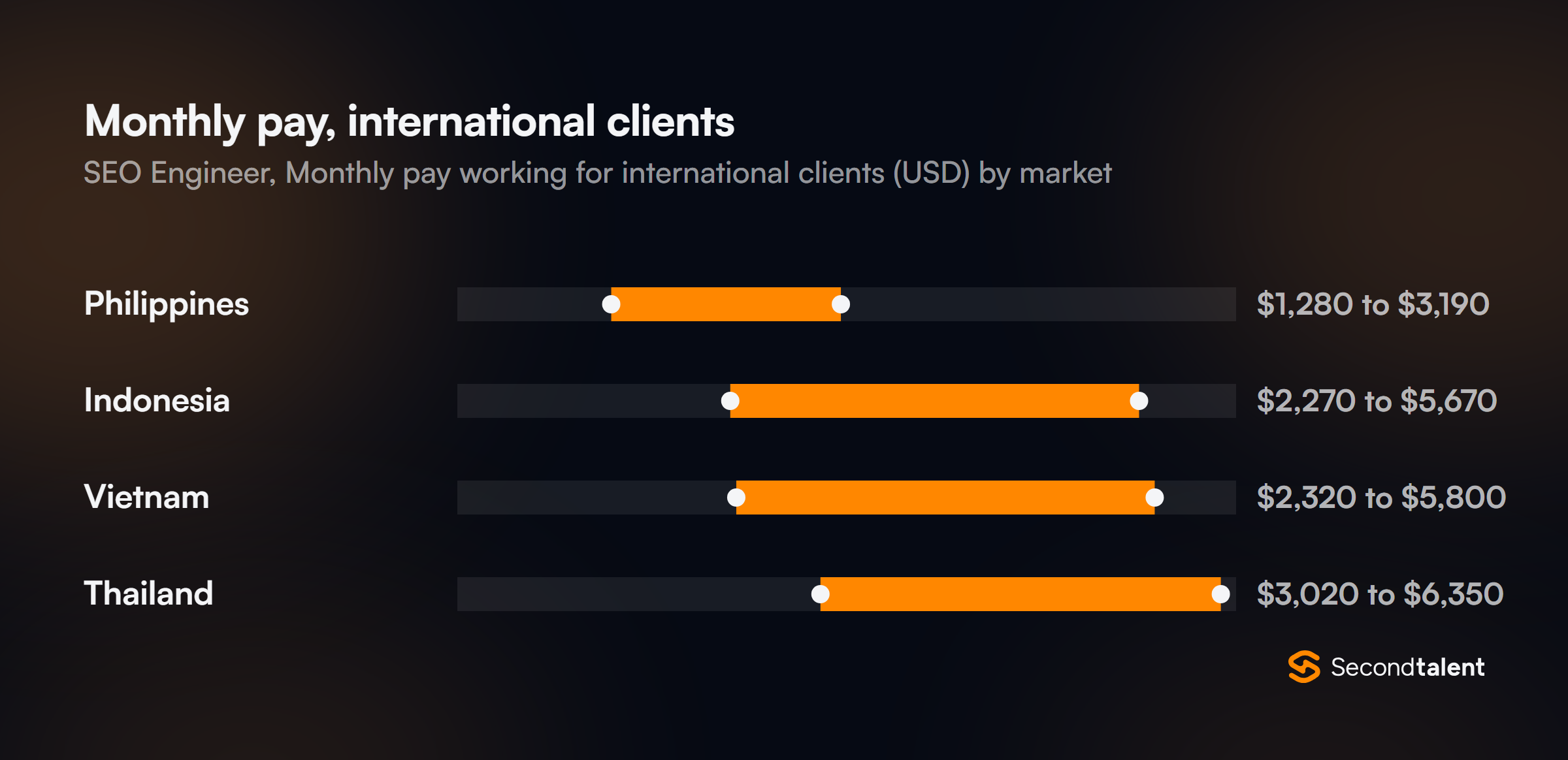
Monthly ranges from the Remote (Working for International Clients) figures on our rate cards for the Philippines, Indonesia, Vietnam and Thailand, converted at ExchangeRate-API mid-market rates for 14 September 2026.
All four cards quote local currency: pesos, rupiah, dong and baht. Indonesia and Vietnam start within $50 of each other, so the choice between them comes down to the candidate, not the market.
Second Talent charges one monthly fee that bundles salary, payroll taxes, statutory contributions and our service fee, set out on our pricing page. For a freelance comparison, our Next.js developer cost-to-hire page puts a mid-level US freelance or contract Next.js developer at $89 to $140 an hour, before payroll, insurance and leave. Much SEO engineering on JavaScript sites is Next.js rendering work.
US Pay Benchmark for SEO Engineers
BLS has no SEO engineer occupation. The role maps to Web Developers (15-1254), because SEO engineers work on how a site renders, loads and marks up its pages, with Software Developers (15-1252) alongside for engineers who build crawl, log and data pipelines.
| BLS OEWS, May 2025, national |
Web Developers (15-1254) |
Software Developers (15-1252) |
| Median annual |
$92,650 |
$135,980 |
| 10th percentile, monthly |
$4,010 |
$6,870 |
| 25th percentile, monthly |
$5,350 |
$8,770 |
| Median, monthly |
$7,720 |
$11,330 |
| 75th percentile, monthly |
$10,520 |
$14,330 |
| 90th percentile, monthly |
$13,520 |
$17,890 |
Monthly figures are the annual wages on the BLS OEWS profiles for 15-1254 and 15-1252 divided by 12, rounded to the nearest $10.
Use the web developers column for a hire who fixes templates and Core Web Vitals. Use the software developers column for one who writes the crawler, the log parser and the structured data generator.
Salary is only part of the US cost. In the BLS Employer Costs for Employee Compensation release for June 2026, wages and salaries made up 68.5% of employer compensation costs for full-time private industry workers, and benefits the other 31.5%.
Time Zone Overlap with ET, CT and PT
Google's Search Status Dashboard lists ranking updates in US/Pacific time. The March 2026 core update began on 27 March and took 12 days and 4 hours to roll out; the May 2026 core update began on 21 May and took 11 days and 21 hours. An engineer in Asia can check logs and rankings on the first morning of a rollout while your US team sleeps.
US daylight time runs until 1 November 2026, per NIST, and none of the cities below change their clocks.
| Engineer's city |
UTC offset |
9:00 am ET (EDT) |
9:00 am CT (CDT) |
9:00 am PT (PDT) |
| Manila, Singapore, Kuala Lumpur, Taipei |
UTC+8 |
9:00 pm |
10:00 pm |
12:00 midnight |
| Ho Chi Minh City, Jakarta, Bangkok |
UTC+7 |
8:00 pm |
9:00 pm |
11:00 pm |
| Bengaluru |
UTC+5:30 |
6:30 pm |
7:30 pm |
9:30 pm |
After 1 November 2026, every time in the table moves one hour later.
A worked example: a Ho Chi Minh City shift from 4:00 pm to 1:00 am runs 09:00 to 18:00 UTC. That is 5:00 am to 2:00 pm EDT, 4:00 am to 1:00 pm CDT and 2:00 am to 11:00 am PDT, so it shares five hours with a 9-to-5 day in New York, four with Chicago and two with San Francisco.
Three of those shift hours, 22:00 to 01:00, fall in Vietnam's night window, where the Labor Code adds at least 30% for employees (Articles 98 and 106). In the Philippines the night shift differential is at least 10% for 10 pm to 6 am (Labor Code Article 86).
Split SEO work along the overlap. Template, redirect and robots.txt changes ship during shared hours, while a US reviewer can check the rendered HTML.
Full-site crawls, log-file parsing and structured data validation run in the Asian morning, and the findings wait in a written report when New York opens. We agree that schedule before the offer, which is how our placements get 4-6 hours of daily overlap with US hours.
SEO Engineer Skills to Screen For

Google's documentation calls dynamic rendering, serving crawlers a separate server-rendered copy, "a workaround and not a recommended solution". It recommends server-side rendering, static rendering or hydration instead. A candidate who still proposes a prerender service for Googlebot has not read the current guidance. Test the five areas below.
Rendering and the 2MB fetch limit
Google's JavaScript SEO basics say pages that return a 200 status go to the rendering queue, and Google might skip rendering for non-200 pages. Client-side routing should use the History API rather than URL fragments, and error views in a single-page app need a noindex tag or a JavaScript redirect to a URL that returns 404, to avoid soft 404s. The Googlebot page caps the Search fetch at the first 2MB of an uncompressed file, with 64MB allowed for PDFs. Hand the candidate a page whose product grid loads from a 3MB uncompressed JavaScript bundle and ask what Google indexes.
Core Web Vitals after INP
The Web Vitals thresholds are LCP within 2.5 seconds, INP of 200 milliseconds or less and CLS of 0.1 or less, all measured at the 75th percentile of page loads. The 2025 Web Almanac SEO chapter found 77% of mobile pages with good INP in June 2025, against 62% for LCP, so loading remains the harder fix. Give the candidate a PageSpeed Insights report with a failing mobile LCP and ask for the three changes they would make first, in order.
Structured data that still earns rich results
Since August 2023, FAQ rich results show only for well-known, authoritative government and health websites, and How-to rich results disappeared once Google dropped them from desktop on 13 September 2023. On 12 June 2025, Google announced the phase-out of Book Actions, Course Info, Claim Review, Estimated Salary, Learning Video, Special Announcement and Vehicle Listing. Search Console dropped reporting for six of them on 9 September 2025. In the Almanac's 2025 crawl, structured data appeared on 50% of pages, and JSON-LD on 43% of home pages. Ask the candidate which types on your site still produce a visible result, and which are dead weight.
Canonicals, hreflang and robots.txt
Canonical tags appear on 68% of desktop and 67% of mobile pages in the Almanac data. Hreflang reached 20.3% of desktop pages, about double the 2024 rate. Google ignores robots.txt content past 500 kibibytes. Plant a canonical that JavaScript rewrites after load, plus an hreflang cluster with a missing return link, and score whether the candidate finds both from the raw and rendered HTML.
AI crawlers and AI features in Search
Google's guide to AI features says a page needs only to be indexed and eligible for a snippet to appear as a supporting link in AI Overviews or AI Mode. Google asks for no new machine-readable files, AI text files or special schema, and Search Console reports traffic from those features under the Web search type.
Adoption of llms.txt stood at 2.13% of desktop sites, and 39.6% of those files related to the All in One SEO plugin. The robots.txt files of 4.5% of desktop sites named GPTBot, up from 2.9% in 2024. Ask the candidate how they would block model training without leaving Search, and expect Google-Extended in the answer. For the analytics side of that brief, we also staff marketing automation engineers.
Contractor or Employer of Record for a US Company
Software is not one of the nine categories of commissioned work that can be "work made for hire" under 17 U.S.C. § 101, and a copyright transfer must be in writing and signed under § 204(a). Name crawl scripts, schema generators, template code and redirect maps in the assignment.
IRS Publication 515 says the place where services are performed determines the source of the income, so an engineer working from Manila or Bangkok earns foreign-source income. A foreign individual gives the payer Form W-8BEN to certify foreign status.
Local law then applies its own employment test. Philippine courts use the four-fold test, and in Atok Big Wedge v. Gison the Supreme Court called the power of control the most important of the four. Under Article 13 of Vietnam's 2019 Labor Code, an agreement under another name that covers a paid job, wages and one party's management and supervision counts as a labor contract.
Access matters as much as paper. In Search Console, only a property owner can add or remove users, and removing a verified owner means removing their verification token from the site. Keep verified ownership on a company account and give the engineer full user access.
|
Independent contractor |
Employer of Record |
| Legal employer |
None; the engineer invoices you |
The EOR's local entity |
| US paperwork |
Form W-8BEN from the engineer |
Service agreement with the EOR |
| IP |
Written assignment covering scripts, templates and schema generators |
Assignment terms in the employment contract and your EOR agreement |
| Local labor law |
Classification risk if you set hours and review methods |
Night premiums, public holidays and leave apply |
| Pay currency |
Agreed in the contract, often USD |
In Vietnam, contract wages are stated in dong (Article 95) |
A one-off site migration audit with a fixed end date suits a contractor agreement. An engineer who deploys to your production templates each week fits the employment tests above, and our Employer of Record service employs that engineer in-country for you. Our EOR, PEO and contractor comparison sets out the trade-offs. This is a summary, not legal advice.
English Level and Working Norms
Thailand, the market with the highest floor in the cost table, scores 402 on the EF English Proficiency Index 2025 and ranks 116th of 123 countries and regions. Its IT workers score 459, against a global average of 488. The Philippines ranks 28th, and Filipino adults score 603 for writing.
| Country |
EF EPI 2025 score |
World rank (of 123) |
IT job-function score |
| Philippines |
569 |
28 |
581 |
| Vietnam |
500 |
64 |
500 |
| Indonesia |
471 |
80 |
523 |
| Thailand |
402 |
116 |
459 |
Scores come from EF's country pages for the Philippines, Vietnam, Indonesia and Thailand.
SEO engineering touches English copy more than most engineering seats: title templates, meta descriptions, alt text and the audit summary a marketing lead reads. Ask finalists to rewrite five title tags for a US product category and to write a one-page audit summary with the fixes ranked.
Thanksgiving on 26 November 2026 is a working day in Asia, so an engineer there can watch crawl errors and page speed through the US holiday shopping weekend. Vietnam's Labor Code gives five paid days for Lunar New Year (Article 112), so schedule a site migration outside that week with a Vietnam-based engineer.
SEO Engineer Hiring Process
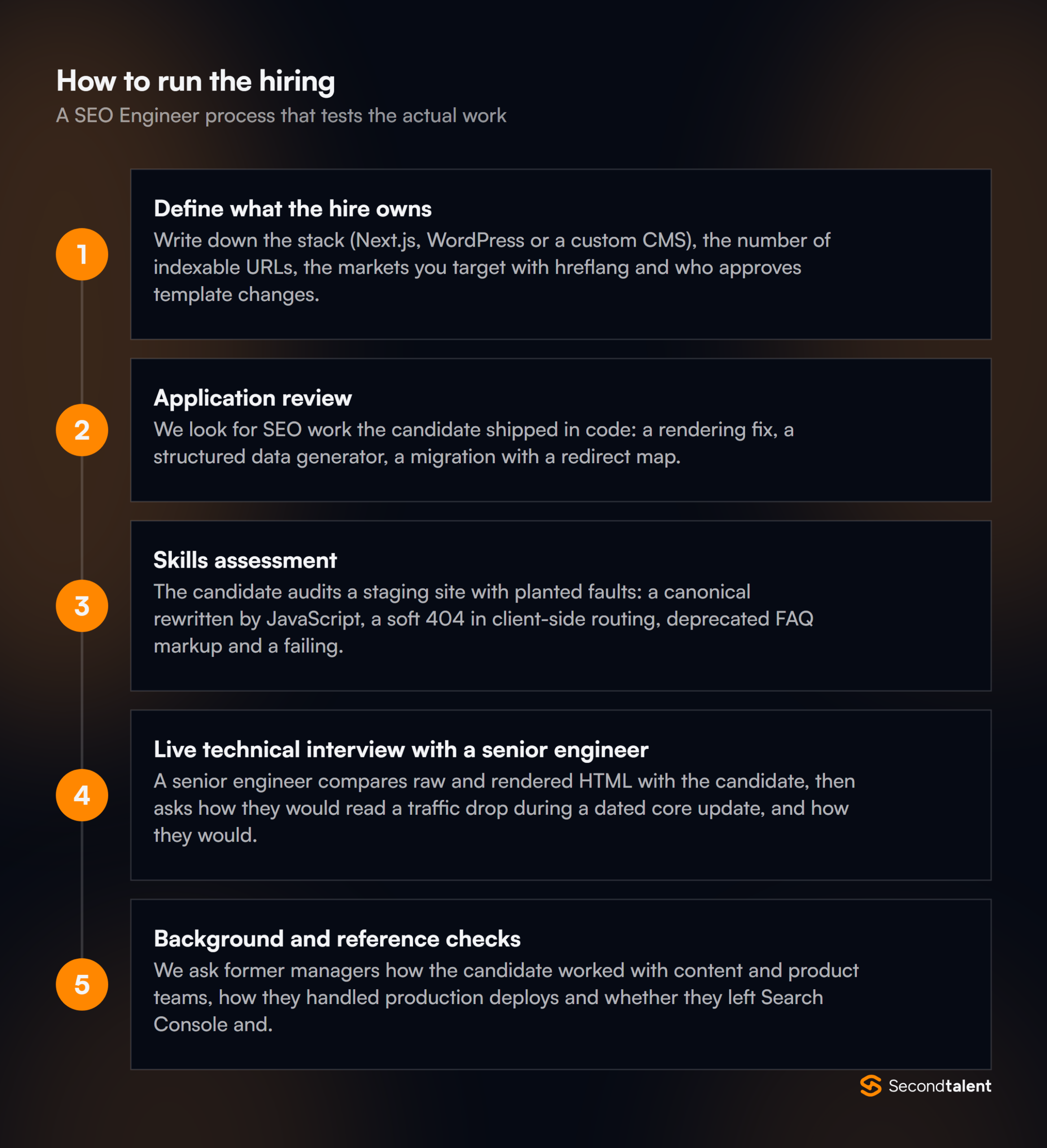
Second Talent's vetting covers stages 2 to 5 before you see a profile. Our Next.js interview challenges suit a final round on a React stack.
Stage 1: Define what the hire owns
Write down the stack (Next.js, WordPress or a custom CMS), the number of indexable URLs, the markets you target with hreflang and who approves template changes. For a hire whose main job is building pages, our web developer track may fit better.
Stage 2: Application review
We look for SEO work the candidate shipped in code: a rendering fix, a structured data generator, a migration with a redirect map. Each claim needs a number they can state, such as URLs indexed before and after, or a p75 LCP they moved.
Stage 3: Skills assessment
The candidate audits a staging site with planted faults: a canonical rewritten by JavaScript, a soft 404 in client-side routing, deprecated FAQ markup and a failing mobile LCP. We score the ranked findings and one pull request that fixes the worst fault.
Stage 4: Live technical interview with a senior engineer
A senior engineer compares raw and rendered HTML with the candidate, then asks how they would read a traffic drop during a dated core update, and how they would separate it from a deploy that broke rendering.
Stage 5: Background and reference checks
We ask former managers how the candidate worked with content and product teams, how they handled production deploys and whether they left Search Console and analytics access in order. You then choose the contractor or EOR route above.
Hire SEO Engineers from Asia with Second Talent
We shortlist 6-8 candidates within 24 hours from 100,000+ pre-vetted engineers, accepting only the top 1% of applicants. SEO engineers come with $0 upfront, no lock-in and 4-6 hours of daily overlap with US hours. We handle contracts, payroll and equipment, with compliant EOR contracts and payroll in 9 Asian markets.
Our pricing page sets out the subscription, direct-hire and EOR options, and for interface-heavy briefs we also staff front-end developers.