TL;DR: TypeScript developers from Asia earn from $1,200 a month working for foreign companies on our Node.js developer rate cards, and Second Talent shortlists 6-8 pre-vetted candidates within 24 hours. The closest US benchmark, the BLS median for software developers, was $135,980 a year in May 2025.
TypeScript 7.0, released on 8 July 2026, is a Go port of the compiler with full builds 8x to 12x faster. It ships without a programmatic API, so typescript-eslint still needs TypeScript 6.0 installed beside it. Your hire will run that two-compiler setup.
Key takeaways
- TypeScript overtook Python and JavaScript in August 2025 to become the most used language on GitHub by contributor count.
- Since TypeScript 6.0,
strict is on by default, and TypeScript 7.0 turns baseUrl, target: es5 and moduleResolution: node10 into hard errors.
- Node.js runs TypeScript files by stripping the types, a feature marked stable in v25.2.0 and v24.12.0, and it performs no type checking.
- Slack told the TypeScript team that type-checking in CI fell from about 7.5 minutes to 1.25 minutes on TypeScript 7.
What TypeScript Developers Earn Working for International Clients in Asia
Thailand has the highest floor in the table at $2,500 a month, and Indonesia the lowest at $1,200. We publish no TypeScript rate card. The table uses our Node.js developer rate cards, the closest match for a developer who writes typed code on the server and in the browser. Each range is what developers in that market earn working for foreign companies as their direct clients, before any employer or platform costs.
| Market |
Monthly pay working for international clients (USD) |
| Indonesia |
$1,200-$4,500 |
| Philippines |
$1,520-$4,070+ |
| India |
$1,880-$7,530+ |
| Vietnam |
$2,000-$5,500 |
| Malaysia |
$2,200-$6,500 |
| Thailand |
$2,500-$6,000 |
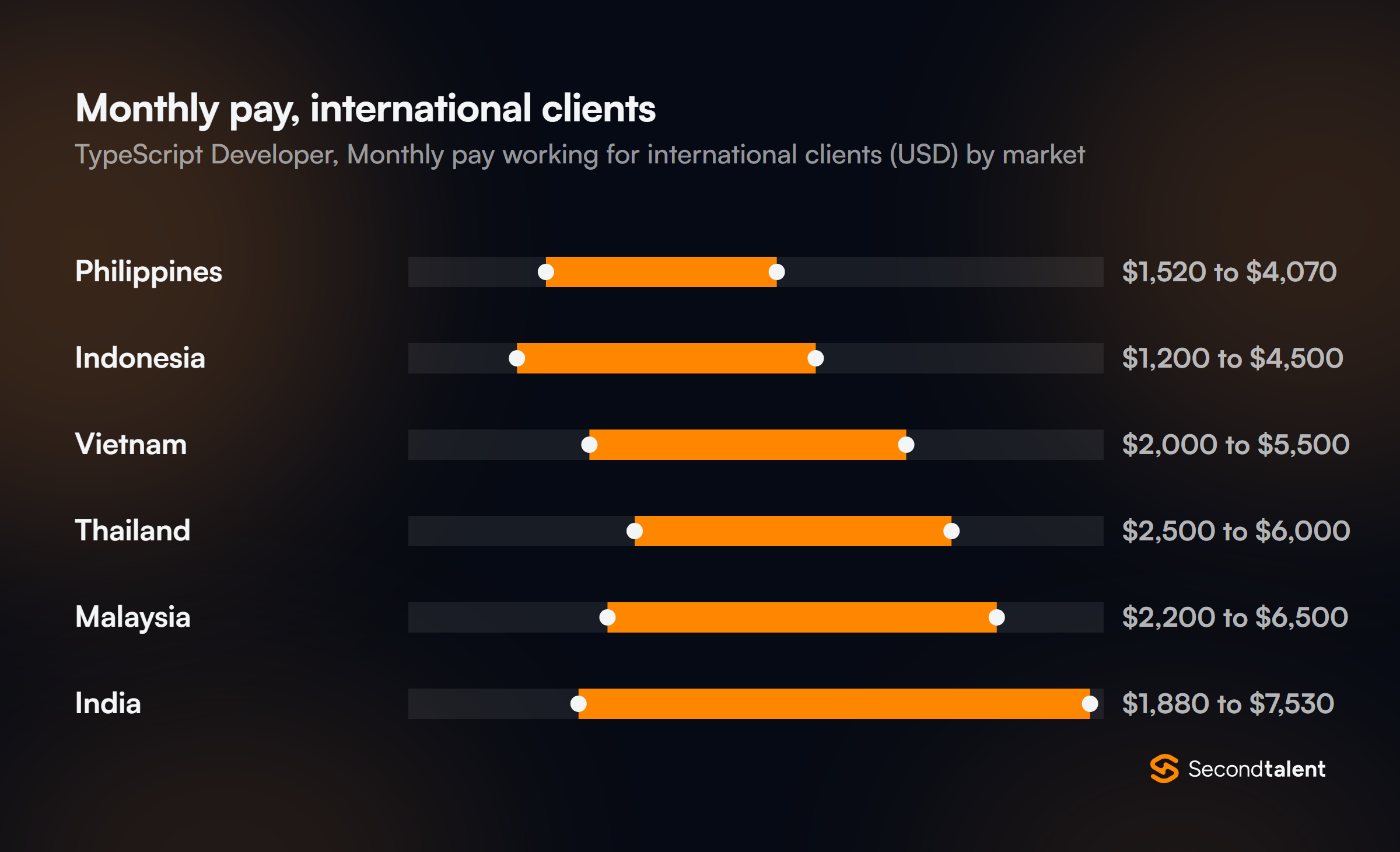
Monthly ranges from the Remote (Working for International Clients) figures on our rate cards for Indonesia, the Philippines, India, Vietnam, Malaysia and Thailand, converted at ExchangeRate-API mid-market rates for 14 September 2026.
Four cards quote US dollars with a fixed ceiling, so conversion leaves them unchanged. The Philippine card quotes ₱95,000 to ₱255,000+ and the Indian card ₹180,000 to ₹720,000+, both converted to dollars and open at the top.
Second Talent bills a TypeScript developer as one monthly fee that bundles salary, payroll taxes, statutory contributions and our service fee. Our pricing page explains the subscription. For a single-framework brief we also staff React developers and Node.js developers.
US Pay Benchmark for TypeScript Developers
TypeScript was used by 48.8% of professional developers in the Stack Overflow 2025 Developer Survey, against 68.8% for JavaScript. BLS tracks no pay series for a single language. TypeScript developers map to Software Developers (SOC 15-1252), because the job is building application software for the browser or the server.
| BLS OEWS, May 2025, national |
Software Developers (15-1252) |
| Median annual |
$135,980 |
| 10th percentile, monthly |
$6,870 |
| 25th percentile, monthly |
$8,770 |
| Median, monthly |
$11,330 |
| 75th percentile, monthly |
$14,330 |
| 90th percentile, monthly |
$17,890 |
Monthly figures are the annual wages on the OEWS profile for 15-1252 divided by 12, rounded to the nearest $10.
Salary is only part of the US cost. In the BLS Employer Costs for Employee Compensation release for June 2026, wages and salaries made up 68.5% of employer compensation costs for full-time private industry workers, and benefits the other 31.5%.
For contract work, our TypeScript cost-to-hire page puts a mid-level US freelance or contract TypeScript developer at $85 to $135 an hour, before payroll, insurance and leave.
Time Zone Overlap with ET, CT and PT
A developer in Ho Chi Minh City on a 9:00 am to 6:00 pm day works 02:00 to 11:00 UTC, which is 10:00 pm to 7:00 am in New York. That leaves no shared hours, and a pull request comment waits a day for its reply. US daylight time runs from 8 March to 1 November 2026, per NIST, and none of the cities below change their clocks.
| Engineer's city |
UTC offset |
9:00 am ET (EDT) |
9:00 am CT (CDT) |
9:00 am PT (PDT) |
| Manila, Singapore, Kuala Lumpur, Taipei |
UTC+8 |
9:00 pm |
10:00 pm |
12:00 midnight |
| Ho Chi Minh City, Jakarta, Bangkok |
UTC+7 |
8:00 pm |
9:00 pm |
11:00 pm |
| Bengaluru |
UTC+5:30 |
6:30 pm |
7:30 pm |
9:30 pm |
After 1 November 2026, every time in the table moves one hour later.
Shift the day and the picture changes. A Bangkok shift from 4:00 pm to 1:00 am runs 09:00 to 18:00 UTC, or 5:00 am to 2:00 pm EDT. That is five hours inside a 9-to-5 New York day, four with Chicago and two with San Francisco.
Use those hours for API reviews and for agreeing the types shared by front end and back end. Keep the Asian afternoon for building. The type check and tests then finish before your team signs on. We agree the shift before the offer, which is how our placements get 4-6 hours of daily overlap with US hours.
Late hours carry premiums for employees in two markets: at least 10% between 10 pm and 6 am in the Philippines (Labor Code Article 86), and at least 30% between 22:00 and 06:00 in Vietnam (Labor Code Articles 98 and 106).
TypeScript Developer Skills to Screen For
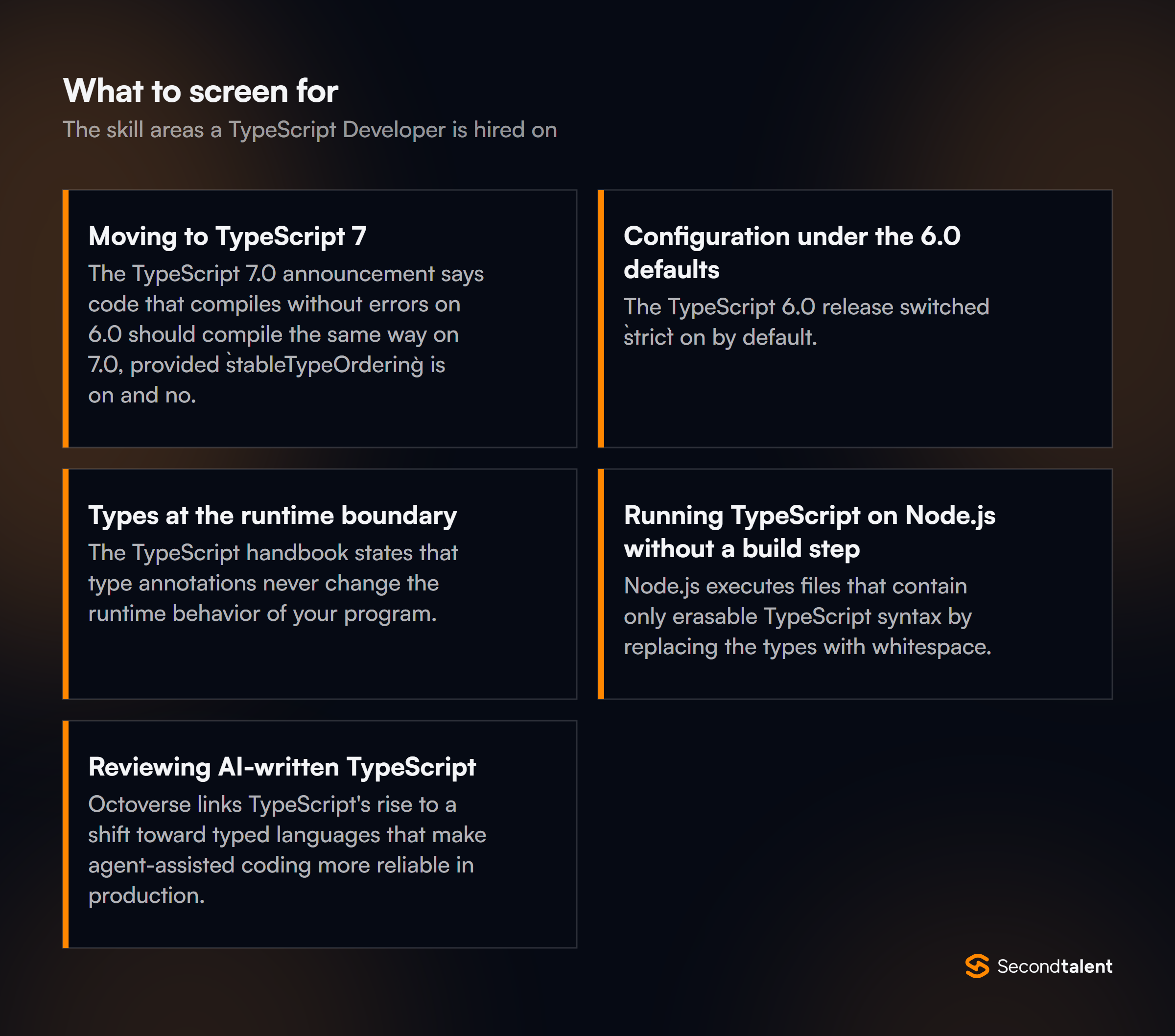
GitHub's Octoverse 2025 reports that TypeScript grew by more than 1 million contributors in 2025, up 66%. A large pool means many candidates who list the language, so test the parts that changed in 2026.
Moving to TypeScript 7
The TypeScript 7.0 announcement says code that compiles without errors on 6.0 should compile the same way on 7.0, provided stableTypeOrdering is on and no ignoreDeprecations flag is set. Tools that import the compiler API, typescript-eslint among them, need the @typescript/typescript6 package through an npm alias. A new API is due in TypeScript 7.1.
Ask the candidate to plan the move for a monorepo that uses typescript-eslint and a custom build script. Score whether they find the tools that call the API before they change the version number.
Configuration under the 6.0 defaults
The TypeScript 6.0 release switched strict on by default. It also set types to an empty list by default, so a project now names global declarations such as @types/node itself. It deprecated baseUrl, and version 7.0 rejects it.
Hand over a legacy tsconfig.json with baseUrl, moduleResolution: node and target: es5. The candidate should rewrite it, run the check, and explain each new error instead of silencing it with any.
Types at the runtime boundary
The TypeScript handbook states that type annotations never change the runtime behavior of your program. A JSON response typed as User is still whatever the server sent. Give the candidate a fetch call cast straight to an interface, and ask where the validation goes and what the code does when a field is missing.
Running TypeScript on Node.js without a build step
Node.js executes files that contain only erasable TypeScript syntax by replacing the types with whitespace. Enums, namespaces with runtime code, parameter properties and import aliases need a transform, so they fail. Node ignores tsconfig.json, and it recommends TypeScript 5.8 or newer with erasableSyntaxOnly turned on. Ask how the candidate would keep tsc --noEmit in CI when production no longer runs the compiler.
Reviewing AI-written TypeScript
Octoverse links TypeScript's rise to a shift toward typed languages that make agent-assisted coding more reliable in production. In Stack Overflow's AI results, 66% of respondents named "AI solutions that are almost right, but not quite" as a frustration. Give the candidate an AI-generated module that compiles because of two as casts and one any, and score which of the three they question first.
Contractor or Employer of Record for a US Company
DefinitelyTyped publishes its type definitions under the MIT licence, and copyright stays with each contributor named at the top of the definition file. That includes fixes your developer sends upstream. Agree before the first pull request which fixes may go upstream and which stay in your repository.
Software is not one of the nine categories of commissioned work that can be "work made for hire" under 17 U.S.C. § 101, and a transfer of copyright must be in writing and signed under § 204(a). Name source code, declaration files, generated API clients and build scripts in the assignment.
IRS Publication 515 says the place where services are performed determines the source of the income, so a developer working from Bangkok or Manila earns foreign-source income. A foreign individual gives the payer Form W-8BEN to certify foreign status.
Local law applies its own test for employment. Philippine courts use the four-fold test, and in Atok Big Wedge v. Gison the Supreme Court called the power of control the most important of the four. In Vietnam, Article 13 of the 2019 Labor Code treats an agreement as a labor contract when it covers a paid job, wages and one party's management and supervision, whatever its name.
A fixed migration project, such as moving one repository to TypeScript 7, suits a contractor agreement. A developer who joins your standups and ships to production each week fits the employment tests above. That is the case an Employer of Record covers, and our comparison of EOR, PEO and contractor models sets out the trade-offs. This is a summary, not legal advice.
|
Independent contractor |
Employer of Record |
| Legal employer |
None; the developer invoices you |
The EOR's local entity |
| US paperwork |
Form W-8BEN from the developer |
Service agreement with the EOR |
| IP |
Written assignment naming source, declaration files and build scripts |
Assignment in the employment contract and your EOR agreement |
| Local labor law |
Classification risk if you control hours and methods |
Night premiums, public holidays and leave apply |
| Pay currency |
Agreed in the contract, often USD |
Local currency; Vietnam's Labor Code states wages in dong (Article 95) |
English Level and Working Norms
India's IT job-function score of 487 on the EF English Proficiency Index 2025 sits one point below the global average of 488. The index ranks 123 countries and regions, and Malaysian IT workers score highest of the markets below, at 590.
| Country |
EF EPI 2025 score |
World rank (of 123) |
IT job-function score |
| Malaysia |
581 |
24 |
590 |
| Philippines |
569 |
28 |
581 |
| Vietnam |
500 |
64 |
500 |
| India |
484 |
74 |
487 |
| Indonesia |
471 |
80 |
523 |
| Thailand |
402 |
116 |
459 |
Scores come from EF's country pages, such as India and Thailand.
TypeScript work leaves a written trail: pull request descriptions, doc comments on exported types and migration notes for other teams. Ask finalists to write the upgrade note for the TypeScript 7 exercise, in half a page, for engineers who did not do the work.
Plan releases around both calendars. Thanksgiving on 26 November 2026 is a working day in Asia, so a developer there can finish a migration branch while your US team is off. Article 112 of Vietnam's Labor Code gives five paid days for Lunar New Year, in late January or February.
TypeScript Developer Hiring Process
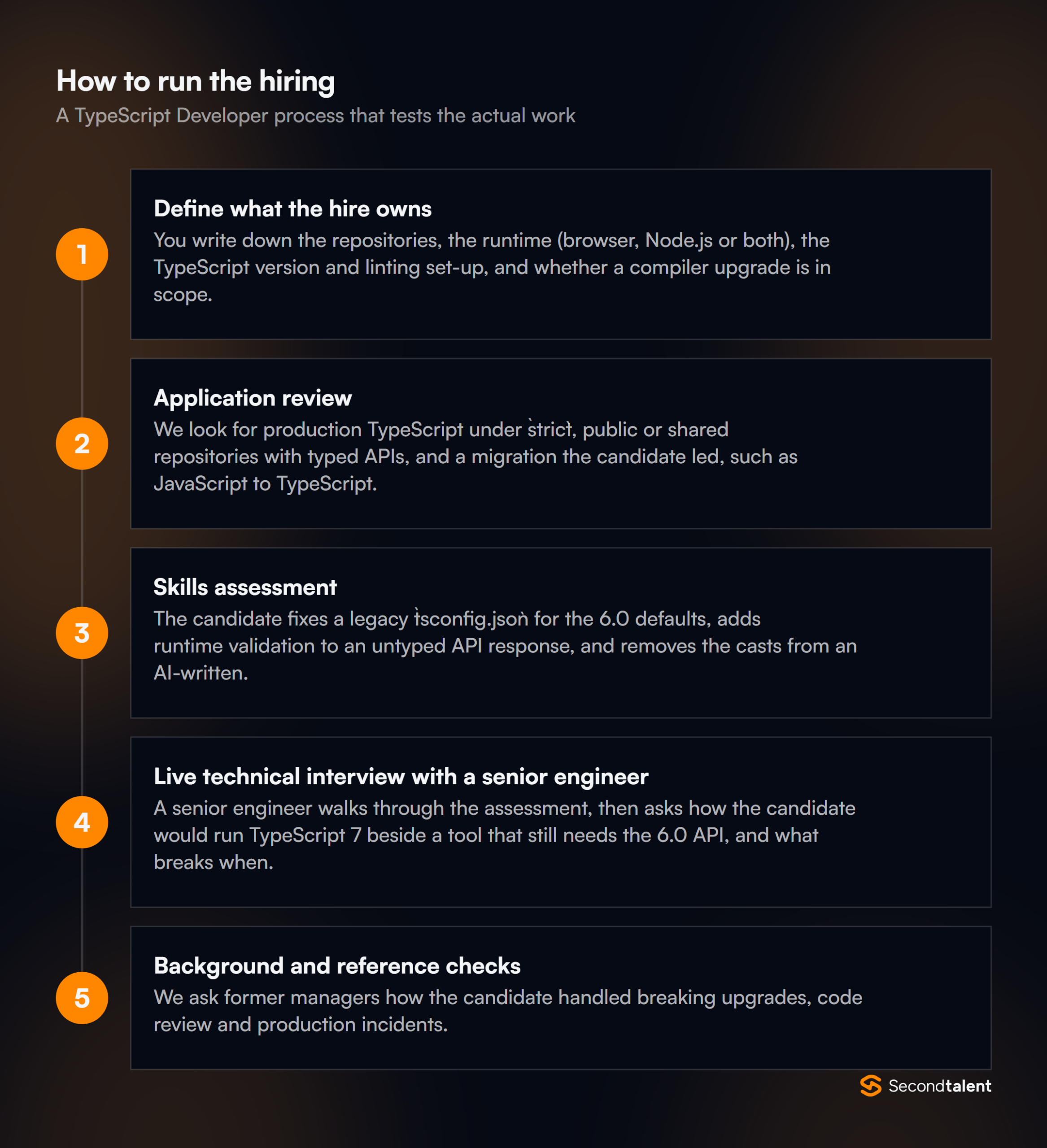
Second Talent's vetting covers stages 2 to 5 before you see a profile.
Stage 1: Define what the hire owns
You write down the repositories, the runtime (browser, Node.js or both), the TypeScript version and linting set-up, and whether a compiler upgrade is in scope. Add the review window your team can cover.
Stage 2: Application review
We look for production TypeScript under strict, public or shared repositories with typed APIs, and a migration the candidate led, such as JavaScript to TypeScript or one major compiler version to the next.
Stage 3: Skills assessment
The candidate fixes a legacy tsconfig.json for the 6.0 defaults, adds runtime validation to an untyped API response, and removes the casts from an AI-written module. We score the explanation of each compiler error with the code.
Stage 4: Live technical interview with a senior engineer
A senior engineer walks through the assessment, then asks how the candidate would run TypeScript 7 beside a tool that still needs the 6.0 API, and what breaks when Node.js strips types from a file with an enum.
Stage 5: Background and reference checks
We ask former managers how the candidate handled breaking upgrades, code review and production incidents. You then choose the contractor or EOR route above.
Hire TypeScript Developers from Asia with Second Talent
We shortlist 6-8 candidates within 24 hours from 100,000+ pre-vetted engineers, accepting only the top 1% of applicants. TypeScript developers come with $0 upfront, no lock-in and 4-6 hours of daily overlap with US hours. We handle contracts, payroll and equipment, with compliant EOR contracts and payroll in 9 Asian markets.
Our pricing page covers subscription, direct-hire and EOR pricing for a first hire or a full team.