TL;DR: React developers from Asia who work for international clients earn $1,200 to $7,530+ a month on our React developer rate cards, and we shortlist 6-8 candidates within 24 hours. The closest US benchmark, the BLS median for software developers, was $135,980 a year in May 2025.
React 19.3 shipped on 9 September 2026 with View Transitions and Fragment Refs marked stable. The release post also ends React's habit of turning values into plain strings before they reach DOM sinks such as innerHTML, so browser Trusted Types policies now work in React apps.
Key takeaways
- Taiwan and Malaysia share a $7,000 ceiling on our React developer rate cards, and the Philippine card stops lowest, at $4,500.
- Since 24 February 2026, React, React Native and JSX have belonged to the React Foundation, hosted by the Linux Foundation, instead of Meta.
- CISA lists the React Server Components flaw CVE-2025-55182 as exploited and known to be used in ransomware campaigns.
- Create React App has been deprecated for new apps since 14 February 2025.
What React Developers Earn Working for International Clients in Asia
The Philippines and Indonesia share the lowest floor, $1,200, while Taiwan and Malaysia start highest, at $2,500 and $2,950. Each figure is what React developers in that market earn working directly for foreign companies, before any employer or platform costs.
| Market |
Monthly pay working for international clients (USD) |
| Philippines |
$1,200-$4,500 |
| Indonesia |
$1,200-$6,500 |
| Vietnam |
$1,800-$6,500 |
| India |
$1,880-$7,530+ |
| Taiwan |
$2,500-$7,000 |
| Malaysia |
$2,950-$7,000+ |
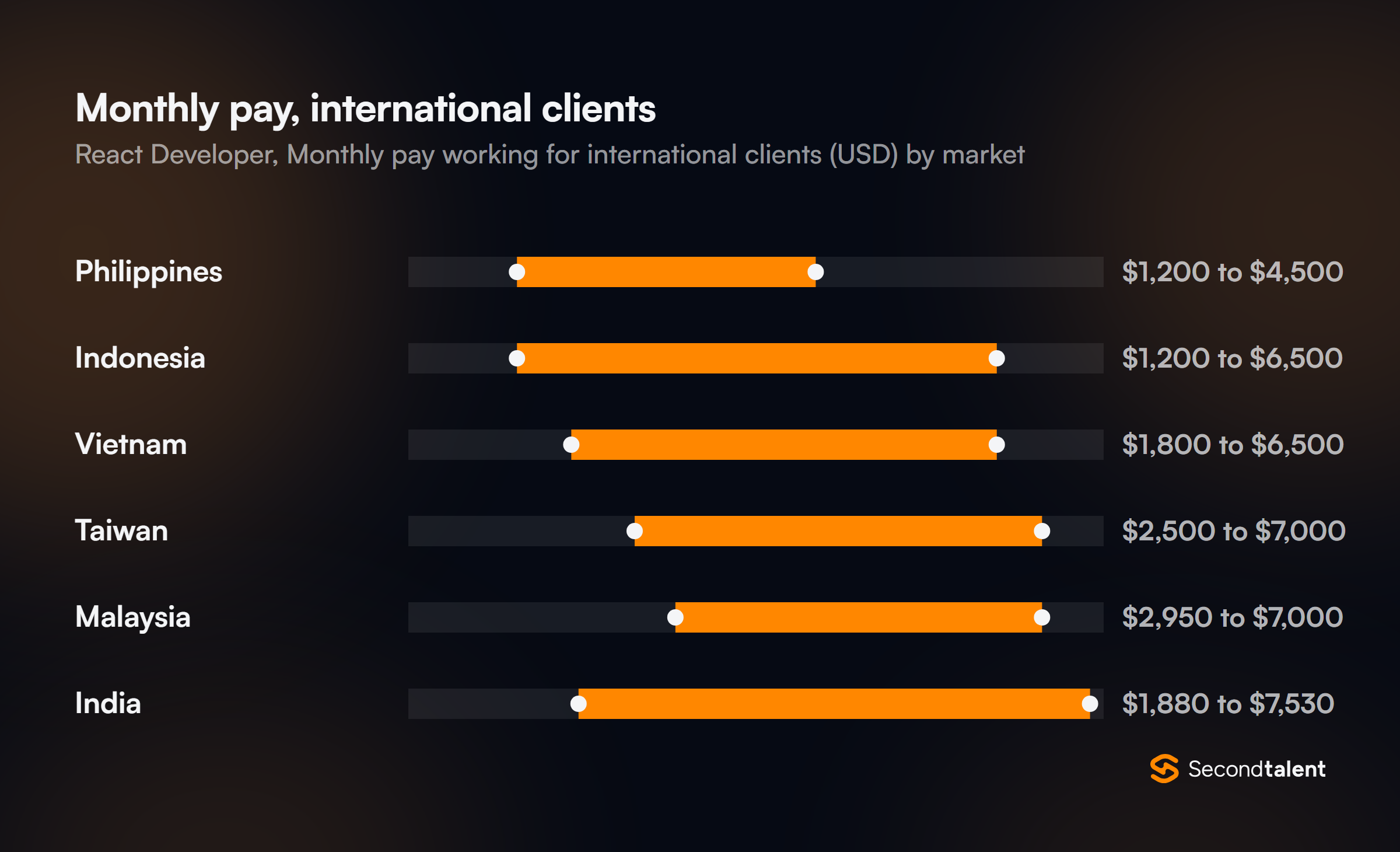
Monthly ranges from the Remote (Working for International Clients) figures on our rate cards for the Philippines, Indonesia, Vietnam, India, Taiwan and Malaysia, converted at ExchangeRate-API mid-market rates for 14 September 2026.
The Philippine, Indonesian, Vietnamese and Taiwanese cards quote US dollars with a fixed top. The Indian card is set in rupees (₹95.61 to the dollar) and the Malaysian card in ringgit (RM4.07), both open at the top.
Our pricing page explains how we bill a Second Talent subscription. For a hire who works across frameworks, our front-end developer page covers the wider role.
US Pay Benchmark for React Developers
BLS has no React occupation. The role maps to Software Developers (15-1252), because a React developer on a product team builds application software, and the table adds Web Developers (15-1254) for a hire whose React work is marketing sites and content pages.
| BLS OEWS, May 2025, national |
Software Developers (15-1252) |
Web Developers (15-1254) |
| Median annual |
$135,980 |
$92,650 |
| 10th percentile, monthly |
$6,870 |
$4,010 |
| 25th percentile, monthly |
$8,770 |
$5,350 |
| Median, monthly |
$11,330 |
$7,720 |
| 75th percentile, monthly |
$14,330 |
$10,520 |
| 90th percentile, monthly |
$17,890 |
$13,520 |
Monthly figures are the annual wages on the BLS OEWS profiles for 15-1252 and 15-1254 divided by 12, rounded to the nearest $10.
Salary is only part of the US cost. In the BLS Employer Costs for Employee Compensation release for June 2026, wages and salaries made up 68.5% of employer compensation costs for full-time private industry workers, and benefits the other 31.5%.
For the contract route, our React developer cost-to-hire page, updated on 12 September 2026, puts a mid-level US freelance or contract React developer at $89 to $140 an hour, before payroll, insurance and leave.
Time Zone Overlap with ET, CT and PT
UI work waits on eyes: a designer approving a transition, a product manager clicking through a flow on staging. Those reviews belong in the shared hours. US daylight time runs from 8 March to 1 November 2026, per NIST, and no city below changes its clocks.
| Engineer's city |
UTC offset |
9:00 am ET (EDT) |
9:00 am CT (CDT) |
9:00 am PT (PDT) |
| Manila, Singapore, Kuala Lumpur, Taipei |
UTC+8 |
9:00 pm |
10:00 pm |
12:00 midnight |
| Ho Chi Minh City, Jakarta, Bangkok |
UTC+7 |
8:00 pm |
9:00 pm |
11:00 pm |
| Bengaluru |
UTC+5:30 |
6:30 pm |
7:30 pm |
9:30 pm |
After 1 November 2026, every time in the table moves one hour later.
A Ho Chi Minh City shift from 5:00 pm to 2:00 am runs 10:00 to 19:00 UTC. That is 6:00 am to 3:00 pm EDT, which covers six hours of a 9-to-5 day in New York, five in Chicago and three in San Francisco.
Four of the nine hours, 22:00 to 02:00, fall inside the window where Vietnam's Labor Code adds at least 30% for employees (Articles 98 and 106). The Philippines sets at least 10% for employee work between 10 pm and 6 am (Labor Code Article 86).
Keep design reviews and release sign-off in the shared hours, and let the developer pick up review comments the next local afternoon. We agree that schedule before the offer, which is how our placements get 4-6 hours of daily overlap with US hours.
React Developer Skills to Screen For
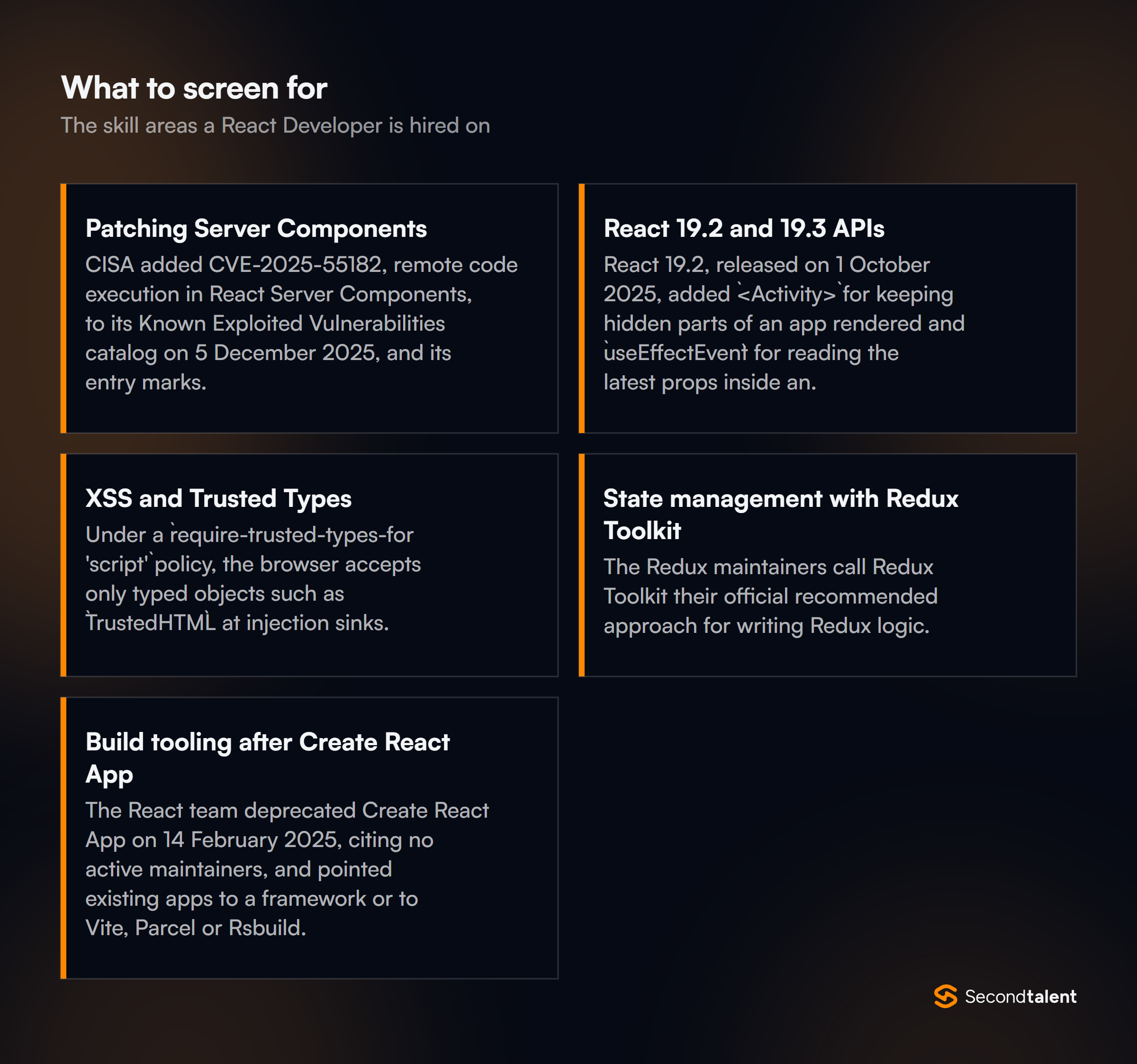
React was used by 44.7% of all respondents to Stack Overflow's 2025 survey, second among web frameworks and technologies only to Node.js, at 48.7%. Next.js reached 20.8%. A React line on a CV is common, so test the five areas below.
Patching Server Components
CISA added CVE-2025-55182, remote code execution in React Server Components, to its Known Exploited Vulnerabilities catalog on 5 December 2025, and its entry marks ransomware use as known. It tells users to check internet-facing React instances for signs of compromise after patching.
On 11 December 2025 the React team disclosed denial-of-service and source code exposure flaws in the same packages, and warned that the 19.0.3, 19.1.4 and 19.2.3 patches were incomplete. Fixes landed in 19.0.4, 19.1.5 and 19.2.4. Ask the candidate how they would find the services still running an affected version, and what they would check beyond the upgrade.
React 19.2 and 19.3 APIs
React 19.2, released on 1 October 2025, added <Activity> for keeping hidden parts of an app rendered and useEffectEvent for reading the latest props inside an Effect without re-running it. It shipped eslint-plugin-react-hooks v6 with flat config by default and opt-in compiler-powered rules. In 19.3, <ViewTransition> animates updates marked as Transitions through the browser's View Transition API.
Show the candidate a chat component that reconnects whenever the theme changes and ask for the fix.
XSS and Trusted Types
Under a require-trusted-types-for 'script' policy, the browser accepts only typed objects such as TrustedHTML at injection sinks. Before 19.3, React converted those objects back into strings, which the browser rejected. Hand the candidate a component that renders CMS content with dangerouslySetInnerHTML, and score where they sanitise it and whether they can turn on the policy without breaking the page.
State management with Redux Toolkit
The Redux maintainers call Redux Toolkit their official recommended approach for writing Redux logic. configureStore replaces hand-wired createStore setups, and createSlice writes immutable updates through Immer. The State of React 2025 survey found Zustand "gaining ground fast" on Redux, and the most popular state library by user satisfaction.
Give the candidate a legacy reducer with hand-written action types. Ask them to port one slice to Redux Toolkit, and to say which state belongs in a server cache instead. Redux Toolkit also re-exports createSelector from Reselect, so ask for one memoized selector and an explanation of when it recomputes.
Build tooling after Create React App
The React team deprecated Create React App on 14 February 2025, citing no active maintainers, and pointed existing apps to a framework or to Vite, Parcel or Rsbuild. Vite was used by 27.2% of professional developers in Stack Overflow's 2025 survey. Ask what broke the last time the candidate moved an app off react-scripts, and how long the cutover took.
What to expect from a senior React developer
A senior React developer should own the decisions a mid-level developer follows: where data is fetched, what renders on the server and how the component library evolves. Three areas show the difference:
- Rendering strategy. Ask the candidate to choose between client rendering, server rendering and React Server Components for three screens in your app, such as a logged-in dashboard, a marketing page and a product listing, and to defend each choice on performance and caching.
- Performance budgets. Give them a list that re-renders on every keystroke and ask how they would find the cause with the React DevTools Profiler before reaching for
memo. A senior hire measures first.
- Design system ownership. Ask how they versioned a shared component library across several apps, and how they shipped a breaking change without blocking product teams.
In the reference call, ask how the candidate reviewed other developers' pull requests and whether they led a React major-version upgrade from start to finish. Senior work shows in the upgrades and reviews a developer has led, more than in years on a CV.
Contractor or Employer of Record for a US Company
Software is not one of the nine categories of commissioned work that can be "work made for hire" under 17 U.S.C. § 101. A React component library a contractor builds for you stays theirs until transferred, and § 204(a) requires that transfer in writing, signed.
IRS Publication 515 says the place where services are performed determines the source of the income, so a developer working from Taipei or Ho Chi Minh City earns foreign-source income. A foreign individual gives the payer Form W-8BEN to certify foreign status.
Each country then applies its own employment test. Philippine courts use the four-fold test, and in Atok Big Wedge v. Gison the Supreme Court called the power of control the most important of the four. Article 13 of Vietnam's 2019 Labor Code treats an agreement under another name as a labor contract when it covers a paid job, wages and one party's management and supervision.
|
Independent contractor |
Employer of Record |
| Legal employer |
None; the developer invoices you |
The EOR's local entity |
| US paperwork |
Form W-8BEN from the developer |
Service agreement with the EOR |
| IP |
Written assignment covering components, hooks, stories and tests |
Assignment terms in the employment contract and your EOR agreement |
| Local labor law |
Classification risk if you set hours and methods |
Night premiums, public holidays and leave apply |
| Pay currency |
Agreed in the contract, often USD |
Local currency; Vietnam's Labor Code states wages in dong (Article 95) |
A fixed-scope migration off Create React App suits a contractor agreement. A developer in your sprints with deploy rights to production fits the employment tests above, and our Employer of Record service employs that developer in-country. Our EOR, PEO and contractor comparison sets out the trade-offs. This is a summary, not legal advice.
English Level and Working Norms
Filipino adults score 603 for writing and 539 for speaking on the EF English Proficiency Index 2025, a 64-point gap that favours the pull request over the stand-up call. The index ranks 123 countries and regions, with a global average of 488.
| Country |
EF EPI 2025 score |
World rank (of 123) |
IT job-function score |
| Malaysia |
581 |
24 |
590 |
| Philippines |
569 |
28 |
581 |
| Vietnam |
500 |
64 |
500 |
| India |
484 |
74 |
487 |
| Indonesia |
471 |
80 |
523 |
Scores come from EF's country pages, such as the Philippines, Indonesia and Vietnam. EF EPI 2025 publishes no page for Taiwan, so the Taiwan row from the cost table has no score here.
React developers write the words your users read: button labels, empty states, form errors and alt text. Ask finalists to write the validation messages for one form in your product, then the pull request note that explains them to a designer.
Plan releases around both calendars. Thanksgiving on 26 November 2026 is a working day in Asia, so a developer there can watch the storefront while your US team is off.
Vietnam's Labor Code gives five paid days for Lunar New Year (Article 112), in late January or February, so keep a redesign launch out of that week with a Vietnam-based developer.
React Developer Hiring Process
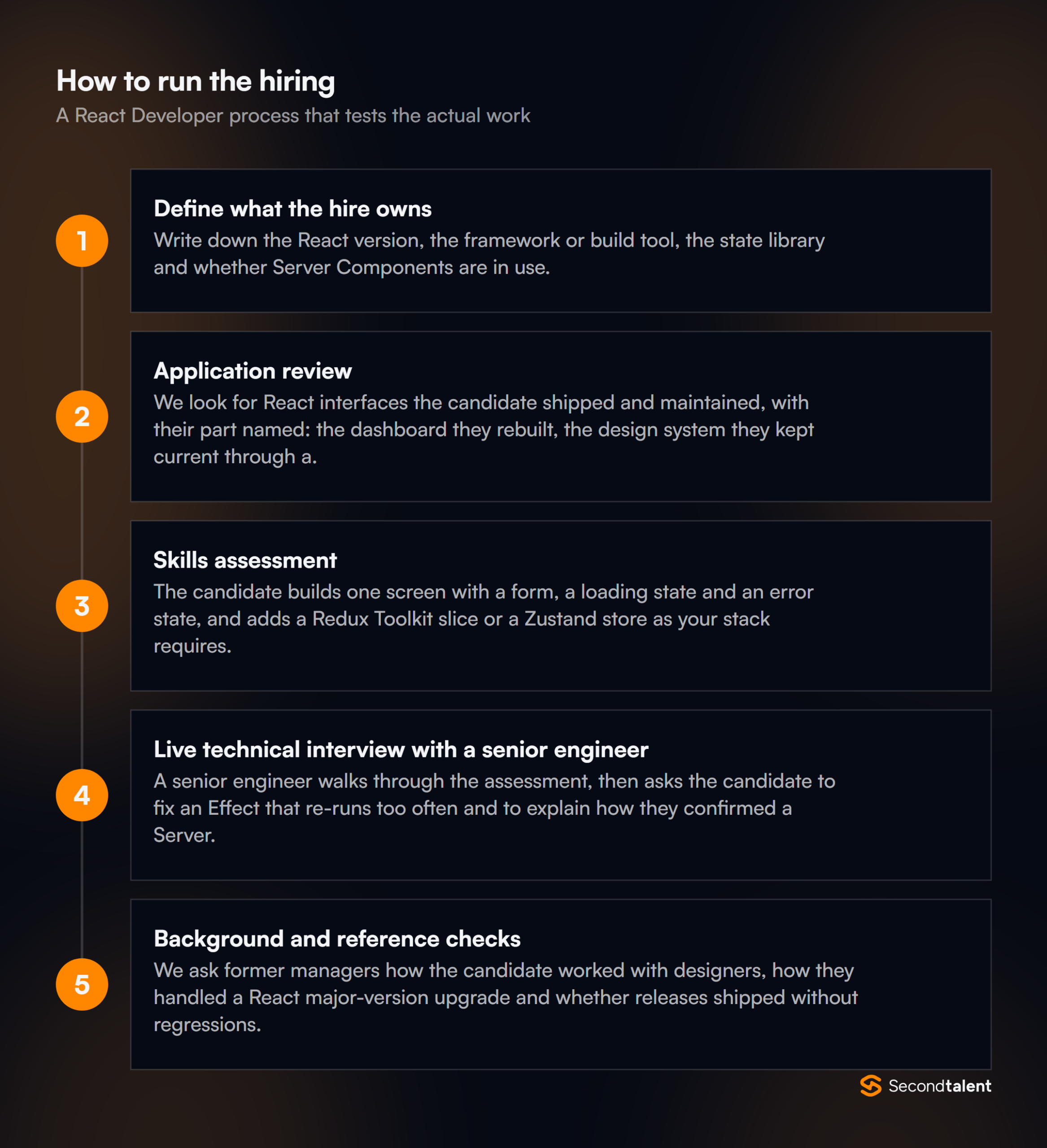
Second Talent's vetting covers stages 2 to 5 before you see a profile. For a TypeScript-heavy codebase, our TypeScript developer track runs the same stages.
Stage 1: Define what the hire owns
Write down the React version, the framework or build tool, the state library and whether Server Components are in use. Name the browsers you support and any Content Security Policy you enforce.
Stage 2: Application review
We look for React interfaces the candidate shipped and maintained, with their part named: the dashboard they rebuilt, the design system they kept current through a major version. A portfolio of template clones does not pass.
Stage 3: Skills assessment
The candidate builds one screen with a form, a loading state and an error state, and adds a Redux Toolkit slice or a Zustand store as your stack requires. We score the tests, keyboard access and the pull request description.
Stage 4: Live technical interview with a senior engineer
A senior engineer walks through the assessment, then asks the candidate to fix an Effect that re-runs too often and to explain how they confirmed a Server Components patch level after the December 2025 advisories.
Stage 5: Background and reference checks
We ask former managers how the candidate worked with designers, how they handled a React major-version upgrade and whether releases shipped without regressions. You then choose the contractor or EOR route above.
Hire React Developers from Asia with Second Talent
We shortlist 6-8 candidates within 24 hours from 100,000+ pre-vetted engineers, accepting only the top 1% of applicants. React developers come with $0 upfront, no lock-in and 4-6 hours of daily overlap with US hours. We handle contracts, payroll and equipment, with compliant EOR contracts and payroll in 9 Asian markets.
Our pricing page sets out subscription, direct-hire and EOR pricing. SatLayer grew its workforce by 20% in two months with front-end engineers and product designers we sourced from Taiwan, according to the SatLayer case study.