TL;DR: Product engineers from Asia earn $850 to $7,000+ a month working for international clients on our full-stack rate cards, and we shortlist 6-8 candidates in 24 hours. The closest US benchmark, the BLS median for software developers, was $135,980 a year in May 2025.
PostHog's Product Engineer Handbook says its product engineers talk to users, decide what to build and own pricing, revenue and user experience. All of them also do customer support. Screen for that ownership first, then for the stack.
Key takeaways
- Taiwan's rate card covers senior full-stack developers only, and its range opens at $4,750 a month.
- CVE-2025-55182, a pre-authentication remote code execution flaw in React Server Components, carries the maximum CVSS score of 10.
- Interaction to Next Paint replaced First Input Delay as a Core Web Vital on 12 March 2024.
- Node.js 20 reached end of life on 30 April 2026, so any product still on it runs without security releases.
What Product Engineers Earn Working for International Clients in Asia
Vietnam's range opens at $3,000, higher than the $2,270+ that marks the top of Indonesia's open-ended range. Our rate cards have no product engineer title, so the table uses our full-stack developer cards, the closest match for engineers who ship a feature from database to screen.
Each figure is what developers in that market earn working directly for foreign companies, before any employer or platform costs.
| Market |
Monthly pay working for international clients (USD) |
| Indonesia |
$850-$2,270+ |
| Philippines |
$1,600-$3,350+ |
| Malaysia |
$2,090-$5,040+ |
| Vietnam |
$3,000-$7,000+ |
| Taiwan |
$4,750-$6,650+ |
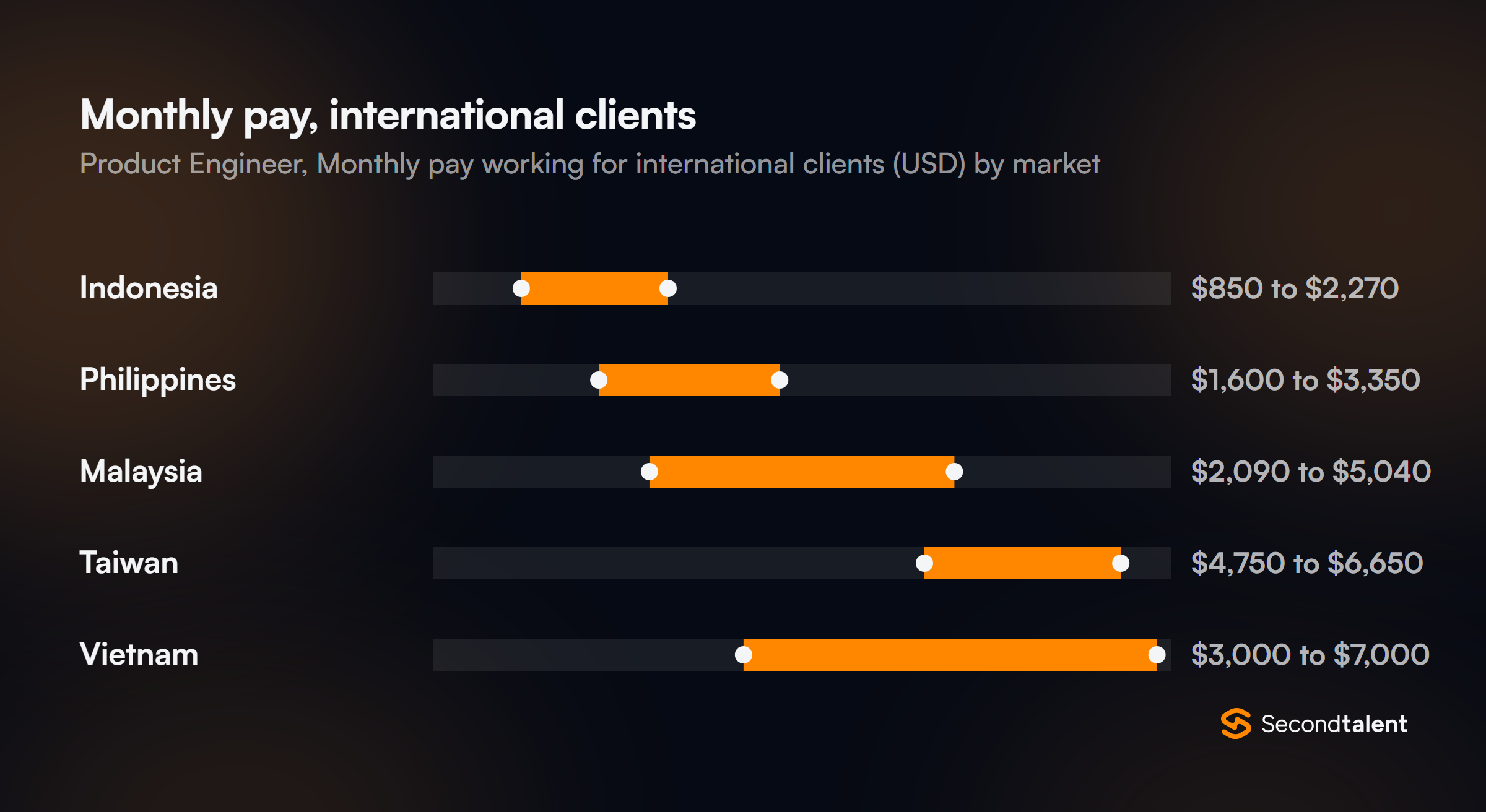
Monthly ranges from the Remote (Working for International Clients) figures on our rate cards for Indonesia, the Philippines, Malaysia, Vietnam and Taiwan, converted at ExchangeRate-API mid-market rates for 14 September 2026.
All five ranges are open at the top. Vietnam's card quotes US dollars, and the other four quote local currency.
Our pricing page explains the monthly fee, which bundles salary, payroll taxes, statutory contributions and our service fee. For a narrower brief we also staff full-stack developers, React developers and Node.js developers.
US Pay Benchmark for Product Engineers
Full-stack developer is the most common role in Stack Overflow's 2025 survey, at 27%, and US respondents with that title reported a median pay of $138,000. BLS has no product engineer occupation. The role maps to Software Developers (15-1252), because a product engineer designs, builds and maintains the application itself, whatever else they own.
| BLS OEWS, May 2025, national |
Software Developers (15-1252) |
| Median annual |
$135,980 |
| 10th percentile, monthly |
$6,870 |
| 25th percentile, monthly |
$8,770 |
| Median, monthly |
$11,330 |
| 75th percentile, monthly |
$14,330 |
| 90th percentile, monthly |
$17,890 |
Monthly figures are the annual wages on the OEWS profile for 15-1252 divided by 12, rounded to the nearest $10.
Salary is only part of the US cost. In the BLS Employer Costs for Employee Compensation release for June 2026, wages and salaries made up 68.5% of employer compensation costs for full-time private industry workers, and benefits the other 31.5%.
For short projects, our full-stack developer cost-to-hire page puts a mid-level US freelance or contract developer at $85 to $135 an hour, before payroll, insurance and leave.
Time Zone Overlap with ET, CT and PT
A product engineer needs live hours with customers as well as with the team: user interviews, sales calls, a support thread that turns into a fix. US daylight time runs from 8 March to 1 November 2026, per NIST, and no city below changes its clocks.
| Engineer's city |
UTC offset |
9:00 am ET (EDT) |
9:00 am CT (CDT) |
9:00 am PT (PDT) |
| Manila, Singapore, Kuala Lumpur, Taipei |
UTC+8 |
9:00 pm |
10:00 pm |
12:00 midnight |
| Ho Chi Minh City, Jakarta, Bangkok |
UTC+7 |
8:00 pm |
9:00 pm |
11:00 pm |
| Bengaluru |
UTC+5:30 |
6:30 pm |
7:30 pm |
9:30 pm |
After 1 November 2026, every time in the table moves one hour later.
A worked example: a Manila shift from 6:00 pm to 3:00 am runs 10:00 to 19:00 UTC. That is 6:00 am to 3:00 pm EDT, six hours inside a New York working day, five with Chicago and three with San Francisco, enough for a morning customer call on either coast.
Keep the shared hours for customer calls, design reviews and release decisions. Coding, tests and experiment analysis fit the engineer's own hours. We agree the schedule before the offer, which is how our placements get 4-6 hours of daily overlap with US hours.
That Manila shift has five hours between 10 pm and 6 am, which earns employees at least 10% extra under the Philippine Labor Code (Article 86). Vietnam sets at least 30% for work between 22:00 and 06:00 (Labor Code Articles 98 and 106).
Product Engineer Skills to Screen For
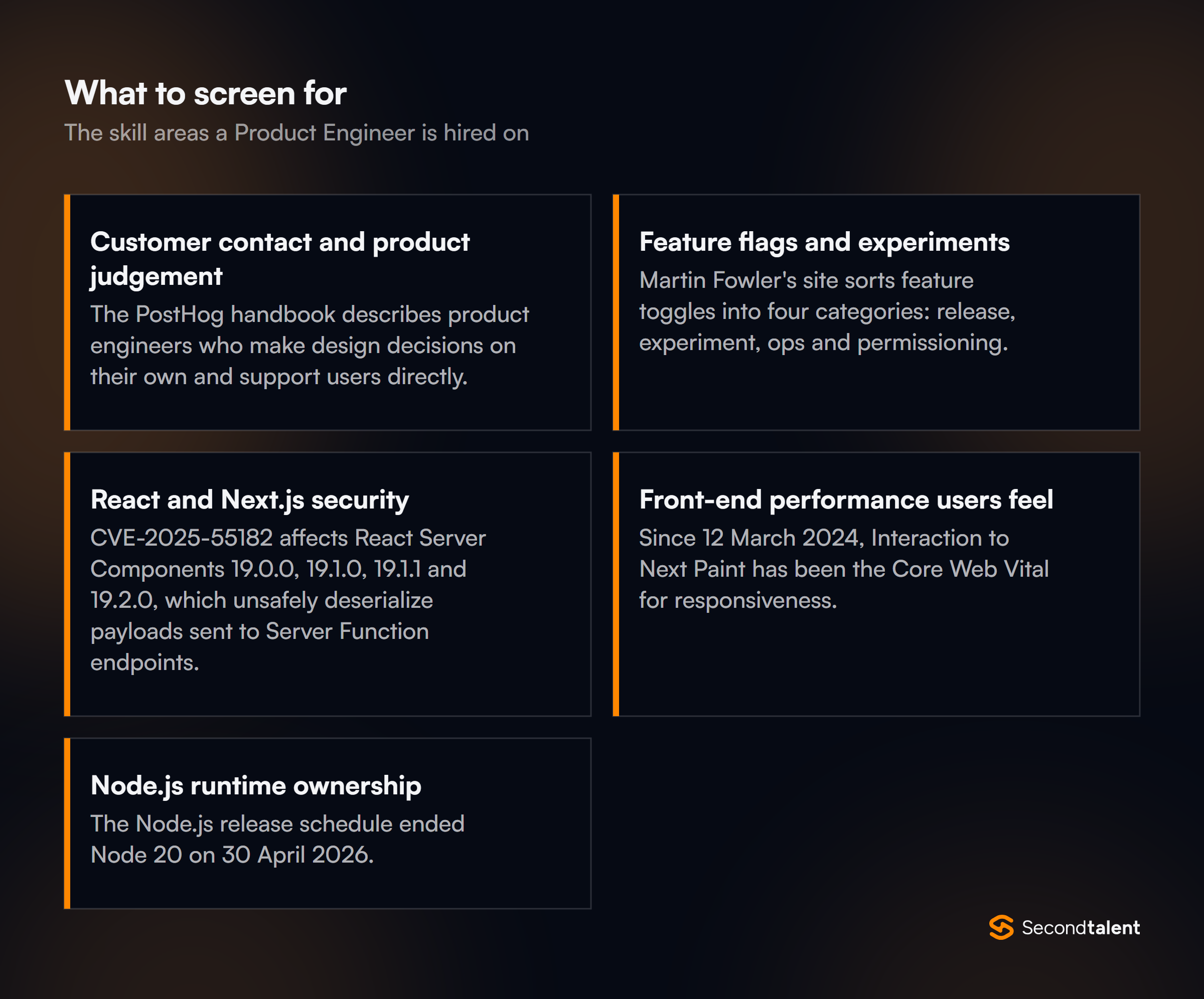
Among professional developers in Stack Overflow's 2025 survey, 49.1% used Node.js, 46.9% React and 21.5% Next.js. Knowing them is the floor. The five areas below separate a product engineer from a full-stack developer who waits for tickets.
Customer contact and product judgement
The PostHog handbook describes product engineers who make design decisions on their own and support users directly. Give the candidate three real support tickets and a usage chart. Ask which problem they would fix first, what they would ship in a week, and which number should move if they are right.
Feature flags and experiments
Martin Fowler's site sorts feature toggles into four categories: release, experiment, ops and permissioning. The same article warns that toggles add complexity and that teams should limit how many they keep. Ask the candidate to design a staged rollout for a pricing page change, then explain when the flag comes out of the code and who deletes it.
React and Next.js security
CVE-2025-55182 affects React Server Components 19.0.0, 19.1.0, 19.1.1 and 19.2.0, which unsafely deserialize payloads sent to Server Function endpoints. CISA added it to its Known Exploited Vulnerabilities catalog on 5 December 2025, two days after the NVD published it.
Earlier that year, CVE-2025-29927 let attackers skip authorization checks placed in Next.js middleware, until versions 12.3.5, 13.5.9, 14.2.25 and 15.2.3. Ask where the candidate puts authorization in a Next.js app, and how they learn a dependency needs patching.
Front-end performance users feel
Since 12 March 2024, Interaction to Next Paint has been the Core Web Vital for responsiveness. Google's web.dev team rates a site's INP as good when at least 75% of experiences respond to input in under 200 milliseconds. Hand the candidate a slow filter or checkout form and a performance trace, and ask for the fix and the before-and-after INP.
Node.js runtime ownership
The Node.js release schedule ended Node 20 on 30 April 2026. Node 22 reaches end of life on 30 April 2027, and Node 24 moves to maintenance on 20 October 2026, eight days before Node 26 becomes LTS.
A product engineer who owns a feature end to end also owns its runtime. Ask for their last major Node upgrade, what broke and how long the whole move took.
Contractor or Employer of Record for a US Company
Software is not one of the nine categories of commissioned work that can be "work made for hire" under 17 U.S.C. § 101, and a transfer of copyright must be in writing and signed under § 204(a). Name the code, designs, experiment configurations and analytics dashboards in the assignment.
IRS Publication 515 says the place where services are performed determines the source of the income, so an engineer working from Taipei or Kuala Lumpur earns foreign-source income. A foreign individual gives the payer Form W-8BEN to certify foreign status.
Each country then applies its own employment test. Philippine courts use the four-fold test, and in Atok Big Wedge v. Gison the Supreme Court held the power of control to be the most important part. Under Article 13 of Vietnam's 2019 Labor Code, an agreement with any title counts as a labor contract when it covers a paid job, wages and management or supervision.
A product engineer who joins your roadmap meetings, talks to your customers and ships to production under your direction fits those employment tests. Our Employer of Record service employs that engineer in-country, and our EOR, PEO and contractor comparison lays out the other routes. This is a summary, not legal advice.
|
Independent contractor |
Employer of Record |
| Legal employer |
None; the engineer invoices you |
The EOR's local entity |
| US paperwork |
Form W-8BEN from the engineer |
Service agreement with the EOR |
| IP |
Written assignment covering code, designs and experiment setups |
Assignment in the employment contract and your EOR agreement |
| Local labor law |
Classification risk if you direct the work day to day |
Night premiums, public holidays and leave apply |
| Pay currency |
Agreed in the contract, often USD |
Local currency; Vietnam's Labor Code states wages in dong (Article 95) |
English Level and Working Norms
A product engineer's English gets tested by your customers, in calls and support replies. Malaysia's IT professionals score 590 on the EF English Proficiency Index 2025, the highest IT score in the table, and the Philippines follows at 581. The index covers 123 countries and regions, with a global average of 488.
| Country |
EF EPI 2025 score |
World rank (of 123) |
IT job-function score |
| Malaysia |
581 |
24 |
590 |
| Philippines |
569 |
28 |
581 |
| Vietnam |
500 |
64 |
500 |
| Indonesia |
471 |
80 |
523 |
Scores come from EF's country pages, such as Malaysia and Vietnam. EF EPI 2025 has no page for Taiwan, so that market has no row.
Run part of the final interview as a mock customer call about a bug the customer reported. Then ask for the written reply and the one-paragraph spec that follows it.
Plan launches around both calendars. Thanksgiving on 26 November 2026 is a working day in Asia, so an engineer there can watch a holiday-week release while your US team is off. Vietnam's Labor Code gives five paid days for Lunar New Year (Article 112), in late January or February, so avoid launches that week with a Vietnam-based engineer.
Product Engineer Hiring Process
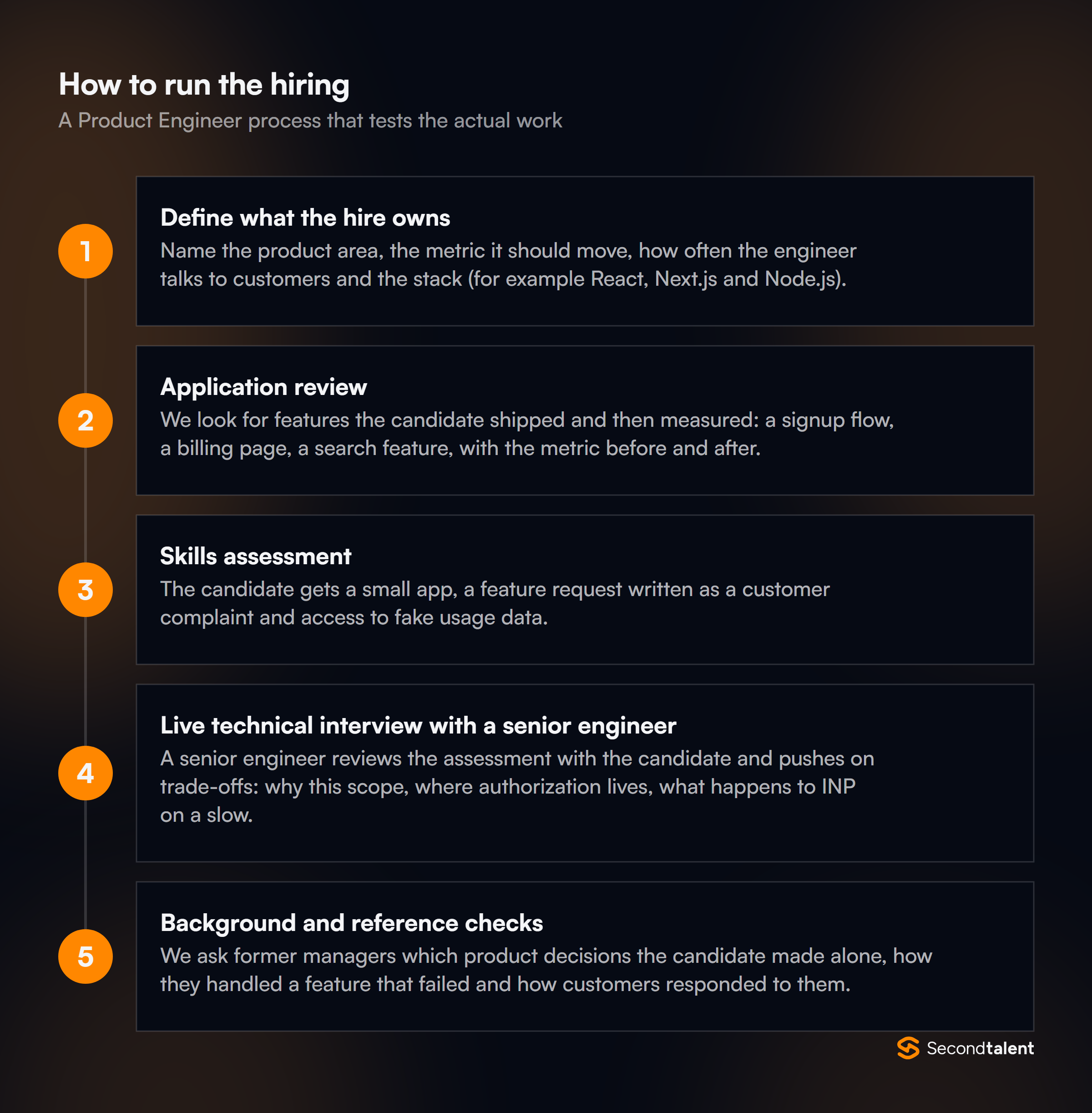
Second Talent's vetting covers stages 2 to 5 before you see a profile. Our full-stack developer interview guide adds technical question sets for your own round.
Stage 1: Define what the hire owns
Name the product area, the metric it should move, how often the engineer talks to customers and the stack (for example React, Next.js and Node.js). Say whether they own the roadmap for that area or execute someone else's.
Stage 2: Application review
We look for features the candidate shipped and then measured: a signup flow, a billing page, a search feature, with the metric before and after. A list of frameworks without outcomes does not pass.
Stage 3: Skills assessment
The candidate gets a small app, a feature request written as a customer complaint and access to fake usage data. They ship the change behind a flag, add the event tracking and write a short note on what they would test next.
Stage 4: Live technical interview with a senior engineer
A senior engineer reviews the assessment with the candidate and pushes on trade-offs: why this scope, where authorization lives, what happens to INP on a slow phone, when the flag gets removed.
Stage 5: Background and reference checks
We ask former managers which product decisions the candidate made alone, how they handled a feature that failed and how customers responded to them. You then choose the contractor or EOR route above.
Hire Product Engineers from Asia with Second Talent
We shortlist 6-8 candidates within 24 hours from 100,000+ pre-vetted engineers, accepting only the top 1% of applicants. Product engineers come with $0 upfront, no lock-in and 4-6 hours of daily overlap with US hours. We handle contracts, payroll and equipment, with compliant EOR contracts and payroll in 9 Asian markets.
Our pricing page sets out subscription, direct-hire and EOR pricing. Beyond Cars, a used-car marketplace, grew its Taiwan engineering team by 50% in 4 months through us, shipped new marketplace features and was later acquired by Carro, according to the Beyond Cars case study.