TL;DR: NLP engineers from Asia who work for foreign clients earn from $2,200 a month on our machine learning engineer rate cards, and we match candidates in 24 hours. The closest US benchmark, the BLS median for software developers, was $135,980 a year in May 2025.
spaCy ships trained pipelines for Chinese, Japanese and Korean, but lists none yet for Hindi, Indonesian, Malay, Tagalog, Thai or Vietnamese on its models page. An NLP engineer working in those languages builds that layer from other tools or picks a model that skips it. You are hiring for that judgment.
Key takeaways
- Malaysia's range tops out at $11,300+ a month, the highest ceiling of the six markets on our machine learning engineer cards.
- Research-track NLP hires map to Computer and Information Research Scientists, a BLS occupation with a $140,300 median.
- The same text can need up to 15 times more tokens in one language than in another, which moves inference cost and latency.
- Indonesian IT workers score 523 on the EF English Proficiency Index 2025, 52 points above the national score.
What NLP Engineers Earn Working for International Clients in Asia
Malaysia and Thailand share the highest floor, $3,930 a month, yet Malaysia's ceiling runs $2,530 higher. We publish no NLP-specific rate card, so the table uses our machine learning engineer cards, the closest match. The figures are what engineers in each market earn working directly for foreign companies, before any employer or platform costs.
| Market |
Monthly pay working for international clients (USD) |
| Indonesia |
$2,200-$8,500 |
| India |
$2,410-$9,410+ |
| Philippines |
$2,500-$6,000 |
| Vietnam |
$2,500-$7,000 |
| Malaysia |
$3,930-$11,300+ |
| Thailand |
$3,930-$8,770+ |
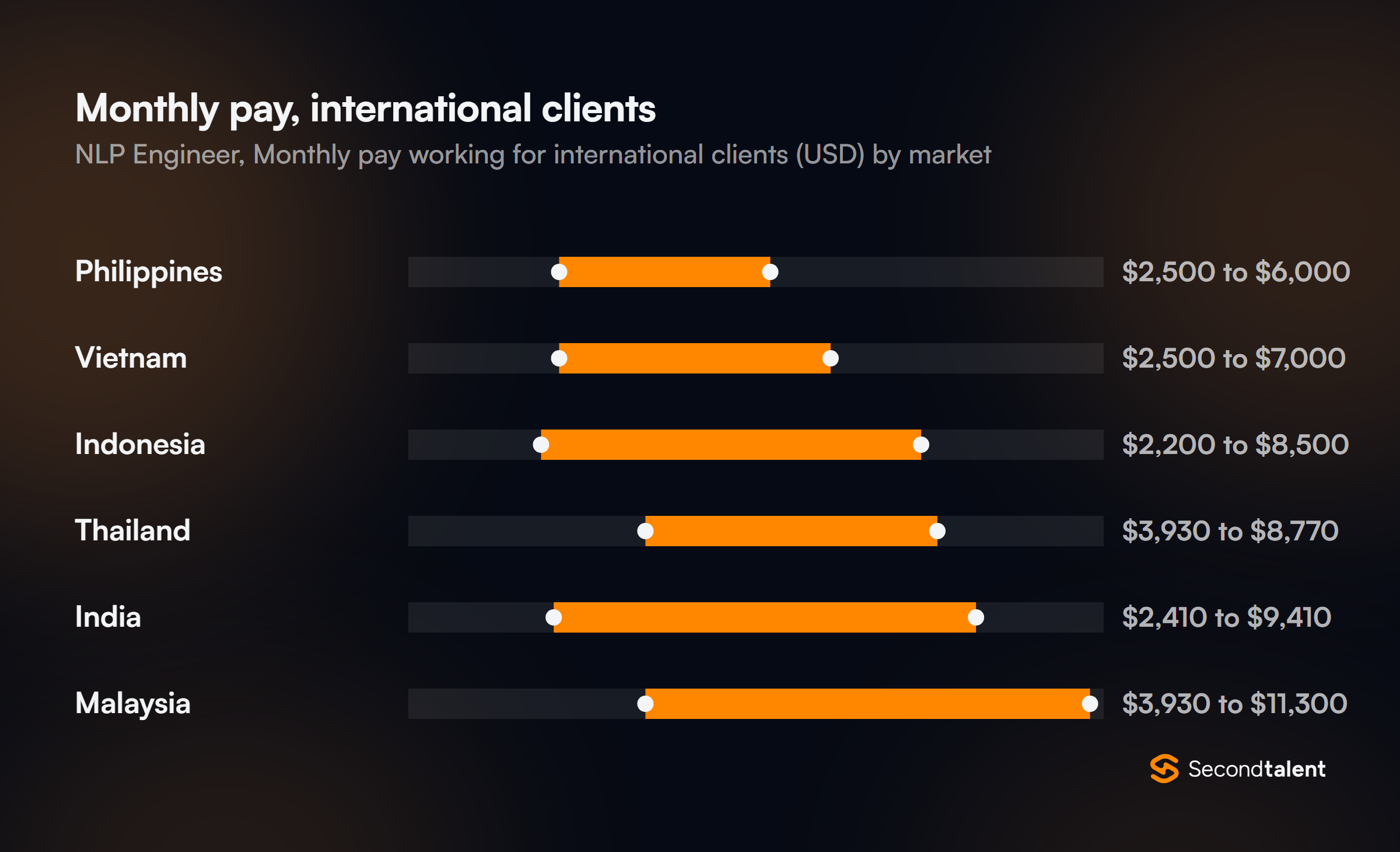
Monthly ranges from the Remote (Working for International Clients) figures on our rate cards for Indonesia, India, the Philippines, Vietnam, Malaysia and Thailand, converted at ExchangeRate-API mid-market rates for 14 September 2026.
The Indonesian, Philippine and Vietnamese cards publish this figure in US dollars with a fixed top, so those rows need no conversion. The Indian, Malaysian and Thai cards quote local currency and leave the top open. For a hire based in India alone, see our India NLP engineer page.
Second Talent charges one monthly fee that bundles salary, payroll taxes, statutory contributions and our service fee, set out on our pricing page.
US Pay Benchmark for NLP Engineers
BLS has no NLP engineer occupation. An engineer who builds extraction pipelines, classifiers and retrieval systems into a product maps to Software Developers (15-1252), because the output is production software. A hire who designs new model architectures or publishes research maps to Computer and Information Research Scientists (15-1221), an occupation where the BLS Occupational Outlook Handbook lists at least a master's degree as the usual entry requirement.
| BLS OEWS, May 2025, national |
Median annual |
10th percentile, monthly |
Median, monthly |
90th percentile, monthly |
| Software Developers (15-1252) |
$135,980 |
$6,870 |
$11,330 |
$17,890 |
| Computer and Information Research Scientists (15-1221) |
$140,300 |
$6,850 |
$11,690 |
$19,220 |
Monthly figures are annual wages divided by 12, rounded to the nearest $10, from the OEWS profiles for 15-1252 and 15-1221.
The two medians sit $360 a month apart, but the research column pulls ahead at the 90th percentile. The Handbook projects research scientist employment to grow 22% from 2025 to 2035.
Salary is only part of the US cost. In the BLS Employer Costs for Employee Compensation release for June 2026, wages and salaries made up 68.5% of employer compensation costs for full-time private industry workers, and benefits the other 31.5%.
For a short engagement, our NLP engineer cost-to-hire page puts a mid-level US freelance or contract NLP engineer at $119 to $185 an hour, before payroll, insurance and leave.
Time Zone Overlap with ET, CT and PT
NLP work splits into jobs that run unattended and decisions that need your team. A fine-tuning run or an embedding backfill can go overnight; a change to the annotation guidelines cannot. US daylight time lasts from 8 March to 1 November 2026, per NIST, and none of the Asian cities below change their clocks.
| Engineer's city |
UTC offset |
9:00 am ET (EDT) |
9:00 am CT (CDT) |
9:00 am PT (PDT) |
| Manila, Singapore, Kuala Lumpur, Taipei |
UTC+8 |
9:00 pm |
10:00 pm |
12:00 midnight |
| Ho Chi Minh City, Jakarta, Bangkok |
UTC+7 |
8:00 pm |
9:00 pm |
11:00 pm |
| Bengaluru |
UTC+5:30 |
6:30 pm |
7:30 pm |
9:30 pm |
After 1 November 2026, every time in the table moves one hour later.
A worked example for Kuala Lumpur: a 5:00 pm to 2:00 am shift is 09:00 to 18:00 UTC. Subtract four hours for EDT and it runs 5:00 am to 2:00 pm in New York.
That gives five hours of a 9-to-5 day in New York, four in Chicago and two in San Francisco. Once New York returns to EST, the same shift overlaps four hours there.
Put the shared hours on error review, label disputes and evaluation readouts. Start training jobs and batch inference at the end of the window, so results are waiting for your morning. We agree the schedule before the offer, which is how our placements get 4-6 hours of daily overlap with US hours.
Late shifts cost more for employees in two markets: at least 10% extra for work between 10 pm and 6 am in the Philippines (Labor Code Article 86), and at least 30% for work between 22:00 and 06:00 in Vietnam (Labor Code Articles 98 and 106).
NLP Engineer Skills to Screen For
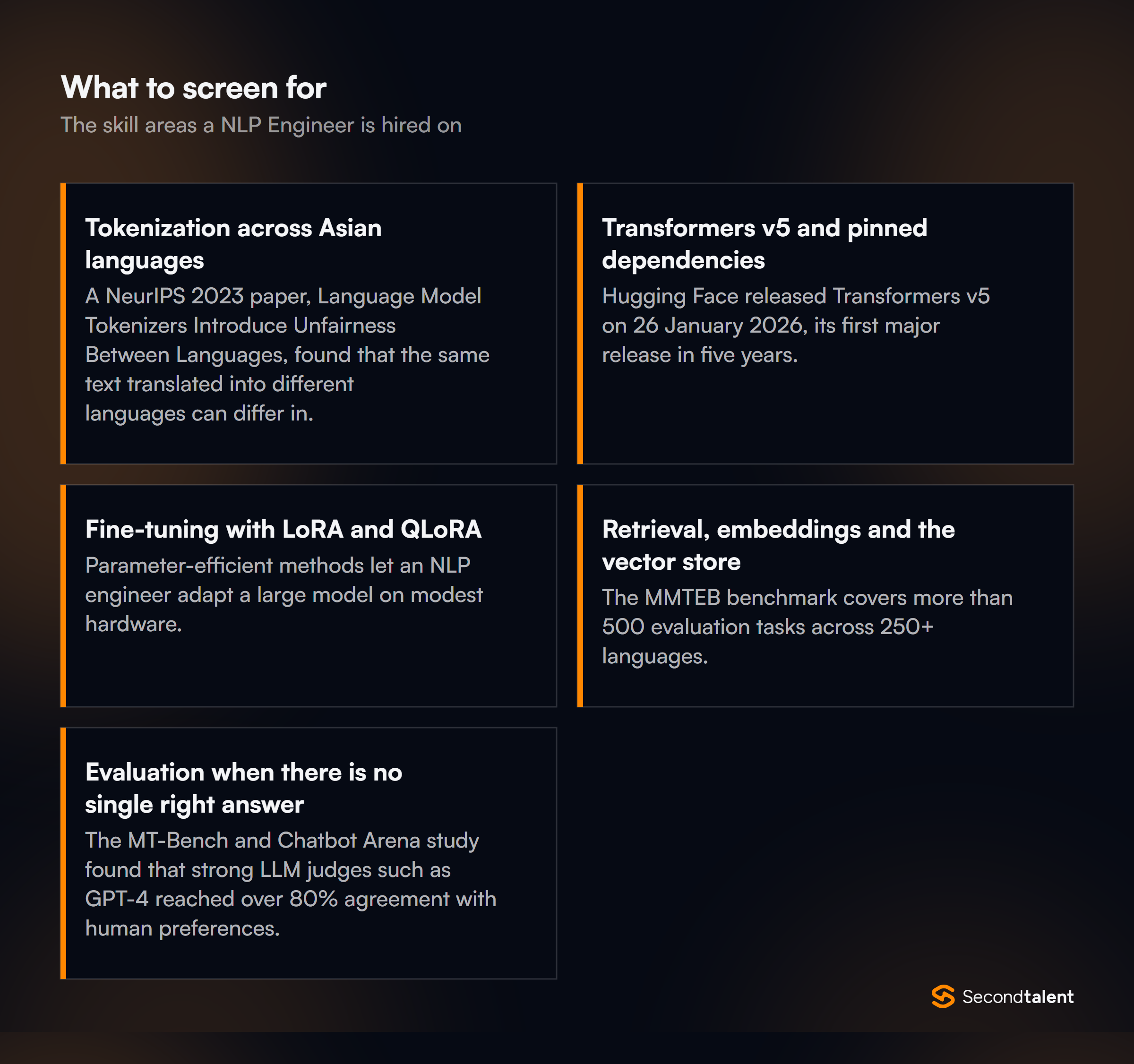
Python was used by 57.9% of respondents in Stack Overflow's 2025 survey, up 7 points on 2024. Screen past Python fluency with the five areas below, where engineers who have shipped language systems stand out.
Tokenization across Asian languages
A NeurIPS 2023 paper, Language Model Tokenizers Introduce Unfairness Between Languages, found that the same text translated into different languages can differ in tokenization length by up to 15 times. The gap held even for tokenizers built for multilingual use. More tokens per sentence means a higher bill per request, slower responses and less room for context.
Word boundaries add a second problem. VinAI's PhoBERT model for Vietnamese requires input that is already word-segmented and recommends the RDRSegmenter from VnCoreNLP for it, while spaCy relies on PyThaiNLP for Thai and Pyvi for Vietnamese. Ask the candidate how they handled word segmentation on their last non-English project, and what broke downstream.
Transformers v5 and pinned dependencies
Hugging Face released Transformers v5 on 26 January 2026, its first major release in five years. It merged the separate "slow" Python and "fast" Rust tokenizer files into one file per model, and moved to weekly minor releases.
The release notes list backwards-incompatible changes, so an unpinned upgrade can break a pipeline built on version 4. Ask which version the candidate's last project ran. Then ask how they check that training and serving tokenize text the same way.
Fine-tuning with LoRA and QLoRA
Parameter-efficient methods let an NLP engineer adapt a large model on modest hardware. The LoRA paper reported 10,000 times fewer trainable parameters and a third of the GPU memory against full fine-tuning of GPT-3 175B. QLoRA fine-tuned a 65B-parameter model on a single 48GB GPU.
AI Singapore's SEA-LION project shows the pattern: its first model was pre-trained from scratch at 3B parameters, and later versions build on Llama, Gemma and Qwen through continued pre-training and supervised fine-tuning. Ask the candidate when they chose a fine-tune over a better prompt, and what the eval showed.
Retrieval, embeddings and the vector store
The MMTEB benchmark covers more than 500 evaluation tasks across 250+ languages. LLMs with billions of parameters led on some language subsets and task categories. Yet the best-performing public model overall was multilingual-e5-large-instruct, with 560 million parameters. Ask how the candidate chose an embedding model for non-English documents and what they measured.
The store itself is an attack surface. The OWASP Top 10 for LLM Applications 2025 lists Vector and Embedding Weaknesses as LLM08, covering cross-tenant context leakage, embedding inversion and data poisoning, and recommends permission-aware vector stores. For RAG-heavy briefs we also staff LLM engineers.
Evaluation when there is no single right answer
The MT-Bench and Chatbot Arena study found that strong LLM judges such as GPT-4 reached over 80% agreement with human preferences. That is the level humans reach with each other. The same study documented position, verbosity and self-enhancement biases in the judges.
Ask the candidate to design an eval for a summarizer, including how they would catch a judge that prefers longer answers. For model-side questions, use our machine learning interview guide.
NLTK, spaCy and when the library is the wrong test
Many briefs that ask for an NLTK developer need text classification or entity extraction running in production. NLTK is strongest for teaching, prototyping and corpus work: tokenizers, the Porter and Snowball stemmers, WordNet and the VADER sentiment lexicon. spaCy packages tokenization, tagging, parsing and named entities into one pipeline object built for throughput, and Hugging Face Transformers covers the fine-tuned models above both.
Version history matters here too. NLTK through 3.8.1 could run pickled code hidden in downloaded data packages such as punkt (CVE-2024-39705), and NLTK 3.10.0, released on 11 June 2026, made a stricter path-security policy the default for resource loading. A pipeline that reads corpora from custom folders can fail after an unpinned upgrade.
Give NLTK candidates a script that removes stopwords, stems with Porter and feeds TF-IDF features into logistic regression. Ask which steps they would keep as a baseline, which they would replace with spaCy lemmas or a transformer, and how they would prove the change helped on your labelled data. Then ask which nltk_data packages the script downloads at runtime, and where they would store them inside a container image.
Contractor or Employer of Record for a US Company
Software is not one of the nine categories of commissioned work that can be "work made for hire" under 17 U.S.C. § 101, and a copyright transfer must be in writing and signed under § 204(a). For an NLP engineer, list the pipeline code, annotation guidelines, labelled datasets, eval sets and fine-tuned adapter weights in the assignment by name.
IRS Publication 515 says the place where services are performed determines the source of the income, so an engineer working from Jakarta or Kuala Lumpur earns foreign-source income. A foreign individual gives the payer Form W-8BEN to certify foreign status.
The engineer's country then applies its own employment test. Philippine courts use the four-fold test. In Atok Big Wedge v. Gison the Supreme Court called the power of control the most important part.
Article 13 of Vietnam's 2019 Labor Code looks past the name on an agreement. If it covers a paid job, wages and one party's management and supervision, it counts as a labor contract.
A one-off extraction project with a fixed dataset suits a contractor agreement. An engineer who works your hours and holds access to customer text fits the employment tests above. An Employer of Record employs that engineer in-country for you. Our Vietnam EOR page lists the statutory employer contributions in one market. This is a summary, not legal advice.
|
Independent contractor |
Employer of Record |
| Legal employer |
None; the engineer invoices you |
The EOR's local entity |
| US paperwork |
Form W-8BEN from the engineer |
Service agreement with the EOR |
| IP |
Written assignment covering code, datasets, guidelines and adapter weights |
Assignment in the employment contract and your EOR agreement |
| Local labor law |
Classification risk if you control hours and methods |
Night premiums, public holidays and leave apply |
| Pay currency |
Agreed in the contract, often USD |
Local currency; Vietnam's Labor Code states wages in dong (Article 95) |
English Level and Working Norms
Thai IT workers score 459 on the EF English Proficiency Index 2025, 57 points above Thailand's national 402. For NLP the gap matters twice: the engineer writes English guidelines for your team and reads Thai text for the model. The index covers 123 countries and regions, with a global average of 488.
| Country |
EF EPI 2025 score |
World rank (of 123) |
IT job-function score |
| Malaysia |
581 |
24 |
590 |
| Philippines |
569 |
28 |
581 |
| Vietnam |
500 |
64 |
500 |
| India |
484 |
74 |
487 |
| Indonesia |
471 |
80 |
523 |
| Thailand |
402 |
116 |
459 |
Scores come from EF's country pages, such as Indonesia and Thailand. If your product serves users in one of these languages, a native speaker who scores lower on English can still be the stronger hire. Test both: an English error analysis and a labelling call on local-language samples.
Plan data work around both calendars. Thanksgiving on 26 November 2026 is a working day in Asia, so an engineer there can clear a labelling backlog while your US team is off. Article 112 of Vietnam's Labor Code gives five paid days for Lunar New Year in late January or February, so schedule annotation deadlines around that week.
NLP Engineer Hiring Process
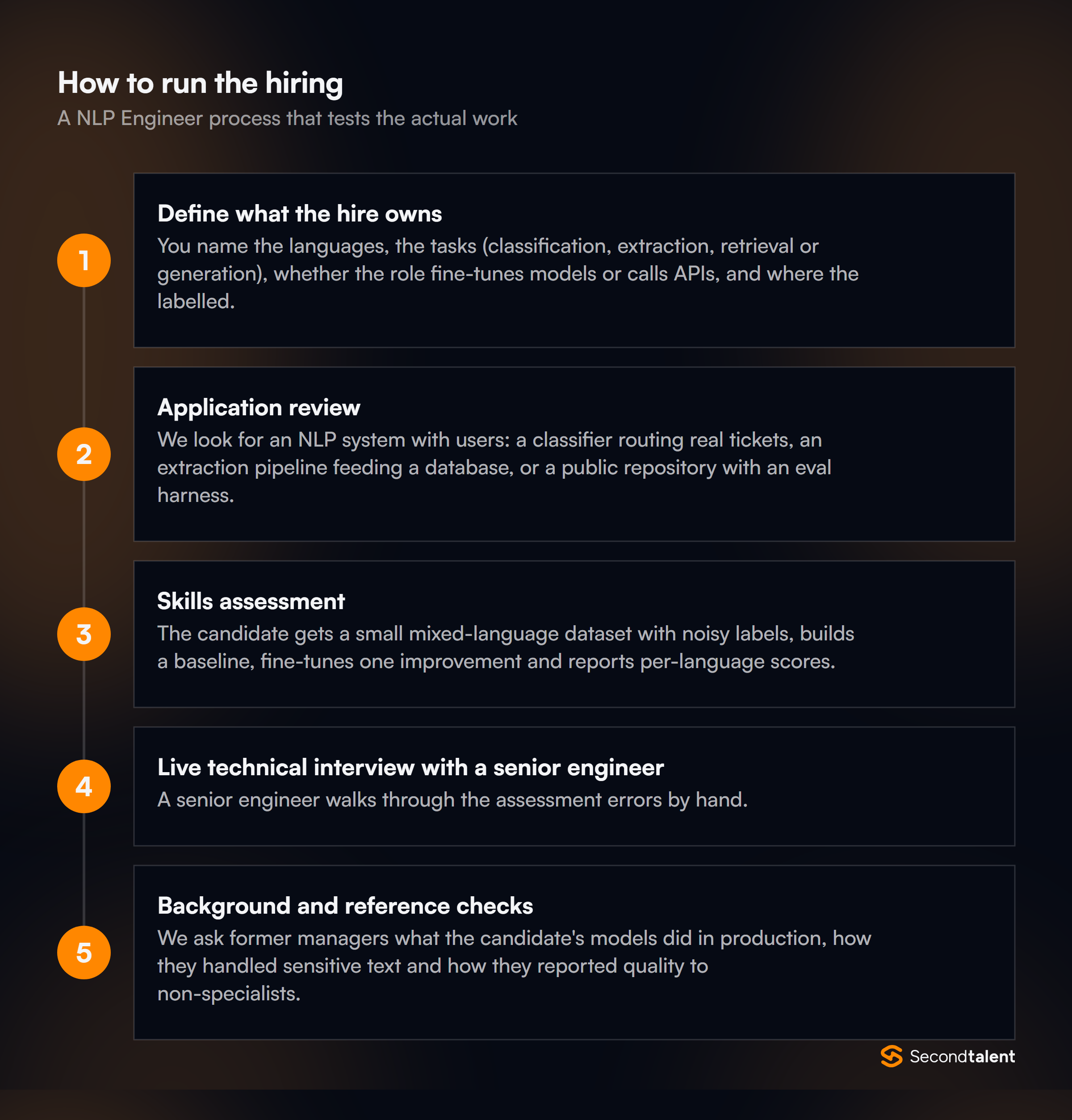
Second Talent's vetting covers stages 2 to 5 before you see a profile.
Stage 1: Define what the hire owns
You name the languages, the tasks (classification, extraction, retrieval or generation), whether the role fine-tunes models or calls APIs, and where the labelled data comes from. Add any rule on sending customer text to outside APIs.
Stage 2: Application review
We look for an NLP system with users: a classifier routing real tickets, an extraction pipeline feeding a database, or a public repository with an eval harness. Kaggle notebooks alone do not pass.
Stage 3: Skills assessment
The candidate gets a small mixed-language dataset with noisy labels, builds a baseline, fine-tunes one improvement and reports per-language scores. We plant duplicate documents across the train and test splits and score whether they find them.
Stage 4: Live technical interview with a senior engineer
A senior engineer walks through the assessment errors by hand. Expect questions on tokenization choices, why the fine-tune beat or lost to the baseline, and how they would monitor drift after launch.
Stage 5: Background and reference checks
We ask former managers what the candidate's models did in production, how they handled sensitive text and how they reported quality to non-specialists. You then choose the contractor or EOR route above.
Hire NLP Engineers from Asia with Second Talent
We shortlist 6-8 candidates within 24 hours from 100,000+ pre-vetted engineers, accepting only the top 1% of applicants. NLP engineers come with $0 upfront, no lock-in and 4-6 hours of daily overlap with US hours. We handle contracts, payroll and equipment, with compliant EOR contracts and payroll in 9 Asian markets.
Our pricing page sets out the subscription, direct-hire and EOR options for a first NLP hire, and our machine learning engineers track covers model-side roles.