TL;DR: Use an employer of record (EOR) to employ someone in a country where you have no entity: the provider becomes the legal employer, from $599 a month per employee. A PEO co-employs staff you already employ through your own US entity, from $79 a month. Contractor management, from $29 a month, pays independent contractors, but the risk of misclassifying them stays with you.
In September 2022, the Philippine Supreme Court ordered Lazada to reinstate five delivery riders, with back wages, overtime and 13th month pay dating to January 2017. Each had signed an Independent Contractor Agreement at PHP 1,200 a day.
The Court looked at how Lazada controlled their work, not at the contract’s title.
- 1A $2,500-a-month engineer in the Philippines costs $3,407 a month through an EOR, against $2,549 as a contractor, by our calculation.
- 2Vietnam’s Labour Code treats any agreement for paid, supervised work as a labour contract, whatever the parties call it.
- 3The US Department of Labor proposed a new contractor test in February 2026 and no longer applies its 2024 rule.
- 4More than 230,000 businesses work with one of the 500-plus PEOs in the US, NAPEO says.
EOR vs PEO vs Contractor Management: The Difference
An employer of record employs your worker on its own local entity, while a PEO shares the employer’s duties for staff on your own entity. Contractor management pays workers who are not employees at all.
| Employer of record | PEO | Contractor management | |
|---|---|---|---|
| Legal employer | The EOR | You and the PEO, as co-employers | None: the worker is self-employed |
| Your own entity needed | No | Yes, in the US | No |
| Where it works | Countries where the provider employs staff | The US | Anywhere the worker can invoice you |
| Payroll, tax and benefits | Run by the EOR | Run by the PEO | The worker’s own job |
| Who directs the work | You | You | The worker, within the contract |
| Misclassification risk | Removed: the worker is an employee | Low: the workers are employees | Stays with you |
| List price per worker, per month | $599 to $699 | $79 to $125 | $29 to $49 |
What an Employer of Record Does
An employer of record is a company that legally employs a worker for you in a country where you have no entity.
It signs the employment contract, runs payroll, pays statutory contributions and benefits, and handles termination under local law. You choose the hire and direct the work.
It is the one model of the three that puts an employee on payroll abroad without a local company.
In the Philippines, registering for SSS, PhilHealth, Pag-IBIG and income tax all requires a registered local employer, and our Philippines payroll guide covers each one.
Statutory costs can outweigh the fee. Statutory employer costs on top of salary run from under 2% in Thailand to 30% or more in China’s largest cities, according to our 2026 country payroll guides:
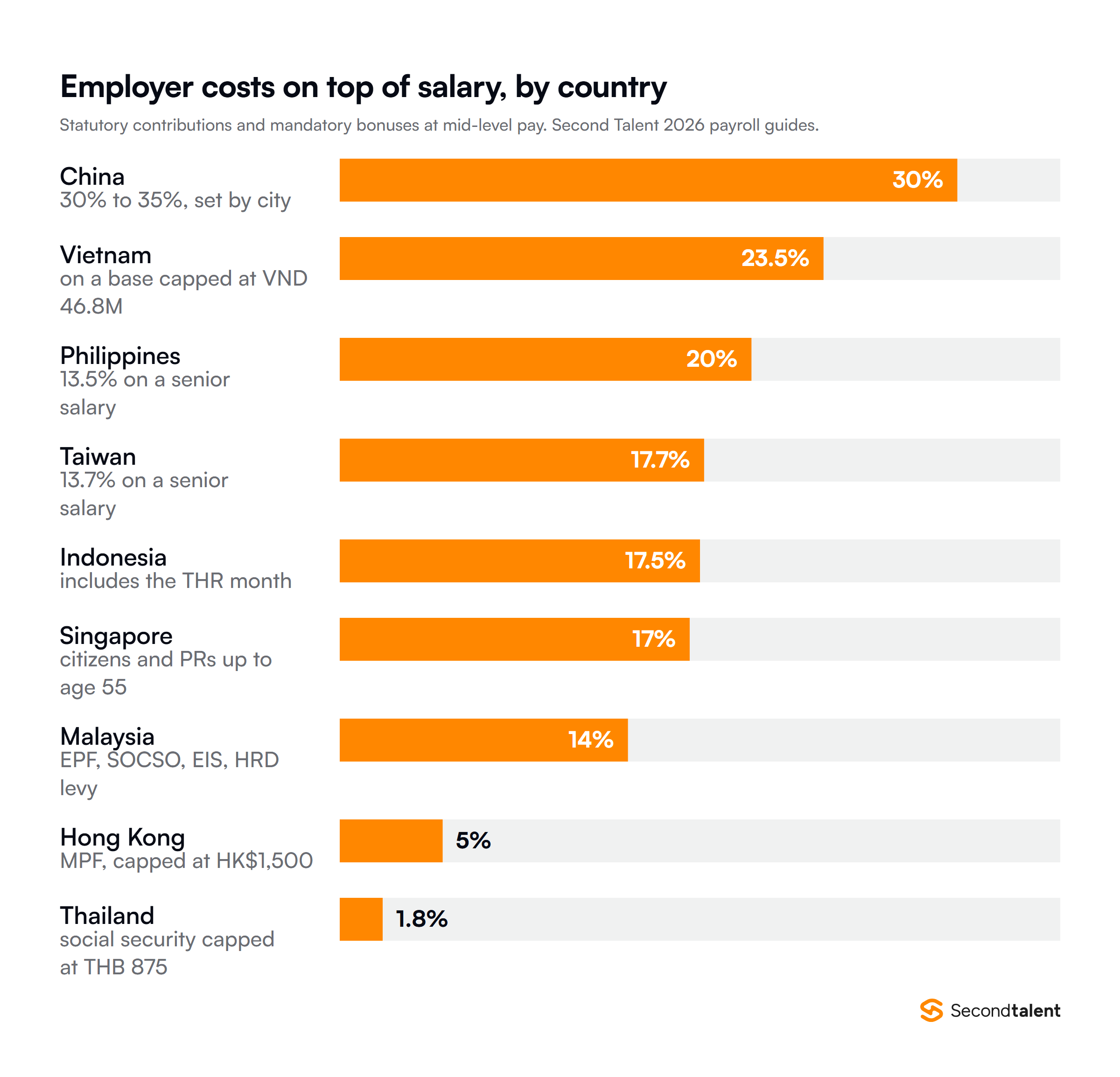
Mandatory bonuses are the line budgets miss. The Philippines’ 13th month and Indonesia’s THR religious holiday allowance each add a month’s pay a year, 8.33% of salary.
Vietnam’s 23.5% applies to a social and health insurance base capped at VND 46.8 million a month, as our Vietnam payroll guide explains.
Our guide to using an employer of record in Asia and our breakdown of what an EOR costs in fees go further on providers and fees.
What a PEO Does
A professional employer organization (PEO) co-employs your existing staff. It takes over payroll, benefits and HR administration, while your company stays an employer too. You need your own legal entity, and the model is a US one.
The draw is benefits. A PEO puts its clients’ employees into one large group for health and retirement plans.
NAPEO’s research found that 52% of PEO clients with 10 to 49 employees offer a retirement plan, against 23% of similar companies without a PEO.
Pricing is per employee. Justworks lists PEO Basic at $79 a month and PEO Plus at $124, Remote starts at $99, and Deel lists $125. The IRS runs a voluntary certification for PEOs, created by the Tax Increase Prevention Act of 2014.
A PEO cannot employ anyone for you in a country where you have no entity. For hires abroad, the same vendors sell an EOR instead: Deel, Remote and Justworks all list both on their pricing pages.
What Contractor Management Does
Contractor management software handles the paperwork for independent contractors: contracts, invoices, payments in local currency and tax forms. No company employs the worker.
They run their own business, pay their own taxes and decide how the work gets done.
It is a common way to work. In July 2023, 11.9 million US workers were independent contractors in their main job, 7.4% of employment and up from 6.9% in 2017, the Bureau of Labor Statistics found.
Remote and Oyster list $29 a month per contractor, Justworks $39 and Deel $49. The software does not change anyone’s legal status, so a contractor who works like an employee is still a risk for you. Two products move that risk:
- You engage and pay the contractor through the platform
- Classification risk stays with you
- Remote’s Plus tier, $99, covers penalties up to $100,000 per contractor
- The provider engages the contractor itself
- Deel describes it as taking on compliance and classification risk
- Listed by Deel and Remote at $325 a month
What Each Model Costs
At list price, contractor management is the cheapest line on the invoice and an EOR the most expensive, by a factor of more than ten.
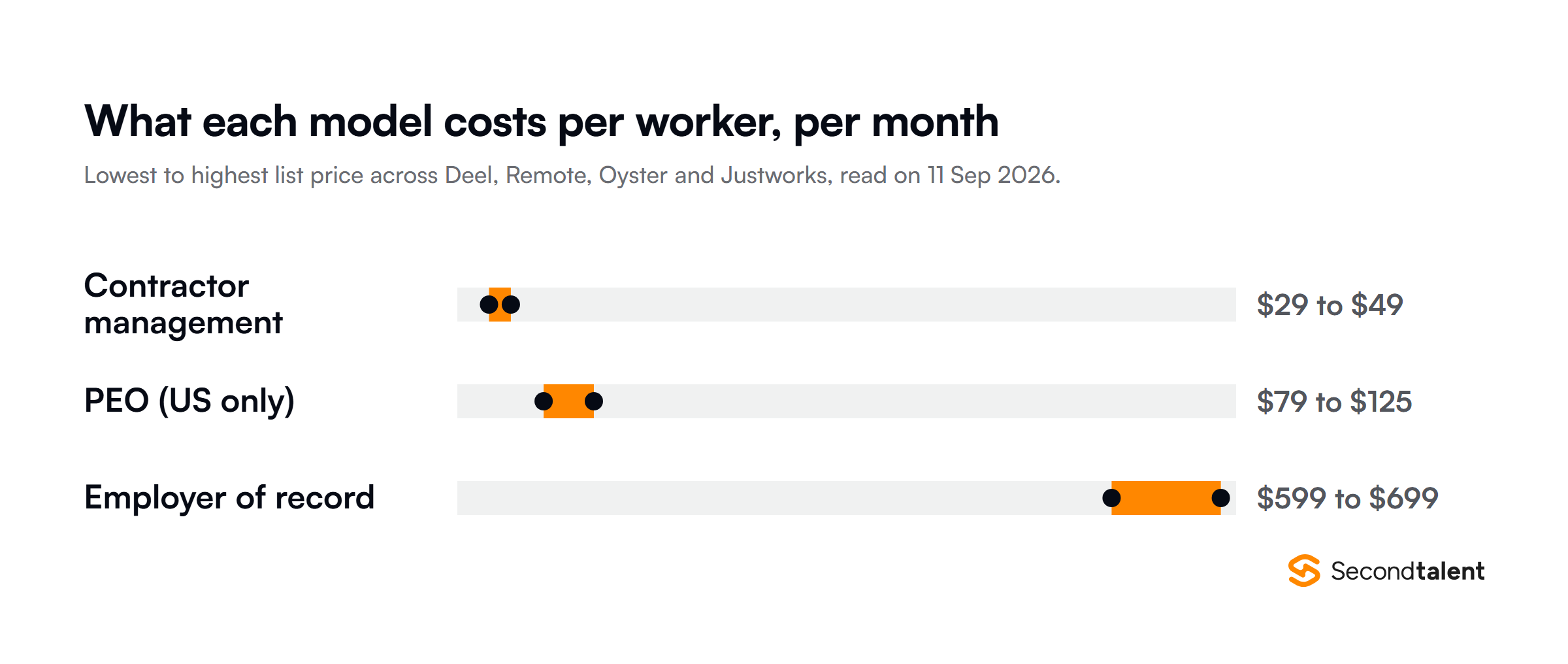
List prices are where negotiation starts. Oyster offers annual discounts on its $699 EOR, and a Deel promotion running from July to December 2026 credits three months of PEO fees on two-year contracts.
Our explainer on flat-fee and per-employee pricing covers how those deals work.
One engineer in the Philippines, both ways
Take a senior engineer paid $2,500 a month, about PHP 156,000 at the European Central Bank rate of 10 September. As a contractor paid through Deel, the monthly cost is the $2,500 fee plus Deel’s $49: $2,549.
Through an EOR at Deel’s $599 list price, the employer also pays SSS, PhilHealth and Pag-IBIG contributions (about $100) and accrues the 13th month ($208), which Presidential Decree 851 guarantees rank-and-file employees.
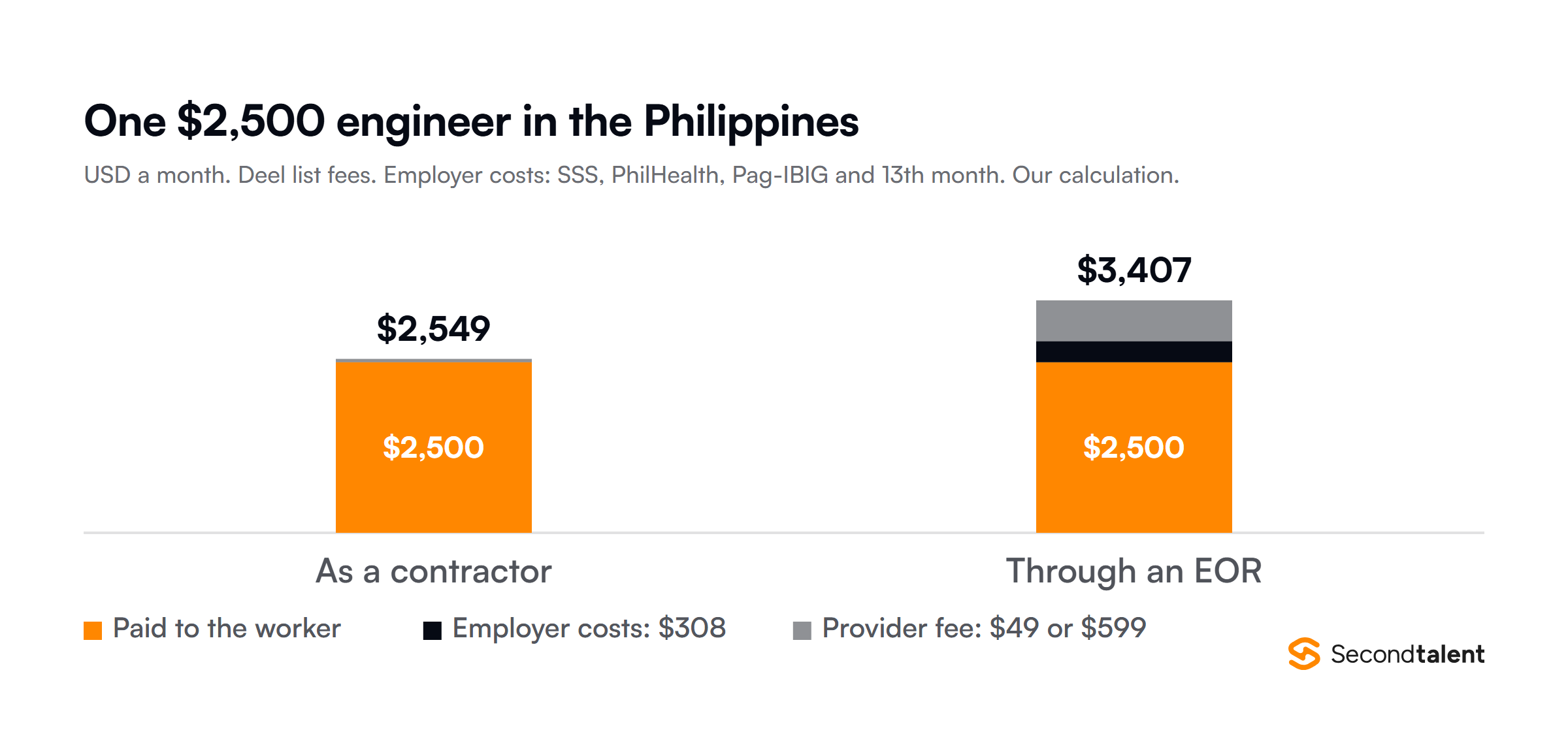
The $858 gap pays for statutory cover, the 13th month and an employment contract, which is the exposure Lazada carried. It shrinks as pay rises, because the EOR fee is flat and all three Philippine contribution ceilings are low.
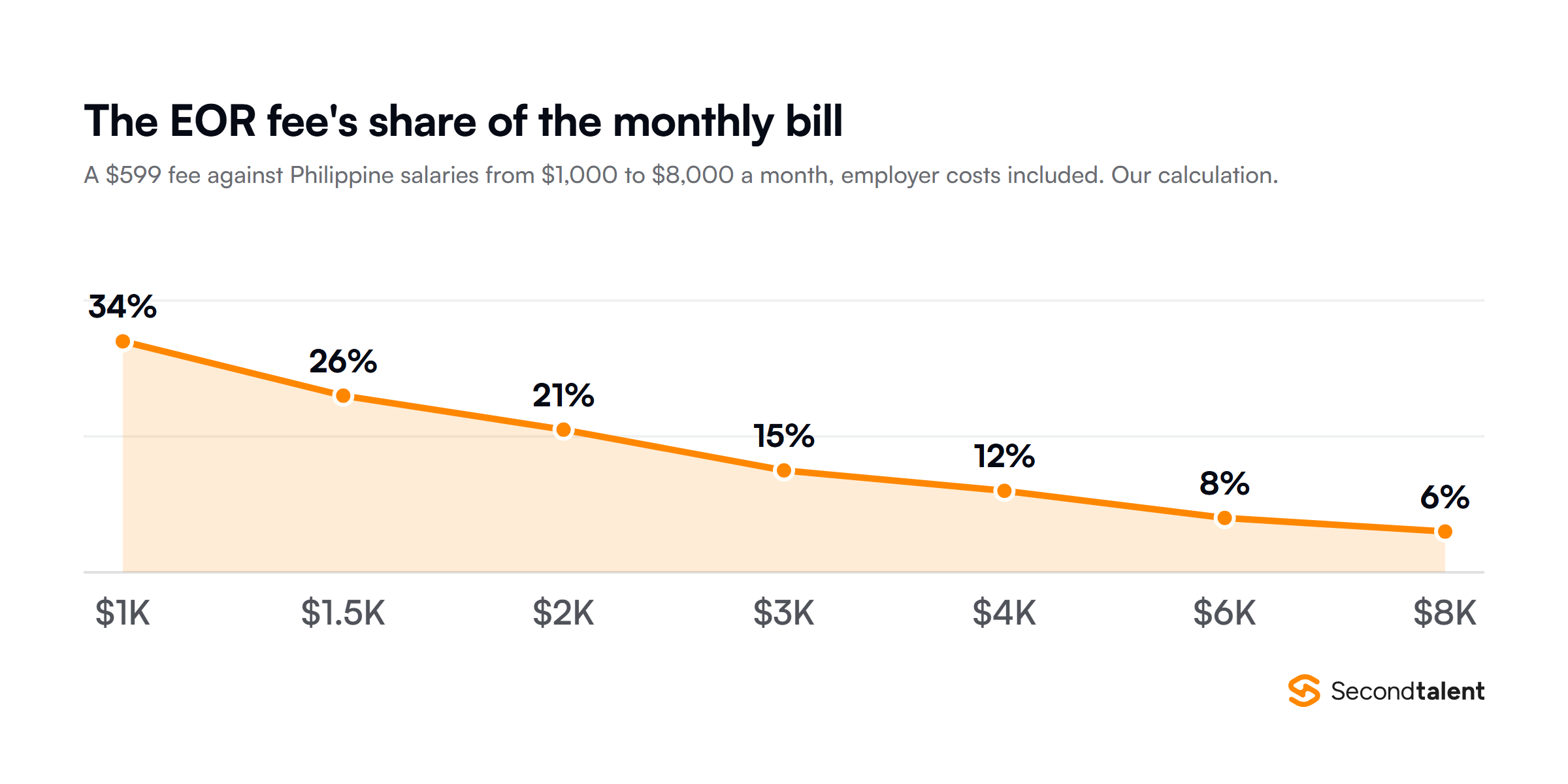
Below about $6,000 a month, the $599 fee costs more than the employer’s contributions and 13th month combined. Our Philippines EOR provider comparison compares local providers, several listed below $599 a month.
When a Contractor Is Legally an Employee
Courts and regulators look at control: who decides how, when and where the work gets done. The name on the contract counts for little, and the rules have moved in the last five years.
Philippines. Courts apply a four-fold test: who selected and engaged the worker, who pays the wages, who can dismiss them, and who controls how the worker does the job.
Control weighs most, and in the Lazada decision it outweighed a signed contractor agreement.
Vietnam. Article 13 of the Labour Code says that when an agreement under another name covers a paid job, wages and one party’s management and supervision, it counts as a labour contract.
United States. The IRS weighs behavioral control, financial control and the relationship between the parties.
The Labor Department’s 2026 proposal would center its wage-law test on two factors: the worker’s control over the work and their chance of profit or loss.
It stopped applying the 2024 rule in its investigations, and the proposal is not yet final.
United Kingdom. Under the off-payroll working rules, a medium or large client decides whether a contractor working through their own company would be an employee. Small private clients leave that call to the contractor’s company.
Warning signs in a contractor setup
Each test above comes back to control and independence. These arrangements point toward employment under each of them:
- You set the hours and expect the worker online when your team is.
- You supply the tools: the laptop, the accounts and the software licences.
- They work for you alone, with no other clients and no plan to take any.
- Pay is a fixed monthly amount rather than an invoice per deliverable or project.
- You manage them like staff, with one-to-ones, performance reviews and approved leave.
- The engagement has no end date, or rolls over every year, as the Lazada contracts did.
No single sign decides the question. Each test weighs them together, which is why a signed contractor agreement did not protect Lazada.
Which Model Fits Your Hire
Two questions settle it: do you have an entity in the worker’s country, and who directs the work?
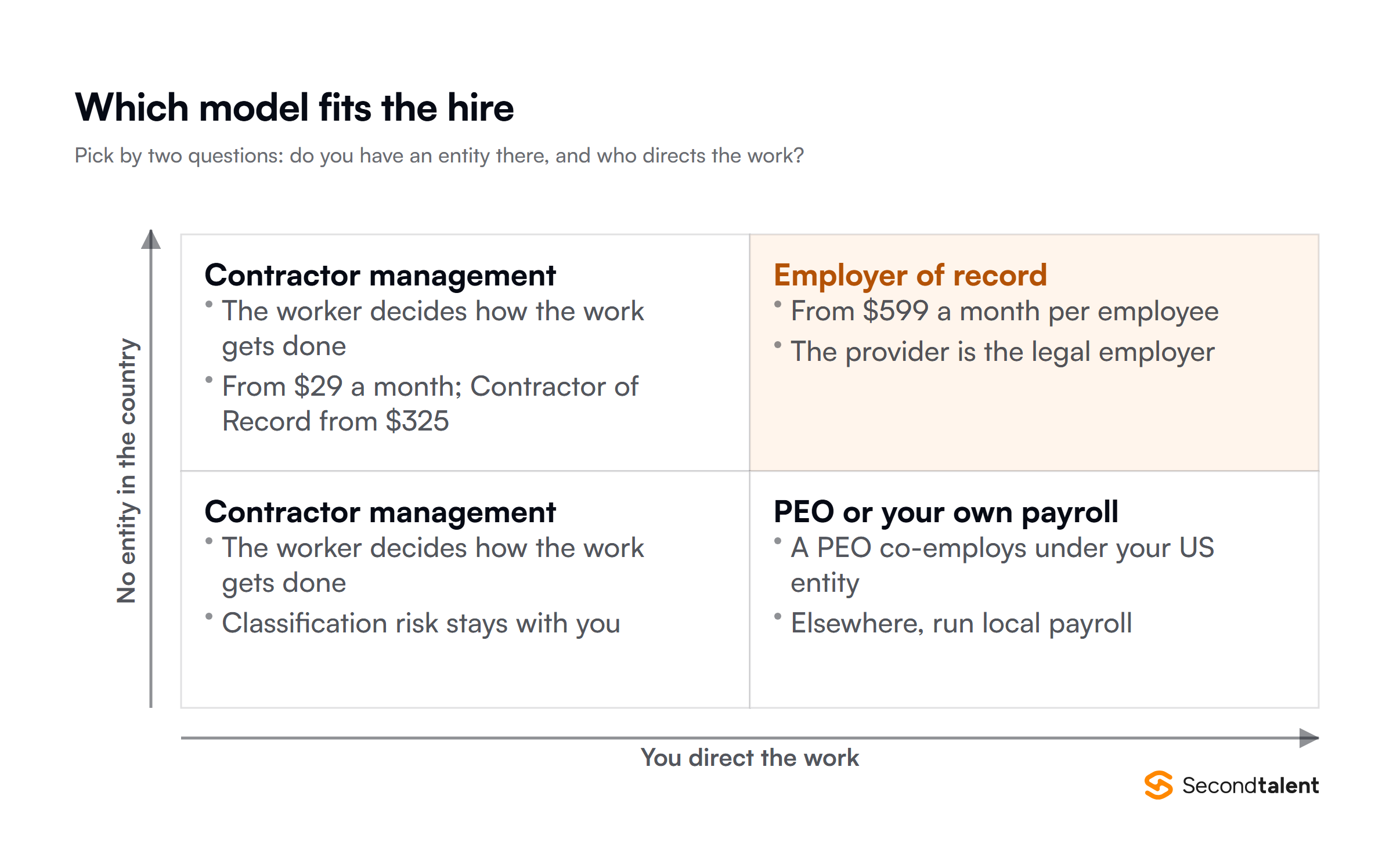
- Employer of record: you want an employee in a country where you have no entity, and you will set their hours, tools and priorities.
- PEO: you already employ staff through your own US entity and want to hand off payroll, benefits and HR administration.
- Contractor management: the worker runs their own business, sets their own hours, uses their own equipment and can take other clients.
- Your own entity: worth pricing once headcount in one country grows. Our EOR cost calculator compares the two.
Contractors who drift into full-time, managed roles are the common case for a switch. Moving one onto an EOR means a new employment contract, and from then on the statutory costs above apply.
Our guide to staff augmentation covers a fourth route, where a vendor supplies the engineer.
Employ Staff in Asia Through Our EOR
We act as employer of record in nine Asian markets, including Vietnam, the Philippines, Indonesia, Singapore and Taiwan.
We handle contracts, payroll, tax filings, statutory benefits and termination under our own entities, on one monthly USD invoice, and you manage the work. See our EOR service or our EOR in the Philippines, or get an EOR quote.
Frequently Asked Questions
Is an EOR the same as a PEO?
No. An EOR is the sole legal employer and works where you have no entity. A PEO co-employs staff with your own company, so you need an entity, and in practice it is a US arrangement.
Can a PEO hire employees in another country?
Not without your own entity there. To employ someone abroad without one, you need an employer of record. Deel, Remote and Justworks all sell one alongside their PEO.
Is an EOR cheaper than setting up an entity?
An entity carries set-up, accounting and local compliance costs whatever its headcount, while an EOR charges per employee. The break-even depends on the country and the number of hires, and our EOR cost calculator models it.