TL;DR: Senior API developers from Asia cost $2,700–$6,500 a month through Second Talent, matched in 24 hours. The median US software developer earns $135,980 a year (BLS, May 2025).
T-Mobile told the SEC in January 2023 that an attacker had pulled data on about 37 million customer accounts through a single API, without authorization. An API developer owns that endpoint, the permission check behind it and the contract its clients build against.
Key takeaways
- Broken object level authorization is the first entry in the OWASP API Security Top 10 for 2023.
- In Postman's 2025 survey, 24% of developers designed APIs with AI agents in mind, and 43% of respondents were located in the Asia-Pacific region.
- OpenAPI 3.2.0, released in September 2025, added the QUERY method and streaming media types.
- In the Philippines, a four-part test decides whether a contractor is in fact an employee, and control of the work weighs most.
What API Developers Earn Working for International Clients in Asia
We do not publish a rate card for API developers by that title, so the table uses our back-end developer rate card, the closest match to the work. Vietnam's range runs highest at $6,500, and the Philippine card is the only one of the three left open at the top.
| Market |
Monthly pay working for international clients (USD) |
| Indonesia |
$1,200-$5,500 |
| Philippines |
$1,520-$4,630+ |
| Vietnam |
$1,800-$6,500 |
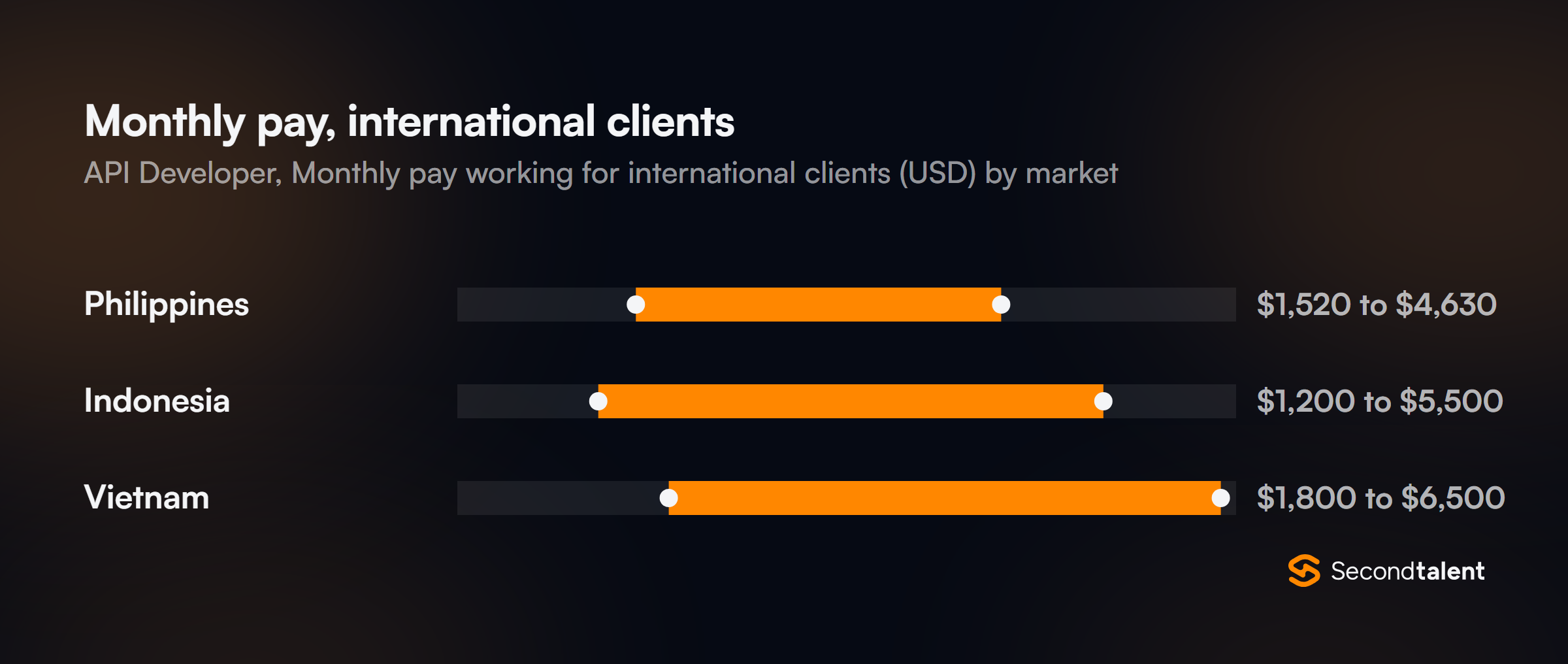
Monthly ranges from the Remote (Working for International Clients) figures on our rate cards for Indonesia, the Philippines and Vietnam, converted at ExchangeRate-API mid-market rates for 14 September 2026. The Philippine card is set at ₱95,000 to ₱290,000+ a month; the other two publish US dollars.
Each range is what back-end developers in that market earn working directly for foreign companies, before any employer or platform costs.
Second Talent's price for a senior API developer is $2,700–$6,500 a month: one monthly fee that bundles salary, payroll taxes, statutory contributions and our service fee, set out on our pricing page. Our back-end developer cost-to-hire page covers US freelance hourly rates for comparison.
US Pay Benchmark for API Developers
API development maps to Software Developers (15-1252). O*NET lists "Application Integration Engineer" among the reported job titles for that occupation, which is the API job under another name.
| BLS OEWS, May 2025, national |
Software Developers (15-1252) |
| 10th percentile, monthly |
$6,870 |
| 25th percentile, monthly |
$8,770 |
| Median, monthly |
$11,330 |
| 75th percentile, monthly |
$14,330 |
| 90th percentile, monthly |
$17,890 |
Monthly figures are the annual wages on the BLS occupation profile for 15-1252 divided by 12, rounded to the nearest $10. The annual median is $135,980.
Salary is only part of the US cost. In the BLS Employer Costs for Employee Compensation release for June 2026, wages and salaries made up 68.5% of employer compensation costs for full-time private industry workers, and benefits the other 31.5%.
Time Zone Overlap with ET, CT and PT
US client teams build against your API during their working day, which is evening and night for an API developer in Asia. Set the shift so the developer is online when those teams hit an error.
| Engineer's city |
UTC offset |
9:00 am ET (EDT) |
9:00 am CT (CDT) |
9:00 am PT (PDT) |
| Manila, Singapore, Kuala Lumpur, Taipei |
UTC+8 |
9:00 pm |
10:00 pm |
12:00 midnight |
| Ho Chi Minh City, Jakarta, Bangkok |
UTC+7 |
8:00 pm |
9:00 pm |
11:00 pm |
| Bengaluru |
UTC+5:30 |
6:30 pm |
7:30 pm |
9:30 pm |
After 1 November 2026, every time in the table moves one hour later. US daylight time runs from 8 March to 1 November 2026, per NIST, and none of these Asian cities change their clocks.
Two shifts that cover a US client's morning, computed for September:
- Manila, 6:00 pm to 3:00 am is 10:00 to 19:00 UTC, or 6:00 am to 3:00 pm EDT. Against a 9-to-5 day that is six hours with New York, five with Chicago and three with San Francisco.
- Ho Chi Minh City, 3:00 pm to midnight is 08:00 to 17:00 UTC, or 4:00 am to 1:00 pm EDT: four hours with New York, three with Chicago and one with San Francisco.
The Manila shift crosses the Philippine night shift window: Article 86 of the Labor Code adds at least 10% for each hour between 10 pm and 6 am, five hours here.
Vietnam adds at least 30% for 22:00 to 06:00 (Labor Code 2019, Articles 98 and 106), the last two hours of the second shift. Second Talent's placements offer 4-6 hours of daily overlap with US hours; outside that window, a paging rota with a US engineer covers the API.
API Developer Skills to Screen For
Postman's 2025 State of the API report surveyed more than 5,700 developers, architects and executives. REST was in use at 93% of them, webhooks at 50%, WebSockets at 35% and GraphQL at 33%. A strong candidate has shipped REST and at least one of the others.
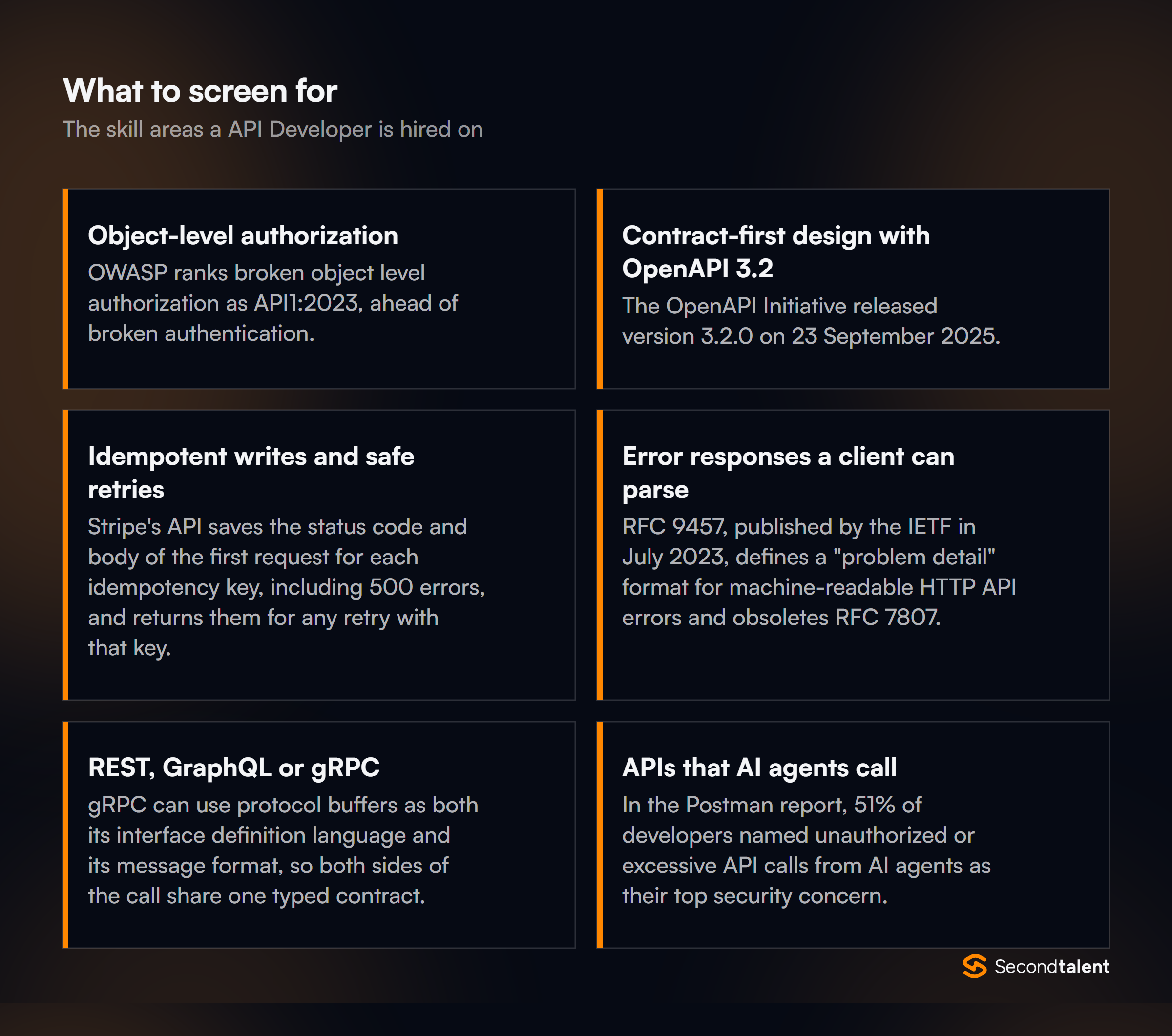
Object-level authorization
OWASP ranks broken object level authorization as API1:2023, ahead of broken authentication. The bug is an endpoint that confirms the caller has a valid session but not that the record in the URL belongs to them. Plant it in a take-home with two test users, and score whether the candidate finds it and writes the test that proves the fix.
Contract-first design with OpenAPI 3.2
The OpenAPI Initiative released version 3.2.0 on 23 September 2025. It added the QUERY HTTP method, streaming media types for Server-Sent Events and JSON Lines, and the OAuth 2.0 Device Authorization Flow. Ask the candidate to write the spec for one endpoint before any code, then change a field without breaking existing clients.
Idempotent writes and safe retries
Stripe's API saves the status code and body of the first request for each idempotency key, including 500 errors, and returns them for any retry with that key. Keys run up to 255 characters and become eligible for removal after 24 hours.
Ask how the candidate would build the same guarantee for a payment or order endpoint, and where they would store the key.
Error responses a client can parse
RFC 9457, published by the IETF in July 2023, defines a "problem detail" format for machine-readable HTTP API errors and obsoletes RFC 7807. A candidate who returns a different error shape from each service creates work for each client team. Review one of their past error payloads in the interview.
REST, GraphQL or gRPC
gRPC can use protocol buffers as both its interface definition language and its message format, so both sides of the call share one typed contract. Give the candidate a mobile client, a partner integration and an internal service, and ask which protocol each should get and why.
APIs that AI agents call
In the Postman report, 51% of developers named unauthorized or excessive API calls from AI agents as their top security concern.
Of the same respondents, 70% knew of the Model Context Protocol and 10% used it on a regular basis. Ask the candidate to scope a key for an agent. Then ask how they would tell agent traffic from human traffic and rate-limit it.
Contractor or Employer of Record for a US Company
Software is not one of the nine categories of commissioned work that can be "work made for hire" under 17 U.S.C. § 101. An API an independent contractor builds for you stays theirs until they transfer it, and § 204(a) requires that transfer in writing, signed. That covers the OpenAPI spec and generated SDKs as well as the server code.
IRS Publication 515 says the place where services are performed determines the source of the income. A developer building your API from Manila earns foreign-source income, and gives you Form W-8BEN to certify foreign status.
The Philippine Supreme Court applies a four-fold test to decide whether someone is an employee. In Atok Big Wedge v. Gison (G.R. No. 169510, 8 August 2011), the court listed selection and engagement, payment of wages, the power of dismissal and the power to control the employee's conduct, and called control "the most important". A developer who works your tickets, in your repositories, on your schedule meets the control test.
|
Independent contractor |
Employer of Record (EOR) |
| Legal employer |
None; the developer invoices you |
The EOR's local entity |
| US paperwork |
Form W-8BEN from the developer |
Service agreement with the EOR |
| IP |
Written assignment signed by the developer |
Assignment terms in the employment contract and your EOR agreement |
| Local labor law |
Classification risk if the work looks like employment |
Night premiums, public holidays and leave apply |
| Pay currency |
Agreed in the contract |
In Vietnam, contract wages are stated in dong (Labor Code Article 95) |
A contractor agreement fits a scoped integration with an end date. A developer on your on-call rota is the case our EOR service covers, with country detail on the Philippines EOR page. This is a summary, not legal advice.
English Level and Working Norms
The Philippines scores 603 for writing on the EF English Proficiency Index 2025 and 539 for speaking. For an API hire, writing is the skill that reaches your clients, through reference docs, changelogs and deprecation notices.
| Country |
EF EPI 2025 score |
World rank (of 123) |
IT job-function score |
| Philippines |
569 |
28 |
581 |
| Vietnam |
500 |
64 |
500 |
| Indonesia |
471 |
80 |
523 |
Scores come from EF's country pages for the Philippines, Vietnam and Indonesia. The global average is 488.
Ask each finalist for a deprecation notice for a field they plan to remove: what changes, the date, and what clients should do. It tests English and API judgement in one page.
Plan holidays in both directions. Thanksgiving, 26 November 2026, is a working day in Asia, so a US client's partner team may be offline while your API developer is shipping. Vietnam's Labor Code gives five paid days for Lunar New Year (Article 112), so avoid a breaking API version in that week with a Vietnam-based team.
API Developer Hiring Process
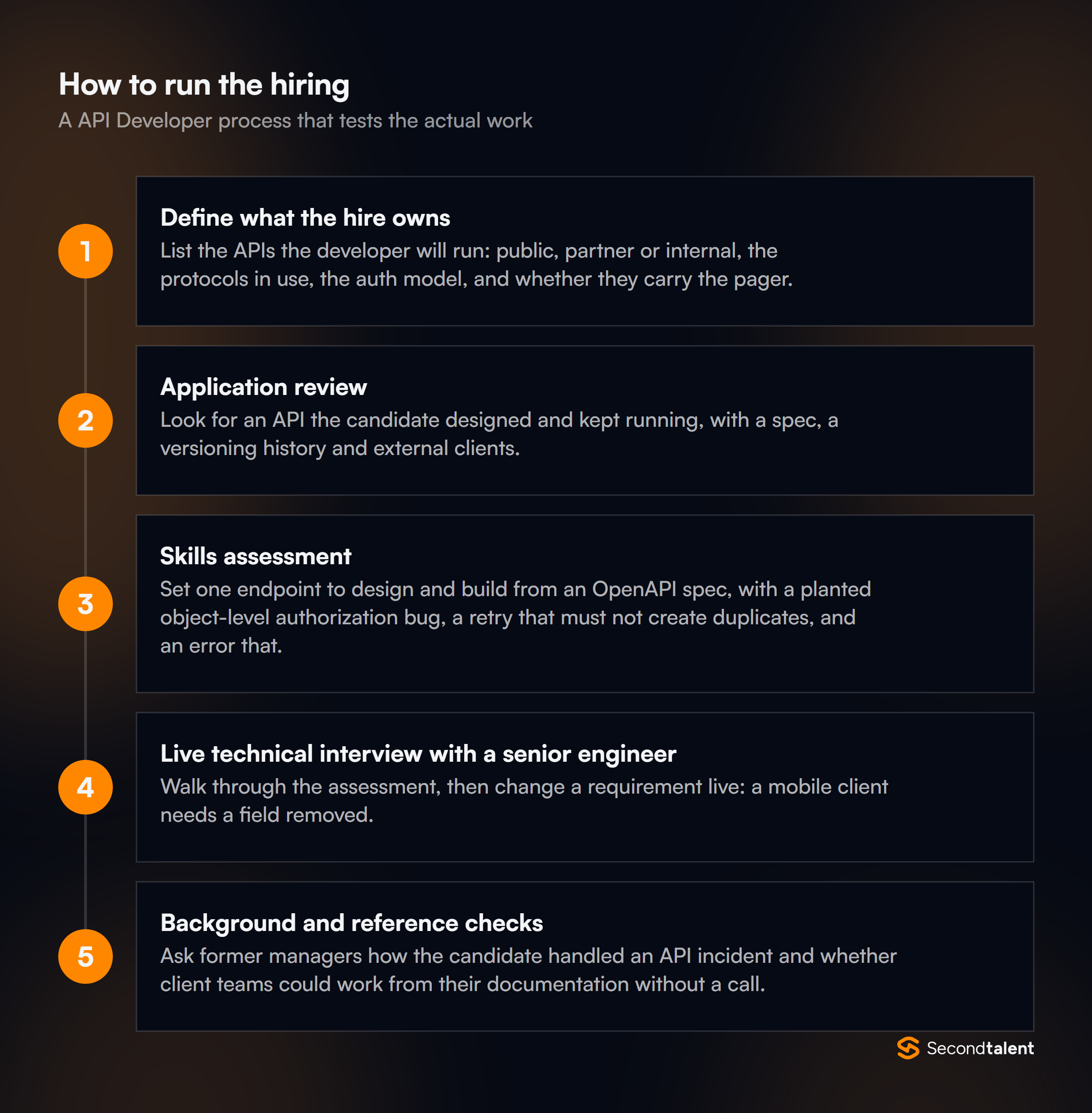
Second Talent's vetting covers stages 2 to 5 before you see a profile. For your own final round, our interview guides for API security and OpenAPI have question sets to reuse.
Stage 1: Define what the hire owns
List the APIs the developer will run: public, partner or internal, the protocols in use, the auth model, and whether they carry the pager. A public payments API and an internal gRPC mesh need different people.
Stage 2: Application review
Look for an API the candidate designed and kept running, with a spec, a versioning history and external clients. Ask how many breaking changes it shipped and how clients heard about them.
Stage 3: Skills assessment
Set one endpoint to design and build from an OpenAPI spec, with a planted object-level authorization bug, a retry that must not create duplicates, and an error that must follow RFC 9457. Give the spec the same weight as the code.
Stage 4: Live technical interview with a senior engineer
Walk through the assessment, then change a requirement live: a mobile client needs a field removed. Ask for the deprecation plan and the version strategy.
Stage 5: Background and reference checks
Ask former managers how the candidate handled an API incident and whether client teams could work from their documentation without a call. Sign the contract with the IP assignment covering specs and SDKs.
Hire API Developers from Asia with Second Talent
We shortlist 6-8 candidates within 24 hours from 100,000+ pre-vetted engineers, accepting only the top 1% of applicants. API developers cost $2,700–$6,500 a month, with $0 upfront, no lock-in and 4-6 hours of daily overlap with US hours. We handle contracts, payroll and equipment, with compliant EOR contracts and payroll in 9 Asian markets.
Our pricing page covers subscription, direct-hire and EOR options. Mixcare Health, whose platform offers OpenAPI integrations across healthcare providers, hired a team of five backend developers and customer operations executives in Vietnam and Malaysia through us, and its case study reports a 70% increase in business efficiency.