TL;DR: Solidity developers from Asia earn from $2,000 a month working for foreign companies on our blockchain developer rate cards, and Second Talent shortlists 6-8 pre-vetted candidates within 24 hours. The closest US benchmark, the BLS median for software developers, was $135,980 a year in May 2025.
In February 2026, Hexens reported a bug that made Solidity 0.8.28 to 0.8.33 write to the wrong kind of storage in contracts built with --via-ir. The Solidity team rated it high severity and found three deployed contracts that matched the pattern. A Solidity review starts at the compiler settings.
Key takeaways
- In the Solidity Developer Survey 2025, 65% of self-rated experts reported stack-too-deep errors, against 25% of beginners.
- Balancer V2 pools and their forks lost more than $120 million on 3 November 2025 through a rounding step in one scaling function.
- Solidity 0.8.35 added an
erc7201 builtin for namespaced storage, the layout OpenZeppelin's upgradeable contracts already use.
- 88% of Solidity survey respondents use AI tools at least monthly, and 45% say they distrust the output.
What Solidity Developers Earn Working for International Clients in Asia
China is the outlier in this table: its floor of $7,150 sits $1,850 below Malaysia's ceiling, and it is the only card quoted in local currency with an open top. We publish no Solidity-only card, so the figures come from our blockchain developer rate cards, the closest match. Each range is what developers in that market earn working for foreign companies as their direct clients, before any employer or platform costs.
| Market |
Monthly pay working for international clients (USD) |
| Indonesia |
$2,000-$8,000 |
| Philippines |
$2,200-$6,500 |
| Vietnam |
$2,200-$8,500 |
| Thailand |
$2,500-$8,500 |
| Malaysia |
$3,500-$9,000 |
| China |
$7,150-$20,550+ |
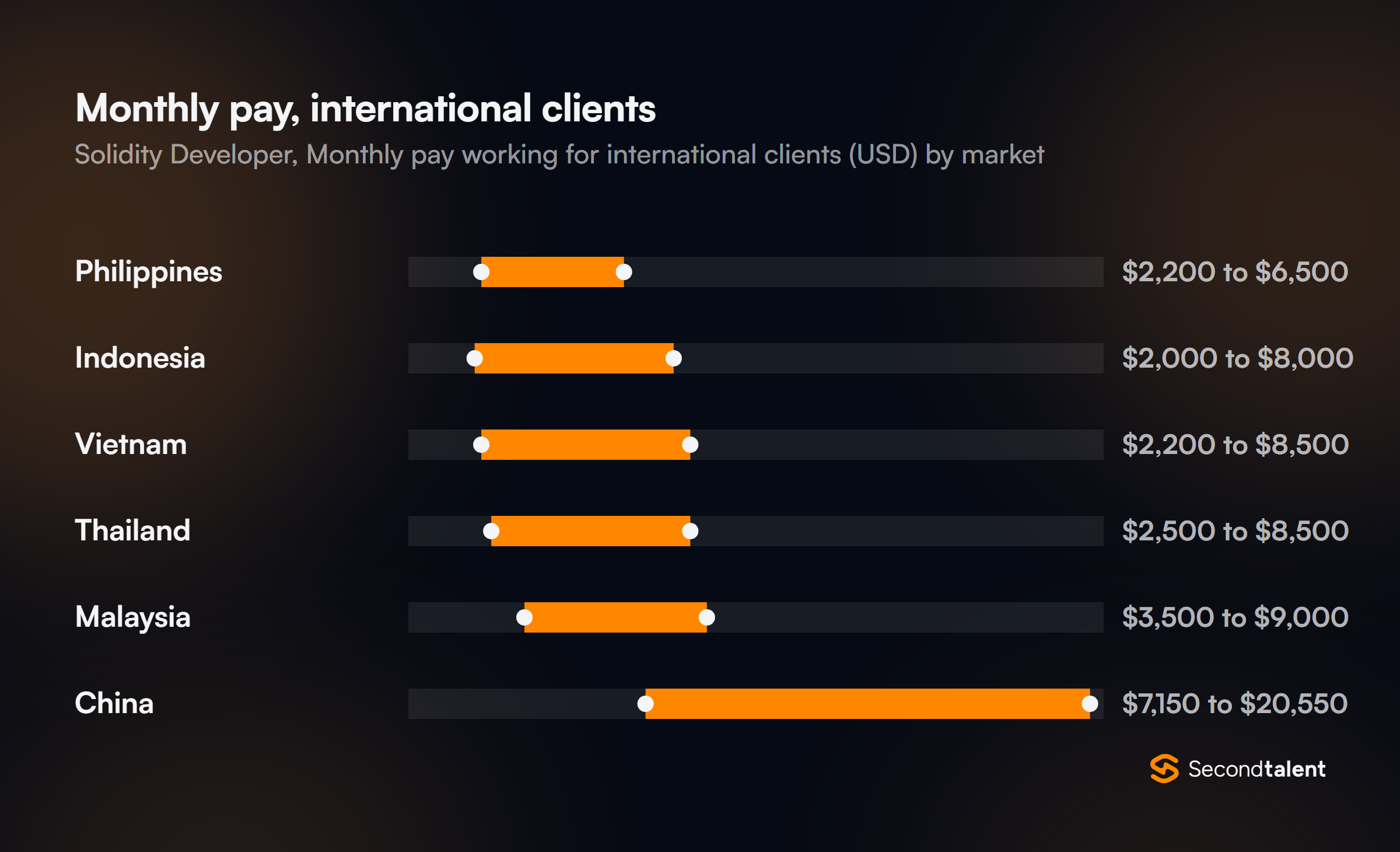
Monthly ranges from the Remote (Working for International Clients) figures on our rate cards for Indonesia, the Philippines, Vietnam, Thailand, Malaysia and China, converted at ExchangeRate-API mid-market rates for 14 September 2026.
The first five cards publish US dollar figures with a fixed ceiling, so conversion leaves them unchanged. The China card quotes ¥48,000 to ¥138,000+ a month, converted at ¥6.716 to the dollar.
Second Talent bills a Solidity developer as one monthly fee that bundles salary, payroll taxes, statutory contributions and our service fee. Our pricing page sets out the subscription and direct-hire options. For chain-wide briefs we also staff blockchain developers and Ethereum developers.
US Pay Benchmark for Solidity Developers
The United States supplied 83 of the 1,095 responses to the Solidity survey, behind India with 205 and Nigeria with 148. BLS publishes no smart contract occupation. Solidity developers map to Software Developers (SOC 15-1252), because the job is building software that runs on the Ethereum Virtual Machine.
| BLS OEWS, May 2025, national |
Software Developers (15-1252) |
| Median annual |
$135,980 |
| 10th percentile, monthly |
$6,870 |
| 25th percentile, monthly |
$8,770 |
| Median, monthly |
$11,330 |
| 75th percentile, monthly |
$14,330 |
| 90th percentile, monthly |
$17,890 |
Monthly figures are the annual wages on the OEWS profile for 15-1252 divided by 12, rounded to the nearest $10. The series covers every software developer, so read the 75th and 90th percentile rows for an engineer with audited mainnet contracts.
Salary is only part of the US cost. In the BLS Employer Costs for Employee Compensation release for June 2026, wages and salaries made up 68.5% of employer compensation costs for full-time private industry workers, and benefits the other 31.5%.
Time Zone Overlap with ET, CT and PT
OpenZeppelin's analysis puts the start of the Balancer V2 attack at around 7:40 am UTC on 3 November 2025. In Manila that was 3:40 pm, the middle of a working afternoon. New York had fallen back to standard time the day before, so it was 2:40 am there. US daylight time runs from 8 March to 1 November 2026, per NIST, and none of the cities below change their clocks.
| Engineer's city |
UTC offset |
9:00 am ET (EDT) |
9:00 am CT (CDT) |
9:00 am PT (PDT) |
| Manila, Singapore, Kuala Lumpur, Taipei |
UTC+8 |
9:00 pm |
10:00 pm |
12:00 midnight |
| Ho Chi Minh City, Jakarta, Bangkok |
UTC+7 |
8:00 pm |
9:00 pm |
11:00 pm |
| Bengaluru |
UTC+5:30 |
6:30 pm |
7:30 pm |
9:30 pm |
After 1 November 2026, every time in the table moves one hour later.
A worked shift for September: Manila from 4:00 pm to 1:00 am is 08:00 to 17:00 UTC. Subtract four hours for EDT and it covers 4:00 am to 1:00 pm in New York, which gives four hours inside a 9-to-5 ET day, three with Chicago and one with San Francisco.
Put the shared hours to work on audit findings, upgrade proposals and multisig sign-off. The Manila afternoon before the overlap covers alerts that fired during the US night. If your runbook allows it, the developer can pause a contract before your team wakes. We agree the shift before the offer, which is how our placements get 4-6 hours of daily overlap with US hours.
Night hours cost more for employees. The Philippine Labor Code sets a night shift differential of at least 10% for work between 10 pm and 6 am (Article 86), which covers the last three hours of that shift. Vietnam's Labor Code adds at least 30% for work between 22:00 and 06:00 (Articles 98 and 106).
Solidity Developer Skills to Screen For
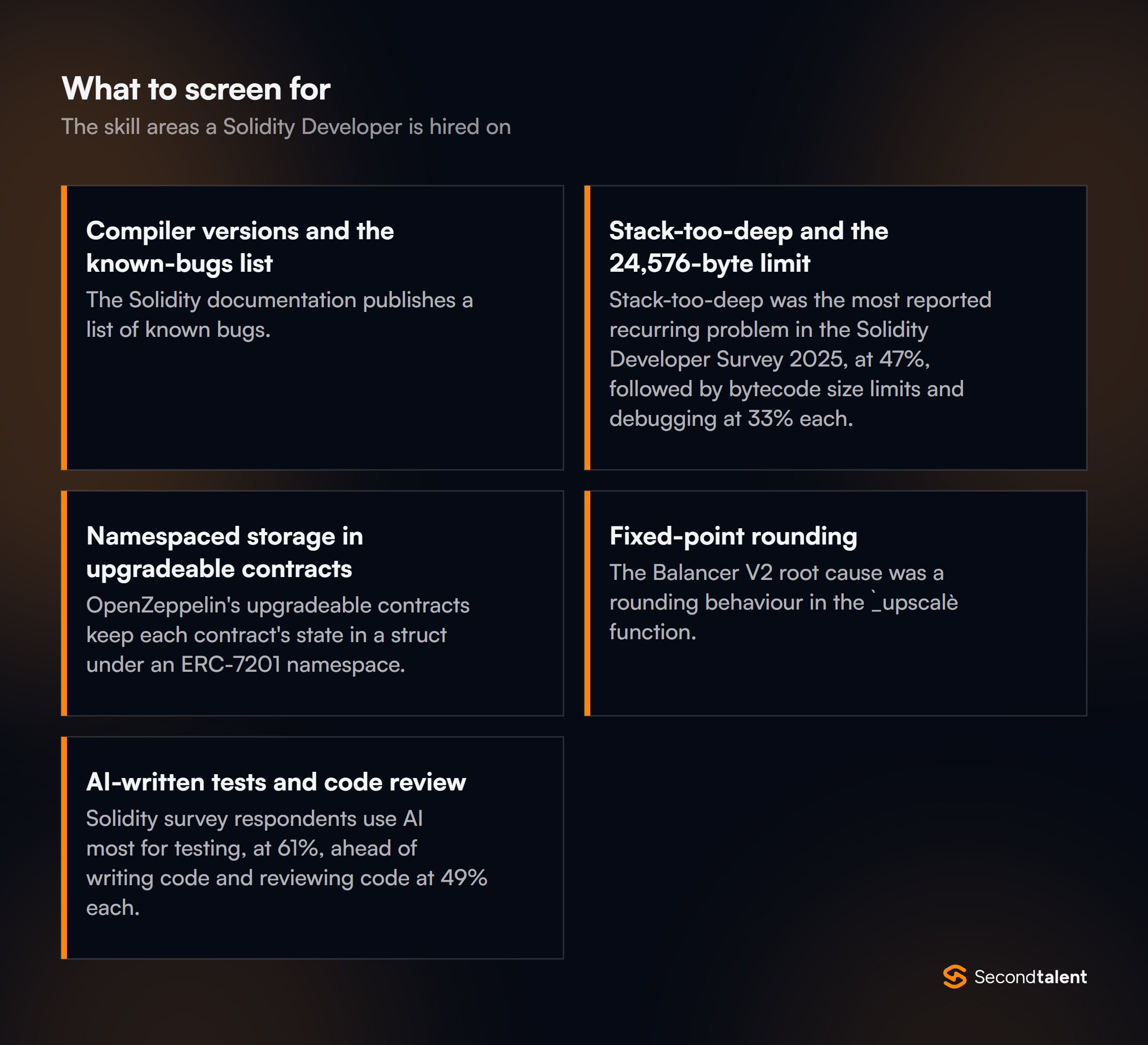
The compiler ships fixes on a steady rhythm: Solidity 0.8.37, released on 10 September 2026, fixed three bugs reported through the Ethereum Foundation's bug bounty program. Test candidates on the language as it stands this month.
Compiler versions and the known-bugs list
The Solidity documentation publishes a list of known bugs. A companion file, bugs_by_version.json, shows which bugs affect a given compiler version. The transient storage bug is one entry. Another, fixed in 0.8.37, reordered the arguments of custom errors passed to require with named parameters under the IR pipeline, from 0.8.26 onward. It changed revert data and left contract state untouched.
Give the candidate a repository pinned to 0.8.30 with viaIR on. Ask which listed bugs apply to that version and which ones the code triggers. Then ask what they would check before moving the pin.
Stack-too-deep and the 24,576-byte limit
Stack-too-deep was the most reported recurring problem in the Solidity Developer Survey 2025, at 47%, followed by bytecode size limits and debugging at 33% each. The size limit comes from EIP-170, which caps deployed code at 0x6000 bytes, or 24,576.
Senior developers hit both walls more often, because their contracts are larger. Ask how the candidate last got a contract under the limit: libraries, a split into several contracts, or cut features. Then ask what the change cost in gas and in audit scope.
Namespaced storage in upgradeable contracts
OpenZeppelin's upgradeable contracts keep each contract's state in a struct under an ERC-7201 namespace. Without that pattern, a new state variable shifts the variables below it in the inheritance chain and breaks storage compatibility. Solidity 0.8.29 added the layout at specifier, and 0.8.35 added erc7201, which computes the base slot from a namespace string at compile time.
Hand over version 1 of an upgradeable vault and a version 2 that adds two fields and a parent contract. Score whether the candidate finds the storage collision before running any tool.
Fixed-point rounding
The Balancer V2 root cause was a rounding behaviour in the _upscale function. A code comment there said the rounding error would be minimal unless _scalingFactor() was overridden. Composable Stable Pools overrode it to include exchange rates. With pool balances pushed low, the attacker chained swaps inside one batchSwap so the discarded fractions added up.
Give the candidate a pool that scales amounts by a rate provider. Ask which direction each rounding step should go, in favour of the pool or the user, and which invariant test would catch a step that goes the wrong way.
AI-written tests and code review
Solidity survey respondents use AI most for testing, at 61%, ahead of writing code and reviewing code at 49% each. Only 6% say they trust the output a lot. An AI-generated test can pass against the same wrong assumption the contract makes. Give the candidate a contract with an AI-written Foundry test suite that misses a reentrancy path, and score whether they question the tests or only run them.
Gas optimization for senior Solidity developers
Teams that search for Solidity experts often have a gas problem: a contract that works but costs users too much to call. Ask the candidate to measure before changing anything, with Foundry gas reports or gas snapshots committed to the repository so every pull request shows the difference.
Then review a contract together. A senior developer should spot state variables that could pack into one 32-byte slot, repeated storage reads inside a loop that belong in a local variable, memory parameters on external functions that could be calldata, and revert strings that custom errors would replace. Ask where they would use transient storage, which Solidity supports for value-type state variables from 0.8.28, such as a reentrancy lock that clears at the end of the transaction. The clearing bug described above is a reason to check the compiler pin before relying on it.
Finish with the trade-off. An unchecked block or inline assembly saves gas and removes a safety check, so ask which invariant test or audit note would justify each one. A saving of a few hundred gas on an admin function rarely pays for the extra audit scope.
Contractor or Employer of Record for a US Company
OpenZeppelin Contracts, the library behind many Solidity codebases, ships under the MIT licence, which requires its copyright and permission notice in all copies or substantial portions of the software. Your IP assignment can only transfer what the developer wrote, so list the developer's contracts, tests and deploy scripts, and keep third-party notices in place.
Software is not one of the nine categories of commissioned work that can be "work made for hire" under 17 U.S.C. § 101, and a transfer of copyright must be in writing and signed under § 204(a).
IRS Publication 515 says the place where services are performed determines the source of the income, so a developer working from Jakarta or Manila earns foreign-source income. A foreign individual gives the payer Form W-8BEN to certify foreign status.
The developer's own country applies its test for employment:
- Philippines: courts use the four-fold test, and in Atok Big Wedge v. Gison the Supreme Court called the power of control the most important of the four.
- Vietnam: Article 13 of the 2019 Labor Code treats an agreement under another name as a labor contract when it covers a paid job, wages and one party's management and supervision.
A fixed-scope job, such as fixing the findings in one audit report, suits a contractor agreement. A developer on your release rota with a key on the upgrade multisig fits the employment tests above. That is the case an Employer of Record covers. Our comparison of EOR, PEO and contractor models sets out the trade-offs, and the Vietnam EOR page covers that market. This is a summary, not legal advice.
|
Independent contractor |
Employer of Record |
| Legal employer |
None; the developer invoices you |
The EOR's local entity |
| US paperwork |
Form W-8BEN from the developer |
Service agreement with the EOR |
| IP |
Written assignment naming contracts, tests and deploy scripts |
Assignment in the employment contract and your EOR agreement |
| Local labor law |
Classification risk if you control hours and methods |
Night premiums, public holidays and leave apply |
| Pay currency |
Agreed in the contract, often USD |
Local currency; Vietnam's Labor Code states wages in dong (Article 95) |
English Level and Working Norms
Malaysian IT workers score 590 on the EF English Proficiency Index 2025, the highest job-function score among the markets in the cost table. The index ranks 123 countries and regions against a global average of 488.
| Country |
EF EPI 2025 score |
World rank (of 123) |
IT job-function score |
| Malaysia |
581 |
24 |
590 |
| Philippines |
569 |
28 |
581 |
| Vietnam |
500 |
64 |
500 |
| Indonesia |
471 |
80 |
523 |
| China |
464 |
86 |
491 |
| Thailand |
402 |
116 |
459 |
Scores come from EF's country pages, such as Malaysia and China.
Solidity puts English in front of your users. The NatSpec format carries messages that wallets may show at the moment a user signs a transaction, and the documentation recommends annotating every public interface. Read the candidate's @notice lines and audit responses with the same care as the code.
Plan releases around both calendars. Thanksgiving on 26 November 2026 is a working day in Asia, so a developer there can watch contracts and alerts while your US team is off. Article 112 of Vietnam's Labor Code gives five paid days for Lunar New Year, in late January or February, so avoid an upgrade that week with a Vietnam-based team.
Solidity Developer Hiring Process
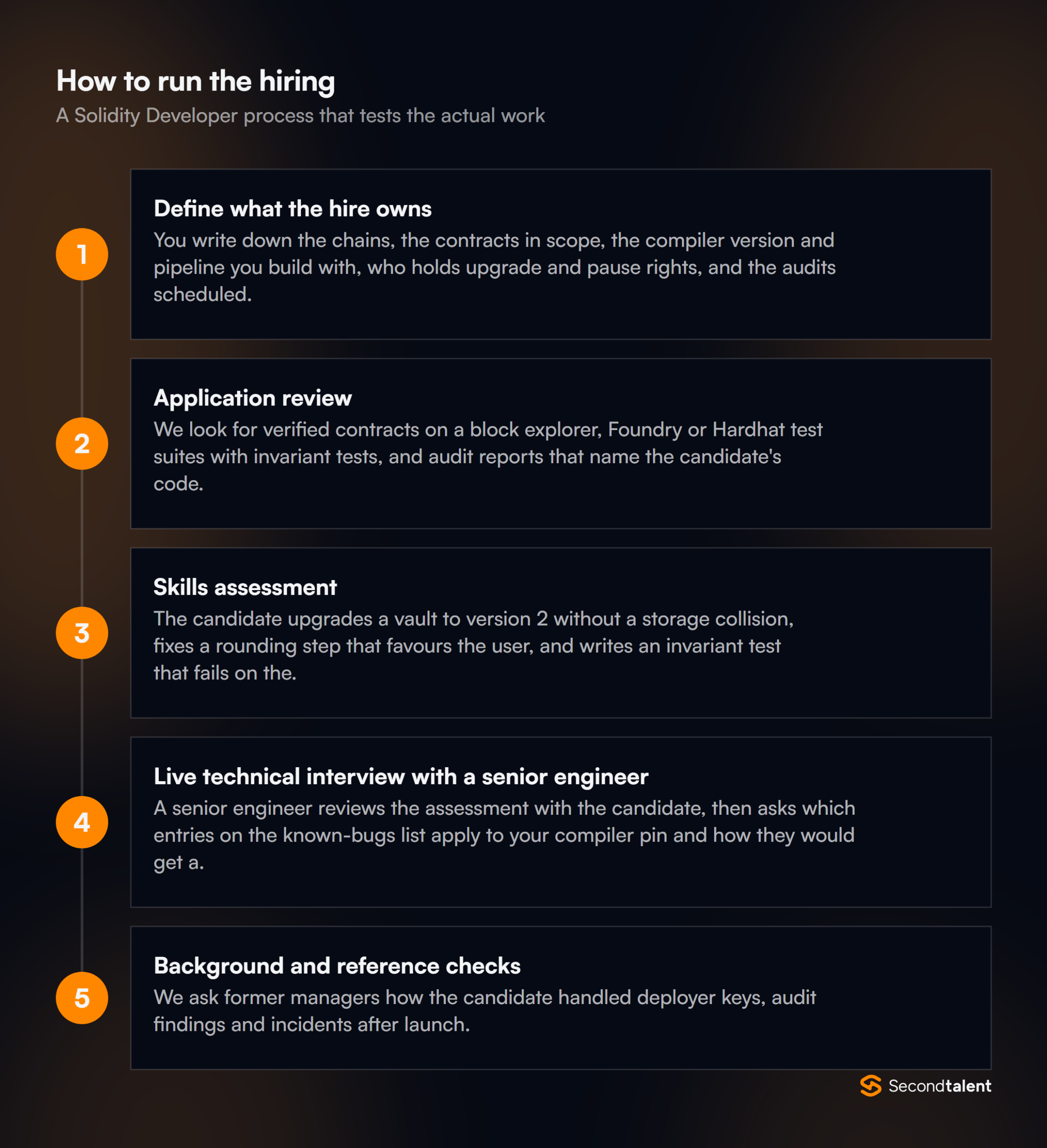
Second Talent's vetting covers stages 2 to 5 before you see a profile.
Stage 1: Define what the hire owns
You write down the chains, the contracts in scope, the compiler version and pipeline you build with, who holds upgrade and pause rights, and the audits scheduled. Add the hours your multisig signers can review.
Stage 2: Application review
We look for verified contracts on a block explorer, Foundry or Hardhat test suites with invariant tests, and audit reports that name the candidate's code. A token contract copied from a tutorial does not pass.
Stage 3: Skills assessment
The candidate upgrades a vault to version 2 without a storage collision, fixes a rounding step that favours the user, and writes an invariant test that fails on the original code. We score the tests with the same weight as the fix.
Stage 4: Live technical interview with a senior engineer
A senior engineer reviews the assessment with the candidate, then asks which entries on the known-bugs list apply to your compiler pin and how they would get a contract back under 24,576 bytes.
Stage 5: Background and reference checks
We ask former managers how the candidate handled deployer keys, audit findings and incidents after launch. You then choose the contractor or EOR route above and grant on-chain roles last.
Hire Solidity Developers from Asia with Second Talent
We shortlist 6-8 candidates within 24 hours from 100,000+ pre-vetted engineers, accepting only the top 1% of applicants. Solidity developers come with $0 upfront, no lock-in and 4-6 hours of daily overlap with US hours. We handle contracts, payroll and equipment, with compliant EOR contracts and payroll in 9 Asian markets.
Our pricing page covers subscription, direct-hire and EOR pricing. Open Campus, the Web3 education protocol, hired 10 engineers in Vietnam within 2 months through us, and the Open Campus case study reports a 70% increase in productivity.