TL;DR: Python developers in Malaysia earn $2,000 to $5,500 a month working for international clients on our rate card, the lowest ceiling of the five markets compared. The closest US benchmark, the BLS median for software developers, was $135,980 a year in May 2025.
Since 1 June 2025, section 12B of Malaysia's Personal Data Protection Act has set breach notification duties toward the Commissioner and affected data subjects, per the Commissioner's reporting manual. The Python developer who owns your ingestion jobs is often the first to notice a leaked export or an open bucket, so screen for that reflex too.
Key takeaways
- The Employment Act's overtime rate of one and a half times hourly pay does not apply to employees earning more than RM4,000 a month, and the whole international-client range on our Malaysia Python card sits above that line.
- Malaysia's Copyright Act hands commissioned code to the client unless an agreement says otherwise, while US law still asks for a signed written transfer.
- A 7 pm to 4 am shift in Kuala Lumpur gives a New York team seven live hours during US daylight time.
- pandas 3.0 turned copy-on-write on by default, so chained assignment in older pipeline code stops updating data without raising an error.
What Python Developers Earn in Malaysia Working for International Clients
Malaysia has the lowest ceiling in the table: $5,500 sits $500 below the Philippines and $2,000 below Vietnam. The figures are what developers in each market earn working directly for foreign companies, before any employer or platform costs.
| Market |
Monthly pay working for international clients (USD) |
| Malaysia |
$2,000-$5,500 |
| Indonesia |
$1,200-$6,500 |
| Vietnam |
$1,800-$7,500 |
| Philippines |
$2,500-$6,000 |
| Thailand |
$2,870-$7,710+ |
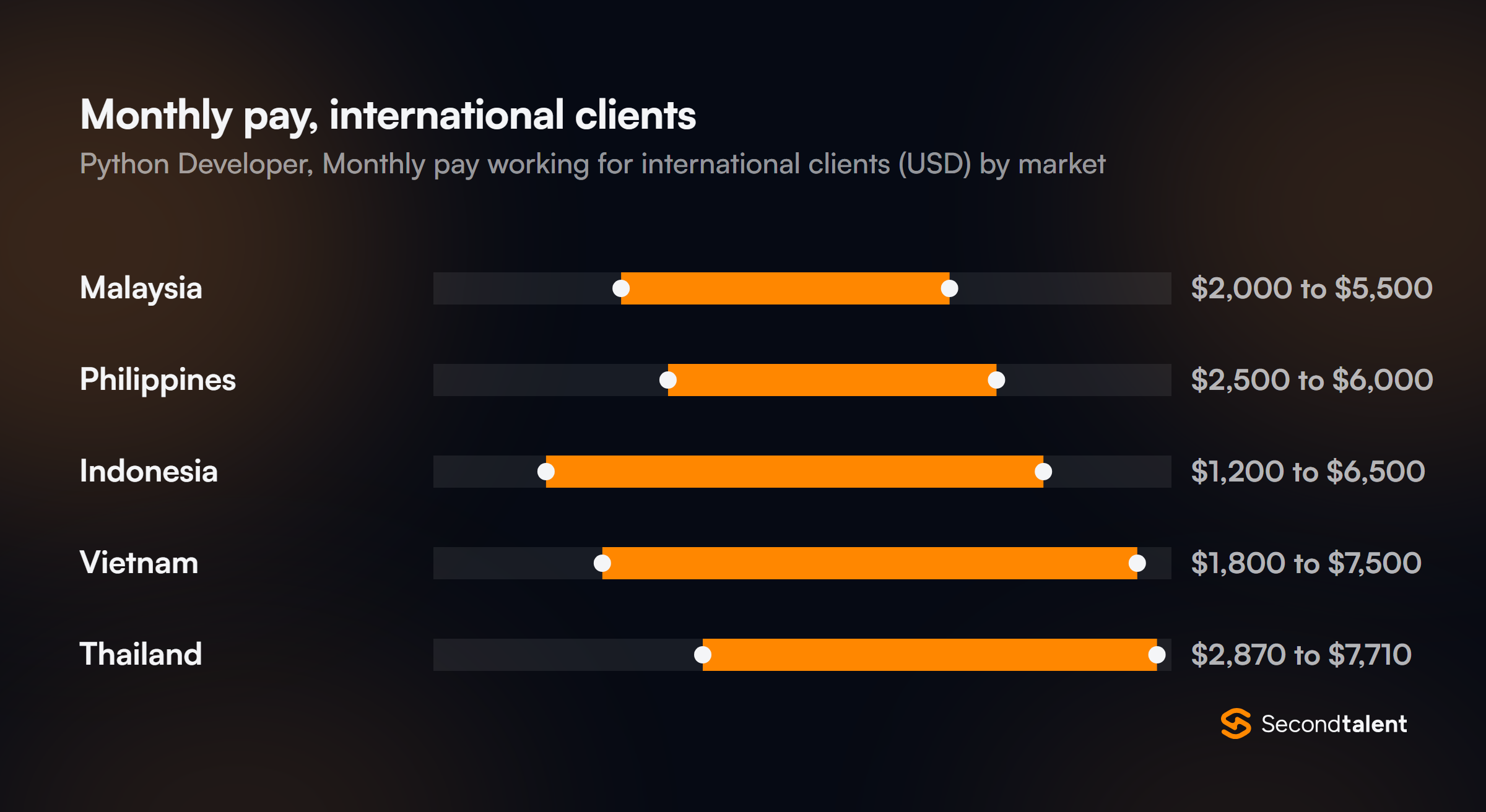
Monthly ranges from the Remote (Working for International Clients) figures on our rate cards for Malaysia, Indonesia, Vietnam, the Philippines and Thailand, converted at ExchangeRate-API mid-market rates for 14 September 2026.
The Malaysia card publishes this figure in US dollars, as do the Indonesia, Vietnam and Philippines cards. Only the Thailand card quotes local currency, ฿95,000 to ฿255,000+, converted for its row.
If the brief leans toward pipelines and warehouses, our Malaysia data engineer hiring page covers that profile. Through Second Talent you pay one monthly fee that bundles salary, payroll taxes, statutory contributions and our service fee, quoted per role and market, as our pricing page explains.
US Pay Benchmark for Python Developers
BLS tracks no occupation by language, so Python developers map to Software Developers (SOC 15-1252), the occupation for engineers who design and build applications and the services behind them.
| BLS OEWS, May 2025, national |
Software Developers (15-1252) |
| Median annual |
$135,980 |
| 10th percentile, monthly |
$6,870 |
| 25th percentile, monthly |
$8,770 |
| Median, monthly |
$11,330 |
| 75th percentile, monthly |
$14,330 |
| 90th percentile, monthly |
$17,890 |
Monthly figures are the annual wages on the OEWS profile for 15-1252 divided by 12, rounded to the nearest $10.
Salary is only part of the US cost. In the BLS Employer Costs for Employee Compensation release for June 2026, wages and salaries made up 68.5% of employer compensation costs for full-time private industry workers, and benefits the other 31.5%.
For short contracts, our Python developer cost-to-hire page sets out US freelance hourly rates.
Time Zone Overlap: Kuala Lumpur Against ET, CT and PT
Kuala Lumpur keeps UTC+8 all year, with no daylight saving time. US clocks stay on daylight time from 8 March to 1 November 2026, per NIST, so the gap to Malaysia grows by an hour in November.
The arithmetic: 9:00 am in New York under EDT (UTC-4) is 13:00 UTC, which is 9:00 pm in Kuala Lumpur. Under EST (UTC-5) the same meeting starts at 10:00 pm. Chicago adds one hour to both, and San Francisco three.
| Kuala Lumpur shift (UTC+8) |
ET overlap (EDT / EST) |
CT overlap (CDT / CST) |
PT overlap (PDT / PST) |
Hours between 10 pm and 6 am |
| 9 am-6 pm |
0 / 0 |
0 / 0 |
0 / 0 |
0 |
| 1 pm-10 pm |
1 / 0 |
0 / 0 |
0 / 0 |
0 |
| 4 pm-1 am |
4 / 3 |
3 / 2 |
1 / 0 |
3 |
| 7 pm-4 am |
7 / 6 |
6 / 5 |
4 / 3 |
6 |
Each shift counts nine clock hours, including a meal break, against a 9 am to 5 pm US day.
Python work splits well across that gap. A nightly batch job, a test run or a data backfill can finish in the Malaysian morning, and the live hours go to code review and incident calls. For most teams the 4 pm to 1 am row is enough.
Malaysian law shapes the shift. Section 60A of the Employment Act 1955 caps normal work at eight hours a day and 45 hours a week. Section 60C lets a shift worker exceed that on some days if hours average no more than 45 a week over three weeks.
The Act's overtime rate of one and a half times hourly pay sits in section 60A(3), and its First Schedule switches that subsection off for anyone earning more than RM4,000 a month.
The bottom of our card's international-client range, $2,000, is about RM8,140 at RM4.07 to the dollar, so a Kuala Lumpur Python hire falls outside the statutory overtime rate. Write the shift and any late-hours pay into the contract instead.
We set the shift before the offer, which is how our placements get 4-6 hours of daily overlap with US hours.
Python Developer Skills to Screen For
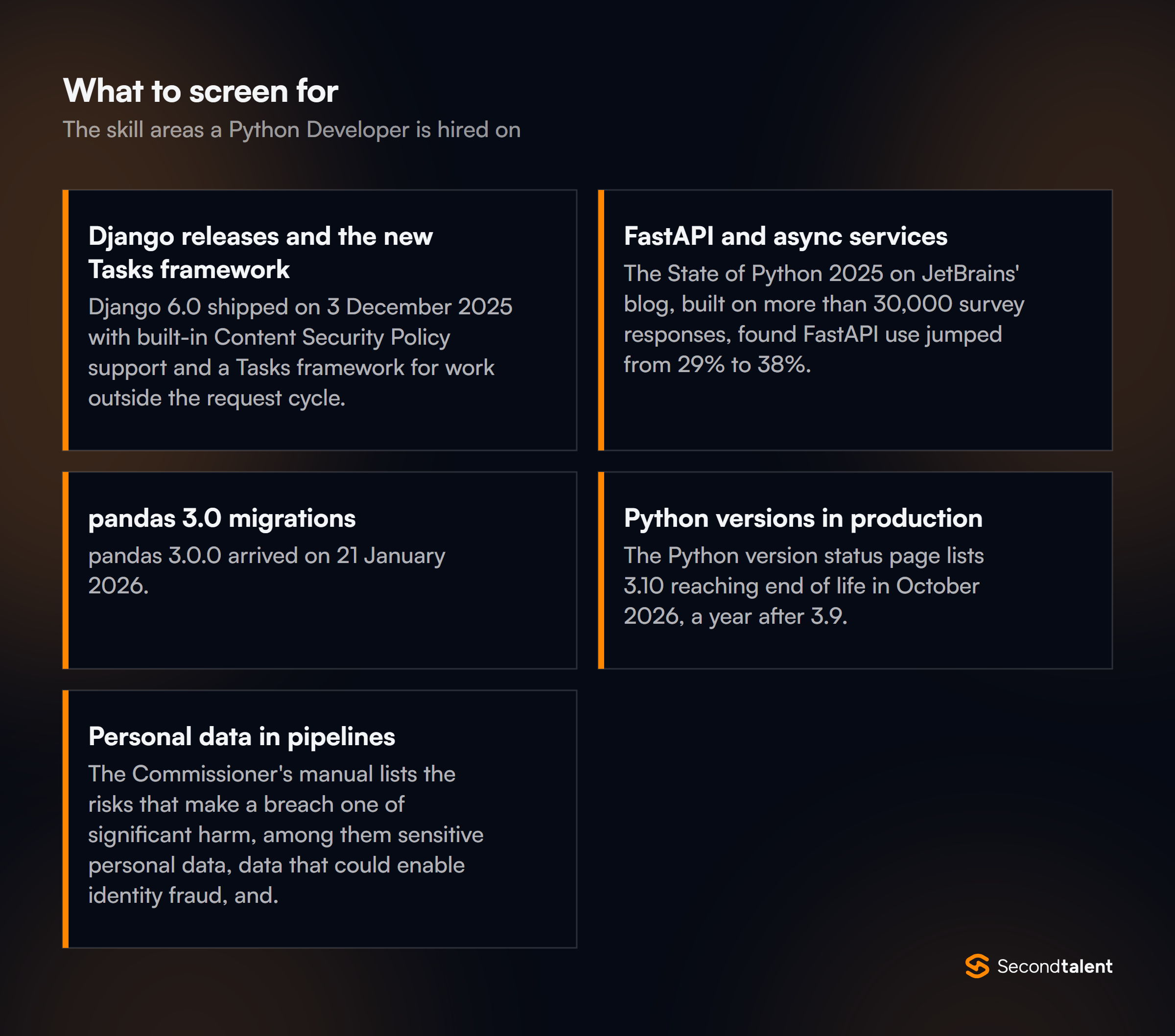
Python was used by 57.9% of all respondents to Stack Overflow's 2025 survey, 7 points more than in 2024. Four of the five checks below start from a recent release note, because a CV seldom shows whether a candidate keeps versions current.
Django releases and the new Tasks framework
Django 6.0 shipped on 3 December 2025 with built-in Content Security Policy support and a Tasks framework for work outside the request cycle. Django defines and queues the tasks, and external worker processes still run them.
The Django download page puts the end of 6.0 support in April 2027 and 5.2 LTS in April 2028. Ask whether the candidate would move a Celery queue onto Tasks, and what the workers would still need.
FastAPI and async services
The State of Python 2025 on JetBrains' blog, built on more than 30,000 survey responses, found FastAPI use jumped from 29% to 38%. The report's author suspects newcomers from machine learning and data work drove much of the jump.
Give the candidate an endpoint that calls a blocking database driver inside async def and ask why latency climbs under load. Then ask where they would move the call.
pandas 3.0 migrations
pandas 3.0.0 arrived on 21 January 2026. Any subset now behaves as a copy, chained assignment no longer updates the original, and SettingWithCopyWarning is gone. String columns load as a dedicated str type instead of object, and Python 3.11 is the minimum.
Hand over a notebook written for pandas 2 and ask which lines now fail without an error.
Python versions in production
The Python version status page lists 3.10 reaching end of life in October 2026, a year after 3.9. JetBrains found 83% of respondents were not on the latest Python version. Ask for the interpreter behind the candidate's last production service, the upgrade blocker and how uv or Docker images pinned the version.
Personal data in pipelines
The Commissioner's manual lists the risks that make a breach one of significant harm, among them sensitive personal data, data that could enable identity fraud, and more than 1,000 affected data subjects. A Python developer who logs raw payloads or copies production tables to a laptop creates that exposure.
Ask the candidate how they would mask national ID numbers in a staging copy and how they would know if a job wrote customer records somewhere public. Our Python interview guide adds question sets by level.
Contractor or Employer of Record in Malaysia
Software is not one of the nine categories of commissioned work that can be "work made for hire" under 17 U.S.C. § 101, and a transfer must be in writing and signed under § 204(a).
Malaysian law starts closer to the client. The Copyright Act 1987 counts computer programs as literary works. Section 26(2) deems copyright in a commissioned work, or one made in the course of employment, transferred to the commissioner or employer, subject to any agreement that limits the transfer.
Section 27(3) makes any assignment or licence ineffective unless it is in writing, so one signed assignment covering code, notebooks and models satisfies both countries.
IRS Publication 515 says the place where services are performed determines the source of the income, so a developer working from Kuala Lumpur or Penang earns foreign-source income. A foreign individual gives the payer Form W-8BEN to certify foreign status.
Since 1 January 2023, the Employment Act has covered all private sector employees regardless of pay, per the Labour Department's summary. Section 101C, added by the Employment (Amendment) Act 2022, presumes in a prosecution under the Act, absent a written contract of service, that a worker is an employee when another party controls the manner or hours of work, supplies the equipment, or pays at regular intervals most of the worker's income.
A full-time contractor inside your sprints meets several of those tests. The Act applies in Peninsular Malaysia and Labuan.
Our Employer of Record service makes the local entity the legal employer, and our Malaysia EOR page and Malaysia payroll guide cover contributions and leave. This is a summary, not legal advice.
|
Independent contractor |
Employer of Record |
| Legal employer |
None; the developer invoices you |
The EOR's Malaysian entity |
| US paperwork |
Form W-8BEN from the developer |
Service agreement with the EOR |
| IP |
Written assignment of code, notebooks and models (sections 26 and 27) |
Employer's copyright under section 26(2), passed on through your EOR agreement |
| Local labor law |
Section 101C presumption if you control hours and tools |
Employment Act hours, leave and holidays apply |
| Pay currency |
Agreed in the contract, often USD |
Local payroll run by the EOR |
English Level and Working Norms in Malaysia
Malaysia's IT job-function score is 590 on the EF English Proficiency Index 2025, above its national score of 581, which ranks 24th of 123 countries and regions against a global average of 488, per EF's Malaysia page. Kuala Lumpur scores 588 as a city.
The skill split matters more than the rank. Reading sits at 596 and writing at 584, while speaking trails at 534. A Python developer will read your docs and write clear pull request descriptions, so judge fluency on a design note as well as the call.
Plan for a different holiday calendar. Section 60D of the Employment Act gives each employee 11 paid gazetted public holidays a year, and the Act names five of them: National Day, the Yang di-Pertuan Agong's birthday, the state Ruler's birthday or Federal Territory Day, Workers' Day and Malaysia Day.
The Holidays Act 1951 schedule adds two days of Hari Raya Puasa and, in most states, two days of Chinese New Year, so schedule releases around both. Thanksgiving on 26 November 2026 is a working day in Malaysia, so a developer there can watch a data migration while your US team is off.
Section 60P gives employees the right to apply in writing for flexible hours, days or place of work. The employer must answer within 60 days, and a refusal must state the ground. Expect requests to revisit a late shift after the first months.
Python Developer Hiring Process in Malaysia
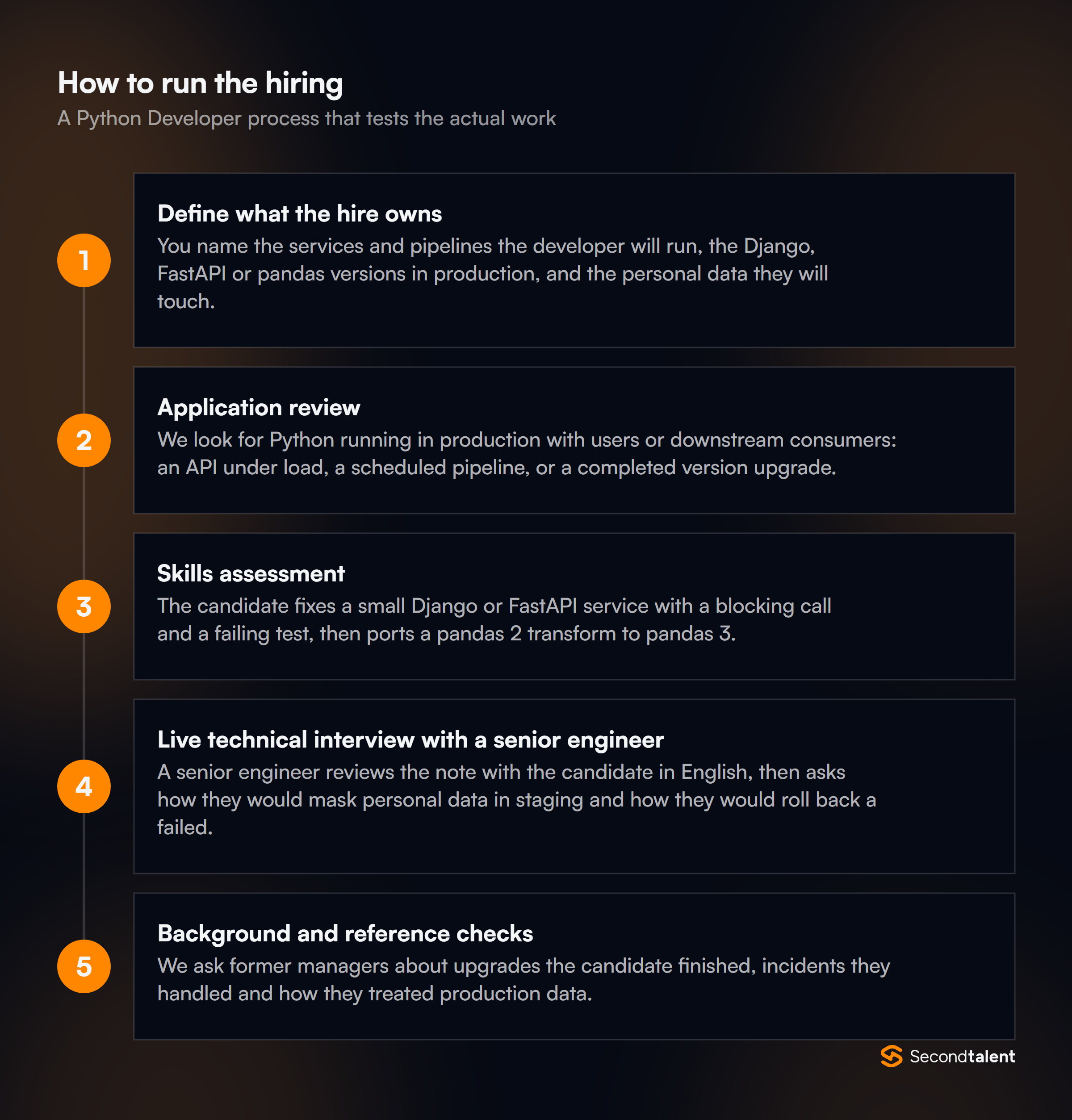
Second Talent's vetting covers stages 2 to 5 before you see a profile.
Stage 1: Define what the hire owns
You name the services and pipelines the developer will run, the Django, FastAPI or pandas versions in production, and the personal data they will touch. Add the Kuala Lumpur shift from the table above.
Stage 2: Application review
We look for Python running in production with users or downstream consumers: an API under load, a scheduled pipeline, or a completed version upgrade. A tutorial clone with no deployment history does not pass.
Stage 3: Skills assessment
The candidate fixes a small Django or FastAPI service with a blocking call and a failing test, then ports a pandas 2 transform to pandas 3. They explain each change in a short written note.
Stage 4: Live technical interview with a senior engineer
A senior engineer reviews the note with the candidate in English, then asks how they would mask personal data in staging and how they would roll back a failed migration at 2 am Kuala Lumpur time.
Stage 5: Background and reference checks
We ask former managers about upgrades the candidate finished, incidents they handled and how they treated production data. You then choose the contractor or EOR route above.
Hire Python Developers from Malaysia with Second Talent
We shortlist 6-8 candidates within 24 hours from 100,000+ pre-vetted engineers, accepting only the top 1% of applicants. Python developers from Malaysia come with $0 upfront, no lock-in and 4-6 hours of daily overlap with US hours. We handle contracts, payroll and equipment, with compliant EOR contracts in Malaysia.
Our pricing page sets out the monthly subscription, and for model work we also staff AI engineers in Malaysia.