TL;DR: An API developer builds the API a product exposes; an integration engineer connects systems by calling APIs that other companies built. An API integration specialist is the partner-facing version of the integration job, scoped to one API or one platform. US postings pay the API side more at the top ($405,000 to $485,000 base at Anthropic) and start integration titles lower ($73,780 at Samsara).
The average company in MuleSoft's 2026 Connectivity Benchmark ran 957 applications, and only 27% of them were connected to each other. Connecting the rest is integration work. Building the endpoints those connections call is API work. I read 14 open postings for the three titles on October 5, 2026, to see where employers draw the line.
- 1Gartner put the integration platform (iPaaS) market at $8.5 billion in 2024, up 23.4%. The platforms add to the integration engineer's toolkit; postings still ask for Python.
- 2In Postman's 2025 survey, 69% of developers spent 10+ hours a week on API work.
- 3The exact title "API integration specialist" did not appear on any company job board I searched. Employers post it as partner integrations, solutions integration or platform integration roles.
- 4Stripe's Singapore integration engineer posting pays SGD 200,000 to 300,000 and asks for 8+ years.
What is the difference between an integration engineer and an API developer?
An API developer is a software engineer who designs, builds and maintains the application programming interfaces a product exposes to other software. An integration engineer is a software engineer who connects separate systems so data and actions flow between them, by calling APIs that other teams built.
One works on the provider side of an API. The other works on the consumer side, across many of them.
The API integration specialist sits between the two. Our integration engineer role guide lists it as a specialization of integration engineering, and our API integration specialist guide places it on the ladder between junior API developer and senior integration architect. In current postings it means integration work facing partners or customers, on one company's API or one platform.
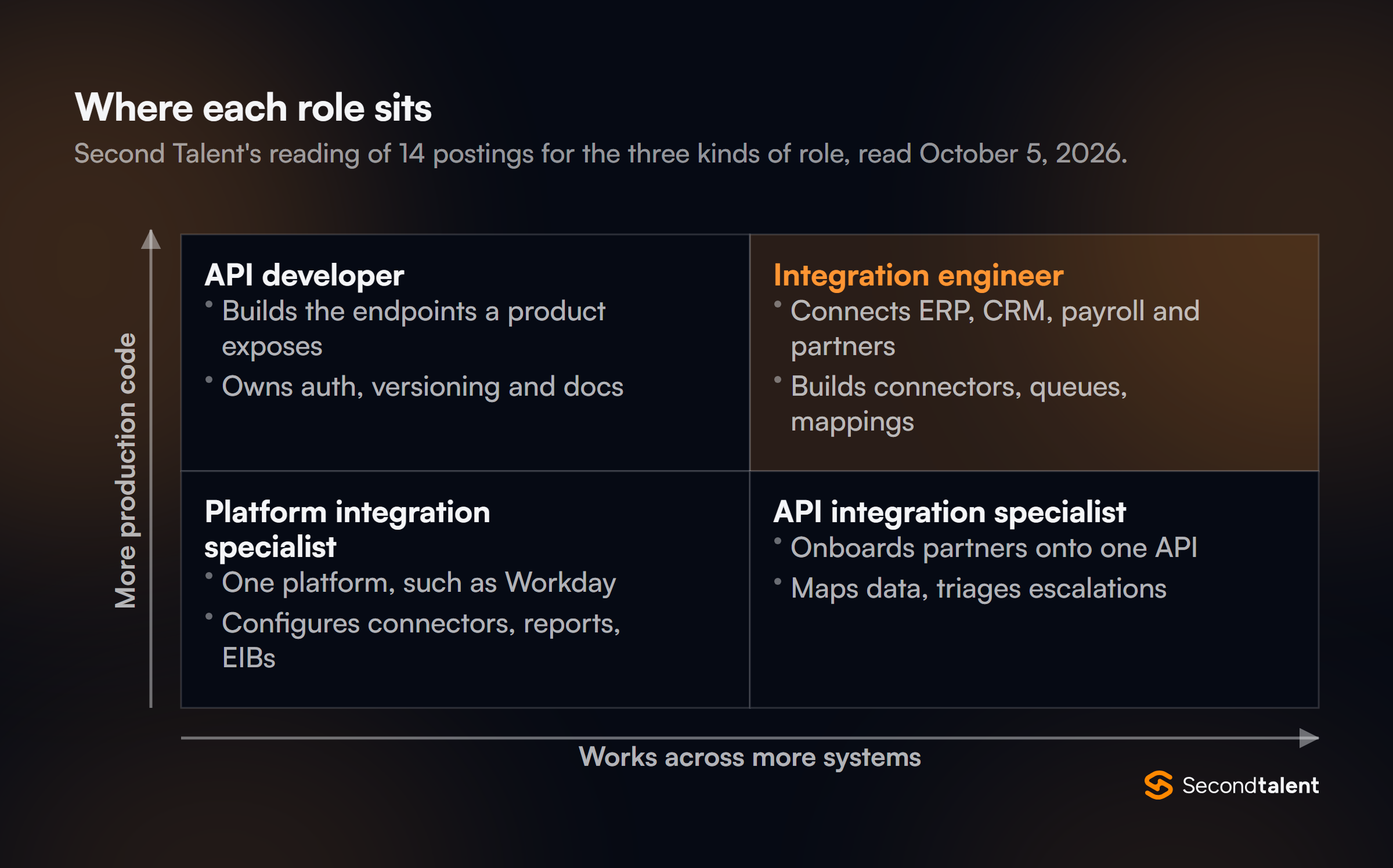
Both bottom boxes are specialist jobs. DoorDash's version manages partners connecting to its API. Cloudflare's configures one platform, Workday. Neither asks for as much production code as the two engineer roles above them.
- Owns the API contract: endpoints, schemas, errors
- Handles authentication, rate limits and versioning
- Writes the OpenAPI spec, SDKs and docs
- Works inside one product's codebase
- Owns the data flow between systems
- Builds data mappings, retries and error handling
- Works with queues, iPaaS tools, files and EDI
- Works across ERP, CRM, payroll and partner systems
What an API developer builds
Ramp's Developer API team "builds the programmatic surfaces that let developers and AI agents read from and write to Ramp." Its Developer API posting asks for 5+ years of backend work and "strong opinions on developer experience". It wants someone who has "felt the pain of bad docs, bad error messages, and bad onboarding."
Most of that work is still REST. The Postman 2025 State of the API surveyed more than 5,700 developers, architects and executives:
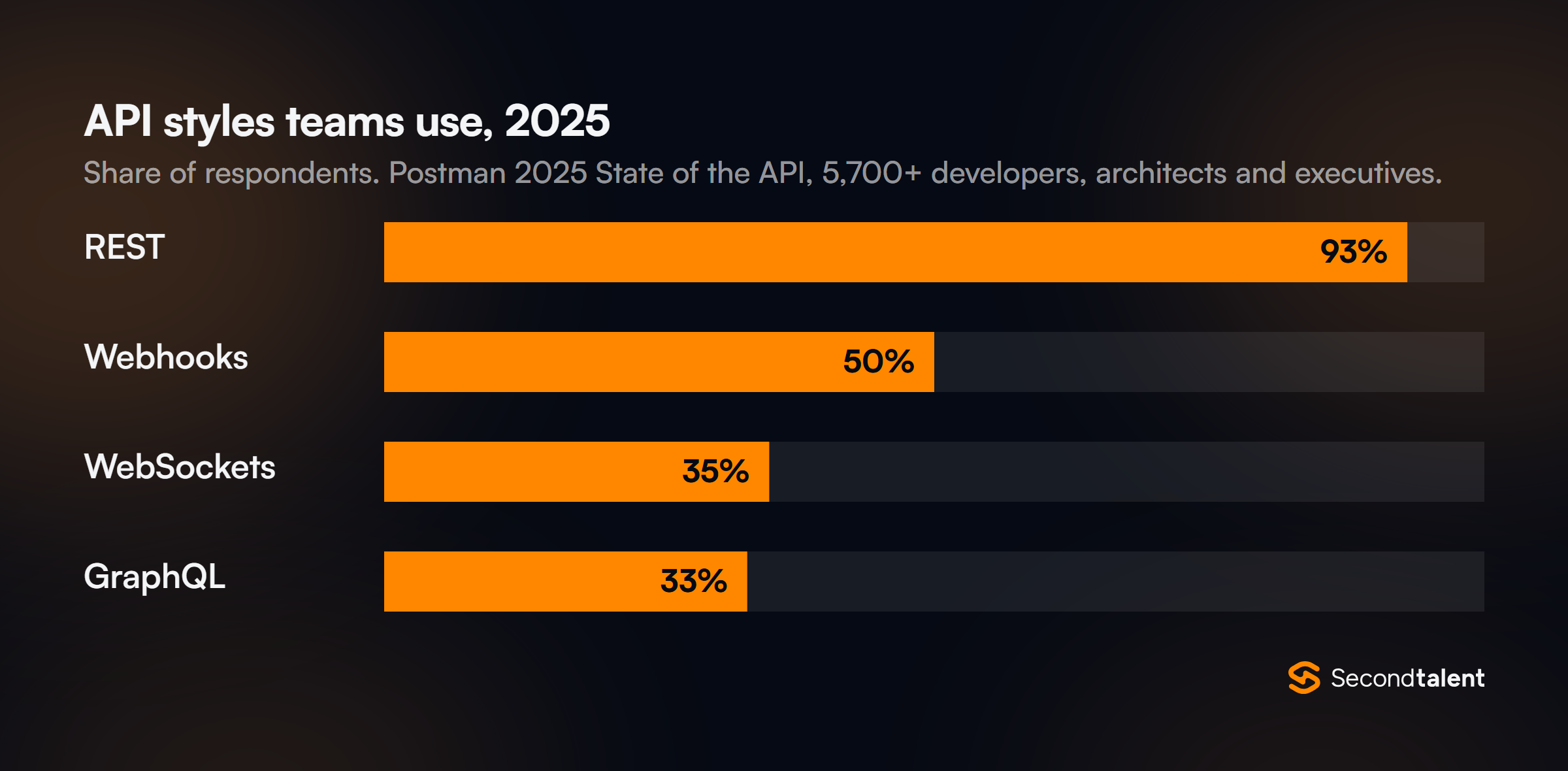
Webhooks in second place matter for this comparison. The API developer publishes the webhook. The integration engineer on the other end receives it, retries it when it fails and reconciles it with records in another system.
The API developer also owns the security of the interface. The OWASP API Security Top 10 for 2023 ranks broken object level authorization first: an API that returns a record without checking that the caller may see it. Our API security interview guide covers how to test candidates on this.
The caller is changing too. Postman found 24% of developers now design APIs with AI agents in mind, and 51% named unauthorized agent access as a top security risk. At larger companies the role reaches into developer experience. OpenAI's API Experience posting covers docs, SDKs, the Playground and onboarding flows, in TypeScript and React.
What an integration engineer connects
OpenAI's senior integrations engineer posting lists what one integration team connects. ERP and supply chain systems, e-commerce platforms, third-party logistics providers, contract manufacturers, retailers and distributors. The engineer builds "workflows, APIs, event-driven services, and batch and file interfaces", and onboards partners over EDI.
The backlog is large. MuleSoft surveys 1,050 IT leaders a year for its benchmark. Between the 2025 report and the 2026 report, the average app count rose and the connected share fell:
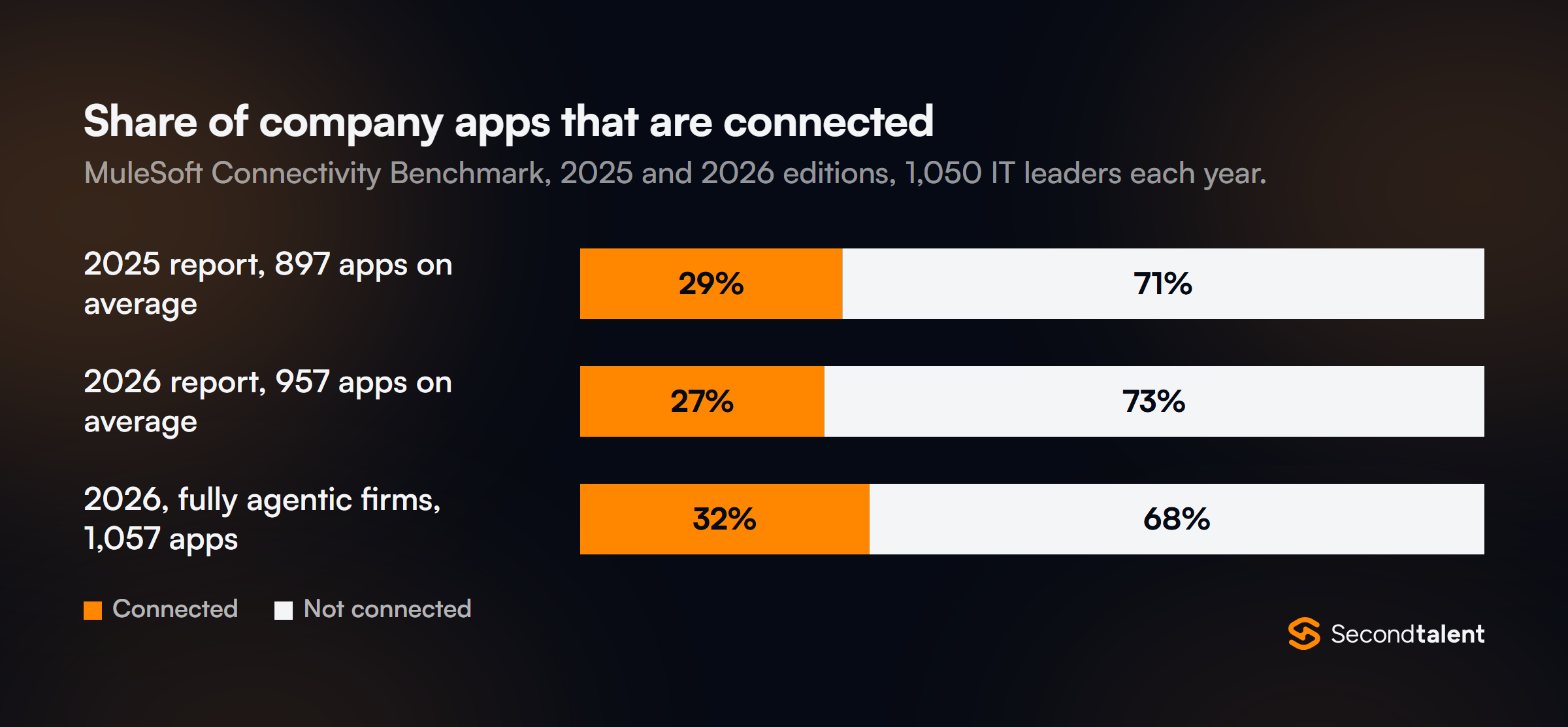
IT teams in the 2026 report spent 36% of their time on custom integrations between systems and data. The same report estimated that IT leaders leave 27% of their APIs ungoverned.
The patterns are older than the platforms. Gregor Hohpe and Bobby Woolf's Enterprise Integration Patterns catalogues 65 of them, from message channels to translators.
Those platforms are a fast-growing market. Gartner's iPaaS market share analysis named iPaaS the second fastest-growing segment of the application and infrastructure middleware market in 2024. The code has not gone away. OpenAI's posting wants two platforms, such as Workato, MuleSoft or Oracle Integration Cloud, and Python as a primary language. Vanta's integrations platform team builds in TypeScript, React and Node.js, at $195,000 to $229,000.
Where the API integration specialist fits
The exact title is rare. On the Greenhouse, Ashby and Lever boards I searched, no company posted an "API Integration Specialist". The same job appears under three other names:
The shared trait is scope: one company's API or one platform, with another team's engineers on the far side. DoorDash's partner integrations specialist guides partners "through new Integration builds". Samsara's solutions integration engineers "map a customer's integration needs to current and future API capabilities".
The coding bar varies with the employer. Samsara wants Python plus one other language and production work with REST APIs and webhooks. DoorDash asks for comfort with engineering terms and the ability to translate them for business stakeholders. Cloudflare's Workday role lists XML and XSLT, with Java as a secondary skill.
Skills and tools side by side
The three roles share HTTP, JSON and authentication. They split on where the code runs and which tools carry the work. The columns below follow our three role guides, checked against the postings.
| API developer | Integration engineer | API integration specialist | |
|---|---|---|---|
| Languages | Python, Java, Node.js, Go, C# | Java, Python, JavaScript | Python, JavaScript; XML and XSLT on platform roles |
| Protocols | REST, GraphQL, gRPC | REST, SOAP, message queues, EDI | REST, SOAP, webhooks |
| Platforms | Kong, Apigee, AWS API Gateway | MuleSoft, Boomi, Workato, Kafka, RabbitMQ | Workato, Zapier, Workday Studio |
| Specs and testing | OpenAPI, Postman, unit and contract tests | Postman, SoapUI, end-to-end tests | Postman, mock servers |
| Works with | Front-end, mobile and partner developers | Application, architecture and operations teams | Partners, customers and account teams |
Seniority varies more than the title does:
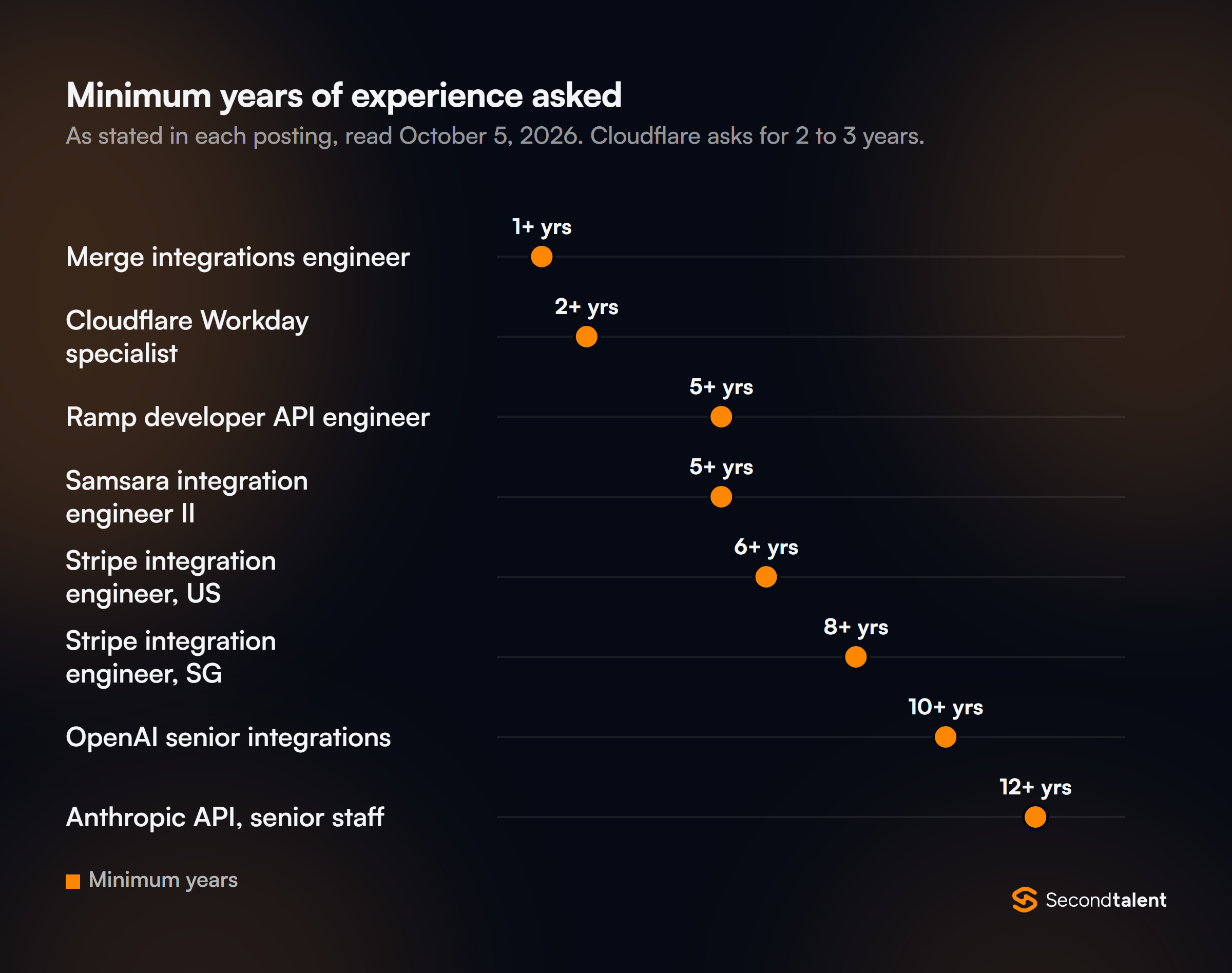
Integration titles span the widest range, from Merge's 1+ years to the 10+ years OpenAI asks for. The two Stripe postings show that location changes the bar too. The US role asks for 6+ years in software or integration engineering. The Singapore role asks for 8+ years plus Mandarin, for clients in Greater China.
Pay: what the postings say
The API side pays more at the top, but seniority explains more of the gap than the title does. Here are the posted base ranges:
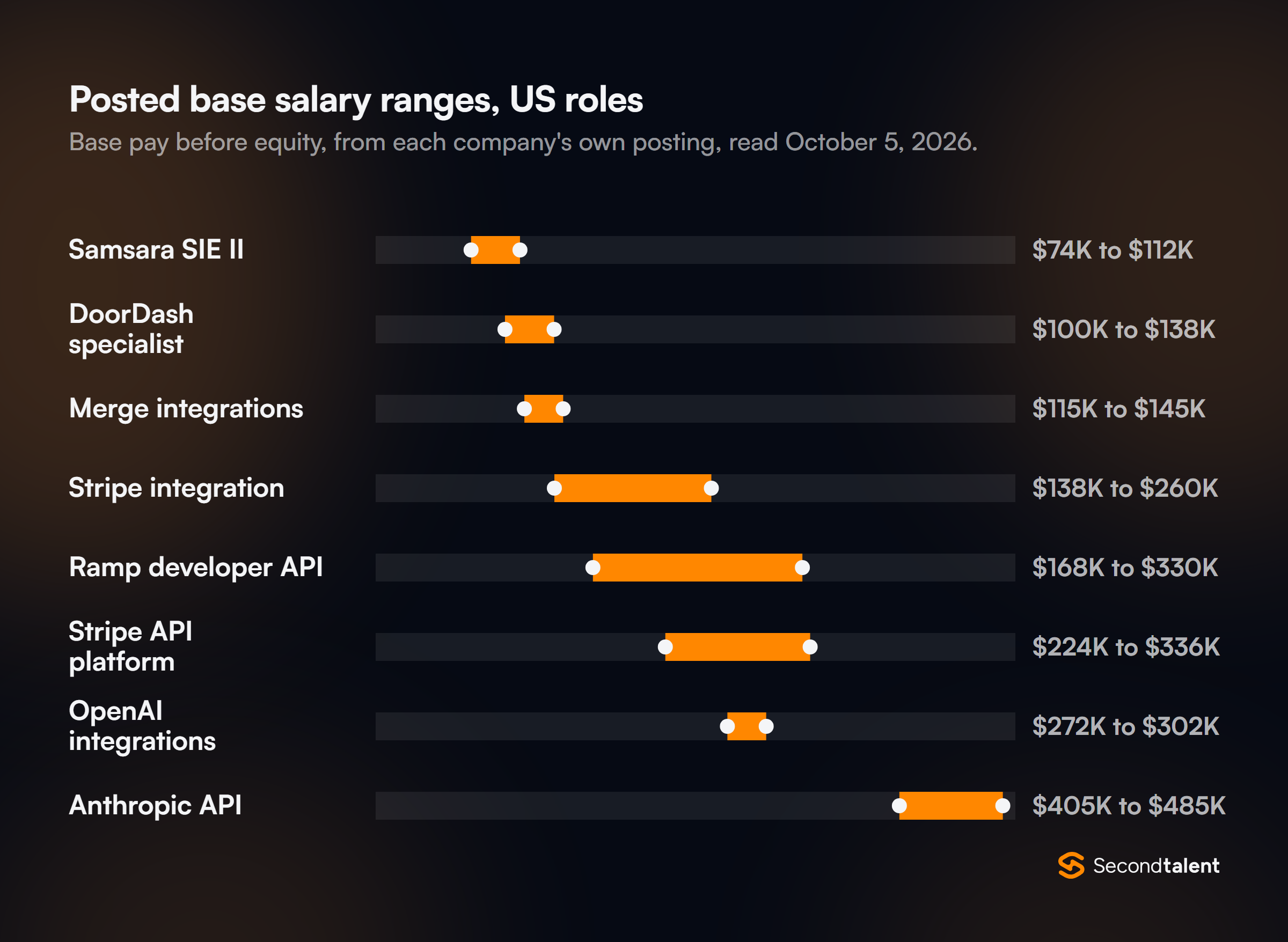
OpenAI's senior integrations engineer, at $272,000 to $302,000, earns more than the bottom of Ramp's and Stripe's API ranges because it asks for 10+ years. Anthropic's API role asks for 12+ years and pays $405,000 to $485,000. Samsara's level II, at the bottom, is remote and excludes the San Francisco, New York and Washington metro areas.
Stripe shows the gap inside one company. Its integration engineer posting pays $138,200 to $259,600. Its staff API platform posting pays $224,000 to $336,000, but asks for 12+ years and 5+ in technical leadership.
The BLS does not publish pay for either title, since both sit inside its software developer category. Our own cost data prices them the same: the integration engineer cost guide and the back-end developer cost guide both put a mid-level US freelancer at $85 to $135 an hour. For Asian salaries, see our back-end rate cards for Vietnam and the Philippines.
Career paths between the three
The career ladders for these roles cross at several points. Our API developer role guide lists integration specialist as one exit, next to API architect, platform engineer, API product manager and developer relations. The integration engineer's ladder runs to integration architect, or sideways into data integration, EDI or one platform such as MuleSoft or Boomi.
Employers write the crossover into their postings. Stripe's US integration role accepts experience "in a Software Engineering / Integration Engineering role". Samsara's level IV accepts 7+ years as a "software engineer, solutions engineer, integrations engineer, solution architect or other customer facing technical roles".
The newest overlap is the Model Context Protocol (MCP), which lets AI agents call tools through a standard interface. OpenAI's integrations posting asks its engineer to build MCP servers. Those servers connect AI applications to supply chain systems. Postman found 70% of developers aware of MCP but only 10% using it on a regular basis. Our AI integration engineer guide covers the role forming around that work.
Which one to hire
Hire the API developer when the API is the product, or when other teams will build on what you expose. Hire the integration engineer when the data lives in systems you bought rather than built. Add a specialist when partner onboarding starts to take engineering time.
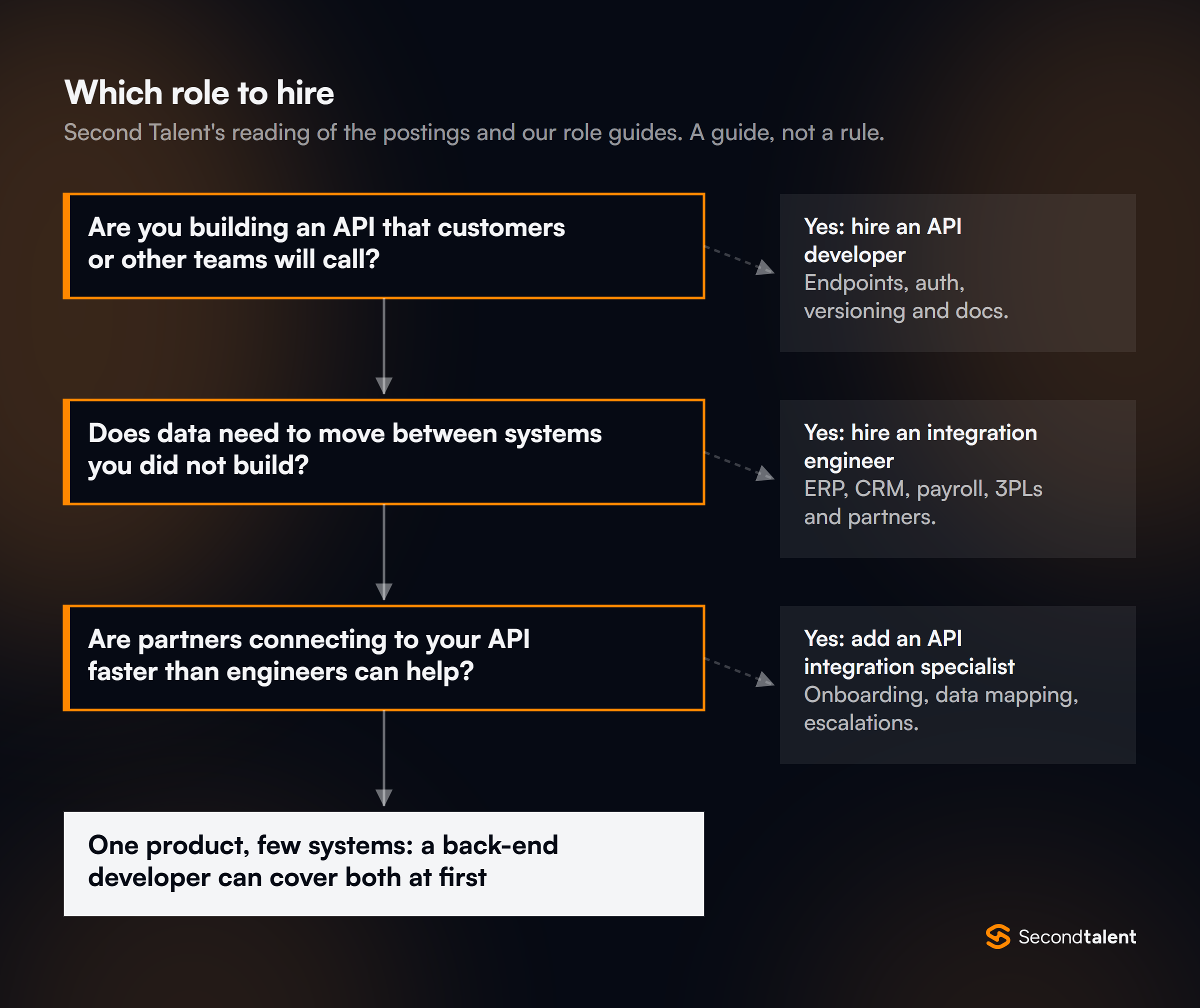
Early on, one back-end engineer often does both halves. Our API developer and integration engineer guides list the same core skills: REST, OAuth, SQL and message queues. The split pays off once the number of connected systems grows, and MuleSoft's average rose from 897 apps to 957 in a year.
Hire API and integration engineers from Asia
We match you with vetted API developers and back-end engineers for integration work in 24 hours, at 50-70% below US cost, with a 90-day, one-time replacement guarantee. We employ them through our own EOR in 9 Asian markets, including the Philippines and Vietnam.
Our monthly plan is $4,999 a month for a senior engineer, all-inclusive. Tell us which systems you need connected and we will send a shortlist.
Frequently Asked Questions
Is an integration engineer a back-end developer?
In most teams, yes. Both write server-side code, and our cost guides price them the same. The integration engineer spends more time on other companies' systems: mappings, retries, iPaaS flows and EDI.
Do API integration specialists write code?
Some of them do. Samsara's solutions integration engineers write Python against REST APIs and webhooks. DoorDash's partner integrations specialist leans on technical fluency and partner management more than code.
Will iPaaS tools replace integration engineers?
The postings say no. OpenAI asks for hands-on use of two integration platforms and Python as a primary language in the same role. MuleSoft's 2026 report still found IT teams spending 36% of their time on custom integrations.