TL;DR: A lead engineer runs the technical work of one team, a staff engineer sets technical direction across several teams, and a principal engineer owns direction for a whole org or company. Staff and principal are rungs on the individual contributor ladder, while lead is usually a role inside a team. Levels.fyi puts reported US total pay at Google at $756K for Staff (L6) and $1.16M for Principal (L8).
Amazon gives the title Principal SDE to its L7 engineers, and their reported US pay on Levels.fyi is $642K a year. That is less than Google pays the level it calls Staff, which sits below its own Principal rung.
I lined up the ladders of Google, Meta, Amazon and Dropbox on October 5, 2026, and the titles matched far less well than the scope descriptions did.
- 1Will Larson counts the Tech Lead as the most common staff archetype, at roughly one for every eight engineers.
- 2His rarest archetype, the Right Hand, shows up only once an organization reaches hundreds of engineers.
- 3Dropbox's public framework names three IC titles above IC4: Staff, Principal and Senior Principal Software Engineer.
- 4At Google's Principal level, $699K of reported first-year pay is stock, against $375K of base salary.
What is the difference between a principal, staff and lead engineer?
A lead engineer runs the technical work of one team: planning, task breakdown, code review standards and team-level decisions. A staff engineer is an individual contributor above senior who sets technical direction across several teams.
A principal engineer sits above staff and owns technical direction for an org or the whole company.
The clearest public wording comes from Dropbox. Its IC5 Staff Software Engineer page opens: "I set the multi-year, multi-team technical strategy and deliver it through direct implementation or broad technical leadership."
Its IC6 Principal page moves the unit from teams to the company: "I own and deliver org/company-wide multi-year, multi-team goals."
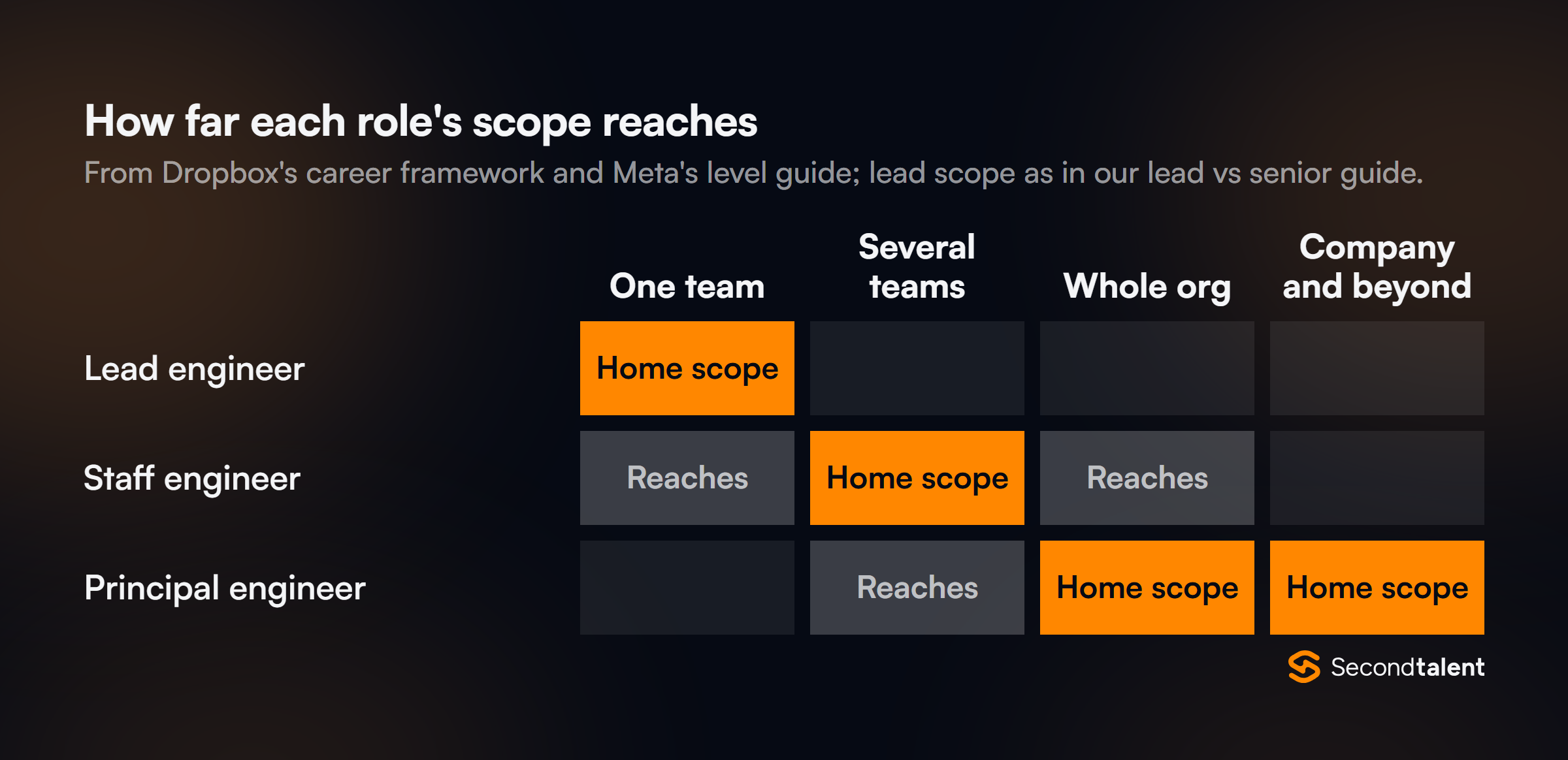
Meta draws the same line with different words. In a level guide by Alex Rashkov, a senior engineering manager at Meta, the two levels read like this:
- "A critical role in setting the direction and goals of the team" (Meta)
- Delivers "multi-year, multi-team product or platform goals" (Dropbox)
- Increasingly influences "the roadmaps of other Dropbox teams"
- "Impact beyond Meta into an industry or specific technology area" (Meta)
- Delivers against "a strategic company-level business objective" (Dropbox)
- Takes "a multi-year, industry-leading perspective"
Between the two, Meta has an E7 Senior Staff level for "large programs spanning multiple teams and orgs". Google has the same rung at L7. So a principal at these two companies is two promotions above staff, not one.
Lead engineer: one team's technical work
The lead engineer is the one role of the three that most companies hire into a team rather than promote into a level.
Lead engineers break projects into tasks, assign work, run technical planning and make the final call on team-level decisions. They also mentor engineers and keep the team unblocked.
The chips above come from our lead engineer vs senior engineer guide, which covers the step below this post. That guide puts the first lead hire at four to six engineers.
It also has leads coding 30 to 50% of their week, against 70 to 80% for a senior engineer.
Larson's Tech Lead archetype overlaps with this job. His Tech Lead "guides the approach and execution of a particular team" and is "the first person called when the roadmap needs to be shuffled."
The difference is level. A staff-level tech lead often leads "a cluster of teams" and partners with one, two or three managers. A lead engineer at a small startup leads one team and may manage it as well.
Titles blur here more than anywhere else. "Lead" can mean a manager with direct reports, a senior engineer with a coordinator's job, or a staff engineer acting as tech lead.
In a job description with "lead" in the title, I look at the reporting line and the team count before the word itself.
Staff engineer: four archetypes
Staff engineers do four different jobs under one title. Will Larson, author of the guides on StaffEng, groups them into four archetypes: Tech Lead, Architect, Solver and Right Hand.
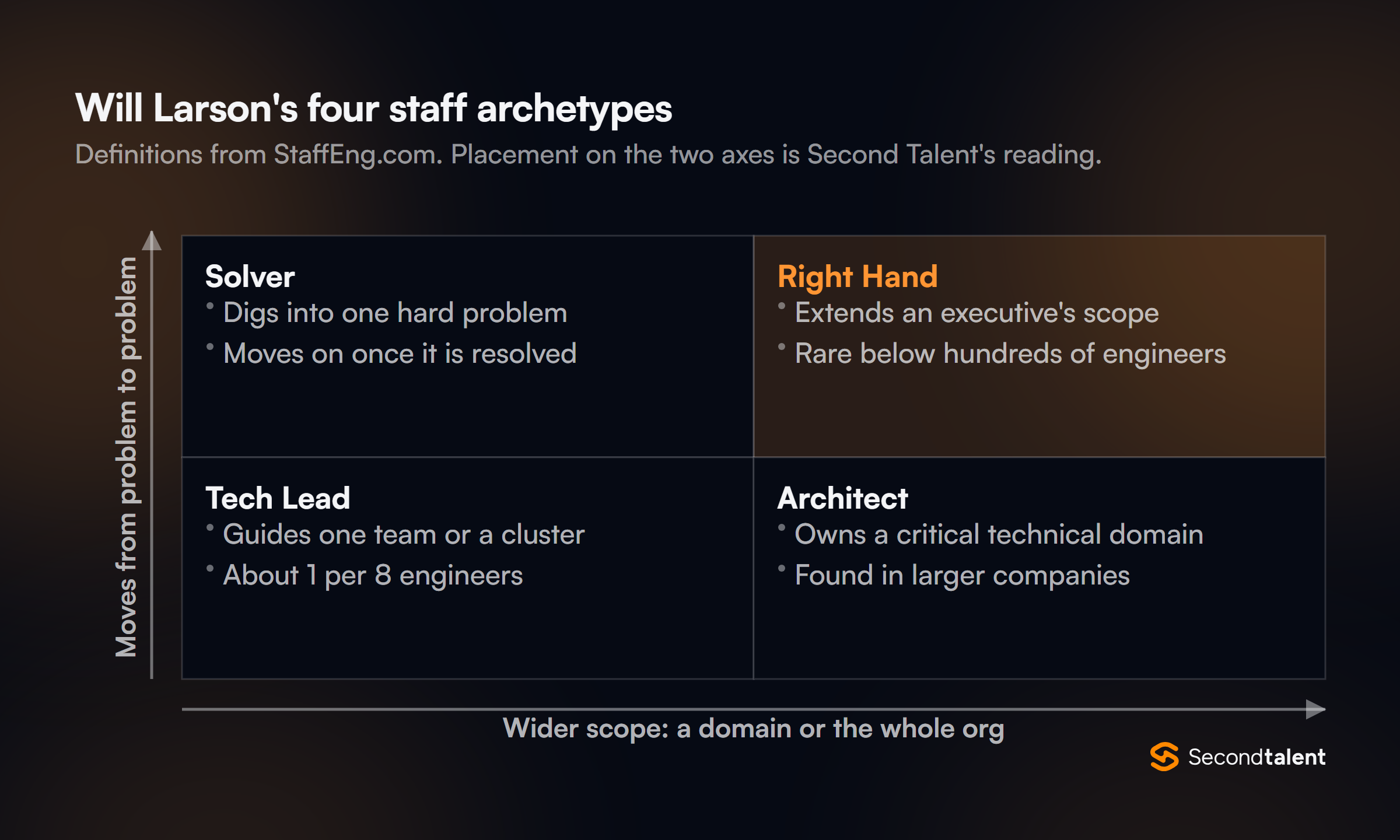
- Tech Lead. Guides one team or a cluster. The most common archetype, at about one per eight engineers.
- Architect. "Responsible for the direction, quality, and approach within a critical area." Larson says the domain "must be both complex and enduringly central" to justify one.
- Solver. "Digs deep into arbitrarily complex problems and finds an appropriate path forward," then moves to the next one. Most common where individuals, not teams, are the unit of planning.
- Right Hand. "Extends an executive's attention, borrowing their scope and authority." The rarest of the four.
The archetype decides who you need. A team of 30 with one tangled payments system needs an architect. A company that keeps hitting performance fires needs a solver.
Architect work often lines up with roles we profile on their own, such as the solutions architect, the microservices architect and the platform engineer.
Code still matters at this level, but less of it is theirs. Larson's guide to what staff engineers do says they keep "building relationships, writing software, coordinating projects", but as auxiliary tasks.
The core work becomes setting direction, mentoring and sponsorship, and adding "the engineering context and perspective into a decision while it's still possible."
Principal engineer: the org or the company
A principal engineer owns the technical bets that outlast a single roadmap. Dropbox's IC6 page asks for products that "adapt to scale, usage, and/or business needs well beyond Dropbox's current scope."
Meta's E8 bar is "an impact beyond Meta into an industry or specific technology area."
Amazon publishes how its principals are meant to behave. Its Principal Engineering Community Tenets start with one line of definition:
"As Amazon's most senior individual contributors, principal engineers work on our company's hardest problems."
Amazon, Principal Engineering Community Tenets
Nine tenets follow, from "Exemplary practitioner" and "Technically fearless" to "Respect what came before" and "Have resounding impact".
Several are about influence rather than output: "Illuminate and clarify", "Learn, educate, and advocate" and "Lead with empathy".
IC track vs management track
Staff and principal are the individual contributor answer to engineering management.
Dropbox publishes both ladders side by side, and an engineer above the senior rung picks between leading through code and design or leading through reports.
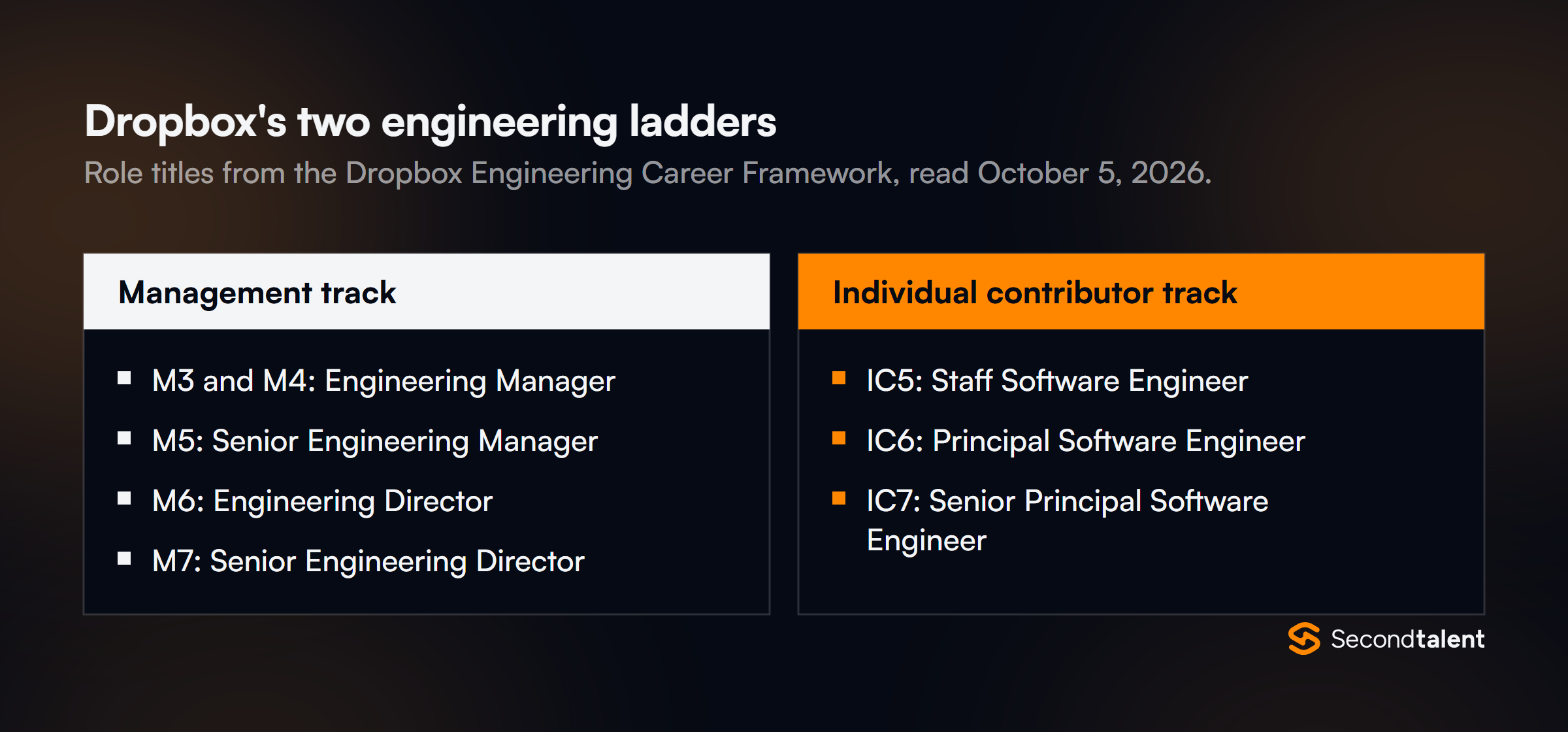
Dropbox's career framework publishes both ladders in full: IC1 to IC7 for engineers and M3 to M7 for managers. It calls itself "not a promotion checklist" and measures each level on business impact, scope and reach.
The lead engineer sits on the line between the two. Some companies treat it as the first management step, others as a senior IC with coordination duties.
Charity Majors, co-founder and CTO of Honeycomb, argued in 2017 that the move into management is a change of job, not a step up:
"Management is NOT a promotion. Management is a change of profession."
Charity Majors, The Engineer/Manager Pendulum, May 11, 2017
She also wrote that "the best individual contributors are the ones who have done time in management." Larson's Right Hand archetype is the IC role closest to that experience.
It borrows an executive's authority without taking on their reports.
How the levels map at Google, Meta, Amazon and Dropbox
The same title sits at different heights at each company. Google and Meta put Principal three rungs above Senior. Amazon puts Principal SDE one rung above SDE III, its senior level.
| Company | Senior rung | One up | Two up | Three up |
|---|---|---|---|---|
| L5 Senior SWE | L6 Staff SWE | L7 Senior Staff SWE | L8 Principal Engineer | |
| Meta | E5 Senior SWE | E6 Staff SWE | E7 Senior Staff SWE | E8 Principal Engineer |
| Amazon | L6 SDE III | L7 Principal SDE | L8 | L10, the top level on Levels.fyi |
| Dropbox | IC4 Software Engineer | IC5 Staff | IC6 Principal | IC7 Senior Principal |
Pay shows the mismatch better than titles do. On Levels.fyi, Amazon's L7 Principal SDE reports less total pay than Meta's E6 or Google's L6, the two levels both companies call Staff.
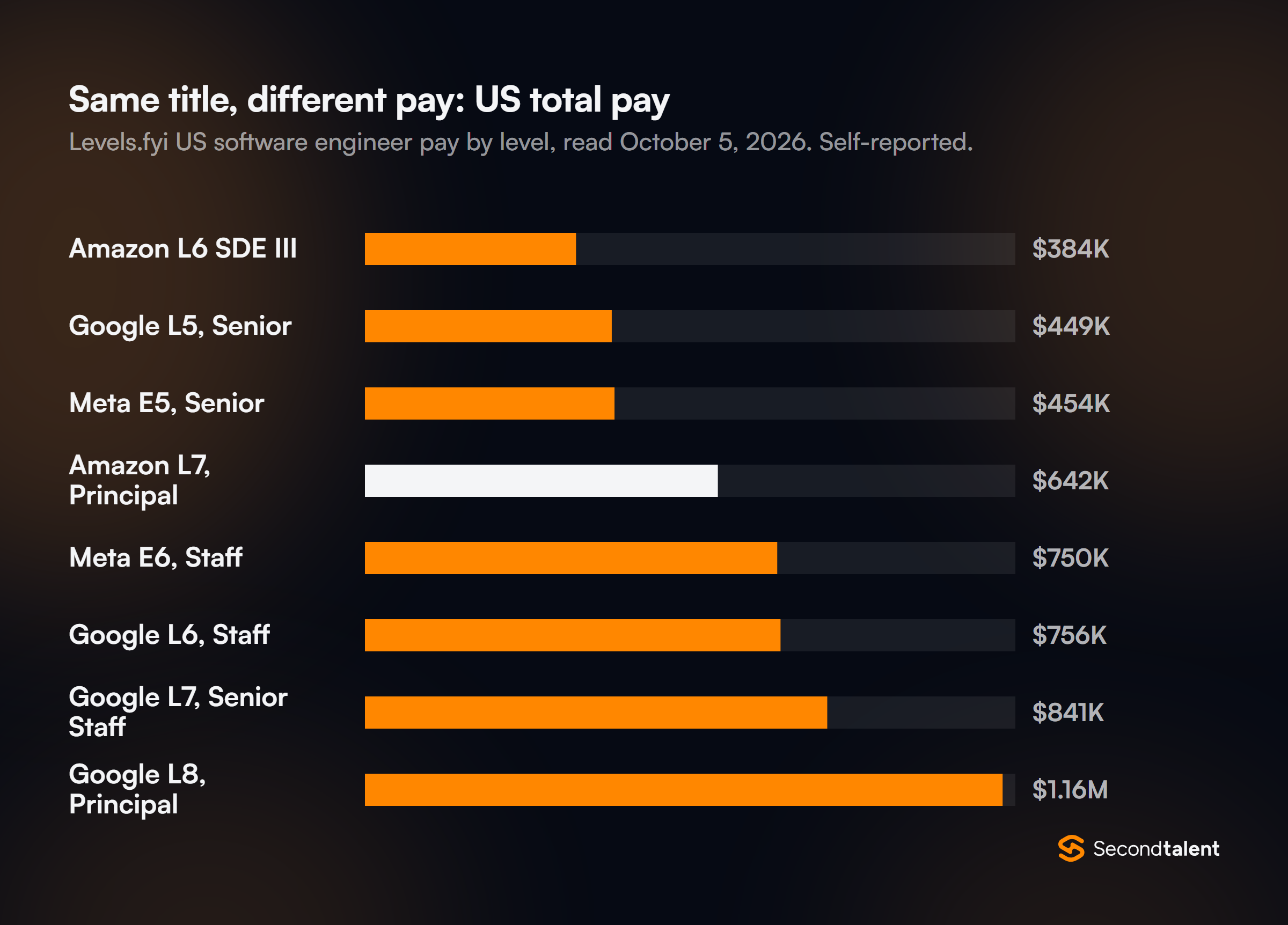
Match on scope, not the word on the offer letter. A Principal SDE from Amazon may have run work the size of a Google Staff or Senior Staff role. A "Principal Engineer" at a 40-person startup may have the scope of a lead engineer.
Pay by level
Stock drives most of the gap between levels. At Google, base salary rises from $233K at Senior to $375K at Principal. First-year stock rises from $183K to $699K over the same four levels.
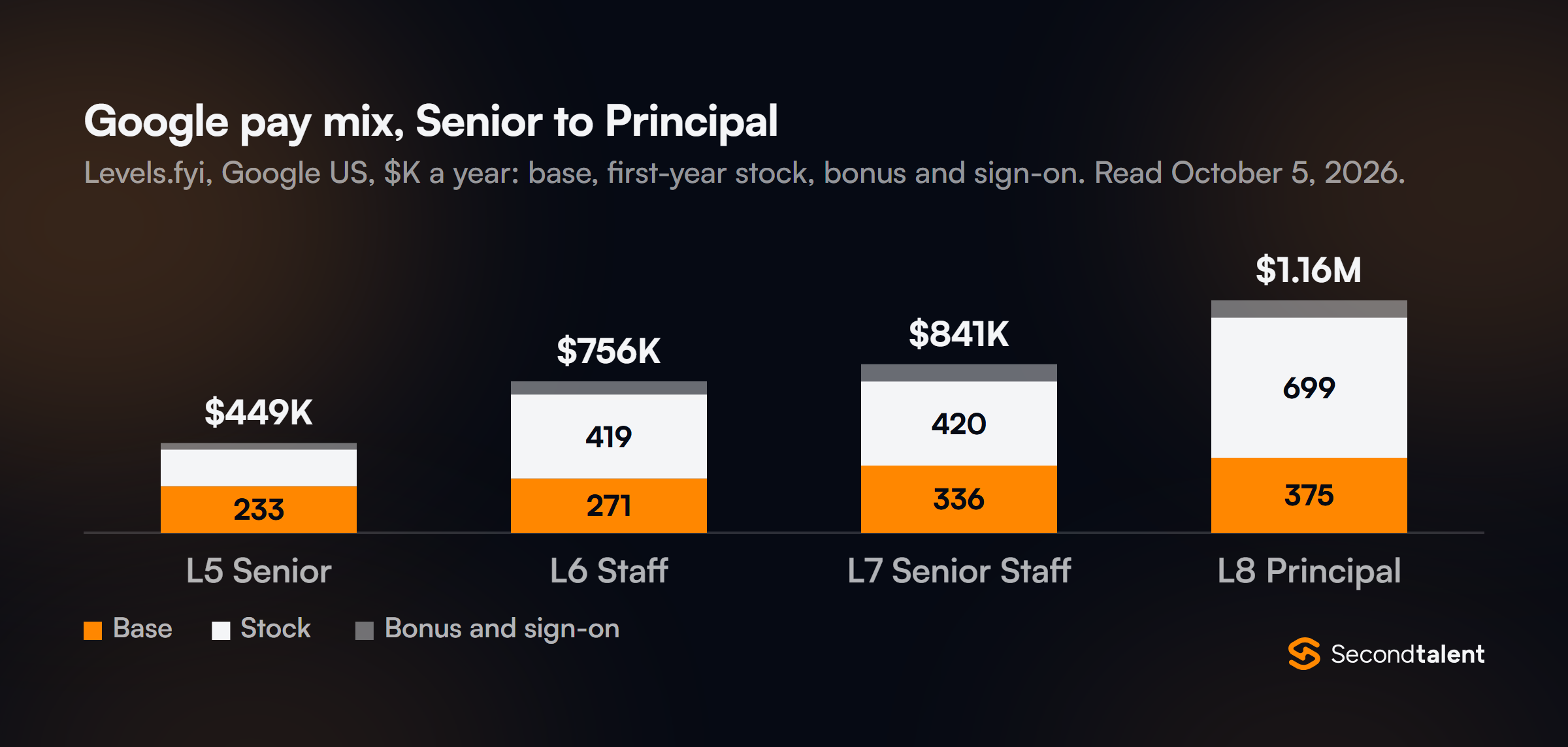
Total pay rises from $449K at L5 to $756K at L6. The L7 Senior Staff step takes it to $841K. The largest single jump, to $1.16M, comes at the L8 Principal level.
Meta's E5 and E6 levels sit within a few thousand dollars of Google's: $454K and $750K. Lead engineer has no line here, since none of the four ladders above uses it as a level title.
Outside the US, our Asia Tech Salary Index and our ranking of the countries with the highest software engineer salaries show how far these numbers fall by market.
Which level does your team need?
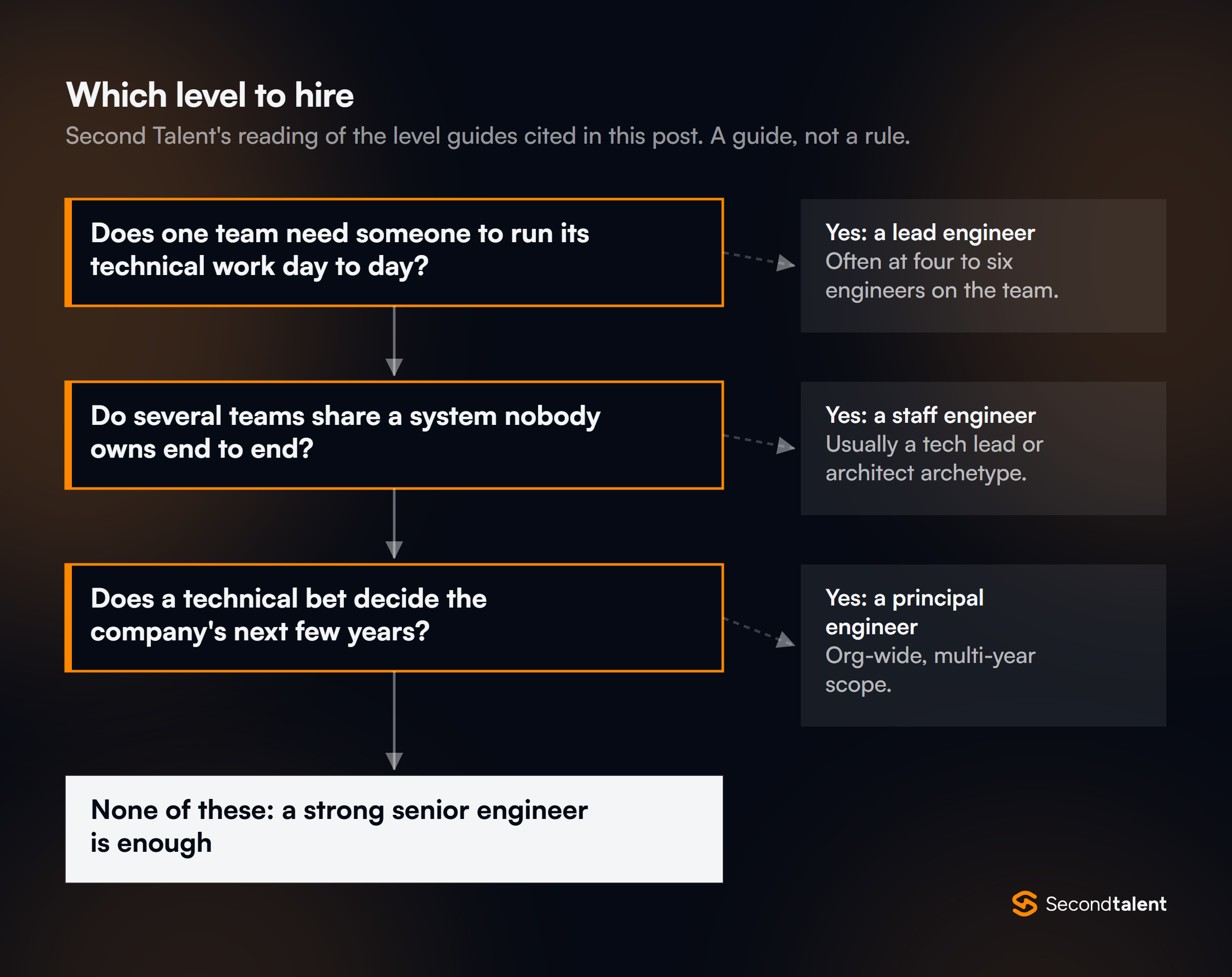
Hire for the scope of the problem, not the title. A lead engineer fits when one team lacks day-to-day technical ownership. A staff engineer fits when several teams depend on a system that no single team owns.
A principal fits when one technical decision will shape the company for years.
Company size sets a ceiling. Larson places the Architect in "relatively large companies" and the Right Hand at hundreds of engineers.
A startup with two teams has little staff-level scope to offer, and a principal hired there tends to end up doing a lead's job at a principal's price.
Whichever level you pick, write down what success looks like before the search starts. Our list of engineering productivity metrics covers the team-level measures a lead or staff engineer owns.
Hire senior engineers and architects from Asia
Most teams need the lead or architect-style staff engineer long before a principal.
Second Talent matches you with vetted senior engineers and software architects in 24 hours, at 50-70% below US cost, with a 90-day, one-time replacement guarantee.
We employ them through our own EOR in 9 Asian markets, including Vietnam, the Philippines and Singapore.
Our monthly plan is $4,999 a month for a senior engineer, all-inclusive. Tell us the scope of the role and we will send a shortlist.
Frequently Asked Questions
Do staff engineers manage engineers?
Not as direct reports, in the frameworks cited here. Staff sits on the individual contributor ladder at Google, Meta and Dropbox. Staff engineers lead through design, mentoring and sponsorship.
Is a lead engineer the same as an engineering manager?
Sometimes. At small companies the lead often manages the team as well.
In companies that split the jobs, the lead owns technical work and partners with the manager, the way Larson describes a staff Tech Lead working with one to three managers.
Can a senior engineer skip to principal?
At Google and Meta it takes three promotions: Staff, Senior Staff, then Principal. Titles shift between companies, though. Amazon's Principal SDE sits one rung above its senior level.