











Skip to content

MLOps Engineer vs Machine Learning Engineer: Roles, Skills, Pay and Which to Hire First

Matt Li By Matt Li, Co-Founder and Director 10 min read
MLOps Engineer vs ML Engineer, a Second Talent comparison of the two machine learning roles.
TL;DR: A machine learning engineer builds, trains and ships the model; an MLOps engineer builds and runs the pipelines, serving and monitoring that keep models working after launch. In Stack Overflow's 2025 survey, US AI/ML engineers reported $189,500 in median pay, against $165,000 for DevOps professionals, the closest listed type to MLOps. Hire the ML engineer first, and add MLOps once several models need retraining and watching.

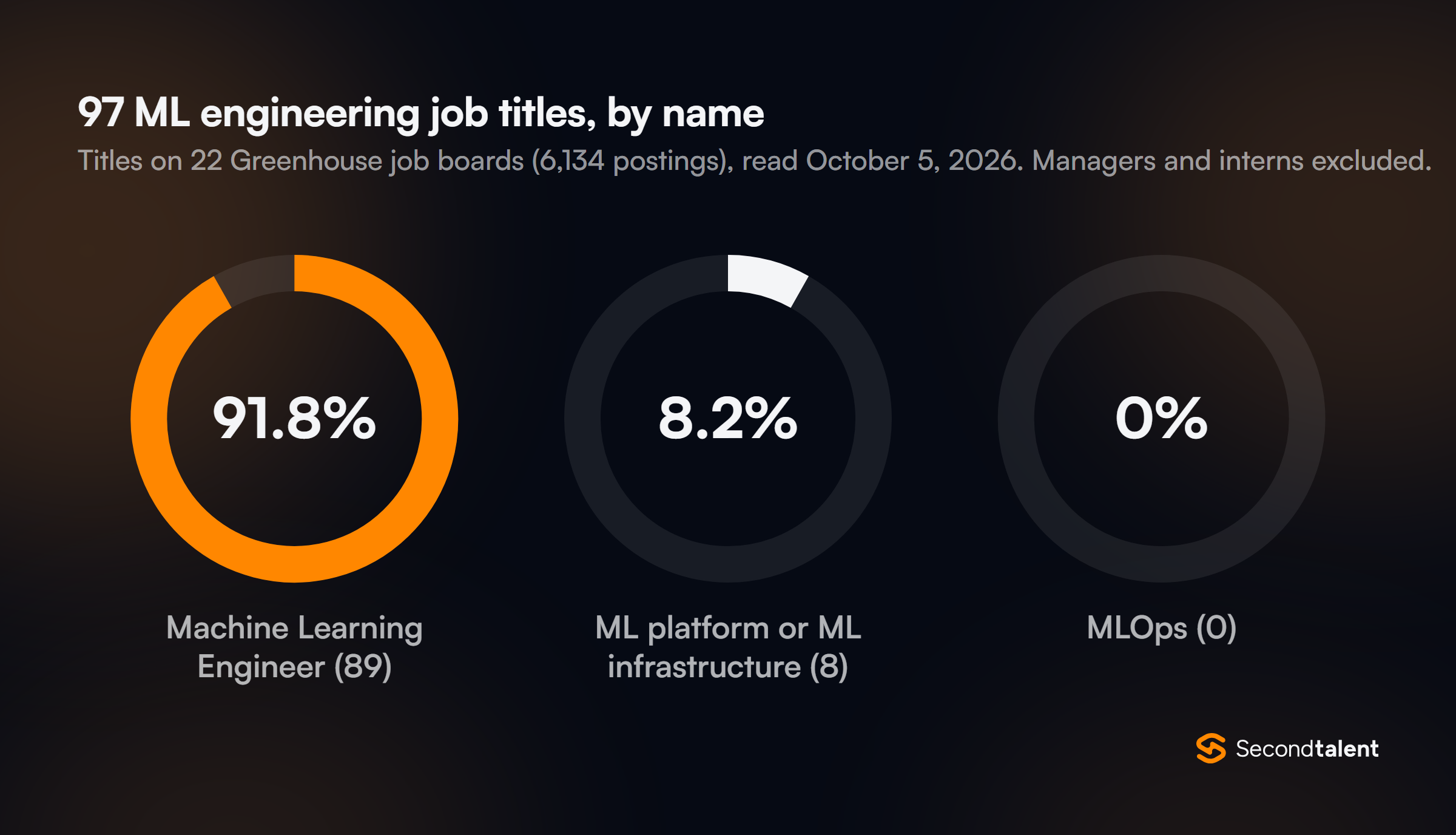
I counted the job titles on 22 Greenhouse job boards on October 5, 2026, from Airbnb and Reddit to Stripe and Coinbase. Out of 6,134 open postings, 89 carried the title Machine Learning Engineer and not one said MLOps.

The same companies still hired for MLOps work under other names: eight postings for ML platform or ML infrastructure engineers.

Key takeaways
  1. 1Google's MLOps guide says a team with no MLOps practice deploys a new model version only a couple of times per year.
  2. 2AWS's ML Engineer Associate exam puts 48% of its scored content on deploying, orchestrating, operating and monitoring models.
  3. 3Coinbase's senior ML platform posting asks for 5+ years as a software engineer, and only enough ML to partner with the ML engineers it serves.
  4. 4Reddit's ML engineer posting folds the MLOps duties in: monitoring, observability and automated retraining belong to the ML engineer.
What is the difference between an MLOps engineer and a machine learning engineer?

A machine learning engineer turns a business problem into a working model: features, training, evaluation and the code that puts predictions into a product.

An MLOps engineer builds the system that trains, ships, serves and watches those models over and over. The ML engineer owns the model. The MLOps engineer owns the path each model takes to production and back.

Machine learning engineer
  • Frames the problem and picks the model
  • Builds features, trains and evaluates
  • Runs experiments against product KPIs
  • Measured on model quality and business lift
MLOps engineer
  • Builds training and deployment pipelines
  • Runs serving, feature stores and model registries
  • Monitors drift, latency and cost
  • Measured on uptime and release speed

Google's architecture guide calls MLOps "an ML engineering culture and practice that aims at unifying ML system development (Dev) and ML system operation (Ops)." So MLOps grew out of ML engineering.

It became a separate job when the operations half got too big for the model builders to carry.

The same Google MLOps guide describes what happens without that split. In a manual setup, it says, "the data scientists hand over a trained model as an artifact to the engineering team to deploy on their API infrastructure."

Our MLOps engineer role guide covers the job on the receiving end.

Where the MLOps job shows up in job titles

The 22 boards I read belong to product companies that run ML at scale, and none of them used the word MLOps in a title. They post the work as ML platform or ML infrastructure engineering:

Three donut charts of 97 ML engineering job titles on 22 Greenhouse job boards on October 5, 2026: Machine Learning Engineer 89 (91.8%), ML platform or ML infrastructure 8 (8.2%), MLOps 0 (0%).

The eight platform postings came from Stripe, Coinbase, Reddit, Pinterest, Samsara and Anthropic. Samsara titles its role "Lead Machine Learning Engineer - ML Infrastructure", so even the platform role can carry the ML engineer title.

Reddit and Pinterest posted 16 and 15 ML engineer roles, against one platform role each.

How the count was made. I pulled every open posting from each company's public Greenhouse board on October 5, 2026 and matched titles. "Machine Learning Engineer" excludes managers, directors and interns. Titles such as "Software Engineer, Machine Learning" were left out of both groups.

A search for "MLOps engineer" will therefore miss most of the market at companies like these. Look for "ML platform", "ML infrastructure" and "ML systems" too. Weighing the platform title against the MLOps one?

Our comparison of ML infrastructure engineers and MLOps engineers covers that pair. The ML infrastructure engineer role guide describes the job.

Responsibilities: who owns which part of the lifecycle

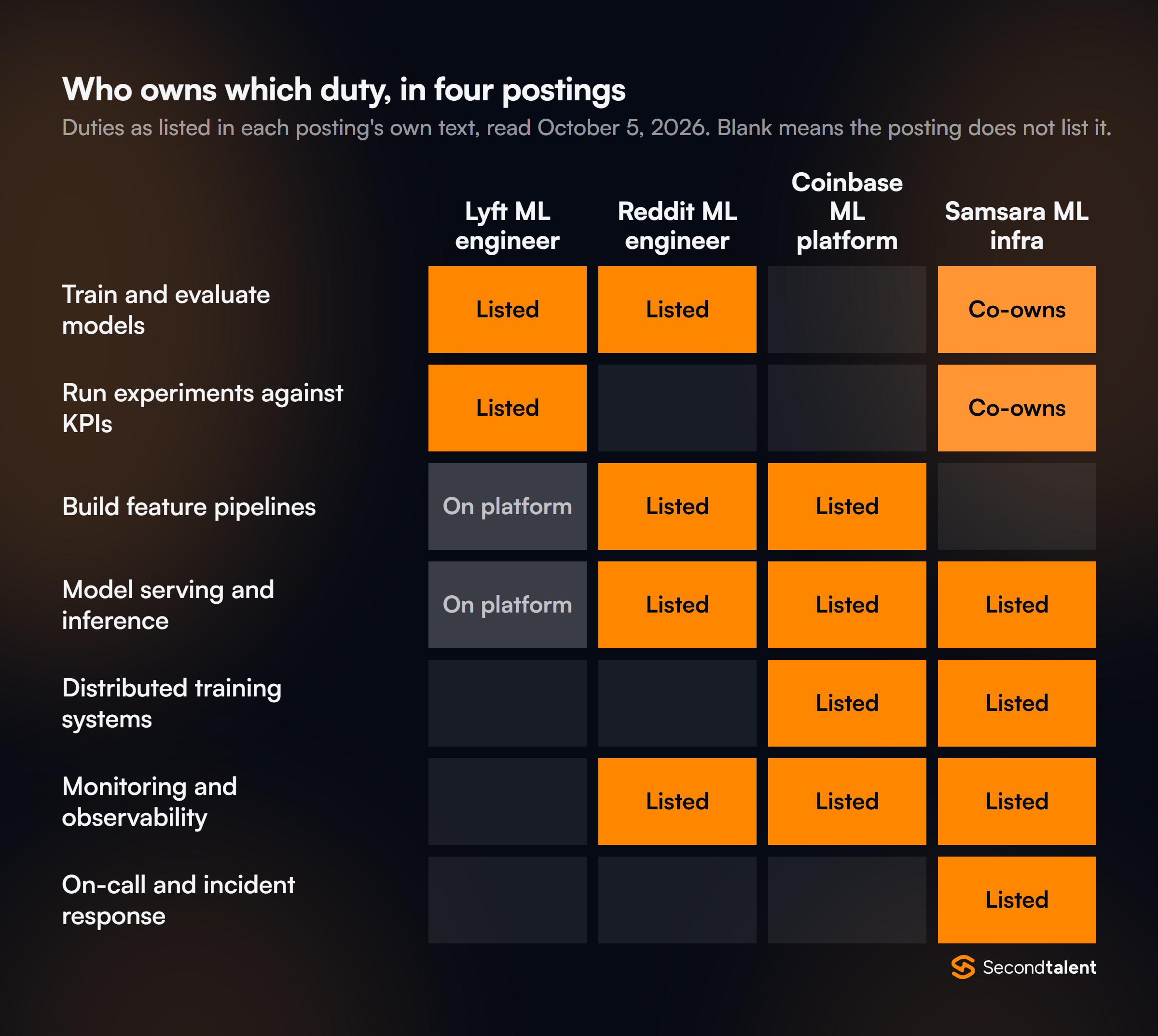
The line moves with the size of the platform team. I read the duty lists of four postings: two ML engineer roles and two platform roles. They split the lifecycle like this:

Heatmap of duties listed in four postings. Lyft ML engineer: trains models and runs KPI experiments, builds pipelines and serving on Lyft's platform. Reddit ML engineer: training, pipelines, serving, monitoring. Coinbase ML platform: pipelines, serving, distributed training, monitoring. Samsara ML infrastructure: serving, training systems, monitoring and on-call, co-owns modeling and outcomes.

Lyft's ML engineer posting asks for feature pipelines, training workflows and serving "using Lyft's ML platform". Someone else built the platform.

Lyft judges the engineer on models: "Evaluate ML system performance against business KPIs, run experiments, and drive continuous model improvement."

Reddit's senior ML engineer posting goes the other way. Its engineers "own the full ML lifecycle", from problem definition to deployment and monitoring.

They also build pipelines "with strong reliability, observability, and automated retraining". At Reddit, the ML engineer does a share of what a dedicated MLOps hire would do elsewhere.

The platform roles start from the opposite end. Coinbase's senior ML platform engineer owns inference infrastructure for "both predictive models and LLMs", streaming feature pipelines and distributed training. Its customers are internal:

"Drive improvements to distributed training infrastructure, enabling ML engineers to process large data volumes efficiently."

Coinbase, Senior Machine Learning Platform Engineer posting, read October 5, 2026

Samsara's ML infrastructure lead adds the one duty no ML engineer posting listed: "on-call practices, incident response, and infrastructure hardening".

The platform behind it spans training, inference and edge deployment across more than 2 million devices.

When MLOps becomes its own job

Google's guide splits MLOps into three levels. Each level adds work that someone has to own.

Level 0Manual
Script-driven
Every step is manual. A new model version ships "only a couple of times per year"
Level 1Pipeline automation
Continuous training
The pipeline retrains the model on new data and ships it to serving
Level 2CI/CD automation
Pipelines as code
Changes to the pipeline itself are built, tested and deployed automatically
Source: Google Cloud, MLOps: Continuous delivery and automation pipelines in machine learning.

Level 1 is where the ML engineer's job and the MLOps engineer's job separate. Google defines continuous training as "a new property, unique to ML systems, that's concerned with automatically retraining and serving the models."

Normal software CI/CD does not include it, so the owner needs to know both the pipeline and the model.

Google researchers named the cost of skipping it a decade ago. Their NeurIPS 2015 paper, Hidden Technical Debt in Machine Learning Systems, warns that "it is common to incur massive ongoing maintenance costs in real-world ML systems."

Google's guide makes the same point: only a small fraction of a real ML system is ML code.

The work keeps moving. Our LLMOps engineer guide covers the newer variant for teams running hosted language models. There the job is prompts, evals and provider costs, not retraining.

Skills and background

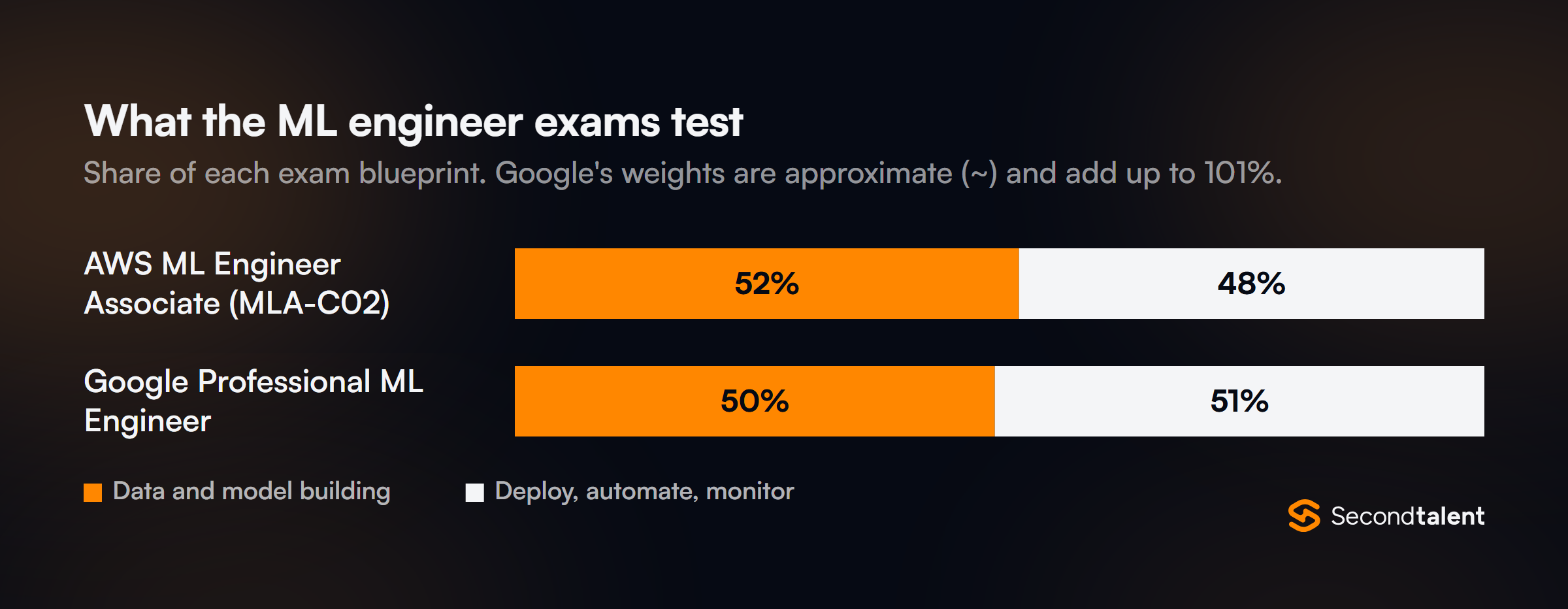
The cloud vendors' own ML engineer exams show how much the two jobs overlap. Both AWS and Google spend about half of their ML engineer certification on operations:

Stacked bar chart of exam blueprints. AWS ML Engineer Associate MLA-C02: 52% data and model building, 48% deploy, automate and monitor. Google Professional ML Engineer: about 50% and 51%.

The AWS MLA-C02 exam guide splits its scored content 28% data preparation, 24% model development, 24% deployment and orchestration and 24% operating, monitoring and security.

Google's Professional ML Engineer guide says its engineer is proficient in "model architecture, data and ML pipeline creation, MLOps, and metrics interpretation."

So the two roles differ in depth more than in topic. An ML engineer needs enough MLOps to ship. An MLOps engineer needs enough ML to know when a model is failing.

Samsara's lead posting asks for "ML fundamentals beyond pipelines: evaluation methodology, dataset design, ablation, drift."

Coinbase asks for ML platform knowledge "sufficient to partner effectively with ML engineers as a platform builder."

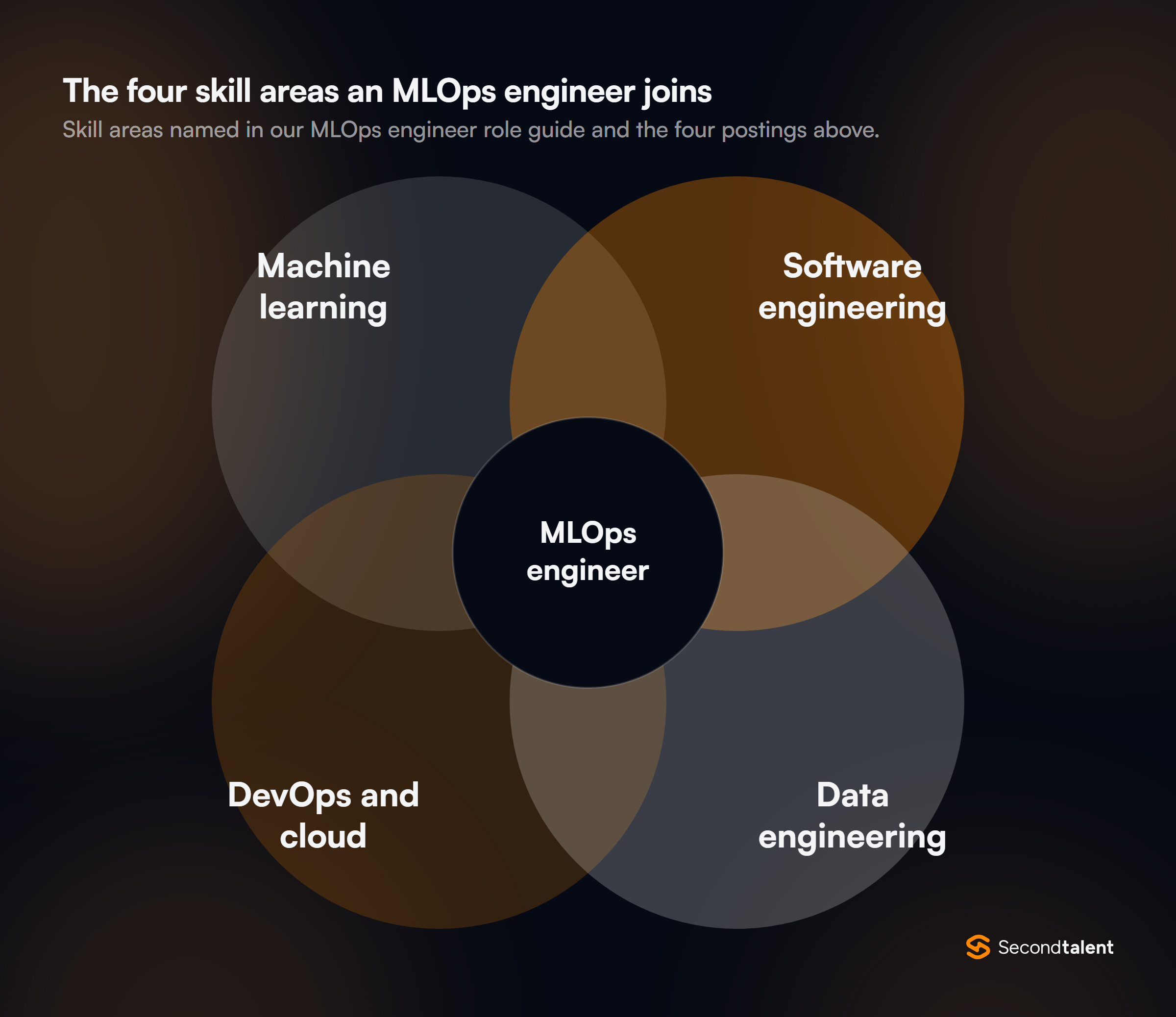
The MLOps engineer draws on four skill areas at once:

Venn diagram of the MLOps engineer at the overlap of four skill areas: machine learning, software engineering, DevOps and cloud, and data engineering.

The tools follow the split. Lyft's ML engineer posting names TensorFlow and PyTorch, and Google's exam adds notebooks and experiment tracking. MLOps engineers run Kubernetes, Ray, Spark, model registries and CI/CD systems.

Samsara's posting asks for "hands-on Ray and Kubernetes expertise in production." MLflow sits between the two, and its project site reports more than 30 million package downloads a month.

Backgrounds overlap as well. AWS names four related roles for its ML engineer exam candidates: backend software developer, DevOps developer, data engineer and data scientist.

Our MLOps role guide maps the common route as DevOps engineer to MLOps engineer, which our DevOps engineer guide covers from the other side. To test each role, start from our ML system design questions for serving and pipelines.

Pay: what the survey and the postings show

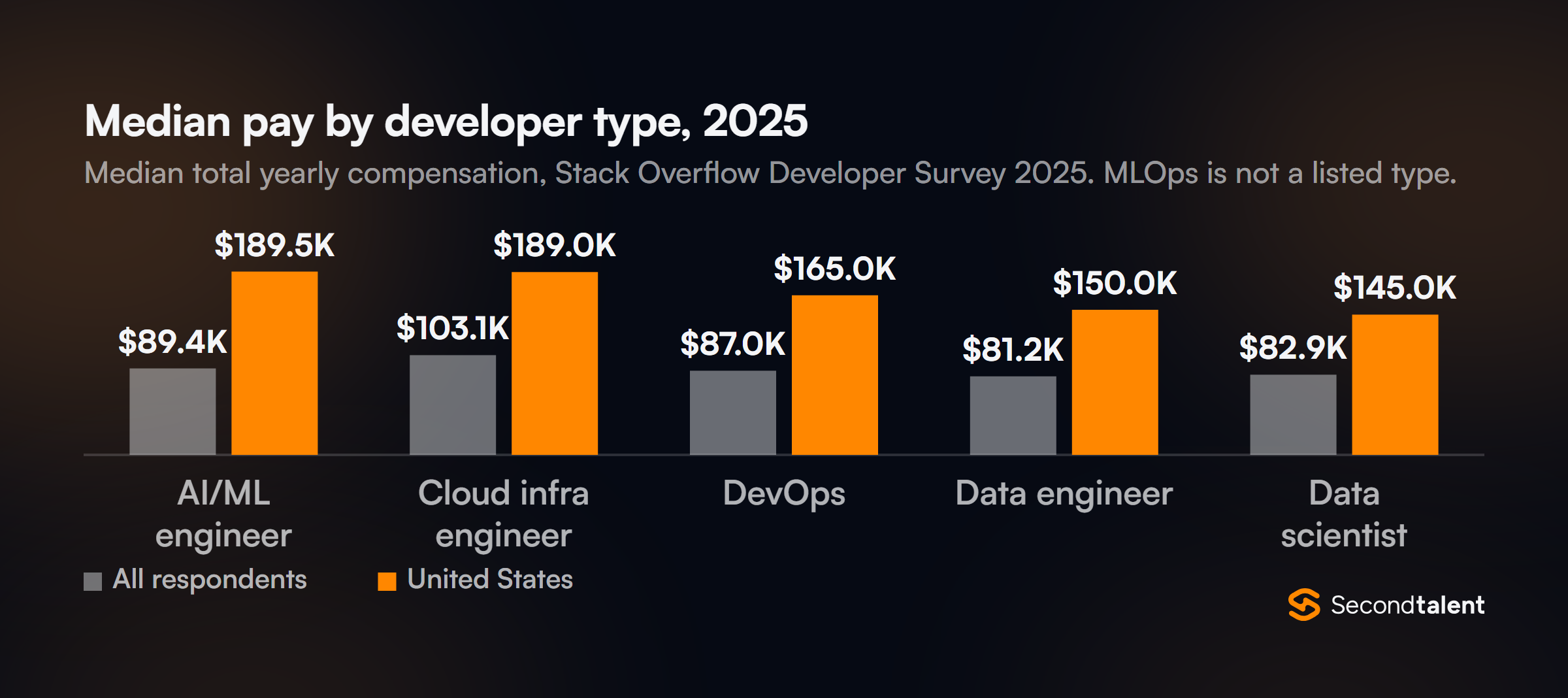
No large salary survey lists MLOps as its own job. Stack Overflow's 2025 survey comes closest, with separate types for AI/ML engineers, DevOps professionals and cloud infrastructure engineers:

Grouped column chart of Stack Overflow 2025 median total pay, all respondents and US: AI/ML engineer $89.4K and $189.5K, cloud infrastructure engineer $103.1K and $189.0K, DevOps $87.0K and $165.0K, data engineer $81.2K and $150.0K, data scientist $82.9K and $145.0K.

In the US, the Stack Overflow Developer Survey 2025 puts AI/ML engineers at $189,500 median total pay and cloud infrastructure engineers at $189,000.

An MLOps engineer sits between the ML and infrastructure types, and those two medians are $500 apart. Worldwide, cloud infrastructure engineers out-earn AI/ML engineers, about $103,100 to $89,427.

Posted base ranges tell the same story. Pay follows level more than title:

Posting (US)TypeExperience askedPosted base range
Lyft, ML Engineer, Fulfillment (SF)ML engineer2+ years$140,800 to $176,000
Samsara, Senior ML Engineer (remote)ML engineer6+ years$170,170 to $286,000
Reddit, Senior ML Engineer (remote)ML engineer5+ years$216,700 to $303,400
Coinbase, Senior ML Platform Engineer (remote)Platform5+ years$191,250 to $225,000
Samsara, Lead ML Engineer, ML Infrastructure (remote)Platform10+ years$200,200 to $357,500
Base salary before equity and bonus, from each company's own posting, read October 5, 2026.

Within one company the pattern holds. Samsara's platform lead tops out $71,500 above its senior ML engineer, but the lead posting asks for 10+ years against 6+.

At the senior level, Coinbase's platform range overlaps Reddit's ML engineer range, with the same 5+ years asked. Our MLOps engineer cost guide and ML engineer cost guide compare hourly rates across markets.

Which one to hire first

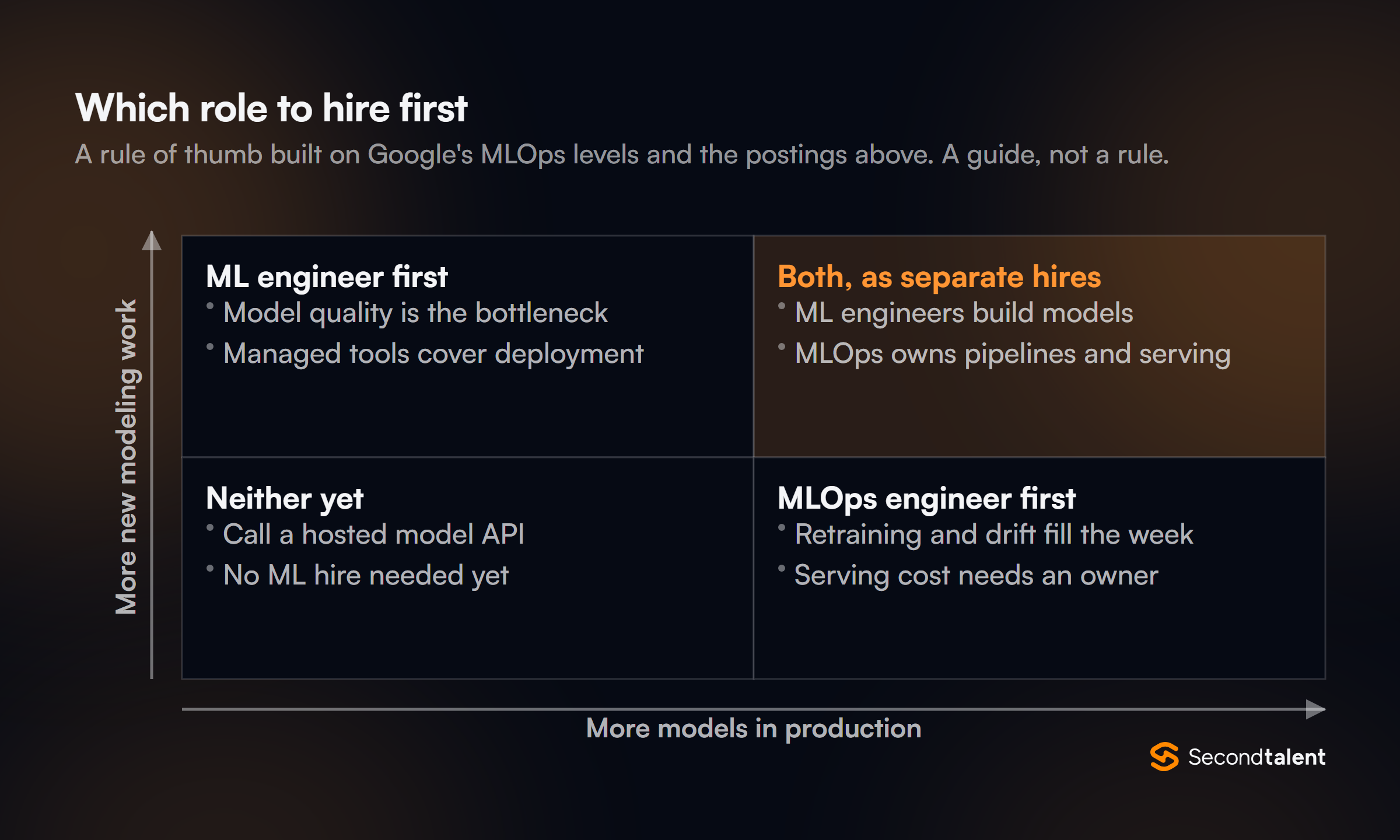
Hire the ML engineer first when the model does not exist yet or is not good enough. Hire MLOps first when the models work but retraining, drift and serving costs are eating the team's week. The matrix below sets out the four cases:

Two-by-two matrix for which role to hire first, by models in production and new modeling work: ML engineer first when modeling is the bottleneck, MLOps engineer first when retraining and serving dominate, both when there is a lot of each, neither yet when a hosted model API will do.

Google's Rules of Machine Learning makes the case for paying attention to infrastructure early. Rule #4 reads: "Keep the first model simple and get the infrastructure right."

Its author, Martin Zinkevich, adds that "you will run into many more infrastructure issues than you expect."

For a first hire, that points to an ML engineer who can ship as well as model: the Reddit profile. The separate MLOps hire pays off at Google's level 1, once retraining has to run without a person kicking it off.

A third option sits between them: an ML model deployment engineer, who handles the path to production without owning a whole platform.

Hire machine learning engineers from Asia

Second Talent matches you with vetted machine learning engineers in 24 hours. Our engineers cost 50-70% below US rates, with a 90-day, one-time replacement guarantee.

We employ them through our own EOR in 9 Asian markets, including Vietnam and the Philippines. Local pay bands are in our Vietnam and Philippines ML engineer rate cards.

Our Monthly plan starts at $25 USD/hr (billed monthly) for a senior engineer, all-inclusive. Tell us which models you are running and we will send a shortlist.

Frequently Asked Questions

Is MLOps part of machine learning engineering?

Yes, by Google's definition: MLOps is "an ML engineering culture and practice". In a small team the ML engineer does it. It becomes a separate role once pipelines, serving and monitoring need a full-time owner.

Is an MLOps engineer just a DevOps engineer for ML?

No, though the two overlap. Google's guide lists what ML adds to normal software delivery: data validation, model validation and continuous training.

A DevOps engineer brings the CI/CD and infrastructure half, then has to learn drift, retraining and model evaluation.

Can one engineer do both jobs?

With one or two models on managed tools, one engineer often can. Reddit's posting asks its ML engineers to own deployment, monitoring and retraining themselves.

Past that point, companies such as Coinbase, Stripe and Samsara post separate platform roles.

Get developers who ship with AI agents. Starts at $25/Hour.

Start Hiring $0 cost until you hire
Matt Li

Written by

Matt Li is a tech-driven entrepreneur with deep expertise in global talent strategy, digital experience optimization, e-commerce, and Web3 innovation. He is the Co-Founder of Second Talent, a US-based company that connects businesses with top-tier tech professionals worldwide. Since launching the company in 2024, Matt has led its growth by leveraging technology to streamline remote hiring and scale distributed teams. With a background spanning product, operations, and innovation, Matt brings a cross-disciplinary perspective to the evolving digital economy. His work sits at the intersection of global talent, emerging technology, and scalable digital transformation.

More posts by Matt Li →