TL;DR: An infrastructure engineer runs compute, network and storage; a DevOps engineer automates the path to production; a platform engineer turns both into self-service tools for other engineers. On 51 tech-company job boards on October 5, 2026, infrastructure titles outnumbered platform engineer titles five to one, and DevOps was the rarest. Posted base pay overlaps, from $94,300 to $279,000, because companies set pay by level, not title.
Anduril's careers page lists one radar job three times: as DevOps Engineer, as DevOps Engineer, Radar, and as Platform Engineer, Radar. All three postings share one description, word for word, and one pay range, $111,000 to $147,000.
Inside it, Anduril calls the hire a Software Quality Engineer. The overlap runs well beyond Anduril.
- 1Gartner forecast that 80% of large software engineering organizations would have platform engineering teams by 2026, up from 45% in 2022.
- 2DORA's 2025 research found 76% of organizations had a dedicated platform team.
- 3In DORA's 2024 data, teams using an internal platform shipped with 8% lower throughput than teams without one.
- 4Twilio posts its L2 Platform Engineering and L2 Cloud Infrastructure jobs at the same $116,960 to $146,200 base range.
What is the difference between a platform engineer, a DevOps engineer and an infrastructure engineer?
An infrastructure engineer builds and operates the systems software runs on: cloud accounts, clusters, networks, storage and, at some companies, physical hardware. A DevOps engineer automates the path from a code commit to production.
A platform engineer packages infrastructure and delivery tooling into self-service products for the company's own developers.
Think of it as layers. Infrastructure sits at the bottom, and pipelines run on top of it. A platform wraps both, so product teams get a database or a deploy without filing a ticket.
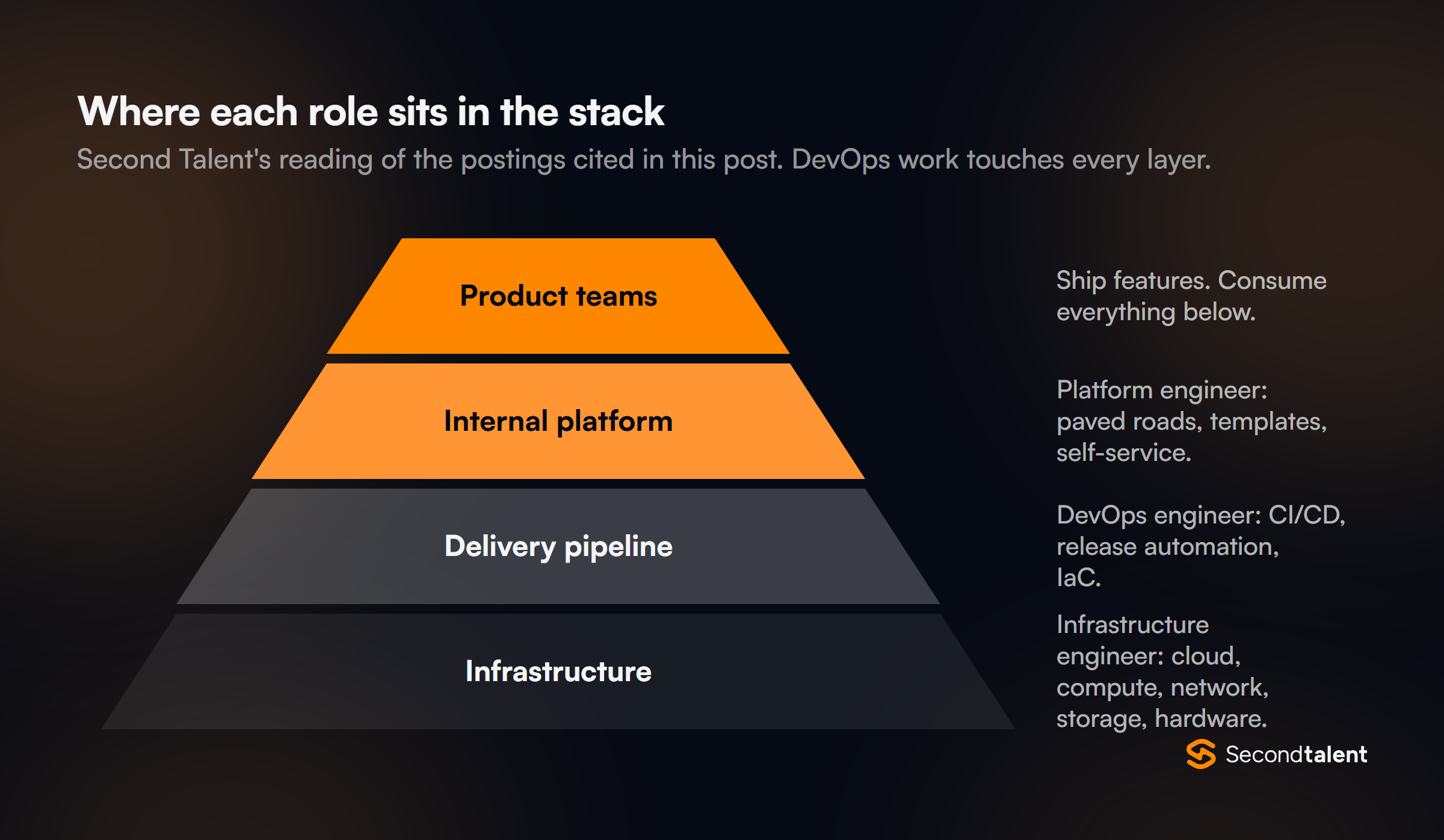
The customer is the clearest dividing line. Infrastructure engineers serve the system: uptime, capacity, cost. DevOps engineers serve the release.
Platform engineers serve other engineers, and the good ones measure success by whether those engineers adopt what they build. Three live postings show the split:
- Run AWS, networking, Kubernetes and observability
- Automate scaling, monitoring and operations
- Build infrastructure as code
- Design and maintain CI/CD pipelines
- Replace manual, disparate deployments
- Build security into all pipeline stages
- Build "paved roads": templates and tooling
- Turn capabilities into reusable abstractions
- Let product engineers focus on shipping
Our role guides for the infrastructure engineer, DevOps engineer and platform engineer cover each job on its own.
Infrastructure engineer: the layer everything runs on
Infrastructure is the oldest of the three jobs and the one closest to the metal.
Cloudflare's Senior Infrastructure Engineer posting covers storage hardware, distributed databases and object storage clusters behind R2, Workers KV and Durable Objects.
The hire validates new storage hardware and plans for failures across multiple failure domains.
Cloud infrastructure jobs work one level above the hardware. Twilio's Cloud Infrastructure engineer builds hardened machine images and EC2 auto scaling groups on AWS. The job also carries an on-call rotation.
Anduril's Infrastructure Engineer, Kubernetes owns the full cluster lifecycle across Google Cloud and bare-metal edge nodes. It also needs a Top Secret clearance.
Infrastructure is also the umbrella the other two often sit under. Chime's infrastructure posting describes an Infrastructure Engineering organization with three sub-teams: Core Infrastructure, Infra Platform and Data Infra.
Platform engineering at Chime is a team inside infrastructure, not a separate department.
DevOps engineer: a practice that became a job title
DevOps started as a conference, not a job. The first devopsdays ran in Ghent, Belgium, in 2009, with Patrick Debois as founder and lead until 2014.
Devopsdays still describes its subject as software development, IT infrastructure operations, "and the intersection between them."
Google compared DevOps with its own model in the SRE book's introduction:
"One could view DevOps as a generalization of several core SRE principles to a wider range of organizations, management structures, and personnel."
Benjamin Treynor Sloss, Site Reliability Engineering, Google
Today's DevOps postings center on the pipeline. Scale AI hired its DevOps Engineer, Infrastructure & Security to move the company "from a state of manual, disparate deployments to a more unified and automated system."
It asks for two to three years of experience and an active TS/SCI clearance. The Anduril posting from the intro is CI/CD for radar software, plus hardware-in-the-loop test rigs.
Site reliability engineering is the close cousin. Google caps SRE operations work at 50%, with the rest spent on engineering. Our site reliability engineer guide covers that role in depth.
Platform engineer: infrastructure run as a product
Platform engineering applies product management to internal tooling. Team Topologies, a 2019 book by Matthew Skelton and Manuel Pais, names four team types.
Its platform team provides "a compelling internal product to accelerate delivery by Stream-aligned teams." The goal is less cognitive load for the teams building features.
The CNCF's platforms white paper, released in April 2023, uses product terms: "A platform exists to serve the requirements of its users." Platform teams research what users need and market the platform.
They also run its portals, APIs, docs and templates.
Postings follow that framing. Duolingo's Platform Engineer II sits on a Compute team that "builds and operates" the Kubernetes platform behind Duolingo's apps. It also asks for SLOs, runbooks and an on-call rotation.
Elastic's Platform Engineer, Kubernetes must "provide technical support and guidance to internal users of the platform" and run knowledge-sharing sessions.
The user separates a platform from a pile of scripts. Scale AI's DevOps posting does not mention internal users or self-service. Duolingo built its platform posting around them.
How common platform teams are now
Platform teams are now the norm in surveys of software organizations. Gartner put the share of large software engineering organizations with platform teams at 45% in 2022.
DORA, Google Cloud's research program, now finds them in most organizations:
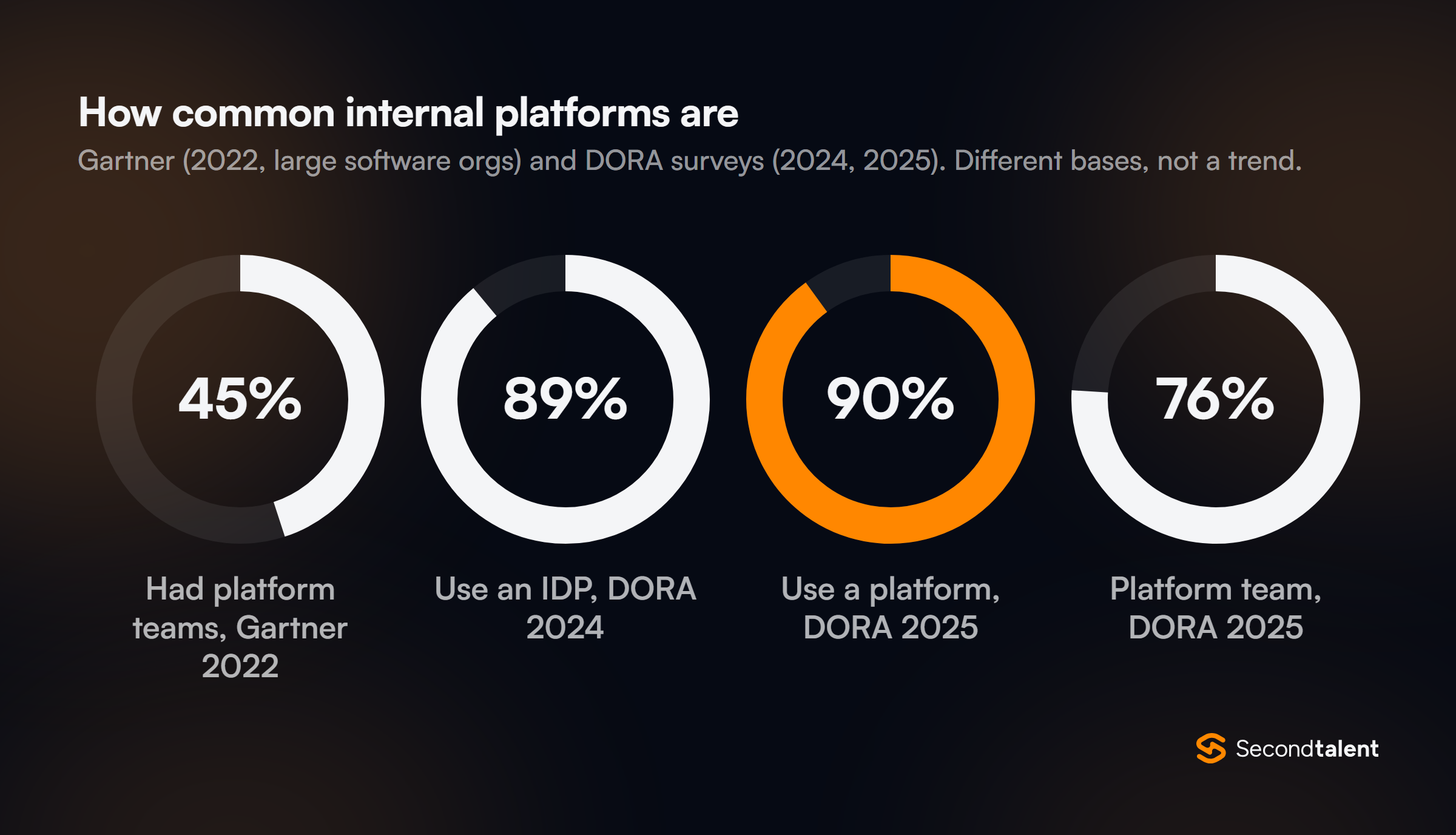
These four figures come from different surveys with different bases, so they are not one trend line. The 90% and 76% come from DORA's platform engineering capability page.
The 2025 DORA report surveyed close to 5,000 technology professionals and tied platform quality to whether AI tools pay off.
The 2024 DORA data was less flattering. Its report summary found real gains and a real cost:
Google's 2024 announcement reads the dip as temporary. A platform initiative, it says, "might lead to a temporary decrease in performance before improvements manifest as the platform matures."
It also found platforms more common in larger organizations. That matters for when to hire one, below.
Which title companies actually post
Infrastructure is the label tech companies reach for. I pulled all 14,880 open postings from 51 Greenhouse job boards, Stripe to Anduril, and counted titles:
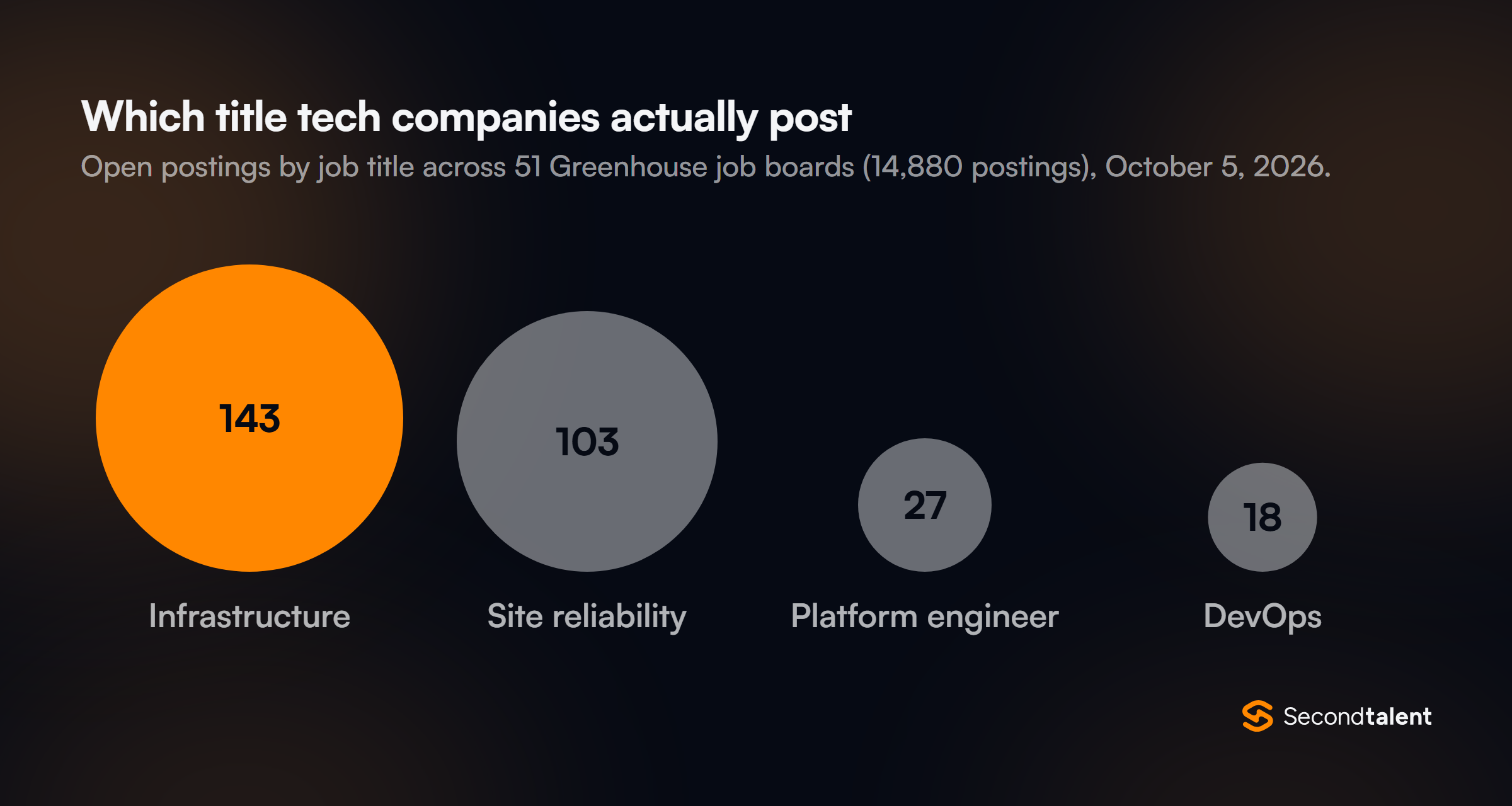
Infrastructure titles appeared on 34 of the 51 boards. Platform engineer titles appeared on 12, and DevOps on 11.
Three of the 18 DevOps titles belong to GitLab's Core DevOps product team, which builds DevOps software rather than doing the job.
Of the other 15, eight were outside the US, in Ireland, Serbia, Argentina, Poland, Slovakia and the Czech Republic.
The titles also blur inside one company. SentinelOne posts a data infrastructure role in five European locations twice: as Senior DevOps Engineer / Platform Engineer, and as Senior Infrastructure Engineer.
In the Slovakia pair, the only change apart from the title is the experience line: "multiple years" in one, "5+" in the other.
Skills: what the postings ask for
Kubernetes appears in four of these six postings and Terraform or IaC in five, whatever the title. The last two columns hold the difference: who the work is for, and whether the job touches physical hardware.
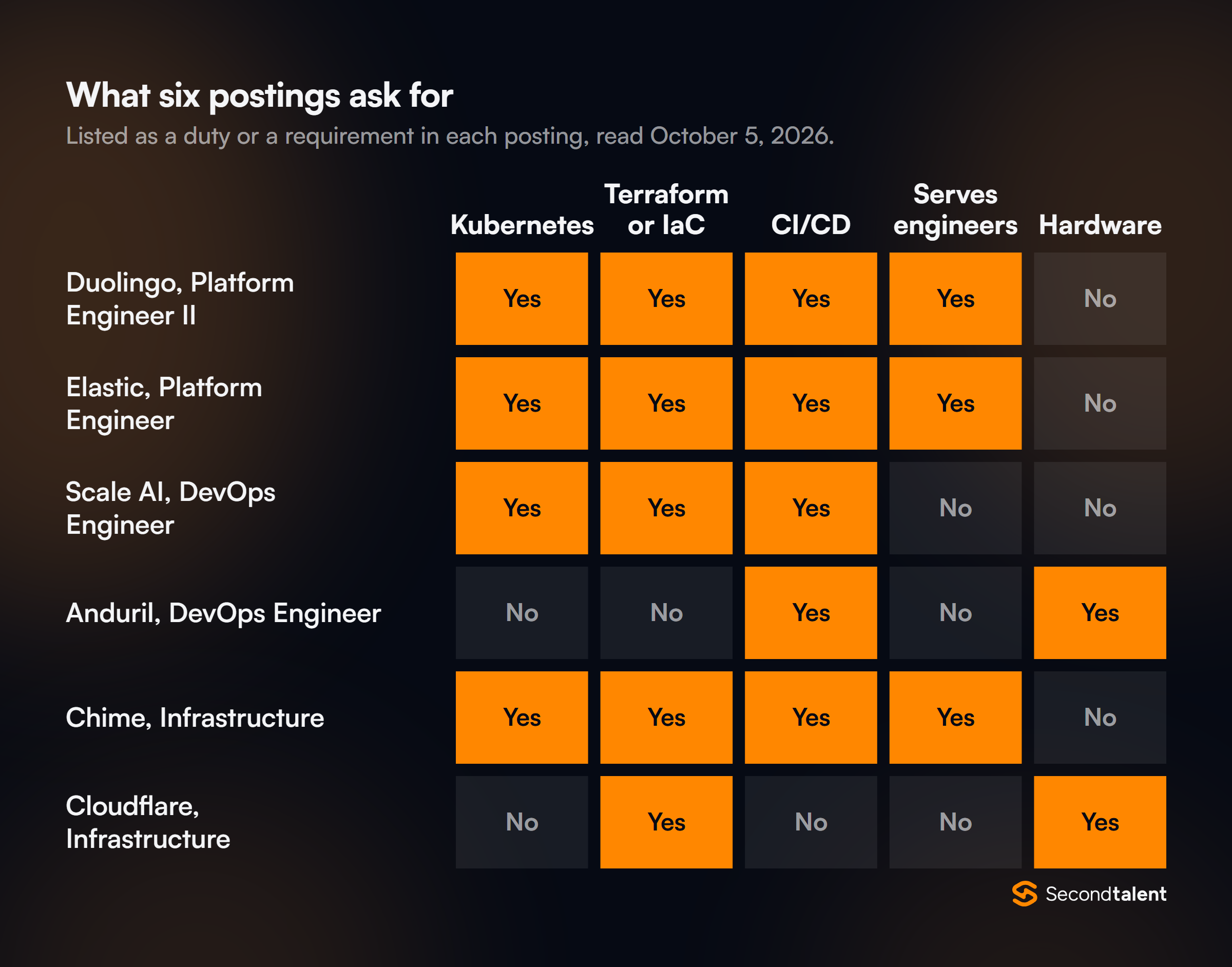
Hardware separates the infrastructure end. Cloudflare's posting covers hardware validation and failure-domain planning, and Anduril's DevOps job deploys firmware to lab benches and fielded units.
Serving engineers separates the platform end. Both platform postings name internal users. So does Chime's infrastructure posting, which asks for tools "to enable self-service" across Chime engineering.
Coding depth depends more on the company than on the title. Chime asks infrastructure hires for Ruby on Rails and Go. Twilio's L2 platform engineer writes production code for distributed systems.
Scale's DevOps hire leans on Python, Bash and PowerShell scripting. For interviews, our Kubernetes interview questions and Terraform interview questions test the shared core.
Pay: level beats title
Twilio settles the pay question with two postings. Its Platform Engineering (L2) and Cloud Infrastructure (L2) jobs carry the same $116,960 to $146,200 base in its Colorado, Illinois and Washington D.C. tier. The level sets the pay.
The title does not.
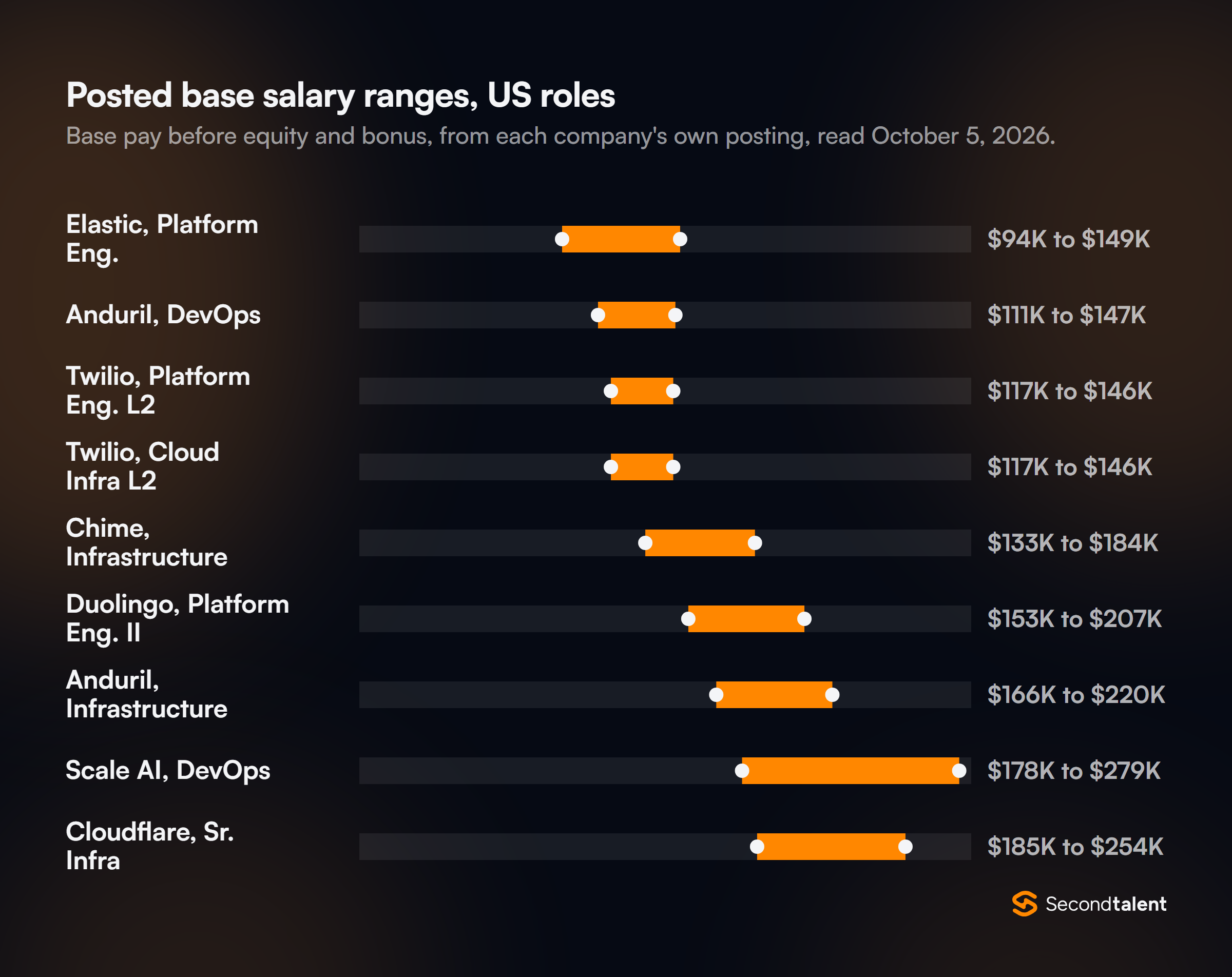
Across nine US postings, DevOps sits at both ends. Anduril's DevOps range starts at $111,000, while Scale AI's tops out at $279,000 in its D.C. tier, with a clearance requirement attached.
Seniority and clearance explain more of the spread than the title. Cloudflare's infrastructure role is a senior one, and Anduril's needs a Top Secret clearance.
All figures are base pay. Most of these companies add equity, and Twilio's roles may also join its corporate bonus plan.
Outside the US, our rate cards track monthly pay for DevOps engineers in Vietnam, DevOps engineers in the Philippines and cloud engineers in Vietnam.
Which one to hire first
A startup with one product team on a managed cloud should hire a DevOps-minded engineer first. That hire owns CI/CD, Terraform and releases.
Add infrastructure depth when you run your own hardware, span several regions or carry strict uptime targets. Hire platform engineers when several teams wait on the same tickets.
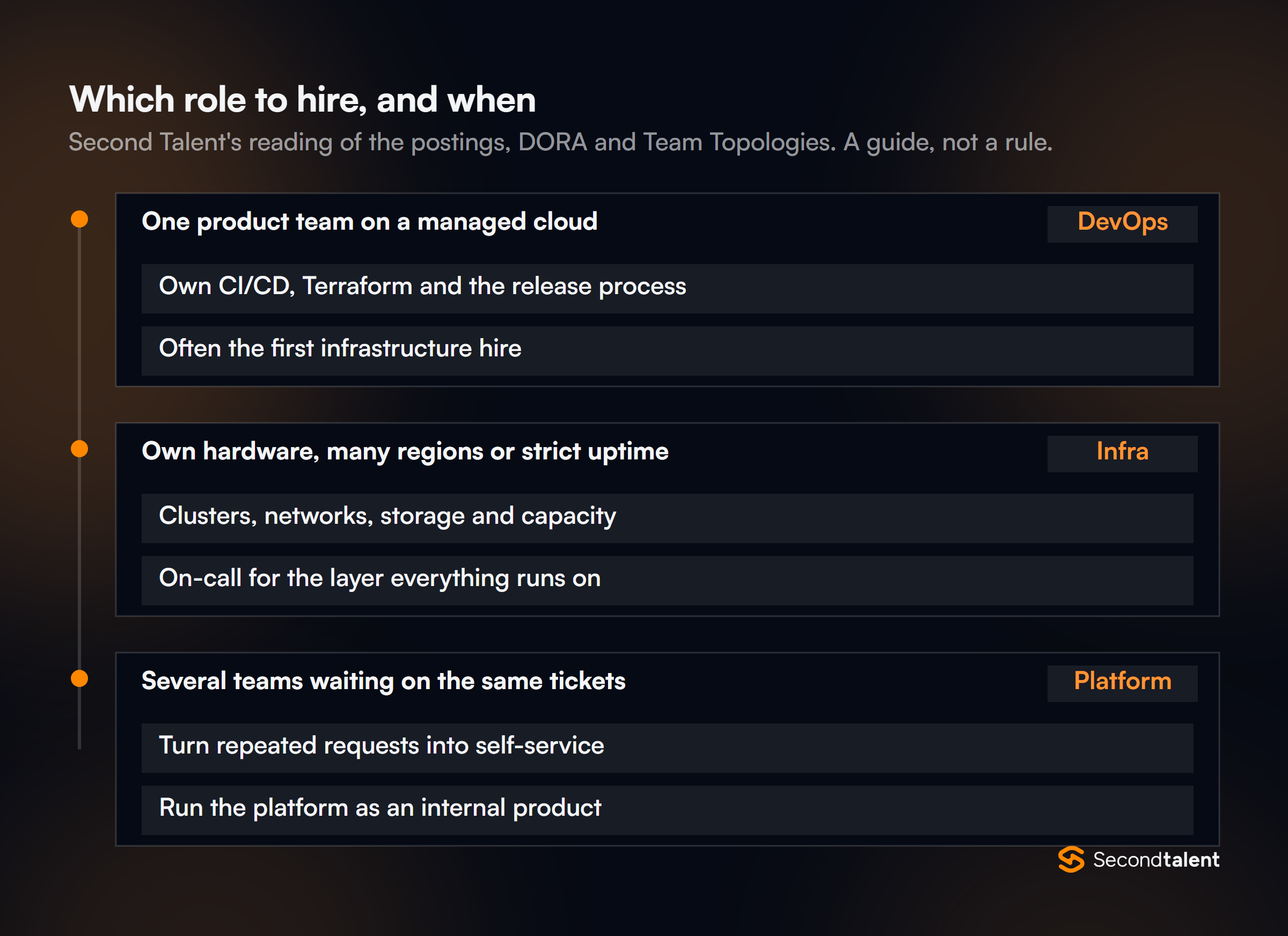
The order follows the research. DORA found platforms more common in larger organizations, and Team Topologies justifies a platform team by the load it removes from several stream-aligned teams. With one team, there is little load to remove.
A platform also costs speed before it pays back, per DORA's 2024 throughput finding. DORA's 2024 report pointed at the fix: user-centered design and developer independence, the same idea behind Duolingo's paved roads.
For agents that now take on some of this work, see our review of AI agents for DevOps and infrastructure management.
Hire DevOps, cloud and platform engineers from Asia
Second Talent matches you with vetted DevOps engineers, cloud engineers and Kubernetes engineers in 24 hours, at 50-70% below US cost. Each hire carries a 90-day, one-time replacement guarantee.
We employ them through our own EOR in 9 Asian markets, including the Philippines and India.
Our Monthly plan is $4,999 a month for a senior engineer, all-inclusive. Tell us which layer you need covered and we will send a shortlist.
Frequently Asked Questions
Is platform engineering replacing DevOps?
No. The CNCF white paper opens by calling platforms "inspired by the cross-functional cooperation promised by DevOps". The practice of shared ownership stays; the platform packages it so each product team does not rebuild the same pipeline.
Is an SRE the same as a DevOps engineer?
They overlap, but SRE is Google's specific model: software engineers running operations, with ops work capped at 50%. DevOps is broader, and today's DevOps postings center on the delivery pipeline.
Can a DevOps engineer move into platform engineering?
Yes, and the postings make it a short move. Chime asks infrastructure hires for prior DevOps, SRE or production engineering experience, and both platform postings above want CI/CD and Terraform.
The new skill is product thinking: treating other engineers as users.