TL;DR: Python developers in India earn $2,090 to $8,050+ a month working for international clients on our rate card, the highest ceiling of the five markets compared. We shortlist 6-8 candidates within 24 hours, and the US benchmark, the BLS median for software developers, was $135,980 a year in May 2025.
India added more than 5.2 million developers to GitHub in 2025, more than any other country, per GitHub's Octoverse report. It also names India the largest contributor base to public and open source projects. A Python developer from that pool may already maintain a library your stack imports.
Key takeaways
- Airflow 2 reached end of life on 22 April 2026, so a data platform still running it gets no fixes.
- Django 4.2 LTS lost security support on 7 April 2026, and Django 5.2 LTS runs to April 2028.
- A 6:30 pm to 3:30 am shift in Bengaluru covers the whole New York working day, in summer and winter.
- Under India's Copyright Act, a code assignment that names no territory is presumed to cover India only.
What Python Developers Earn in India Working for International Clients
India's floor sits $90 above Malaysia's and $410 below the Philippines, while its ceiling is the only open-topped range in the table. The figures are what developers in each market earn working directly for foreign companies, before any employer or platform costs.
| Market |
Monthly pay working for international clients (USD) |
| India |
$2,090-$8,050+ |
| Indonesia |
$1,200-$6,500 |
| Vietnam |
$1,800-$7,500 |
| Malaysia |
$2,000-$5,500 |
| Philippines |
$2,500-$6,000 |
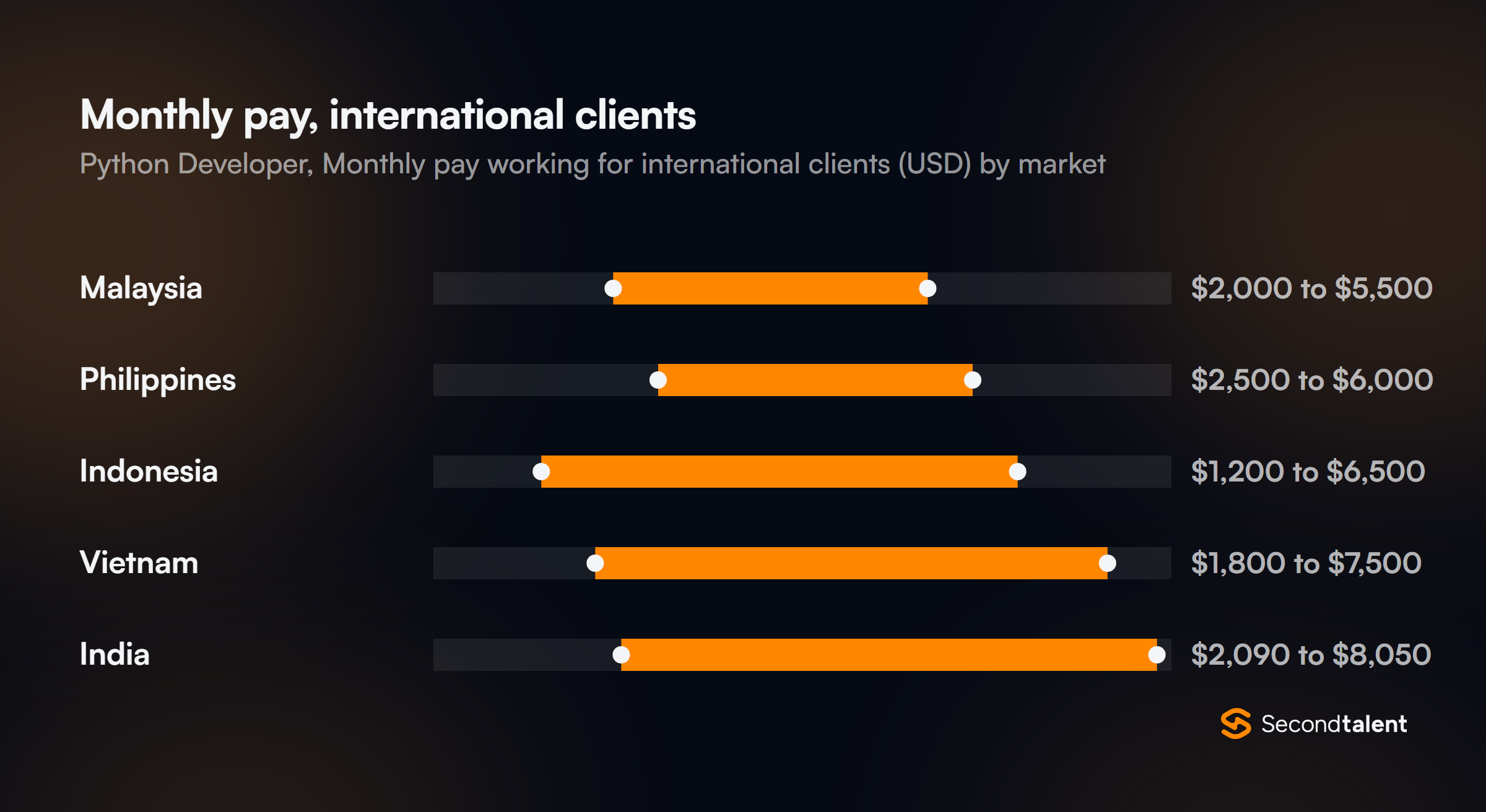
Monthly ranges from the Remote (Working for International Clients) figures on our rate cards for India, Indonesia, Vietnam, Malaysia and the Philippines, converted at ExchangeRate-API mid-market rates for 14 September 2026.
The India card quotes ₹200,000 to ₹770,000+ a month, converted for the India row. The other four cards publish this figure in US dollars with a fixed top.
Through Second Talent you pay one monthly fee that bundles salary, payroll taxes, statutory contributions and our service fee, quoted per role and market. Our pricing page explains the monthly subscription.
US Pay Benchmark for Python Developers
BLS tracks no occupation by programming language, so Python developers map to Software Developers (SOC 15-1252), the occupation for engineers who build and maintain applications and services.
| BLS OEWS, May 2025, national |
Software Developers (15-1252) |
| Median annual |
$135,980 |
| 10th percentile, monthly |
$6,870 |
| 25th percentile, monthly |
$8,770 |
| Median, monthly |
$11,330 |
| 75th percentile, monthly |
$14,330 |
| 90th percentile, monthly |
$17,890 |
Monthly figures are the annual wages on the OEWS profile for 15-1252 divided by 12, rounded to the nearest $10.
Salary is only part of the US cost. In the BLS Employer Costs for Employee Compensation release for June 2026, wages and salaries made up 68.5% of employer compensation costs for full-time private industry workers, and benefits the other 31.5%.
For contract work, our Python developer cost-to-hire page puts a mid-level US freelance or contract Python developer at $85 to $135 an hour, before payroll, insurance and leave.
Time Zone Overlap: Bengaluru Against ET, CT and PT
Bengaluru sits nine and a half hours ahead of New York while US daylight time lasts, and ten and a half after it ends. India keeps UTC+5:30 all year, and US clocks change on 8 March and 1 November 2026, per NIST.
The arithmetic: 5:00 pm in Chicago under CDT (UTC-5) is 22:00 UTC, which is 3:30 am the next day in Bengaluru. Under CST (UTC-6) it is 4:30 am, so a shift ending at 3:30 am loses the last hour of a Chicago winter day.
| Bengaluru shift (UTC+5:30) |
ET overlap (EDT / EST) |
CT overlap (CDT / CST) |
PT overlap (PDT / PST) |
Hours between 10 pm and 6 am |
| 10 am-7 pm |
0.5 / 0 |
0 / 0 |
0 / 0 |
0 |
| 1 pm-10 pm |
3.5 / 2.5 |
2.5 / 1.5 |
0.5 / 0 |
0 |
| 3:30 pm-12:30 am |
6 / 5 |
5 / 4 |
3 / 2 |
2.5 |
| 6:30 pm-3:30 am |
8 / 8 |
8 / 7 |
6 / 5 |
5.5 |
Each shift is nine clock hours with a meal break, counted against a 9 am to 5 pm US day.
Python back-end work splits along two lines. Code review, API design calls and incident response need the shared window. The 3:30 pm to 12:30 am row gives New York six hours of it in September.
Scheduled Airflow runs, backfills and data migrations can start in the Indian morning, which is the middle of the US night, and finish before your team logs on.
We agree that split before the offer, which is how our placements get 4-6 hours of daily overlap with US hours.
Python Developer Skills to Screen For
TypeScript overtook Python in August 2025 as the most used language on GitHub. Python still accounts for 582,196 new AI repositories, close to half of them.
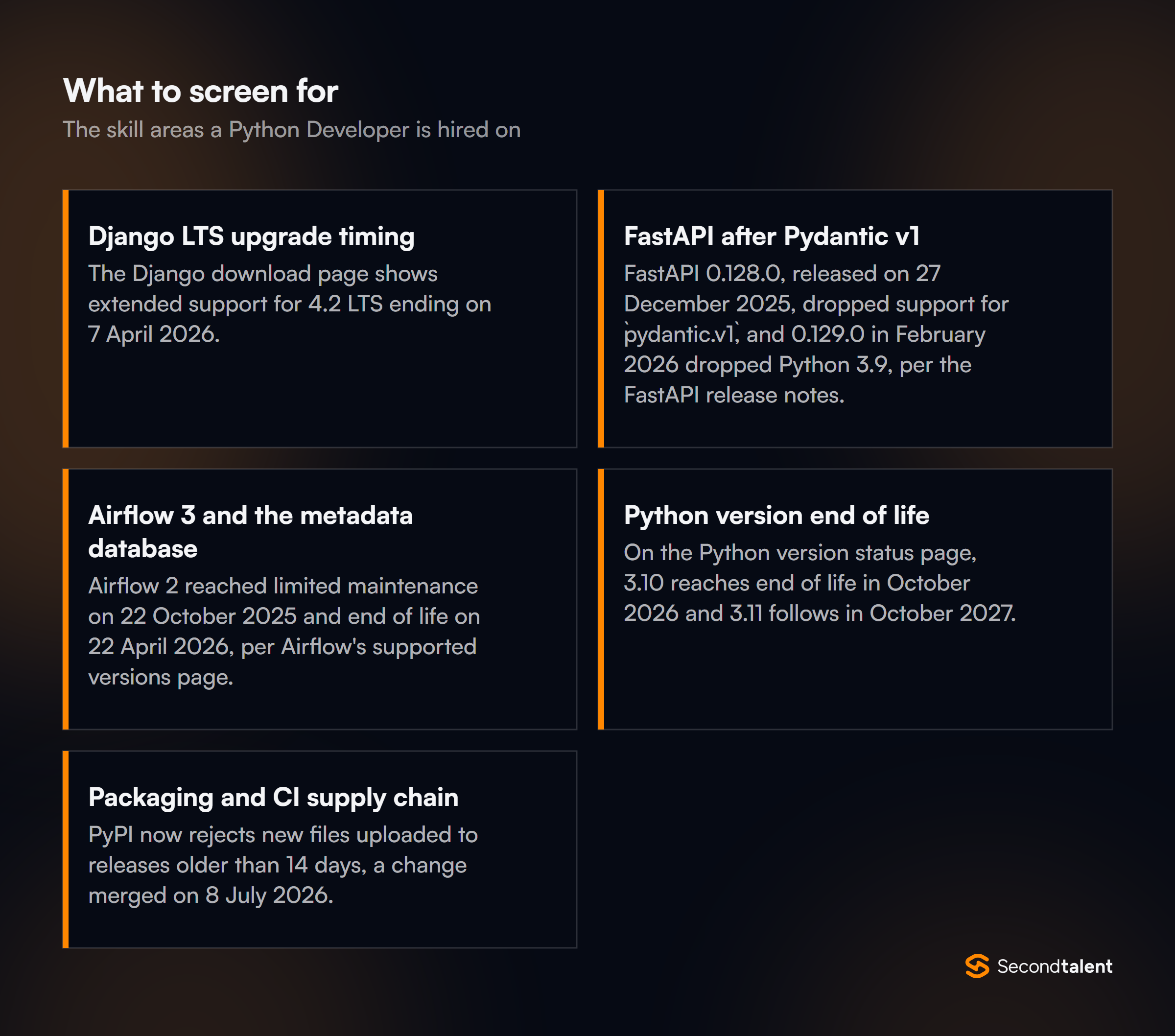
A Python developer you hire in 2026 may split time between a Django or FastAPI service and the data or AI pipelines behind it. Django, FastAPI and Airflow all passed a support deadline or shipped a breaking change in the past year.
Django LTS upgrade timing
The Django download page shows extended support for 4.2 LTS ending on 7 April 2026. Django 5.2 LTS runs to April 2028, while 6.0 support ends in April 2027 and 6.2 LTS is due that month. Ask the candidate for the last Django major upgrade they ran, which third-party packages held it back, and how they tested migrations against a copy of production data.
FastAPI after Pydantic v1
FastAPI 0.128.0, released on 27 December 2025, dropped support for pydantic.v1, and 0.129.0 in February 2026 dropped Python 3.9, per the FastAPI release notes. A service that still imports pydantic.v1 stays on FastAPI 0.127 or earlier. Give the candidate a v1 model with a custom validator and ask for the v2 version plus a test proving the API response did not change.
Airflow 3 and the metadata database
Airflow 2 reached limited maintenance on 22 October 2025 and end of life on 22 April 2026, per Airflow's supported versions page. The Airflow 3 upgrade guide states that task code can no longer import database sessions or models. Tasks now reach Airflow through a Task Execution API. Ask whether the candidate's DAGs queried the metadata database, and how they would find those calls with Ruff's AIR301 rule.
Python version end of life
On the Python version status page, 3.10 reaches end of life in October 2026 and 3.11 follows in October 2027. Airflow drops a Python version from support once it reaches end of life, so an old interpreter blocks the scheduler too. Ask which interpreter the candidate's last production service ran and what the upgrade plan was.
Packaging and CI supply chain
PyPI now rejects new files uploaded to releases older than 14 days, a change merged on 8 July 2026. Its announcement links the decision to the LiteLLM and Telnyx compromise, which came through a mutable reference to the Trivy GitHub Action. Show the candidate a workflow file that pins actions by tag and ask what they would change first.
Contractor or Employer of Record in India
Software is not one of the nine categories of commissioned work that can be "work made for hire" under 17 U.S.C. § 101, and a copyright transfer must be in writing and signed under § 204(a).
India's Copyright Act, 1957 treats computer programmes as literary works. An employer under a contract of service is first owner of the code (section 17(c)), but a contractor owns what they write until they assign it.
Section 19 wants the assignment in writing and signed. If it names no period, the Act deems it to run five years; if it names no territory, the Act presumes India only. Name services, DAGs, migrations and infrastructure code in the assignment, with worldwide rights for the full term.
IRS Publication 515 says the place where services are performed determines the source of the income, so a developer working from Pune or Hyderabad earns foreign-source income. A foreign individual gives the payer Form W-8BEN to certify foreign status.
In Sushilaben Indravadan Gandhi v. New India Assurance (2020), India's Supreme Court held that no single test settles whether a contract is one of service. The court weighed control, integration into the business and who owns the tools. India's four labour codes took effect on 21 November 2025 and make appointment letters mandatory.
A developer on your on-call rota with standing production access looks integrated into your business. The Employer of Record route needs a provider with its own Indian entity; our EOR overview explains the model, and Second Talent's own EOR contracts cover nine other Asian markets. This is a summary, not legal advice.
|
Independent contractor |
Employer of Record |
| Legal employer |
None; the developer invoices you |
The EOR provider's Indian entity |
| US paperwork |
Form W-8BEN from the developer |
Service agreement with the EOR |
| IP |
Signed assignment naming worldwide rights and full term (section 19) |
Employer first owner (section 17(c)), passed on through the EOR agreement |
| Local labor law |
Employment finding if control and integration point that way |
Labour codes apply, including appointment letters |
| Pay currency |
Agreed in the contract, often USD |
Local payroll in rupees |
English Level and Working Norms in India
Kochi, Mumbai and Bengaluru lead India's cities on the EF English Proficiency Index 2025 at 577, 570 and 569, and Pune scores 502, per EF's India page. India's national score is 484, ranking 74th of 123 countries and regions against a global average of 488. Its IT job-function score is 487.
Writing, at 504, is India's strongest skill and listening, at 457, its weakest. Python work leans on writing: pull request descriptions, docstrings, incident notes. Ask finalists to write the description for a pull request that changes a database migration, then discuss it on a call.
India's central government holiday list for 2026 makes Mahatma Gandhi's Birthday on 2 October, Dussehra and Diwali compulsory holidays in its offices. Offices outside Delhi pick three more from a list of 12. Set deploy freezes from the developer's own list rather than a national one.
Thanksgiving on 26 November 2026 is a working day in India, so a developer there can watch your services through the holiday while your US team is off.
Python Developer Hiring Process in India
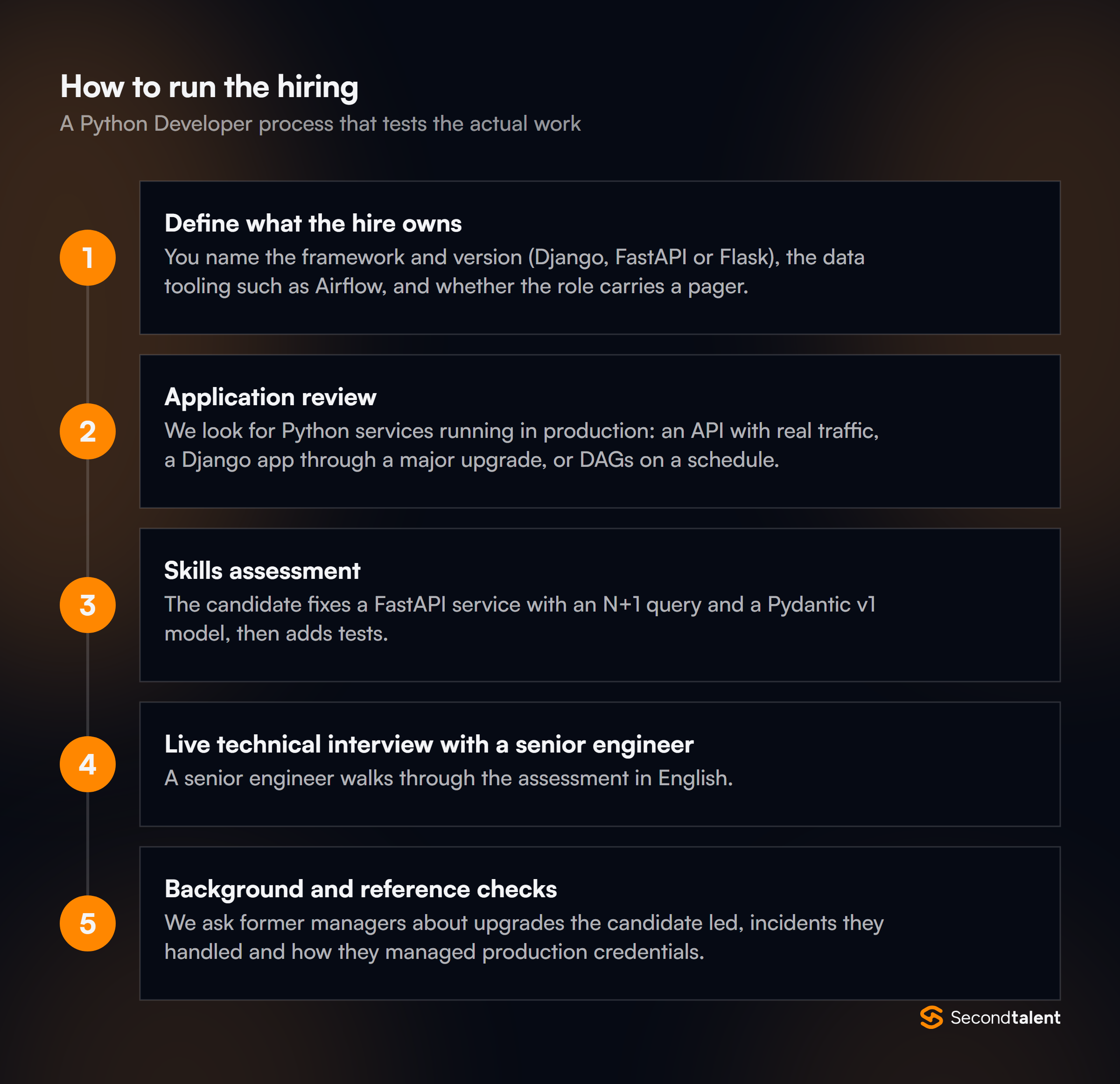
Second Talent's vetting covers stages 2 to 5 before you see a profile.
Stage 1: Define what the hire owns
You name the framework and version (Django, FastAPI or Flask), the data tooling such as Airflow, and whether the role carries a pager. Add the Bengaluru shift from the table above.
Stage 2: Application review
We look for Python services running in production: an API with real traffic, a Django app through a major upgrade, or DAGs on a schedule. A tutorial repository alone does not pass.
Stage 3: Skills assessment
The candidate fixes a FastAPI service with an N+1 query and a Pydantic v1 model, then adds tests. We score the pull request description with the code.
Stage 4: Live technical interview with a senior engineer
A senior engineer walks through the assessment in English. Then the questions move to operations: a failed migration, a stuck Airflow task and a pinned dependency with a known vulnerability.
Stage 5: Background and reference checks
We ask former managers about upgrades the candidate led, incidents they handled and how they managed production credentials. You then choose the contractor or EOR route above.
Hire Python Developers from India with Second Talent
We shortlist 6-8 candidates within 24 hours from 100,000+ pre-vetted engineers, accepting only the top 1% of applicants. Python developers from India come with $0 upfront, no lock-in and 4-6 hours of daily overlap with US hours. We handle contracts, payroll and equipment.
Our pricing page sets out the monthly subscription, and our FastAPI interview guide has questions for your own final round. For pipeline-heavy roles we also staff data engineers in India.