TL;DR: Python developers in Singapore earn $8,680 to $14,600+ a month working for international clients on our rate card, above the Southeast Asian markets we compare. We shortlist 6-8 candidates within 24 hours, and the BLS median for US software developers was $135,980 a year in May 2025.
The AI Verify Foundation ships Moonshot, its toolkit for benchmarking and red-teaming LLM applications, as a Python library that needs Python 3.11. A Python developer in Singapore who ships AI features may already have run a client's chatbot through it.
Key takeaways
- Python 3.10 reaches end of life in October 2026, and 3.14 is the first release with an officially supported free-threaded build.
- Singapore's Copyright Act 2021 leaves commissioned code with its author unless a written agreement says otherwise.
- The hours and overtime rules in Part 4 of the Employment Act stop at a basic salary of S$2,600 a month for employees who are not workmen, less than a quarter of our card's floor.
- A 4 pm to 1 am shift in Singapore gives a Chicago team three live hours while US daylight time lasts.
What Python Developers Earn in Singapore Working for International Clients
Singapore's floor sits $1,180 above Vietnam's ceiling of $7,500, the highest ceiling among the three Southeast Asian rows. Hong Kong opens $2,800 higher still. The figures are what developers in each market earn working directly for foreign companies, before any employer or platform costs.
| Market |
Monthly pay working for international clients (USD) |
| Singapore |
$8,680-$14,600+ |
| Vietnam |
$1,800-$7,500 |
| Malaysia |
$2,000-$5,500 |
| Philippines |
$2,500-$6,000 |
| Hong Kong |
$11,480-$22,320+ |
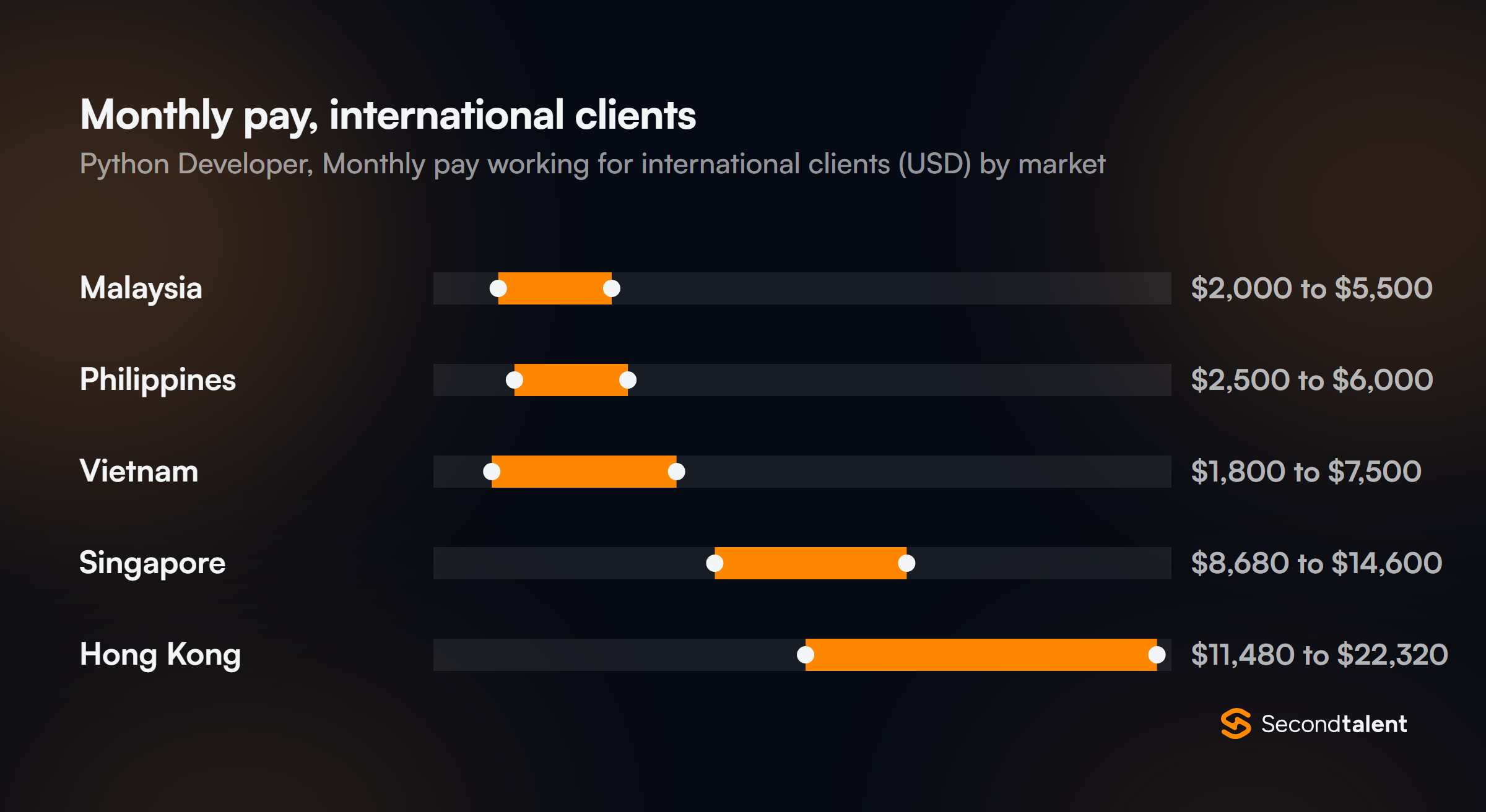
Monthly ranges from the Remote (Working for International Clients) figures on our rate cards for Singapore, Vietnam, Malaysia, the Philippines and Hong Kong, converted at ExchangeRate-API mid-market rates for 14 September 2026.
The Singapore card is set at S$11,000 to S$18,500+ a month. The Vietnam, Malaysia and Philippines cards publish US dollars, so only the Singapore and Hong Kong rows move with the exchange rate.
Through Second Talent you pay one monthly fee that bundles salary, payroll taxes, statutory contributions and our service fee, quoted per role and market. Our pricing page explains the subscription. For short contract work, our Python developer cost-to-hire page sets out US freelance rates.
US Pay Benchmark for Python Developers
BLS has no Python developer occupation. The role maps to Software Developers (SOC 15-1252), because a Python developer writes and maintains production services, pipelines and libraries.
| BLS OEWS, May 2025, national |
Software Developers (15-1252) |
| Median annual |
$135,980 |
| 10th percentile, monthly |
$6,870 |
| 25th percentile, monthly |
$8,770 |
| Median, monthly |
$11,330 |
| 75th percentile, monthly |
$14,330 |
| 90th percentile, monthly |
$17,890 |
Monthly figures are the annual wages on the OEWS profile for 15-1252 divided by 12, rounded to the nearest $10.
Set the two tables side by side before you pick Singapore. The card's floor sits $90 under the US 25th percentile, and the US median falls inside the Singapore range. The case for hiring there rests on experience with regulated data, bank systems or Singapore's AI testing tools, and on the time zone.
Salary is only part of the US cost. In the BLS Employer Costs for Employee Compensation release for June 2026, wages and salaries made up 68.5% of employer compensation costs for full-time private industry workers, and benefits the other 31.5%.
Time Zone Overlap: Singapore Against ET, CT and PT
A nightly batch job that starts at 2:00 am in Singapore runs at 2:00 pm the previous afternoon in New York while daylight time lasts. Singapore keeps UTC+8 all year with no daylight saving, and US clocks stay on daylight time from 8 March to 1 November 2026, per NIST.
The arithmetic: 9:00 am in New York under EDT (UTC-4) is 13:00 UTC, which is 9:00 pm in Singapore. Under EST (UTC-5) the same meeting lands at 10:00 pm. Chicago adds an hour to each, and Los Angeles three.
| Singapore shift (UTC+8) |
ET overlap (EDT / EST) |
CT overlap (CDT / CST) |
PT overlap (PDT / PST) |
Hours between 10 pm and 6 am |
| 9 am-6 pm |
0 / 0 |
0 / 0 |
0 / 0 |
0 |
| 1 pm-10 pm |
1 / 0 |
0 / 0 |
0 / 0 |
0 |
| 4 pm-1 am |
4 / 3 |
3 / 2 |
1 / 0 |
3 |
| 6 pm-3 am |
6 / 5 |
5 / 4 |
3 / 2 |
5 |
Overlap counts clock hours of a nine-hour shift, meal break included, against a 9 am to 5 pm US day.
Python work splits well across the gap. Pull request reviews, data contract changes and incident calls need the shared hours. Test suites, backfills and model evaluations can run through the US night, with results waiting in the morning.
We fix the shift in the offer, which is how our placements get 4-6 hours of daily overlap with US hours.
Python Developer Skills to Screen For
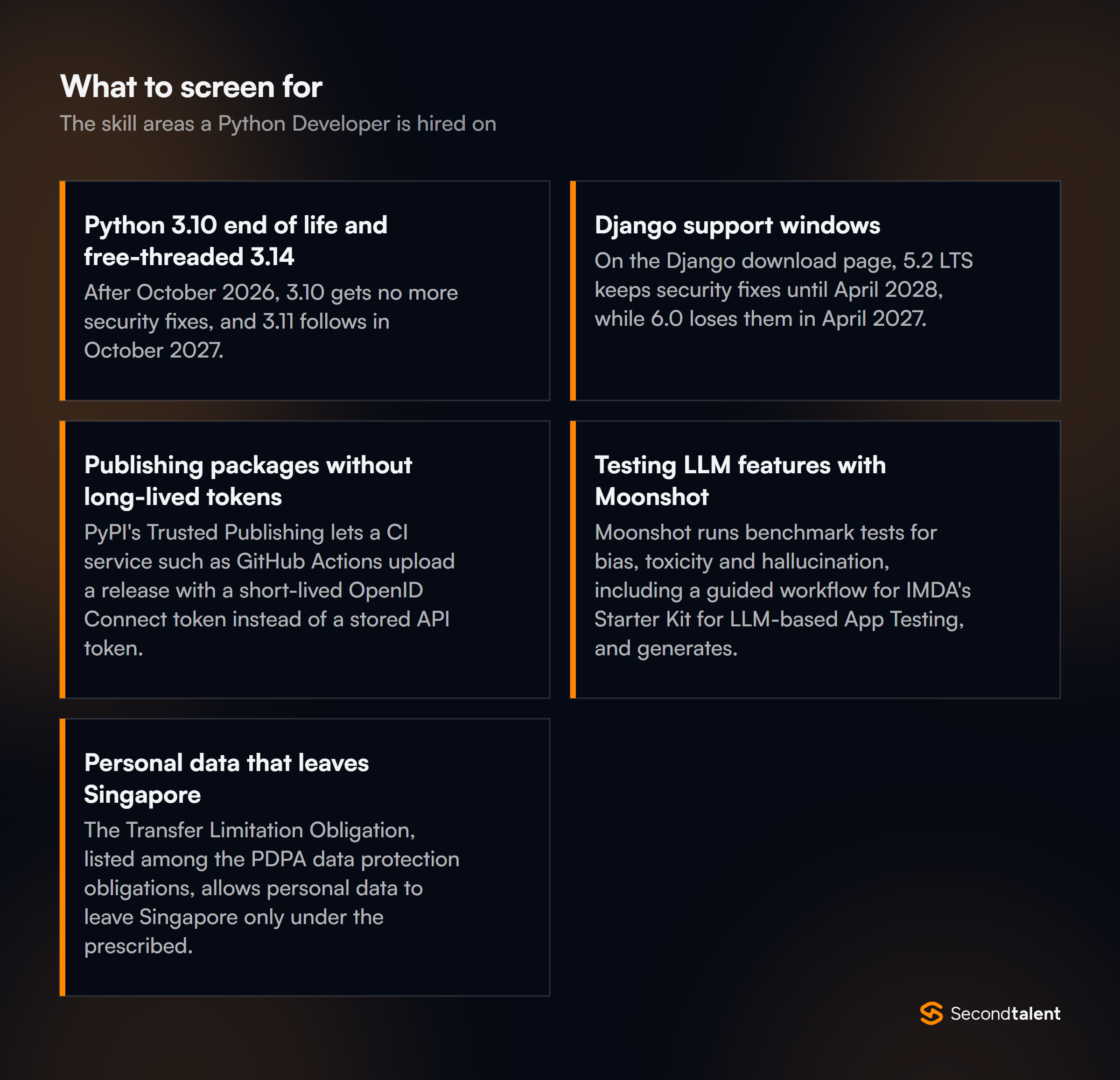
Python's release calendar sets two deadlines inside the next year. The Python developer guide schedules 3.15 for 1 October 2026 and end of life for 3.10 that same month. Start the screen with the versions you run.
Python 3.10 end of life and free-threaded 3.14
After October 2026, 3.10 gets no more security fixes, and 3.11 follows in October 2027. Python 3.14, released on 7 October 2025, made the free-threaded build officially supported but still optional under PEP 779. Its release notes put the single-threaded penalty at roughly 5-10%.
Ask the candidate how they would move a 3.10 service to 3.13 or 3.14. Then ask which of your C extensions they would test first on the free-threaded build.
Django support windows
On the Django download page, 5.2 LTS keeps security fixes until April 2028, while 6.0 loses them in April 2027. Django 6.2 LTS, due in April 2027, is the last release under the old policy.
The policy then changes. From Django 2028 onward a feature release ships each January, and each gets three years of support. Ask which version a new Django project should start on, and what the upgrade plan looks like after that.
Publishing packages without long-lived tokens
PyPI's Trusted Publishing lets a CI service such as GitHub Actions upload a release with a short-lived OpenID Connect token instead of a stored API token. PyPI also accepts PEP 740 digital attestations, which bind each wheel or sdist to a digest of its contents. Ask the candidate to set up a release workflow for an internal library that uses both.
Testing LLM features with Moonshot
Moonshot runs benchmark tests for bias, toxicity and hallucination, including a guided workflow for IMDA's Starter Kit for LLM-based App Testing, and generates adversarial prompts for red-teaming. Custom recipes take a dataset of input-target pairs, a metric and a grading scale, and results come out as HTML reports and raw JSON.
Give the candidate one of your prompts and ask for a recipe that would catch its worst failure. Our AI engineers in Singapore page covers hires whose main job is the AI feature itself.
Personal data that leaves Singapore
The Transfer Limitation Obligation, listed among the PDPA data protection obligations, allows personal data to leave Singapore only under the prescribed requirements, so that its protection stays comparable to the PDPA. An ETL job that copies Singapore customer records into a US warehouse is such a transfer. Ask the candidate which columns they would mask or keep in the region, and how the pipeline proves it.
Contractor or Employer of Record in Singapore
Software is not one of the nine categories of commissioned work that can be "work made for hire" under 17 U.S.C. § 101, and a transfer must be in writing and signed under § 204(a).
Singapore's Copyright Act 2021 counts a computer program as a literary work (section 13). The author is the default first owner (section 133), and an employee's work made under a contract of service belongs to the employer (section 134). A contractor's code stays with the contractor until a written assignment signed by them moves it (section 138). IPOS summarises the same split for commissioned and employee works. Name packages, notebooks, trained artefacts and test data in the assignment.
IRS Publication 515 says the place where services are performed determines the source of the income, so a developer working from Singapore earns foreign-source income. A foreign individual gives the payer Form W-8BEN to certify foreign status.
Singapore has no single conclusive test for employment. The Ministry of Manpower's contract of service page weighs who controls timing and method, who provides the workplace and materials, and whether the person shares in profit or risk of loss. It also requires written key employment terms within 14 days of the start.
The Employment Act covers most employees under a contract of service, but Part 4 on hours, rest days and overtime applies only to workmen earning up to S$4,500 and other employees earning up to S$2,600, excluding managers and executives, per MOM. At Singapore's Python pay, the shift and overtime terms come from the contract. CPF contributions are due for citizens and permanent residents, per the CPF Board.
A developer who works your sprint hours on your laptop leans towards employment. Our Employer of Record service employs that developer, and our Singapore EOR page explains the setup. This is a summary, not legal advice.
|
Independent contractor |
Employer of Record |
| Legal employer |
None; the developer invoices you |
The EOR's Singapore entity |
| US paperwork |
Form W-8BEN from the developer |
Service agreement with the EOR |
| IP |
Signed written assignment of code, notebooks and artefacts (section 138) |
Employer first owner (section 134), passed on through your EOR agreement |
| Local labor law |
Employment risk if you control timing, method and tools |
Employment Act, written key terms and CPF for citizens and PRs |
| Pay currency |
Agreed in the contract, often USD |
Local payroll run by the EOR |
English Level and Working Norms in Singapore
English was the language spoken most often at home by 58.1% of Singapore residents aged 5 and over in 2025, up from 48.3% in 2020, according to the General Household Survey 2025. EF's English Proficiency Index 2025 has no Singapore page, so there is no EF score to quote.
Python teams run on written context: docstrings, README files, data dictionaries, incident notes. Ask finalists to write the postmortem for a failed nightly job, covering cause, blast radius and the check that would have caught it.
Singapore's Ministry of Manpower lists 11 public holidays for 2026. Deepavali falls on Sunday 8 November, so employees whose rest day is Sunday get Monday 9 November off. Christmas lands on a Friday. Keep release freezes and data migrations clear of those days.
Thanksgiving on 26 November 2026 is a working day in Singapore, so a developer there can watch a deploy or a backfill while your US team is off.
Python Developer Hiring Process in Singapore
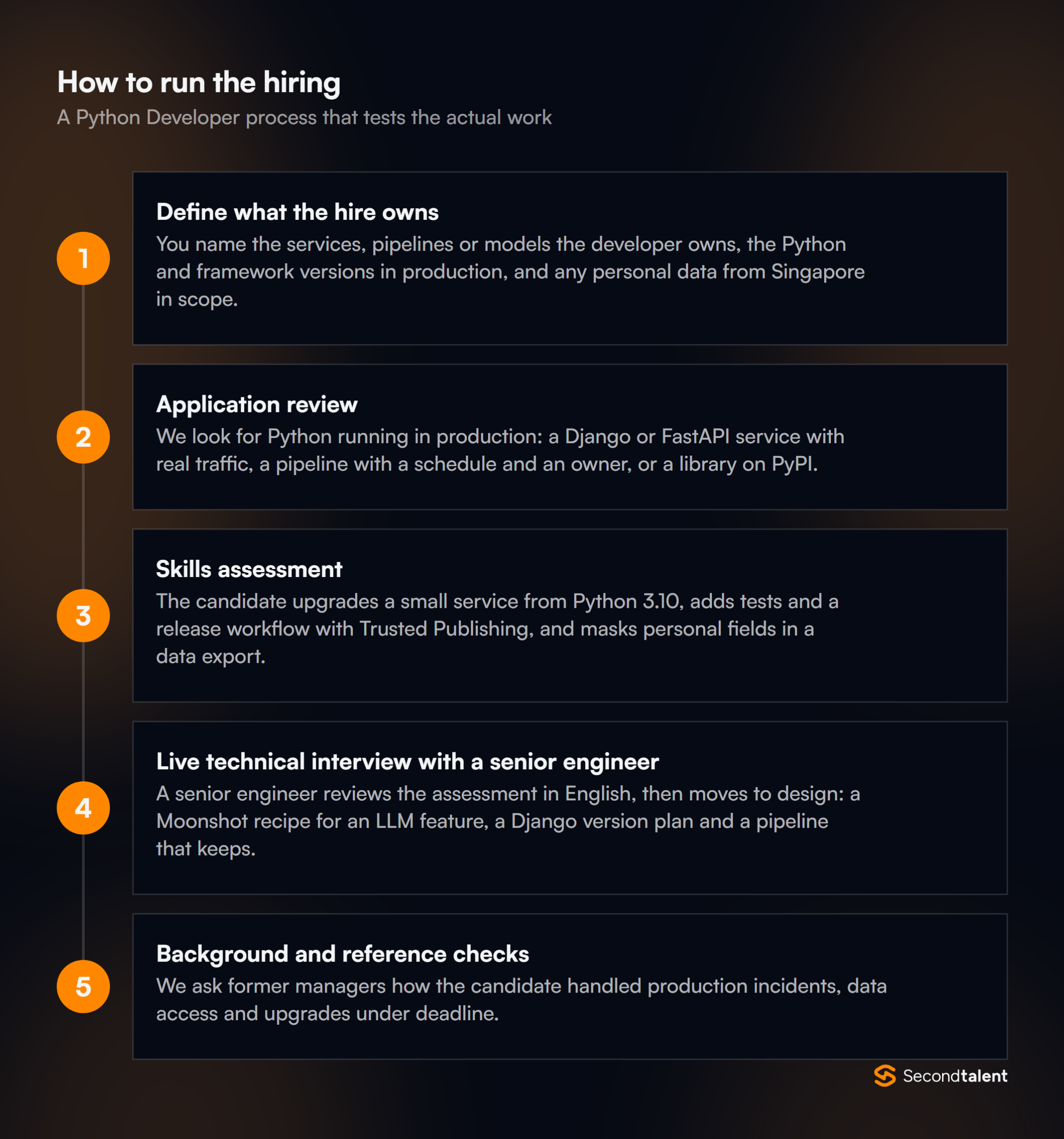
Second Talent's vetting covers stages 2 to 5 before you see a profile.
Stage 1: Define what the hire owns
You name the services, pipelines or models the developer owns, the Python and framework versions in production, and any personal data from Singapore in scope. Pick a shift from the table above.
Stage 2: Application review
We look for Python running in production: a Django or FastAPI service with real traffic, a pipeline with a schedule and an owner, or a library on PyPI. A candidate should name the version upgrade they led and what broke.
Stage 3: Skills assessment
The candidate upgrades a small service from Python 3.10, adds tests and a release workflow with Trusted Publishing, and masks personal fields in a data export. We score the diff, the tests and the written notes.
Stage 4: Live technical interview with a senior engineer
A senior engineer reviews the assessment in English, then moves to design: a Moonshot recipe for an LLM feature, a Django version plan and a pipeline that keeps customer records in Singapore.
Stage 5: Background and reference checks
We ask former managers how the candidate handled production incidents, data access and upgrades under deadline. You then choose the contractor or EOR route above.
Hire Python Developers from Singapore with Second Talent
We shortlist 6-8 candidates within 24 hours from 100,000+ pre-vetted engineers, accepting only the top 1% of applicants. Python developers from Singapore come with $0 upfront, no lock-in and 4-6 hours of daily overlap with US hours. We handle contracts, payroll and equipment, with compliant EOR contracts in Singapore.
Our pricing page covers subscription, direct-hire and EOR pricing, and for pipeline-heavy work we also staff data engineers in Singapore.