TL;DR: Staff augmentation is a hiring model in which a provider employs contract engineers who join your team and take day-to-day direction from your managers. In the US, providers bill the engineer's pay rate plus a markup, and Robert Half's public contract with a Texas purchasing co-op sets that markup at 70% for IT roles. Engineers from Asia hired through Second Talent cost $3,000 to $6,000 a month, all-in.
The 57 largest IT staffing firms in the US billed $27.4 billion in 2025, 4.4% less than the year before, according to Staffing Industry Analysts. SIA puts that third straight year of decline down to offshoring, AI-assisted coding, the end of the post-pandemic hiring bubble and buyers moving spend from staffing to IT solutions.
- 1The provider is the legal employer; you direct the work. Blur that line and you risk what Microsoft paid in the permatemp case: $96.9 million plus 3,000 contractors moved onto its payroll.
- 2Benefits are 30% of what US private employers spend per hour worked, which is why a direct hire costs more than the salary on the offer letter.
- 3Converting a contractor to your payroll often carries a fee. Robert Half's scale starts at 25% of salary and drops to zero after 640 billed hours.
- 4AI skills carry a 62% average wage premium, so AI staff augmentation is priced off a different rate card from general development.
What Is Staff Augmentation?
Staff augmentation is a way of adding capacity to a team by contracting skilled workers from an outside provider for a set period. The provider employs and pays them. You assign their work, set their hours and review what they ship, the same as for your own staff.
That split is what separates it from outsourcing. Wikipedia's entry puts it well: augmented workers "work alongside employees and may take day-to-day direction from the client", while an outsourcing supplier delivers "a defined service or outcome under its own management."
A few terms you will see used for the same thing:
- Augmented staff are the contract workers themselves, placed inside your team.
- Staff augmentation services are what a provider sells: sourcing, vetting, employment and payroll for those workers.
- Resource and staff augmentation is the procurement phrasing of the same thing, used in contracts that buy skilled labor by the hour or month.
- IT staff augmentation narrows it to engineers, QA, data and infrastructure roles.
How Staff Augmentation Works
An engagement runs through five stages, and the work in each one is split between you, the provider and the engineer. The provider's side is employment. Yours is direction.
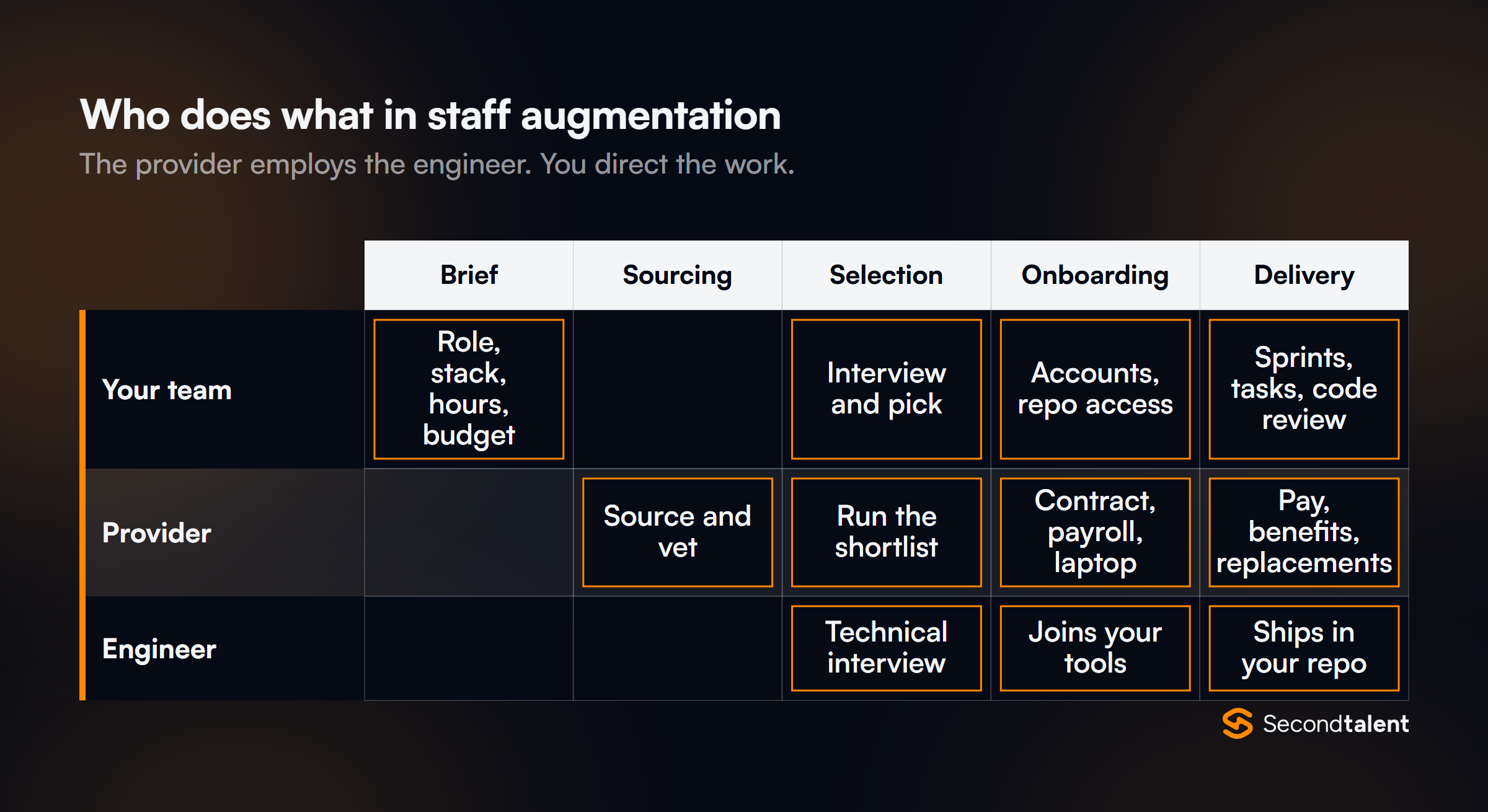
- Brief. You define the role, stack, seniority, working hours and budget.
- Sourcing. The provider searches its bench and the market, then screens for skills and English.
- Selection. You interview a shortlist and pick.
- Onboarding. The provider signs the employment contract, runs payroll and ships a laptop. You grant repository and tool access.
- Delivery. The engineer joins your standups and sprints. The provider handles pay, leave and a replacement if the fit is wrong.
Time to start depends on the market and the role. For our own clients, the first shortlist usually arrives within 24 hours of the brief, and the slower part is your interview loop.
Types of Staff Augmentation
Staff augmentation services are usually sorted three ways: by how specialized the skill is, by how long the engagement runs, and by where the engineer sits.
By skill level
- Commodity: roles with a deep labor pool, such as manual QA, support or data entry. Rates are lowest and replacement is quick.
- Skill-based: a named stack or discipline your team lacks, such as DevOps engineers for a CI/CD rebuild or mobile developers for a first iOS app.
- Highly specialized: scarce technical specializations such as machine learning, security research or platform architecture, where the rate follows the shortage.
By duration
Short-term augmentation covers a release, a migration or a backlog. Long-term augmentation keeps the same engineers for a year or more, which starts to look like a dedicated team. Price it like one.
By location
- Onshore: engineers in your own country. Full working-hour overlap, highest rates.
- Nearshore: a neighboring time zone, such as Latin America for US teams.
- Offshore: a distant market such as the Philippines or Vietnam, with partial overlap and the largest cost gap.
Staff Augmentation Pricing Models
Staff augmentation contracts use one of four pricing models. The one you sign decides how much of the bill reaches the engineer, and what it costs to leave or hire them yourself.
Pay rate plus markup (time and materials)
This is the default in the US. The provider pays the engineer an hourly pay rate and bills you that rate times a markup. Robert Half's pricing under a Texas purchasing co-op contract, filed in a City of Galveston agenda item, sets the markup at 70% for IT roles and 65% for administrative ones.
The markup is not all profit. It pays the employer's share of payroll tax, 7.65% for FICA under IRS Topic 751, plus unemployment insurance, workers' compensation, benefits, recruiting and the provider's margin. Applied to the median US developer pay rate, it looks like this:
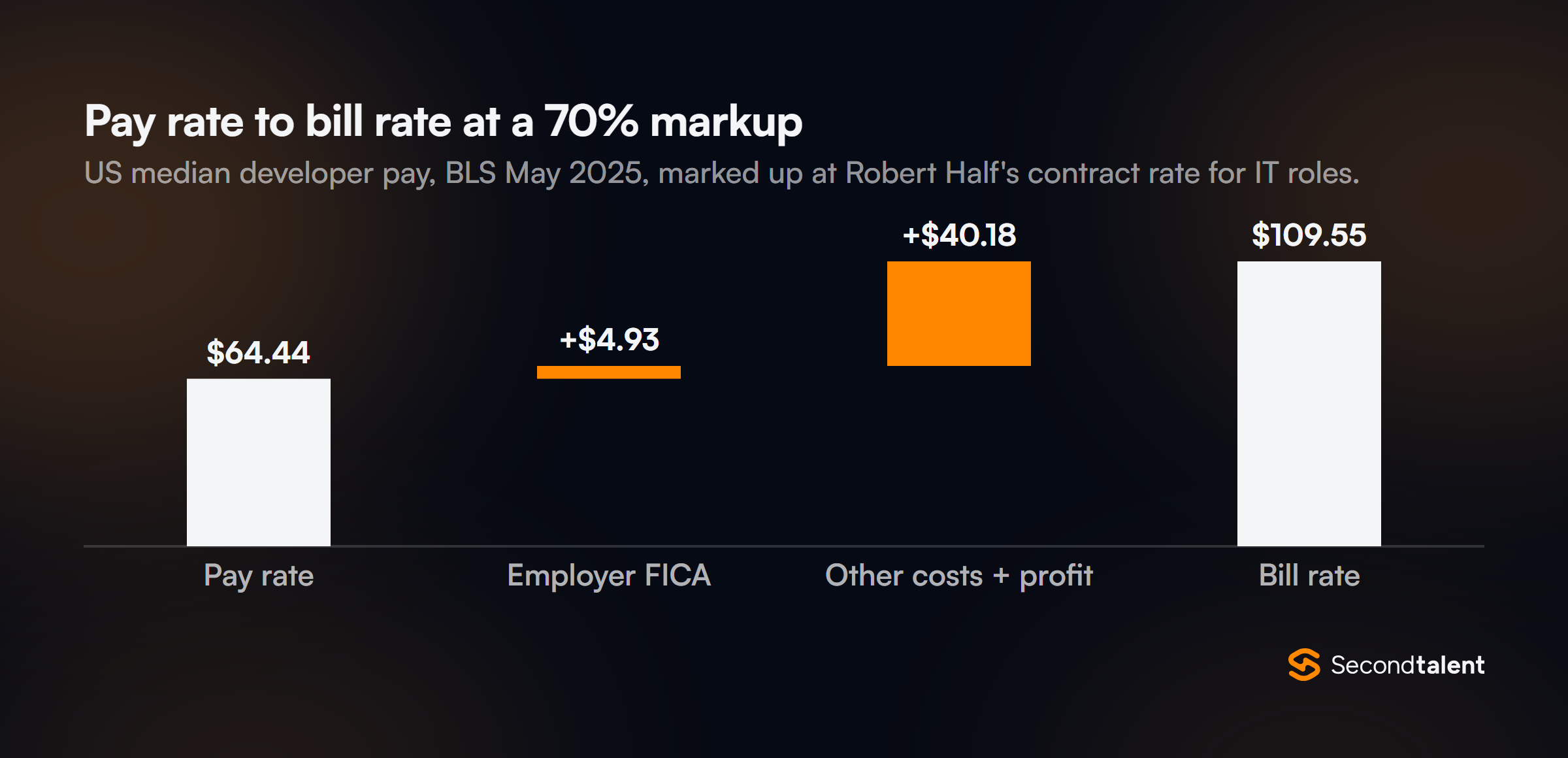
Ask any provider on this model for the pay rate as well as the bill rate. If they will not show it, you cannot tell a 40% markup from a 90% one. Our guide to staffing agency fees covers markups, direct hire fees and margins in more depth.
Flat monthly rate
Offshore providers more often quote one monthly number per engineer that folds in salary, statutory benefits, the employment contract and equipment. It is easier to budget, and it removes the incentive to pad hours. The trade-off is less visibility into the pay rate, so ask what share reaches the engineer.
Fixed price and retainer
A fixed price for a defined deliverable turns the deal into project outsourcing, because the provider now owns the result. A retainer buys a block of hours or seats each month, and you pay for them whether or not the work is there.
How Much Does Staff Augmentation Cost?
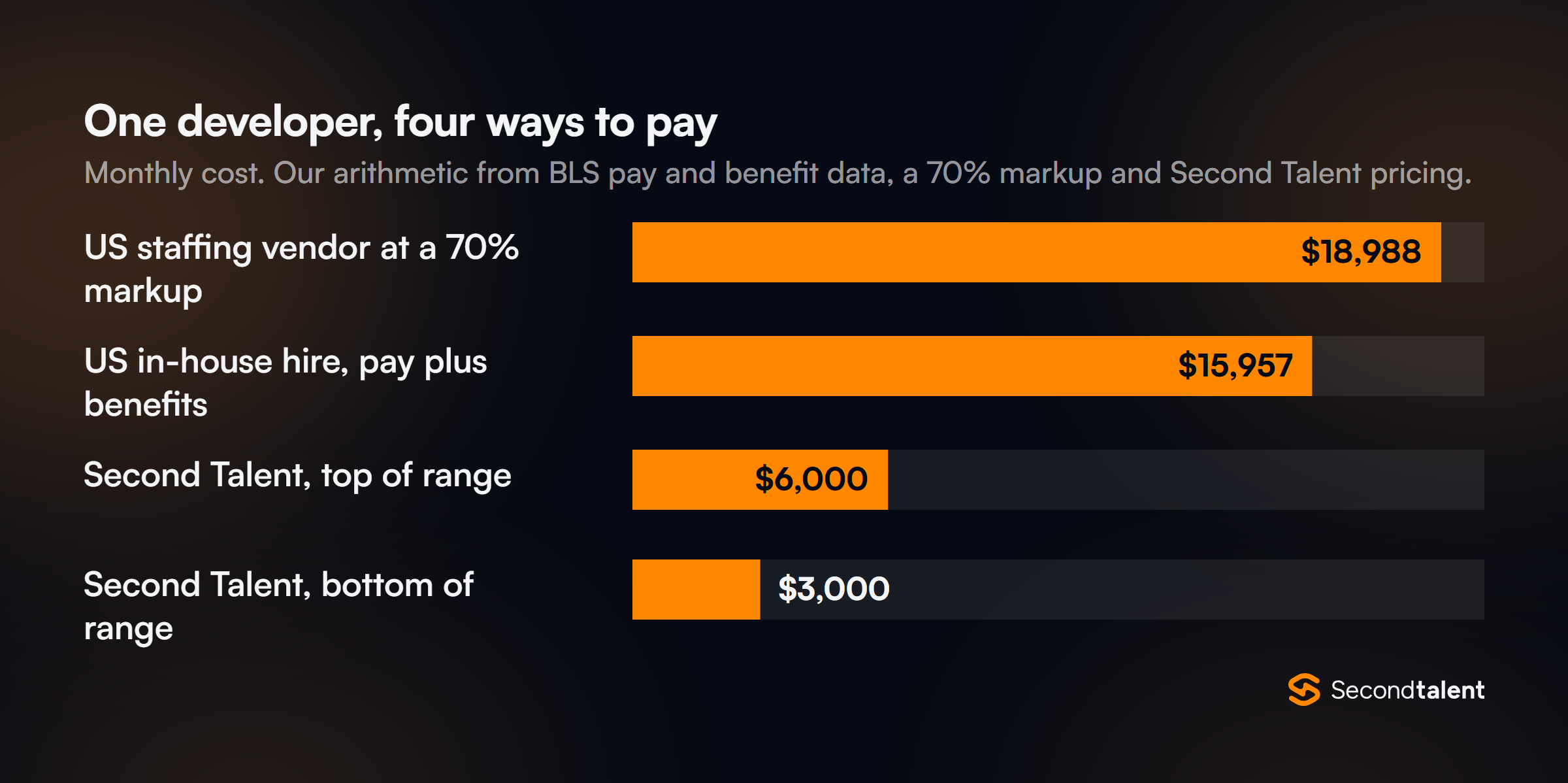
For a median-paid US software developer, staff augmentation through a domestic provider costs about $110 an hour, or close to $19,000 a month. The same developer hired directly costs about $16,000 a month in pay and benefits. An engineer from Asia through Second Talent costs $3,000 to $6,000.
Clutch's staff augmentation pricing page, built from verified client reviews, puts the most common hourly band at $25 to $49 and lists the Philippines under $25, Poland at $50 to $99 and Canada at $100 to $149. Those bands mix offshore and onshore vendors, so read them as a spread of what buyers paid, not as US rates.
Four costs rarely appear on the rate card:
- Ramp-up: the first weeks at partial output while the engineer learns your codebase.
- Management time: someone on your side sets tasks and reviews code. Augmentation adds hands, not leads.
- Tool seats: licences for your IDE, cloud, ticketing and security tooling.
- Exit terms: notice periods, minimum terms and conversion fees.
Our staff augmentation cost calculator puts ramp-up, management and recruiting into one monthly figure per engineer, for an onshore vendor, an offshore agency, a direct hire and Second Talent side by side. For fees charged by providers in Asia, see staffing agency fees in Asia.
Staff Augmentation vs Outsourcing, Managed Services and Consulting
The question that separates the four is who directs the work. In staff augmentation you do. In the other three the vendor does, and you buy an outcome, a service level or advice.
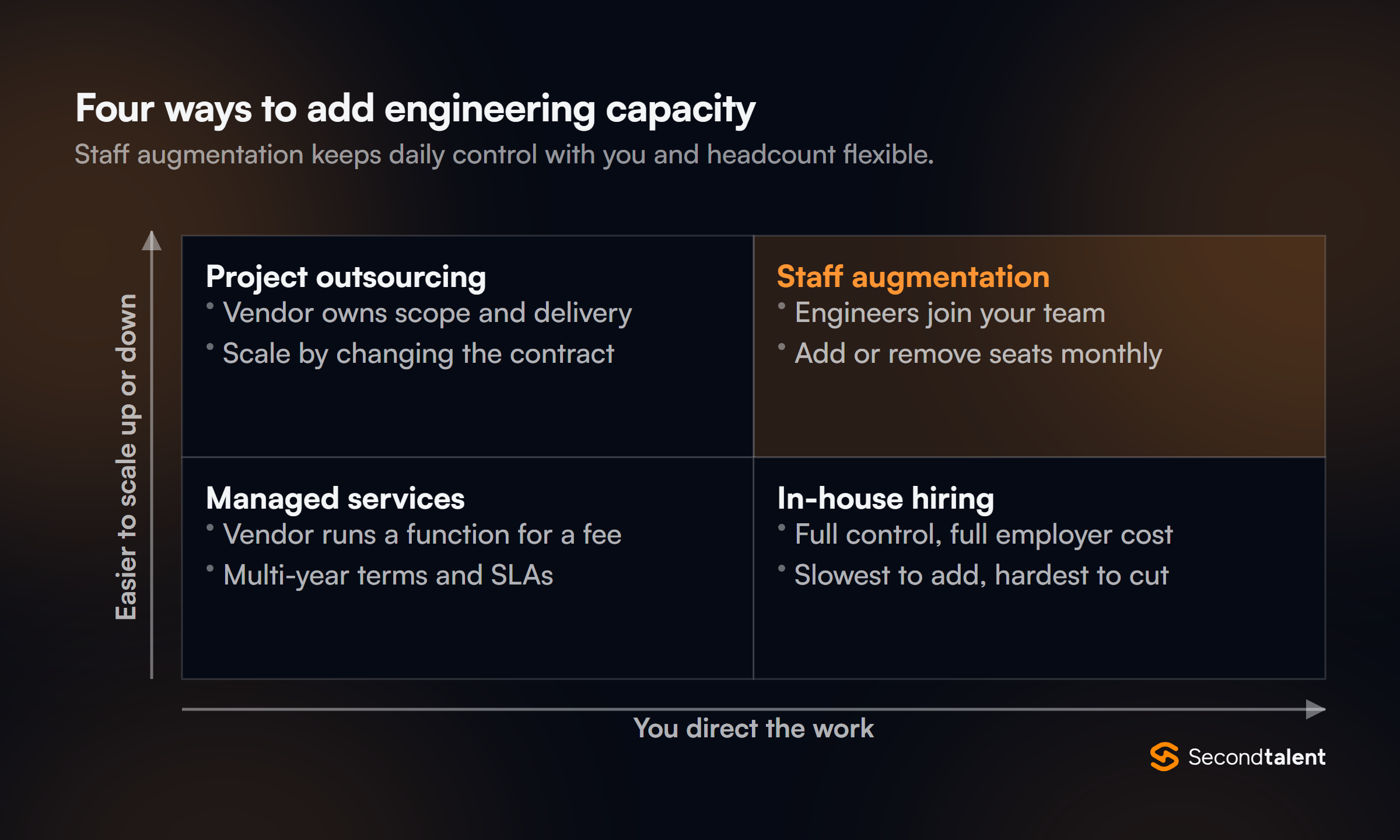
| Model | Who directs the work | What you pay for | Usual pricing |
|---|---|---|---|
| Staff augmentation | You | Engineer time inside your team | Hourly with markup, or flat monthly |
| Project outsourcing | Vendor | A defined deliverable | Fixed price or milestones |
| Managed services | Vendor | A running function, such as support or infrastructure | Monthly fee against service levels |
| Consulting | Vendor, advising you | Analysis and recommendations | Day rate or project fee |
Outsourcing makes sense when no one on your team can own the architecture, or when the work has a clean boundary, such as a marketing site or a one-off migration. Our list of software development outsourcing companies covers that route.
Benefits and Risks of Staff Augmentation
- You keep control of priorities, code and architecture
- Headcount scales up or down without layoffs
- Access to skills you cannot hire locally in time
- No payroll, benefits or entity in the engineer's country
- Co-employment claims if long-term contractors are run like staff
- Knowledge leaves with the engineer
- Markups compound on long engagements
- Management load lands on your leads
The co-employment risk has a famous price tag. Long-term Microsoft contract workers sued in 1992, arguing they should have been treated as employees with access to its benefit plans. The court's 2001 fee ruling in Vizcaino v. Microsoft records what the settlement cost: a $96.885 million cash fund and the conversion of 3,000 class members into regular W-2 employees.
The IRS test for who is an employee weighs behavioral control, financial control and the type of relationship. Directing an augmented engineer's daily work is normal. The exposure grows when your company also sets their pay, hands out company benefits or keeps them on an open-ended assignment with no provider involvement.
Knowledge loss is the quieter risk. Ask for documentation as part of the definition of done, and pair augmented engineers with an employee on anything you will maintain for years.
AI Staff Augmentation
AI staff augmentation places machine learning engineers, data engineers and AI application developers inside your team, and it is the part of IT staffing that is still growing. SIA's March 2026 IT staffing outlook names AI and machine learning, data and analytics, and cloud architects as the best opportunities, and adds forward-deployed engineers, who work directly with customers, to the emerging roles.
The same report lists QA testers, entry-level programmers and help desk support as the roles with lagging demand, because AI tools now do part of that work. Rates are splitting the same way.
PwC's 2026 AI Jobs Barometer found the premium as high as 118% in consumer markets and 16% in the public sector. Robert Half's salary guide shows the same pattern at the level of individual offers. A good AI augmentation provider tests for applied work, such as shipping a retrieval pipeline or an evaluation harness, rather than matching keywords on a CV. See how we vet AI engineers.
The IT Staff Augmentation Market in 2026
Five firms account for 29% of US IT staffing, and TEKsystems, part of Allegis Group, is the largest by some distance. SIA's 2026 ranking put Kforce third, up from sixth a year earlier.
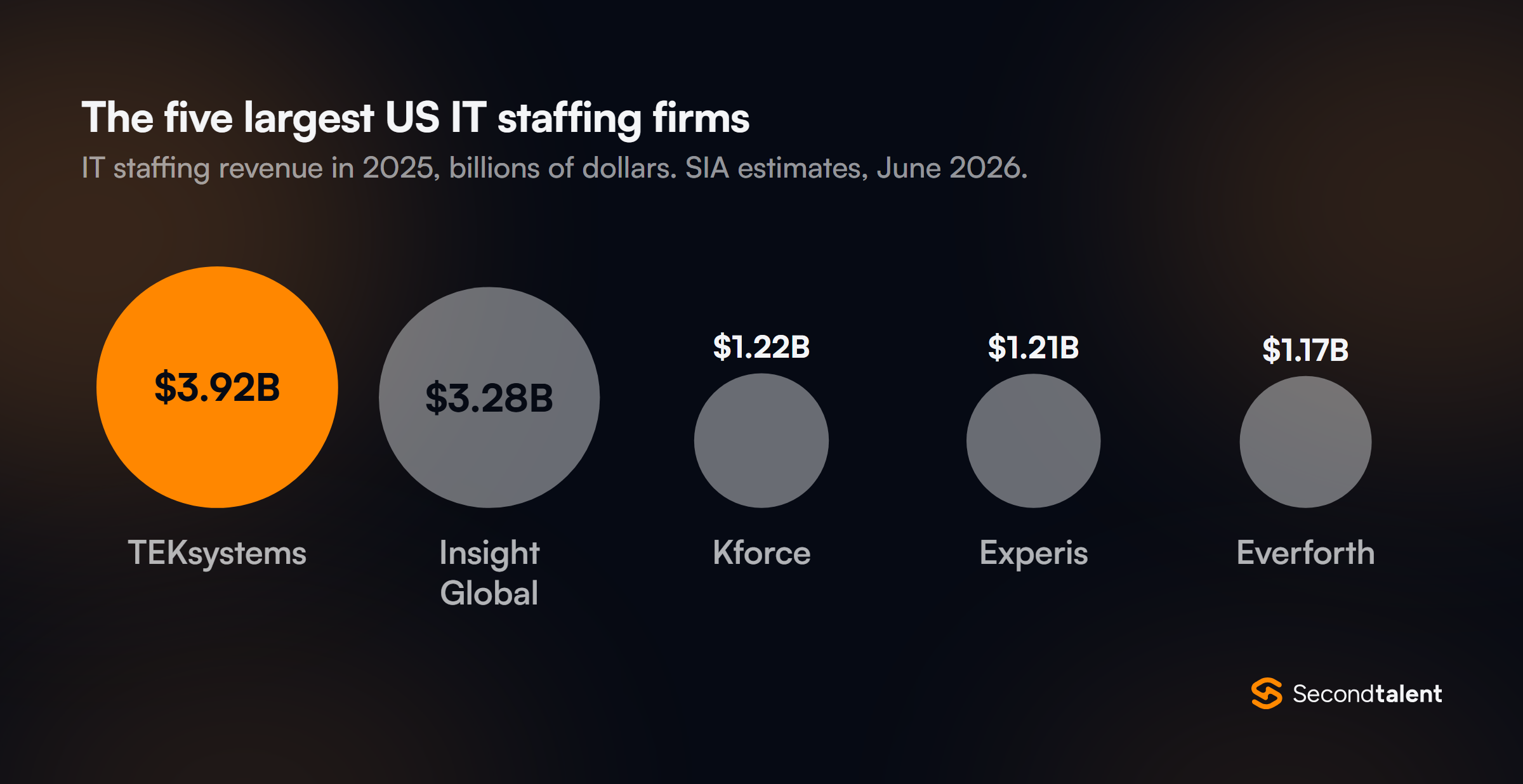
SIA expects IT staffing revenue to grow 1% in both 2026 and 2027 after three years of decline.
Its pulse survey showed a median 3% year-over-year gain for IT staffing firms early in 2026, and the SIA and Bullhorn indicator had IT staffing hours up 2% in early March. The recovery is narrow: AI, data and cloud roles, and new buyers in healthcare, data centers and utilities.
Offshoring is one of the reasons SIA gives for the slump, and it shows in who US buyers now shortlist. Our rankings of offshore staffing companies in the Philippines and in Vietnam compare the providers on that side of the market.
When to Use Staff Augmentation
Use it when you can direct the work, the need is real but not permanent, and you need someone in weeks. If any of those three fails, another model is usually cheaper.
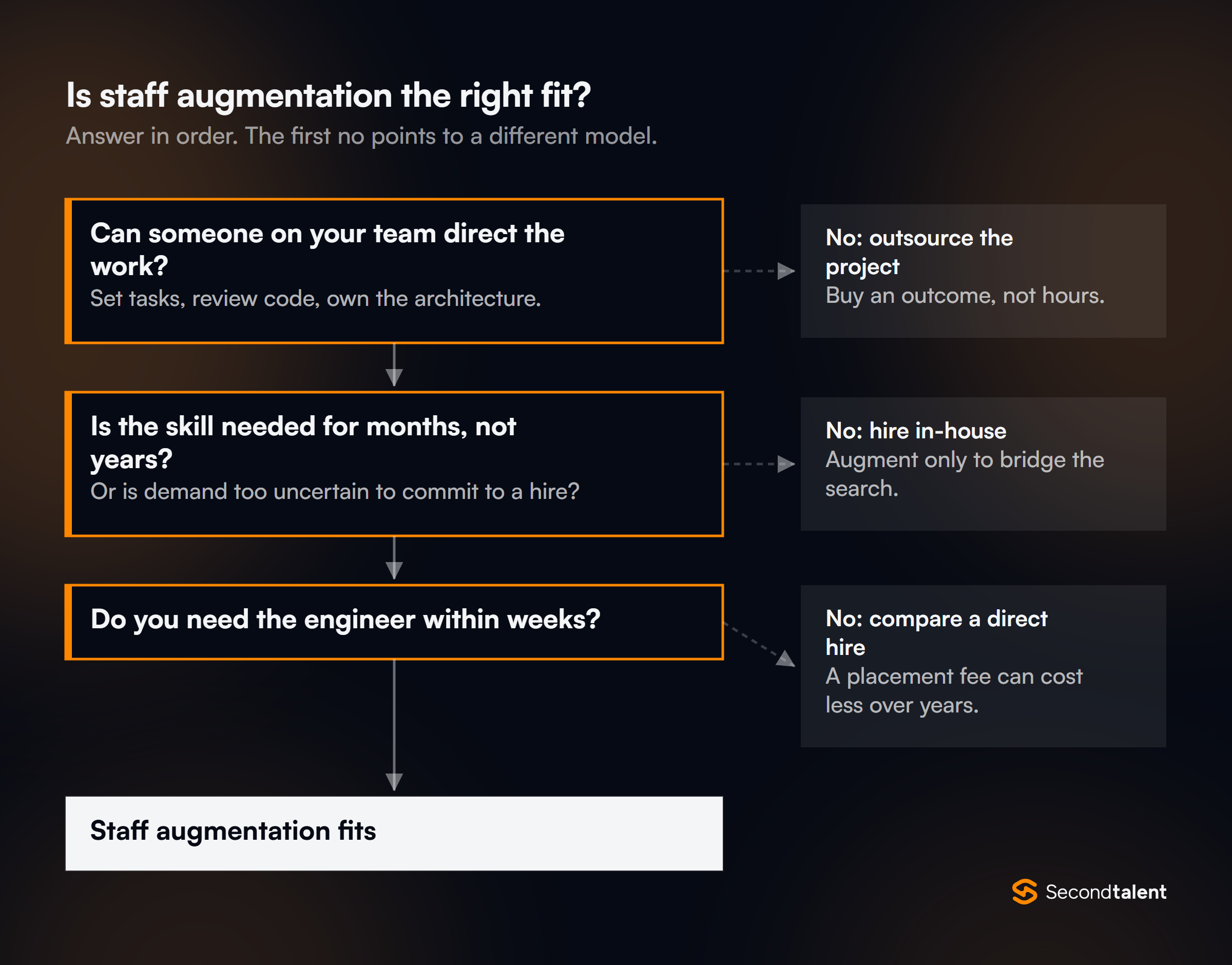
- Good fits: a skill gap on a live product, a release that needs two more engineers for a quarter, a backlog after a funding round, or a trial period before a permanent offer.
- Poor fits: no technical lead on your side, work you want delivered without managing it, or a core capability you plan to own for years. For that last case, compare contract and direct hire.
How to Choose a Staff Augmentation Provider
Most providers look alike on their websites. The differences show up in six questions:
- How do you vet? Ask for the stages. A live coding or system design interview beats a CV screen and a quiz.
- Who is the legal employer? The provider, through its own entity or an employer of record. Engineers paid as freelancers with no employer carry misclassification risk to you.
- What is the pay rate? On hourly contracts, ask for pay and bill rates side by side.
- What happens if it does not work? Look for a written replacement guarantee and how many days a replacement takes.
- What does conversion cost? Robert Half's OfficeTeam scale in the Galveston contract charges 25% of annual salary in the first 160 hours, 10% at 481 to 640 hours, and nothing after 640.
- Who owns the code? The contract should assign IP to you and bind the engineer to confidentiality.
A staff augmentation contract usually pairs a master services agreement with a statement of work or order for each engineer. The order names the role, rate, start date, hours and notice period. Check that minimum terms and notice periods match how long you expect to need the person.
Staff Augmentation with Second Talent
Second Talent places engineers from Asia into your team at a flat $3,000 to $6,000 a month each, covering salary, payroll, compliant employment in nine Asian markets, equipment and a replacement guarantee. Clients typically save 50 to 70% against a comparable US hire, with no upfront fee and rolling monthly terms. See pricing, how vetting works, or tell us the role and get a shortlist within 24 hours.
Frequently Asked Questions
Is staff augmentation the same as an employer of record?
No. An employer of record employs someone you found yourself. A staff augmentation provider also finds and vets the engineer, and often uses its own entity or an EOR to employ them.
Can an augmented engineer become a full-time employee?
Yes, if the contract allows it. Most providers charge a conversion fee that falls the longer the engineer has worked for you, so read that clause before the engagement starts.
Is staff augmentation the same as temp staffing?
The contract structure is the same: the provider employs, you direct. The term staff augmentation is mostly used for skilled roles on longer assignments, especially in IT.