TL;DR: LLM developers in India earn $2,610 to $10,150+ a month working for international clients on our AI engineer rate card, the widest of five markets compared. The closest US benchmark, the BLS median for software developers, was $135,980 a year in May 2025.
Bengaluru's Sarvam AI released Sarvam 105B under Apache 2.0 on 6 March 2026, trained from scratch in India on IndiaAI mission compute. Its tokenizer covers all 22 scheduled Indian languages. A developer who has served that traffic knows what a Hindi prompt costs on your model.
Key takeaways
- A copyright assignment signed in India that leaves out its duration is deemed to last five years, and one that names no territory covers India only.
- Sarvam's 105B model routes each token to 8 of 128 experts, so its active parameter count is about a tenth of its size.
- A 3 pm to midnight shift in Bengaluru gives a New York team five and a half live hours while US daylight time lasts.
- India's IT Rules, amended in February 2026, require platforms to label realistic AI-generated audio, images and video.
What LLM Developers Earn in India Working for International Clients
India's ceiling of $10,150+ sits $60 below Indonesia's, while its floor starts $220 above the Philippines'. We publish no LLM developer card, so the table uses our AI engineer rate cards, the closest match. The figures are what engineers in each market earn working directly for foreign companies, before any employer or platform costs.
| Market |
Monthly pay working for international clients (USD) |
| India |
$2,610-$10,150+ |
| Philippines |
$2,390-$4,790+ |
| Malaysia |
$3,690-$7,370+ |
| Vietnam |
$3,870-$7,730+ |
| Indonesia |
$4,540-$10,210+ |
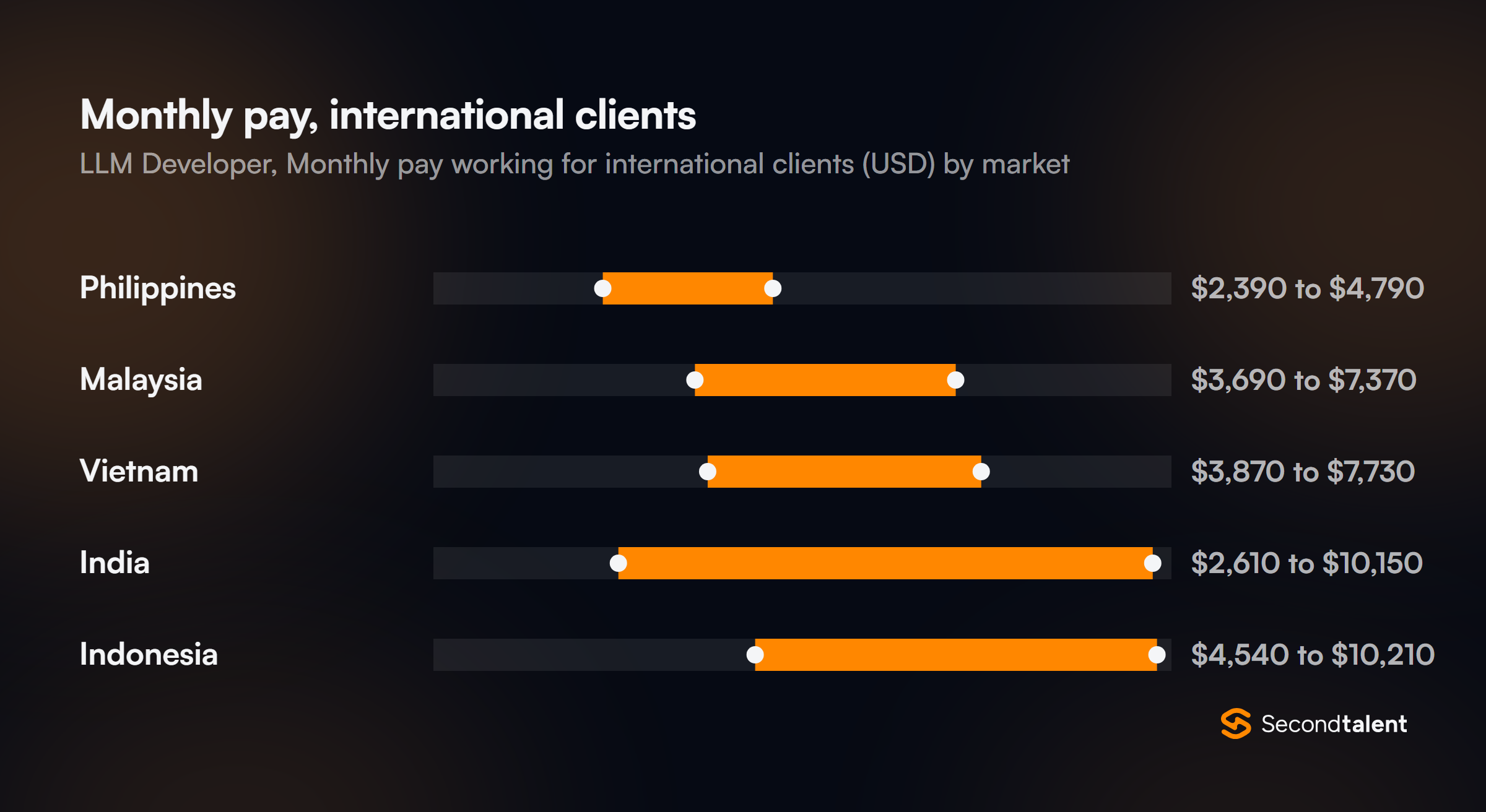
Monthly ranges from the Remote (Working for International Clients) figures on our rate cards for India, the Philippines, Malaysia, Vietnam and Indonesia, converted at ExchangeRate-API mid-market rates for 14 September 2026.
The India card quotes ₹250,000 to ₹970,000+ a month, at ₹95.61 to the dollar. A developer who spends the week on fine-tuning runs and evaluation sits closer to our India machine learning engineer card. That card runs $2,410 to $9,410+.
A developer who wires a hosted model into a support tool and one who trains adapters on your GPUs both carry the LLM title. They sit at opposite ends of the card, so say which one you need.
Through Second Talent you pay one monthly fee that bundles salary, payroll taxes, statutory contributions and our service fee, quoted per role and market. Our pricing page explains the subscription. For contract work, our LLM developer cost-to-hire page covers US freelance rates. Budget GPU hours and token bills on top of pay.
US Pay Benchmark for LLM Developers
The top of India's range, $10,150+, falls between the US 25th percentile and the median for software developers. LLM developers map to Software Developers (SOC 15-1252), because retrieval pipelines, agents and fine-tuned models reach users as production software.
| BLS OEWS, May 2025, national |
Software Developers (15-1252) |
| Median annual |
$135,980 |
| 10th percentile, monthly |
$6,870 |
| 25th percentile, monthly |
$8,770 |
| Median, monthly |
$11,330 |
| 75th percentile, monthly |
$14,330 |
| 90th percentile, monthly |
$17,890 |
Monthly figures are the annual wages on the OEWS profile for 15-1252 divided by 12, rounded to the nearest $10.
Salary is only part of the US cost. In the BLS Employer Costs for Employee Compensation release for June 2026, wages and salaries made up 68.5% of employer compensation costs for full-time private industry workers, and benefits the other 31.5%.
Time Zone Overlap: Bengaluru Against ET, CT and PT
Bengaluru runs nine and a half hours ahead of New York in September and ten and a half after 1 November, so calendar invites carry a half hour. India keeps UTC+5:30 all year with no daylight saving. US daylight time runs from 8 March to 1 November 2026, per NIST.
The arithmetic: 9:00 am in New York under EDT (UTC-4) is 13:00 UTC, and 13:00 UTC is 6:30 pm in Bengaluru. Under EST (UTC-5) it is 7:30 pm. San Francisco's 9:00 am lands at 9:30 pm in Bengaluru in summer and 10:30 pm in winter.
| Bengaluru shift (UTC+5:30) |
ET overlap (EDT / EST) |
CT overlap (CDT / CST) |
PT overlap (PDT / PST) |
Hours after 10 pm |
| 9:30 am-6:30 pm |
0 / 0 |
0 / 0 |
0 / 0 |
0 |
| 1 pm-10 pm |
3.5 / 2.5 |
2.5 / 1.5 |
0.5 / 0 |
0 |
| 3 pm-12 am |
5.5 / 4.5 |
4.5 / 3.5 |
2.5 / 1.5 |
2 |
| 6:30 pm-3:30 am |
8 / 8 |
8 / 7 |
6 / 5 |
5.5 |
Each shift is nine clock hours with a meal break, counted against a 9 am to 5 pm US day.
The 3 pm to midnight row suits an LLM team on the East Coast. The shared hours cover prompt reviews and eval readouts, and fine-tuning jobs started at logoff are done when the developer returns. A West Coast team gets two and a half hours at most from that shift.
India's four Labour Codes took effect on 21 November 2025. They provide double wages for overtime and let women work night shifts with their consent and mandatory safety measures. Write the late shift in as the contracted day, so evening calls do not become overtime. We fix it before the offer, which is how our placements get 4-6 hours of daily overlap with US hours.
LLM Developer Skills to Screen For
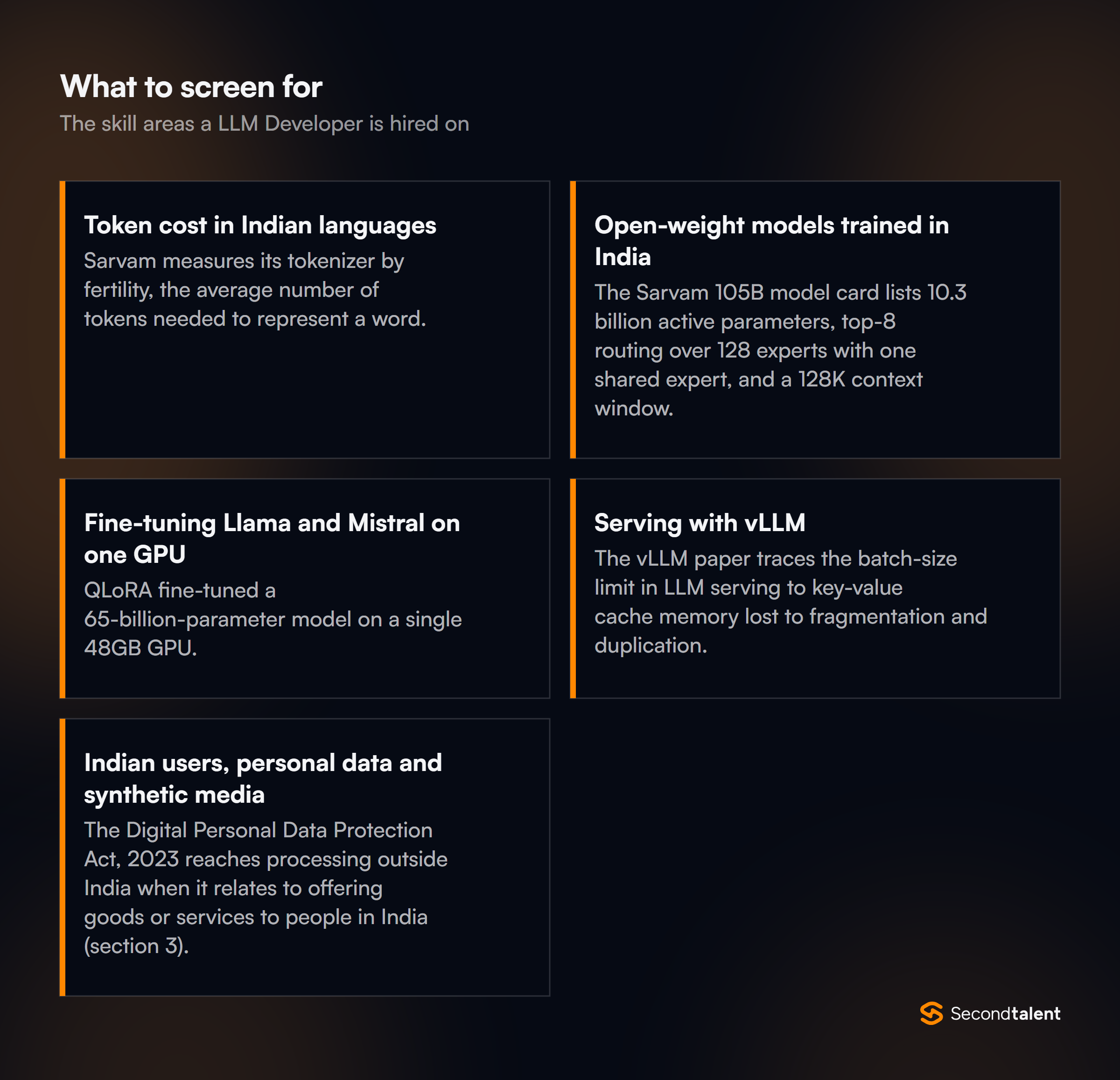
Sarvam credits the latency of its 30B model on Samvaad, its conversational agent platform, to fewer active parameters, targeted inference work and lower tokenizer overhead. An LLM developer makes the last two calls on any model you run, so screen for them first.
Token cost in Indian languages
Sarvam measures its tokenizer by fertility, the average number of tokens needed to represent a word. It reports that its tokenizer needs fewer tokens for Indic text than other open-source tokenizers.
Fertility sets both the bill and the context budget. Give the candidate one support ticket in Hindi and its English translation. Ask for the token count and price of each on the model you run today.
Open-weight models trained in India
The Sarvam 105B model card lists 10.3 billion active parameters, top-8 routing over 128 experts with one shared expert, and a 128K context window. Sarvam trained it on 12 trillion tokens. Its 30B sibling has 2.4 billion active parameters and saw 16 trillion.
Ask why a model with 10.3 billion active parameters still needs GPU memory for all of its weights. Then ask which of the two models your latency budget allows.
Fine-tuning Llama and Mistral on one GPU
QLoRA fine-tuned a 65-billion-parameter model on a single 48GB GPU. It trains low-rank adapters on top of a frozen 4-bit model and matched full 16-bit fine-tuning on the tasks tested.
Hand the candidate a Llama or Mistral checkpoint, a labelled dataset and a baseline. Ask for an adapter and the eval that shows it earned its GPU hours. Our fine-tuning engineer profile covers the training-heavy version of this hire.
Serving with vLLM
The vLLM paper traces the batch-size limit in LLM serving to key-value cache memory lost to fragmentation and duplication. PagedAttention cut that waste and lifted throughput two to four times at the same latency.
Ask the candidate to size KV cache for your peak concurrent sessions at your average prompt length. Then ask for the first setting they would change when p95 latency climbs.
Indian users, personal data and synthetic media
The Digital Personal Data Protection Act, 2023 reaches processing outside India when it relates to offering goods or services to people in India (section 3). A retrieval index built on Indian users' chats falls under it wherever the servers sit, so ask the candidate how they would honour a deletion request in a vector store.
If your product serves India, the amended IT Rules cover "synthetically generated information": realistic audio, visual or audio-visual content made or altered by a computer. Platforms must label it and, where feasible, embed provenance metadata. Ask the candidate which of your features would fall inside that definition. For Indic speech and classical text work, we also staff NLP engineers in India.
Contractor or Employer of Record in India
Software is not one of the nine categories of commissioned work that can be "work made for hire" under 17 U.S.C. § 101, and a copyright transfer must be in writing and signed under § 204(a).
India's Copyright Act points the same way. Section 17(c) makes the employer first owner of a work made under a contract of service, absent an agreement to the contrary, so a contractor keeps the copyright. Section 19 needs the assignment in writing and signed. An assignment with no stated period is deemed to last five years, and one with no stated territory covers India only. Rights the assignee leaves unused for a year lapse unless the deed says otherwise. Name weights, adapters, eval sets, prompts and code, and state a worldwide territory and the full copyright term.
IRS Publication 515 says the place where services are performed determines the source of the income, so a developer working from Pune or Hyderabad earns foreign-source income. A foreign individual gives the payer Form W-8BEN to certify foreign status.
India's courts apply no single employment test. In Sushilaben Indravadan Gandhi v. New India Assurance (2020), the Supreme Court held that "no one test of universal application can ever yield the correct result". It weighed all applicable tests on the totality of the facts. A developer on your hours, inside your sprints, on your tooling scores high on most of them. An Employer of Record with an Indian entity becomes the legal employer in that case. This is a summary, not legal advice.
|
Independent contractor |
Employer of Record |
| Legal employer |
None; the developer invoices you |
The EOR's Indian entity |
| US paperwork |
Form W-8BEN from the developer |
Service agreement with the EOR |
| IP |
Signed section 19 assignment stating worldwide territory and full term |
Employer first owner under section 17(c), passed to you in the EOR agreement |
| Local labor law |
Employment finding if the facts, taken together, point to service |
Labour Codes apply, including appointment letters and double overtime wages |
| Pay currency |
Agreed in the contract, often USD |
Local payroll run by the EOR |
English Level and Working Norms in India
Bengaluru scores 569 on the EF English Proficiency Index 2025, 85 points above India's national score of 484, and Hyderabad scores 554. India ranks 74th of 123 countries and regions, against a global average of 488. Its IT job-function score is 487, per EF's India page. Listening is India's weakest skill at 457, while writing reaches 504.
LLM work leans on writing, from system prompts to eval rubrics and failure write-ups, so run one assessment stage in writing and one live call and score them apart. A live call alone can undersell a strong writer.
India's central government holiday list for 2026, issued by the Department of Personnel and Training, puts Dussehra on Tuesday 20 October and Diwali on Sunday 8 November, with no substitute day. Guru Nanak's Birthday follows on Tuesday 24 November.
Private employers set their own lists, so agree dates in the contract. Thanksgiving on 26 November 2026 is a working day in India, so a developer there can run an eval sweep while your US team is off.
LLM Developer Hiring Process in India
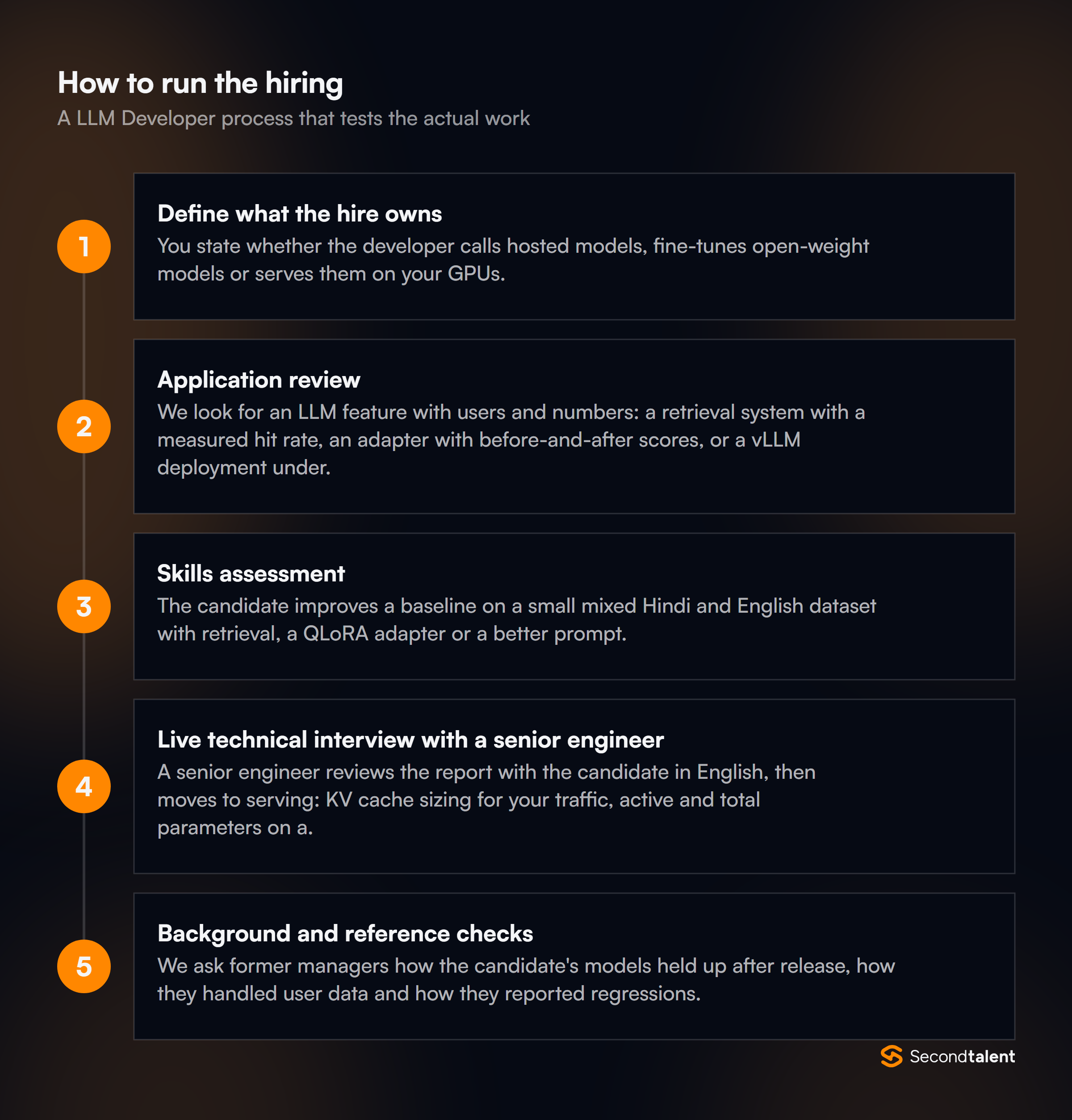
Second Talent's vetting covers stages 2 to 5 before you see a profile.
Stage 1: Define what the hire owns
You state whether the developer calls hosted models, fine-tunes open-weight models or serves them on your GPUs. Name the languages your users write in, the models and licences you accept, the GPU budget and the Bengaluru shift from the table above.
Stage 2: Application review
We look for an LLM feature with users and numbers: a retrieval system with a measured hit rate, an adapter with before-and-after scores, or a vLLM deployment under real load. A notebook demo with no eval does not pass.
Stage 3: Skills assessment
The candidate improves a baseline on a small mixed Hindi and English dataset with retrieval, a QLoRA adapter or a better prompt. They report scores, tokens per request in each language and cost per thousand requests.
Stage 4: Live technical interview with a senior engineer
A senior engineer reviews the report with the candidate in English, then moves to serving: KV cache sizing for your traffic, active and total parameters on a mixture-of-experts model, and the data a feature for Indian users may touch.
Stage 5: Background and reference checks
We ask former managers how the candidate's models held up after release, how they handled user data and how they reported regressions. You then choose the contractor or EOR route above.
Hire LLM Developers from India with Second Talent
We shortlist 6-8 candidates within 24 hours from 100,000+ pre-vetted engineers, accepting only the top 1% of applicants. LLM developers from India come with $0 upfront, no lock-in and 4-6 hours of daily overlap with US hours. We handle contracts, payroll and equipment.
Our pricing page sets out the monthly subscription, and for product AI work beyond language models we also staff AI developers in India.