Frontier models are extraordinary out of the box. They are also generic, often expensive, and not yours. The teams getting the most leverage from AI in 2026 are the ones who have learned to fine-tune. They take a base model, train it on their proprietary data, and end up with a smaller, cheaper, faster system that out-performs the frontier on their specific task.
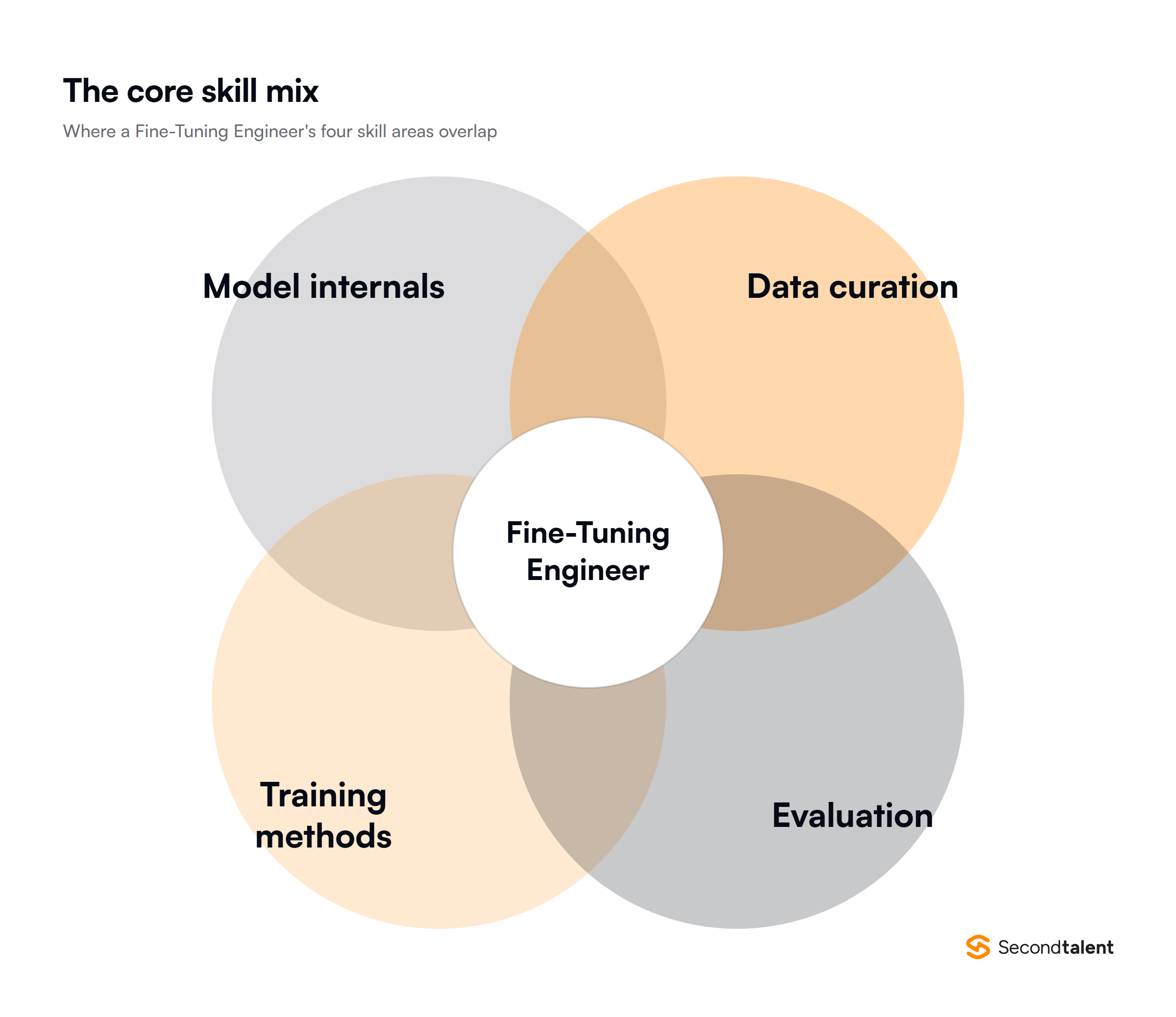
Fine-Tuning Engineers are the specialists who make this work in production. They design the dataset, choose the training method, run the experiments, evaluate the result, and ship the model into a system that other engineers can rely on. The skills sit at the intersection of large language model internals, applied machine learning, and the discipline of production ML.
What is a Fine-Tuning Engineer?
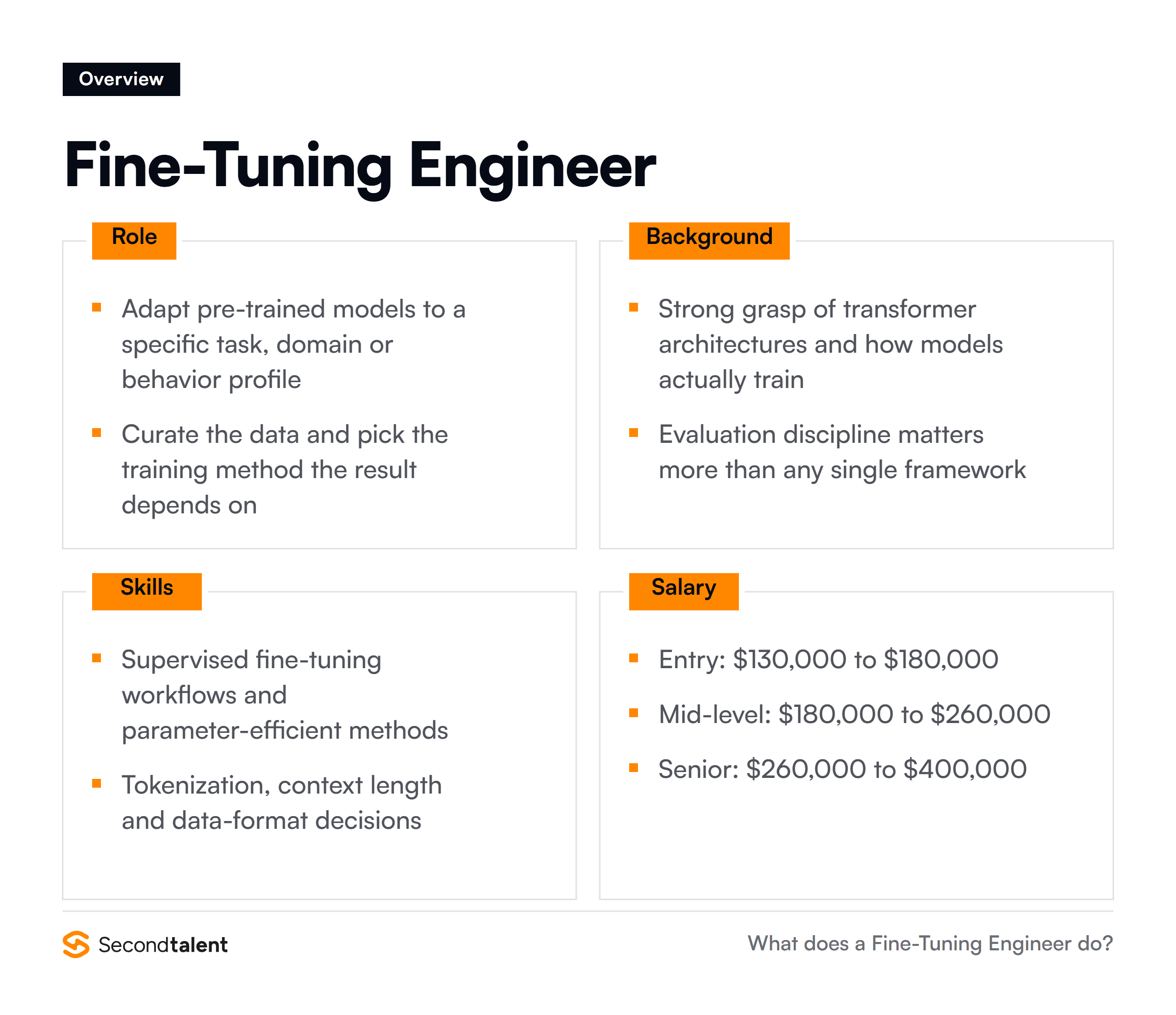
A Fine-Tuning Engineer specializes in adapting pre-trained language and multimodal models to specific tasks, domains, or behavior profiles. The role covers data curation, training-method selection (supervised fine-tuning, parameter-efficient methods such as LoRA, preference-optimization methods like DPO and RLHF), training infrastructure, evaluation, and deployment.
The discipline is distinct from general machine-learning engineering. Fine-tuning engineers rarely train models from scratch. They start with strong base models, work with relatively small but high-quality datasets, and operate in a regime where the bottleneck is usually data quality, evaluation rigor, and iteration speed rather than raw compute.
Fine-Tuning Engineer Job Market and Career Opportunities
The role barely existed before 2023. By 2026, every serious AI team has either hired one or is actively recruiting for one. Open-weight models from Meta, Mistral, Alibaba, and several research labs have made fine-tuning practical for teams that do not have AI-lab-scale compute, and the cost economics now favor fine-tuned smaller models over frontier API calls for high-volume workloads.
Average Salary Ranges (US-equivalent):
- Entry-level Fine-Tuning Engineer: $130,000 – $180,000
- Mid-level Fine-Tuning Engineer: $180,000 – $260,000
- Senior Fine-Tuning Engineer: $260,000 – $400,000
- Principal Fine-Tuning Engineer: $400,000 – $600,000+
Demand is heaviest at AI-native startups whose product depends on a specialized model, at enterprises with privacy or cost constraints that rule out frontier APIs, at AI infrastructure vendors offering managed fine-tuning, at consulting firms running fine-tuning engagements for clients, and at research labs working on alignment and post-training techniques.
Essential Fine-Tuning Skills and Qualifications
Core Knowledge Areas:
- Transformer architectures, attention, and the basics of how language models work
- Tokenization, vocabulary design, and context-length implications
- Supervised fine-tuning (SFT) workflows and data formats
- Parameter-efficient methods (LoRA, QLoRA, prefix tuning, adapter methods)
- Preference-optimization techniques (DPO, IPO, KTO, ORPO, RLHF)
- Distillation methods for compressing large teacher models into small ones
- Evaluation methodology specific to fine-tuned models
Technical Competencies:
- Strong PyTorch fluency, including custom training loops when needed
- Hugging Face ecosystem (transformers, datasets, accelerate, trl, peft)
- Distributed training (DeepSpeed, FSDP, accelerate-launched multi-GPU)
- GPU economics, memory budgeting, and gradient-checkpointing trade-offs
- Data curation, cleaning, and synthetic data generation pipelines
- Vector databases and retrieval for hybrid systems where fine-tuning meets RAG
- Inference serving (vLLM, TGI, SGLang) and deployment patterns
Soft Skills:
- Patience for the iterative experiment loop that quality fine-tuning requires
- Discipline around versioning datasets, prompts, and model checkpoints
- Strong technical writing for experiment reports and model cards
- Comfort communicating with product teams about realistic timelines and quality bounds
Fine-Tuning Career Paths and Specializations
The role specializes by training method, domain, or modality.
Supervised Fine-Tuning Specialist: Deep skill in instruction tuning, data formatting, curriculum design, and high-quality SFT workflows. The foundational specialization.
Preference Optimization Specialist: Focused on DPO, RLHF, and the broader post-training stack that aligns models to human preferences or specific behavior targets.
Parameter-Efficient Fine-Tuning Specialist: Focused on LoRA, QLoRA, and adapter methods that enable training on commodity hardware and serving many task-specific variants efficiently.
Domain-Adaptation Specialist: Working on continued pretraining and domain-specific fine-tuning for verticals like medical, legal, financial, or code.
Distillation Specialist: Compressing large teacher models into much smaller production models without losing task performance.
Multimodal Fine-Tuning Specialist: Adapting vision-language, audio-language, or document-understanding models for specific tasks.
Alignment and Safety Specialist: Working on the part of fine-tuning that shapes model behavior, refusal handling, and value alignment for production deployment.
Fine-Tuning Tools and Technologies
Training Frameworks:
- Hugging Face transformers and trl for the dominant training surface
- peft for parameter-efficient methods and adapter management
- accelerate and DeepSpeed for distributed training
- PyTorch FSDP for fully-sharded data parallel training
- Axolotl and LLaMA-Factory for higher-level training orchestration
Base Models and Weights:
- Open-weight families from Meta (Llama), Alibaba (Qwen), Mistral, Google (Gemma), Microsoft (Phi), and the broader open community
- Hugging Face Hub as the primary distribution surface
- Domain-specific base models for code, medical, and legal use cases
Data Tools:
- datasets and Argilla for dataset preparation and human-in-the-loop labeling
- Distilabel and Bespoke for synthetic data generation pipelines
- Snorkel, Cleanlab, and Lilac for dataset quality and curation
Evaluation:
- lm-evaluation-harness for standard academic benchmarks
- Custom golden datasets and LLM-as-judge pipelines for task-specific evaluation
- Promptfoo and Braintrust for production-style regression testing
- Ragas and DeepEval where the fine-tuned model is part of a retrieval system
Infrastructure:
- Managed training platforms (Modal, RunPod, Lambda, Together, Replicate)
- Cloud-native GPU clusters on AWS, GCP, Azure, CoreWeave, and Crusoe
- Weights and Biases or MLflow for experiment tracking
- Hugging Face Hub for model versioning and distribution
Inference Serving:
- vLLM for high-throughput serving
- TGI from Hugging Face for production-grade inference
- SGLang for advanced batching and structured generation
- Ollama for developer-local and on-prem deployment
Building Your Fine-Tuning Portfolio
Hiring managers screen on rigor more than scale. A single well-documented fine-tune outperforms a dozen sloppy ones.
Project ideas that signal seriousness:
- A specialized model fine-tuned for a real task (code review, contract extraction, customer-support routing), with a published evaluation report showing measurable lift over the base model
- A LoRA-based experiment comparing different ranks, learning rates, or data mixes, with results and analysis
- A DPO or KTO fine-tune that demonstrably improves a specific behavior metric over the SFT baseline
- A distillation project that shrinks a large model into a much smaller one with negligible task-quality loss
- A reproducible training recipe published as a notebook or template, with the model and dataset on Hugging Face Hub
The narrative carries weight. A clear writeup of the dataset choices, the experiment plan, the failure modes, and the trade-offs is the single strongest signal a fine-tuning engineer can produce.
Fine-Tuning Methodology and Best Practices
Start with evaluation, not training. The first artifact in any fine-tuning project is a golden evaluation dataset. Without it, every experiment is a guess.
Try prompting and RAG first. Fine-tuning is the right answer for behavior shaping, format conformance, and high-volume cost reduction. For knowledge addition, retrieval almost always beats fine-tuning. Pick the right tool.
Treat data quality as the dominant factor. Almost every disappointing fine-tune is a data-quality problem in disguise. Spend more time on the data than on hyperparameters.
Version everything. Datasets, prompts, base model checkpoints, training configs, and adapter weights. Reproducibility is the foundation of being able to iterate.
Use parameter-efficient methods by default. LoRA and QLoRA produce most of the quality of full fine-tuning at a fraction of the cost and operational complexity. Reach for full fine-tuning only when the parameter-efficient path is demonstrably blocked.
Evaluate both quantitatively and qualitatively. Benchmarks tell you whether the model is statistically better. Human eyes tell you whether the model is actually better. Both are required.
Build a regression suite that includes safety and refusal behavior. Fine-tuning can subtly degrade safety behavior. Track it explicitly, not as an afterthought.
Plan for model maintenance. A fine-tuned model is not a one-time artifact. Drift, dataset updates, and base-model upgrades will require re-training. Build the pipeline for the second run, not just the first.
Future of Fine-Tuning Engineering Careers
The discipline is professionalizing in several directions at once.
Smaller, specialized models keep winning specific workloads. The economics of running a 7B or 13B fine-tuned model on commodity hardware versus a frontier API at scale increasingly favor the specialized model. The trend line is firmly in fine-tuning’s favor.
Synthetic data is becoming first-class. Distillation from larger models, LLM-generated training data, and self-improvement pipelines are turning into standard practice. The engineers fluent in synthetic data generation will be among the most marketable.
Preference optimization is replacing pure SFT for many use cases. DPO, IPO, KTO, and ORPO have become practical to run without a dedicated reward model. The post-training stack continues to deepen.
On-device and edge models are creating a parallel market. Quantization, distillation, and small-model fine-tuning are the foundation of on-device AI. Specialists who pair fine-tuning skill with edge-deployment expertise will be in extreme demand.
Fine-tuning infrastructure is consolidating. Managed training platforms now make it possible for small teams to ship competitive fine-tuned models. The barrier is now skill and data, not compute.
Getting Started as a Fine-Tuning Engineer
Run one end-to-end fine-tune on a small open-weight model. Llama-3 8B or Qwen-2.5 7B, a real dataset, LoRA, and a published evaluation report. The reps build the intuition.
Read the post-training papers actively. The papers from Meta, Mistral, Hugging Face, and the Allen Institute on instruction tuning, DPO, and synthetic data are essential reading. They publish their recipes, and the recipes work.
Build mastery of one training framework. Hugging Face trl with peft is the dominant choice. Axolotl and LLaMA-Factory are excellent higher-level alternatives. Pick one and go deep.
Set up rigorous evaluation early. Before training anything serious, build a golden evaluation dataset and a scoring pipeline you trust. This habit alone separates strong fine-tuning engineers from the rest.
Publish your work on Hugging Face. Models, datasets, and writeups on the Hub get noticed. Several fine-tuning engineers have built their careers entirely on a few well-documented open-source releases.
Engage with the fine-tuning communities. The Hugging Face forums, the Eleuther and Nous Research Discord servers, and the various open-source training communities are where current best practice gets debated.
Fine-tuning is one of the highest-leverage AI specializations in the modern stack. The base models keep getting better, the tooling keeps getting friendlier, and the economic case for owning a specialized model keeps strengthening. Get fluent now and you will spend the next decade shipping the models that quietly run companies.