TL;DR: LLM engineers in China earn $9,680 to $18,760+ a month working for international clients on our AI engineer rate card, and we shortlist 6-8 candidates within 24 hours. The closest US benchmark, the BLS median for software developers, was $135,980 a year in May 2025.
DeepSeek's V3 technical report put the full training of a 671-billion-parameter model at 2.788 million H800 GPU hours, with 37 billion parameters active per token. An LLM engineer in China should be able to explain how routing and FP8 training kept that number down.
Key takeaways
- DeepSeek-V4.1-Flash carries the MIT licence on Hugging Face, while Moonshot AI's Kimi K3 licence asks large model-as-a-service businesses to sign a separate agreement.
- China's generative AI measures cover services offered to the public inside China, and research that serves no one there falls outside them.
- A 5 pm to 2 am shift in Shanghai gives a Chicago team four live hours while US daylight time lasts.
- An employer in China that runs more than a month without a written labour contract owes the worker double wages.
What LLM Engineers Earn in China Working for International Clients
China's floor sits within $530 of Indonesia's ceiling. We publish no LLM engineer card, so the table uses our AI engineer rate cards, the closest match. The figures are what engineers in each market earn working directly for foreign companies, before any employer or platform costs.
| Market |
Monthly pay working for international clients (USD) |
| China |
$9,680-$18,760+ |
| Malaysia |
$3,690-$7,370+ |
| Indonesia |
$4,540-$10,210+ |
| Singapore |
$14,210-$27,620+ |
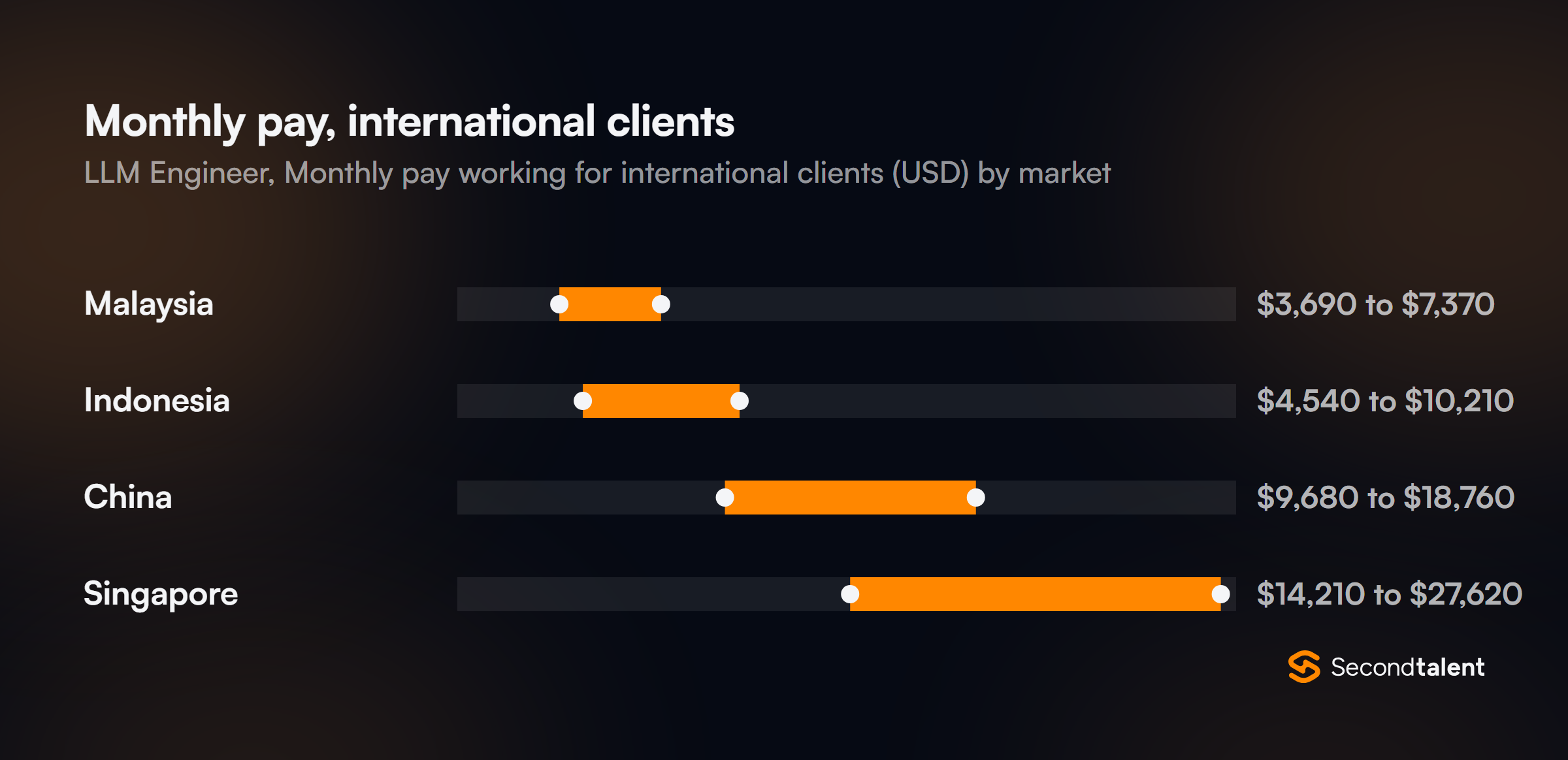
Monthly ranges from the Remote (Working for International Clients) figures on our rate cards for China, Malaysia, Indonesia and Singapore, converted at ExchangeRate-API mid-market rates for 14 September 2026.
The China card quotes ¥65,000 to ¥126,000+ a month. For a hire who trains models rather than building on them, our China machine learning engineer card starts at the same $9,680 and runs to $25,760+.
Compute sits on top of pay for this role. Fine-tuning needs GPU time and hosted models run up token bills, so budget both in the brief. For contract work, our LLM developer cost-to-hire page lists US freelance rates, and our pricing page explains how we bill a full-time hire.
US Pay Benchmark for LLM Engineers
LLM engineers who build products on models map to Software Developers (SOC 15-1252). Engineers whose job is training runs, fine-tuning experiments and evaluation research sit closer to Computer and Information Research Scientists (15-1221).
| BLS OEWS, May 2025, national |
Median annual |
10th percentile, monthly |
Median, monthly |
90th percentile, monthly |
| Software Developers (15-1252) |
$135,980 |
$6,870 |
$11,330 |
$17,890 |
| Computer and Information Research Scientists (15-1221) |
$140,300 |
$6,850 |
$11,690 |
$19,220 |
Monthly figures are the annual wages on the BLS OEWS profiles for 15-1252 and 15-1221 divided by 12, rounded to the nearest $10.
Use the research column for a hire who will own pretraining or post-training experiments. Its 90th percentile runs $1,330 a month above the software developer column.
Salary is only part of the US cost. In the BLS Employer Costs for Employee Compensation release for June 2026, wages and salaries made up 68.5% of employer compensation costs for full-time private industry workers, and benefits the other 31.5%.
Time Zone Overlap: Shanghai Against ET, CT and PT
Shanghai's working day falls in the US night. An evaluation sweep started at 9 am in Shanghai, 9 pm the evening before in New York, can report by the time your team logs on. Shanghai is on UTC+8 with no daylight saving, and US daylight time runs from 8 March to 1 November 2026, per NIST.
The arithmetic: 9:00 am in Chicago is 14:00 UTC under CDT (UTC-5), and 14:00 UTC is 10:00 pm in Shanghai. Under CST (UTC-6) it is 11:00 pm. New York's 9:00 am lands an hour earlier in Shanghai, at 9:00 pm, and San Francisco's lands at midnight.
| Shanghai shift (UTC+8) |
ET overlap (EDT / EST) |
CT overlap (CDT / CST) |
PT overlap (PDT / PST) |
Hours between 10 pm and 6 am |
| 9 am-6 pm |
0 / 0 |
0 / 0 |
0 / 0 |
0 |
| 2 pm-11 pm |
2 / 1 |
1 / 0 |
0 / 0 |
1 |
| 5 pm-2 am |
5 / 4 |
4 / 3 |
2 / 1 |
4 |
| 8 pm-5 am |
8 / 7 |
7 / 6 |
5 / 4 |
7 |
Overlap counts clock hours of a nine-hour shift, including a meal break, against a 9 am to 5 pm US day.
The two middle rows suit most LLM teams: a few live hours for reviewing eval results, then long jobs that run through the US night. China's Labor Law limits a working day to eight hours (Article 36). Its pay premiums attach to extended hours, rest days and statutory holidays (Article 44). A later shift inside eight hours buys overlap at base pay, while calls after a day shift count as extended hours.
We fix the shift before the offer, which is how our placements get 4-6 hours of daily overlap with US hours.
LLM Engineer Skills to Screen For
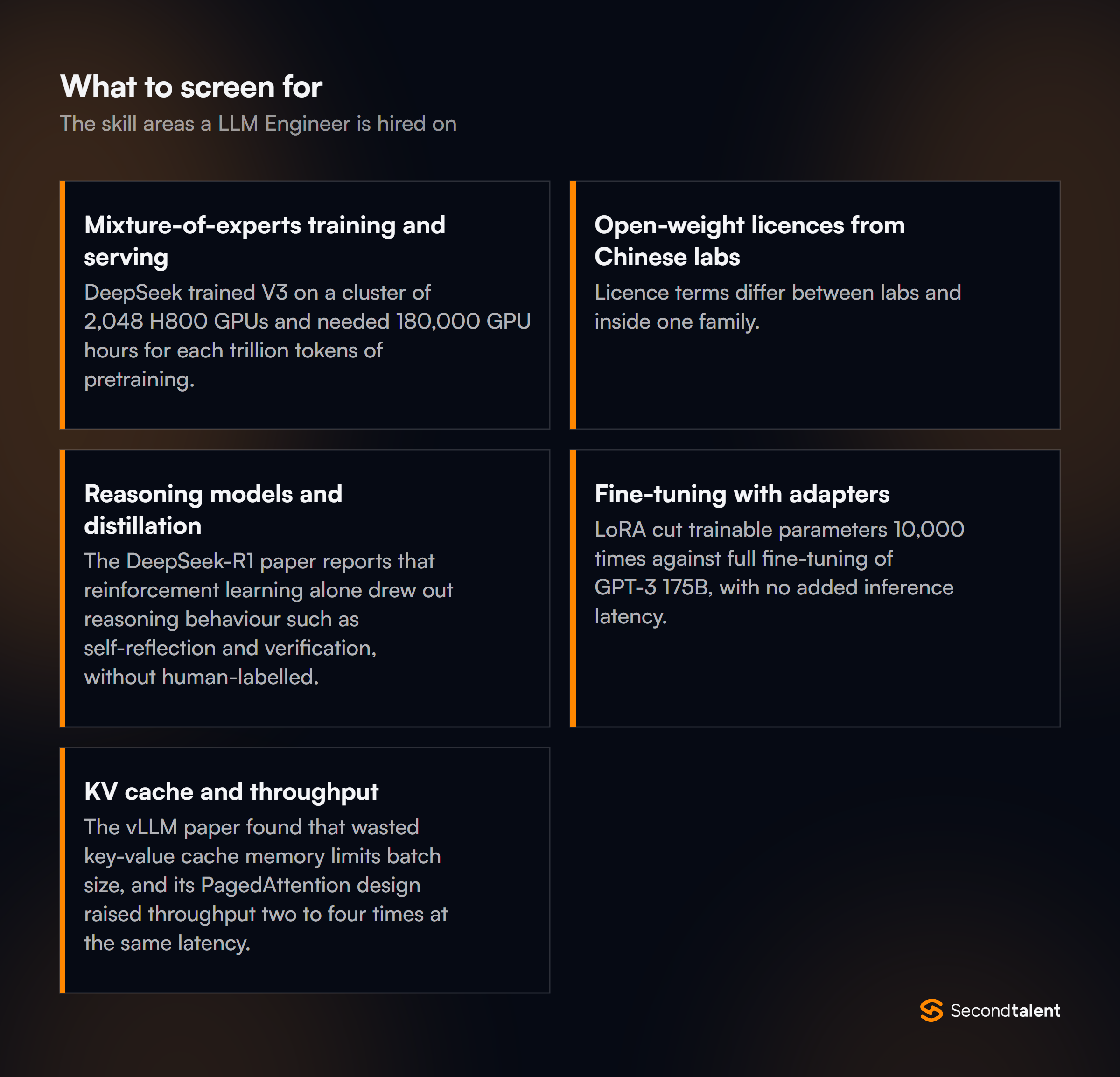
In Stack Overflow's 2025 survey, 23.3% of respondents used DeepSeek's reasoning models for development work, ahead of Meta Llama at 17.8%. Alibaba's Qwen stood at 5.2%. Screen for the model families you plan to run, then test the five areas below.
Mixture-of-experts training and serving
DeepSeek trained V3 on a cluster of 2,048 H800 GPUs and needed 180,000 GPU hours for each trillion tokens of pretraining. Its cost figures leave out prior research and ablation runs.
The report also claims FP8 mixed-precision training on a model of that size as a first. Ask the candidate why a model with 37 billion active parameters still needs memory for all 671 billion. Then ask how they would place experts across GPUs for your traffic.
Open-weight licences from Chinese labs
Licence terms differ between labs and inside one family. DeepSeek-V4.1-Flash ships under MIT, and Qwen3.8-27B under Apache 2.0.
Its sibling Qwen3.8-Flash-Next uses the Qwen Community License 1.0, which requires the model name on screen for products above 100 million monthly active users or $20 million in monthly revenue.
The Kimi K3 licence asks any model-as-a-service business with more than $20 million in revenue over 12 months to sign a separate agreement. Ask the candidate which clause would bite first for your product.
Reasoning models and distillation
The DeepSeek-R1 paper reports that reinforcement learning alone drew out reasoning behaviour such as self-reflection and verification, without human-labelled reasoning traces. It adds that the patterns can guide smaller models. Ask how the candidate would distil a reasoning model into one you can serve, and which eval would show the student had copied answer formats without the reasoning.
Fine-tuning with adapters
LoRA cut trainable parameters 10,000 times against full fine-tuning of GPT-3 175B, with no added inference latency. Give the candidate a labelled dataset and a baseline prompt, and ask whether an adapter, retrieval or a better prompt moves the score most per dollar. Our fine-tuning engineer profile covers the training-heavy version of the role.
KV cache and throughput
The vLLM paper found that wasted key-value cache memory limits batch size, and its PagedAttention design raised throughput two to four times at the same latency. Ask the candidate to size GPU memory for your peak concurrency and name what they would trade when latency and batch size collide.
Contractor or Employer of Record in China
Software is not one of the nine categories of commissioned work that can be "work made for hire" under 17 U.S.C. § 101, and a copyright transfer must be in writing and signed under § 204(a). On the Chinese side, Article 11 of the Computer Software Protection Regulations leaves commissioned software with the developer unless a written contract says otherwise. List adapters, fine-tuned weights, training and eval datasets, prompts and serving code in the assignment.
IRS Publication 515 says the place where services are performed determines the source of the income, so an engineer working from Hangzhou or Beijing earns foreign-source income. A foreign individual gives the payer Form W-8BEN to certify foreign status.
China's Labor Contract Law applies to employing units inside China (Article 2). A written contract is due within a month of the start (Article 10), with double wages owed after that (Article 82). A 2005 labour ministry notice finds employment without a contract when the worker does paid work under the employer's rules and management, as part of its business.
Two AI rules frame the work itself. Article 2 of China's generative AI measures, in force since 15 August 2023, applies to services offered to the public inside China. It excludes organisations that research or apply the technology without offering such services there.
On the US side, the Justice Department treats an individual primarily resident in China as a covered person. Giving that person access to bulk US sensitive personal data under an employment agreement requires CISA's security requirements, so keep training data free of US personal records where you can.
An engineer who owns your model pipeline full time looks like an employee under the notice above. Our Employer of Record service supplies the local employing unit, and our China EOR page has the details. This is a summary, not legal advice.
|
Independent contractor |
Employer of Record |
| Legal employer |
None; the engineer invoices you |
The EOR's employing unit in China |
| US paperwork |
Form W-8BEN from the engineer |
Service agreement with the EOR |
| IP |
Written assignment of weights, adapters, datasets and code |
Employee software rule (Article 13) plus your EOR agreement |
| Local labor law |
Employment finding if you set rules and manage the work |
Written contract, eight-hour day and statutory holidays apply |
| Pay currency |
Agreed in the contract, often USD |
Local payroll run by the EOR |
English Level and Working Norms in China
China's IT job-function score is 491 on the EF English Proficiency Index 2025, 27 points above its national score of 464, which ranks 86th of 123 countries and regions. The global average is 488, per EF's China page.
LLM engineers write for models as well as colleagues: system prompts, evaluation rubrics, model cards. Ask finalists to write a rubric for one of your prompts in English and grade three model answers against it.
China's statutory holidays grew from 11 days to 13 in 2025, when State Council Order 795 made Spring Festival four days from Lunar New Year's Eve and Labour Day two. The State Council's 2026 schedule gives 1 to 7 October off for National Day, with Saturday 10 October a make-up workday. Book GPU reservations and model releases around that week.
Thanksgiving on 26 November 2026 is a working day in China, so an engineer there can run an evaluation cycle while your US team is off.
LLM Engineer Hiring Process in China
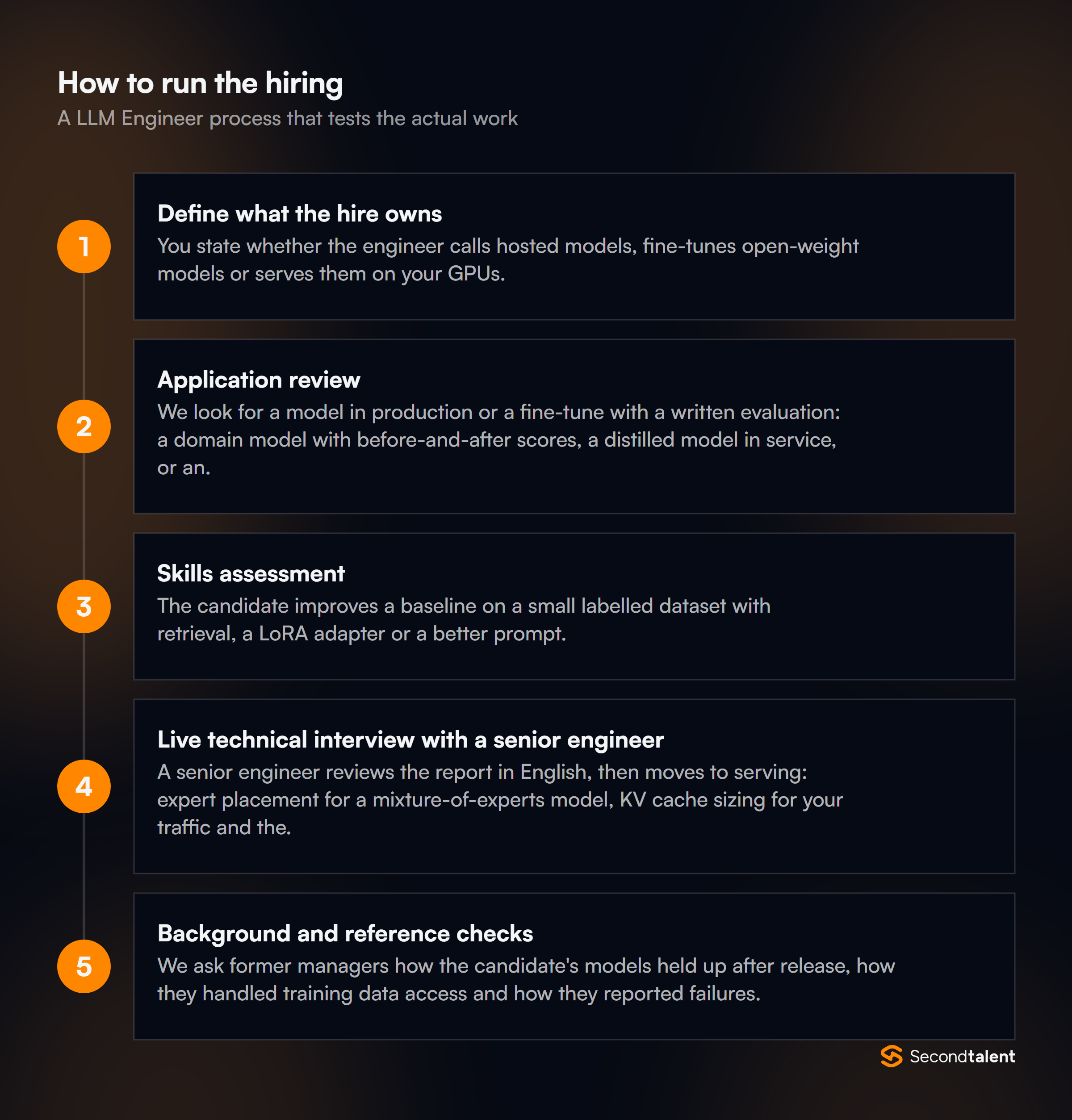
Second Talent's vetting covers stages 2 to 5 before you see a profile.
Stage 1: Define what the hire owns
You state whether the engineer calls hosted models, fine-tunes open-weight models or serves them on your GPUs. Name the model families and licences you accept, the compute budget, and the data the engineer may use.
Stage 2: Application review
We look for a model in production or a fine-tune with a written evaluation: a domain model with before-and-after scores, a distilled model in service, or an inference stack under real load. A chatbot demo with no numbers does not pass.
Stage 3: Skills assessment
The candidate improves a baseline on a small labelled dataset with retrieval, a LoRA adapter or a better prompt. They write an evaluation report covering scores, token cost and the licence of the model they chose.
Stage 4: Live technical interview with a senior engineer
A senior engineer reviews the report in English, then moves to serving: expert placement for a mixture-of-experts model, KV cache sizing for your traffic and the licence clause that fits your product.
Stage 5: Background and reference checks
We ask former managers how the candidate's models held up after release, how they handled training data access and how they reported failures. You then choose the contractor or EOR route above.
Hire LLM Engineers from China with Second Talent
We shortlist 6-8 candidates within 24 hours from 100,000+ pre-vetted engineers, accepting only the top 1% of applicants. LLM engineers from China come with $0 upfront, no lock-in and 4-6 hours of daily overlap with US hours. We handle contracts, payroll and equipment, with compliant EOR contracts in China.
Our pricing page covers the subscription, and for product AI work we also staff AI engineers in China.