TL;DR: Staffing agencies bill temporary staff at the worker's pay rate plus a markup, and Robert Half's public contract with a Texas purchasing co-op sets that markup at 65% for administrative roles and 70% for IT. Direct hire placements most often cost 20% of first-year salary, and retained executive search about one-third of first-year cash pay.
A City of Galveston council agenda file shows what a staffing invoice looks like in practice: a data entry clerk billed at $27.00 an hour, with overtime at 1.5 times that rate. The clerk sees none of that number.
Behind that bill rate sits a lower pay rate and a markup that has to cover payroll taxes, insurance, recruiting and the agency's profit. The fee model you sign sets the size of that markup and what else lands on the invoice.
- 1Listed staffing firms kept between 16.7% and 39.0% of contract revenue as gross margin in 2025, from ManpowerGroup to Robert Half.
- 2Temp-to-hire fees shrink as hours build up, and at Robert Half's OfficeTeam they reach zero after 640 hours.
- 3In the UK, a temp-to-perm transfer fee stops being enforceable 14 weeks after the first day or 8 weeks after the last, whichever ends later.
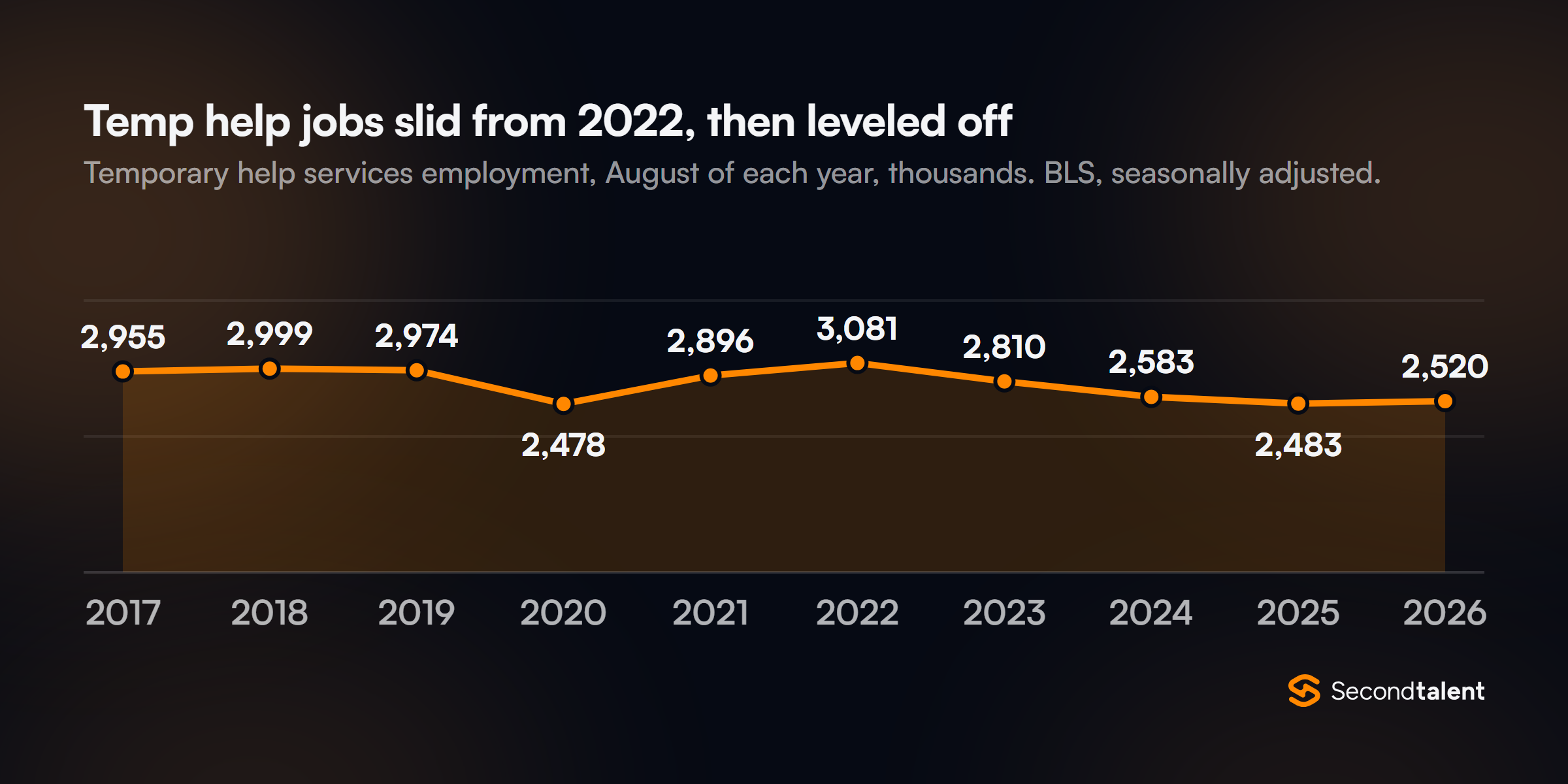
- 4US temporary help employment stood at 2.52 million in August 2026, down from 3.16 million at its March 2022 peak.
How Much Do Staffing Agencies Charge?
It depends on who ends up employing the worker. If the agency stays the employer, you pay a marked-up hourly rate for as long as the assignment runs. If you hire the candidate onto your own payroll, you pay a one-time fee tied to salary. The fee models below are versions of those two.
| Fee model | How it is priced | Published example |
|---|---|---|
| Temporary or contract staffing | Markup on the worker's hourly pay rate | 65% administrative, 70% IT (Robert Half) |
| Short assignments | Higher markup for small jobs | Up to 150% under 40 hours (Reliable Staffing) |
| Temp-to-hire | Hourly markup, then a conversion fee | 25% of salary, falling to 0% after 640 hours (Robert Half) |
| Direct hire (contingency) | Share of first-year salary, paid on hire | 20% most common (SIA survey); 30% default (Robert Walters, New York) |
| Retained executive search | Share of first-year cash pay, in stages | About one-third (Korn Ferry) |
| Managed service program (MSP) | Fee as a share of spend | Used by 80% of MSP clients (SIA) |
Our recruitment agency fee calculator runs these models against a salary you enter. For the wider choice between a contractor and an employee, see contract vs. direct hire.
Staffing Agency Markup Rates and Bill Rates
The bill rate is the pay rate multiplied by one plus the markup. Robert Half's pricing under the H-GAC cooperative purchasing contract, filed with a City of Galveston agenda item in September 2024, adds 65% to the base rate for administrative roles and 70% for IT roles. A $20 pay rate becomes a $33 bill rate; a $40 IT contractor bills at $68.
Only part of that spread is fixed by law. The employer share of FICA is 7.65% of wages, 6.2% for Social Security and 1.45% for Medicare, according to the IRS. Federal unemployment tax is 6.0% on the first $7,000 of wages, less a credit of up to 5.4%, which leaves about $42 a year per worker once the credit applies (IRS Topic 759).
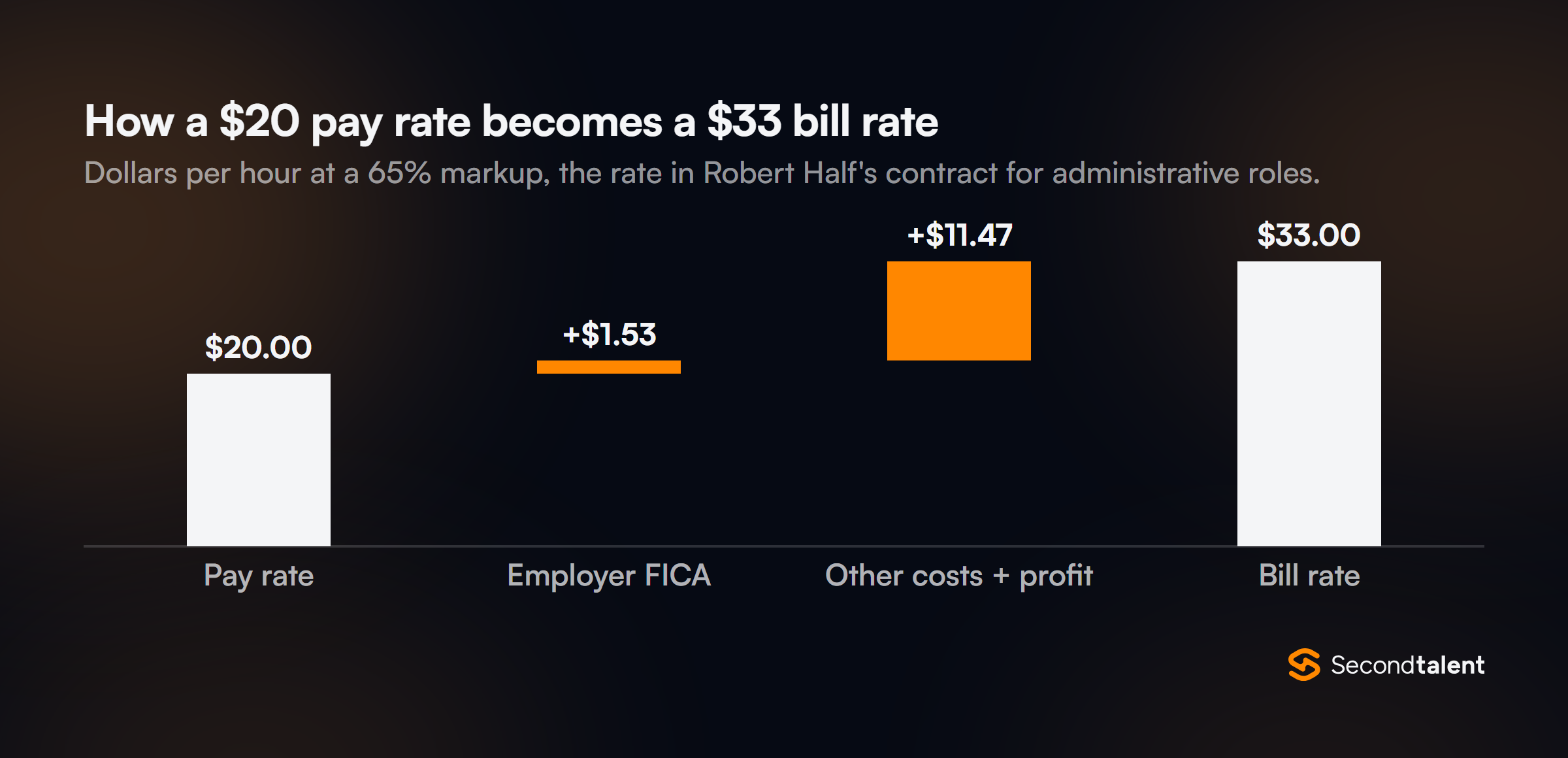
The rest varies by state and job. State unemployment tax rates depend on the agency's claims history, and workers' compensation premiums depend on the job's risk class, so a warehouse assignment carries a heavier load than an office one. Benefits the agency offers, recruiting costs, payroll administration and profit all come out of what is left.
Markups climb with the effort a role takes to fill. The five-point gap between Robert Half's administrative and IT rates is consistent with the extra recruiting and skills screening technical roles need, and some roles add licensing checks on top.
Skilled trades add a compliance step to that screening. An HVAC staffing agency, for example, checks that each technician holds EPA Section 608 certification and any state or local license the job requires before a placement, and that vetting is part of what the markup or placement fee covers.
Short jobs cost more per hour. The terms of Reliable Staffing in San Antonio allow a markup of up to 150% when an assignment runs less than 40 hours in total. Recruiting and onboarding cost the agency the same whether a job lasts two days or two months.
How Much Do Staffing Agencies Make Off Their Employees?
Public filings answer this better than any survey. After paying workers and the payroll costs tied to them, Robert Half kept 39.0% of its contract talent revenue in 2025, according to its fourth-quarter earnings release. Volume staffers keep far less: ManpowerGroup's gross profit came to 16.7% of revenue, based on the totals in its 2025 results.
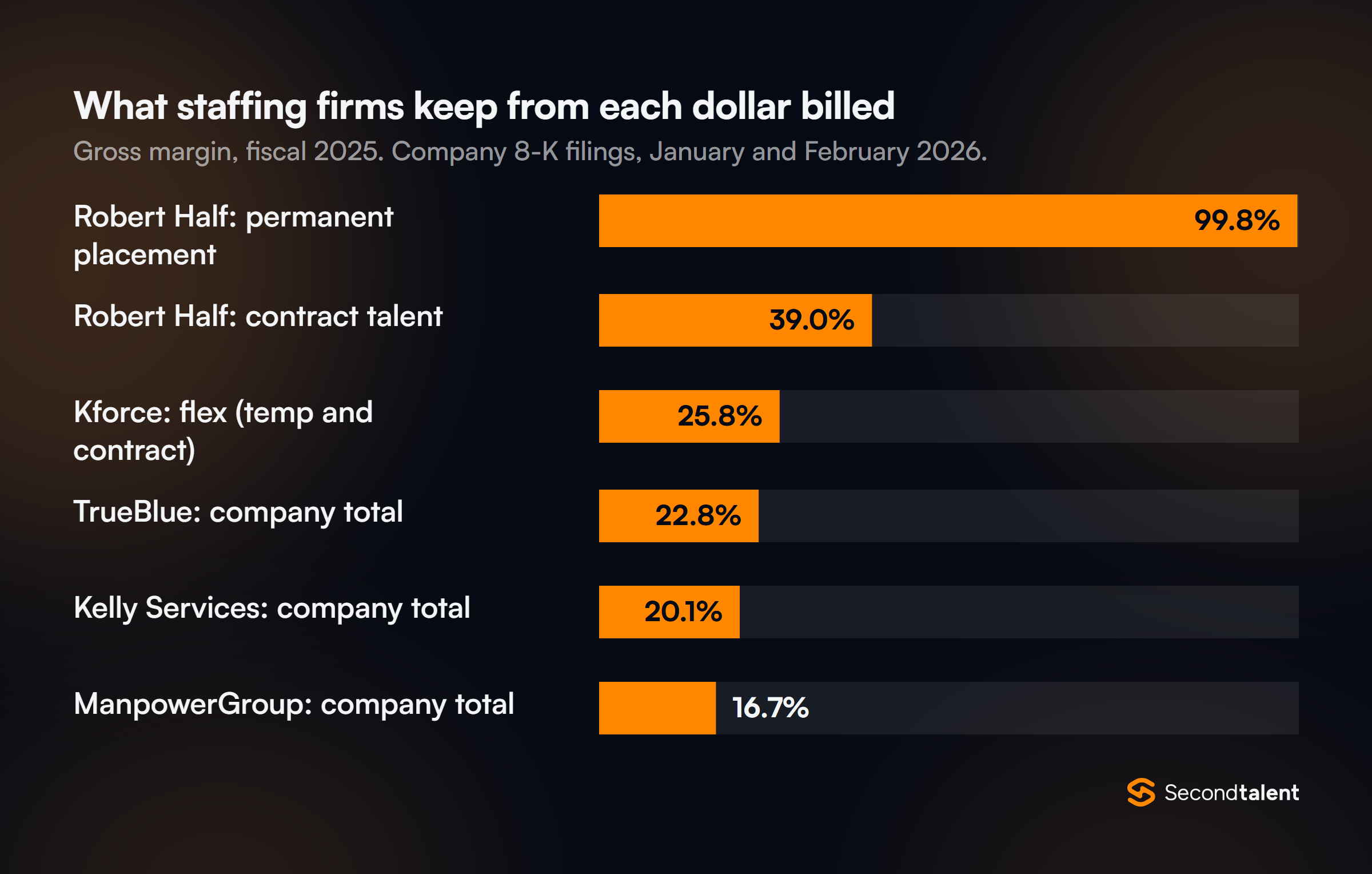
Between them sit Kforce, whose temp and contract business ran at 25.8%, TrueBlue at 22.8%, down from 25.9% a year earlier, and Kelly Services at 20.1%. The firms at the top place mostly professional and technology staff; those lower down do more industrial and high-volume work.
Gross margin is not profit. Recruiters' pay, offices, job boards and technology all come out of it. The 99.8% figure for permanent placement looks extreme for the same reason: a direct hire fee has almost no direct cost attached, since the candidate goes onto the client's payroll, and the recruiter's time sits in operating expenses instead.
Direct Hire Placement Fees
The most common direct hire fee is 20% of first-year salary, charged by 42% of staffing firms in a Staffing Industry Analysts survey of North American firms. On an $80,000 hire that is $16,000, due once the candidate starts.
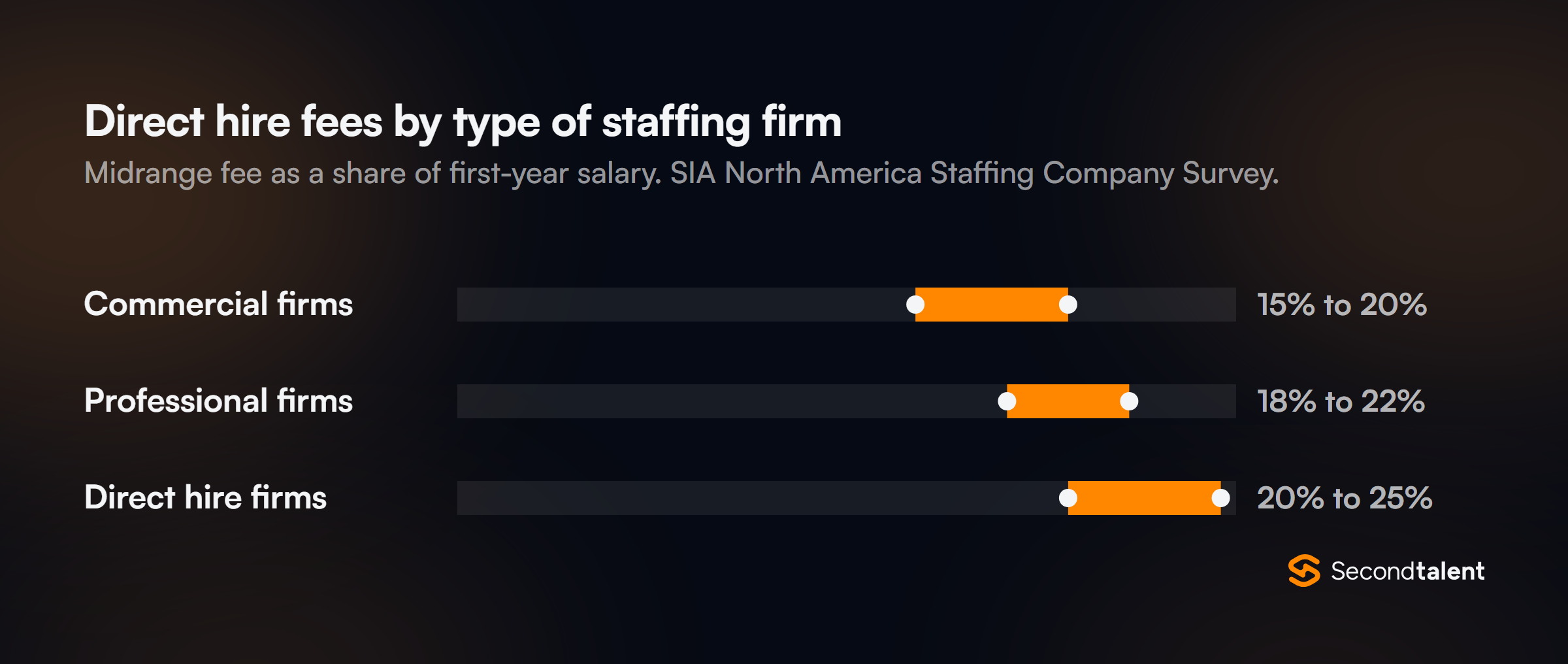
Firms that only do direct hire charge the most, with a midrange of 20% to 25%. The survey data dates from 2021, so check it against quotes. Recent contracts sit at or above that band: Robert Half's H-GAC pricing sets direct hire at 25% of annual salary, and the New York terms of Robert Walters use a standard 30% of the candidate's salary package.
Read what "salary" means in the contract. Robert Walters counts two-thirds of a likely bonus that is not guaranteed as part of the package, so a $100,000 base with a $30,000 target bonus is billed on $120,000, a $36,000 fee at 30%.
Contingency vs. retained executive search
- Paid only when a candidate is hired
- 20% of first-year salary is the most common fee
- Used for most roles below the executive level
- Paid in stages whether or not the search succeeds
- About one-third of first-year cash pay, plus expenses
- Used for executive and board roles
Korn Ferry's annual report puts its search fees at generally one-third of the placed candidate's estimated first-year cash compensation, plus a percentage of the fee for indirect expenses. If the final package comes in higher than estimated, an extra fee applies. On a $300,000 package the base fee is $100,000.
Temp-to-Hire Conversion Fees
A conversion fee is what you pay to hire a temp before the agency has earned enough markup from them. Robert Half's OfficeTeam scale charges 25% of the annual starting salary if you convert within the first 160 hours billed, and nothing after 640 hours, about 16 weeks of full-time work.
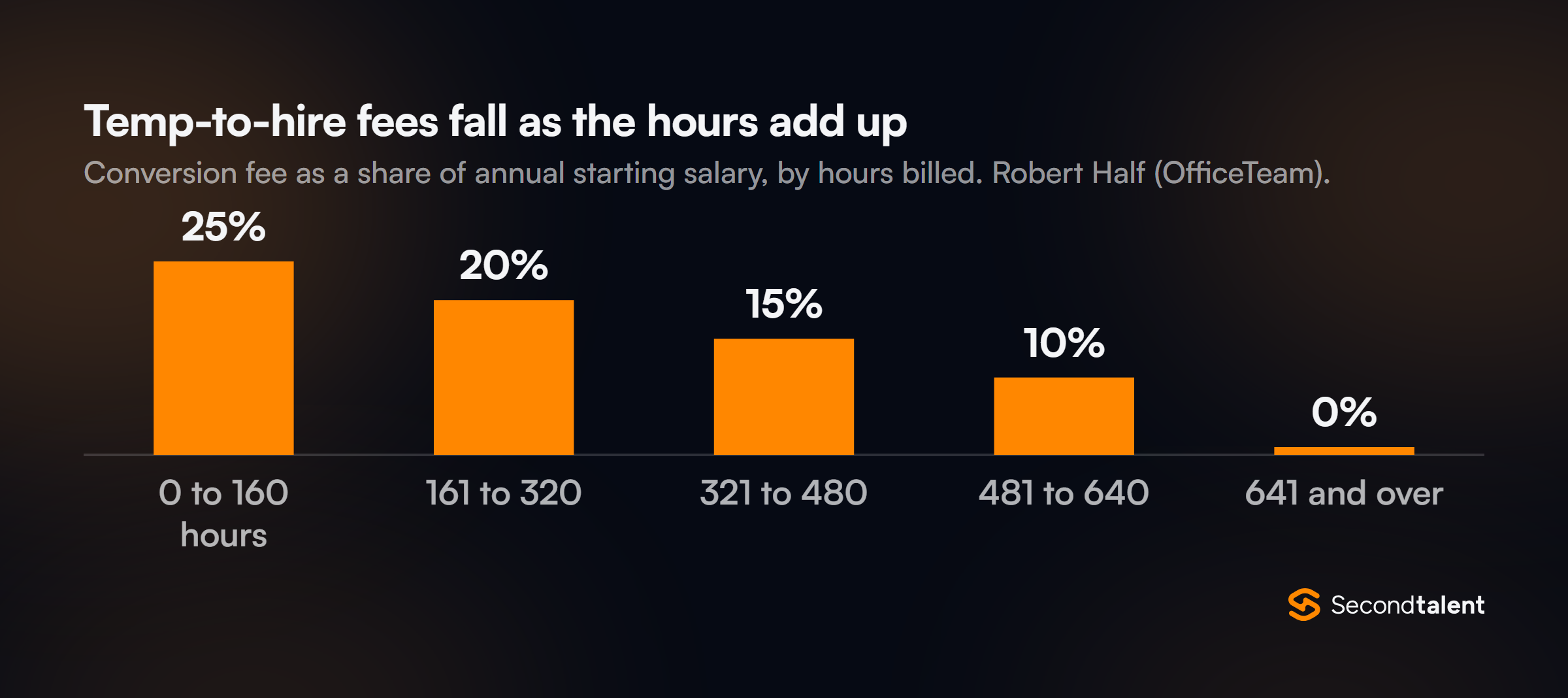
The same contract says the no-fee point for other Robert Half divisions varies from 641 to 1,561 hours depending on the position.
Smaller agencies use different triggers. Reliable Staffing's terms treat an assignment as temp-to-hire after 520 consecutive hours, charge a prorated 20% placement fee for an earlier hire within 12 months of the start date, and add a 10% violation fee if the client hires without telling the agency.
The cheapest conversion is usually the one you plan. If you expect to hire the temp, agree the hours threshold and fee in writing before the assignment starts, and time the offer to land after the fee drops.
Contract Clauses That Add to the Bill
The markup is rarely the only charge. These clauses come from the published terms of Robert Half and Reliable Staffing, and most agency agreements carry some version of them.
Pass-through costs are the ones to cap. Reliable can bill at cost for legal, medical or technology fees a worker incurs, and passes through new or increased labor costs. Robert Half may charge a technology fee when it supplies equipment. Both are reasonable in principle and open-ended in practice, so ask for a list and a ceiling.
Large buyers often run staffing through a managed service program. In SIA's research, 80% of MSP clients pay a fee as a percent of the spend running through the program. Ask who funds that fee, since it can sit inside supplier markups rather than on your invoice.
UK Temp Agency Charges and Transfer Fees
UK law limits when an agency can charge a temp-to-perm fee. Under regulation 10 of the Conduct of Employment Agencies and Employment Businesses Regulations 2003, a transfer fee is unenforceable unless the contract lets the hirer choose an extended hire period instead, and it lapses after the "relevant period" below.
The week-12 point comes from the Agency Workers Regulations 2010: after 12 weeks in the same role with the same hirer, an agency worker gets the same pay, annual leave and pension enrolment rights as someone employed directly. A break of more than six weeks resets the count.
Equal pay can lift the pay rate, and the charge rate built on it, so price long assignments on the post-12-week rate.
Employer National Insurance adds 15% on earnings above £5,000 a year to a UK charge rate, per HMRC's 2026 to 2027 rates. For contractors working through their own companies, the off-payroll rules make the client responsible for deciding employment status in most cases, and agencies in the chain carry their own duties.
Staffing Industry Trends in 2026
US staffing is coming out of a three-year slump. The American Staffing Association reported its first year-over-year growth since late 2022 in the second quarter of 2026, with revenue up 3.3% and employment up 0.6%.
SIA expects the market to reach $183.1 billion in 2026 and grow a further 2.2% in 2027, in its September 2026 forecast. Its total covers more than the ASA's temporary and contract sales, so the two figures do not compare directly.
The BLS count of temporary help jobs shows the same turn. It fell every August from 2022 to 2025, then edged up 1.5% to 2,519,500 in the preliminary August 2026 figure.
The UK is turning too. The KPMG and REC Report on Jobs for August 2026 recorded the first rise in permanent placements since September 2022 and a fifth straight month of growth in temp billings.
Hiring Developers Without Agency Markups
For engineering roles, a 20% to 30% placement fee or a 70% hourly markup is paid on top of US salaries. Second Talent matches companies with vetted developers from Asia at 50 to 70% below US hiring costs, and our guide to staffing agency fees in Asia compares local rates. Tell us the role you need to fill and we will come back with candidates.
Frequently Asked Questions
Who pays the staffing agency fee, the employer or the worker?
The employer. Robert Half's annual report states that it charges candidates no fee for placement services. In the UK, regulation 26 of the 2003 conduct regulations bars agencies from charging work-seekers for finding them work, outside a short list of occupations such as entertainment and modeling.
What happens if a placed candidate leaves early?
Most contracts carry a guarantee, but its form varies. Robert Half's annual report refers to a 90-day guarantee period on permanent placements. Robert Walters' New York terms give no refund and instead look for a replacement if the hire leaves within 12 weeks. For temps, Robert Half does not charge for the first eight hours if you are unhappy with the worker and let it send a replacement.
Is an agency more expensive than hiring directly?
Usually, on fees alone. SHRM benchmarking put the average cost per hire at nearly $4,700 in 2022 data, against $16,000 for a 20% fee on an $80,000 salary. The gap narrows once you count recruiter time and the cost of a slow or failed search. For contractors, compare the bill rate with the cost of an employer of record or direct contract.