TL;DR: Back-end developers in Singapore earn $9,470 to $16,180+ a month working for international clients on our Node.js developer rate card, and we shortlist 6-8 candidates within 24 hours. The closest US benchmark, the BLS median for software developers, was $135,980 a year in May 2025.
MAS Notice FSM-N05 caps unscheduled downtime at a Singapore bank at 4 hours per critical system in any 12 months. It also gives the bank 1 hour to report a relevant incident. A back-end developer from that sector should show you the failover and alerting behind both numbers.
Key takeaways
- Singapore's range starts above the top of the Philippine, Vietnamese and Malaysian ranges in the table.
- Node.js 20 reached end of life on 30 April 2026, and Node.js 26 becomes an LTS line on 28 October 2026.
- Once an organisation assesses a data breach as notifiable under Singapore's PDPA, it has no more than 3 calendar days to tell the regulator.
- A 5 pm to 2 am shift in Singapore gives a New York team five live hours while US daylight time lasts.
What Back-End Developers Earn in Singapore Working for International Clients
Singapore's floor sits $2,970 above the highest ceiling of the three neighbouring markets. We publish no back-end card for Singapore, so the Singapore row uses our Node.js developer rate card, the closest match. Malaysia has no back-end card either, so its row uses the Node.js card as well.
The figures are what developers in each market earn working directly for foreign companies, before any employer or platform costs.
| Market |
Monthly pay working for international clients (USD) |
| Singapore |
$9,470-$16,180+ |
| Philippines |
$1,520-$4,630+ |
| Vietnam |
$1,800-$6,500 |
| Malaysia |
$2,200-$6,500 |
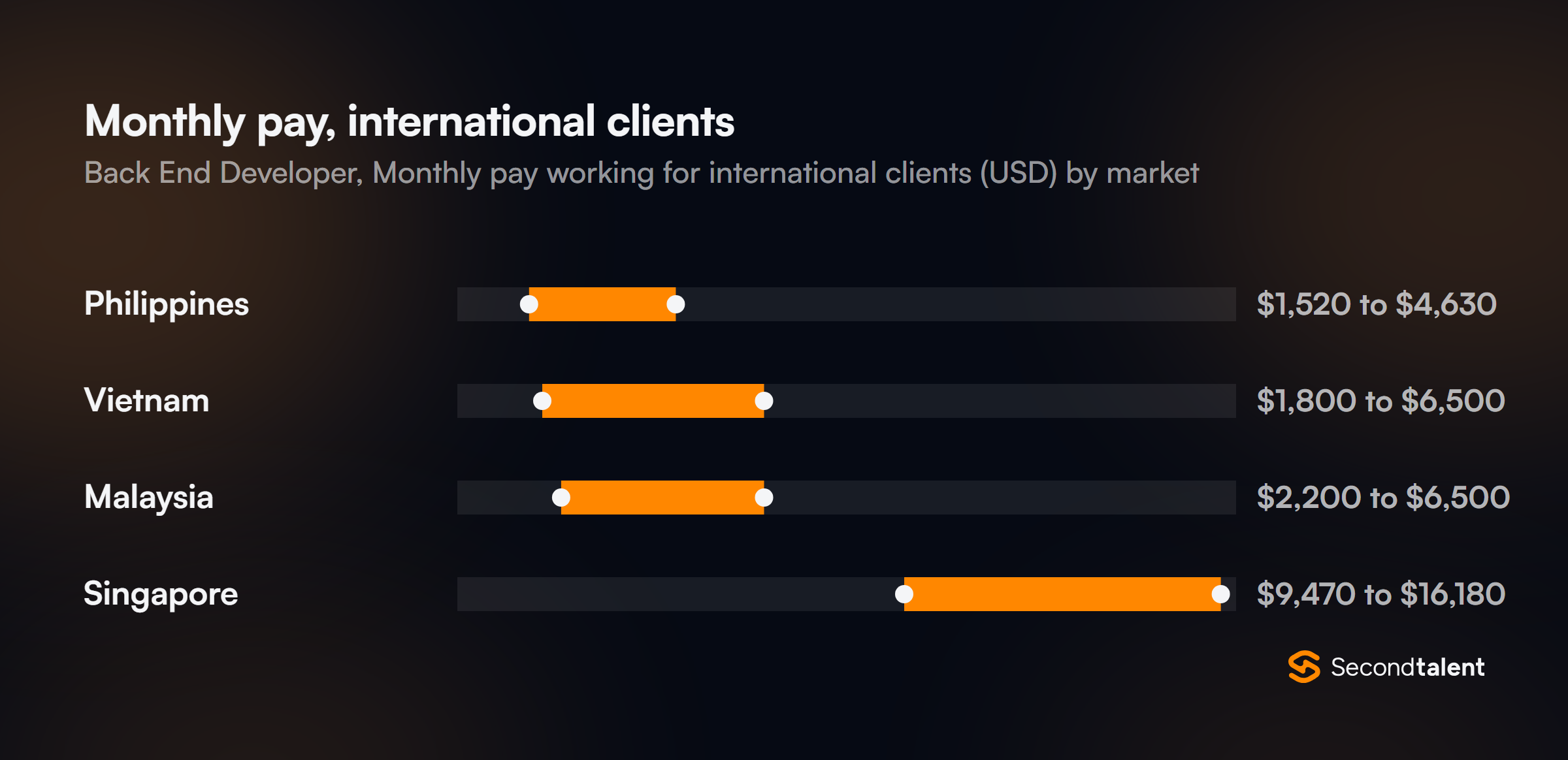
Monthly ranges from the Remote (Working for International Clients) figures on our rate cards for Singapore, the Philippines, Vietnam and Malaysia, converted at ExchangeRate-API mid-market rates for 14 September 2026.
The Singapore card quotes S$12,000 to S$20,500+ a month. If your services run on Go or Java instead, our Singapore Golang developer card and Java developer card both open at $8,680.
Through Second Talent you pay one monthly fee that bundles salary, payroll taxes, statutory contributions and our service fee, quoted per role and market. Our pricing page explains the subscription, and our back-end developer cost-to-hire page covers US freelance rates for contract work.
US Pay Benchmark for Back-End Developers
BLS publishes no back-end developer occupation. The role maps to Software Developers (SOC 15-1252), because a back-end developer designs, writes and runs the server-side software behind a product.
| BLS OEWS, May 2025, national |
Software Developers (15-1252) |
| Median annual |
$135,980 |
| 10th percentile, monthly |
$6,870 |
| 25th percentile, monthly |
$8,770 |
| Median, monthly |
$11,330 |
| 75th percentile, monthly |
$14,330 |
| 90th percentile, monthly |
$17,890 |
Monthly figures are the annual wages on the OEWS profile for 15-1252 divided by 12, rounded to the nearest $10.
The Singapore card's floor falls between the US 25th percentile and median monthly figures, and its open top passes the US 75th percentile. On pay, a Singapore hire sits close to a US one, so the case for it rests on work history, such as services built for banks under MAS rules.
Salary is only part of the US cost. In the BLS Employer Costs for Employee Compensation release for June 2026, wages and salaries made up 68.5% of employer compensation costs for full-time private industry workers, and benefits the other 31.5%.
Time Zone Overlap: Singapore Against ET, CT and PT
A deploy that ships at 10 am in Singapore lands at 10 pm the previous evening in New York while US daylight time lasts. Singapore keeps UTC+8 all year with no daylight saving, and US clocks stay on daylight time from 8 March to 1 November 2026, per NIST.
The arithmetic: 9:00 am in New York is 13:00 UTC under EDT (UTC-4), and 13:00 UTC is 9:00 pm in Singapore. Under EST (UTC-5) it is 10:00 pm. Chicago's 9:00 am lands an hour later in Singapore, and San Francisco's three hours later.
| Singapore shift (UTC+8) |
ET overlap (EDT / EST) |
CT overlap (CDT / CST) |
PT overlap (PDT / PST) |
Hours between 10 pm and 6 am |
| 9 am-6 pm |
0 / 0 |
0 / 0 |
0 / 0 |
0 |
| 1 pm-10 pm |
1 / 0 |
0 / 0 |
0 / 0 |
0 |
| 3 pm-12 am |
3 / 2 |
2 / 1 |
0 / 0 |
2 |
| 5 pm-2 am |
5 / 4 |
4 / 3 |
2 / 1 |
4 |
Each shift is nine clock hours with a meal break, counted against a 9 am to 5 pm US day.
The first row has a use of its own for back-end work. A Singapore day from 9 am to 6 pm runs from 9 pm to 6 am in New York in September. A developer there can take first-line on-call for your US night without working one.
Shift terms at these salaries are a contract matter. Part 4 of the Employment Act regulates hours of work and overtime. It stops at a basic monthly salary of S$2,600 for employees other than workmen, and excludes managers and executives.
We fix the shift before the offer, which is how our placements get 4-6 hours of daily overlap with US hours.
Back-End Developer Skills to Screen For
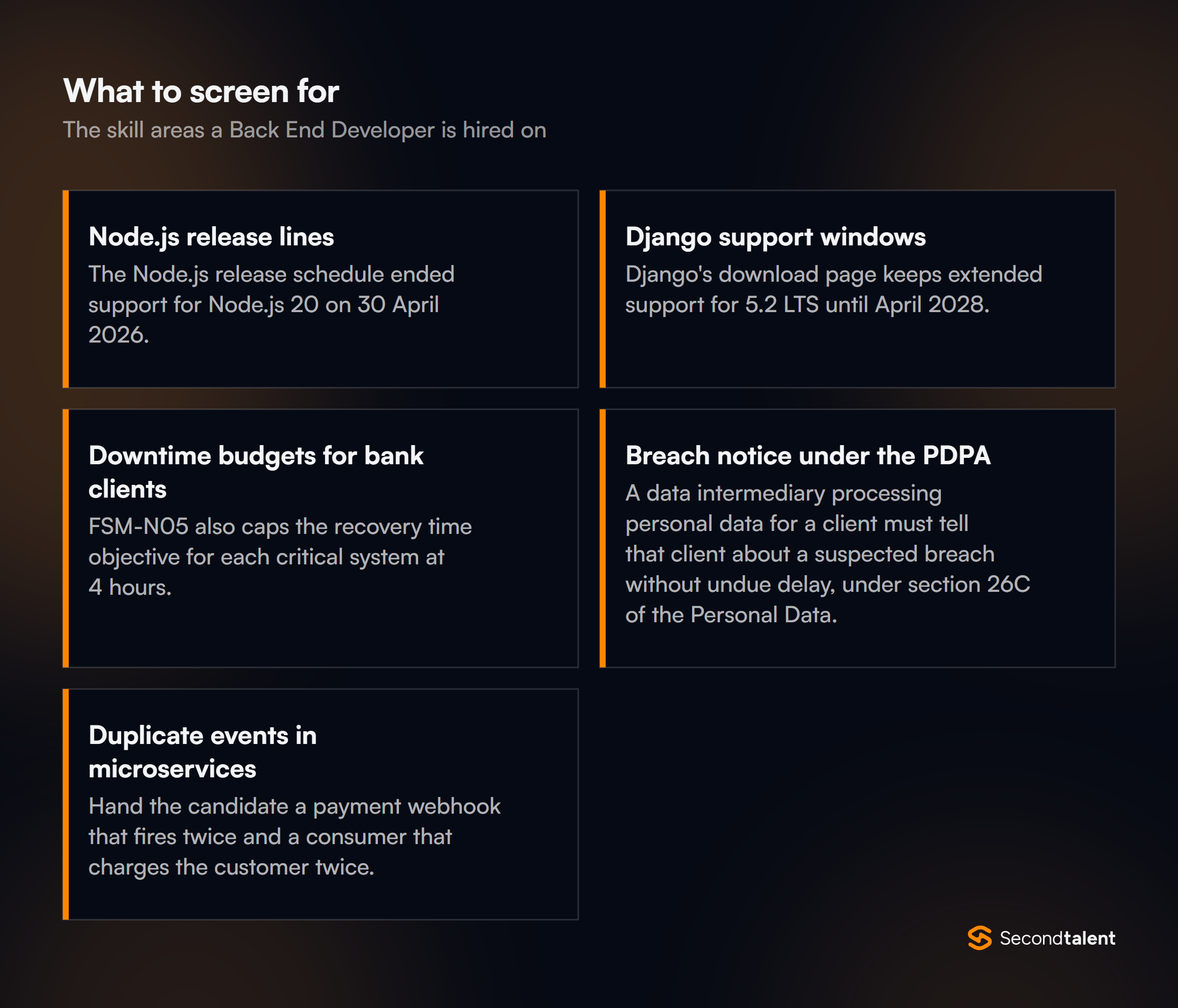
A back end built for a client regulated by the Monetary Authority of Singapore answers to downtime and breach rules as well as to its product team. Screen for runtime upkeep and incident handling alongside code.
Node.js release lines
The Node.js release schedule ended support for Node.js 20 on 30 April 2026. Node.js 22 runs in maintenance until 30 April 2027, and Node.js 24 moves from active LTS to maintenance on 20 October 2026. Ask which line the candidate's last production service ran and how they moved it off an end-of-life version.
Django support windows
Django's download page keeps extended support for 5.2 LTS until April 2028. It names 6.2, due April 2027, as the last release under the old policy. From 2028, each feature release carries a year number, ships in January and gets three years of support.
Ask a Python candidate to plan an upgrade path for a 4.2 codebase, a series that no longer receives security fixes.
Downtime budgets for bank clients
FSM-N05 also caps the recovery time objective for each critical system at 4 hours. It requires a root cause and impact report within 14 days of a relevant incident. Give the candidate a single-region payments service and ask how they would meet the 4-hour budget, what they would page on, and who writes the report.
Breach notice under the PDPA
A data intermediary processing personal data for a client must tell that client about a suspected breach without undue delay, under section 26C of the Personal Data Protection Act. The client then assesses the breach, and a notifiable one goes to the regulator within 3 calendar days of that assessment.
The regulator's guide on managing and notifying data breaches treats a breach affecting 500 or more individuals as significant in scale. Ask the candidate which access logs would let them count affected records within a day.
Duplicate events in microservices
Hand the candidate a payment webhook that fires twice and a consumer that charges the customer twice. Ask for the fix in code. An idempotency key, a unique constraint and a processed-events table all work; the follow-up is how each one holds when two consumer instances read the same queue.
Contractor or Employer of Record in Singapore
Software is not one of the nine categories of commissioned work that can be "work made for hire" under 17 U.S.C. § 101, and a copyright transfer must be in writing and signed under § 204(a).
Singapore's Copyright Act 2021 counts a computer program as a literary work (section 13). The author is the default first owner (section 133), and for work an employee makes under a contract of service, the employer is (section 134).
A contractor therefore owns the code they write for you unless a written agreement says otherwise, and section 138 makes an assignment valid only in writing, signed by the assignor.
IRS Publication 515 says the place where services are performed determines the source of the income, so work done in Singapore produces foreign-source income. A foreign individual gives the payer Form W-8BEN to certify foreign status.
The Ministry of Manpower says there is no single conclusive test to tell a contract of employment from a contract for services. Its factors include who controls the timing and method of work, who provides the tools and workplace, and who takes the profit and the risk.
The Employment Act reaches local and foreign employees alike. An employer must give an employee it covers, hired for 14 days or more, key employment terms in writing within 14 days of the start.
A full-time developer on your sprints and your pager fits the employment side of those factors. Our Employer of Record service employs that developer in Singapore, and our Singapore EOR page covers the details. CPF contributions apply when the employee is a Singapore Citizen or permanent resident. This is a summary, not legal advice.
|
Independent contractor |
Employer of Record |
| Legal employer |
None; the developer invoices you |
The EOR's Singapore entity |
| US paperwork |
Form W-8BEN from the developer |
Service agreement with the EOR |
| IP |
Signed written assignment of code, schemas and runbooks (section 138) |
Employer first owner (section 134), passed on through your EOR agreement |
| Local labor law |
Employment finding if you control hours, tools and methods |
Employment Act, written key terms and CPF for citizens and permanent residents |
| Pay currency |
Agreed in the contract, often USD |
Local payroll run by the EOR |
English Level and Working Norms in Singapore
English is one of Singapore's four official languages, with Malay, Mandarin and Tamil, under Article 153A of the Constitution. EF's English Proficiency Index 2025 publishes no page for Singapore, so we quote no EF score. Test the English you need instead: ask finalists to write a post-incident summary for a US audience.
Singapore's Tripartite Guidelines on Flexible Work Arrangement Requests, in effect since 1 December 2024, let an employee who has completed probation make a formal written request. Staggered hours and flexi-shifts count. The employer should give a written decision within two months.
An employed developer on a US-facing shift can use that route to ask for other hours later, so write the shift and its reason into the offer.
The Ministry of Manpower lists 11 public holidays for 2026. Deepavali falls on Sunday 8 November, so Monday 9 November is a holiday for employees whose rest day is Sunday, and Christmas is a Friday.
Chinese New Year 2027 lands on 6 and 7 February, with Monday 8 February off in the same way. Thanksgiving on 26 November 2026 is a working day in Singapore, so a developer there can watch production while your US team is off.
Back-End Developer Hiring Process in Singapore
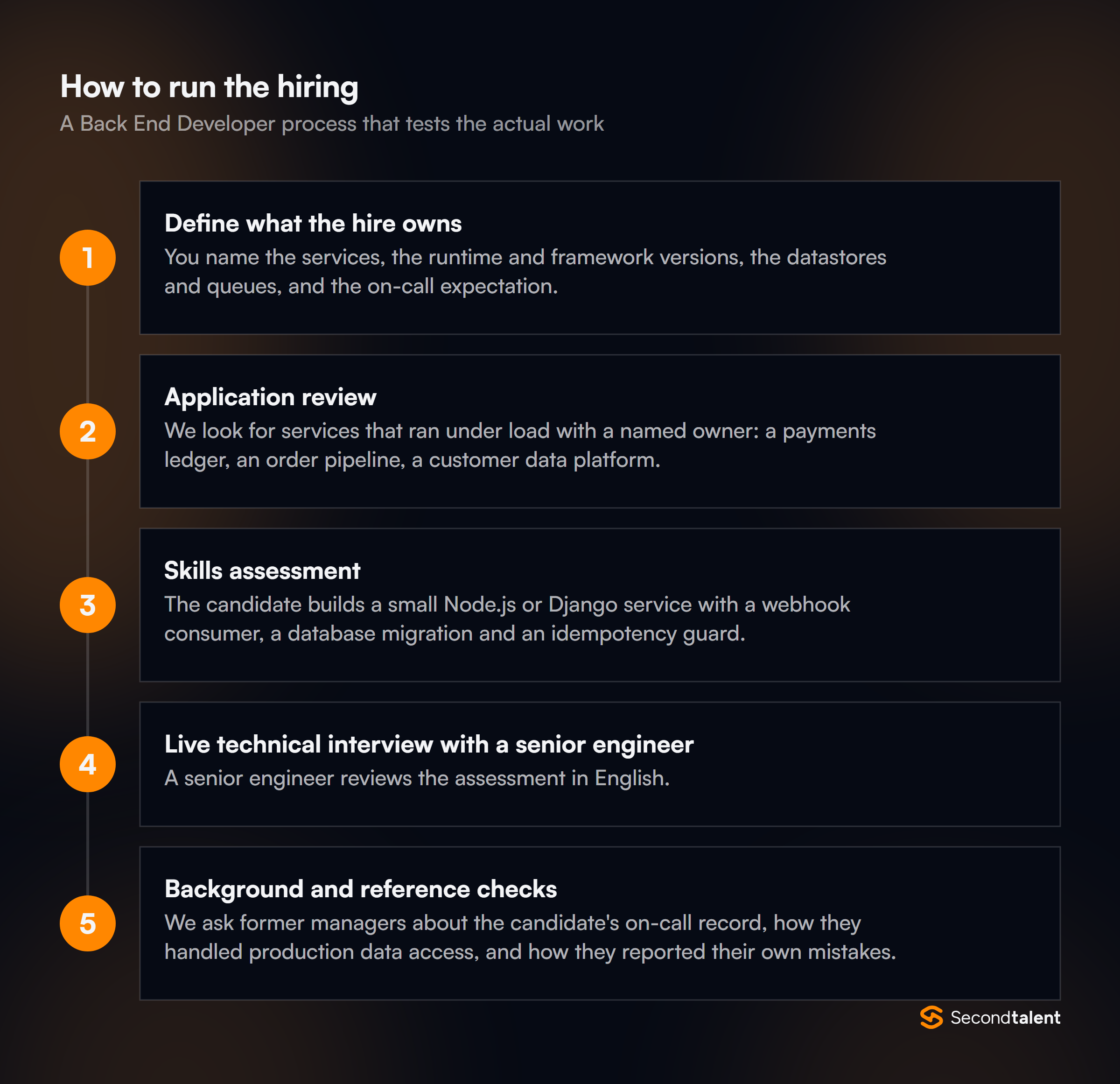
Second Talent's vetting covers stages 2 to 5 before you see a profile.
Stage 1: Define what the hire owns
You name the services, the runtime and framework versions, the datastores and queues, and the on-call expectation. Add whether any client is a bank bound by FSM-N05, and pick a shift from the table above.
Stage 2: Application review
We look for services that ran under load with a named owner: a payments ledger, an order pipeline, a customer data platform. A candidate should state the traffic, the uptime target and the incident they handled worst.
Stage 3: Skills assessment
The candidate builds a small Node.js or Django service with a webhook consumer, a database migration and an idempotency guard. We send duplicate events and a slow dependency, then score correctness, logs and the upgrade notes they leave.
Stage 4: Live technical interview with a senior engineer
A senior engineer reviews the assessment in English. The design question is a single-region payments service that must meet a 4-hour yearly downtime budget and count breached records within a day.
Stage 5: Background and reference checks
We ask former managers about the candidate's on-call record, how they handled production data access, and how they reported their own mistakes. You then choose the contractor or EOR route above.
Hire Back-End Developers from Singapore with Second Talent
We shortlist 6-8 candidates within 24 hours from 100,000+ pre-vetted engineers, accepting only the top 1% of applicants. Back-end developers from Singapore come with $0 upfront, no lock-in and 4-6 hours of daily overlap with US hours. We handle contracts, payroll and equipment, with compliant EOR contracts in Singapore.
Our pricing page covers subscription, direct-hire and EOR pricing. Beyond Cars, the used-car marketplace, grew its engineering team by 50% in 4 months with engineers we sourced for its Taiwan team, as the Beyond Cars case study sets out. For contracts built around external integrations, we also staff API developers in Singapore.