Hire Back-End Developers in India | Onboard in Aug, 2026
Skip to content

Hire Back-End Developers in India

Hire back-end engineers in India who ship Java Spring Boot, Django and Node APIs at scale. Pre-vetted seniors from $2,500/month, shortlists in about 24 hours.

Adobe Crypto.com Lacoste L'Occitane Lululemon Yusen Logistics Neopets Adobe Crypto.com Lacoste L'Occitane Lululemon Yusen Logistics Neopets Adobe Crypto.com Lacoste L'Occitane Lululemon Yusen Logistics Neopets Adobe Crypto.com Lacoste L'Occitane Lululemon Yusen Logistics Neopets

We help companies save $103,000+ per hire

24 Hours

to get matched

4.9

avg client rating

200 +

companies building with us

92 %

talent retention rate

50-70 %

payroll savings

Automate Workflows Build AI Agents Ship LLM Features Build RAG Pipelines Cut LLM Costs Tame AI Sprawl Build MVPs Scale Engineering Automate Workflows Build AI Agents Ship LLM Features Build RAG Pipelines Cut LLM Costs Tame AI Sprawl Build MVPs Scale Engineering
End DevOps Burnout Modernize Stack Hit Q4 Roadmap Cut Burn Rate Replace Agencies Extend Runway Build Without Borders Ship 3x Faster End DevOps Burnout Modernize Stack Hit Q4 Roadmap Cut Burn Rate Replace Agencies Extend Runway Build Without Borders Ship 3x Faster

1,200+ Back-End Developers Available to Hire in August 2026

What our clients say

Thanks to Second Talent, Open Campus quickly built a skilled tech team of 10 within two months, boosting productivity by 70% and accelerating our Web3 platform's development.

This success has strengthened our role in decentralized education and fueled our market expansion, highlighting our leadership in Web3 innovation.

Jonah L.

Jonah L.

Head of Portfolio (raised US$100m)

Animoca Brands

Second Talent helped Beyond Cars (acquired by Carro) swiftly build a top-tier tech team in just a month, accelerating our platform's development and boosting productivity.

This success allowed us to expand into new markets, ultimately leading to our acquisition by a major automotive e-commerce company.

Garry Y.

Garry Y.

Co-Founder (acquired by Carro)

Carro

Partnering with Second Talent has been a game-changer for our tech expansion.

Their ability to source top-tier talent from Vietnam helped us scale rapidly while maintaining quality. Their pre-vetted candidates integrated seamlessly, and their account management ensured smooth onboarding.

Tom F.

Tom F.

Co-founder (#1 US Real Estate Coach)

Tom Ferry

Second Talent played a key role in our tech expansion, quickly providing high-quality frontend talent that integrated seamlessly into our projects.

Their pre-vetted candidates, smooth onboarding process, and excellent support helped us build a strong, cost-effective team that drives our success.

Marco A.

Marco A.

Co-founder & CTO

Finno

Second Talent built our team of pre-vetted engineers who made our hiring decisions straightforward.

Once onboarded, our tech team saw a significant boost in productivity and development speed. Their excellent account management and responsive customer service also ensured smooth handling of all post-onboarding HR matters.

Jack N.

Jack N.

Director of IT (10,000+ employees)

Lane Crawford

Second Talent helped us rapidly scale by sourcing top-quality SDR talent from Indonesia.

Their pre-screened candidates fit perfectly, and their smooth onboarding and support built a strong, cost-effective team that helped to test and experiment sales with another market.

Leo W.

Leo W.

Co-founder (raised US$5m)

imbee

Why Second Talent?

Engineers who build, ship and automate with AI. Less overhead, more output.

  • 75% cost savings

    No office overhead, no traditional employee expenses.

  • AI-native talent

    Teams equipped with the latest AI tools.

  • Working U.S. hours

    4-6 hours of overlap to stay aligned.

  • Rigorous vetting

    Coding tests, peer interviews, and role checks, matched to your exact stack.

How Second Talent Works

Hire Back-End Developers in India from the US, EU, and Australia

We work with engineering teams in the United States, Europe, the UK, and Australia who hire Back-End Developers in India every week. The model is the same across origins. Senior, pre-vetted talent. Time-zone overlap that fits your workday. Compliant employment handled by Second Talent.

Hiring from United States

  • 4โ€“6 hours of overlap with US Eastern, 6โ€“8 with Pacific
  • Delaware MSA, NDA and IP assignment on file
  • USD billing, monthly invoices, Stripe or bank transfer

Most US clients hiring Back-End Developers in India start with one engineer and scale to a 3โ€“5 person team within the first quarter.

Hiring from Europe & the UK

  • 6โ€“8 hours of daily overlap with CET and UK working hours
  • GDPR aligned, EU standard contractual clauses available
  • EUR or GBP billing supported, SEPA / Wise / bank transfer

European teams hiring Back-End Developers in India typically replace 3โ€“4 senior open roles with one Second Talent engagement.

Hiring from Australia

  • 6โ€“8 hours of daily overlap with Sydney and Melbourne working hours
  • AU-aligned contracts, ABN-friendly invoicing
  • AUD or USD billing, monthly cycle

Australian teams hiring Back-End Developers in India get the closest time-zone alignment of any offshore destination.

Hiring Back-End Developers is Easy with Second Talent

Hire in 3 steps, not 3 months.

1

Tell Us What You Are Building

Share what to ship, automate, or scale. Plus stack, budget, and timezone overlap.

2

Meet Top Picks in 24 Hours

6โ€“8 pre-vetted Back-End Developers fluent in Claude Code and modern AI stacks. Interview the ones you like.

3

Ship From Day One

We handle contracts, payroll, and equipment. Your Back-End Developer ships real output within the first week.

Hire Back-End Developers in India

Contents (10 sections)

TL;DR: India has the world's deepest back-end talent pool. Senior engineers cost $2,500-$6,000 a month. We shortlist in about 24 hours, with $0 upfront and a 14-day replacement guarantee.

Why companies hire back-end engineers in India

Back-end work rewards depth over novelty. You want an engineer who has already broken a database under load, already debugged a stuck Kafka consumer, already migrated a monolith without a weekend outage. India produces more of those engineers than any other market we recruit in.

The reason is volume plus history. India has run enterprise back-end systems for global banks, insurers, telcos and retailers for over two decades. That created a generation of engineers who understand transactions, idempotency, reconciliation and audit trails. Product startups in Bengaluru and Hyderabad then added the other half of the skill set, which is scale under consumer traffic and fast release cycles.

When you hire developers in India for server-side roles, you are not buying cheap hands. You are buying engineers who have owned uptime.

Factor What we see in India, 2026
Estimated back-end engineers Over 1.5 million working primarily server-side
Dominant stack Java with Spring Boot, then Python, then Node
Typical senior monthly rate $2,500-$6,000
US equivalent $11,000-$18,000 all in
Time zone IST, UTC+5:30
English Working language of engineering and documentation
Median notice period 30 to 90 days at Indian employers
Our shortlist speed About 24 hours

The supply math matters more than the rate

A cheap rate with no supply is useless. India gives you both. In a typical senior back-end search we screen 90 to 140 applicants and present four to six. In smaller Asian markets the same search yields two. That difference shows up in how well the shortlist matches your exact stack, not just in price.

India's back-end ecosystem and hubs

India is not one market. Rates, stack bias and attrition all shift by city. We recruit across all major hubs and place remotely, but the hub still predicts what an engineer has worked on.

Hub Back-end strength Stack bias Rate position
Bengaluru Product engineering, high-scale consumer systems Java, Go, Node, Python Highest, 10-20% premium
Hyderabad Enterprise SaaS, cloud platform teams Java, .NET, Python, AWS and Azure High
Pune Banking cores, payments, telecom Java, Spring, Oracle, Kafka Mid to high
NCR (Gurugram, Noida) Fintech, ecommerce, marketplaces Node, Java, Python Mid to high
Chennai Insurance, logistics, ERP integration Java, .NET, SQL Server Mid
Ahmedabad, Indore, Kochi, Coimbatore Services and product delivery teams PHP, Node, Java, Python Lowest, 15-25% below Bengaluru

Bengaluru

If you need someone who has run a service at millions of requests per day, start here. Bengaluru engineers move between funded startups and global product offices, so they have seen sharding, read replicas, rate limiting and cache invalidation in production. Expect the highest rates and the most competitive offers.

Hyderabad

Hyderabad has become the strongest hub for cloud-native enterprise back ends. Many engineers here have shipped multi-tenant SaaS with real isolation requirements. That is exactly the profile B2B software companies need. Hyderabad also pairs well with cloud engineers in India when you are standing up a new platform team.

Pune and Chennai

These hubs carry the deepest transactional systems experience in the country. Core banking, claims processing, settlement files, batch jobs that cannot fail. If your product touches money or regulated records, Pune and Chennai resumes are worth a close read.

Tier-two cities

Indore, Kochi, Coimbatore, Jaipur and Nagpur now supply solid mid-level back-end engineers at 15 to 25 percent below Bengaluru rates. Remote work made this pool accessible. Screen harder on system design, because exposure to very high scale is less common.

The skills and stack to screen for

Back-end is a broad title. Two candidates with the same years of experience can be completely different hires. Define the shape of the work before you write the brief.

Languages and frameworks

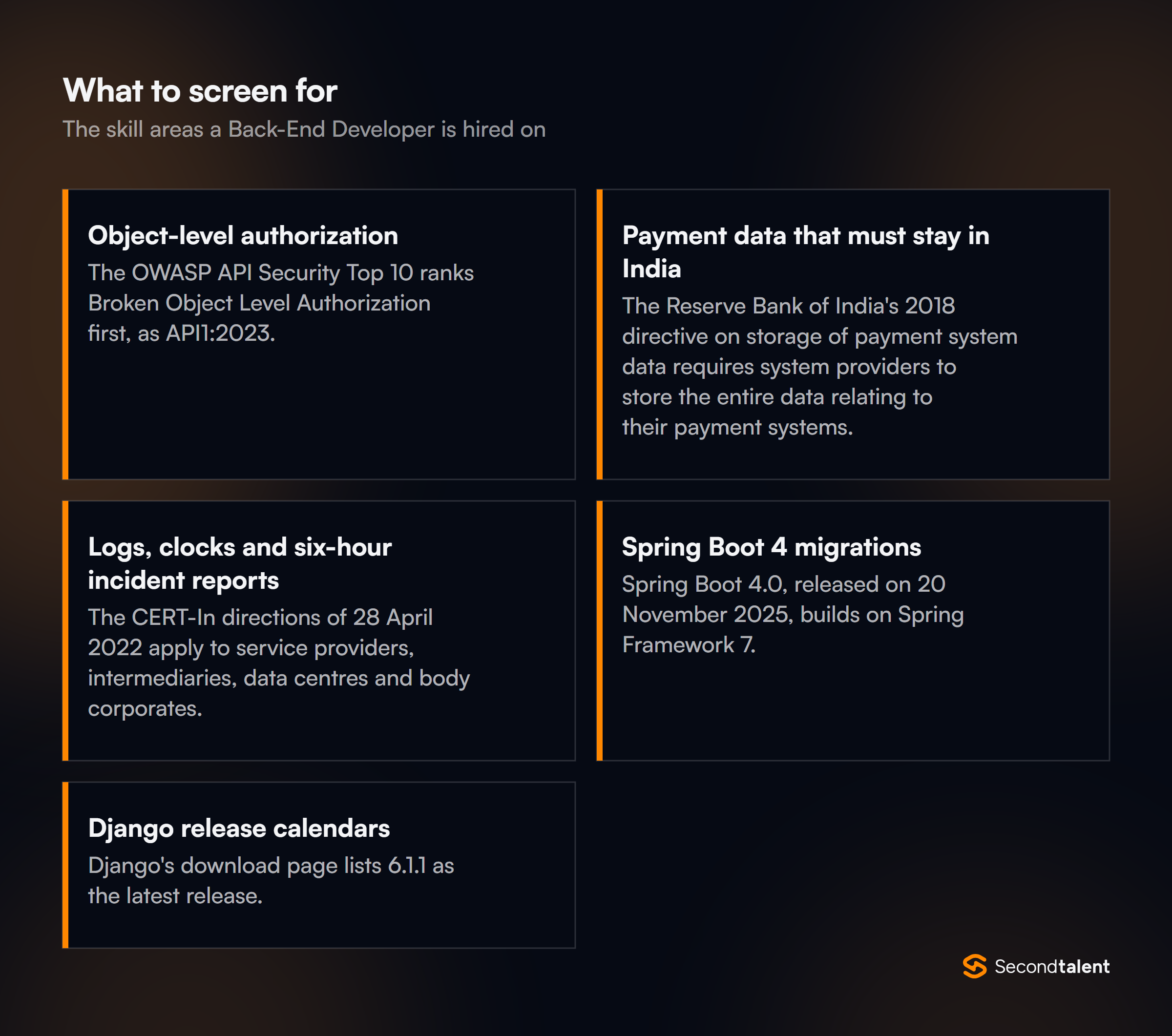
Java with Spring Boot is the largest pool in India by a wide margin. It is the safe choice for regulated products and for teams that value long-term maintainability. If that is your stack, our Java developer searches usually close fastest.

Python with Django, FastAPI or Flask is the fastest growing pool, partly because AI work pulled so many engineers into Python. Our Python developer pipeline overlaps heavily with data and ML candidates, which helps if your back end serves models.

Node with NestJS or Express dominates consumer startups and marketplaces. Go is smaller but rising quickly, mostly in infrastructure and payments teams. .NET is concentrated in Chennai, Hyderabad and Noida enterprise accounts.

Data layer

This is where weak candidates fall apart. Screen for it directly.

  • PostgreSQL and MySQL, including index design, query plans and lock behaviour
  • Transaction isolation levels and what actually happens under concurrency
  • Schema migration strategy with zero downtime
  • Redis for caching, locks and rate limiting, plus eviction awareness
  • MongoDB, DynamoDB or Cassandra where access patterns justify them
  • Read replicas, connection pooling, partitioning and archival policy

Messaging, events and integration

Kafka, RabbitMQ, SQS and Pub/Sub knowledge is common at senior level in India. What is less common is correct handling of retries, dead letter queues, ordering guarantees and exactly-once illusions. Ask about a message that was processed twice and what they did about it.

APIs and platform

REST design, versioning and pagination are table stakes. GraphQL and gRPC appear on stronger resumes. Docker is universal. Kubernetes is common at senior level. Terraform, CI pipelines and observability with Prometheus, Grafana, Datadog or OpenTelemetry separate engineers who own services from engineers who only write handlers. For deeper infrastructure ownership, pair the hire with DevOps engineers in India.

Seniority Must have Should have Signals of a strong hire
Junior, 1-3 yrs One framework, SQL basics, Git, tests Docker, one cloud provider Reads existing code before writing new code
Mid, 3-5 yrs API design, query tuning, queues, CI Kubernetes, caching strategy, IaC Has fixed a production incident end to end
Senior, 5-8 yrs System design, data modelling, observability, on-call Multi-region, event-driven design, cost tuning Can defend a trade-off they later regretted
Staff, 8+ yrs Architecture across services, migration planning, mentoring Security review, capacity planning, vendor decisions Has decommissioned something safely

2026 salary bands for back-end engineers in India

These are our actual India rates, quoted monthly. They reflect fully loaded engagement cost through Second Talent, not local base salary alone.

Level Experience Monthly rate (India) Typical scope
Junior 1-3 years $1,000-$1,800 Endpoints, bug fixes, tests under review
Mid-level 3-5 years $1,800-$3,200 Owns services, writes migrations, joins on-call
Senior 5-8 years $2,500-$6,000 Designs systems, sets standards, leads reviews
Staff / Lead 8+ years $6,000-$9,000 Architecture, cross-team decisions, mentoring
US comparison 5-8 years $11,000-$18,000 all in Same scope as senior above

What pushes a rate to the top of the band

  • Go or Rust in production, not in side projects
  • Payments, ledgers or reconciliation experience
  • Kafka at meaningful throughput with correctness requirements
  • Kubernetes ownership including cost and capacity work
  • Multi-region or active-active deployments
  • Proven on-call leadership and postmortem discipline

A mid-level engineer with real Kafka and Kubernetes exposure often prices above a senior engineer who only wrote CRUD services. Pay for the evidence, not the years. Our developer rate card breaks this down further by role.

Budget planning note

One senior India back-end engineer at $4,500 a month costs about $54,000 a year. The US equivalent runs $130,000 to $215,000 all in. That gap funds a second engineer plus tooling. Most of our clients use the saving to add a QA automation engineer rather than to cut the total budget.

How to interview and vet for this role

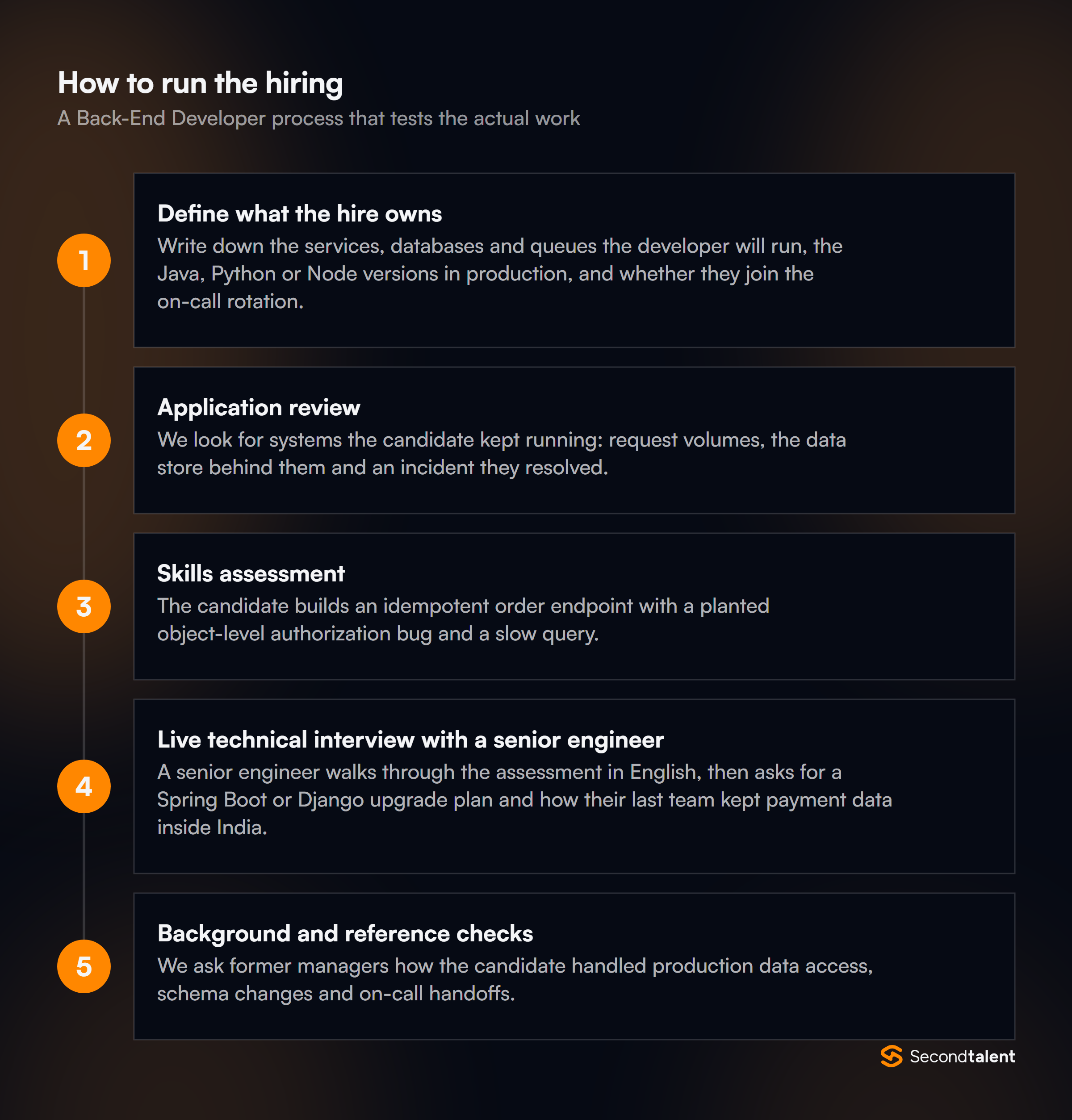
Back-end interviews fail in a predictable way. Teams over-index on algorithm puzzles and under-test the things that break in production. We run a four-stage process and recommend clients mirror it.

Stage Length What it tests Pass signal
Screen 30 min Stack depth, ownership history, English clarity Names specific systems and their limits
Live coding 60 min Working code, error handling, tests Handles edge cases without prompting
System design 60 min Data model, scaling, failure modes Asks about load and consistency first
Code review exercise 45 min Judgement on someone else's code Flags the migration risk, not the formatting

Ask questions with a wrong answer

Good back-end prompts have failure modes. Try these.

  • Design an idempotent payment webhook receiver. What happens on a duplicate?
  • This query got slow after 10 million rows. Walk me through diagnosis.
  • Add a non-null column to a busy table with no downtime. How?
  • Your queue consumer is 4 hours behind. What do you check, in order?
  • Two services need the same data. When do you copy it and when do you call?

Candidates who have owned production answer these with specifics. Candidates who have not will reach for buzzwords like microservices and eventual consistency without saying what they would type.

Read the resume for ownership, not logos

Large Indian service firms train excellent engineers, but titles inflate. A "Technical Architect" may have written slide decks. A "Software Engineer II" at a product company may have run a service handling 50,000 requests per second. Ask what they were paged for. That single question sorts resumes faster than anything else.

Red flags we screen out

  • Cannot explain an index they added and why
  • Describes tests as a separate team's job
  • No experience with a deploy that went wrong
  • Vague about team size and their own contribution
  • Multiple 8-month tenures with no explanation

Time zones and working models

IST sits at UTC+5:30, which is one of the most convenient positions in the world for back-end collaboration. India overlaps with Asia, Europe and the Middle East on standard hours, and reaches the US East Coast with a modest shift.

Your HQ Difference from IST Practical overlap Recommended model
London India is 5.5 hrs ahead 4-5 hours Standard IST hours, no shift
New York India is 10.5 hrs ahead 3-4 hours India works 2pm-11pm IST
San Francisco India is 13.5 hrs ahead 1-2 hours Async first, one daily call
Singapore India is 2.5 hrs behind 6+ hours Standard IST hours
Dubai India is 1.5 hrs ahead 7+ hours Standard IST hours
Sydney India is 4.5 hrs behind 4 hours India morning overlap

Making the handoff work

Back-end teams benefit from asynchronous work more than most roles, because the artefacts are written. Insist on written design notes before implementation. Require pull request descriptions that explain the migration and rollback path. Keep one live hour for design debate and unblocking. That is enough for most distributed teams.

For US Pacific clients we usually recommend a follow-the-sun on-call split rather than forcing India engineers onto US hours permanently. Attrition rises fast when senior engineers work 9pm to 5am IST for months.

Entity, payroll and compliance in India

You have three options. Each has a real cost.

Set up an Indian private limited company. Full control, but expect two to four months, ongoing statutory filings, a local director and audit obligations. Worth it above roughly 25 engineers.

Engage contractors. Fast and simple. The risk is misclassification. Once an engineer works full time on your roadmap, under your direction, with your tools, Indian authorities may treat that relationship as employment. Benefits arrears and penalties follow.

Use an Employer of Record. Our Employer of Record service hires the engineer in India on your behalf. We handle EPF contributions, ESIC where applicable, gratuity accrual, professional tax by state, TDS deduction and Shops and Establishments registration. You direct the work. Onboarding takes days, not months.

Details that catch teams out

  • Notice periods at Indian employers run 30 to 90 days. Build that into your start date planning.
  • Gratuity accrues and becomes payable after five years of continuous service.
  • Professional tax varies by state, so Karnataka and Maharashtra differ.
  • Equity grants to Indian employees have specific tax timing. Get advice before promising options.
  • IP assignment must be explicit in the employment contract, not assumed.

Common hiring mistakes

Writing a full-stack brief for a back-end role. If you list React, Kubernetes, Kafka and Postgres in one job, you will get generalists. Decide whether you need depth in services or breadth across the app. If it is breadth, look at full-stack developers in India instead.

Hiring only for your current stack. A strong Java engineer learns Go in weeks. A weak Go engineer stays weak. Screen for data modelling and debugging ability first.

Skipping the code review exercise. Senior back-end value shows up in what an engineer stops other engineers from shipping. You cannot see that in a coding test.

Anchoring on the cheapest rate. The gap between a $1,800 and a $4,000 engineer is not 2x output. It is often the difference between a system that survives growth and one you rewrite in 18 months.

Ignoring counter offers. Indian employers counter aggressively for good back-end engineers. Move from shortlist to offer inside two weeks, and confirm the resignation was accepted.

Treating the hire as a solo unit. A back-end engineer with no data pipeline support ends up building one badly. Many of our clients pair the role with data engineers in India or with AI developers in India when the product serves models.

How Second Talent matches for back-end roles

We recruit across 9 Asian markets and have placed engineers with over 200 clients. For back-end searches in India our process is deliberately narrow.

First we map the work. Not the job title, the work. Request volume, data size, consistency requirements, deploy frequency, on-call expectations and who reviews code. That intake takes about 40 minutes and removes most mismatch risk.

Then we source against that map. We do not forward resumes that merely contain your keywords. Every candidate has passed live coding, a system design session and a code reading exercise run by engineers who have shipped production back ends themselves.

You get a shortlist in about 24 hours, with $0 upfront. Interview as many as you like. If a placement is not working, our 14-day replacement guarantee applies. Employer of Record is available if you have no Indian entity.

A client example

A Series B fintech in Singapore had one back-end engineer holding together a ledger service written in Node. Reconciliation ran overnight and failed roughly twice a week. They needed depth in transactional correctness, not more endpoints.

We shortlisted five engineers from Pune and Bengaluru within a day. All had payments or core banking experience. They hired two, a senior at $4,800 a month and a mid-level at $2,900. The pair rebuilt reconciliation as an event-driven flow with idempotent replay. Failed runs dropped to zero over the following quarter. Total monthly cost was under half of one US senior hire.

Where back-end sits in a wider team

Most of our India engagements grow beyond one role. Teams that start with back-end commonly add machine learning engineers in India once model serving becomes real, or mobile app developers in India as the client surface expands. You can see current rates across roles in our Asia tech salary index, and browse every role we cover when you hire engineers in India.

Start your search

Back-end hires are the ones you feel two years later, in your uptime, your bill and your rewrite risk. Get the screening right and India gives you engineers who have already carried that weight.

Tell us your stack, scale and time zone. We will send a shortlist of pre-vetted India back-end engineers in about 24 hours, with no upfront cost.

Find the talent you need

Guide to Hiring Developers in India

Everything you need to know about employment laws, payroll, and compliance when hiring developers in India.

Working Hours

48 hours/week max (9 hrs/day) under state Shops & Establishments Acts. Tech firms run 40 hrs (Mon-Fri).

Overtime Pay

200% of ordinary wages beyond 9 hrs/day or 48 hrs/week. Exact caps vary by state.

Probation Period

No statutory cap. Set by contract, typically 3-6 months in tech.

Leave Entitlements in India

Leave Type
Entitlement
Annual Leave
15-21 days earned leave per year depending on state. Tech firms commonly offer 18-24.
Sick Leave
12 days casual/sick leave per year is the common state standard. ESI covers wages under INR 21,000/mo.
Maternity Leave
26 weeks paid for the first two children, 12 weeks thereafter. Paid by the employer.
Paternity Leave
No private-sector statutory entitlement. 5-15 days by company policy is standard in tech.
Public Holidays
3 mandatory national holidays plus state holidays. 10-14 days total in practice.

Notice Period

30-90 days by contract. 60-90 days is the norm for senior tech roles in India.

Severance Pay

Retrenchment: 15 days average pay per completed year. Gratuity: 15 days wages per year after 5 years.

Payroll & Tax in India

Component
Details
Employer Contributions
~13% (EPF 12% of basic + admin charges). ESI 3.25% for wages under INR 21,000/mo.
Employee Contributions
EPF 12% of basic. ESI 0.75% where applicable. Professional tax varies by state.
Income Tax
Progressive 0%-30% (new regime). Income up to INR 12 lakh is effectively tax-free after the 87A rebate.
Minimum Wage
Set per state and skill level. Delhi skilled: INR 24,356/mo (~$280). Karnataka is lower.
13th Month / Bonus
Not a 13th month. Statutory bonus of 8.33%-20% applies under INR 21,000/mo; tech pays performance bonuses.
Senior Developer Salary
$2,500-$6,000/mo

Second Talent handles all of this for you

Payroll, taxes, social contributions, leave tracking, contracts, and compliance in India. You focus on building your product.

Hire Talent

Frequently Asked Questions

What does it cost to hire a back-end developer in India in 2026?
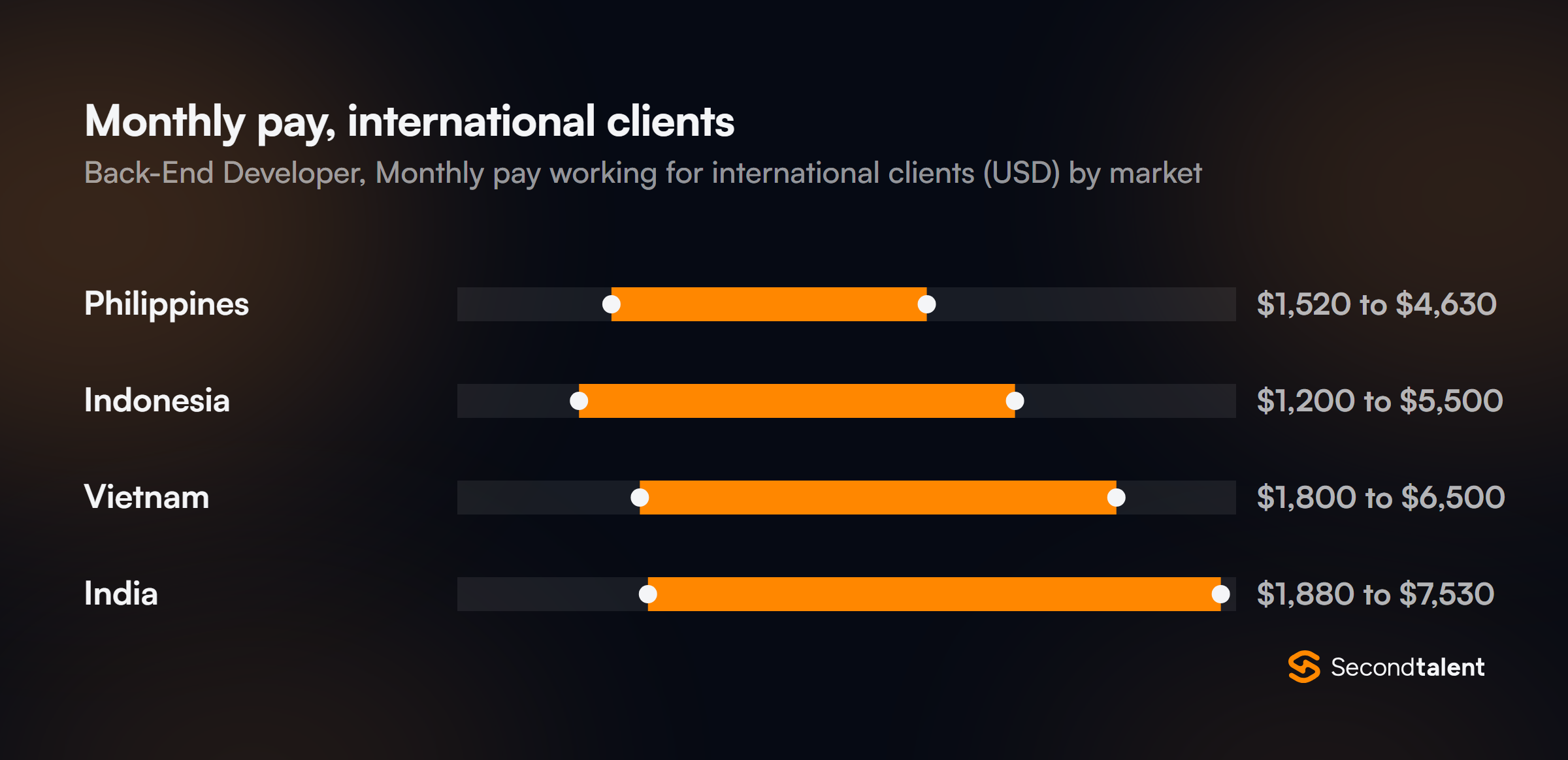
Our 2026 India bands are $1,000-$1,800/month for junior engineers with 1-3 years, $1,800-$3,200 for mid-level at 3-5 years, $2,500-$6,000 for senior engineers at 5-8 years, and $6,000-$9,000 for staff or lead engineers with 8+ years. A comparable US back-end hire costs $11,000-$18,000 per month all in. Rates rise for Go, Kafka and high-scale payments experience.
How do you vet back-end engineers before we see them?
Every candidate clears a live coding session, a system design review and a code reading exercise on real repositories. We test schema design, indexing, idempotency, queue semantics and failure handling, not algorithm trivia. We also check production ownership, on-call history and incident write-ups. Roughly 3 in 100 applicants reach a client shortlist, which we deliver in about 24 hours.
How much time zone overlap will we get with an India-based back-end team?
India runs on IST, UTC+5:30. London teams get four to five hours of natural overlap with no shifting. Singapore and Dubai get six or more. US Eastern teams typically get three to four hours when the India engineer works 2pm to 11pm IST. Most of our back-end clients use that shifted window for standups, code review and deploy coordination.
Is English strong enough for design reviews and written specs?
Yes. English is the working language of Indian engineering, from university coursework to internal documentation. Back-end work is written work, so we grade communication explicitly. Candidates submit a written design note and defend it live. We score clarity on trade-offs, migration plans and rollback steps. Reject anyone who cannot explain a schema decision in plain prose.
Do we need an Indian entity to employ these engineers?
No. Our Employer of Record hires in India on your behalf and handles EPF, ESIC, gratuity accrual, professional tax, TDS and state Shops and Establishments registration. You keep day to day direction of the work. Contractor agreements are also possible for shorter engagements, but misclassification risk grows once the engineer works full time on your roadmap.
Which back-end stacks are deepest in the India talent pool?
Java with Spring Boot is the largest pool by far, driven by banking, insurance and enterprise product work. Python with Django or FastAPI is second and growing fastest. Node with NestJS is strong in consumer startups. Go and .NET pools are smaller but real. PostgreSQL, MySQL, Redis, Kafka, Docker, Kubernetes and AWS appear on most credible senior resumes.

Asia's top Back-End Developers fully compliant, matched in 24 hours.

$0 upfront costs, pay only when you make a hire

Start Hiring
WhatsApp