TL;DR: Back-end developers in Vietnam earn $1,800 to $6,500 a month working for international clients on our rate card, and we shortlist 6-8 candidates within 24 hours. The closest US benchmark, the BLS median for software developers, was $135,980 a year in May 2025.
Since 1 January 2026, a data controller under Vietnam's personal data law has 72 hours to report a violation likely to cause harm to the data protection agency. A back-end developer from Vietnam who has run production services there should be able to show you the access logs and alerts that make that deadline reachable.
Key takeaways
- Vietnam's range opens $280 above the Philippines' and tops out level with Malaysia's.
- Go 1.27 shipped on 19 August 2026, which ended support for Go 1.25 under Go's two-release policy.
- Python 3.10 reaches end of life in October 2026.
- A 5 pm to 2 am shift in Ho Chi Minh City gives a New York team six live hours in September, four of them at Vietnam's night rate.
What Back-End Developers Earn in Vietnam Working for International Clients
Vietnam's card is one of only two in the table with a closed top, and it matches Malaysia's $6,500. India's open-topped range runs $1,030 higher. The figures are what developers in each market earn working directly for foreign companies, before any employer or platform costs.
| Market |
Monthly pay working for international clients (USD) |
| Vietnam |
$1,800-$6,500 |
| Philippines |
$1,520-$4,630+ |
| India |
$1,880-$7,530+ |
| Malaysia |
$2,200-$6,500 |
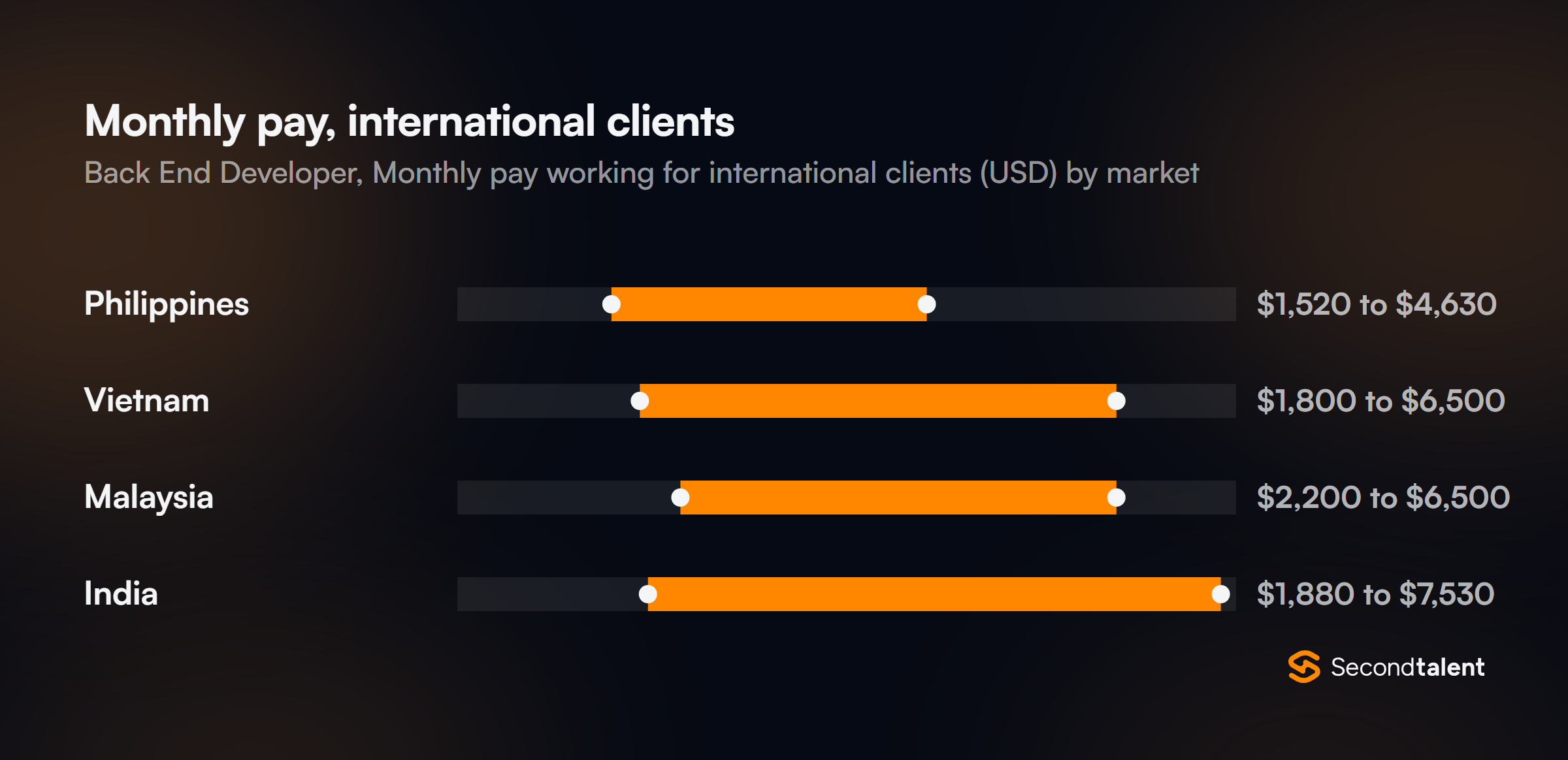
Monthly ranges from the Remote (Working for International Clients) figures on our rate cards for Vietnam, the Philippines, India and Malaysia, converted at ExchangeRate-API mid-market rates for 14 September 2026. India and Malaysia have no back-end card, so their rows use our Node.js developer rate card.
The Vietnam card quotes its range in US dollars. If your services run on one stack, the stack cards narrow it: our Vietnam Golang developer card opens at $2,200 and our Node.js developer card at $2,000.
Through Second Talent you pay one monthly fee that bundles salary, payroll taxes, statutory contributions and our service fee, quoted per role and market. Our pricing page explains the subscription, and our back-end developer cost-to-hire page covers US freelance rates for contract work.
US Pay Benchmark for Back-End Developers
BLS publishes no back-end developer occupation. The role maps to Software Developers (SOC 15-1252), because a back-end developer designs, writes and operates the server-side software behind a product.
| BLS OEWS, May 2025, national |
Software Developers (15-1252) |
| Median annual |
$135,980 |
| 10th percentile, monthly |
$6,870 |
| 25th percentile, monthly |
$8,770 |
| Median, monthly |
$11,330 |
| 75th percentile, monthly |
$14,330 |
| 90th percentile, monthly |
$17,890 |
Monthly figures are the annual wages on the OEWS profile for 15-1252 divided by 12, rounded to the nearest $10.
The top of the Vietnam card, $6,500, sits $370 below the US 10th percentile monthly figure.
Salary is only part of the US cost. In the BLS Employer Costs for Employee Compensation release for June 2026, wages and salaries made up 68.5% of employer compensation costs for full-time private industry workers, and benefits the other 31.5%.
Time Zone Overlap: Ho Chi Minh City Against ET, CT and PT
A back-end developer working 9 am to 6 pm in Ho Chi Minh City covers 10 pm to 7 am in New York while US daylight time lasts, so first-line on-call for your US night needs no night shift.
Vietnam keeps UTC+7 all year with no daylight saving, and US daylight time runs from 8 March to 1 November 2026, per NIST.
The arithmetic: 9:00 am in San Francisco is 16:00 UTC under PDT (UTC-7), and 16:00 UTC is 11:00 pm in Ho Chi Minh City. Under PST (UTC-8) it is midnight. New York's 9:00 am lands three hours earlier, at 8:00 pm.
| Ho Chi Minh City shift (UTC+7) |
ET overlap (EDT / EST) |
CT overlap (CDT / CST) |
PT overlap (PDT / PST) |
Hours in the 22:00-06:00 night window |
| 9 am-6 pm |
0 / 0 |
0 / 0 |
0 / 0 |
0 |
| 1 pm-10 pm |
2 / 1 |
1 / 0 |
0 / 0 |
0 |
| 3 pm-12 am |
4 / 3 |
3 / 2 |
1 / 0 |
2 |
| 5 pm-2 am |
6 / 5 |
5 / 4 |
3 / 2 |
4 |
Each shift is nine clock hours with a meal break, counted against a 9 am to 5 pm US day.
For an employee, the hours in the last column are night work under Vietnam's Labor Code 2019 (Article 106, 22:00 to 06:00), paid at least 30% extra (Article 98). The 1 pm to 10 pm row gives two hours with New York at base pay.
Article 105 caps normal working time at 8 hours a day and 48 a week. Overtime needs the employee's consent and stays within 200 hours a year for most jobs (Article 107), so budget incident calls outside the shift as overtime.
We fix the shift before the offer, which is how our placements get 4-6 hours of daily overlap with US hours.
Back-End Developer Skills to Screen For
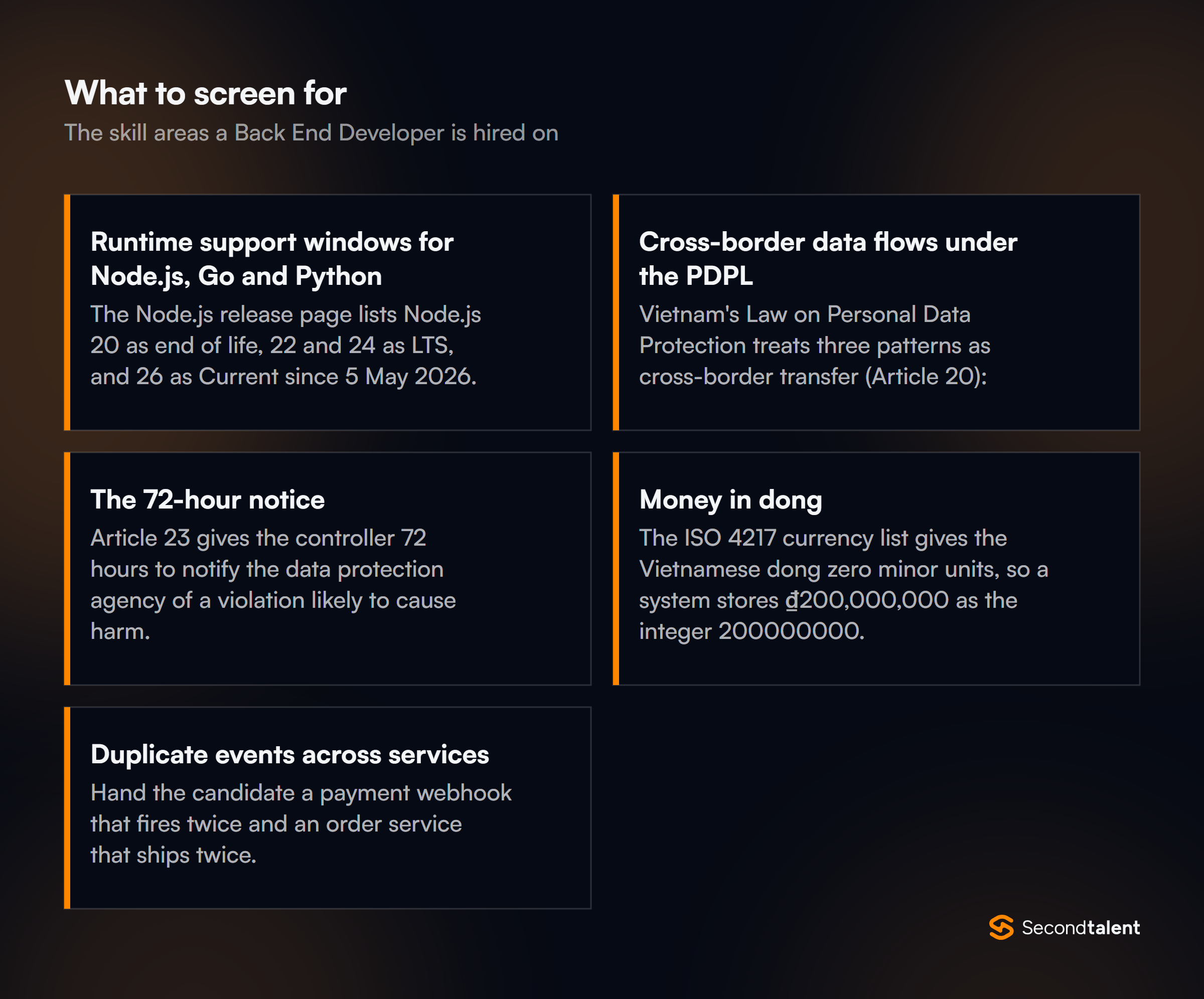
Under Vietnam's personal data law, where a database sits decides whether a filing is due. Screen the five areas below alongside code.
Runtime support windows for Node.js, Go and Python
The Node.js release page lists Node.js 20 as end of life, 22 and 24 as LTS, and 26 as Current since 5 May 2026. From Node.js 27, each major release will move to LTS after its Current phase.
Go supports each major release until two newer ones ship, per its release history, and Go 1.27 arrived on 19 August 2026. Python's status page puts the end of life for 3.10 in October 2026. Ask which runtime version the candidate's last service ran and what the upgrade broke.
Cross-border data flows under the PDPL
Vietnam's Law on Personal Data Protection treats three patterns as cross-border transfer (Article 20):
- moving personal data stored in Vietnam to storage outside the country
- sending it from Vietnam to a recipient abroad
- processing data collected in Vietnam on a platform outside the country
The transferring party files an impact assessment dossier within 60 days of the first transfer. Storing employees' own data on a cloud service is exempt. Draw a US-hosted API that serves Vietnamese customers and ask the candidate which hops trigger the dossier.
The 72-hour notice
Article 23 gives the controller 72 hours to notify the data protection agency of a violation likely to cause harm. A processor that detects one must notify the controller. Give the candidate a leaked API key with read access to a customer table, and ask what they would query in the first hour to size the exposure.
Money in dong
The ISO 4217 currency list gives the Vietnamese dong zero minor units, so a system stores ₫200,000,000 as the integer 200000000. A signed 32-bit integer tops out at 2,147,483,647, about $83,000 at ₫25,873 to the dollar. Ask the candidate how their schema stores a ₫5 billion invoice and converts it to dollars without floating-point drift.
Duplicate events across services
Hand the candidate a payment webhook that fires twice and an order service that ships twice. Ask for the fix in code, then run two consumer instances against the same queue. An idempotency key, a unique constraint or a processed-events table can each work; the follow-up is which one survives a crash between the write and the acknowledgement.
Contractor or Employer of Record in Vietnam
Software is not one of the nine categories of commissioned work that can be "work made for hire" under 17 U.S.C. § 101, and a copyright transfer must be in writing and signed under § 204(a).
Vietnam starts closer to the client. Article 39 of the Law on Intellectual Property makes an organisation that assigns an author the task of creating a work the holder of its economic rights, unless otherwise agreed. The same default covers an organisation or individual that contracts an author to create one.
Its 2022 amendments protect computer programs as literary works in source or machine code (Article 22). Still, list services, schemas, migrations, infrastructure code and runbooks in the agreement.
IRS Publication 515 says the place where services are performed determines the source of the income, so a developer working from Hanoi or Da Nang earns foreign-source income. A foreign individual gives the payer Form W-8BEN to certify foreign status.
Article 13 of the Labor Code looks past the name on the contract. An agreement that covers a paid job, wages and one party's management and supervision counts as a labor contract. A developer carrying your pager on your schedule meets that test.
Our Employer of Record service employs that developer in Vietnam, and our Vietnam EOR page covers the details. This is a summary, not legal advice.
|
Independent contractor |
Employer of Record |
| Legal employer |
None; the developer invoices you |
The EOR's Vietnamese entity |
| US paperwork |
Form W-8BEN from the developer |
Service agreement with the EOR |
| IP |
Contracting party holds economic rights unless agreed (Article 39); list code, schemas and runbooks |
Assigning organisation holds economic rights (Article 39), passed on through your EOR agreement |
| Local labor law |
Labor contract finding under Article 13 if you manage and supervise |
Night pay, the 8-hour day and overtime caps apply |
| Pay currency |
Agreed in the contract, often USD |
Vietnam dong; wages in labor contracts are stated in dong (Article 95) |
English Level and Working Norms in Vietnam
Vietnam's writing score on the EF English Proficiency Index 2025 is 508, while its listening score is 470. The overall score is 500, 64th of 123 countries and regions, against a global average of 488, per EF's Vietnam page. The IT job-function score matches it at 500, and Hanoi leads the listed cities at 532.
Back-end work leans on the stronger skill: pull requests, API docs and post-incident reports. Ask finalists to write a post-incident summary for a US audience, then discuss it on a call to test listening.
Article 112 of the Labor Code gives five paid days for Lunar New Year, plus Victory Day on 30 April and International Labor Day on 1 May, back to back. Freeze risky deploys over both breaks, or confirm who covers on-call in Vietnam before them.
Thanksgiving on 26 November 2026 is a working day in Vietnam, so a developer there can watch production while your US team is off.
Back-End Developer Hiring Process in Vietnam
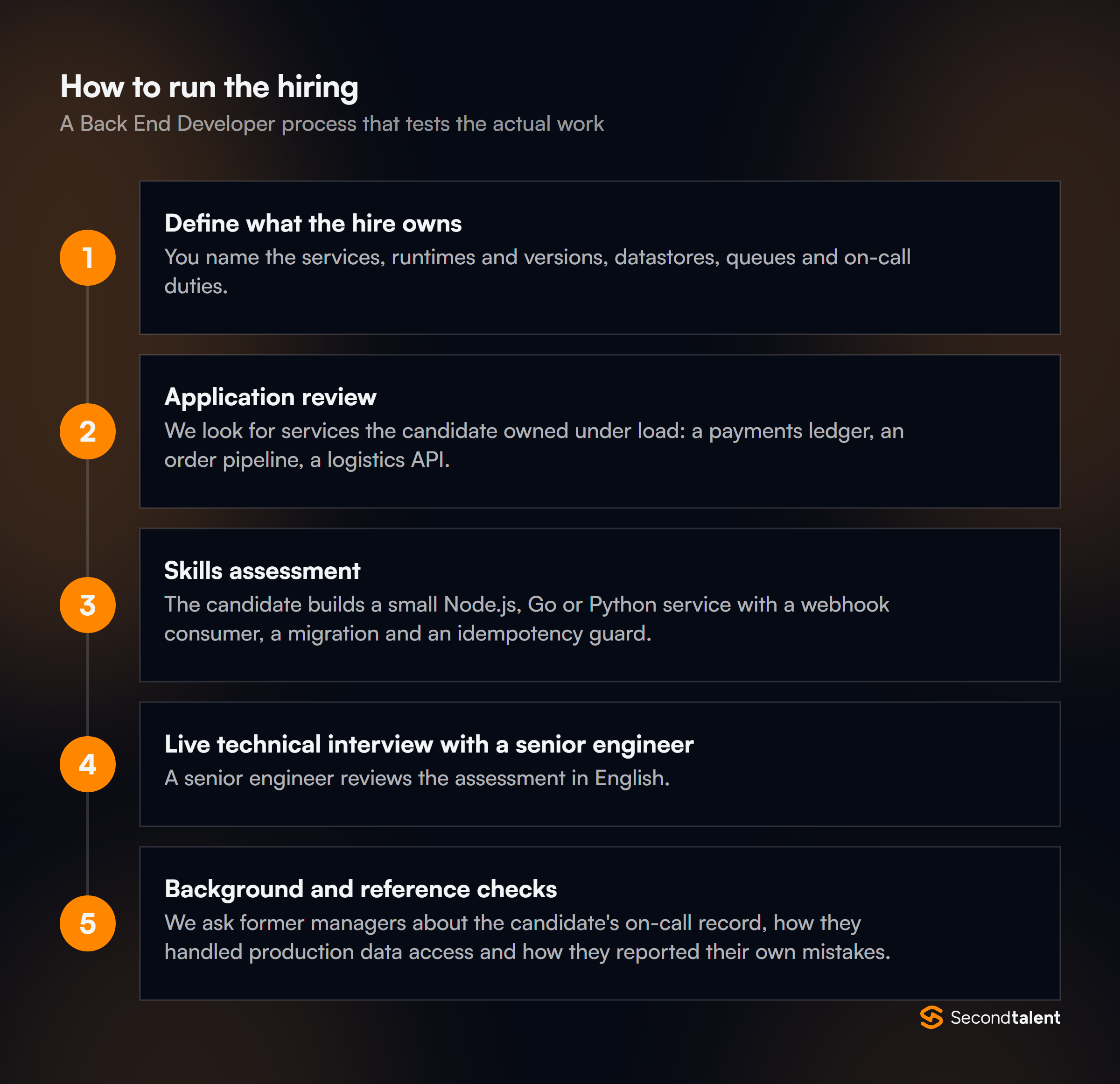
Second Talent's vetting covers stages 2 to 5 before you see a profile.
Stage 1: Define what the hire owns
You name the services, runtimes and versions, datastores, queues and on-call duties. Add whether any users or data sit in Vietnam, and pick a shift from the table above.
Stage 2: Application review
We look for services the candidate owned under load: a payments ledger, an order pipeline, a logistics API. A candidate should state the traffic, the uptime target and the worst incident they handled.
Stage 3: Skills assessment
The candidate builds a small Node.js, Go or Python service with a webhook consumer, a migration and an idempotency guard. We send duplicate events and a ₫5 billion amount, then score correctness, logs and upgrade notes.
Stage 4: Live technical interview with a senior engineer
A senior engineer reviews the assessment in English. The design question is a US-hosted API serving Vietnamese customers: where the data sits, what triggers a dossier and how the team would size a breach within 72 hours.
Stage 5: Background and reference checks
We ask former managers about the candidate's on-call record, how they handled production data access and how they reported their own mistakes. You then choose the contractor or EOR route above.
Hire Back-End Developers from Vietnam with Second Talent
We shortlist 6-8 candidates within 24 hours from 100,000+ pre-vetted engineers, accepting only the top 1% of applicants. Back-end developers from Vietnam come with $0 upfront, no lock-in and 4-6 hours of daily overlap with US hours. We handle contracts, payroll and equipment, with compliant EOR contracts in Vietnam.
Our pricing page covers subscription, direct-hire and EOR pricing. Truckstop, the freight technology company, placed eight engineers in Vietnam through us at an average of 22 days to hire, with all roles filled inside 83 days, as the Truckstop case study sets out.