TL;DR: Back-end developers in the Philippines earn $1,520 to $4,630+ a month working for international clients on our rate card, and we shortlist 6-8 candidates within 24 hours. The closest US benchmark, the BLS median for software developers, was $135,980 a year in May 2025.
Philippine employers list MySQL among the skills they want from back-end developers on JobStreet. Oracle moved MySQL 8.0 to Sustaining Support on 21 April 2026, so a back-end hire in Manila may start by planning that upgrade.
Key takeaways
- India's Node.js card reaches $7,530+, the highest ceiling of the five markets compared below.
- A 2:00 am maintenance window in New York opens at 2:00 pm in Manila while US daylight time lasts, inside a normal working day.
- A Philippine employee who resigns without just cause must give written notice at least one month in advance.
- Four of the last eight days of 2026 are holidays in the Philippines: 24, 25, 30 and 31 December.
What Back-End Developers Earn in the Philippines Working for International Clients
The Philippine floor sits $320 above Indonesia's and $280 below Vietnam's. India and Malaysia have no back-end card, so those two rows use our Node.js developer rate card, the closest match.
The figures are what developers in each market earn working directly for foreign companies, before any employer or platform costs.
| Market |
Monthly pay working for international clients (USD) |
| Philippines |
$1,520-$4,630+ |
| Indonesia |
$1,200-$5,500 |
| Vietnam |
$1,800-$6,500 |
| India |
$1,880-$7,530+ |
| Malaysia |
$2,200-$6,500 |
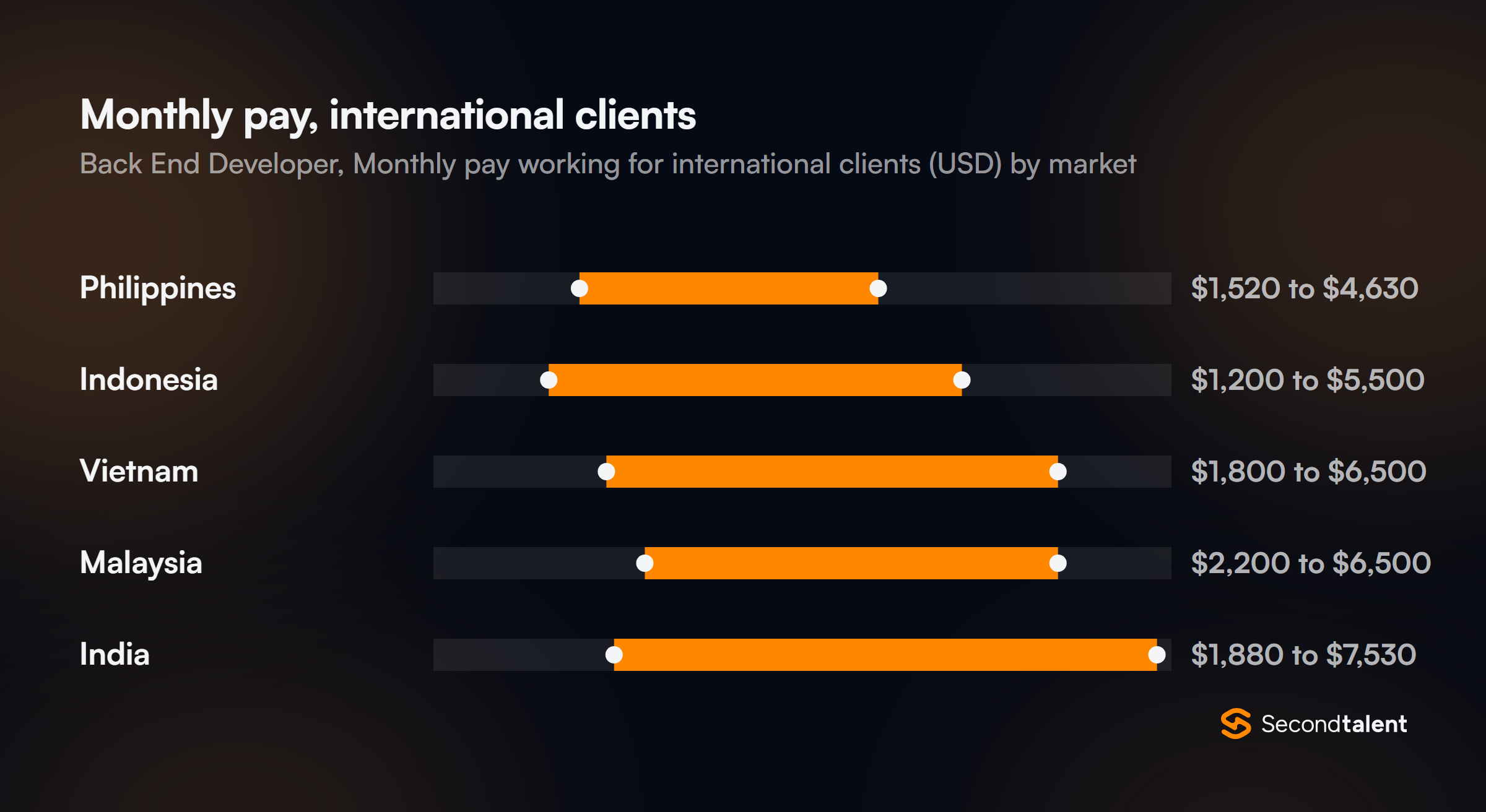
Monthly ranges from the Remote (Working for International Clients) figures on our rate cards for Philippines, Indonesia, Vietnam, India and Malaysia, converted at ExchangeRate-API mid-market rates for 14 September 2026.
The Philippine card quotes ₱95,000 to ₱290,000+ a month, one of two ranges in the table left open at the top. Write the brief before you anchor on a number, since a developer who owns a service in production and one who adds endpoints to it can sit at opposite ends of that range.
For local-market pay, JobStreet's Philippine back-end developer page puts advertised base salaries at ₱70,000 to ₱80,000 a month for the middle half of job ads, with a median of ₱75,000. The skills it lists include Node.js, Java, AWS, MySQL, PostgreSQL and MongoDB.
Through Second Talent you pay one monthly fee that bundles salary, payroll taxes, statutory contributions and our service fee, quoted per role and market. Our pricing page explains the subscription, and our back-end cost-to-hire page prices the US freelance route.
US Pay Benchmark for Back-End Developers
BLS publishes no back-end developer occupation. The role maps to Software Developers (SOC 15-1252), because it builds application software and runs the data layer under it.
| BLS OEWS, May 2025, national |
Software Developers (15-1252) |
| Median annual |
$135,980 |
| 10th percentile, monthly |
$6,870 |
| 25th percentile, monthly |
$8,770 |
| Median, monthly |
$11,330 |
| 75th percentile, monthly |
$14,330 |
| 90th percentile, monthly |
$17,890 |
Monthly figures are the annual wages on the OEWS profile for 15-1252 divided by 12, rounded to the nearest $10.
Salary is only part of the US cost. In the BLS Employer Costs for Employee Compensation release for June 2026, wages and salaries made up 68.5% of employer compensation costs for full-time private industry workers, and benefits the other 31.5%.
Time Zone Overlap: Manila Against ET, CT and PT
Manila's working afternoon is the US night. A schema migration set for 2:00 am in New York runs at 06:00 UTC, which is 2:00 pm in Manila. Manila keeps UTC+8 all year, and US daylight time runs from 8 March to 1 November 2026, per NIST.
The arithmetic: 9:00 am in Chicago is 14:00 UTC under CDT (UTC-5), and 14:00 UTC is 10:00 pm in Manila. Under CST (UTC-6) it is 11:00 pm. New York's 9:00 am lands an hour earlier, at 9:00 pm, and San Francisco's at midnight.
| Manila shift (UTC+8) |
ET overlap (EDT / EST) |
CT overlap (CDT / CST) |
PT overlap (PDT / PST) |
Hours between 10 pm and 6 am |
| 9 am-6 pm |
0 / 0 |
0 / 0 |
0 / 0 |
0 |
| 2 pm-11 pm |
2 / 1 |
1 / 0 |
0 / 0 |
1 |
| 5 pm-2 am |
5 / 4 |
4 / 3 |
2 / 1 |
4 |
| 8 pm-5 am |
8 / 7 |
7 / 6 |
5 / 4 |
7 |
Each shift is nine clock hours with a meal break, counted against a 9 am to 5 pm US day.
Split the work by risk. Backfills, index builds and dependency upgrades suit the Manila afternoon, while US traffic is low. Design reviews and incident follow-ups need the shared hours, and the 5 pm to 2 am row gives a New York team five of them in summer.
That row also puts four hours inside the Philippine night band. The Labor Code sets a night shift differential of at least 10% of the regular wage for each hour an employee works between 10 pm and 6 am (Article 86). We fix the shift before the offer, which is how our placements get 4-6 hours of daily overlap with US hours.
Back-End Developer Skills to Screen For
Among professional developers in Stack Overflow's 2025 survey, 58.2% used PostgreSQL, 39.6% MySQL, 30.7% Redis and 24.3% MongoDB. JobStreet's Philippine listing names three of the four. Test the one your production data lives in.
MySQL 8.0 to 8.4 upgrades
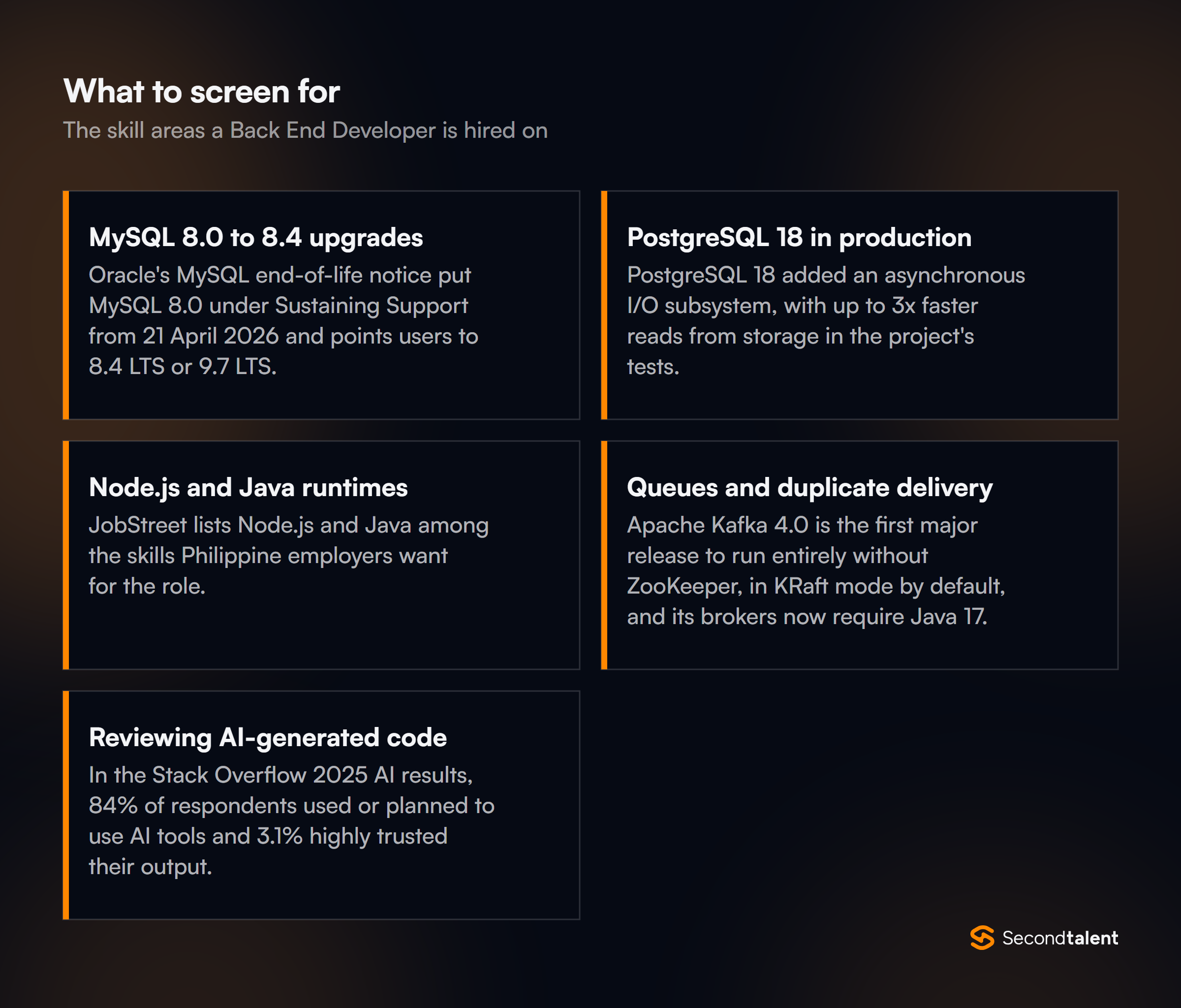
Oracle's MySQL end-of-life notice put MySQL 8.0 under Sustaining Support from 21 April 2026 and points users to 8.4 LTS or 9.7 LTS. The MySQL 8.4 release notes overview shows one change that breaks logins: the deprecated mysql_native_password plugin is no longer enabled by default.
Ask the candidate how they would find the accounts and client libraries that still depend on it. Then ask for the order of replica and primary upgrades, and the rollback.
PostgreSQL 18 in production
PostgreSQL 18 added an asynchronous I/O subsystem, with up to 3x faster reads from storage in the project's tests. Two smaller additions matter for back-end teams: a uuidv7() function that indexes better than random UUIDs, and OAuth 2.0 authentication for single sign-on.
Hand the candidate a slow query plan on a table keyed by random UUIDs. Ask what they would change, and how they would migrate without locking the table.
Node.js and Java runtimes
JobStreet lists Node.js and Java among the skills Philippine employers want for the role. The Node.js release page marks version 20 as end of life, lists 22 and 24 as LTS and 26 as Current. It says production applications should only use Active LTS or Maintenance LTS releases.
On the Java side, JDK 25 reached General Availability on 16 September 2025 and is a long-term support release from most vendors. Ask for the last major runtime upgrade the candidate shipped and what broke.
Queues and duplicate delivery
Apache Kafka 4.0 is the first major release to run entirely without ZooKeeper, in KRaft mode by default, and its brokers now require Java 17. A consumer that processes the same event twice can ship an order twice or send a refund twice. Ask the candidate how their last consumer detected a repeat and where it stored the marker.
Reviewing AI-generated code
In the Stack Overflow 2025 AI results, 84% of respondents used or planned to use AI tools and 3.1% highly trusted their output. 66% named "AI solutions that are almost right, but not quite" as a frustration. Give the candidate an AI-written endpoint that passes its happy-path test and skips the ownership check, and score what they catch in review.
Contractor or Employer of Record in the Philippines
Software is not one of the nine categories of commissioned work that can be "work made for hire" under 17 U.S.C. § 101, and a transfer must be in writing and signed under § 204(a). The Philippine Intellectual Property Code leaves copyright in a commissioned work with its creator unless a written stipulation says otherwise (section 178.4). Name services, schemas and migration scripts in the assignment.
IRS Publication 515 says the place where services are performed determines the source of the income, so a developer working from Quezon City earns foreign-source income. A foreign individual gives the payer Form W-8BEN to certify foreign status.
Philippine courts decide employment with the four-fold test: selection and engagement, payment of wages, the power of dismissal and the power to control the employee's conduct. In Atok Big Wedge v. Gison, the Supreme Court called control the most important of the four. A developer on your on-call rota, working your tickets, meets it.
Employment brings the Labor Code's other rules as well. Probation cannot exceed six months, and the employer must make its standards known at the start. An employee who resigns without just cause owes one month's written notice, which gives you a handover window for the services that developer runs.
Four statutory lines sit on top of salary:
A fixed integration project suits a contractor agreement. A developer with standing access to your production database is the case our Employer of Record service covers, and our Philippines EOR page explains how it works without a local entity. This is a summary, not legal advice.
|
Independent contractor |
Employer of Record |
| Legal employer |
None; the developer invoices you |
The EOR's Philippine entity |
| US paperwork |
Form W-8BEN from the developer |
Service agreement with the EOR |
| IP |
Written stipulation assigning services, schemas and migrations (section 178.4) |
Employer owns work from regular duties (section 178.3), passed on through your EOR agreement |
| Local labor law |
Employment finding if the four-fold test is met |
Probation, notice, 13th month pay and night differential apply |
| Pay currency |
Agreed in the contract, often USD |
Local payroll run by the EOR |
English Level and Working Norms in the Philippines
The Philippines scores 569 on the EF English Proficiency Index 2025, 28th of 123 countries and regions against a global average of 488. Its IT job-function score is 581, and its writing score of 603 runs 64 points above speaking, per EF's Philippines page.
That split suits back-end work, where most decisions travel in writing: pull request descriptions, migration plans and incident notes. Ask finalists to write the note for an outage they caused, with the timeline, the root cause and the change that stops a repeat.
Plan the year end around Proclamation 1006. Christmas Day and Rizal Day on 30 December are regular holidays, and Christmas Eve and 31 December are special non-working days. Freeze schema changes that week or name a US engineer on call.
Thanksgiving on 26 November 2026 is a working day in the Philippines, so a developer there can watch queue depth and error rates while your US team is off.
Back-End Developer Hiring Process in the Philippines
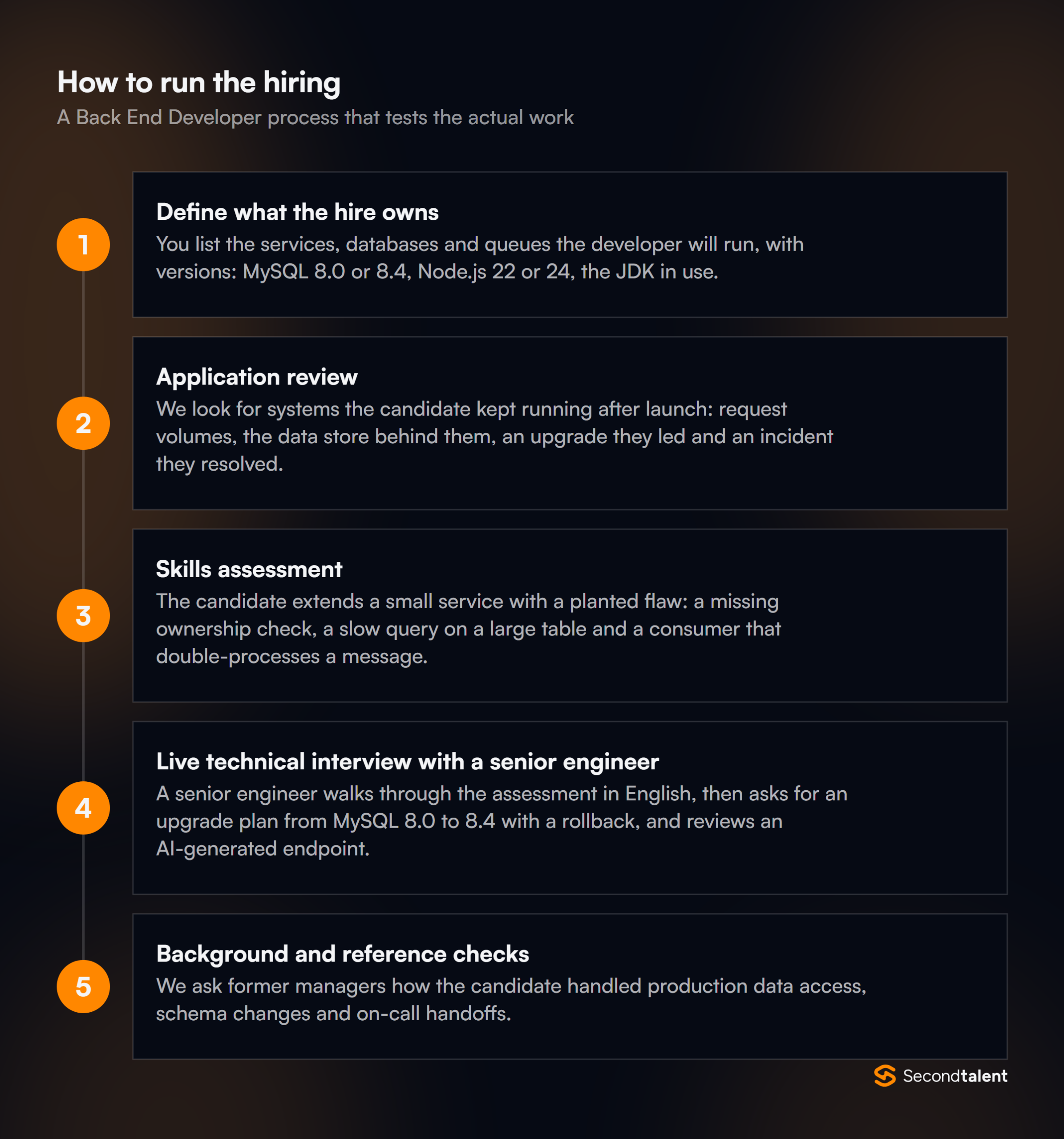
Second Talent's vetting covers stages 2 to 5 before you see a profile. Our back-end interview guide has question sets for your own final round.
Stage 1: Define what the hire owns
You list the services, databases and queues the developer will run, with versions: MySQL 8.0 or 8.4, Node.js 22 or 24, the JDK in use. Say whether they join the on-call rota and which Manila shift from the table above they will work.
Stage 2: Application review
We look for systems the candidate kept running after launch: request volumes, the data store behind them, an upgrade they led and an incident they resolved. A list of frameworks with no production story does not pass.
Stage 3: Skills assessment
The candidate extends a small service with a planted flaw: a missing ownership check, a slow query on a large table and a consumer that double-processes a message. We score the migration and the written explanation with the code.
Stage 4: Live technical interview with a senior engineer
A senior engineer walks through the assessment in English, then asks for an upgrade plan from MySQL 8.0 to 8.4 with a rollback, and reviews an AI-generated endpoint with the candidate.
Stage 5: Background and reference checks
We ask former managers how the candidate handled production data access, schema changes and on-call handoffs. You then choose the contractor or EOR route above.
Hire Back-End Developers from the Philippines with Second Talent
We shortlist 6-8 candidates within 24 hours from 100,000+ pre-vetted engineers, accepting only the top 1% of applicants. Back-end developers from the Philippines come with $0 upfront, no lock-in and 4-6 hours of daily overlap with US hours. We handle contracts, payroll and equipment, with compliant EOR contracts in the Philippines.
Our pricing page covers the subscription, and for partner-facing endpoints we also staff API developers in the Philippines.