TL;DR: Data engineers in the Philippines earn $1,750 to $4,070+ a month working for international clients on our data scientist rate card, and we shortlist 6-8 candidates within 24 hours. The closest US benchmark, the BLS median for data scientists, was $120,230 a year in May 2025.
The Philippine Data Privacy Act does not apply to personal information collected from residents of foreign jurisdictions under their laws and processed in the Philippines (Section 4(g)). A data engineer in Manila loading customer data your company collected in the US, under US law, works on records the Act leaves out.
Key takeaways
- The Philippines is not on the US Justice Department's list of six countries of concern for bulk sensitive personal data.
- Snowflake enforces NOT NULL and CHECK constraints on standard tables, but not primary key, unique or foreign key constraints.
- Apache Airflow 2 reached end of life on 22 April 2026, so DAGs still on it get no further fixes.
- A 9 am start in Manila is 9 pm the evening before in New York, so a failed overnight load reaches the engineer before your analysts log on.
What Data Engineers Earn in the Philippines Working for International Clients
The top of the Philippine range sits below the floor of Malaysia's. We publish no data engineer card for the Philippines, so that row uses our data scientist rate card, the closest match; the other rows use our data engineer cards.
The figures are what engineers in each market earn working directly for foreign companies, before any employer or platform costs.
| Market |
Monthly pay working for international clients (USD) |
| Philippines |
$1,750-$4,070+ |
| India |
$2,300-$8,470+ |
| Vietnam |
$3,480-$6,960+ |
| Malaysia |
$4,420-$8,600+ |
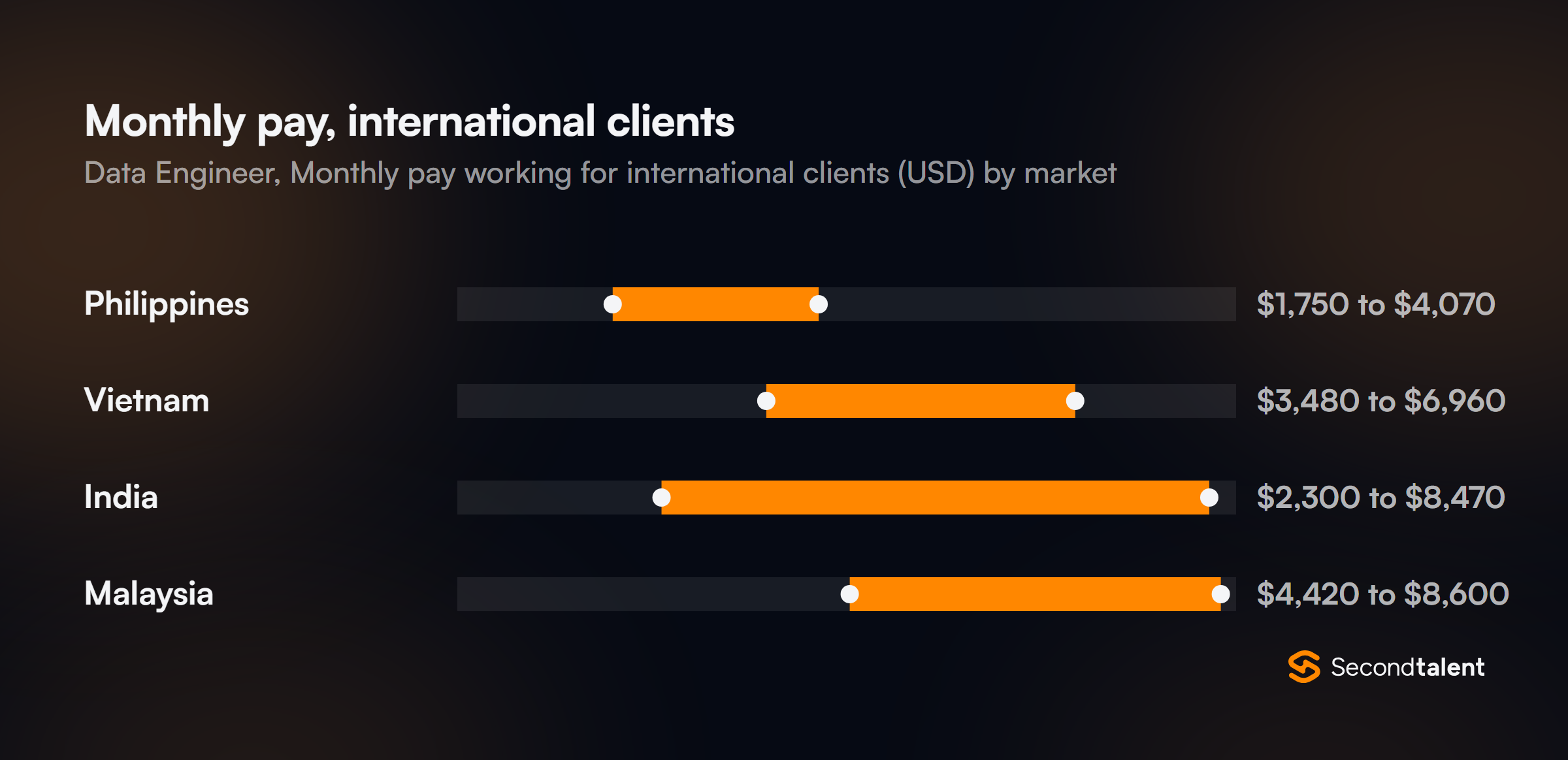
Monthly ranges from the Remote (Working for International Clients) figures on our rate cards for Philippines, India, Vietnam and Malaysia, converted at ExchangeRate-API mid-market rates for 14 September 2026.
The Philippine card quotes ₱110,000 to ₱255,000+ a month. Because it covers data scientists, check whether your brief is pipeline work or modelling before you compare it with the other rows.
For local-market pay, JobStreet's Philippine data engineer page puts the middle half of advertised base salaries at ₱81,000 to ₱91,000 a month, with a median of ₱86,250. The skills it lists include pipelines, SQL, Python, data quality, data modelling and the Snowflake platform.
Through Second Talent you pay one monthly fee that bundles salary, payroll taxes, statutory contributions and our service fee, quoted per role and market. Our pricing page explains the subscription. For a short contract, our data engineer cost-to-hire page puts a mid-level US freelance data engineer at $92 to $145 an hour.
US Pay Benchmark for Data Engineers
BLS has no data engineer occupation. Our fixed mapping uses Data Scientists (SOC 15-2051), the closest federal series for a role that turns raw data into tables a business can query.
| BLS OEWS, May 2025, national |
Data Scientists (15-2051) |
| Median annual |
$120,230 |
| 10th percentile, monthly |
$5,600 |
| Median, monthly |
$10,020 |
| 90th percentile, monthly |
$16,590 |
Monthly figures are the annual wages on the OEWS profile for 15-2051 divided by 12, rounded to the nearest $10.
Salary is only part of the US cost. In the BLS Employer Costs for Employee Compensation release for June 2026, wages and salaries made up 68.5% of employer compensation costs for full-time private industry workers, and benefits the other 31.5%.
Time Zone Overlap: Manila Against ET, CT and PT
An overnight load that fails at 1:00 am in New York fails at 1:00 pm in Manila while US daylight time lasts. Manila keeps UTC+8 all year with no daylight saving, and US clocks stay on daylight time from 8 March to 1 November 2026, per NIST.
The arithmetic: 9:00 am in San Francisco is 16:00 UTC under PDT (UTC-7), and 16:00 UTC is midnight in Manila. Under PST (UTC-8) it is 1:00 am. New York's 9:00 am lands at 9:00 pm in summer, and Chicago's at 10:00 pm.
| Manila shift (UTC+8) |
ET overlap (EDT / EST) |
CT overlap (CDT / CST) |
PT overlap (PDT / PST) |
Hours between 10 pm and 6 am |
| 9 am-6 pm |
0 / 0 |
0 / 0 |
0 / 0 |
0 |
| 1 pm-10 pm |
1 / 0 |
0 / 0 |
0 / 0 |
0 |
| 3 pm-12 am |
3 / 2 |
2 / 1 |
0 / 0 |
2 |
| 7 pm-4 am |
7 / 6 |
6 / 5 |
4 / 3 |
6 |
Each shift is nine clock hours with a meal break, counted against a 9 am to 5 pm US day.
The day shift suits pipeline ownership. The engineer reruns failed jobs, backfills the gaps and posts a freshness note before your US analysts start, all at base pay. Metric definitions and schema changes need the analysts who consume them, and the 3 pm row buys a New York team three live hours for that.
The 7 pm row covers more of the US day but puts six hours inside the Philippine night band. The Labor Code sets a night shift differential of at least 10% of the regular wage for each hour an employee works between 10 pm and 6 am (Article 86). We agree the shift before the offer, which is how our placements get 4-6 hours of daily overlap with US hours.
Data Engineer Skills to Screen For
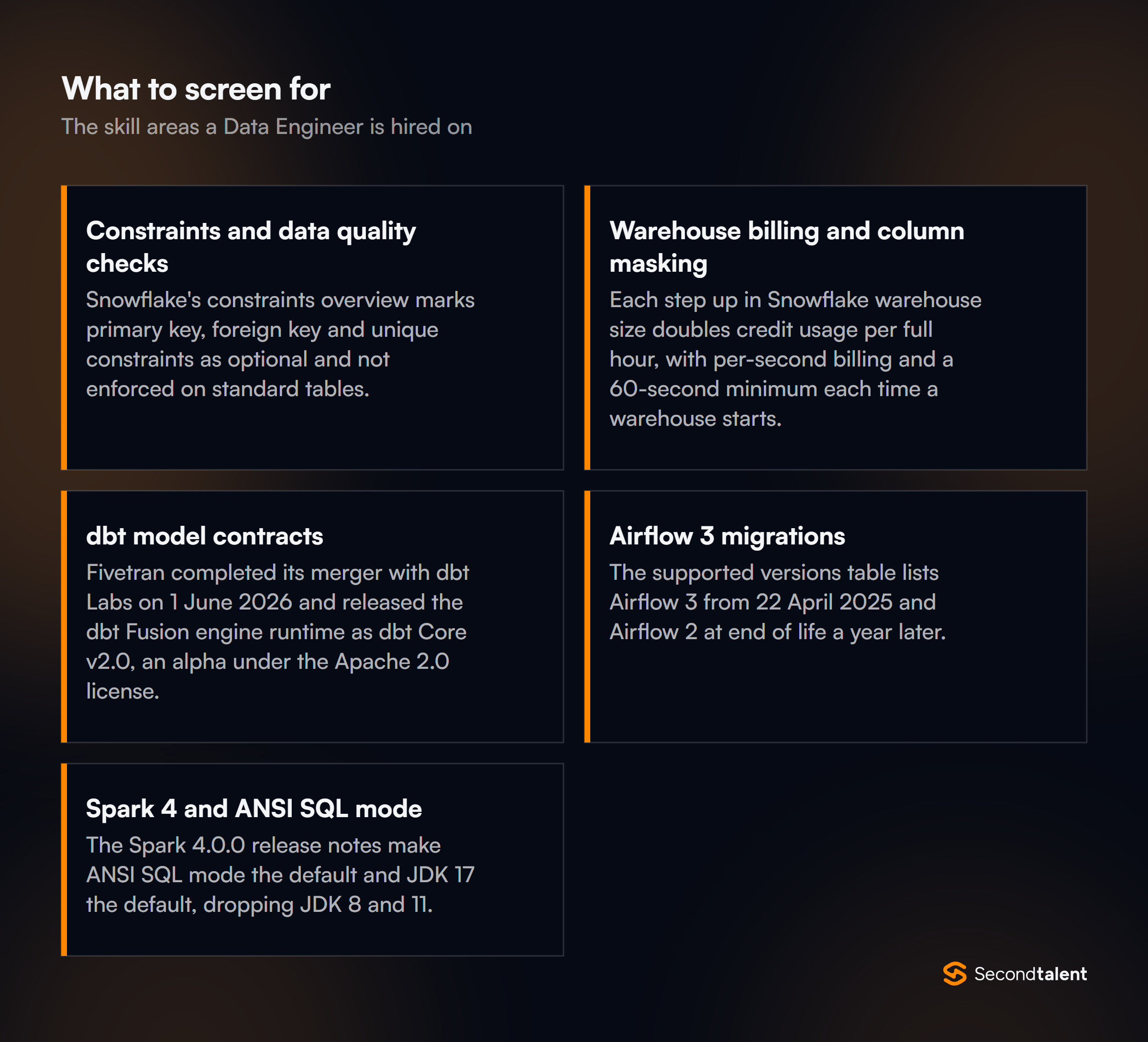
JobStreet lists Snowflake and data quality among the skills Philippine employers ask data engineers for. Test those on your own warehouse, then the orchestration and transformation layers around it.
Constraints and data quality checks
Snowflake's constraints overview marks primary key, foreign key and unique constraints as optional and not enforced on standard tables. Snowflake does enforce NOT NULL and CHECK. A table can declare a primary key and still load the same order twice. Load a table with duplicate keys and ask the candidate which test catches it, and where in the pipeline it runs.
Warehouse billing and column masking
Each step up in Snowflake warehouse size doubles credit usage per full hour, with per-second billing and a 60-second minimum each time a warehouse starts. Dynamic Data Masking masks plain-text columns at query time through masking policies, and requires Enterprise Edition or higher. Ask for a warehouse bill the candidate cut, and how they would hide email addresses from a role that should not see them, without copying the table.
dbt model contracts
Fivetran completed its merger with dbt Labs on 1 June 2026 and released the dbt Fusion engine runtime as dbt Core v2.0, an alpha under the Apache 2.0 license. With an enforced model contract, dbt runs a preflight check that the model returns the column names and data types defined for it. Ask which of your models the candidate would put under contract first.
Airflow 3 migrations
The supported versions table lists Airflow 3 from 22 April 2025 and Airflow 2 at end of life a year later. The upgrade guide says task code can no longer import Airflow database sessions or models, replaces SubDAGs with TaskGroups and Assets, and swaps SLAs for Deadline Alerts. Ask which of those three changes cost the candidate the most time on their last DAG estate.
Spark 4 and ANSI SQL mode
The Spark 4.0.0 release notes make ANSI SQL mode the default and JDK 17 the default, dropping JDK 8 and 11. Under ANSI mode, Spark throws a runtime exception instead of returning null for invalid inputs, per its ANSI compliance guide. Give the candidate a Spark 3 job that casts dirty strings to integers and ask what fails after the upgrade.
Contractor or Employer of Record in the Philippines
Software is not one of the nine categories of commissioned work that can be "work made for hire" under 17 U.S.C. § 101, and a transfer must be in writing and signed under § 204(a).
The Philippine Intellectual Property Code protects computer programs (section 172.1) and compilations of data that are original in their selection or arrangement (section 173.1). For a commissioned work, copyright stays with the creator unless a written stipulation says otherwise (section 178.4). Name pipeline code, dbt models and warehouse schemas in the assignment.
IRS Publication 515 says the place where services are performed determines the source of the income, so a data engineer working from Makati earns foreign-source income. A foreign individual gives the payer Form W-8BEN to certify foreign status.
Philippine courts apply the four-fold test: selection and engagement, payment of wages, the power of dismissal and the power to control the employee's conduct. The Supreme Court called control the most important of the four in Atok Big Wedge v. Gison. An engineer who answers for your nightly load on your schedule meets it.
On data access, the Data Privacy Act exclusion in Section 4(g) covers data collected abroad under foreign law. The exclusion covers only information originally collected from residents of foreign jurisdictions, so records of Philippine customers stay inside the Act. Keep them in a separate scope. The US rule on bulk sensitive personal data names six countries of concern: China, Cuba, Iran, North Korea, Russia and Venezuela.
An employee costs four statutory lines on top of salary:
A one-off warehouse migration with an end date suits a contractor agreement. An engineer with standing credentials to production data is the case our Employer of Record service covers, and our Philippines EOR page explains the employment route. This is a summary, not legal advice.
|
Independent contractor |
Employer of Record |
| Legal employer |
None; the engineer invoices you |
The EOR's Philippine entity |
| US paperwork |
Form W-8BEN from the engineer |
Service agreement with the EOR |
| IP |
Written stipulation assigning pipelines, dbt models and schemas (section 178.4) |
Employer owns work from regular duties (section 178.3), passed on through your EOR agreement |
| Local labor law |
Employment finding if the four-fold test is met |
13th month pay, SSS, PhilHealth, Pag-IBIG and night differential apply |
| Pay currency |
Agreed in the contract, often USD |
Local payroll run by the EOR |
English Level and Working Norms in the Philippines
The Philippines' writing score on the EF English Proficiency Index 2025 is 603, against 539 for speaking. Its overall score of 569 ranks 28th of 123 countries and regions against a global average of 488, and its IT job-function score is 581, per EF's Philippines page.
A data engineer's English shows in column descriptions, model docs and the note that explains why a dashboard was wrong on Monday. Ask finalists to document one of your messiest tables in YAML, so a US analyst could use it without asking.
Proclamation 1006 makes All Souls' Day on Monday 2 November 2026 a special non-working day in the Philippines. It is also the first US working day after clocks go back on 1 November, when any job scheduled in US local time moves an hour later against Manila. Check the DAG schedules with the engineer the Friday before.
Thanksgiving on 26 November 2026 is a working day in the Philippines, so an engineer there can watch the holiday-weekend loads while your US team is off.
Data Engineer Hiring Process in the Philippines
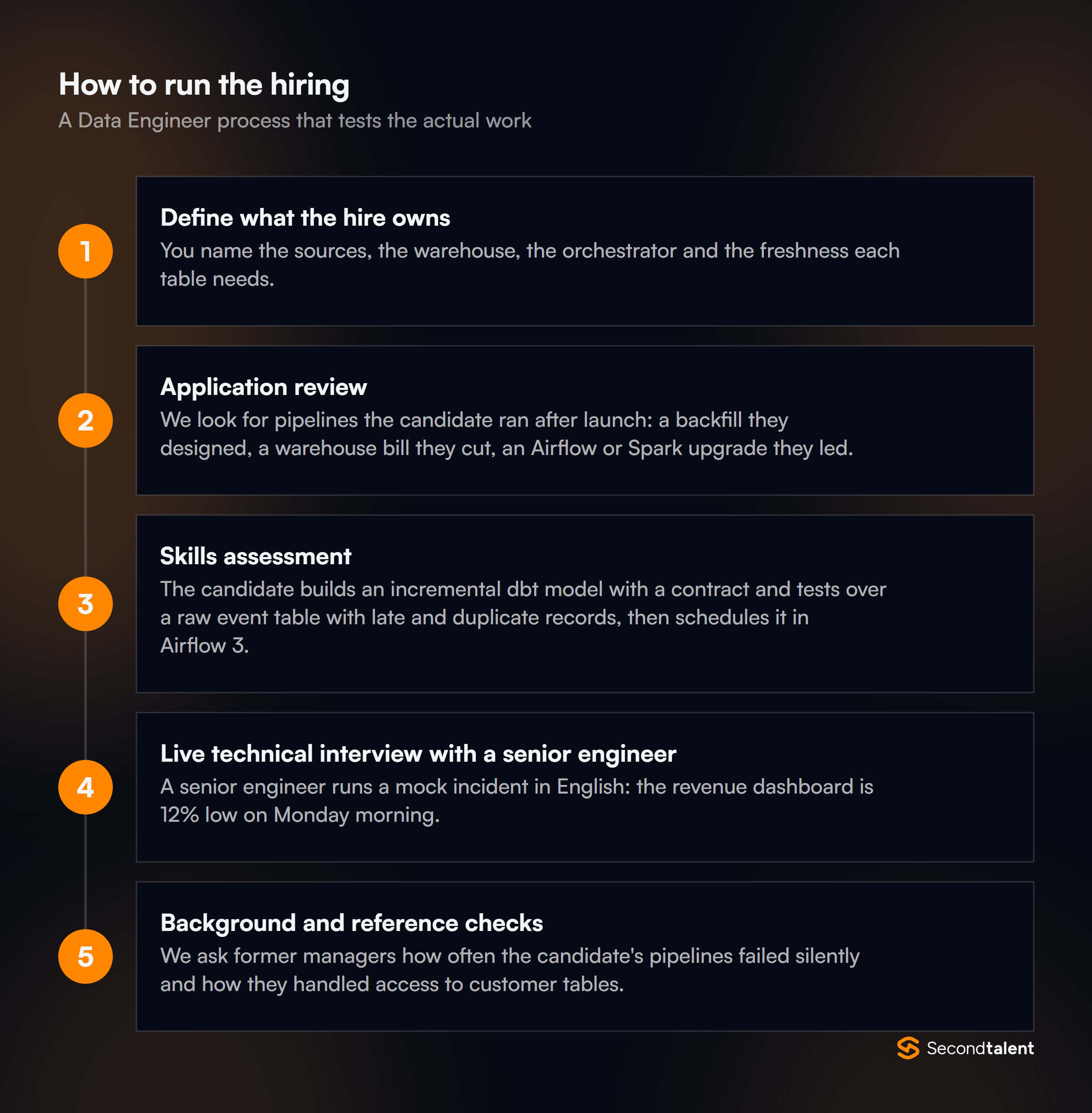
Second Talent's vetting covers stages 2 to 5 before you see a profile.
Stage 1: Define what the hire owns
You name the sources, the warehouse, the orchestrator and the freshness each table needs. Say whether the engineer will touch personal data and which columns need masking, and pick a Manila shift from the table above.
Stage 2: Application review
We look for pipelines the candidate ran after launch: a backfill they designed, a warehouse bill they cut, an Airflow or Spark upgrade they led. They give volumes in rows or gigabytes a day. A tool list with no production story does not pass.
Stage 3: Skills assessment
The candidate builds an incremental dbt model with a contract and tests over a raw event table with late and duplicate records, then schedules it in Airflow 3. We score the tests and the pull request note with the SQL.
Stage 4: Live technical interview with a senior engineer
A senior engineer runs a mock incident in English: the revenue dashboard is 12% low on Monday morning. The candidate traces lineage, checks the last good load and writes the note to the analytics team.
Stage 5: Background and reference checks
We ask former managers how often the candidate's pipelines failed silently and how they handled access to customer tables. You then choose the contractor or EOR route above.
Hire Data Engineers from the Philippines with Second Talent
We shortlist 6-8 candidates within 24 hours from 100,000+ pre-vetted engineers, accepting only the top 1% of applicants. Data engineers from the Philippines come with $0 upfront, no lock-in and 4-6 hours of daily overlap with US hours. We handle contracts, payroll and equipment, with compliant EOR contracts in the Philippines.
Our pricing page covers the subscription, and for the code around your pipelines we also staff Python developers in the Philippines.