TL;DR: API developers in the Philippines earn $1,520 to $4,630+ a month working for international clients on our back-end developer rate card, and we shortlist 6-8 candidates within 24 hours. The closest US benchmark, the BLS median for software developers, was $135,980 a year in May 2025.
Under the Philippine Intellectual Property Code, a client who commissions a work owns it, but the copyright stays with the developer without a written stipulation. For an API a Manila contractor builds, that covers the spec partners code against, the generated SDKs and the server code.
Key takeaways
- A 4 pm to 1 am shift in Manila overlaps a New York day by four hours while US daylight time lasts, with three of those hours inside the night differential window.
- OWASP's 2023 API list names unsafe consumption of APIs as a top risk: code that trusts a third-party response more than user input.
- Philippine job ads put local base pay for back-end developers at ₱70,000 to ₱80,000 a month, while our card for foreign-client work starts at ₱95,000.
- Bonifacio Day, a regular holiday, falls on Monday 30 November 2026, the first working day after Thanksgiving weekend in the US.
What API Developers Earn in the Philippines Working for International Clients
The Philippine row is the only range in the table left open at the top, and its floor sits $320 above Indonesia's. We publish no API developer card, so the table uses our back-end developer rate cards, the closest match to the work. Malaysia has no back-end card, so its row uses our Node.js developer card.
The figures are what developers in each market earn working directly for foreign companies, before any employer or platform costs.
| Market |
Monthly pay working for international clients (USD) |
| Philippines |
$1,520-$4,630+ |
| Indonesia |
$1,200-$5,500 |
| Vietnam |
$1,800-$6,500 |
| Malaysia |
$2,200-$6,500 |
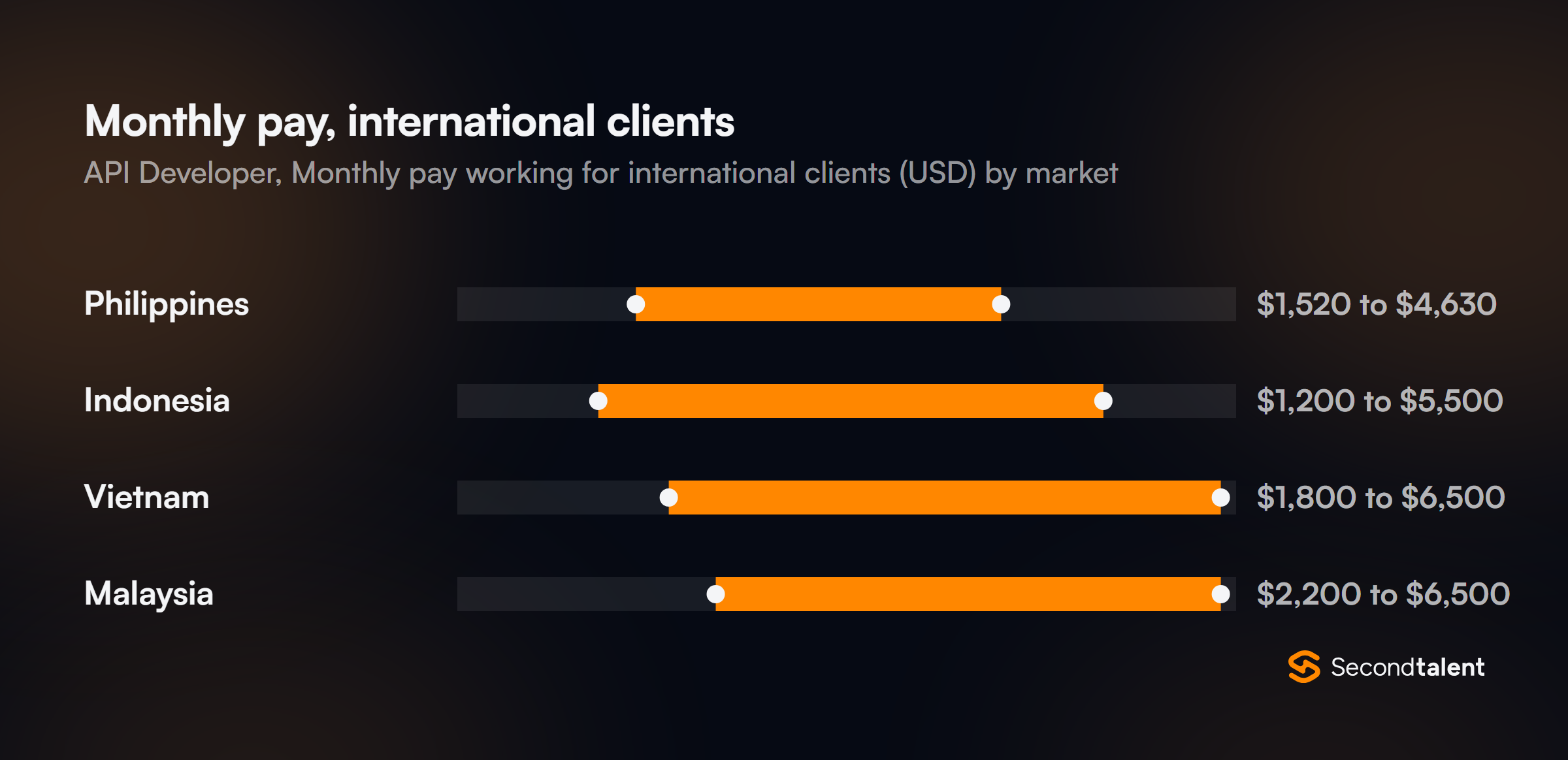
Monthly ranges from the Remote (Working for International Clients) figures on our rate cards for Philippines, Indonesia, Vietnam and Malaysia, converted at ExchangeRate-API mid-market rates for 14 September 2026.
The Philippine card quotes ₱95,000 to ₱290,000+ a month. Local-market pay sits lower: JobStreet's back-end developer salary page puts the middle half of advertised base salaries at ₱70,000 to ₱80,000, from pay that employers disclose in Philippine job ads. The same page lists "API" and "Rest API" among the skills those employers ask for.
Through Second Talent you pay one monthly fee that bundles salary, payroll taxes, statutory contributions and our service fee, quoted per role and market. Our pricing page explains the subscription, and our back-end developer cost-to-hire page covers US freelance rates for a short integration contract.
US Pay Benchmark for API Developers
O*NET lists "Application Integration Engineer" among the reported job titles for Software Developers (SOC 15-1252). API development maps to that occupation, because the job is writing and running production software that other systems call.
| BLS OEWS, May 2025, national |
Software Developers (15-1252) |
| Median annual |
$135,980 |
| 10th percentile, monthly |
$6,870 |
| 25th percentile, monthly |
$8,770 |
| Median, monthly |
$11,330 |
| 75th percentile, monthly |
$14,330 |
| 90th percentile, monthly |
$17,890 |
Monthly figures are the annual wages on the OEWS profile for 15-1252 divided by 12, rounded to the nearest $10.
Salary is only part of the US cost. In the BLS Employer Costs for Employee Compensation release for June 2026, wages and salaries made up 68.5% of employer compensation costs for full-time private industry workers, and benefits the other 31.5%.
Time Zone Overlap: Manila Against ET, CT and PT
A partner's webhook that starts failing at 10 am in Chicago lands at 11 pm in Manila while US daylight time lasts. Manila keeps UTC+8 all year with no daylight saving, and US clocks stay on daylight time from 8 March to 1 November 2026, per NIST.
The arithmetic: 9:00 am in New York is 13:00 UTC under EDT (UTC-4), and 13:00 UTC is 9:00 pm in Manila. Under EST (UTC-5) it is 10:00 pm. Chicago's 9:00 am lands at 10:00 pm in summer, and San Francisco's at midnight.
| Manila shift (UTC+8) |
ET overlap (EDT / EST) |
CT overlap (CDT / CST) |
PT overlap (PDT / PST) |
Hours between 10 pm and 6 am |
| 9 am-6 pm |
0 / 0 |
0 / 0 |
0 / 0 |
0 |
| 4 pm-1 am |
4 / 3 |
3 / 2 |
1 / 0 |
3 |
| 6 pm-3 am |
6 / 5 |
5 / 4 |
3 / 2 |
5 |
| 9 pm-6 am |
8 / 8 |
8 / 7 |
6 / 5 |
8 |
Each shift is nine clock hours with a meal break, counted against a 9 am to 5 pm US day.
The night column is a pay line for employees. The Philippine Labor Code sets a night shift differential of at least 10% of the regular wage for each hour worked between 10 pm and 6 am (Article 86). A 4 pm start keeps most of the day at base pay and still covers the first hours of an East Coast morning, when partner teams test against your sandbox.
API work also runs well without a live window. Postman's 2025 State of the API report placed 43% of its respondents in Asia-Pacific and 30% in North America. With teams split across continents, it found, most API changes happen asynchronously. A spec change that a reviewer in Manila approves overnight in a pull request needs no call at all.
We agree the shift before the offer, which is how our placements get 4-6 hours of daily overlap with US hours.
API Developer Skills to Screen For
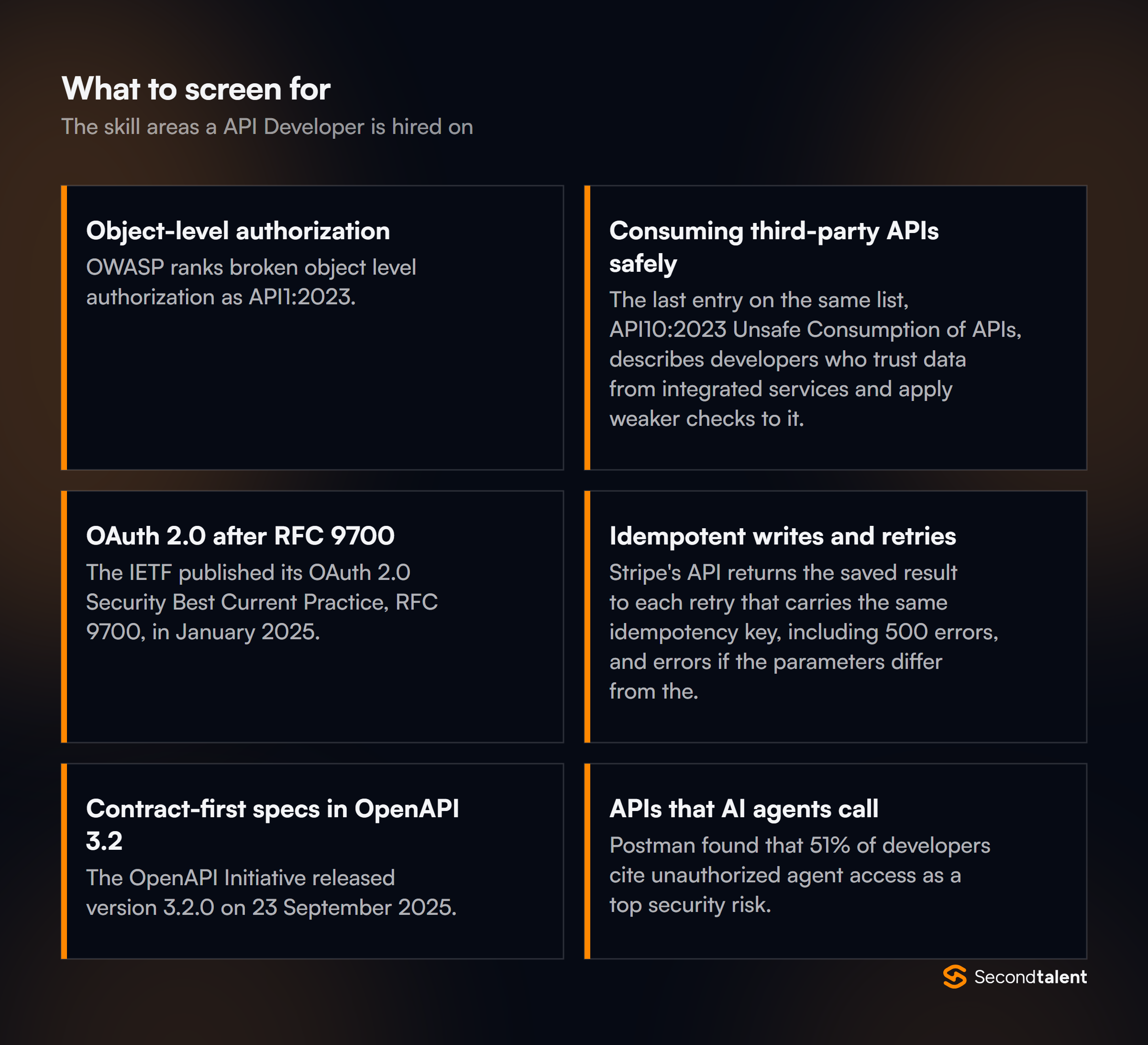
Postman surveyed more than 5,700 developers, architects and executives for that report: 89% used AI, but only 24% designed APIs with AI agents in mind. Screen first for the basics that stop data leaking. Then test for the new consumers.
Object-level authorization
OWASP ranks broken object level authorization as API1:2023. An endpoint that receives an object ID should check that the logged-in user may act on that object. OWASP warns that comparing the session's user ID with the ID parameter is not enough on its own.
Give the candidate two test accounts and an invoice endpoint, and score whether they find the leak and write the test that proves the fix.
Consuming third-party APIs safely
The last entry on the same list, API10:2023 Unsafe Consumption of APIs, describes developers who trust data from integrated services and apply weaker checks to it. OWASP's example is an address enrichment service that returns a stored SQL injection payload.
The fixes OWASP lists: validate and sanitize data from integrated APIs, send all calls over TLS, and keep an allowlist of redirect targets. Ask the candidate what their last payment or shipping integration did with a malformed response.
OAuth 2.0 after RFC 9700
The IETF published its OAuth 2.0 Security Best Current Practice, RFC 9700, in January 2025. It bans the resource owner password credentials grant, requires PKCE for public clients and tells clients not to use the implicit grant. Hand the candidate a mobile app still on the implicit flow and ask for the migration plan.
Idempotent writes and retries
Stripe's API returns the saved result to each retry that carries the same idempotency key, including 500 errors, and errors if the parameters differ from the original request. Keys run up to 255 characters, and Stripe advises against email addresses or other personal identifiers as keys. Ask the candidate to build that behaviour into an order endpoint.
Then ask what the client should do when it times out after the server has already created the order.
Contract-first specs in OpenAPI 3.2
The OpenAPI Initiative released version 3.2.0 on 23 September 2025. It added the QUERY HTTP method for idempotent requests with a query payload, and the OAuth 2.0 Device Authorization Flow for devices with limited input. Ask for the spec before the code, then change a field and check that existing clients still work.
APIs that AI agents call
Postman found that 51% of developers cite unauthorized agent access as a top security risk. While 70% knew of the Model Context Protocol, only 10% used it on a regular basis. Ask how the candidate would scope a key for an agent, tell its traffic from a human's and rate-limit it.
Contractor or Employer of Record in the Philippines
Software is not one of the nine categories of commissioned work that can be "work made for hire" under 17 U.S.C. § 101, and a transfer must be in writing and signed under § 204(a). Section 178.4 of the Philippine Intellectual Property Code points the same way, and section 172.1 lists computer programs among protected works. For employees, section 178.3 gives the employer the copyright in work from regularly assigned duties, unless an agreement says otherwise.
IRS Publication 515 says the place where services are performed determines the source of the income, so a developer working from Cebu earns foreign-source income. A foreign individual gives the payer Form W-8BEN to certify foreign status.
Philippine courts apply the four-fold test. In Atok Big Wedge v. Gison, the Supreme Court listed selection and engagement, payment of wages, the power of dismissal and the power to control the employee's conduct, and called control the most important. A developer who carries your API pager and works your tickets on your schedule meets the control limb.
Employment adds four statutory lines on top of salary:
A scoped integration with an end date suits a contractor agreement with a written IP stipulation. A developer who owns your public API long term is the case our Employer of Record service covers, and our Philippines EOR page sets out the employment route. This is a summary, not legal advice.
|
Independent contractor |
Employer of Record |
| Legal employer |
None; the developer invoices you |
The EOR's Philippine entity |
| US paperwork |
Form W-8BEN from the developer |
Service agreement with the EOR |
| IP |
Written stipulation assigning code, specs and SDKs (section 178.4) |
Employer owns work from regular duties (section 178.3), passed on through your EOR agreement |
| Local labor law |
Employment finding if the four-fold test is met |
13th month pay, SSS, PhilHealth, Pag-IBIG and night differential apply |
| Pay currency |
Agreed in the contract, often USD |
Local payroll run by the EOR |
English Level and Working Norms in the Philippines
Test takers in the Philippines score 603 for writing on the EF English Proficiency Index 2025, against 539 for speaking. The overall score is 569, 28th of 123 countries and regions against a global average of 488, and the IT job-function score is 581, per EF's Philippines page.
Writing is the skill an API hire uses most with your partners: reference docs, changelogs and deprecation notices. Ask each finalist for a one-page notice retiring a field, with the date, the replacement and the code change a client must make.
Plan releases around the Philippine calendar. Proclamation 1006 makes Bonifacio Day on Monday 30 November a regular holiday. Christmas Eve and 31 December are special non-working days. Article 94 of the Labor Code pays an employee twice the regular rate for work on a regular holiday, so agree API cover for that Monday in advance.
Thanksgiving on 26 November 2026 is a working day in the Philippines, so a developer there can watch error rates on partner integrations while your US team is off.
API Developer Hiring Process in the Philippines
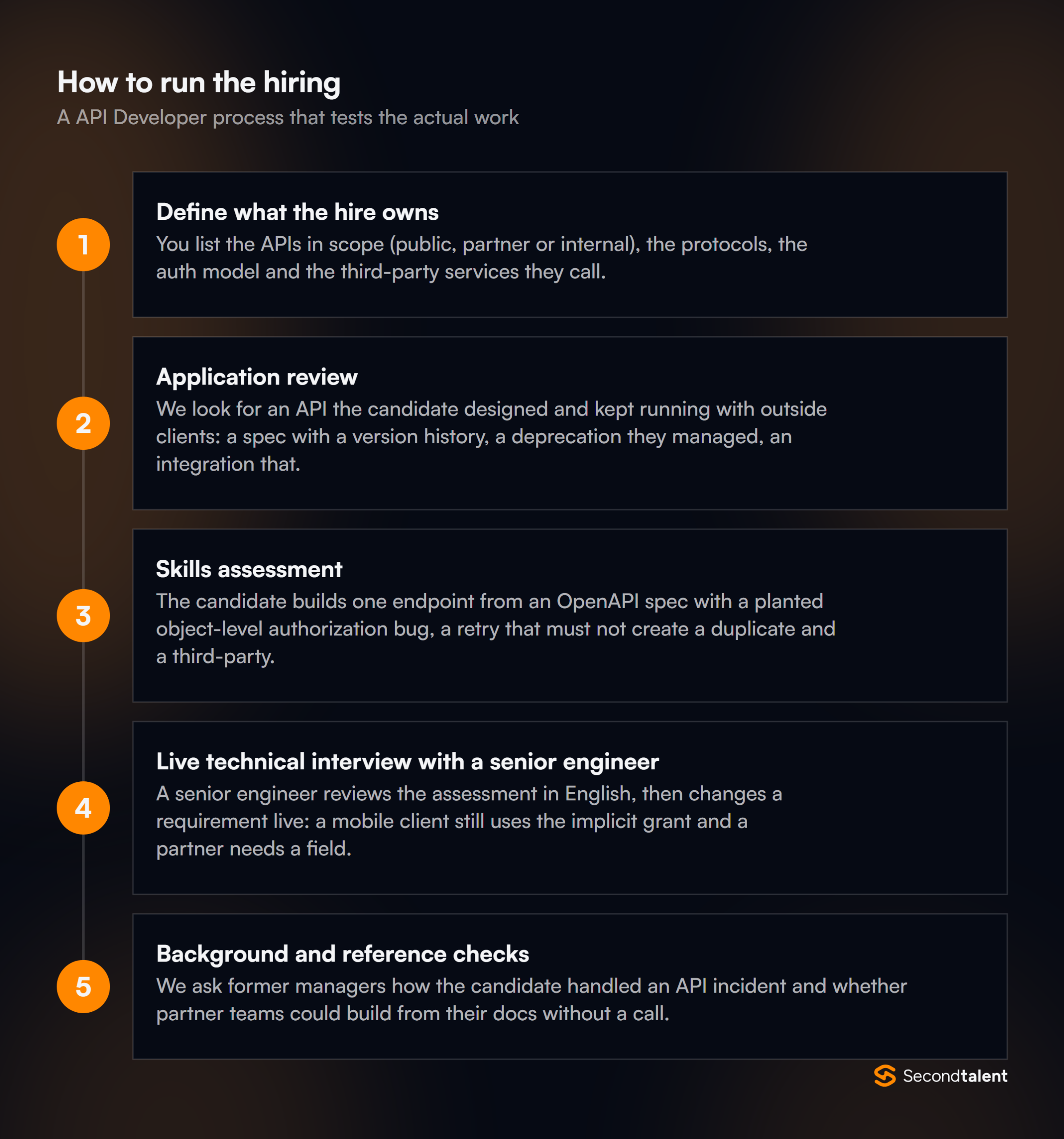
Second Talent's vetting covers stages 2 to 5 before you see a profile. Our interview guides for API security and OpenAPI have question sets for your own final round.
Stage 1: Define what the hire owns
You list the APIs in scope (public, partner or internal), the protocols, the auth model and the third-party services they call. Say whether the developer carries the pager, and pick a Manila shift from the table above.
Stage 2: Application review
We look for an API the candidate designed and kept running with outside clients: a spec with a version history, a deprecation they managed, an integration that survived a provider outage. A list of CRUD endpoints does not pass.
Stage 3: Skills assessment
The candidate builds one endpoint from an OpenAPI spec with a planted object-level authorization bug, a retry that must not create a duplicate and a third-party response carrying bad data. We score the spec and the tests with the code.
Stage 4: Live technical interview with a senior engineer
A senior engineer reviews the assessment in English, then changes a requirement live: a mobile client still uses the implicit grant and a partner needs a field removed. The candidate plans both.
Stage 5: Background and reference checks
We ask former managers how the candidate handled an API incident and whether partner teams could build from their docs without a call. You then sign with a written IP stipulation, as a contractor agreement or through an EOR.
Hire API Developers from the Philippines with Second Talent
We shortlist 6-8 candidates within 24 hours from 100,000+ pre-vetted engineers, accepting only the top 1% of applicants. API developers from the Philippines come with $0 upfront, no lock-in and 4-6 hours of daily overlap with US hours. We handle contracts, payroll and equipment, with compliant EOR contracts in the Philippines.
Our pricing page covers the subscription, and for the services behind your endpoints we also staff back-end developers in the Philippines.