TL;DR: Java developers in the Philippines earn $2,500 to $7,500 a month working for international clients on our rate card, the second-lowest floor of the four markets compared. The closest US benchmark, the BLS median for software developers, was $135,980 a year in May 2025.
Oracle JDK 21 updates released after September 2026 move to the OTN licence, and Oracle's Java SE support roadmap tells users who want permissive terms to upgrade to JDK 25. A Java developer from the Philippines who joins you this quarter should be able to plan that move.
Key takeaways
- Oracle's Java SE Universal Subscription counts the staff of your contractors and outsourcers who support internal operations, so an offshore hire can change your licence count.
- A 7 pm to 4 am Manila shift gives a New York team seven live hours in summer, and six of those nine hours carry the night shift differential.
- JobStreet's Philippine Java page lists J2EE and JUnit among the skills employers ask for, next to Spring Boot and microservices.
- Spring Boot 3.5 lost open-source support on 30 June 2026, so a Spring Boot 3 estate now runs on commercial support or needs a move to version 4.
What Java Developers Earn in the Philippines Working for International Clients
Our Philippine card quotes US dollars and closes at $7,500, while India's opens $300 lower and runs past $8,470. The figures are what developers in each market earn working directly for foreign companies, before any employer or platform costs.
| Market |
Monthly pay working for international clients (USD) |
| Philippines |
$2,500-$7,500 |
| India |
$2,200-$8,470+ |
| Thailand |
$2,870-$6,200+ |
| Malaysia |
$2,950-$6,270+ |
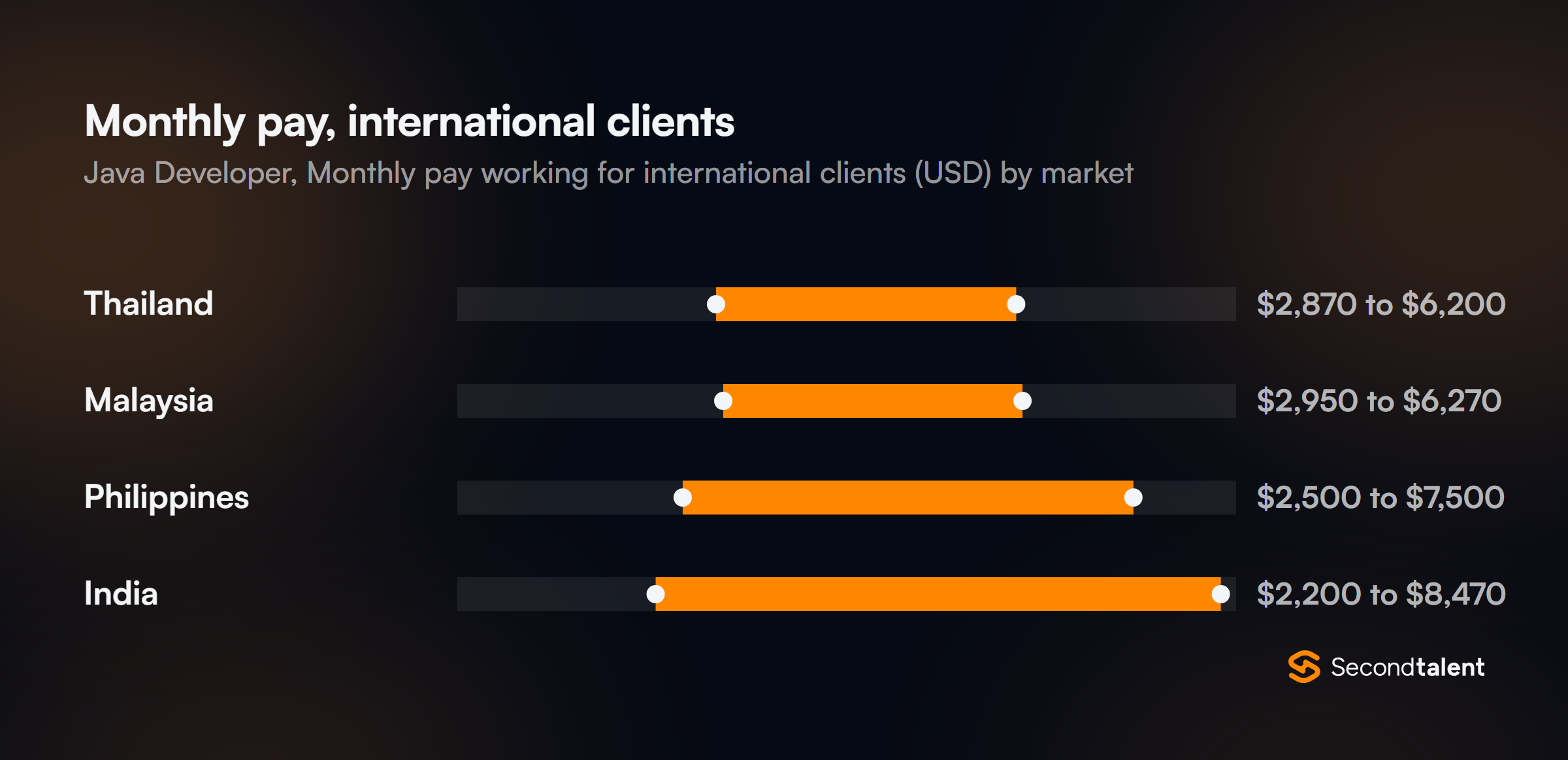
Monthly ranges from the Remote (Working for International Clients) figures on our rate cards for the Philippines, India, Thailand and Malaysia, converted at ExchangeRate-API mid-market rates for 14 September 2026.
Thailand and Malaysia open higher, and their cards leave the top open past $6,200 and $6,270, where the Philippine card stops at a fixed $7,500.
Philippine employers pay far less than foreign clients. JobStreet's Java developer salary page, built from pay disclosed in Philippine job ads, puts the middle half at ₱90,000 to ₱100,000 a month ($1,440 to $1,600). Its 90th percentile of ₱110,000 ($1,750) sits $750 below the floor on our card. Price your offer against the card, because those are the developers already working for foreign companies.
Through Second Talent you pay one monthly fee that bundles salary, payroll taxes, statutory contributions and our service fee, quoted per role and market. Our pricing page explains the monthly subscription, and for contract work our Java developer cost-to-hire page lists US freelance rates.
US Pay Benchmark for Java Developers
BLS publishes no Java occupation. The role maps to Software Developers (SOC 15-1252), because a Java developer designs and builds the services, APIs and batch jobs a business runs on.
| BLS OEWS, May 2025, national |
Software Developers (15-1252) |
| Median annual |
$135,980 |
| 10th percentile, monthly |
$6,870 |
| 25th percentile, monthly |
$8,770 |
| Median, monthly |
$11,330 |
| 75th percentile, monthly |
$14,330 |
| 90th percentile, monthly |
$17,890 |
Monthly figures are the annual wages on the OEWS profile for 15-1252 divided by 12, rounded to the nearest $10.
The top of the Philippine card, $7,500, falls between the US 10th and 25th percentiles.
Salary is only part of the US cost. In the BLS Employer Costs for Employee Compensation release for June 2026, wages and salaries made up 68.5% of employer compensation costs for full-time private industry workers, and benefits the other 31.5%.
Time Zone Overlap: Manila Against ET, CT and PT
Night work costs extra in the Philippines. Article 86 of the Labor Code gives employees a night shift differential of at least 10% of the regular wage for each hour between 10 pm and 6 am.
Manila runs on UTC+8 with no daylight saving time, and US daylight time lasts from 8 March to 1 November 2026, per NIST. The arithmetic: 9:00 am in New York under EDT (UTC-4) is 13:00 UTC, which is 9:00 pm in Manila. Under EST (UTC-5) the same meeting starts at 10:00 pm, and 9:00 am in Chicago under CDT also lands at 10:00 pm.
| Manila shift (UTC+8) |
ET overlap (EDT / EST) |
CT overlap (CDT / CST) |
PT overlap (PDT / PST) |
Hours between 10 pm and 6 am |
| 9 am-6 pm |
0 / 0 |
0 / 0 |
0 / 0 |
0 |
| 4 pm-1 am |
4 / 3 |
3 / 2 |
1 / 0 |
3 |
| 7 pm-4 am |
7 / 6 |
6 / 5 |
4 / 3 |
6 |
| 9 pm-6 am |
8 / 8 |
8 / 7 |
6 / 5 |
8 |
Each shift counts nine clock hours, meal break included, against a 9 am to 5 pm US working day.
Java work splits well. A developer on the 4 pm to 1 am row reviews pull requests and joins stand-up with an East Coast team, then runs long integration builds and database migrations after the US logs off. The 9 pm to 6 am row covers a full New York day and puts the differential on eight hours.
We fix the shift before the offer, which is how our placements get 4-6 hours of daily overlap with US hours.
Java Developer Skills to Screen For
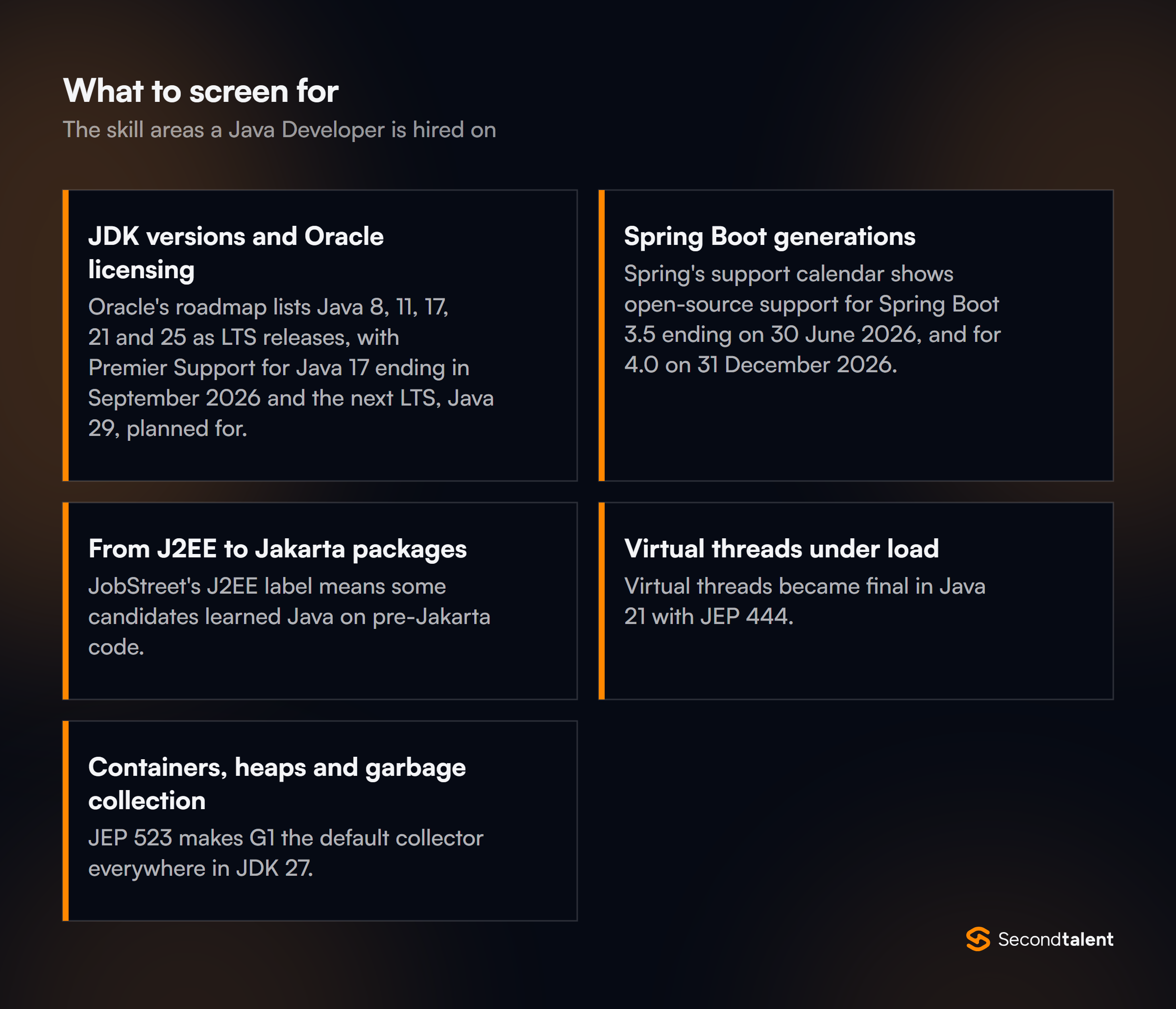
In Stack Overflow's 2025 survey, 29.6% of professional developers used Java and 15.6% used Spring Boot. Expect both on most CVs, and screen for version history, migrations and production behaviour instead.
JDK versions and Oracle licensing
Oracle's roadmap lists Java 8, 11, 17, 21 and 25 as LTS releases, with Premier Support for Java 17 ending in September 2026 and the next LTS, Java 29, planned for September 2027. JDK 27, a non-LTS release, reached general availability on 15 September 2026, per the OpenJDK project page.
Ask which JDK build the candidate's last team ran in production and who supplied it. Then ask what changes on your estate when JDK 21 updates move to the OTN licence.
Spring Boot generations
Spring's support calendar shows open-source support for Spring Boot 3.5 ending on 30 June 2026, and for 4.0 on 31 December 2026. Spring Boot 4.0 builds on Spring Framework 7, supports Java 25 and keeps Java 17 compatibility. It also splits the codebase into smaller modules and adds API versioning and HTTP service clients.
Give the candidate a Spring Boot 3.5 service with a few starters and ask for an upgrade plan to 4.x, ordered by risk.
From J2EE to Jakarta packages
JobStreet's J2EE label means some candidates learned Java on pre-Jakarta code. The Spring Boot 3.0 migration guide notes that Jakarta EE uses jakarta packages rather than javax, so servlet, persistence and validation imports all change.
Ask a candidate with J2EE experience how they moved a javax codebase across, which libraries blocked it, and how they tested the result.
Virtual threads under load
Virtual threads became final in Java 21 with JEP 444. Java 24's JEP 491 lets virtual threads that block inside synchronized code release their platform threads, which removes nearly all cases of pinning, per the JEP.
Hand the candidate a thread dump from a service that stalls under load and ask whether virtual threads would help, and which JDK version they would need.
Containers, heaps and garbage collection
JEP 523 makes G1 the default collector everywhere in JDK 27. Since JDK 9, the JVM had chosen Serial on machines with a single CPU or less than 1792 MB of memory. JEP 534 turns on compact object headers by default, cutting headers from 96 bits to 64 on 64-bit systems.
Ask how the candidate sizes heap and CPU limits for a Spring Boot service in Kubernetes, and what they would watch in the first week after moving to JDK 27.
Contractor or Employer of Record in the Philippines
Software is not one of the nine categories of commissioned work that can be "work made for hire" under 17 U.S.C. § 101, and a transfer must be in writing and signed under § 204(a).
The Philippine rule points the same way. Section 178.4 of the Intellectual Property Code gives the commissioning party ownership of a commissioned work, but the copyright stays with the creator unless a written stipulation says otherwise. Section 178.3 gives an employer the copyright in work from an employee's regularly assigned duties. Name source code, build scripts, schemas and test suites in the assignment.
IRS Publication 515 says the place where services are performed determines the source of the income, so a developer working from Manila or Cebu earns foreign-source income. A foreign individual gives the payer Form W-8BEN to certify foreign status.
Check the Java licence before either route. Oracle's Java SE Universal Subscription price list, dated 1 March 2023, counts every employee, plus the staff of agents, contractors and outsourcers who support internal operations, not only those who run Java. It lists $15 per employee a month for a count under 1,000. A company on Oracle JDK under that metric adds each offshore Java developer to the count, whichever route it uses.
Philippine courts apply the four-fold test: selection and engagement, payment of wages, the power of dismissal and control over how the work is done. In Atok Big Wedge v. Gison, the Supreme Court named control the most important. A contractor who joins your sprint rituals and takes tickets from your engineering manager starts to look like an employee.
Employment adds four statutory lines to salary:
Our Employer of Record service runs those lines through payroll, and our Philippines EOR page and Philippines payroll guide show the employer cost. This is a summary, not legal advice.
|
Independent contractor |
Employer of Record |
| Legal employer |
None; the developer invoices you |
The EOR's Philippine entity |
| US paperwork |
Form W-8BEN from the developer |
Service agreement with the EOR |
| IP |
Written stipulation assigning code, schemas and tests (IP Code 178.4) |
Employer copyright under 178.3, passed to you through the EOR agreement |
| Local labor law |
Four-fold test; control points to employment |
Night differential, 13th month pay and statutory contributions apply |
| Pay currency |
Agreed in the contract, often USD |
Local payroll run by the EOR |
English Level and Working Norms in the Philippines
The Philippines' IT job-function score on the EF English Proficiency Index 2025 is 581, above its national score of 569, which ranks 28th of 123 countries and regions against a global average of 488. Writing, at 603, runs 64 points ahead of speaking at 539, per EF's Philippines page.
That favours written review. Java teams that settle design changes in pull requests and architecture decision records get the most from a Manila developer, so ask finalists to write one for a real change in your service.
Proclamation 1006 sets the Philippine holidays for 2026. Bonifacio Day on Monday 30 November is a regular holiday, 8 December is a special non-working day, and Christmas Eve joins them as an additional special non-working day. Oracle's next Critical Patch Update lands on 20 October 2026, per its security alerts page, so schedule JDK patching before the December break.
Thanksgiving on 26 November 2026 is a working day in the Philippines, so a Manila developer can watch a release while your US team is off.
Java Developer Hiring Process in the Philippines
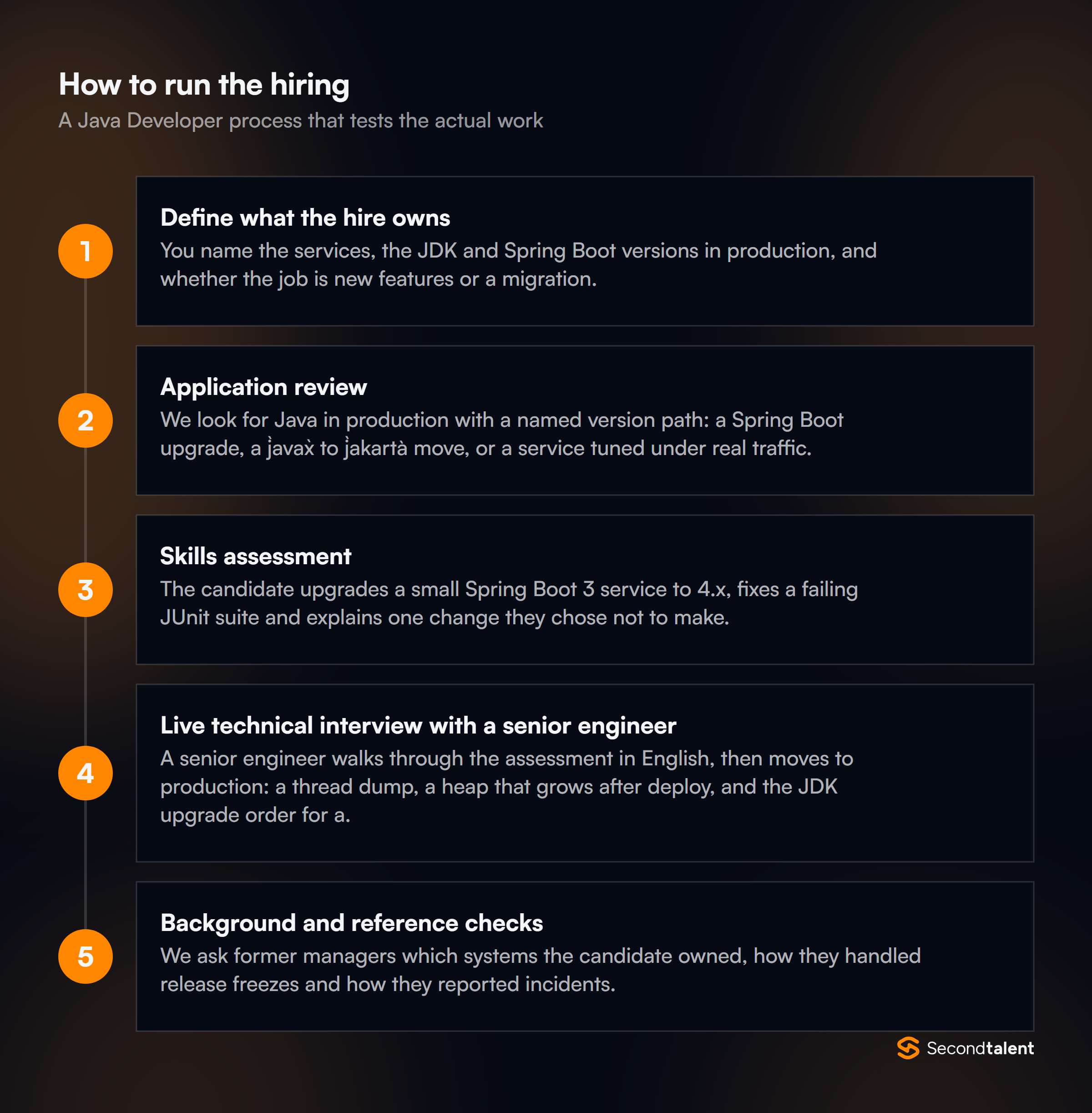
Second Talent's vetting covers stages 2 to 5 before you see a profile.
Stage 1: Define what the hire owns
You name the services, the JDK and Spring Boot versions in production, and whether the job is new features or a migration. Add the Manila shift from the table above and the Java licence your estate runs under.
Stage 2: Application review
We look for Java in production with a named version path: a Spring Boot upgrade, a javax to jakarta move, or a service tuned under real traffic. A list of frameworks with no dates or versions does not pass.
Stage 3: Skills assessment
The candidate upgrades a small Spring Boot 3 service to 4.x, fixes a failing JUnit suite and explains one change they chose not to make. Scoring weighs the test results and the written notes.
Stage 4: Live technical interview with a senior engineer
A senior engineer walks through the assessment in English, then moves to production: a thread dump, a heap that grows after deploy, and the JDK upgrade order for a mixed estate.
Stage 5: Background and reference checks
We ask former managers which systems the candidate owned, how they handled release freezes and how they reported incidents. You then choose the contractor or EOR route above.
Hire Java Developers from the Philippines with Second Talent
We shortlist 6-8 candidates within 24 hours from 100,000+ pre-vetted engineers, accepting only the top 1% of applicants. Java developers from the Philippines come with $0 upfront, no lock-in and 4-6 hours of daily overlap with US hours. We handle contracts, payroll and equipment, with compliant EOR contracts in the Philippines.
Our pricing page sets out the monthly subscription, and our Java developers page compares the pool in other Asian markets.