TL;DR: Golang developers in the Philippines earn $1,800 to $6,500 a month working for international clients on our rate card, and we shortlist 6-8 candidates within 24 hours. The BLS median for US software developers was $135,980 a year in May 2025.
JobStreet's back-end developer page for the Philippines lists Java, Node.js, MySQL, PostgreSQL and MongoDB among the skills employers ask for, and Go is not on it. Ask each candidate where they wrote Go in production, and test for Go idiom as well as syntax.
Key takeaways
- The Philippine Golang card tops out at the same figure as Vietnam's and starts $400 lower.
- The Fiber framework runs on fasthttp, where a request context's Done channel closes only at server shutdown.
- A Manila shift starting at 11 pm runs 8 am to 5 pm in San Francisco while US daylight time lasts.
- The Data Privacy Act lists personal information collected from residents of foreign jurisdictions under their own laws among the cases it does not apply to.
What Golang Developers Earn in the Philippines Working for International Clients
The Philippine card shares Vietnam's $6,500 ceiling and starts at $1,800, $400 below Vietnam's floor. The figures are what Go developers in each market earn working directly for foreign companies, before any employer or platform costs.
| Market |
Monthly pay working for international clients (USD) |
| Philippines |
$1,800-$6,500 |
| Indonesia |
$1,200-$5,500 |
| Vietnam |
$2,200-$6,500 |
| India |
$2,410-$8,990+ |
| Malaysia |
$2,700-$5,040+ |
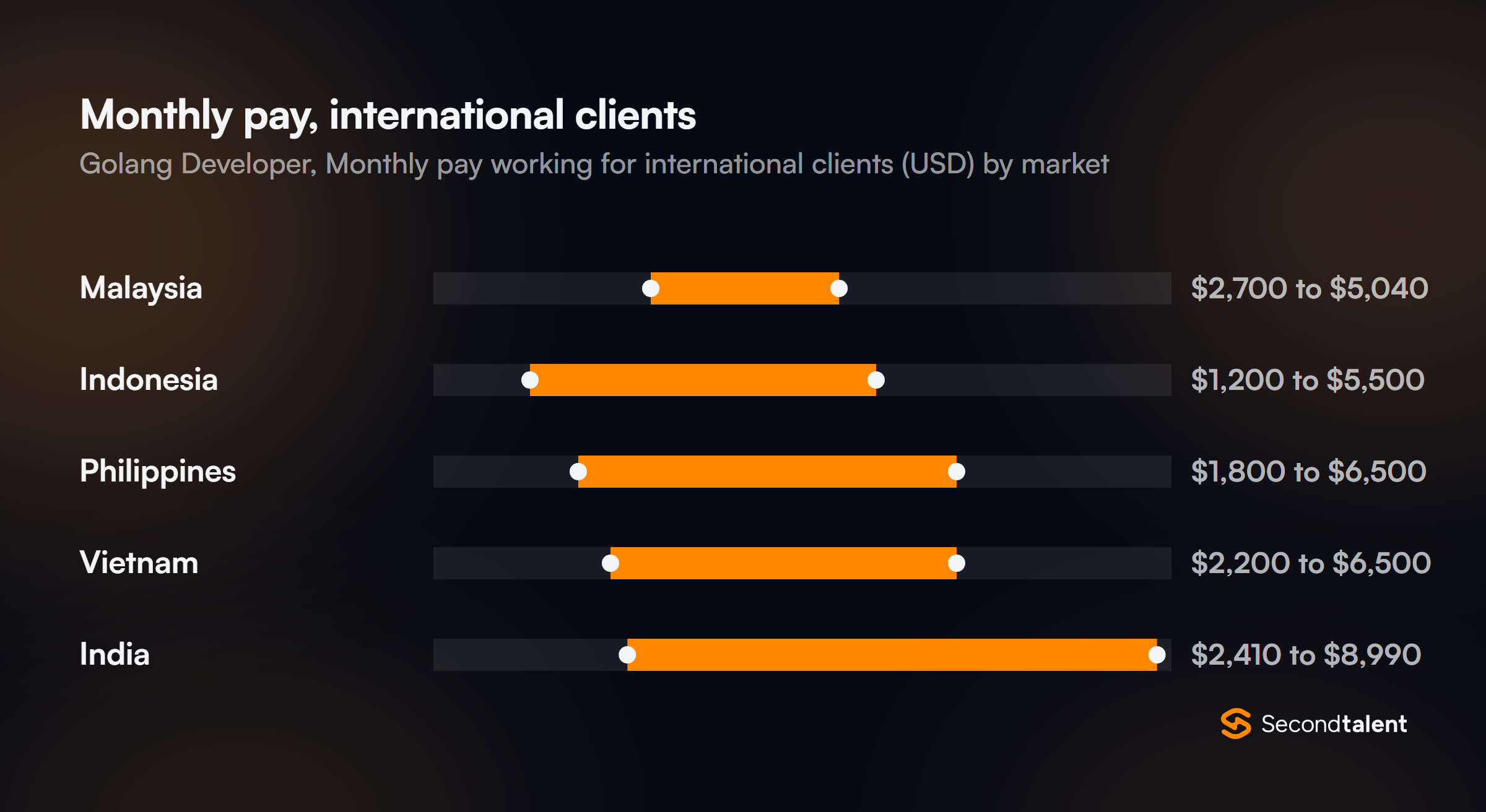
Monthly ranges from the Remote (Working for International Clients) figures on our rate cards for the Philippines, Indonesia, Vietnam, India and Malaysia, converted at ExchangeRate-API mid-market rates for 14 September 2026.
The Philippine card publishes US dollars with a fixed top, so its row needs no conversion; the Indian and Malaysian cards quote rupees and ringgit and stay open at the top. Our Philippine card links the demand to fintech, where Go runs payment processing and banking systems.
JobStreet has no Go page for the Philippines. Its back-end developer salary page, built from pay disclosed in Philippine job ads, puts the middle half at ₱70,000 to ₱80,000 a month ($1,120 to $1,280) and the 90th percentile at ₱90,000 ($1,440). That local-market figure sits below the floor of the Go card, so budget from the foreign-client row.
Through Second Talent you pay one monthly fee that bundles salary, payroll taxes, statutory contributions and our service fee, quoted per role and market. Our pricing page explains the monthly subscription, and our Golang developers page compares the wider pool in Asia.
US Pay Benchmark for Golang Developers
BLS has no Go occupation. The role maps to Software Developers (15-1252), because Go developers build the services, command-line tools and infrastructure software that occupation covers.
| BLS OEWS, May 2025, national |
Software Developers (15-1252) |
| Median annual |
$135,980 |
| 10th percentile, monthly |
$6,870 |
| 25th percentile, monthly |
$8,770 |
| Median, monthly |
$11,330 |
| 75th percentile, monthly |
$14,330 |
| 90th percentile, monthly |
$17,890 |
Monthly figures are the annual wages on the OEWS profile for 15-1252 divided by 12, rounded to the nearest $10.
Salary is only part of the US cost. In the BLS Employer Costs for Employee Compensation release for June 2026, wages and salaries made up 68.5% of employer compensation costs for full-time private industry workers, and benefits the other 31.5%.
For a contract comparison, our Golang cost-to-hire page prices the US freelance and agency routes.
Time Zone Overlap: Manila Against ET, CT and PT
A Manila shift can land fully inside a San Francisco working day. Manila keeps UTC+8 all year, and US daylight time runs from 8 March to 1 November 2026, per NIST.
The arithmetic: 11:00 pm in Manila is 15:00 UTC, which is 8:00 am PDT (UTC-7) and 11:00 am EDT (UTC-4). Under PST (UTC-8) the same shift starts at 7:00 am in San Francisco.
| Manila shift (UTC+8) |
ET overlap (EDT / EST) |
CT overlap (CDT / CST) |
PT overlap (PDT / PST) |
Hours between 10 pm and 6 am |
| 10 am-7 pm |
0 / 0 |
0 / 0 |
0 / 0 |
0 |
| 3 pm-12 am |
3 / 2 |
2 / 1 |
0 / 0 |
2 |
| 8 pm-5 am |
8 / 7 |
7 / 6 |
5 / 4 |
7 |
| 11 pm-8 am |
6 / 7 |
7 / 8 |
8 / 7 |
7 |
Each shift is nine clock hours counted against a 9 am to 5 pm US day.
The first row shares no working hours with the US and still suits a review loop. Manila's 10:00 am is 10:00 pm EDT, so a pull request left at 6:00 pm in New York is waiting when the shift starts, and the fix is back by 7:00 am Eastern.
The 8 pm row covers a full New York working day while daylight time lasts. The last row serves a West Coast team whose Go services need a second pair of hands during business hours.
The Labor Code sets a night shift differential of at least 10% for each hour between 10 pm and 6 am (Article 86), seven hours in each of the two late rows. We agree the shift before the offer, which is how our placements get 4-6 hours of daily overlap with US hours.
Golang Developer Skills to Screen For
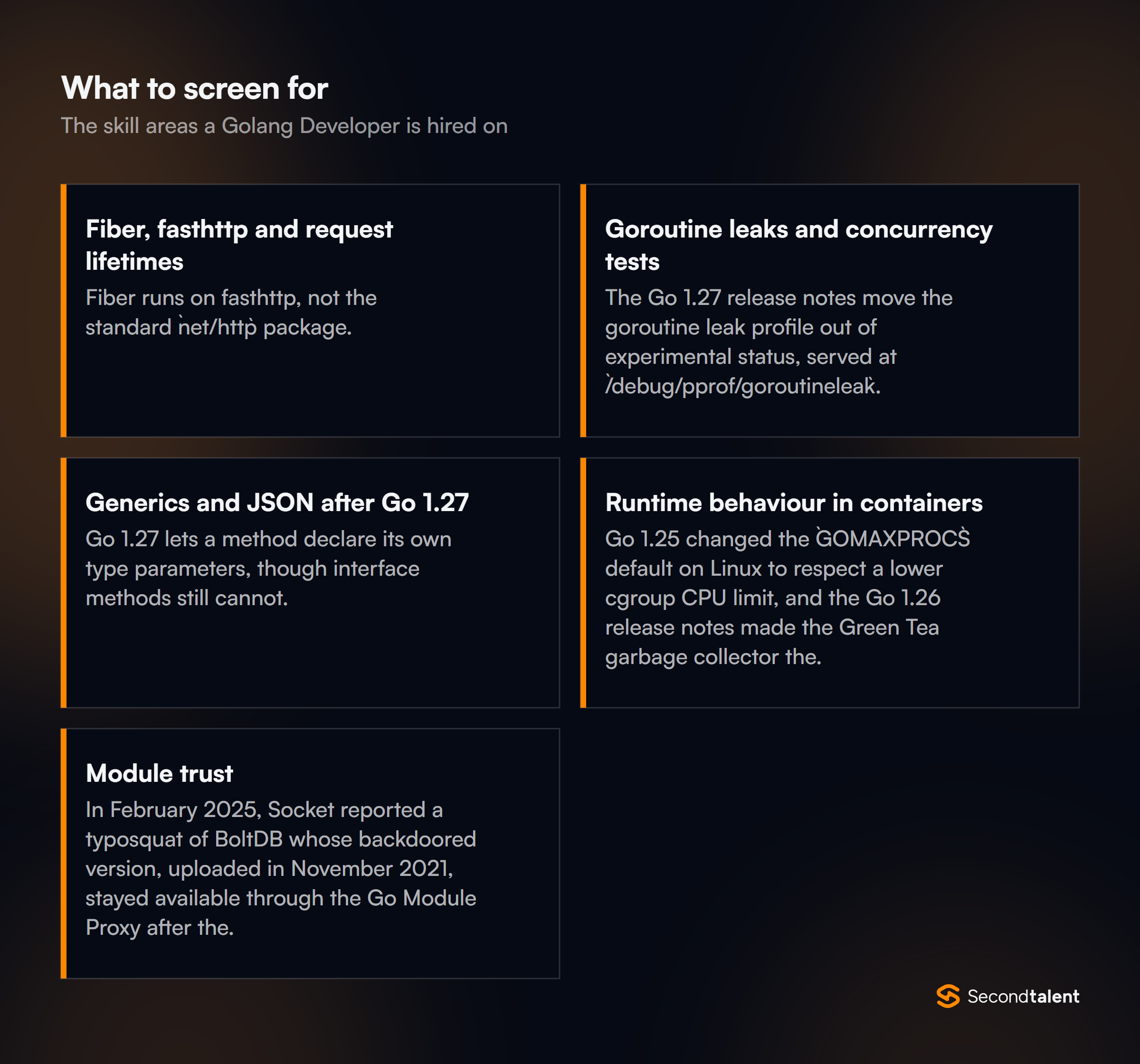
In the 2025 Go Developer Survey, the top frustration, at 33%, was making sure code follows Go best practices and idioms. Go 1.27 shipped on 19 August 2026, and the Go team supports each major release only until two newer ones ship, so Go 1.25 is out of support.
Fiber, fasthttp and request lifetimes
Fiber runs on fasthttp, not the standard net/http package. The fasthttp README says the channel from RequestCtx.Done() closes only when the server shuts down, and it disallows holding references to RequestCtx after the handler returns.
A developer used to Gin or Echo can carry net/http habits into Fiber and ship a data race. Give the candidate a Fiber handler that starts a goroutine reading the request context, and ask what breaks and how to fix it.
Goroutine leaks and concurrency tests
The Go 1.27 release notes move the goroutine leak profile out of experimental status, served at /debug/pprof/goroutineleak. The Go 1.25 release notes added testing/synctest, which runs a test on a fake clock. Hand over a worker pool that leaks when a client cancels, and ask for the fix and a test that proves it.
Generics and JSON after Go 1.27
Go 1.27 lets a method declare its own type parameters, though interface methods still cannot. The same release added encoding/json/v2, which rejects invalid UTF-8 and duplicate object names by default, and moved encoding/json onto the new implementation, where error message text may differ. Ask the candidate which tests in a payments service would fail after the upgrade.
Runtime behaviour in containers
Go 1.25 changed the GOMAXPROCS default on Linux to respect a lower cgroup CPU limit, and the Go 1.26 release notes made the Green Tea garbage collector the default. Ask how the candidate reads a CPU throttling graph for a Go pod before blaming the collector for a latency spike.
Module trust
In February 2025, Socket reported a typosquat of BoltDB whose backdoored version, uploaded in November 2021, stayed available through the Go Module Proxy after the attacker pointed the Git tags at clean code. In the Go survey, 26% named finding trustworthy modules among their top frustrations. Ask how the candidate vets a new dependency and where govulncheck runs in their pipeline.
Contractor or Employer of Record in the Philippines
Software is not one of the nine categories of commissioned work that can be "work made for hire" under 17 U.S.C. § 101, and a transfer must be in writing and signed under § 204(a). Section 178.4 of the Philippine Intellectual Property Code leaves copyright in a commissioned work with its creator unless a written stipulation says otherwise. Name services, CLIs, Protobuf definitions and internal modules in the assignment.
IRS Publication 515 says the place where services are performed determines the source of the income, so a developer working from Makati or Davao earns foreign-source income. A foreign individual gives the payer Form W-8BEN to certify foreign status.
Your user data raises its own question. Section 4(g) of the Data Privacy Act lists personal information originally collected from residents of foreign jurisdictions, under those jurisdictions' laws and processed in the Philippines, among the cases the Act does not apply to. Your US obligations still travel with the data, so write them into the developer's production access terms.
Philippine courts apply the four-fold test: selection and engagement, payment of wages, the power of dismissal and the power to control the work. In Atok Big Wedge v. Gison the Supreme Court called control the most important of the four. A developer holding your pager, with production credentials and hours you set, meets it.
For employees, Article 84 of the Labor Code counts all time an employee is required to be on duty as hours worked. Section 5 of the Telecommuting Act requires the same treatment for home-based staff as for comparable office staff. Employment also brings 13th month pay for rank-and-file employees under PD 851 and Memorandum Order 28, with contributions to SSS (15% shared, credit cap ₱35,000), PhilHealth (5%, cap at ₱100,000) and Pag-IBIG (2% each side, ₱10,000 cap).
Worked examples sit in our Philippines payroll, benefits and tax guide. A one-off CLI or a migration with an end date suits a contractor agreement. A developer on your on-call rotation is the case our Employer of Record service covers, and the Philippines EOR page has the local details. This is a summary, not legal advice.
|
Independent contractor |
Employer of Record |
| Legal employer |
None; the developer invoices you |
The EOR's Philippine entity |
| US paperwork |
Form W-8BEN from the developer |
Service agreement with the EOR |
| IP |
Written assignment covering services, modules and Protobuf files (IP Code 178.4) |
Employer owns work from regular duties (IP Code 178.3), passed on through your EOR agreement |
| Local labor law |
Four-fold test risk if the developer holds your pager on your schedule |
On-duty hours, night differential and 13th month pay apply |
| Pay currency |
Agreed in the contract, often USD |
Peso payroll run by the EOR |
English Level and Working Norms in the Philippines
A Go developer's English reaches your team as design notes and review comments, and the Philippines scores 603 for writing on the EF English Proficiency Index 2025, against 539 for speaking. Its national score is 569, 28th of 123 countries and regions and above the global average of 488, and the IT job-function score is 581, per EF's Philippines page.
A US reviewer who reads a pull request at 9 am cannot ask a follow-up until the evening, so the description has to stand alone. Ask finalists for a one-page design note on a new endpoint, with its error contract and timeout budget, then a review comment on a colleague's change.
Plan upgrades and freezes around two calendars. Proclamation 1006 makes 30 November, 25 December and 30 December regular holidays in 2026, and 24 and 31 December special non-working days. PAGASA puts nearly 70% of typhoons between July and October, so ask on-call finalists about backup power and a second connection. Thanksgiving on 26 November 2026 is a working day in the Philippines, and a developer there can hold the pager while your US team is off.
Golang Developer Hiring Process in the Philippines
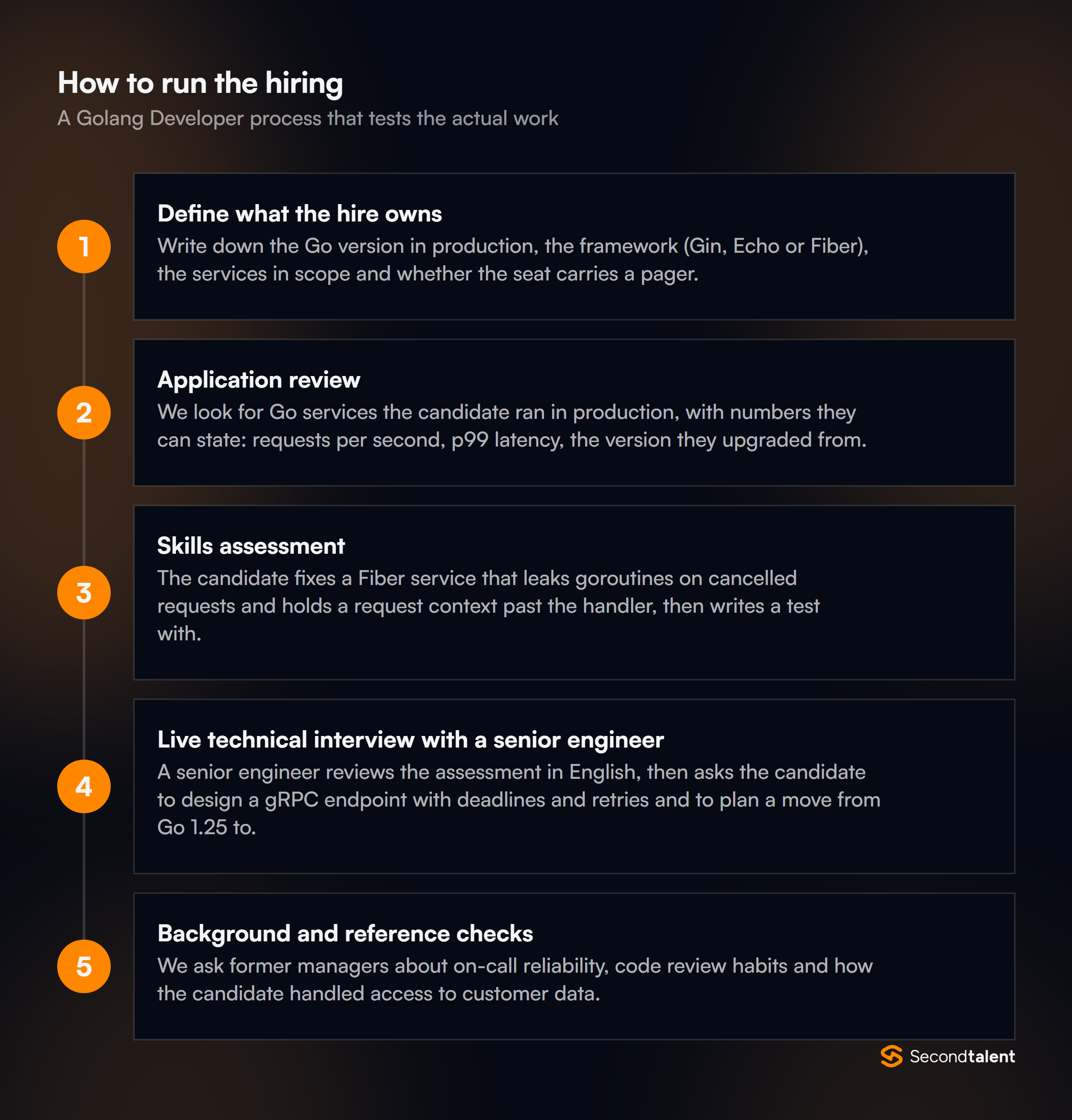
Second Talent's vetting covers stages 2 to 5 before you see a profile. Our Golang interview guide has question sets for your own final round.
Stage 1: Define what the hire owns
Write down the Go version in production, the framework (Gin, Echo or Fiber), the services in scope and whether the seat carries a pager. Pick a shift from the table above and write the on-call terms before the offer.
Stage 2: Application review
We look for Go services the candidate ran in production, with numbers they can state: requests per second, p99 latency, the version they upgraded from. A CV with Java, Node.js or PHP before Go gets a question about what the candidate rewrote and why.
Stage 3: Skills assessment
The candidate fixes a Fiber service that leaks goroutines on cancelled requests and holds a request context past the handler, then writes a test with testing/synctest. We score the fix, the test and the pull request description.
Stage 4: Live technical interview with a senior engineer
A senior engineer reviews the assessment in English, then asks the candidate to design a gRPC endpoint with deadlines and retries and to plan a move from Go 1.25 to 1.27.
Stage 5: Background and reference checks
We ask former managers about on-call reliability, code review habits and how the candidate handled access to customer data. You then choose the contractor or EOR route above.
Hire Golang Developers from the Philippines with Second Talent
We shortlist 6-8 candidates within 24 hours from 100,000+ pre-vetted engineers, accepting only the top 1% of applicants. Golang developers from the Philippines come with $0 upfront, no lock-in and 4-6 hours of daily overlap with US hours. We handle contracts, payroll and equipment, with compliant EOR contracts in the Philippines.
Our pricing page sets out the monthly subscription, and for services written in other languages we also staff back-end developers in the Philippines.