TL;DR: DevOps engineers in the Philippines earn $2,390 to $4,790+ a month working for international clients on our rate card, and we shortlist 6-8 candidates within 24 hours. The closest US benchmark, the BLS median for computer network architects, was $134,050 a year in May 2025.
An average of 20 tropical cyclones enter the Philippine Area of Responsibility each year, and 8 or 9 of them cross the country, according to PAGASA. A DevOps engineer from the Philippines who holds your pager should know what happens to the rotation when the power fails at 3 am.
Key takeaways
- AWS runs a Local Zone in Manila, ap-southeast-1-mnl-1a, with Asia Pacific (Singapore) as its parent Region.
- A Manila day shift from 9 am to 6 pm runs from 9 pm to 6 am in New York while US daylight time lasts, so US overnight on-call needs no night shift.
- The Philippine Labor Code counts all time an employee is required to be on duty as hours worked, and pays at least 25% extra past eight hours.
- JobStreet lists Jenkins and Ansible among the skills for DevOps engineers in the Philippines, next to Terraform and Kubernetes.
What DevOps Engineers Earn in the Philippines Working for International Clients
The Philippine range is the narrowest of the four, $2,400 from floor to open top, against $6,270 for India. The figures are what DevOps engineers in each market earn working directly for foreign companies, before any employer or platform costs.
| Market |
Monthly pay working for international clients (USD) |
| Philippines |
$2,390-$4,790+ |
| India |
$2,200-$8,470+ |
| Vietnam |
$3,090-$6,180+ |
| Malaysia |
$3,690-$7,370+ |
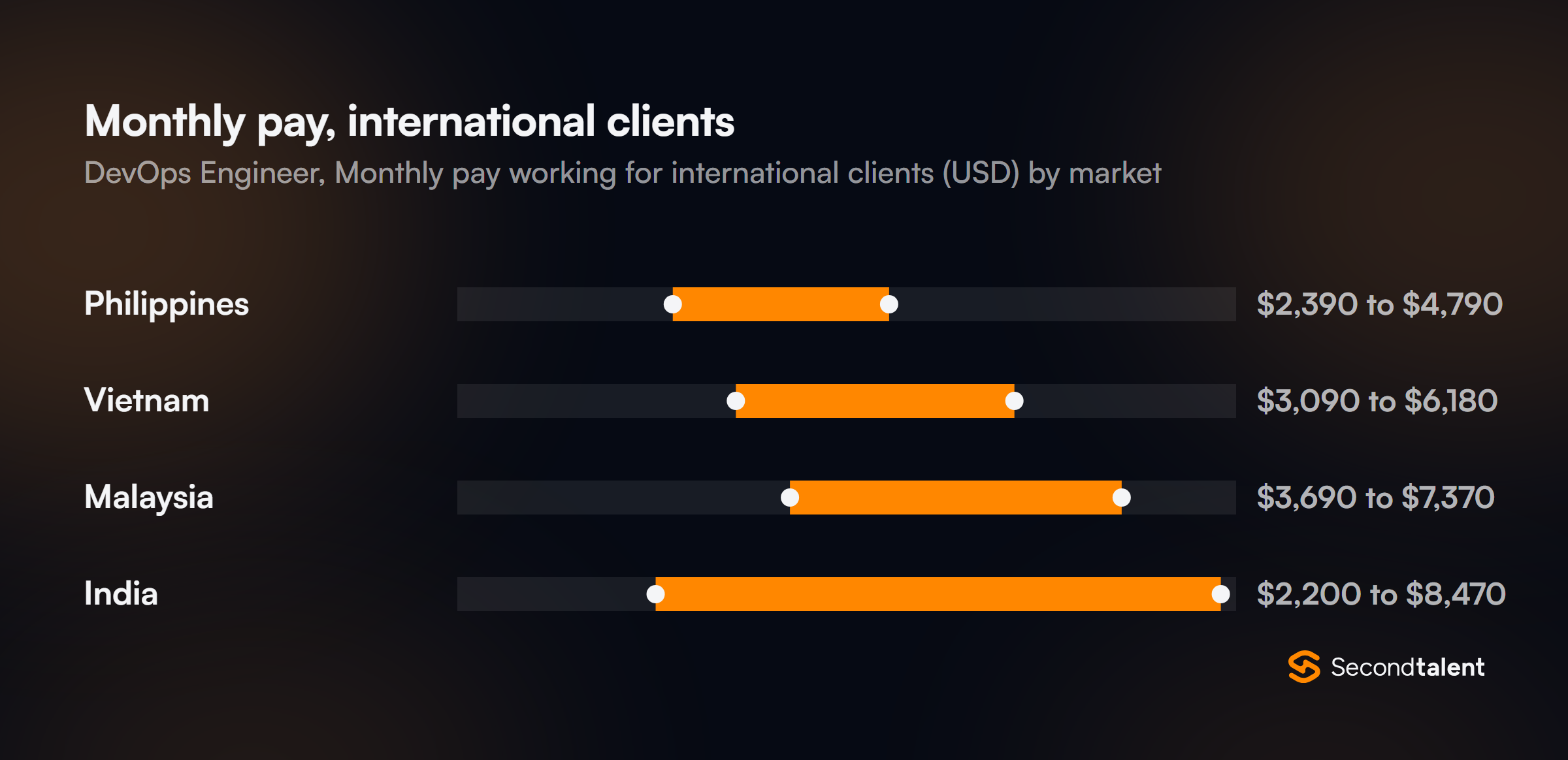
Monthly ranges from the Remote (Working for International Clients) figures on our rate cards for the Philippines, India, Vietnam and Malaysia, converted at ExchangeRate-API mid-market rates for 14 September 2026.
The Philippine card quotes ₱150,000 to ₱300,000+ a month, converted at ₱62.69 to the dollar. Local employers pay well below that.
On JobStreet's DevOps engineer salary page, built from pay disclosed in Philippine job ads, the middle half runs ₱90,000 to ₱100,000 a month ($1,440 to $1,600).
Its 90th percentile is ₱110,000, and that local-market ceiling sits ₱40,000 below the floor for engineers who already work for foreign companies.
Budget from the foreign-client row, since that is the range your offer competes in.
Through Second Talent you pay one monthly fee that bundles salary, payroll taxes, statutory contributions and our service fee, quoted per role and market. Our pricing page explains the monthly subscription, and our DevOps engineers page compares the wider pool in Asia.
US Pay Benchmark for DevOps Engineers
BLS has no DevOps occupation. The role maps to Computer Network Architects (15-1241), because a DevOps engineer designs the delivery and infrastructure systems software runs on, with Network and Computer Systems Administrators (15-1244) alongside for a job built around operating existing systems.
| BLS OEWS, May 2025, national |
Computer Network Architects (15-1241) |
Network and Computer Systems Administrators (15-1244) |
| Median annual |
$134,050 |
$99,130 |
| 10th percentile, monthly |
$6,660 |
$5,220 |
| Median, monthly |
$11,170 |
$8,260 |
| 90th percentile, monthly |
$16,890 |
$12,920 |
Monthly figures are the annual wages on the BLS OEWS profiles for 15-1241 and 15-1244 divided by 12, rounded to the nearest $10.
Pick the column that matches the job. A hire who designs landing zones and clusters compares with architects, while one who works a patch cycle and a ticket queue compares with administrators.
Salary is only part of the US cost. In the BLS Employer Costs for Employee Compensation release for June 2026, wages and salaries made up 68.5% of employer compensation costs for full-time private industry workers, and benefits the other 31.5%.
Time Zone Overlap: Manila Against ET, CT and PT
Manila keeps UTC+8 all year with no daylight saving time. US clocks stay on daylight time from 8 March to 1 November 2026, per NIST, so the gap to New York, Chicago and San Francisco widens by an hour in November.
The arithmetic: 9:00 am in New York under EDT (UTC-4) is 13:00 UTC, and 13:00 UTC is 9:00 pm in Manila. Under EST (UTC-5) it is 10:00 pm. Chicago's 9:00 am lands an hour later again, and San Francisco's three hours later.
| Manila shift (UTC+8) |
ET overlap (EDT / EST) |
CT overlap (CDT / CST) |
PT overlap (PDT / PST) |
Hours between 10 pm and 6 am |
| 9 am-6 pm |
0 / 0 |
0 / 0 |
0 / 0 |
0 |
| 3 pm-12 am |
3 / 2 |
2 / 1 |
0 / 0 |
2 |
| 5 pm-2 am |
5 / 4 |
4 / 3 |
2 / 1 |
4 |
| 9 pm-6 am |
8 / 8 |
8 / 7 |
6 / 5 |
8 |
Each shift is nine clock hours counted against a 9 am to 5 pm US day. The Labor Code sets eight normal hours (Article 83) and a meal break of at least 60 minutes (Article 85), which is where the ninth hour goes.
The top row is the on-call row. A Manila day from 01:00 to 10:00 UTC covers 9:00 pm to 6:00 am in New York and 6:00 pm to 3:00 am in San Francisco, so the engineer answers US night pages in daylight and hands over as your team signs in.
The 5 pm to 2 am row suits deploy windows and pairing.
Late hours cost more for employees. The Labor Code sets a night shift differential of at least 10% for each hour between 10 pm and 6 am (Article 86), four hours of the 5 pm row and eight of the nine clock hours in the last. We agree the shift before the offer, which is how our placements get 4-6 hours of daily overlap with US hours.
DevOps Engineer Skills to Screen For
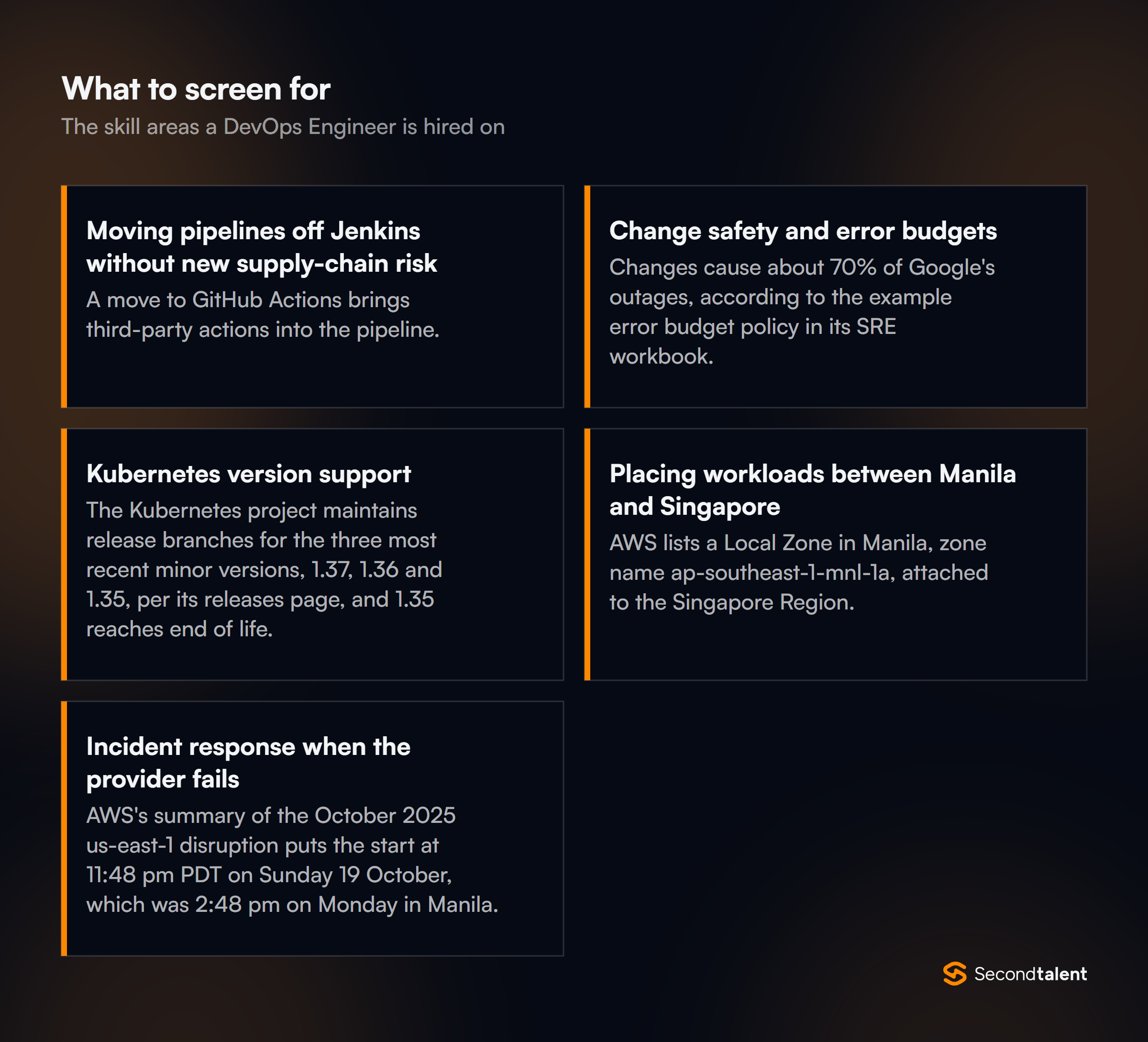
JobStreet's DevOps page lists the skills Philippine employers ask for: CI/CD, Terraform, Kubernetes, Jenkins, Ansible, Python and AWS. If your pipelines run on something else, screen for the migration as well as the tools.
Moving pipelines off Jenkins without new supply-chain risk
A move to GitHub Actions brings third-party actions into the pipeline. In March 2025, attackers moved version tags of tj-actions/changed-files, used in over 23,000 repositories, to a malicious commit that printed secrets into workflow logs, per GitHub's advisory.
GitHub's secure use reference calls pinning to a full-length commit SHA the only way to use an action as an immutable release. Give the candidate a Jenkinsfile to port and score whether the result pins actions and uses OpenID Connect instead of a stored cloud key.
Change safety and error budgets
Changes cause about 70% of Google's outages, according to the example error budget policy in its SRE workbook. A 99.9% SLO on 1,000,000 requests in four weeks allows 1,000 errors, and once the budget is spent, releases stop except for P0 issues and security fixes. Ask the candidate which SLO their last team missed and what the release process did next.
Kubernetes version support
The Kubernetes project maintains release branches for the three most recent minor versions, 1.37, 1.36 and 1.35, per its releases page, and 1.35 reaches end of life on 28 February 2027. Ask for the candidate's last minor-version upgrade, what broke and how they rolled it back. For deeper cluster work we also staff Kubernetes engineers.
Placing workloads between Manila and Singapore
AWS lists a Local Zone in Manila, zone name ap-southeast-1-mnl-1a, attached to the Singapore Region. A US product with users in the Philippines may want latency-sensitive tiers there and everything else in the parent Region. Ask the candidate which services they would keep in Singapore, how they would route traffic between the two, and what the Terraform module looks like.
Incident response when the provider fails
AWS's summary of the October 2025 us-east-1 disruption puts the start at 11:48 pm PDT on Sunday 19 October, which was 2:48 pm on Monday in Manila. New EC2 launches failed from 2:25 am to 10:36 am PDT, or 5:25 pm to 1:36 am Manila time.
A Manila engineer on a day shift would have caught the start and handed over mid-incident. Run that handover as an exercise: the candidate writes the status note a US engineer reads at 9 am. Our CI/CD interview guide has more question sets.
Contractor or Employer of Record in the Philippines
Software is not one of the nine categories of commissioned work that can be "work made for hire" under 17 U.S.C. § 101, and a transfer must be in writing and signed under § 204(a). On the Philippine side, section 178.4 of the Intellectual Property Code leaves copyright in a commissioned work with its creator unless a written stipulation says otherwise. Name pipelines, Terraform modules, Helm charts and runbooks in the assignment.
IRS Publication 515 says the place where services are performed determines the source of the income, so an engineer working from Cebu or Makati earns foreign-source income. A foreign individual gives the payer Form W-8BEN to certify foreign status.
Philippine courts apply the four-fold test: selection and engagement, payment of wages, the power of dismissal and the power to control the work. In Atok Big Wedge v. Gison the Supreme Court called control the most important of the four. An engineer on your pager rotation, with admin access to production and a schedule you set, meets it.
On-call time is a cost line for employees. Article 84 counts as hours worked all time an employee is required to be on duty, and Article 87 pays at least 25% on top of the regular wage for work past eight hours. Write the rotation, standby terms and overtime rate into the contract. Employment also brings four statutory lines:
Worked examples sit in our Philippines payroll, benefits and tax guide. Our Employer of Record service employs the engineer for you, and the Philippines EOR page covers the local details. This is a summary, not legal advice.
|
Independent contractor |
Employer of Record |
| Legal employer |
None; the engineer invoices you |
The EOR's Philippine entity |
| US paperwork |
Form W-8BEN from the engineer |
Service agreement with the EOR |
| IP |
Written assignment covering pipelines, modules, charts and runbooks (IP Code 178.4) |
Employer owns work from regular duties (IP Code 178.3), passed on through your EOR agreement |
| Local labor law |
Four-fold test risk if you set the rotation and control methods |
On-duty hours, overtime, night differential and 13th month pay apply |
| Pay currency |
Agreed in the contract, often USD |
Peso payroll run by the EOR |
English Level and Working Norms in the Philippines
The Philippines scores 581 for the IT job function on the EF English Proficiency Index 2025, above its national score of 569, which ranks 28th of 123 countries and regions against a global average of 488, per EF's Philippines page. Writing scores 603 and speaking 539.
An overnight engineer's work reaches your team as text: the incident channel, the handover note, the postmortem. That plays to the stronger skill. Ask finalists to write a runbook entry for a failed deploy they handled, then have a US engineer follow it cold.
PAGASA puts nearly 70% of typhoons between July and October, so ask each finalist what backup power and second connection they work from, and name a second engineer for the rotation. The 2026 holiday proclamation makes 30 November and 30 December regular holidays, with 8, 24 and 31 December special non-working days, so book December cover before the month starts. Thanksgiving on 26 November 2026 is a working day in the Philippines, and an engineer there can hold the pager while your US team is off.
DevOps Engineer Hiring Process in the Philippines
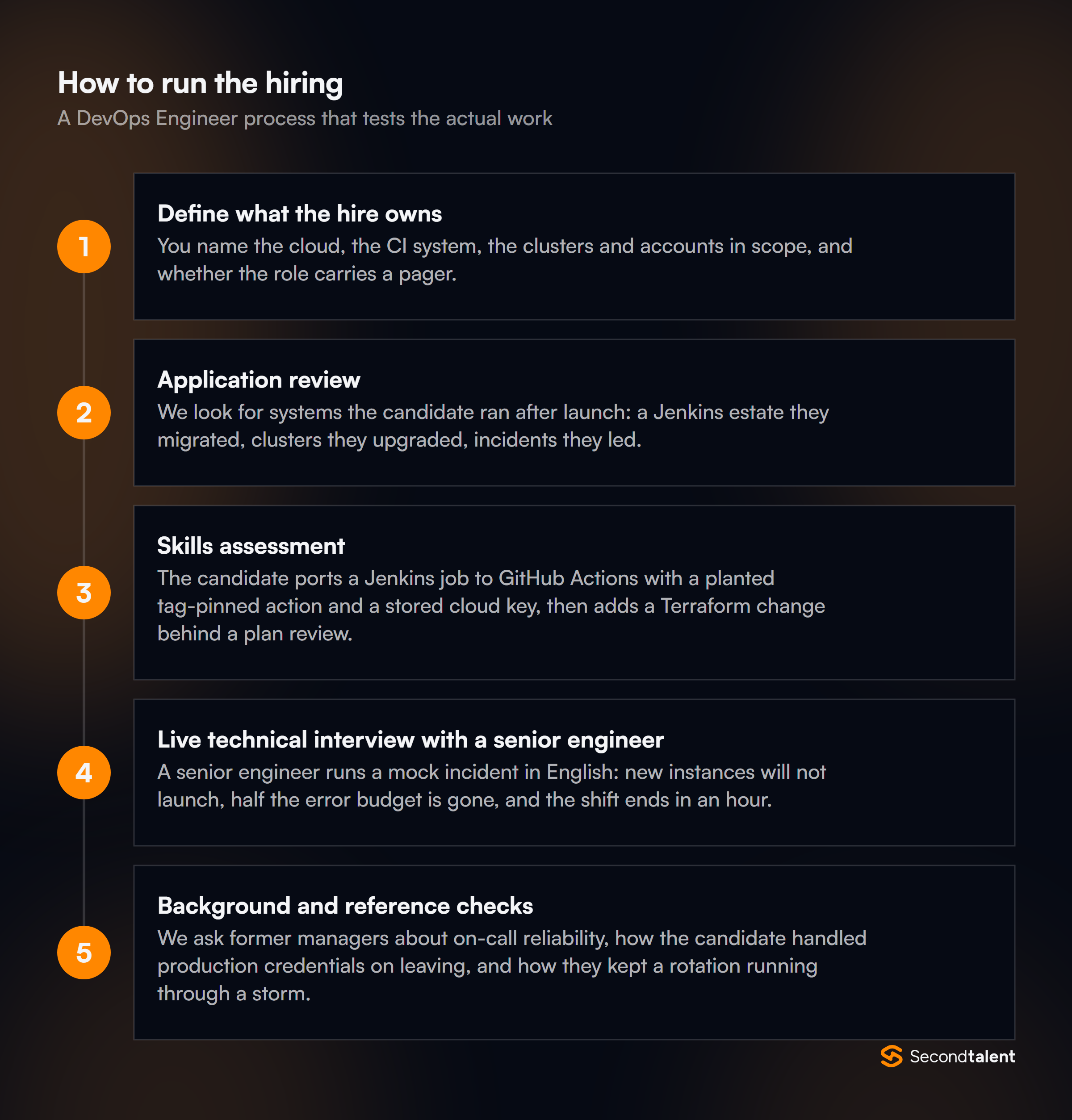
Second Talent's vetting covers stages 2 to 5 before you see a profile.
Stage 1: Define what the hire owns
You name the cloud, the CI system, the clusters and accounts in scope, and whether the role carries a pager. Pick a shift from the table above and write the on-call and overtime terms before the offer.
Stage 2: Application review
We look for systems the candidate ran after launch: a Jenkins estate they migrated, clusters they upgraded, incidents they led. Scale goes in plain numbers, such as deploys a day or nodes under management.
Stage 3: Skills assessment
The candidate ports a Jenkins job to GitHub Actions with a planted tag-pinned action and a stored cloud key, then adds a Terraform change behind a plan review. We score the pull request description along with the code.
Stage 4: Live technical interview with a senior engineer
A senior engineer runs a mock incident in English: new instances will not launch, half the error budget is gone, and the shift ends in an hour. The candidate picks rollback or fix-forward and writes the handover.
Stage 5: Background and reference checks
We ask former managers about on-call reliability, how the candidate handled production credentials on leaving, and how they kept a rotation running through a storm. You then choose the contractor or EOR route above.
Hire DevOps Engineers from the Philippines with Second Talent
We shortlist 6-8 candidates within 24 hours from 100,000+ pre-vetted engineers, accepting only the top 1% of applicants. DevOps engineers from the Philippines come with $0 upfront, no lock-in and 4-6 hours of daily overlap with US hours. We handle contracts, payroll and equipment, with compliant EOR contracts in the Philippines.
Our pricing page sets out the monthly subscription, and for Python-heavy automation work we also staff Python developers in the Philippines.