TL;DR: Node.js developers in the Philippines earn $1,520 to $4,070+ a month working for international clients on our rate card, and we shortlist 6-8 candidates within 24 hours. The closest US benchmark, the BLS median for software developers, was $135,980 a year in May 2025.
PayMongo's API takes GCash, PayMaya and QR Ph payments, and its webhook documentation says PayMongo does not re-send missed events. A Node.js developer from the Philippines who builds your checkout should plan for that before writing the first handler.
Key takeaways
- JobStreet's Node JS developer page for the Philippines lists NestJS and React next to Node.js, and TypeScript is not on the list.
- In Philippine job ads for the role, the 90th percentile of pay sits ₱1,000 above the floor of our foreign-client card.
- Node.js 26 becomes the LTS line on 28 October 2026, and Node.js 22 reaches end of life on 30 April 2027.
- All Souls' Day, Monday 2 November 2026, is a special non-working day in the Philippines, the day after US daylight time ends.
What Node.js Developers Earn in the Philippines Working for International Clients
The Philippine range has the lowest ceiling of the five markets below, and its floor sits $320 above Indonesia's. The figures are what Node.js developers in each market earn working directly for foreign companies, before any employer or platform costs.
| Market |
Monthly pay working for international clients (USD) |
| Philippines |
$1,520-$4,070+ |
| Indonesia |
$1,200-$4,500 |
| India |
$1,880-$7,530+ |
| Vietnam |
$2,000-$5,500 |
| Malaysia |
$2,200-$6,500 |
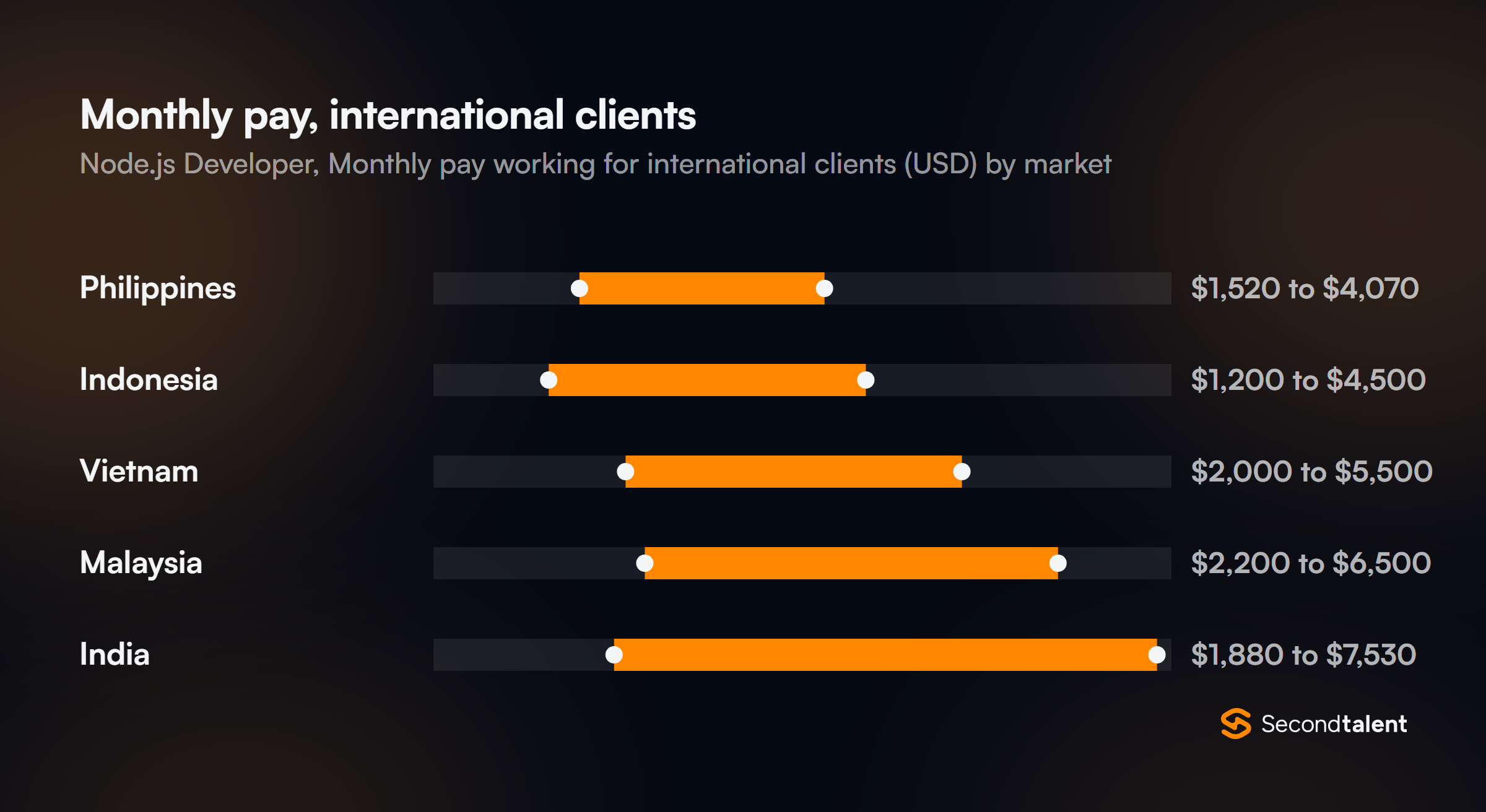
Monthly ranges from the Remote (Working for International Clients) figures on our rate cards for the Philippines, Indonesia, India, Vietnam and Malaysia, converted at ExchangeRate-API mid-market rates for 14 September 2026.
The Philippine card quotes ₱95,000 to ₱255,000+ a month, converted at ₱62.69 to the dollar. It and the Indian card leave the top open. The other three quote US dollars with a fixed ceiling.
Local pay runs close to the card's floor for this role. JobStreet's Node JS developer salary page, built from salary ranges employers disclose in Philippine job ads, puts the middle half at ₱80,000 to ₱88,000 a month ($1,280 to $1,400). Its 90th percentile is ₱96,000.
An offer at the bottom of the foreign-client range therefore competes with the best-paying local ads. Aim above it for a senior hire.
Through Second Talent you pay one monthly fee that bundles salary, payroll taxes, statutory contributions and our service fee, quoted per role and market. Our pricing page explains the monthly subscription, and our Node.js developers page compares the wider pool in Asia.
US Pay Benchmark for Node.js Developers
BLS publishes no series for a single runtime. Node.js developers map to Software Developers (SOC 15-1252), because the job is writing and running server-side application software: APIs, workers and real-time services.
| BLS OEWS, May 2025, national |
Software Developers (15-1252) |
| Median annual |
$135,980 |
| 10th percentile, monthly |
$6,870 |
| 25th percentile, monthly |
$8,770 |
| Median, monthly |
$11,330 |
| 75th percentile, monthly |
$14,330 |
| 90th percentile, monthly |
$17,890 |
Monthly figures are the annual wages on the OEWS profile for 15-1252 divided by 12, rounded to the nearest $10.
Salary is only part of the US cost. In the BLS Employer Costs for Employee Compensation release for June 2026, wages and salaries made up 68.5% of employer compensation costs for full-time private industry workers, and benefits the other 31.5%.
For contract work, our Node.js cost-to-hire page sets out US freelance rates.
Time Zone Overlap: Manila Against ET, CT and PT
A US evening is a Manila morning. At 8:00 pm in New York under EDT (UTC-4) it is 00:00 UTC and 8:00 am in Manila, so a Node.js developer on a normal day shift is at the desk during your East Coast users' evening.
Manila keeps UTC+8 all year with no daylight saving time. US clocks stay on daylight time from 8 March to 1 November 2026, per NIST. The arithmetic for the table: 9:00 am EDT is 13:00 UTC and 9:00 pm in Manila, and 9:00 am EST (UTC-5) is 14:00 UTC and 10:00 pm.
| Manila shift (UTC+8) |
ET overlap (EDT / EST) |
CT overlap (CDT / CST) |
PT overlap (PDT / PST) |
Hours between 10 pm and 6 am |
| 9 am-6 pm |
0 / 0 |
0 / 0 |
0 / 0 |
0 |
| 3 pm-12 am |
3 / 2 |
2 / 1 |
0 / 0 |
2 |
| 7 pm-4 am |
7 / 6 |
6 / 5 |
4 / 3 |
6 |
| 10 pm-7 am |
7 / 8 |
8 / 8 |
7 / 6 |
8 |
Each shift is nine clock hours with a meal break, counted against a 9 am to 5 pm US day. The last row loses an hour with New York under daylight time, because the shift starts at 10:00 am EDT.
Pick by the work. The 3 pm to midnight row gives API contract reviews with a New York front-end team three hours, and leaves the Manila afternoon for building. The 7 pm to 4 am row suits a developer who shares an on-call rotation with a West Coast team.
Night hours cost more for employees. The Labor Code sets a night shift differential of at least 10% for each hour between 10 pm and 6 am (Article 86), six of the nine clock hours in the 7 pm row. We agree the shift before the offer, which is how our placements get 4-6 hours of daily overlap with US hours.
Node.js Developer Skills to Screen For
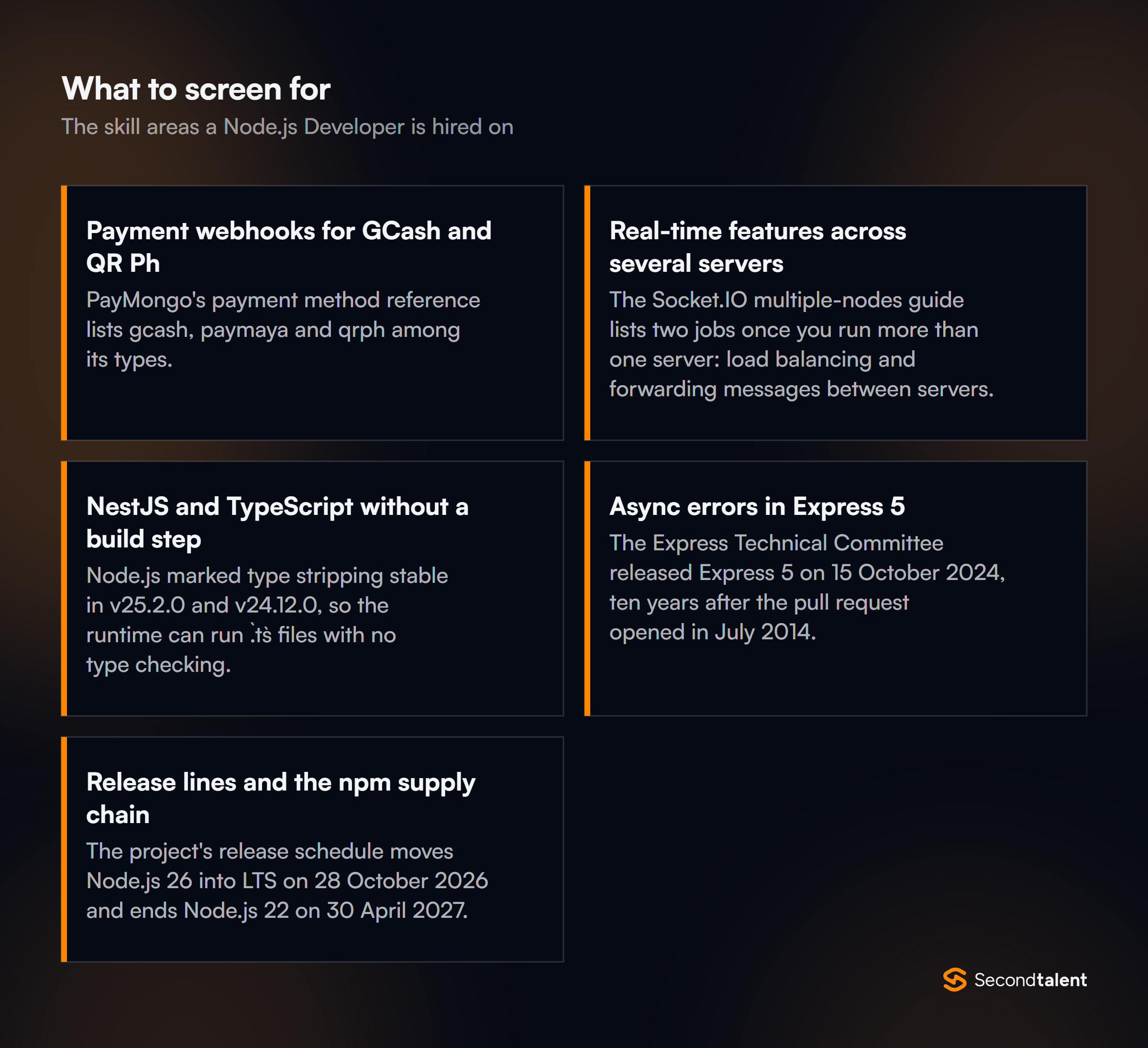
JobStreet's Node JS developer page lists the skills Philippine employers attach to the role: Node.js, REST API, debugging, NestJS, design patterns, React and AWS. If your services run on TypeScript with real-time features and payment flows, screen for those gaps as well as the listed skills.
Payment webhooks for GCash and QR Ph
PayMongo's payment method reference lists gcash, paymaya and qrph among its types. Its webhook reference says your server must return a status between 200 and 209 with a JSON body. PayMongo retries a failed delivery up to 12 times and disables the webhook after three consecutive events exhaust their retries.
Missed events are not re-sent, and PayMongo suggests retrieving the payment intent by ID as a fallback. Ask the candidate to write a handler that acknowledges fast, processes once and reconciles against the payment intent when the queue was down.
Real-time features across several servers
The Socket.IO multiple-nodes guide lists two jobs once you run more than one server: load balancing and forwarding messages between servers. All requests for a session ID must reach the process that opened it, through sticky sessions, disabling HTTP long-polling or client-side balancing. Ask how the candidate configured affinity on their last load balancer and which adapter carried broadcasts between nodes.
NestJS and TypeScript without a build step
Node.js marked type stripping stable in v25.2.0 and v24.12.0, so the runtime can run .ts files with no type checking. Decorators are not transformed and cause a parser error, and NestJS builds controllers from decorators. A NestJS service still needs a compile step. Hand the candidate a NestJS module and ask what happens when someone runs it with plain node.
Async errors in Express 5
The Express Technical Committee released Express 5 on 15 October 2024, ten years after the pull request opened in July 2014. It forwards rejected promises from middleware to the error handler and drops Node.js versions before 18. The migration guide also requires named wildcards such as /*splat. Give the candidate an Express 4 router full of try/catch wrappers and review the migration.
Release lines and the npm supply chain
The project's release schedule moves Node.js 26 into LTS on 28 October 2026 and ends Node.js 22 on 30 April 2027. Upgrades compete with dependency risk. CISA's September 2025 alert on the Shai-Hulud worm told teams to check lockfiles, pin to releases from before 16 September 2025 and rotate developer credentials.
npm's access token documentation says only granular tokens have worked since November 2025, and direct publishing with them ends in January 2027. Ask the candidate to set up a publish job with trusted publishing, which needs npm CLI 11.5.1 and Node.js 22.14.0 or later. Our Node.js interview guide has more question sets.
Contractor or Employer of Record in the Philippines
Software is not one of the nine categories of commissioned work that can be "work made for hire" under 17 U.S.C. § 101, and a transfer must be in writing and signed under § 204(a). On the Philippine side, section 178.4 of the Intellectual Property Code leaves copyright in a commissioned work with its creator unless a written stipulation says otherwise. Name the services, internal npm packages and CI workflows in the assignment, and keep the npm organization under a company account.
IRS Publication 515 says the place where services are performed determines the source of the income, so a developer working from Davao or Quezon City earns foreign-source income. A foreign individual gives the payer Form W-8BEN to certify foreign status.
Philippine courts apply the four-fold test: selection and engagement, payment of wages, the power of dismissal and the power to control the work. In Atok Big Wedge v. Gison the Supreme Court called control the most important of the four. A developer with deploy rights, a place on your pager and hours you set meets it.
Working from home changes none of that for employees. Section 5 of the Telecommuting Act gives telecommuting employees the same treatment as comparable employees at the employer's premises, with pay, overtime and night shift differential no lower than the law requires. Employment also brings four statutory lines:
Worked examples sit in our Philippines payroll, benefits and tax guide. Our Employer of Record service employs the developer for you, and the Philippines EOR page covers the local details. This is a summary, not legal advice.
|
Independent contractor |
Employer of Record |
| Legal employer |
None; the developer invoices you |
The EOR's Philippine entity |
| US paperwork |
Form W-8BEN from the developer |
Service agreement with the EOR |
| IP |
Written assignment covering services, npm packages and CI code (IP Code 178.4) |
Employer owns work from regular duties (IP Code 178.3), passed on through your EOR agreement |
| Local labor law |
Four-fold test risk if you set the rotation and control methods |
Telecommuting parity, night differential and 13th month pay apply |
| Pay currency |
Agreed in the contract, often USD |
Peso payroll run by the EOR |
English Level and Working Norms in the Philippines
The Philippines scores 581 for the IT job function on the EF English Proficiency Index 2025, above its national score of 569, which ranks 28th of 123 countries and regions against a global average of 488, per EF's Philippines page. Writing scores 603 and speaking 539.
For a Node.js hire the writing score is the one to test. The API changelog, the OpenAPI description and the incident note your team reads in the morning are all text. Ask finalists to write the note for a webhook outage: what failed, which payments need reconciling, and what changes.
Two holidays sit next to US calendar changes. The 2026 holiday proclamation makes All Souls' Day, Monday 2 November, a special non-working day, the first morning after US clocks go back. It also makes Bonifacio Day, Monday 30 November, a regular holiday, when Article 94 of the Labor Code pays an employee who works twice the regular rate. That Monday follows the US Thanksgiving weekend, so agree cover in advance.
Thanksgiving on 26 November 2026 is a working day in the Philippines, and a developer there can watch error rates while your US team is off.
Node.js Developer Hiring Process in the Philippines
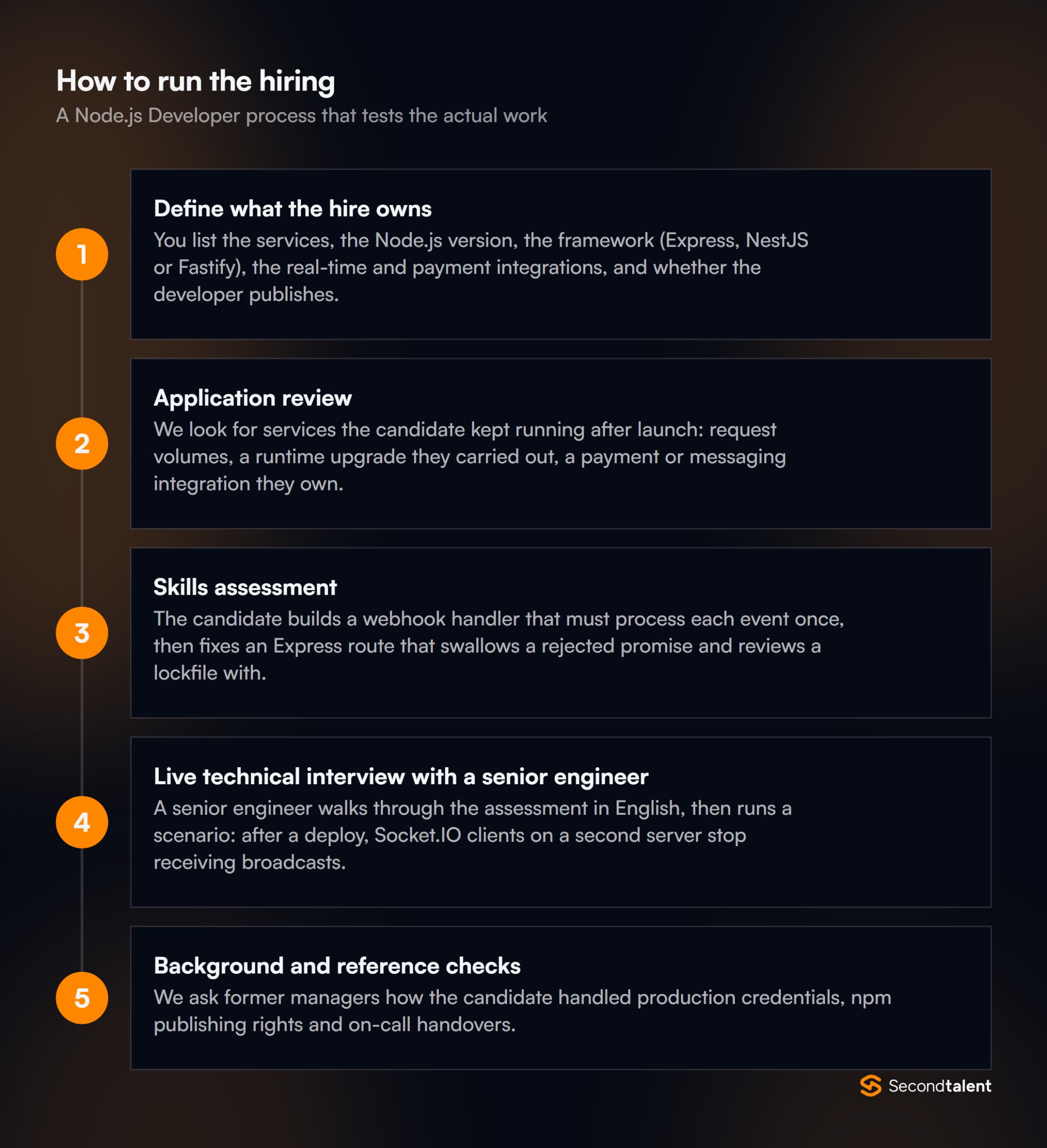
Second Talent's vetting covers stages 2 to 5 before you see a profile.
Stage 1: Define what the hire owns
You list the services, the Node.js version, the framework (Express, NestJS or Fastify), the real-time and payment integrations, and whether the developer publishes packages or joins the on-call rotation. Pick a shift from the table above.
Stage 2: Application review
We look for services the candidate kept running after launch: request volumes, a runtime upgrade they carried out, a payment or messaging integration they own. Tutorial repositories alone do not pass.
Stage 3: Skills assessment
The candidate builds a webhook handler that must process each event once, then fixes an Express route that swallows a rejected promise and reviews a lockfile with one compromised package planted in it. We score the pull request description with the code.
Stage 4: Live technical interview with a senior engineer
A senior engineer walks through the assessment in English, then runs a scenario: after a deploy, Socket.IO clients on a second server stop receiving broadcasts. The candidate explains what they check first and how they roll back.
Stage 5: Background and reference checks
We ask former managers how the candidate handled production credentials, npm publishing rights and on-call handovers. You then choose the contractor or EOR route above.
Hire Node.js Developers from the Philippines with Second Talent
We shortlist 6-8 candidates within 24 hours from 100,000+ pre-vetted engineers, accepting only the top 1% of applicants. Node.js developers from the Philippines come with $0 upfront, no lock-in and 4-6 hours of daily overlap with US hours. We handle contracts, payroll and equipment, with compliant EOR contracts in the Philippines.
Our pricing page sets out the monthly subscription, and for services written in other languages we also staff back-end developers in the Philippines.