TL;DR: AI developers in the Philippines earn $2,390 to $4,790+ a month working for international clients on our AI engineer rate card, the lowest range of the five markets compared. The closest US benchmark, the BLS median for software developers, was $135,980 a year in May 2025.
The Philippines' National Privacy Commission issued Advisory 2024-04 on 19 December 2024. It applies the Data Privacy Act to the training and testing of AI systems, and states that publicly available personal data keeps its protection. An AI developer in Manila who scrapes a dataset for your model is working under that rule.
Key takeaways
- A 6 pm to 3 am shift in Manila gives a New York team six live hours in summer, and five of those nine hours earn employees a night shift differential of at least 10%.
- Under the Philippine IP Code, a contractor keeps the copyright in commissioned code unless a written stipulation says otherwise.
- Ultralytics YOLO ships under AGPL-3.0, and Ultralytics requires an Enterprise License for closed commercial products, including custom-trained models.
- AI Singapore's SEA-LION embedding model covers Filipino but reads only 512 tokens per passage, which decides how a retrieval system chunks documents.
What AI Developers Earn in the Philippines Working for International Clients
The Philippine range opens $220 below India's and tops out $2,580 below Malaysia's. We publish no AI developer card, so the table uses our AI engineer rate cards, the closest match. The figures are what developers in each market earn working directly for foreign companies, before any employer or platform costs.
| Market |
Monthly pay working for international clients (USD) |
| Philippines |
$2,390-$4,790+ |
| India |
$2,610-$10,150+ |
| Malaysia |
$3,690-$7,370+ |
| Vietnam |
$3,870-$7,730+ |
| Indonesia |
$4,540-$10,210+ |
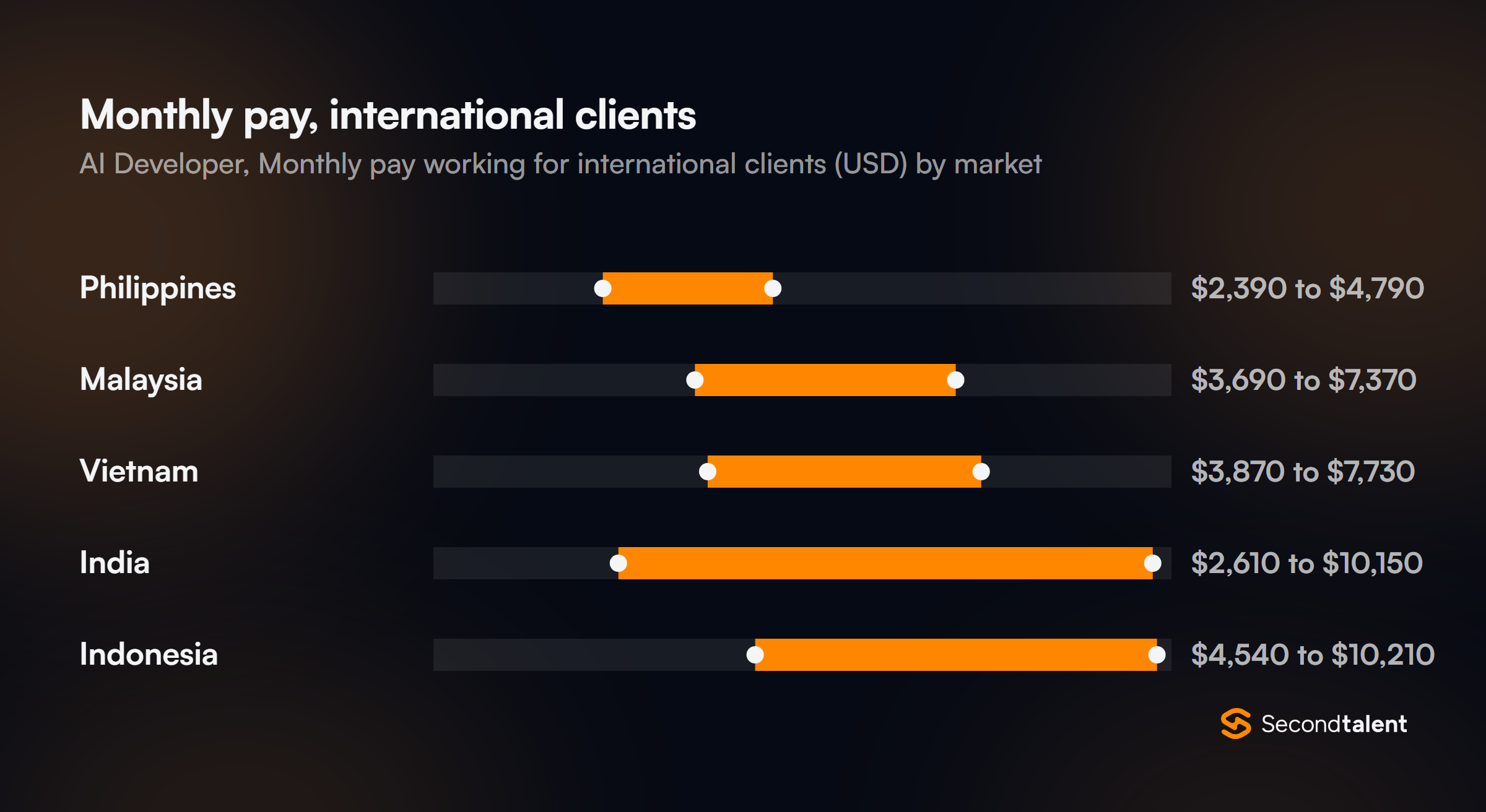
Monthly ranges from the Remote (Working for International Clients) figures on our rate cards for the Philippines, India, Malaysia, Vietnam and Indonesia, converted at ExchangeRate-API mid-market rates for 14 September 2026.
The Philippines card quotes ₱150,000 to ₱300,000+ a month. For a hire who trains models in PyTorch or TensorFlow rather than building on hosted ones, our Philippines machine learning engineer card runs $2,500 to $6,000, quoted in US dollars.
Through Second Talent you pay one monthly fee that bundles salary, payroll taxes, statutory contributions and our service fee, quoted per role and market. Our pricing page explains the monthly subscription.
US Pay Benchmark for AI Developers
No BLS occupation carries the AI developer title. The role maps to Software Developers (SOC 15-1252), because a developer who wires models, retrieval and vision pipelines into a product is writing production software.
| BLS OEWS, May 2025, national |
Software Developers (15-1252) |
| Median annual |
$135,980 |
| 10th percentile, monthly |
$6,870 |
| 25th percentile, monthly |
$8,770 |
| Median, monthly |
$11,330 |
| 75th percentile, monthly |
$14,330 |
| 90th percentile, monthly |
$17,890 |
Monthly figures are the annual wages on the OEWS profile for 15-1252 divided by 12, rounded to the nearest $10.
Salary is only part of the US cost. In the BLS Employer Costs for Employee Compensation release for June 2026, wages and salaries made up 68.5% of employer compensation costs for full-time private industry workers, and benefits the other 31.5%.
For project work, our AI engineer cost-to-hire page lists US freelance hourly rates.
Time Zone Overlap: Manila Against ET, CT and PT
Each hour a Manila employee works between 10 pm and 6 am carries a night shift differential of at least 10% of the regular wage, under Article 86 of the Labor Code. Most shifts that overlap the US working day cross that line.
Manila stays on UTC+8 all year. US daylight time runs from 8 March to 1 November 2026, per NIST. The arithmetic: 9:00 am in New York under EDT (UTC-4) is 13:00 UTC, or 9:00 pm in Manila. Under EST (UTC-5) it becomes 10:00 pm, and 9:00 am in San Francisco under PDT (UTC-7) is midnight.
| Manila shift (UTC+8) |
ET overlap (EDT / EST) |
CT overlap (CDT / CST) |
PT overlap (PDT / PST) |
Hours between 10 pm and 6 am |
| 9 am-6 pm |
0 / 0 |
0 / 0 |
0 / 0 |
0 |
| 3 pm-12 am |
3 / 2 |
2 / 1 |
0 / 0 |
2 |
| 6 pm-3 am |
6 / 5 |
5 / 4 |
3 / 2 |
5 |
| 9 pm-6 am |
8 / 8 |
8 / 7 |
6 / 5 |
8 |
Each shift is nine clock hours with a meal break, measured against a 9 am to 5 pm US day.
AI work tolerates a split. Evaluation runs, fine-tuning jobs and batch labelling can run while one side sleeps, so a 3 pm to midnight shift keeps two premium hours and still gives an East Coast team three live ones in summer.
The 9 pm to 6 am row buys a full New York day, with the differential on eight of its nine hours.
We agree the shift before the offer, which is how our placements get 4-6 hours of daily overlap with US hours.
AI Developer Skills to Screen For
In Stack Overflow's 2025 survey, 84% of respondents used or planned to use AI tools, but only 3.1% highly trusted their output, and 66% were frustrated by "AI solutions that are almost right, but not quite." An AI developer's job is closing that gap for your users, so screen for evidence before features.
Evaluation sets before prompts
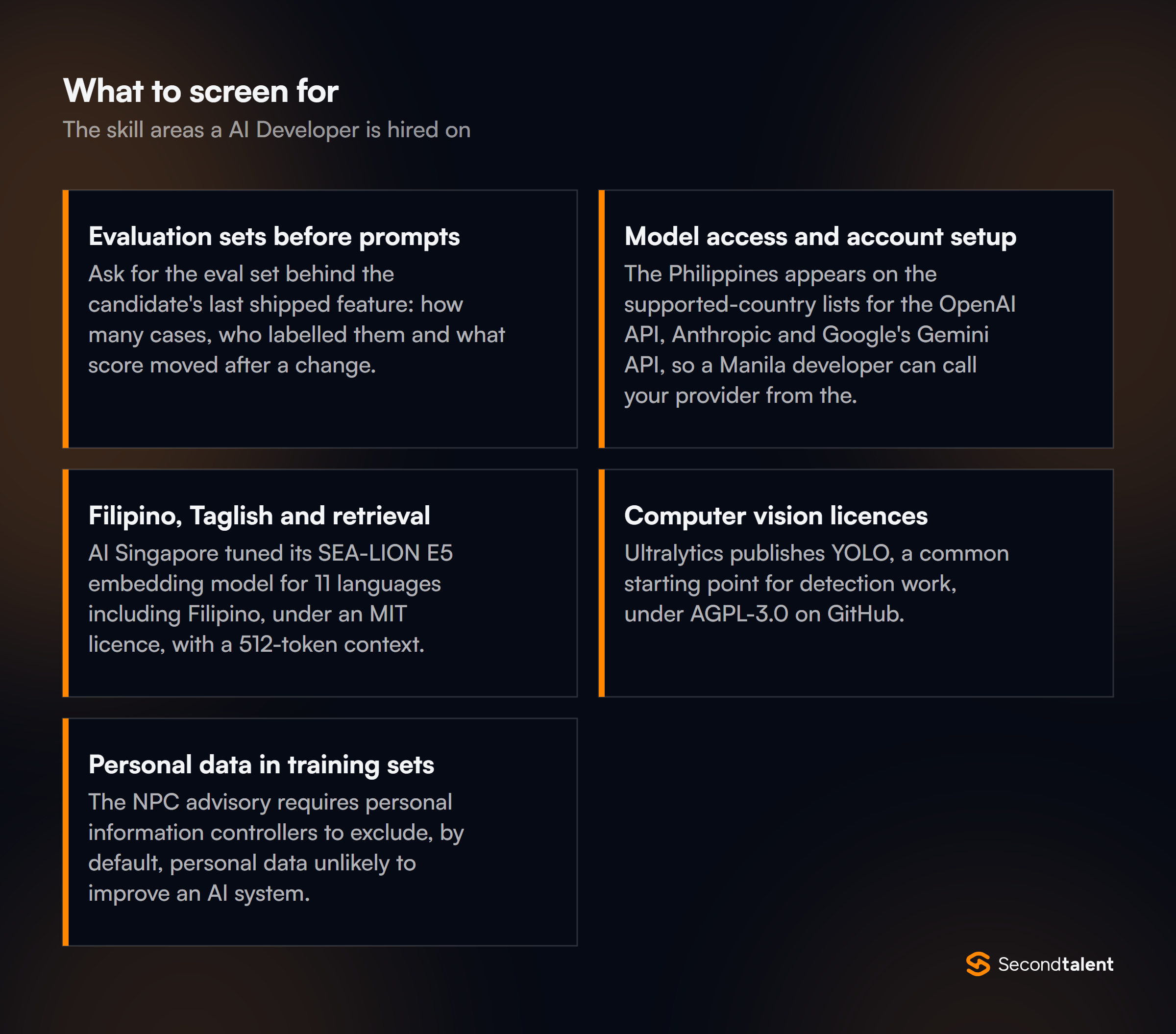
Ask for the eval set behind the candidate's last shipped feature: how many cases, who labelled them and what score moved after a change. A developer who can only show a demo has not measured "almost right." Give them a small labelled set and a baseline, and score whether they report failures by category or only an average.
Model access and account setup
The Philippines appears on the supported-country lists for the OpenAI API, Anthropic and Google's Gemini API, so a Manila developer can call your provider from the Philippines within its terms. Ask who held the keys on their last project, how spend limits were set and which calls sent customer data to the provider.
Filipino, Taglish and retrieval
AI Singapore tuned its SEA-LION E5 embedding model for 11 languages including Filipino, under an MIT licence, with a 512-token context. The same group's Qwen-SEA-LION-v4-32B-IT chat model saw about 100 billion tokens of continued pretraining across seven regional languages, Filipino among them.
Hand the candidate a support log that mixes English and Tagalog in one sentence. Ask how they would chunk it for a 512-token embedder and how they would measure retrieval for each language on its own.
Computer vision licences
Ultralytics publishes YOLO, a common starting point for detection work, under AGPL-3.0 on GitHub. The Ultralytics licensing page says any commercial product or service that does not open-source the entire project needs an Enterprise License, including custom-trained or fine-tuned YOLO models. Ask the candidate which licence covered the last vision model they shipped, and what they would swap in if your lawyers rejected AGPL.
Personal data in training sets
The NPC advisory requires personal information controllers to exclude, by default, personal data unlikely to improve an AI system. It also calls for meaningful human intervention, by someone with the competence and authority to act, where automated decisions pose a significant risk to data subjects.
A controller that outsources the work stays accountable for its processors. Ask the candidate how they would strip names and ID numbers from a training export, and where a reviewer would overrule the model in your product. Our data annotator hiring guide covers the labelling side.
Contractor or Employer of Record in the Philippines
Software is not one of the nine categories of commissioned work that can be "work made for hire" under 17 U.S.C. § 101, and a transfer must be in writing and signed under § 204(a).
Philippine law leaves commissioned code with the developer. Section 178.4 of the Intellectual Property Code gives the commissioning party ownership of the work, but the copyright stays with the creator unless a written stipulation says otherwise. Section 178.3 gives the employer copyright in work from an employee's regularly assigned duties. List code, prompts, eval sets, labelled data and model weights in the assignment.
IRS Publication 515 says the place where services are performed determines the source of the income, so an AI developer working from Manila or Cebu earns foreign-source income. A foreign individual gives the payer Form W-8BEN to certify foreign status.
Philippine courts apply the four-fold test: selection and engagement, payment of wages, the power of dismissal and control over the means and methods of the work. In Atok Big Wedge v. Gison, the Supreme Court called control the most important of the four. A contractor who works your hours under your engineering manager starts to look like an employee.
An employee brings four statutory lines on top of salary:
Our Employer of Record service carries those lines, and our Philippines EOR page and Philippines payroll guide show the employer cost. This is a summary, not legal advice.
|
Independent contractor |
Employer of Record |
| Legal employer |
None; the developer invoices you |
The EOR's Philippine entity |
| US paperwork |
Form W-8BEN from the developer |
Service agreement with the EOR |
| IP |
Written stipulation assigning code, data and weights (IP Code 178.4) |
Employer copyright under 178.3, passed on through your EOR agreement |
| Local labor law |
Four-fold test; control points to employment |
Night differential, 13th month pay and statutory contributions apply |
| Pay currency |
Agreed in the contract, often USD |
Local payroll run by the EOR |
English Level and Working Norms in the Philippines
Writing is the strongest English skill in the Philippines, at 603 on the EF English Proficiency Index 2025, while speaking sits at 539. The national score of 569 ranks 28th of 123 countries and regions against a global average of 488, and the IT job-function score is 581, per EF's Philippines page.
That profile fits AI teams, where prompts, eval rubrics and incident write-ups carry most decisions. Ask finalists to write a grading rubric for one of your prompts and apply it to three model answers.
Proclamation 1006 puts four non-working days into the last eight days of 2026: Christmas Eve, Christmas Day, Rizal Day on 30 December and the last day of the year. Plan model releases and on-call cover around that week.
Thanksgiving on 26 November 2026 is a working day in the Philippines, so a Manila developer can watch a model release while your US team is off. Bonifacio Day, a regular holiday, follows on Monday 30 November.
AI Developer Hiring Process in the Philippines
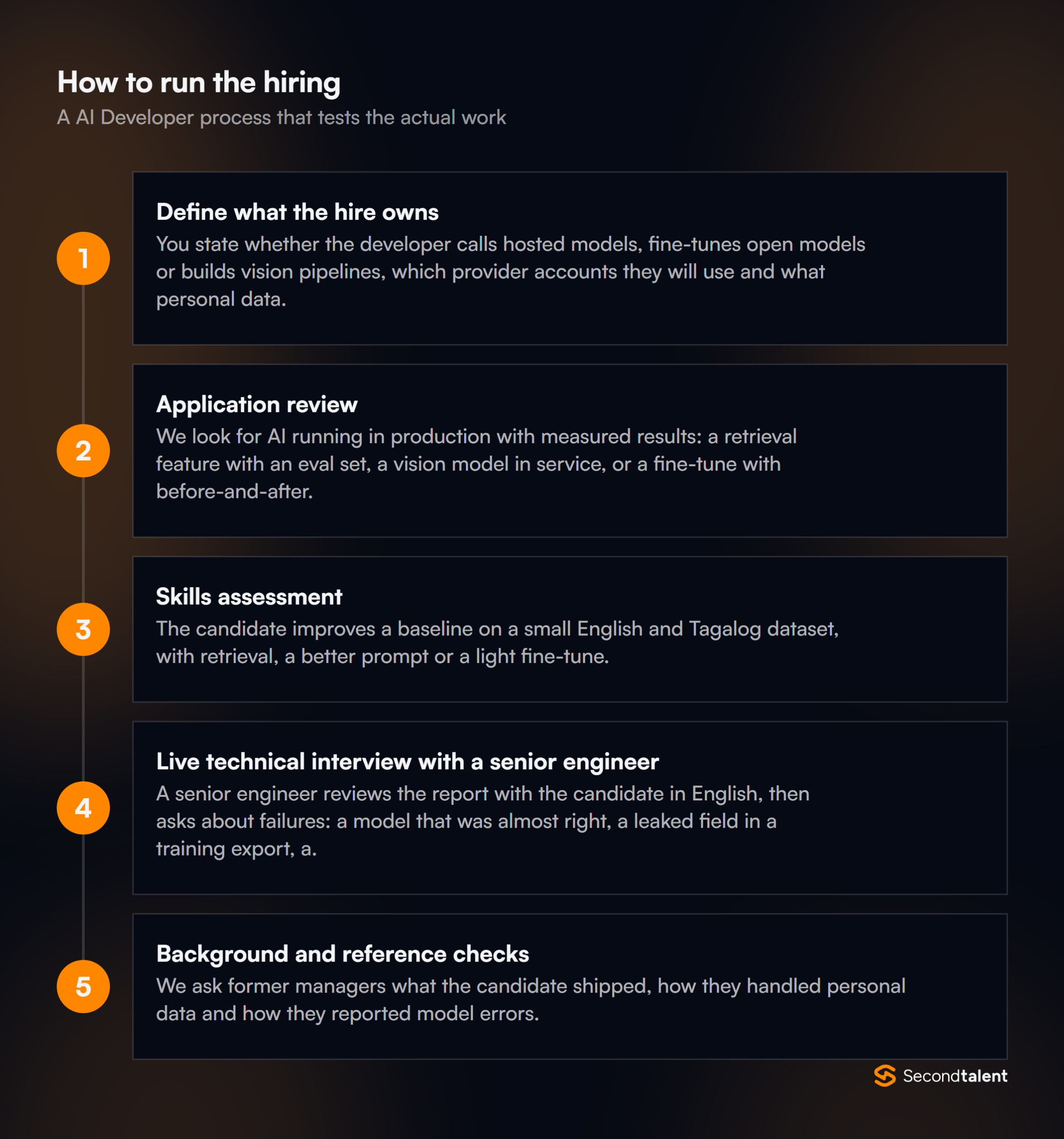
Second Talent's vetting covers stages 2 to 5 before you see a profile.
Stage 1: Define what the hire owns
You state whether the developer calls hosted models, fine-tunes open models or builds vision pipelines, which provider accounts they will use and what personal data enters training or prompts. Add the Manila shift from the table above.
Stage 2: Application review
We look for AI running in production with measured results: a retrieval feature with an eval set, a vision model in service, or a fine-tune with before-and-after scores. A notebook demo with no users does not pass.
Stage 3: Skills assessment
The candidate improves a baseline on a small English and Tagalog dataset, with retrieval, a better prompt or a light fine-tune. They write a short report with scores by language, cost per run and the licence of each model used.
Stage 4: Live technical interview with a senior engineer
A senior engineer reviews the report with the candidate in English, then asks about failures: a model that was almost right, a leaked field in a training export, a vision model that broke on new camera data.
Stage 5: Background and reference checks
We ask former managers what the candidate shipped, how they handled personal data and how they reported model errors. You then choose the contractor or EOR route above.
Hire AI Developers from the Philippines with Second Talent
We shortlist 6-8 candidates within 24 hours from 100,000+ pre-vetted engineers, accepting only the top 1% of applicants. AI developers from the Philippines come with $0 upfront, no lock-in and 4-6 hours of daily overlap with US hours. We handle contracts, payroll and equipment, with compliant EOR contracts in the Philippines.
Our pricing page sets out the monthly subscription, and for large language model work we also staff LLM engineers in the Philippines.