TL;DR: Data engineers in India earn $2,300 to $8,470+ a month working for international clients on our rate card, and we shortlist 6-8 candidates within 24 hours. The closest US benchmark, the BLS median for data scientists, was $120,230 a year in May 2025.
India's Digital Personal Data Protection Act, 2023 switches off most of its duties when a person based in India processes the personal data of individuals outside India under a contract with a person outside India. Section 8(5), the duty to take reasonable security safeguards, stays on, and a breach carries the Act's largest penalty: up to ₹250 crore.
Key takeaways
- Spark 4.0 made ANSI SQL mode the default, so an invalid cast now throws an error where older jobs returned null.
- Airflow 2 reached end of life on 22 April 2026 and gets no further fixes.
- A 5:30 pm to 2:30 am shift in Bengaluru gives a New York team eight live hours while US daylight time lasts.
- India is not on the US Justice Department's list of countries of concern for bulk sensitive personal data.
What Data Engineers Earn in India Working for International Clients
The India range opens lowest of the four markets, $1,180 below Vietnam's, and its ceiling sits between Malaysia's and Vietnam's. The figures are what data engineers in each market earn working directly for foreign companies, before any employer or platform costs.
| Market |
Monthly pay working for international clients (USD) |
| India |
$2,300-$8,470+ |
| Vietnam |
$3,480-$6,960+ |
| Malaysia |
$4,420-$8,600+ |
| Indonesia |
$4,540-$10,210+ |
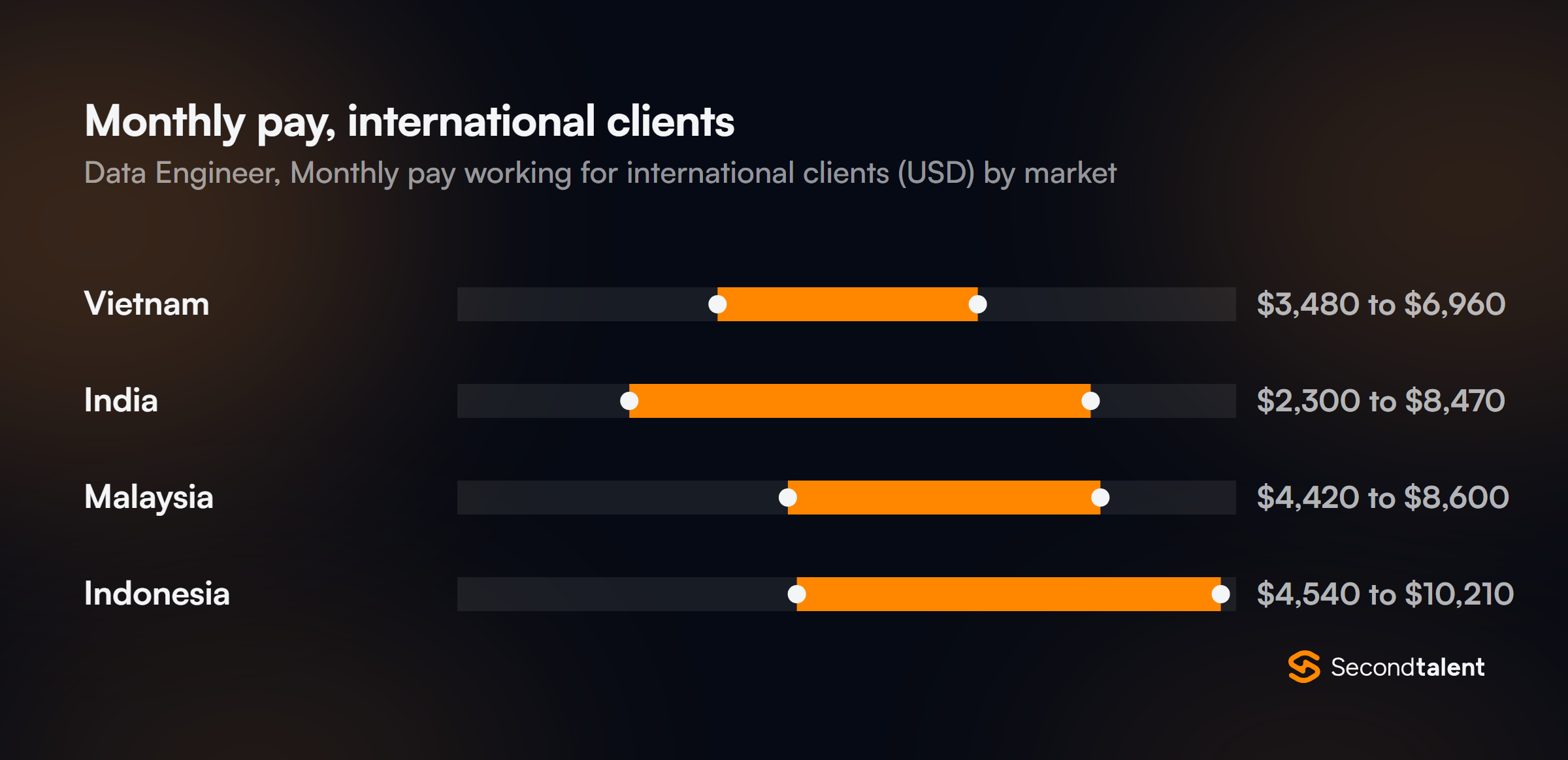
Monthly ranges from the Remote (Working for International Clients) figures on our rate cards for India, Vietnam, Malaysia and Indonesia, converted at ExchangeRate-API mid-market rates for 14 September 2026.
The India card quotes ₹220,000 to ₹810,000+ a month. A range that wide covers an engineer maintaining SQL jobs on an old warehouse and one who designs a lakehouse, so write the brief before you anchor on a number.
Through Second Talent you pay one monthly fee that bundles salary, payroll taxes, statutory contributions and our service fee, quoted per role and market. Our pricing page explains the monthly subscription.
Mid-level US freelance data engineers cost $92 to $145 an hour on our data engineer cost-to-hire page, the reference point for a short contract.
US Pay Benchmark for Data Engineers
No BLS occupation carries the data engineer title. We map the role to Data Scientists (15-2051), whose BLS definition takes in data modelling and converting raw data into information.
| BLS OEWS, May 2025, national |
Data Scientists (15-2051) |
| Median annual |
$120,230 |
| 10th percentile, monthly |
$5,600 |
| 25th percentile, monthly |
$7,140 |
| Median, monthly |
$10,020 |
| 75th percentile, monthly |
$13,240 |
| 90th percentile, monthly |
$16,590 |
Monthly figures are the annual wages on the OEWS profile for 15-2051 divided by 12, rounded to the nearest $10.
Salary is only part of the US cost. In the BLS Employer Costs for Employee Compensation release for June 2026, wages and salaries made up 68.5% of employer compensation costs for full-time private industry workers, and benefits the other 31.5%.
Time Zone Overlap: Bengaluru Against ET, CT and PT
A pipeline that fails at midnight in New York fails at 9:30 am in Bengaluru while US daylight time lasts. Bengaluru runs on UTC+5:30 with no daylight saving, and US clocks stay on daylight time from 8 March to 1 November 2026, per NIST.
The arithmetic: 9:00 am in Chicago is 14:00 UTC under CDT (UTC-5), which is 7:30 pm in Bengaluru. Under CST (UTC-6) it is 8:30 pm. New York's 9:00 am lands at 6:30 pm in summer, and San Francisco's at 9:30 pm.
| Bengaluru shift (UTC+5:30) |
ET overlap (EDT / EST) |
CT overlap (CDT / CST) |
PT overlap (PDT / PST) |
Hours between 10 pm and 6 am |
| 9:30 am-6:30 pm |
0 / 0 |
0 / 0 |
0 / 0 |
0 |
| 12:30 pm-9:30 pm |
3 / 2 |
2 / 1 |
0 / 0 |
0 |
| 3:30 pm-12:30 am |
6 / 5 |
5 / 4 |
3 / 2 |
2.5 |
| 5:30 pm-2:30 am |
8 / 7 |
7 / 6 |
5 / 4 |
4.5 |
Each shift is nine clock hours with a meal break, counted against a 9 am to 5 pm US day.
The day shift suits batch ownership. The engineer reruns failed jobs and backfills gaps, then posts a freshness note before your analysts log on. The 12:30 pm row adds a short overlap for schema changes that need a US product owner.
We fix the shift before the offer, which is how our placements get 4-6 hours of daily overlap with US hours.
Data Engineer Skills to Screen For
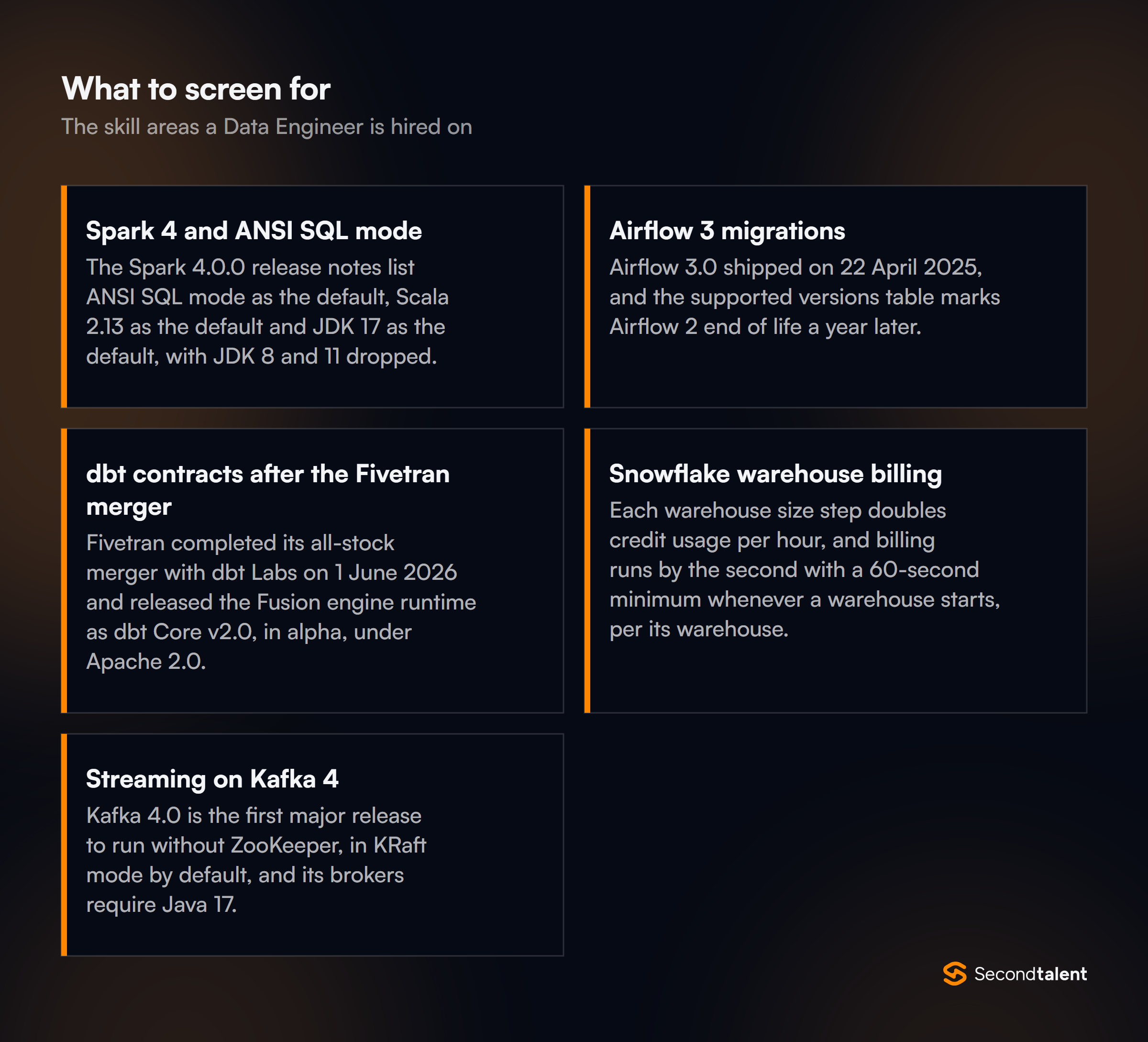
In Stack Overflow's 2025 survey, 58.2% of professional developers used PostgreSQL, against 6.5% for BigQuery, 4.2% for Snowflake and 3.2% for Databricks SQL. Many candidates will have spent more years on Postgres than on your warehouse, so test the warehouse you run.
Spark 4 and ANSI SQL mode
The Spark 4.0.0 release notes list ANSI SQL mode as the default, Scala 2.13 as the default and JDK 17 as the default, with JDK 8 and 11 dropped. Under ANSI mode, Spark throws an exception at runtime instead of returning null for invalid inputs, per its ANSI compliance guide. Hand over a Spark 3 job that casts dirty strings to integers and ask what breaks after the upgrade.
Airflow 3 migrations
Airflow 3.0 shipped on 22 April 2025, and the supported versions table marks Airflow 2 end of life a year later. The upgrade guide says task code can no longer import Airflow database sessions or models, replaces SubDAGs with TaskGroups and Assets, and swaps SLAs for Deadline Alerts. Ask which of the three hit the candidate's last DAG estate.
dbt contracts after the Fivetran merger
Fivetran completed its all-stock merger with dbt Labs on 1 June 2026 and released the Fusion engine runtime as dbt Core v2.0, in alpha, under Apache 2.0. An enforced model contract makes dbt run a preflight check on column names and data types. Ask which models the candidate would put under contract first and why.
Snowflake warehouse billing
Each warehouse size step doubles credit usage per hour, and billing runs by the second with a 60-second minimum whenever a warehouse starts, per its warehouse overview. A job that wakes a suspended warehouse every five minutes pays that minimum 12 times an hour. Ask the candidate for a bill they cut and the before-and-after figure.
Streaming on Kafka 4
Kafka 4.0 is the first major release to run without ZooKeeper, in KRaft mode by default, and its brokers require Java 17. Ask how the candidate would move a ZooKeeper cluster across, and how their consumers handle a late or duplicated event.
Contractor or Employer of Record in India
Software is not one of the nine categories of commissioned work that can be "work made for hire" under 17 U.S.C. § 101, and a transfer must be in writing and signed under § 204(a).
India's Copyright Act, 1957 defines literary work to include computer programmes and compilations including computer databases, a definition that reaches pipeline code and the databases it assembles.
Section 17(c) gives the employer first ownership only of work made under a contract of service, so a contractor keeps copyright until a written, signed assignment under section 19. That assignment defaults to five years and to India unless it states a term and territory.
IRS Publication 515 says the place where services are performed determines the source of the income, so a data engineer in Hyderabad earns foreign-source income. A foreign individual gives the payer Form W-8BEN to certify foreign status.
India's Supreme Court, in Ram Singh v. Union Territory, Chandigarh, held that control matters but is not the sole test, and weighed integration into the business, who organises the work and who supplies the tools.
On data access, the US rule on bulk sensitive personal data names six countries of concern: China, Cuba, Iran, North Korea, Russia and Venezuela. India is not among them.
Whichever route you pick, ask a finalist who will load your US customer tables which security safeguards they would build first, since the DPDP duty in section 8(5) survives the exemption.
Our Employer of Record overview explains how an EOR employs a hire through its own local entity. This is a summary, not legal advice.
|
Independent contractor |
Employer of Record |
| Legal employer |
None; the engineer invoices you |
The EOR's Indian entity |
| US paperwork |
Form W-8BEN from the engineer |
Service agreement with the EOR |
| IP |
Section 19 assignment naming pipelines, dbt models and schemas, with term and territory |
Employer first owner under section 17(c), passed on through your EOR agreement |
| Local labor law |
Employment finding if the engineer is part of your data team's daily operation |
Indian employment and social security rules apply |
| Pay currency |
Agreed in the contract, often USD |
Local payroll in rupees run by the EOR |
English Level and Working Norms in India
India's writing score on the EF English Proficiency Index 2025 is 504, while its listening score is 457, per EF's India page. The national score is 484, 74th of 123 countries and regions against a global average of 488, and the IT job-function score is 487. Hyderabad scores 554 and Chennai 534.
A 47-point gap between writing and listening favours written handoffs. Keep schema decisions in a pull request or a design note, and follow each call with a written summary. Ask finalists to write the incident note for a backfill that loaded duplicate rows.
India's central government list for 2026, set by a DoPT office memorandum of 3 July 2025, puts Dussehra on Tuesday 20 October and Diwali on Sunday 8 November. Private employers set their own lists, so agree pipeline cover for that stretch before October.
Thanksgiving on 26 November 2026 is a working day in India, so an engineer there can watch the Black Friday loads while your US team is off.
Data Engineer Hiring Process in India
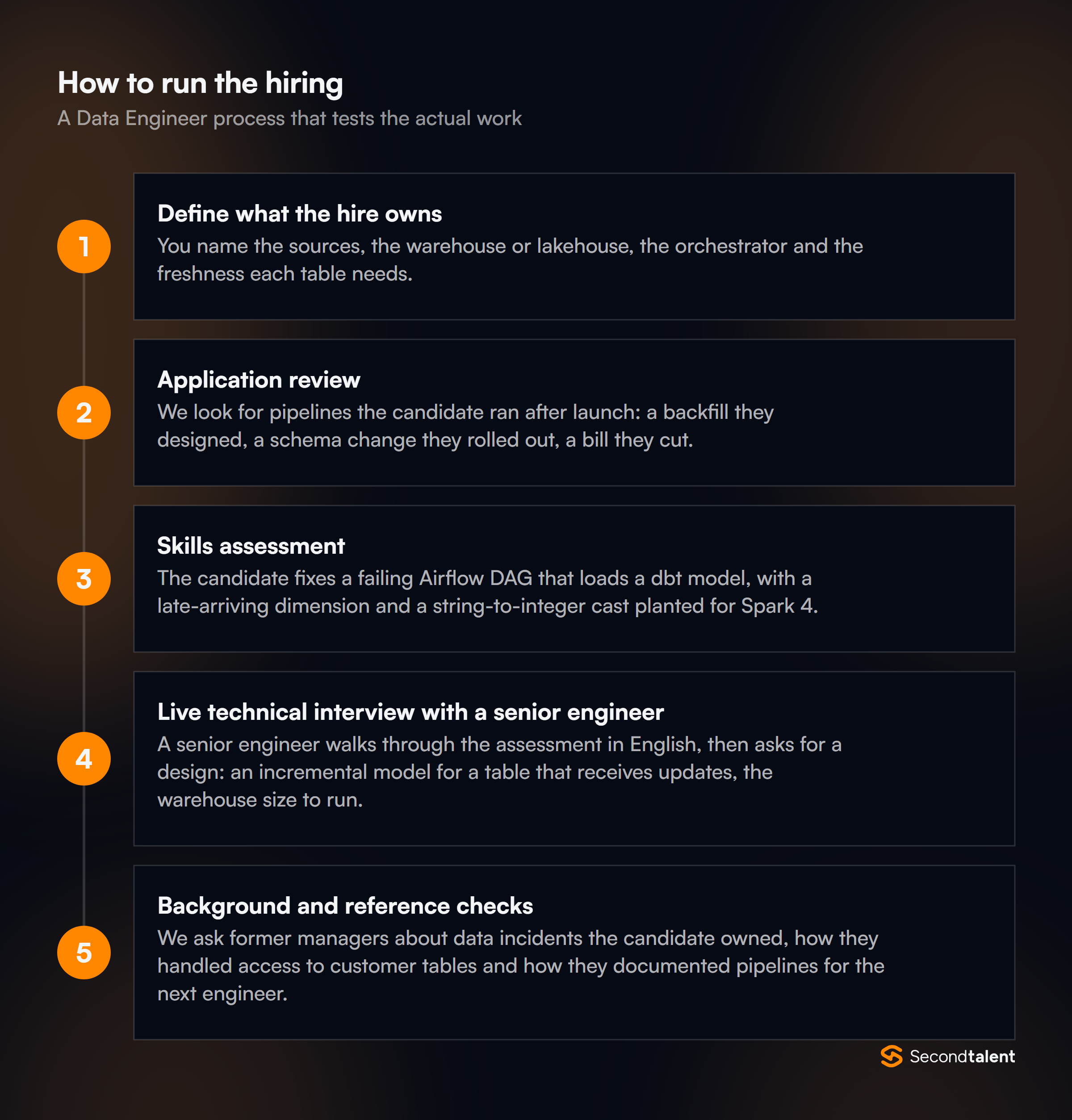
Second Talent's vetting covers stages 2 to 5 before you see a profile.
Stage 1: Define what the hire owns
You name the sources, the warehouse or lakehouse, the orchestrator and the freshness each table needs. Say whether the engineer touches personal data, and fix the Bengaluru shift from the table above.
Stage 2: Application review
We look for pipelines the candidate ran after launch: a backfill they designed, a schema change they rolled out, a bill they cut. They give volumes in rows or terabytes a day. A tool list with no production story does not pass.
Stage 3: Skills assessment
The candidate fixes a failing Airflow DAG that loads a dbt model, with a late-arriving dimension and a string-to-integer cast planted for Spark 4. We score idempotency, tests and the pull request note.
Stage 4: Live technical interview with a senior engineer
A senior engineer walks through the assessment in English, then asks for a design: an incremental model for a table that receives updates, the warehouse size to run it on, and what pages whom when it fails.
Stage 5: Background and reference checks
We ask former managers about data incidents the candidate owned, how they handled access to customer tables and how they documented pipelines for the next engineer. You then choose the contractor or EOR route above.
Hire Data Engineers from India with Second Talent
We shortlist 6-8 candidates within 24 hours from 100,000+ pre-vetted engineers, accepting only the top 1% of applicants. Data engineers from India come with $0 upfront, no lock-in and 4-6 hours of daily overlap with US hours. We handle contracts, payroll and equipment.
Our pricing page covers the subscription, and for the modelling on top of your pipelines we also staff data scientists in India.