TL;DR: Data engineers in Thailand earn $4,530 to $9,070+ a month working for international clients on our rate card, and we shortlist 6-8 candidates within 24 hours. The closest US benchmark, the BLS median for data scientists, was $120,230 a year in May 2025.
Thailand's Personal Data Protection Act gives a controller 72 hours from learning of a breach to notify the regulator, where feasible, and it reaches controllers abroad that serve data subjects in Thailand. A US company holding Thai customer rows is on that clock, and its Bangkok data engineer counts the affected records.
Key takeaways
- AWS lists an Asia Pacific (Thailand) Region, ap-southeast-7, with three Availability Zones, and an account must opt in before using it.
- Buddhist Era years run 543 ahead of the Gregorian calendar, so a real Thai date such as 29 February 2567 fails a Gregorian date parse.
- Under Thai copyright law, code a contractor writes on commission belongs to the client unless agreed otherwise, while an employee keeps copyright unless a written agreement says otherwise.
- Thailand's EF EPI 2025 writing score, 363, is its lowest of the four skills.
What Data Engineers Earn in Thailand Working for International Clients
Thailand's floor sits $10 below Indonesia's and $110 above Malaysia's, while its open top runs $1,140 under Indonesia's. The figures are what data engineers in each market earn working directly for foreign companies, before any employer or platform costs.
| Market |
Monthly pay working for international clients (USD) |
| Thailand |
$4,530-$9,070+ |
| Vietnam |
$3,480-$6,960+ |
| Malaysia |
$4,420-$8,600+ |
| Indonesia |
$4,540-$10,210+ |
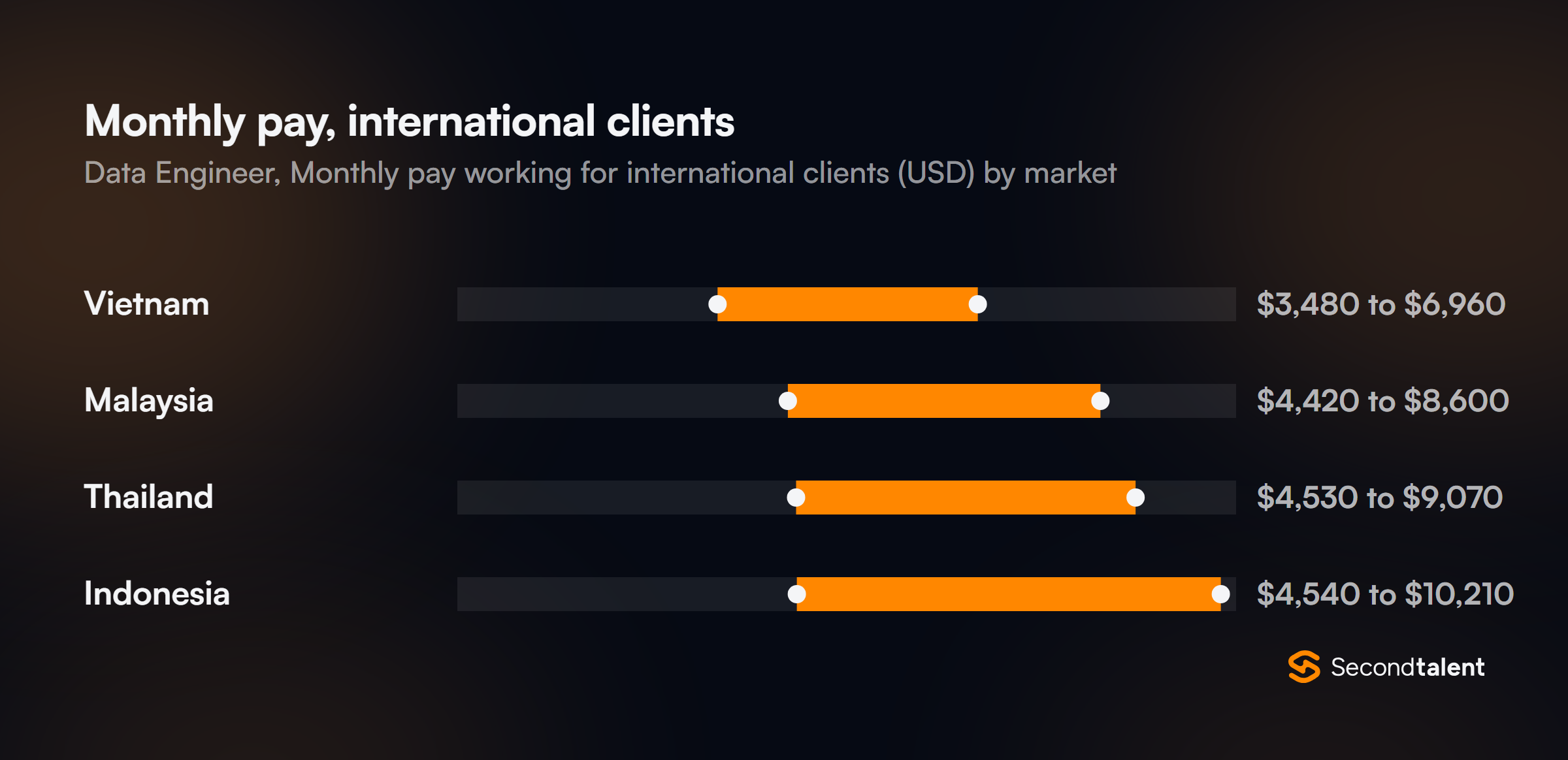
Monthly ranges from the Remote (Working for International Clients) figures on our rate cards for Thailand, Vietnam, Malaysia and Indonesia, converted at ExchangeRate-API mid-market rates for 14 September 2026.
The Thailand card quotes ฿150,000 to ฿300,000+ a month, converted at ฿33.08 to the dollar. That floor is ฿30,000 above the Thai data scientist card, which opens at ฿120,000.
For the neighbouring pools, our Vietnam data engineer page and Malaysia data engineer page cover the same role.
Through Second Talent you pay one monthly fee that bundles salary, payroll taxes, statutory contributions and our service fee, quoted per role and market. Our pricing page explains the monthly subscription, and our data engineer cost-to-hire page sets out US freelance rates for the contract route.
US Pay Benchmark for Data Engineers
BLS publishes no data engineer occupation, so we benchmark against Data Scientists (SOC 15-2051), the occupation whose models and analyses depend on a data engineer's pipelines.
| BLS OEWS, May 2025, national |
Data Scientists (15-2051) |
| Median annual |
$120,230 |
| 10th percentile, monthly |
$5,600 |
| Median, monthly |
$10,020 |
| 90th percentile, monthly |
$16,590 |
Monthly figures are the annual wages on the OEWS profile for 15-2051 divided by 12, rounded to the nearest $10.
The Thai card's open top sits below the US monthly median. Place a Bangkok candidate on it by what they have owned: an engineer who ran a bank's streaming platform alone belongs near the top, and one who maintained reports on it does not.
Salary is only part of the US cost. In the BLS Employer Costs for Employee Compensation release for June 2026, wages and salaries made up 68.5% of employer compensation costs for full-time private industry workers, and benefits the other 31.5%.
Time Zone Overlap: Bangkok Against ET, CT and PT
A load your team starts at 6 pm in San Francisco lands at 8 am in Bangkok while US daylight time lasts, and at 9 am after it ends. An engineer there can check row counts and rerun a failed partition before the Pacific morning.
Bangkok keeps UTC+7 all year with no daylight saving. US clocks stay on daylight time from 8 March to 1 November 2026, per NIST.
The arithmetic: 6:00 pm PDT (UTC-7) is 01:00 UTC, which is 8:00 am in Bangkok. A 9 am to 5 pm day in New York runs from 8 pm to 4 am Bangkok time under EDT, and from 9 pm to 5 am under EST.
| Bangkok shift (UTC+7) |
ET overlap (EDT / EST) |
CT overlap (CDT / CST) |
PT overlap (PDT / PST) |
Hours between 10 pm and 6 am |
| 9 am-6 pm |
0 / 0 |
0 / 0 |
0 / 0 |
0 |
| 6 am-3 pm |
0 / 0 |
0 / 0 |
1 / 2 |
0 |
| 4 pm-1 am |
5 / 4 |
4 / 3 |
2 / 1 |
3 |
| 7 pm-4 am |
8 / 7 |
7 / 6 |
5 / 4 |
6 |
Each shift is nine clock hours with a one-hour meal break, counted against a 9 am to 5 pm US day. The 6 am row gives a West Coast analytics team a daily handover with no night hours. The 4 pm row gives New York five live hours in September, enough for a design review and an incident call.
The Labour Protection Act caps normal working time at eight hours a day and 48 a week (Section 23), and requires at least a one-hour rest after no more than five consecutive hours (Section 27). Hours beyond normal time on a working day carry at least 1.5 times the hourly wage (Section 61).
A nine-hour shift with its break stays inside normal time. We agree the shift before the offer, which is how our placements get 4-6 hours of daily overlap with US hours.
Data Engineer Skills to Screen For
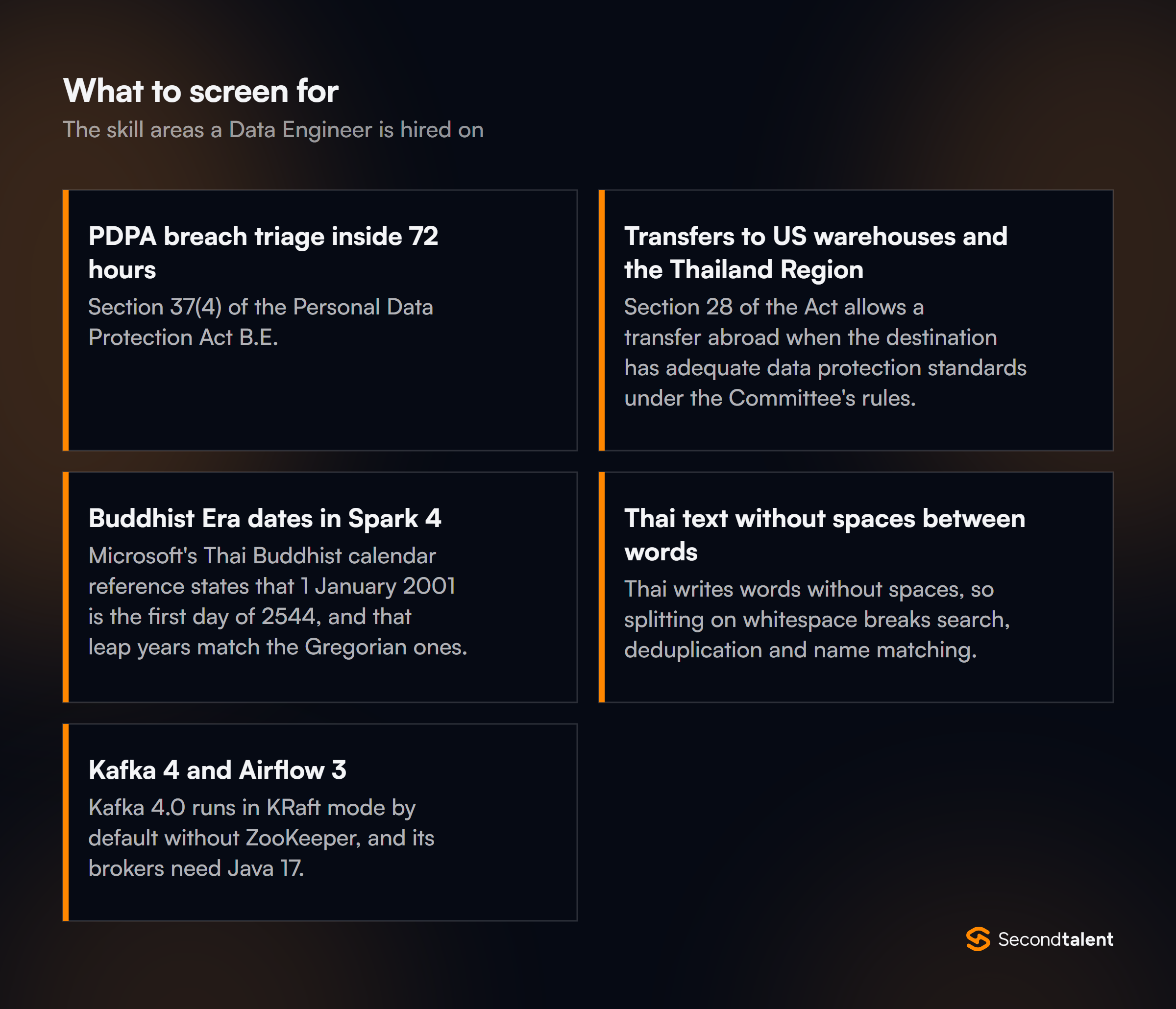
Two of the five areas below come from Thai law and Thai data: the PDPA and Buddhist Era dates. The others test the cloud region and the Kafka and Airflow releases a Bangkok pipeline now runs on.
PDPA breach triage inside 72 hours
Section 37(4) of the Personal Data Protection Act B.E. 2562 requires a controller to notify the Office of a breach without delay and, where feasible, within 72 hours of becoming aware of it. A breach likely to put data subjects at high risk must also be reported to them.
A breach of Section 37 carries an administrative fine of up to ฿3 million (Section 83), about $90,690.
Give the candidate an exposed S3 prefix and a warehouse schema, then ask for the count of distinct data subjects and the tables that hold the same national ID. Then ask what they would put in the notice.
Transfers to US warehouses and the Thailand Region
Section 28 of the Act allows a transfer abroad when the destination has adequate data protection standards under the Committee's rules. Its exceptions include consent after the data subject is told the standards are inadequate, and necessity for a contract with the data subject.
Section 5 applies the Act to controllers outside Thailand that offer goods or services to data subjects in the country.
AWS's Regions list shows ap-southeast-7, Asia Pacific (Thailand), with three Availability Zones and opt-in required. Ask the candidate which tables they would keep in that Region, which they would replicate to us-east-1, and what the transfer basis is for each.
Buddhist Era dates in Spark 4
Microsoft's Thai Buddhist calendar reference states that 1 January 2001 is the first day of 2544, and that leap years match the Gregorian ones. So 29 February 2567 is a real Thai date (2024), while the string 2567-02-29 is not a valid Gregorian date.
The Spark 4.0.0 release notes make ANSI SQL mode the default. Under that mode, per the ANSI compliance guide, to_date fails with an exception when it cannot parse a string, and try_to_date returns NULL. Hand over an ERP extract with Buddhist Era dates and ask where the job fails, and where a silent NULL would hide the error.
Thai text without spaces between words
Thai writes words without spaces, so splitting on whitespace breaks search, deduplication and name matching. PyThaiNLP's word_tokenize defaults to the dictionary-based newmm engine and keeps whitespace, which it describes as a common end-of-phrase mark in Thai. Ask the candidate to deduplicate customer names written in Thai and English, and to explain how they would add product names missing from the dictionary.
Kafka 4 and Airflow 3
Kafka 4.0 runs in KRaft mode by default without ZooKeeper, and its brokers need Java 17. Apache Airflow's supported versions table shows Airflow 2 at end of life since 22 April 2026. The Airflow 3 upgrade guide stops task code from importing database sessions or models. Ask which of those changes hit the candidate's last platform, and what they rewrote.
Contractor or Employer of Record in Thailand
Software is not one of the nine categories of commissioned work that can be "work made for hire" under 17 U.S.C. § 101, and a transfer must be in writing and signed under § 204(a).
Thailand's Copyright Act B.E. 2537 splits the two routes. It counts computer programs as literary works (Section 4).
Copyright in work made on commission vests in the party that commissioned it unless the two sides agree otherwise (Section 10). Copyright in an employee's work vests in the employee unless a written agreement says otherwise, though the employer is entitled to communicate the work to the public for the purpose of the employment (Section 9).
An assignment must be in writing and signed by both assignor and assignee, and one that states no duration is deemed to last ten years (Section 17). Write "for the full term of copyright" into the assignment of DAGs, dbt models and ingestion code.
IRS Publication 515 says the place where services are performed determines the source of the income, so work done in Bangkok produces foreign-source income. A foreign individual gives the payer Form W-8BEN to certify foreign status.
On the Thai side, Section 41 of the Revenue Code taxes income from employment or business carried on in Thailand, whether the client pays it inside or outside Thailand.
The Labour Protection Act defines an employee as a person who agrees to work for an employer in return for a wage, "regardless of the name given" to the status (Section 5, ILO English translation).
A contractor on your on-call rota, paid monthly and working on your cloud accounts, can fit that definition. An employer pays wages in Thai currency unless the employee consents to foreign currency (Section 54).
Our Employer of Record service employs the engineer in Thailand and runs payroll, with local detail on our Thailand EOR page. This is a summary, not legal advice.
|
Independent contractor |
Employer of Record |
| Legal employer |
None; the engineer invoices you |
The EOR's Thai entity |
| US paperwork |
Form W-8BEN from the engineer |
Service agreement with the EOR |
| IP |
Commissioned work vests in you unless agreed otherwise (Section 10); sign a full-term written assignment (Section 17) |
Employee owns unless a written agreement says otherwise (Section 9), so the contract assigns it and the EOR passes it to you |
| Local labor law |
Employee status if the engineer works for you for a wage, whatever the contract is called (Section 5) |
Labour Protection Act hours, holidays and termination rules apply |
| Pay currency |
Agreed in the contract, often USD |
Thai baht payroll, unless the employee consents to foreign currency |
English Level and Working Norms in Thailand
Thailand scored 402 in the EF English Proficiency Index 2025, 116th of 123 countries and regions, against a global average of 488. Its IT job-function score is higher, at 459. EF's city table puts Bangkok at 467 and Chiang Mai at 453, and the score fell 13 points on the previous edition.
The skill scores matter more for data work. Writing, at 363, is Thailand's lowest skill, below reading at 416.
Data contracts, incident timelines and a PDPA breach assessment are all written documents. Ask finalists to write the breach summary from the skills test in English, as your compliance lead would file it, and screen the individual rather than the national average.
The Labour Protection Act requires at least 13 traditional holidays a year (Section 29). The Bank of Thailand's holiday list for financial institutions shows how the end of 2026 falls: 13 and 23 October, a substitution day on Monday 7 December, Constitution Day on 10 December and New Year's Eve. Thai banks close on those days, so schedule reconciliation jobs that wait on bank files around them.
Thanksgiving on 26 November 2026 is a working day in Thailand, so a Bangkok engineer can watch the loads while your US team is off.
Data Engineer Hiring Process in Thailand
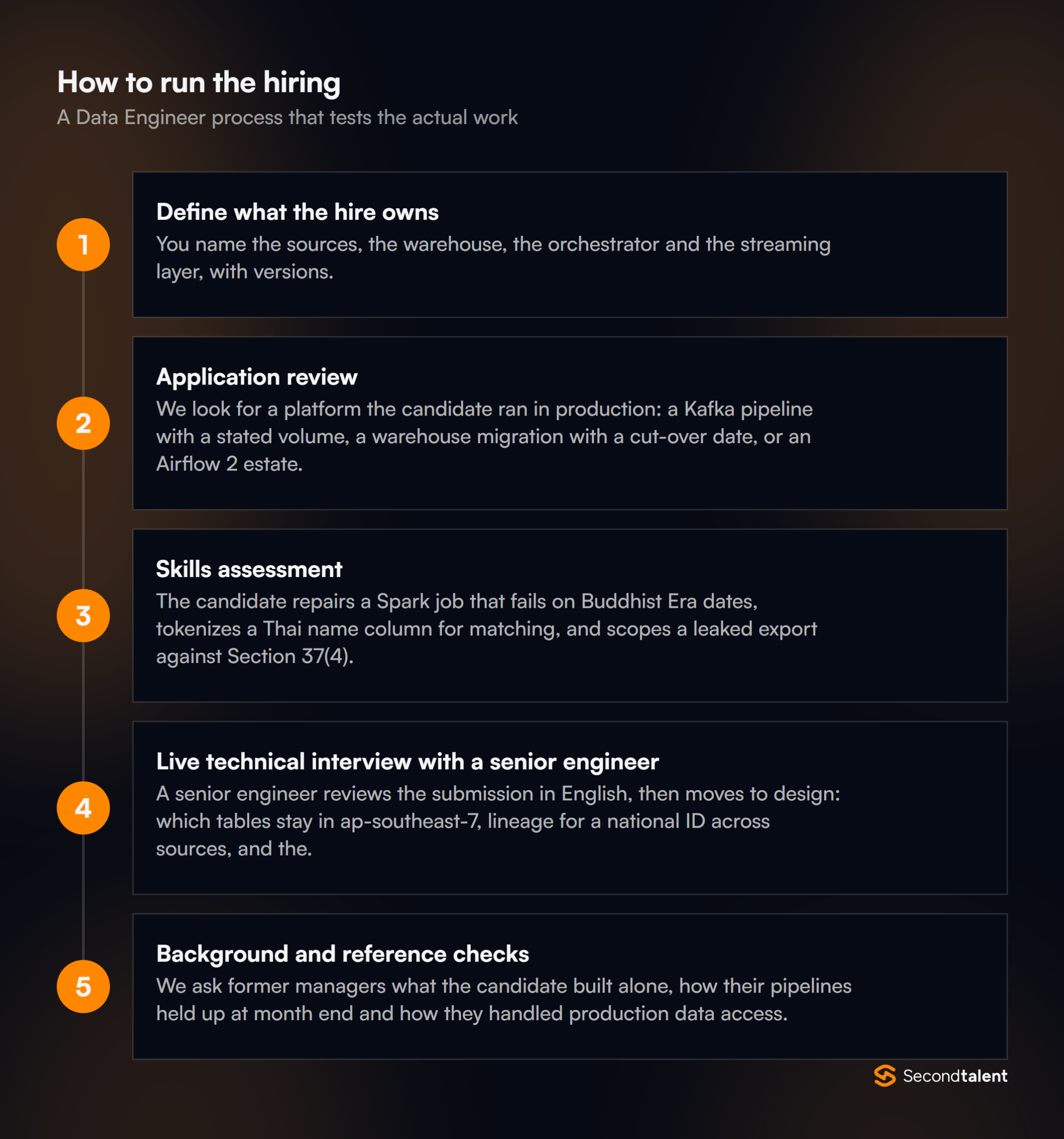
Second Talent's vetting covers stages 2 to 5 before you see a profile.
Stage 1: Define what the hire owns
You name the sources, the warehouse, the orchestrator and the streaming layer, with versions. Add where Thai personal data sits, the AWS Region it lives in, who signs a breach notice and a shift from the table above.
Stage 2: Application review
We look for a platform the candidate ran in production: a Kafka pipeline with a stated volume, a warehouse migration with a cut-over date, or an Airflow 2 estate they moved to Airflow 3. Work at Thai banks, insurers or telecom operators counts when the candidate can name the controls they worked under.
Stage 3: Skills assessment
The candidate repairs a Spark job that fails on Buddhist Era dates, tokenizes a Thai name column for matching, and scopes a leaked export against Section 37(4). We score the code, the tests and the written count of affected data subjects.
Stage 4: Live technical interview with a senior engineer
A senior engineer reviews the submission in English, then moves to design: which tables stay in ap-southeast-7, lineage for a national ID across sources, and the cost of the candidate's last warehouse.
Stage 5: Background and reference checks
We ask former managers what the candidate built alone, how their pipelines held up at month end and how they handled production data access. You then choose the contractor or EOR route above.
Hire Data Engineers from Thailand with Second Talent
We shortlist 6-8 candidates within 24 hours from 100,000+ pre-vetted engineers, accepting only the top 1% of applicants. Data engineers from Thailand come with $0 upfront, no lock-in and 4-6 hours of daily overlap with US hours. We handle contracts, payroll and equipment, with compliant EOR contracts in Thailand.
Our pricing page sets out the monthly subscription, and our data engineers page compares the pool across Asia.